REVIEW 3 major objections 5 minor 61 references
Articulated Object Estimation in the Wild
T0 review · 3 major / 5 minor · reviewed 2026-08-05 · deepseek-v4-flash
Pith's one-line read ArtiPoint claims articulated object models—joint type, axis direction, and axis position for prismatic and revolute joints—can be estimated from egocentric RGB-D video of a human interacting with objects, even with a moving camera and parti
desk verdict ArtiPoint and Arti4D are a useful, well-engineered contribution to in-the-wild articulation estimation, but the 'raw RGB-D' claim needs to wait for an unmatched-interaction recall analysis and a stated odometry dependency. read the letter →
The pith
A machine-rendered reading of the paper's core claim, the machinery that carries it, and where it could break.
The reading
What carries the argument
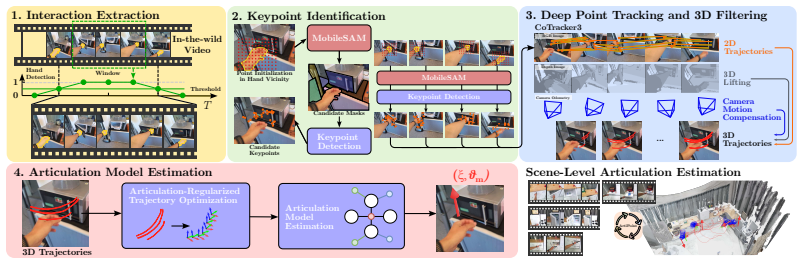
The key mechanism is an articulation-regularized factor graph over point trajectories. A one-degree-of-freedom articulation is represented as a twist ξ = (ω, v), a six-parameter screw motion; moving through configuration θ applies the rigid transform exp(ξθ). Instead of estimating independent inter-frame transformations and then fitting a joint, ArtiPoint solves for one shared twist and all per-frame configuration parameters simultaneously, so every tracked point votes on the same axis. The input trajectories come from a deep any-point tracker applied to keypoints sampled around a detected hand, and the factor graph optimization is solved with a general-purpose factor graph solver.
What would settle it
Run ArtiPoint on Arti4D sequences after adding controlled noise to the provided ground-truth camera poses—for instance, translation noise from 1 to 5 cm and rotation noise from 1 to 5 degrees—and plot prismatic and revolute axis errors against the noise level. If errors grow sharply or joint-type accuracy collapses before the object motion itself becomes ambiguous, the claim that articulation estimation works under dynamic camera motion would be falsified.
Extended reading notes
Core claim
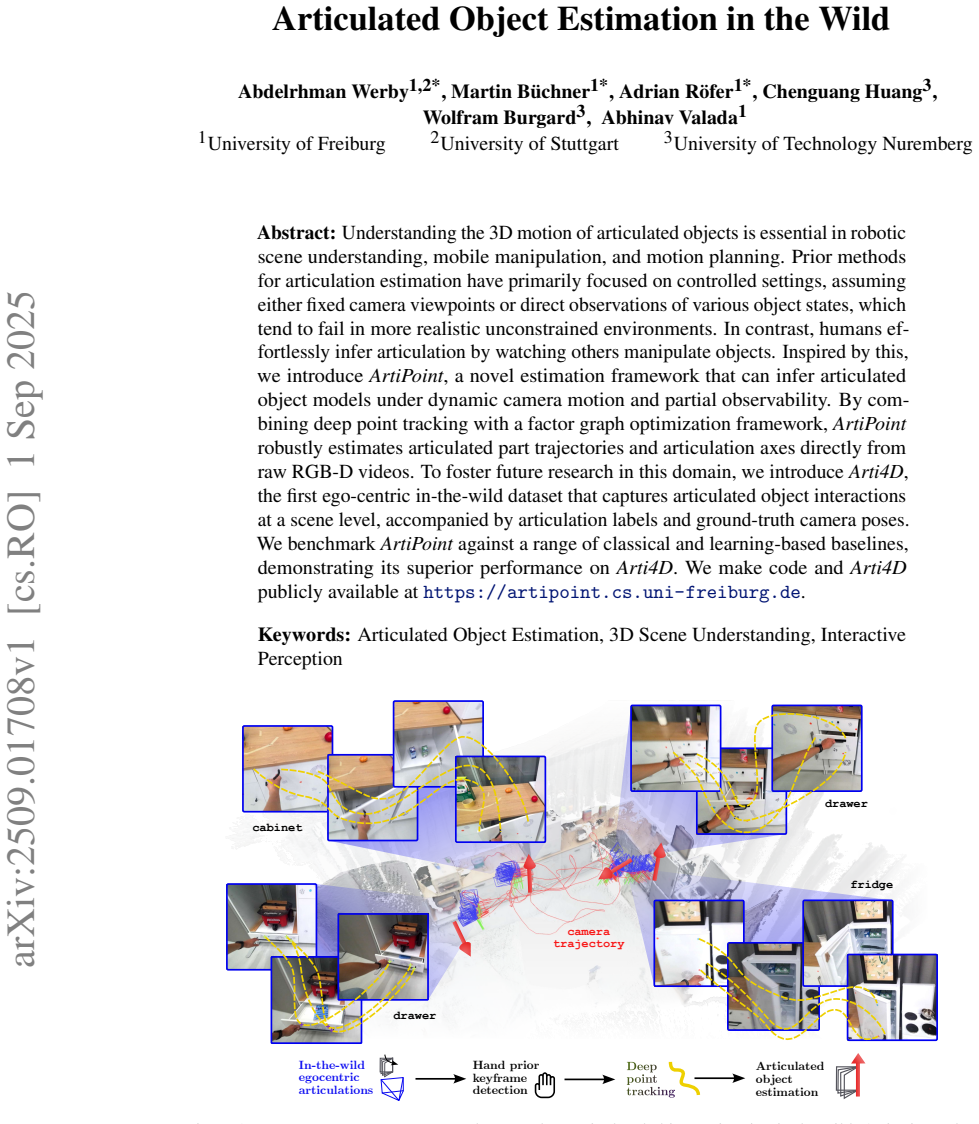
The paper's central claim is that articulated object parameters can be estimated directly from raw RGB-D videos of human-object interactions, without requiring a fixed camera, isolated objects, or full observability. ArtiPoint detects the manipulating hand to isolate interaction segments, samples query points in the hand's vicinity, tracks those points through the segment with a deep any-point tracker, lifts the tracks to 3D using depth, compensates for camera motion, and filters out static and unreliable tracks. It then estimates a single articulation model—joint type, axis direction, and axis position—by solving an articulation-regularized factor graph over all point trajectories. On the A
Load-bearing premise
The pipeline assumes the camera's position and orientation are already known accurately for every frame; the headline numbers come from external trackers, and if that pose information is noisy or absent the estimated axes inherit the error.
Editorial extensions
If this is right
- Fixed-camera assumptions in prior articulation estimators can be dropped: a hand-held moving sensor with partial occlusion is sufficient.
- Hand detection can automatically isolate interaction segments in unconstrained scenes, enabling extraction of demonstration data without manual labeling.
- The same pipeline handles both prismatic and revolute joints category-agnostically, so drawers, doors, fridges, and sliders are covered by one method.
- Arti4D provides ground-truth axes, interaction windows, difficulty labels, and camera poses, making it a benchmark for both articulation estimation and visual odometry in scenes with articulated motion.
- If paired with reliable odometry, the approach supports learning manipulation skills from human demonstrations in everyday environments.
Reading between the lines
- The dependence on accurate external camera poses could be dissolved by treating camera pose as unknowns in the same factor graph, jointly estimating camera motion and articulation axes; that would make the 'raw RGB-D' claim self-contained.
- Swapping the hand-detection trigger for egocentric action recognition or gaze could extend the method to tool-mediated interaction, remote manipulation, or scenes where hands are not visible.
- Because the twist representation covers screw motions, ArtiPoint may already be capable of estimating screw joints even though the experiments only report prismatic and revolute types; a dedicated screw-motion benchmark would test this.
- A natural next step, not implemented in the paper, is to feed the estimated axes and part trajectories into a manipulation policy so a robot can replay the demonstrated articulation.
Editorial analysis
A structured set of objections, weighed in public.
Referee Report
Summary. The paper proposes ArtiPoint, a four-stage pipeline for estimating 1-DoF articulated object models from egocentric RGB-D video. The method extracts interaction intervals using a hand-detection trigger, samples and tracks keypoints near the hand with MobileSAM and CoTracker3, lifts and filters 3D tracks, and then estimates articulation axes and joint types through a factor-graph optimization that extends the estimator of Buchanan et al. with an articulation-regularized trajectory objective (Eq. 4). The authors introduce Arti4D, a 45-sequence, 414-interaction ego-centric dataset with ground-truth camera poses, interaction windows, and articulated-axis labels, and report that ArtiPoint outperforms ArtGS, Ditto, Sturm et al., and Buchanan et al. baselines on that dataset. The core claim is that ArtiPoint can infer articulated object models directly from raw RGB-D videos under dynamic camera motion and partial observability.
Significance. If the reported results hold, ArtiPoint would be a meaningful step toward in-the-wild articulated object estimation, where prior work has largely assumed static cameras, isolated objects, or full observability. The Arti4D dataset itself is a notable contribution and is released with code, model predictions, and ground-truth poses. The paper has several concrete strengths: the supplementary evaluation with DROID-SLAM poses (Table S.1) addresses, at least partially, the camera-odometry dependence; the ablations in Tables 3 and S.3 cover key components and hyperparameters; and the articulation-regularized estimator in Eq. (4) is a sensible extension that shows consistent improvement over independent transforms in Table 1. However, the empirical support for the headline 'raw RGB-D' claim is incomplete. The evaluation protocol matches predicted interaction segments to ground-truth segments and only scores matched predictions, but it never reports how many of the 414 interactions are missed by the hand-trigger segmentation front-end. Without a recall/failure analysis, Table 1 can materially overstate end-to-end performance. The absence of error bars or statistical tests also makes the sm
major comments (3)
- [Section S.1.1, Table 1, Sec. 4] The evaluation protocol computes all metrics only for predicted interaction segments with IoU > 0.5 to a ground-truth segment. The paper claims in Sec. 4 that the aim is to 'detect all interactions and estimate the articulation parameters of all manipulated objects,' and Sec. 5 says results are 'averaged across all object interactions,' but no recall, precision, or unmatched-interaction count is reported anywhere. The supplementary even admits in S.1.6 that ArtiPoint 'detects the majority of interactions' and in S.1.5 that RH078 contains non-separable interactions. If a substantial fraction of the 414 interactions are dropped because the hand is not detected or segments are merged/split, those failures never enter Table 1. This is load-bearing for the central claim that the method works 'directly from raw RGB-D videos.' The authors should report the number of predicted segments, the matc
- [Sec. 3.3, Table 1, Section S.1.2] The headline numbers in Table 1 are produced with ground-truth VIVE-tracker camera poses, while Sec. 3.3 states that the method 'transform[s] all the 3D point tracks ... assuming accurate camera odometry.' The supplementary shows that classical SLAM methods fail on the interaction segments and only DROID-SLAM gives usable poses, and even then the DROID-SLAM trajectories are registered to the ground-truth map with KISS-Matcher before evaluation. Table S.1 shows only a mild degradation, which is encouraging, but this is one SLAM method and the registration step may hide alignment errors. The phrase 'directly from raw RGB-D videos' in the abstract is therefore not fully supported by the main evaluation. The main protocol should either use estimated poses or the authors should prominently state that the principal results assume known camera poses and report the SLAM-based results as the raw-
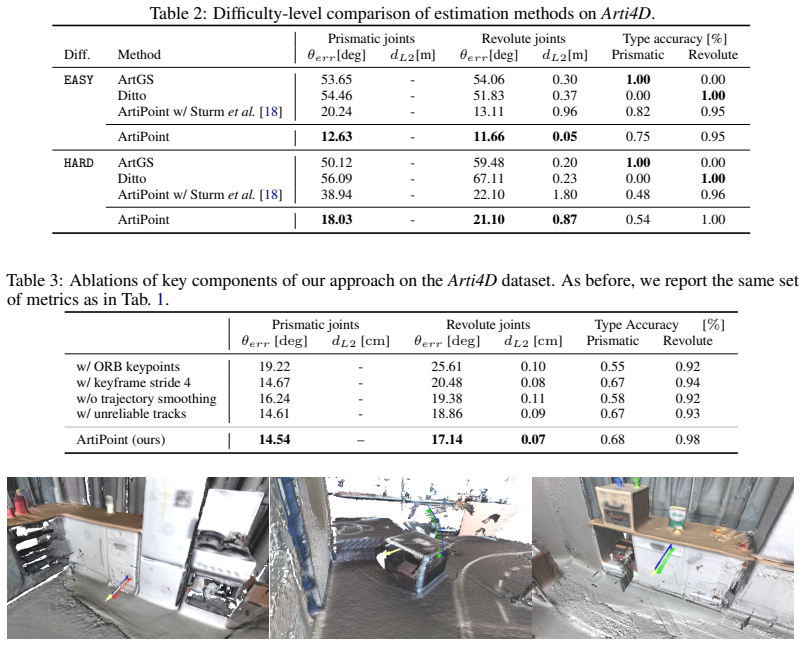
- [Tables 1-3 and S.1-S.4] All quantitative claims of superiority rest on single mean values with no error bars, confidence intervals, or significance tests. Several margins are small: for example, ArtiPoint versus ArtiPoint with independent transforms in Table 1 gives prismatic θerr 14.54° vs 15.60°, revolute θerr 17.14° vs 18.61°, and revolute type accuracy 0.98 vs 0.96. The per-scene results in Table S.4 show large variability (e.g., prismatic θerr ranges from 7.86° in DR080 to 35.11° in RH078), so the overall means may be driven by specific scenes. The authors should report variances or per-segment distributions and, where possible, paired comparisons, especially for the ablation claims in Table 3.
minor comments (5)
- [Eqs. (2)-(4)] The temporal offset ε used in the observation pairs is never defined. Please state its value or explain how it is chosen; this affects the construction of the pose observations and the articulation-regularized objective.
- [Sec. 5.1, Table 3 caption] The text says 'revolute and rotational joints' in Sec. 5.3; this is likely a typo for 'revolute.' Also, Table 3 reports dL2 in cm while Table 1 uses m; please use consistent units.
- [Sec. 3.1/S.1.4.1] The values of τh and σstatic are not reported, although they are central to interaction extraction and static-track filtering. The paper gives defaults for wh, Tmin, Tmax, σreliable, λvel, and λjerk, but these two thresholds are omitted. Please add them and, if possible, show sensitivity in the supplementary.
- [Sec. 3.4] Minor wording: 'an extend the estimation' should be 'and extend the estimation.' Also, the relationship between the twist estimated by Eq. (4) and the final twist returned by the Buchanan et al. estimator is not entirely explicit; a sentence clarifying that Eq. (4) is a front-end to the final factor-graph estimator would improve reproducibility.
- [S.1.2] The DROID-SLAM poses are registered against the ground-truth point cloud with KISS-Matcher before evaluation. This should be described as a form of alignment that may partly compensate for global drift, so the results in Table S.1 should be interpreted with that caveat.
Circularity Check
No circular derivation: the articulation objective uses only point tracks and visibility, the Buchanan et al. back-end is independent published work, and the evaluation caveats are correctness issues rather than circularity.
full rationale
The derivation chain is self-contained. The articulation parameters are estimated by solving Eq. (4) from point tracks and visibility masks; ground-truth axes are not used in the objective and are only used for evaluation. The final twist is produced by the Buchanan et al. factor-graph estimator [9], a prior published method. Although two authors of this paper are also co-authors of [9], the citation is not circular: [9] is an externally falsifiable estimator, and the key comparisons in Table 1 run the same back-end under different front-ends, so the comparison isolates the contribution of the ArtiPoint front-end and articulation-regularized trajectory optimization. The main caveats are evaluation-selection and input-dependence issues, not circularity: Sec. S.1.1 matches predictions to ground-truth segments at IoU>0.5 and does not report recall of unmatched interactions, and Sec. S.1.2 states that the headline numbers use ground-truth VIVE odometry, with DROID-SLAM poses giving slightly worse results. The limitations in Sec. 7 (hand-detection trigger, two-body kinematics, depth dependence) and S.1.5 (non-separable interactions in RH078) are acknowledged and affect real-world robustness, but they do not make any equation or prediction equivalent to its input by construction. No circular step was found.
Assumptions & free parameters
free parameters (8)
- tau_h (hand detection trigger threshold)
- Hand-detection window wh =
6
- Segment length bounds Tmin, Tmax =
Tmin=30, Tmax=90
- Static-track percentile threshold sigma_static
- Reliability threshold sigma_reliable =
0.5
- Smoothing weights lambda_vel, lambda_jerk =
lambda_vel=0.5, lambda_jerk=5
- Keyframe stride for point tracking =
2 (implied)
- Sampling density / number of keypoints F
assumptions (7)
- standard math 1-DoF articulated motion is exactly representable as a twist xi in se(3) times configuration theta, with exp map to SE(3).
- domain assumption Hand presence is a reliable trigger for interaction segments.
- domain assumption Accurate camera odometry is available for each segment.
- domain assumption Depth measurements and camera intrinsics correctly lift tracked 2D points to 3D.
- domain assumption CoTracker3 visibility and tracking are reliable enough for downstream estimation.
- domain assumption Objects have two-body, 1-DoF articulation models.
- domain assumption The factor graph back-end of Buchanan et al. [9] correctly recovers a twist from relative pose observations.
Cite this review
Pith. "Pith review of Articulated Object Estimation in the Wild." pith.science (2026). https://pith.science/paper/N26WOS2A
@misc{pith2026250901708,
  author       = {Pith},
  title        = {Pith review of: Articulated Object Estimation in the Wild},
  year         = {2026},
  howpublished = {\url{https://pith.science/paper/N26WOS2A}},
  note         = {Machine review of arXiv:2509.01708}
}
read the original abstract
Understanding the 3D motion of articulated objects is essential in robotic scene understanding, mobile manipulation, and motion planning. Prior methods for articulation estimation have primarily focused on controlled settings, assuming either fixed camera viewpoints or direct observations of various object states, which tend to fail in more realistic unconstrained environments. In contrast, humans effortlessly infer articulation by watching others manipulate objects. Inspired by this, we introduce ArtiPoint, a novel estimation framework that can infer articulated object models under dynamic camera motion and partial observability. By combining deep point tracking with a factor graph optimization framework, ArtiPoint robustly estimates articulated part trajectories and articulation axes directly from raw RGB-D videos. To foster future research in this domain, we introduce Arti4D, the first ego-centric in-the-wild dataset that captures articulated object interactions at a scene level, accompanied by articulation labels and ground-truth camera poses. We benchmark ArtiPoint against a range of classical and learning-based baselines, demonstrating its superior performance on Arti4D. We make code and Arti4D publicly available at https://artipoint.cs.uni-freiburg.de.
Figures
Reference graph
Works this paper leans on
-
[1]
M. Kim, K. Pertsch, S. Karamcheti, T. Xiao, A. Balakrishna, S. Nair, R. Rafailov, E. Foster, G. Lam, P. Sanketi, Q. Vuong, T. Kollar, B. Burchfiel, R. Tedrake, D. Sadigh, S. Levine, P. Liang, and C. Finn. Openvla: An open-source vision-language-action model. Conference on Robot Learning, 2024
work page 2024
-
[2]
C. Chi, Z. Xu, S. Feng, E. Cousineau, Y . Du, B. Burchfiel, R. Tedrake, and S. Song. Diffusion policy: Visuomotor policy learning via action diffusion. International Journal of Robotics Research, 2024
work page 2024
-
[3]
E. Chisari, N. Heppert, M. Argus, T. Welschehold, T. Brox, and A. Valada. Learning robotic manipulation policies from point clouds with conditional flow matching. Conference on Robot Learning, 2024
work page 2024
- [4]
-
[5]
I. Nematollahi, E. Rosete-Beas, A. R¨ofer, T. Welschehold, A. Valada, and W. Burgard. Robot skill adaptation via soft actor-critic gaussian mixture models. In IEEE International Conference on Robotics and Automation, pages 8651–8657. IEEE, 2022
work page 2022
- [6]
- [7]
-
[8]
D. Honerkamp, T. Welschehold, and A. Valada. N2 m2: Learning navigation for arbitrary mobile manipulation motions in unseen and dynamic environments. IEEE Transactions on Robotics, 39 (5):3601–3619, 2023
work page 2023
Show all 61 references
-
[9]
Buchanan, A
R. Buchanan, A. R¨ofer, J. Moura, A. Valada, and S. Vijayakumar. Online estimation of articulated objects with factor graphs using vision and proprioceptive sensing. In IEEE International Conference on Robotics and Automation, pages 16111–16117, 2024
2024
-
[10]
Schmalstieg, D
F. Schmalstieg, D. Honerkamp, T. Welschehold, and A. Valada. Learning hierarchical interactive multi-object search for mobile manipulation. IEEE Robotics and Automation Letters , 8(12): 8549–8556, 2023
2023
-
[11]
J. Liu, A. Mahdavi-Amiri, and M. Savva. Paris: Part-level reconstruction and motion analysis for articulated objects. In International Conference on Computer Vision, pages 352–363, 2023
2023
-
[12]
Y . Liu, B. Jia, R. Lu, J. Ni, S.-C. Zhu, and S. Huang. Building interactable replicas of complex articulated objects via gaussian splatting. In International Conf. on Learning Representations, 2025
2025
-
[13]
Honerkamp, M
D. Honerkamp, M. B¨uchner, F. Despinoy, T. Welschehold, and A. Valada. Language-grounded dynamic scene graphs for interactive object search with mobile manipulation. IEEE Robotics and Automation Letters, 2024
2024
-
[14]
Mohammadi, D
M. Mohammadi, D. Honerkamp, M. B ¨uchner, M. Cassinelli, T. Welschehold, F. Despinoy, I. Gilitschenski, and A. Valada. More: Mobile manipulation rearrangement through grounded language reasoning. IEEE/RSJ International Conference on Intelligent Robots and Systems , 2025
2025
-
[15]
Bandura and R
A. Bandura and R. H. Walters. Social learning theory, volume 1. Prentice hall Englewood Cliffs, NJ, 1977
1977
-
[16]
Doersch, Y
C. Doersch, Y . Yang, M. Vecerik, D. Gokay, A. Gupta, Y . Aytar, J. Carreira, and A. Zisserman. Tapir: Tracking any point with per-frame initialization and temporal refinement. In International Conference on Computer Vision, pages 10061–10072, 2023
2023
-
[17]
Karaev, I
N. Karaev, I. Rocco, B. Graham, N. Neverova, A. Vedaldi, and C. Rupprecht. Cotracker: It is better to track together. In European Conference on Computer Vision, pages 18–35, 2024
2024
-
[18]
Sturm, C
J. Sturm, C. Stachniss, and W. Burgard. A probabilistic framework for learning kinematic models of articulated objects, 2011
2011
-
[19]
Pillai, M
S. Pillai, M. Walter, and S. Teller. Learning articulated motions from visual demonstration. In Robotics: Science and Systems, Berkeley, USA, July 2014. doi:10.15607/RSS.2014.X.050
2014 doi
-
[20]
D. Katz, A. Orthey, and O. Brock. Interactive perception of articulated objects. In International Symposium on Experimental Robotics, pages 301–315. Springer, 2014
2014
-
[21]
H. Bay, T. Tuytelaars, and L. Van Gool. Surf: Speeded up robust features. In European Conference on Computer Vision, pages 404–417, 2006
2006
-
[22]
Sturm, K
J. Sturm, K. Konolige, C. Stachniss, and W. Burgard. 3d pose estimation, tracking and model learning of articulated objects from dense depth video using projected texture stereo. In RGB-D: Advanced Reasoning with Depth Cameras Workshop, RSS, 2010
2010
-
[23]
A. Jain, R. Lioutikov, C. Chuck, and S. Niekum. Screwnet: Category-independent articulation model estimation from depth images using screw theory. In IEEE International Conference on Robotics and Automation, pages 13670–13677, 2021
2021
-
[24]
A. Jain, S. Giguere, R. Lioutikov, and S. Niekum. Distributional depth-based estimation of object articulation models. In Conference on Robot Learning, pages 1611–1621, 2022
2022
-
[25]
X. Li, H. Wang, L. Yi, L. J. Guibas, A. L. Abbott, and S. Song. Category-level articulated object pose estimation. In IEEE/CVF Conf. on Computer Vision and Pattern Recognition, pages 3706–3715, 2020
2020
-
[26]
Heppert, T
N. Heppert, T. Migimatsu, B. Yi, C. Chen, and J. Bohg. Category-independent articulated object tracking with factor graphs. In IEEE/RSJ International Conference on Intelligent Robots and Systems, pages 3800–3807, 2022
2022
-
[27]
V . Zeng, T. E. Lee, J. Liang, and O. Kroemer. Visual identification of articulated object parts. In IEEE/RSJ International Conference on Intelligent Robots and Systems, pages 2443–2450, 2021
2021
-
[28]
Heppert, M
N. Heppert, M. Z. Irshad, S. Zakharov, K. Liu, R. A. Ambrus, J. Bohg, A. Valada, and T. Kollar. Carto: Category and joint agnostic reconstruction of articulated objects. In IEEE/CVF Conf. on Computer Vision and Pattern Recognition, pages 21201–21210, 2023
2023
-
[29]
Huang, I
X. Huang, I. Walker, and S. Birchfield. Occlusion-aware reconstruction and manipulation of 3d articulated objects. In IEEE International Conference on Robotics and Automation, pages 1365–1371, 2012
2012
-
[30]
Mart´ın-Mart´ın, S
R. Mart´ın-Mart´ın, S. H ¨ofer, and O. Brock. An integrated approach to visual perception of articulated objects. In IEEE International Conference on Robotics and Automation , pages 5091–5097. IEEE, 2016
2016
-
[31]
Jiang, C.-C
Z. Jiang, C.-C. Hsu, and Y . Zhu. Ditto: Building digital twins of articulated objects from interaction. In IEEE/CVF Conf. on Computer Vision and Pattern Recognition, pages 5616–5626, 2022
2022
-
[32]
D. G. Lowe. Distinctive image features from scale-invariant keypoints. International Journal of Computer Vision, 60:91–110, 2004
2004
-
[33]
Shi et al
J. Shi et al. Good features to track. In IEEE/CVF Conf. on Computer Vision and Pattern Recognition, pages 593–600, 1994
1994
-
[34]
A. W. Harley, Z. Fang, and K. Fragkiadaki. Particle video revisited: Tracking through occlusions using point trajectories. In European Conference on Computer Vision, pages 59–75, 2022
2022
-
[35]
Doersch, A
C. Doersch, A. Gupta, L. Markeeva, A. Recasens, L. Smaira, Y . Aytar, J. Carreira, A. Zisserman, and Y . Yang. Tap-vid: A benchmark for tracking any point in a video. Advances in Neural Information Processing Systems, 35:13610–13626, 2022
2022
-
[36]
Zheng, A
Y . Zheng, A. W. Harley, B. Shen, G. Wetzstein, and L. J. Guibas. Pointodyssey: A large-scale synthetic dataset for long-term point tracking. In International Conference on Computer Vision, pages 19855–19865, 2023
2023
-
[37]
S. Cho, J. Huang, J. Nam, H. An, S. Kim, and J.-Y . Lee. Local all-pair correspondence for point tracking. In European Conference on Computer Vision, pages 306–325, 2024
2024
-
[38]
Doersch, P
C. Doersch, P. Luc, Y . Yang, D. Gokay, S. Koppula, A. Gupta, J. Heyward, I. Rocco, R. Goroshin, J. Carreira, et al. Bootstap: Bootstrapped training for tracking-any-point. In Proceedings of the Asian Conference on Computer Vision, pages 3257–3274, 2024
2024
-
[39]
Karaev, I
N. Karaev, I. Makarov, J. Wang, N. Neverova, A. Vedaldi, and C. Rupprecht. Cotracker3: Sim- pler and better point tracking by pseudo-labelling real videos. arXiv preprint arXiv:2410.11831, 2024
2024 arXiv
-
[40]
Zhang, D
C. Zhang, D. Han, Y . Qiao, J. U. Kim, S.-H. Bae, S. Lee, and C. S. Hong. Faster segment anything: Towards lightweight sam for mobile applications. arXiv preprint arXiv:2306.14289, 2023
2023 arXiv
-
[41]
Camporese
G. Camporese. Hands segmentation is all you need. https://github.com/guglielmocamporese,
-
[42]
T. D. Barfoot. State estimation for robotics. Cambridge University Press, 2024
2024
-
[43]
Dellaert and G
F. Dellaert and G. Contributors. borglab/gtsam, May 2022. URL https://github.com/ borglab/gtsam)
2022
-
[44]
Y . Weng, B. Wen, J. Tremblay, V . Blukis, D. Fox, L. Guibas, and S. Birchfield. Neural implicit representation for building digital twins of unknown articulated objects. In Proceedings of the IEEE/CVF Conference on Computer Vision and Pattern Recognition, pages 3141–3150, 2024
2024
-
[45]
Xiang, Y
F. Xiang, Y . Qin, K. Mo, Y . Xia, H. Zhu, F. Liu, M. Liu, H. Jiang, Y . Yuan, H. Wang, et al. Sapien: A simulated part-based interactive environment. In IEEE/CVF Conf. on Computer Vision and Pattern Recognition
-
[46]
Mart´ın-Mart´ın, C
R. Mart´ın-Mart´ın, C. Eppner, and O. Brock. The rbo dataset of articulated objects and interac- tions. International Journal of Robotics Research, 38(9):1013–1019, 2019
2019
-
[47]
Rotondi, F
D. Rotondi, F. Scaparro, H. Blum, and K. O. Arras. Fungraph: Functionality aware 3d scene graphs for language-prompted scene interaction. IEEE/RSJ International Conference on Intelligent Robots and Systems (IROS), 2025
2025
-
[48]
Zhang, A
C. Zhang, A. Delitzas, F. Wang, R. Zhang, X. Ji, M. Pollefeys, and F. Engelmann. Open- vocabulary functional 3d scene graphs for real-world indoor spaces. IEEE/CVF Conf. on Computer Vision and Pattern Recognition, 2025
2025
-
[49]
Kassab, S
C. Kassab, S. Morin, M. B¨uchner, M. Mattamala, K. Gupta, A. Valada, L. Paull, and M. Fallon. Openlex3d: A new evaluation benchmark for open-vocabulary 3d scene representations. arXiv preprint arXiv:2503.19764, 2025
2025
-
[50]
Delitzas, A
A. Delitzas, A. Takmaz, F. Tombari, R. Sumner, M. Pollefeys, and F. Engelmann. SceneFun3D: Fine-Grained Functionality and Affordance Understanding in 3D Scenes. In IEEE/CVF Conf. on Computer Vision and Pattern Recognition, 2024
2024
-
[51]
Werby, C
A. Werby, C. Huang, M. B¨uchner, A. Valada, and W. Burgard. Hierarchical Open-V ocabulary 3D Scene Graphs for Language-Grounded Robot Navigation. In Robotics: Science and Systems, Delft, Netherlands, July 2024. doi:10.15607/RSS.2024.XX.077
2024 doi
-
[52]
Palazzolo, J
E. Palazzolo, J. Behley, P. Lottes, P. Gigu`ere, and C. Stachniss. ReFusion: 3D Reconstruction in Dynamic Environments for RGB-D Cameras Exploiting Residuals. In IEEE/RSJ International Conference on Intelligent Robots and Systems, 2019
2019
-
[53]
C.-C. Hsu, Z. Jiang, and Y . Zhu. Ditto in the house: Building articulation models of indoor scenes through interactive perception. In IEEE International Conference on Robotics and Automation, pages 3933–3939, 2023
2023
-
[54]
Sturm, V
J. Sturm, V . Pradeep, C. Stachniss, C. Plagemann, K. Konolige, and W. Burgard. Learning kine- matic models for articulated objects. In International Joint Conferences on Artificial Intelligence, 2009
2009
-
[55]
Rublee, V
E. Rublee, V . Rabaud, K. Konolige, and G. Bradski. Orb: An efficient alternative to sift or surf. In International Conference on Computer Vision, pages 2564–2571, 2011
2011
-
[56]
Campos, R
C. Campos, R. Elvira, J. J. G. Rodr ´ıguez, J. M. Montiel, and J. D. Tard ´os. Orb-slam3: An accurate open-source library for visual, visual–inertial, and multimap slam. IEEE Transactions on Robotics, 37(6):1874–1890, 2021
2021
-
[57]
Geneva, K
P. Geneva, K. Eckenhoff, W. Lee, Y . Yang, and G. Huang. OpenVINS: A research platform for visual-inertial estimation. In IEEE International Conference on Robotics and Automation, 2020
2020
-
[58]
Murai, E
R. Murai, E. Dexheimer, and A. J. Davison. MASt3R-SLAM: Real-time dense SLAM with 3D reconstruction priors. IEEE/CVF Conf. on Computer Vision and Pattern Recognition, 2025
2025
-
[59]
Teed and J
Z. Teed and J. Deng. DROID-SLAM: Deep Visual SLAM for Monocular, Stereo, and RGB-D Cameras. Advances in Neural Information Processing Systems, 2021
2021
-
[60]
H. Lim, D. Kim, G. Shin, J. Shi, I. Vizzo, H. Myung, J. Park, and L. Carlone. KISS-Matcher: Fast and Robust Point Cloud Registration Revisited. In IEEE International Conference on Robotics and Automation, 2025. Articulated Object Estimation in the Wild: Supplementary Material ...
2025
-
[2021]
URL https://github.com/guglielmocamporese/ hands-segmentation-pytorch
Reviewed August 5, 2026 · model on record in the stance chip above.
Discussion (0). Continue with ORCID to comment.