REVIEW 4 major objections 5 minor 51 references
Stochastic dynamics simulation of the focused electron beam induced deposition process
T0 review · 4 major / 5 minor · reviewed 2026-08-06 · deepseek-v4-flash
Pith's one-line read The paper claims that a stochastic dynamics model with molecular-dynamics-derived rates can simulate focused electron beam-induced deposition of W(CO)$_6$ on silica at experimental time and length scales, producing a 100-cycle deposit of…
desk verdict Useful multiscale framework for FEBID, but the validation rests on a post-selected parameter set and an internally inconsistent metal-content claim; worth refereeing, not for unconditional acceptance. read the letter →
The pith
A machine-rendered reading of the paper's core claim, the machinery that carries it, and where it could break.
The reading
What carries the argument
The machinery is a lattice stochastic-dynamics (kinetic Monte Carlo type) model: a cubic grid with cell size 0.63 nm and one particle per cell, where particle types include the intact precursor W(CO)$_6$, fragments W(CO)$_i$ ($i=1,\dots,5$), tungsten atoms, CO ligands, and immobile substrate cells. The load-bearing identity is the factorization of a particle's translocation probability into pairwise bond-break and bond-maintenance probabilities, $p_{\mathrm{dis}}(\alpha,\beta)$ and $p_{\mathrm{dif}}(\alpha,\beta)$, with exponents set by the number of broken and maintained bonds on the lattice. These pairwise probabilities are inverted from desorption and diffusion rates obtained by fitting Morse potentials to MD trajectories, and the fastest process, precursor surface diffusion, fixes the simulation time step $\Delta t = 0.097$ ns; every other event occurs per step with probability $\Delta t \Gamma$. Electron-induced fragmentation uses a fitted radial profile of primary, secondary, and backscattered electron flux multiplied by a fragmentation cross section, with the flux distribution taken from a prior track-structure Monte Carlo study.
What would settle it
Measure the desorption rate or surface diffusion coefficient of an intermediate fragment such as W(CO)$_3$ on SiO$_2$-H, for example by temperature-programmed desorption or single-molecule tracking, and compare with the linearly extrapolated values used here; a large disagreement would collapse the parameter chain. Alternatively, run the same SD protocol without parameter rescaling for a different precursor, such as Fe(CO)$_5$, and compare predicted deposit height and iron content against published experiments; a systematic mismatch would indicate that the present agreement with W(CO)$_6$ data is a fitting outcome rather than a prediction.
Extended reading notes
Core claim
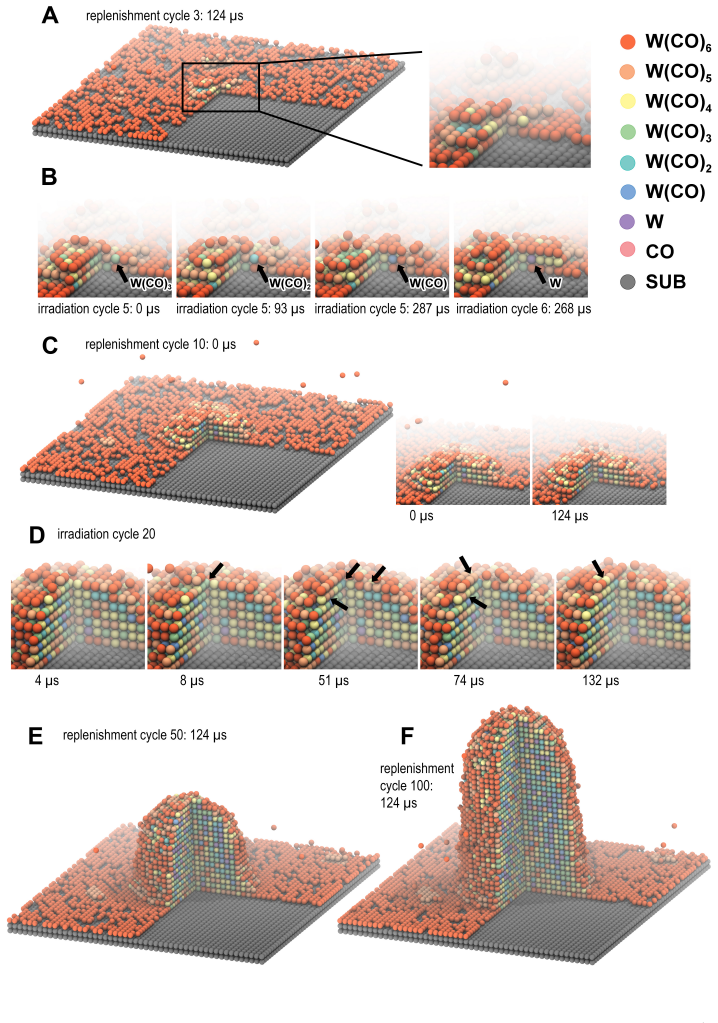
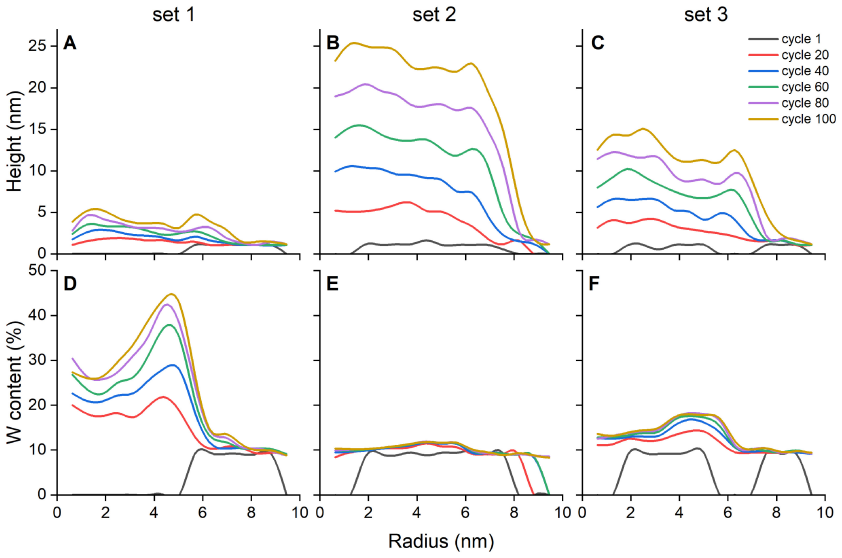
The central claim, stated as the authors would state it, is that the stochastic dynamics approach overcomes the size and time limitations of atomistic irradiation-driven molecular dynamics: it reaches millisecond and sub-micrometer scales while still resolving the elemental composition and morphology of the growing deposit. For a 30 keV electron beam on W(CO)$_6$ over SiO$_2$-H, the model predicts a dome-shaped deposit that grows to about 15 nm in height after 100 cycles (43 ms of simulated time, corresponding to a vertical growth rate near 0.35 nm/ms) and stabilizes at about 15\% tungsten content. These values are reported as consistent with experimental W(CO)$_6$-based FEBID measurements. The simulations also predict a crown-shaped radial metal profile, with the tungsten fraction peaking away from the beam center, which the authors attribute to hindered CO-ligand escape in the dense central region of the deposit.
Load-bearing premise
The load-bearing premise is that the desorption rates for intermediate fragments W(CO)$_i$ ($i=1,\dots,5$) can be linearly interpolated between the simulated intact-precursor and pure-tungsten values, and that the ad hoc scaling used to produce parameter Set 3 represents real physics rather than being tuned to match the chosen experimental targets.
Editorial extensions
If this is right
- The method can follow FEBID over tens of milliseconds of simulated time and sub-micrometer lateral distances, capturing hundreds of irradiation/replenishment cycles while retaining sub-nanometer compositional and morphological detail.
- The computed vertical growth rate of about 0.35 nm/ms falls within the experimentally reported 200--500 nm/s range for W(CO)$_6$ FEBID, supporting the use of the same SD parameter chain for growth-rate prediction.
- The crown-shaped radial tungsten profile emerges from transport-limited CO escape in the dense central deposit, offering a mechanistic explanation for metal-enriched rings observed around experimental FEBID structures.
- The workflow of deriving SD rate constants from MD and then simulating full deposition cycles is transferable to other precursors and substrates, and can be extended toward modeling 3D nanoprinting and related growth techniques.
Reading between the lines
- Because the final parameter Set 3 was adopted after comparing simulated height and tungsten content with experimental values, a prospective test would strengthen the method: fix all rates from MD and experiment without rescaling, then predict a new FEBID system, such as Fe(CO)$_5$ or Me$_2$Au(tfac), and compare with measurements.
- The single-particle-per-cell lattice treats each CO ligand as one grid cell; a finer or multi-occupancy grid could alter the crown-shaped metal profile, whose magnitude depends on whether CO can escape the dense central region.
- The conversion of particle counts into deposit height uses van der Waals volumes, so the predicted 15 nm height and 15\% tungsten content could be checked for sensitivity by repeating the same simulations with a modestly different cell size or volume assignment.
- If the growth-rate scaling holds, the same parameter chain could be used to design deposition recipes, such as beam current, pressure, or cycle timing, to position or suppress the metal-enriched ring in real FEBID fabrication.
Editorial analysis
A structured set of objections, weighed in public.
Referee Report
Summary. The paper presents a stochastic dynamics (SD) model of focused electron beam-induced deposition (FEBID) for W(CO)6 on a hydroxylated SiO2-H substrate, implemented in the MBN Explorer/MBN Studio software. Input parameters—precursor–substrate and precursor–precursor detachment energies, vibrational frequencies, and diffusion probabilities—are derived from molecular dynamics (MD) simulations using Morse-potential fits and Arrhenius rates, while the electron-induced fragmentation profile is taken from a prior Monte Carlo track-structure study. The model simulates 100 irradiation/replenishment cycles (43 ms total) on a cubic grid, producing a dome-shaped deposit with a peak height of about 15 nm and a tungsten content of about 15%. The authors claim these results 'align well with known experimental measurements' and that the SD approach reaches temporal and spatial scales typical of FEBID experiments (milliseconds, submicrometers).
Significance. If the central claim is established, the SD approach would be a valuable multiscale tool, bridging the gap between atomistic irradiation-driven MD (limited to tens of nanometers and nanoseconds) and continuum reaction–diffusion models. The paper's strengths are the explicit step-by-step parameterization from MD, the detailed tabulation of all input parameters, and the demonstration that a lattice SD simulation can follow FEBID growth over tens of milliseconds while retaining particle-type-level composition information. The claim of predictive, experimentally consistent atomistic insight is, however, currently not fully supported: the agreement with experiment is obtained after selecting one of three parameter sets based on how closely it reproduces the target observables, and several input parameters are extrapolated or self-referenced rather than independently validated. With revision to remove the post hoc selection and to clarify the provenance of key inputs, the methodology could be a useful contribution to FEBID modeling.
major comments (4)
- [Section III, Figs. 8–9; Section II.D.3, Table V] The validation claim is weakened by post hoc selection of parameter Set 3. The paper states that Set 1, Set 2, and Set 3 were generated by scaling pairwise detachment probabilities with ad hoc factors of 2.065 and 1.460 'to explore the influence of these parameters' (Section II.D.3), and then Set 3 is declared 'the most physically realistic and experimentally consistent' (Section III) because it yields approximately 15 nm height and 15% W content. This is a calibration procedure, not an independent predictive test. To support the stated claim that the SD framework provides predictive atomistic insight, the authors should either derive Set 3 (or the scaling factors) from a physical argument before comparison with experiment, or validate the chosen parameters against observables not used in the selection (e.g., the radial profile shape, time evolution, or composition distribution) and show that the agreement is not merely a consequence of fitting.
- [Section III, Fig. 9B and accompanying text] There is an internal inconsistency in the reported metal content. The text states that the simulated W content stabilizes at about 15% and that 'This value is consistent with experimental measurements of tungsten concentrations in FEBID structures grown from W(CO)6, where typical metal contents fall within 25–40%.' Since 15% lies outside the cited 25–40% range, the statement is contradictory. The authors should either provide a specific experimental reference supporting W contents near 15% for their particular beam parameters and precursor flux, or explicitly acknowledge that the simulated composition falls below the typical experimental range and discuss possible reasons.
- [Section II.D.1, Table I; Section II.D.3, Table IV] The detachment energies and vibrational frequencies for intermediate fragments W(CO)i (i=1..5) are linearly extrapolated between the simulated W(CO)6 and W values, and the resulting rate constants are then used in Eqs. (7)–(8) to define the pairwise detachment and diffusion probabilities in Tables II, III, and V. This is a load-bearing approximation that is not tested against MD simulations or quantum chemistry for the intermediate species. The paper claims that 'the parameters for the new SD-based FEBID model were determined using molecular dynamics (MD) simulations' (Abstract), but for the great majority of fragment species the parameters are assumed, not derived. The authors should justify the linear extrapolation or provide additional MD data for at least some intermediate fragments (e.g., W(CO)3 or W(CO)) to demonstrate that the trend is physically reasonable.
- [Section II.D.2] The provenance of the surface diffusion coefficients is not adequately established. The text states that D_W6 = 29.10 µm²/s and D_W0 = 0.21 µm²/s were 'adapted from the literature, see [21,22,24,25,34,35]', but references [21], [22], [24], [25], [34], and [35] are the authors' own software papers, books, and MBN Explorer user guide and tutorials. No independent experimental or first-principles source for these values is provided. Since precursor diffusion is a fast process that sets the time step (Eq. (9)) and directly enters the diffusion probabilities in Table III, the authors should clarify the original source of these coefficients and, ideally, benchmark them against independent experimental measurements or density-functional-theory-based estimates.
minor comments (5)
- [Section III] In the paragraph reporting the vertical growth rate, the phrase 'consistent with with experimentally reported growth rates' contains a duplicated 'with'.
- [Table V caption] The caption reads 'have been used to in the FEBID simulations'; the word 'to' should be removed.
- [Section II.F, Eq. (19)] The sentence 'The fragmentation rates shown in Fig. 5 are obtained by dividing the values used in simulations by 3.13×10^-7' is ambiguous. It should specify whether the plotted rates are normalized, and how the values from Eq. (19) are converted into the per-step fragmentation probabilities used in the SD simulations.
- [Section II.D.2] The sentence 'The probabilities of the diffusion of particles describing the precursor, the tungsten, and precursor fragments over the substrate are summarised in Table III' is awkwardly phrased; 'the tungsten' should be 'the tungsten atom' (or 'a W atom').
- [Section III and Section V] The supporting video is referred to as 'Supplementary video 1' in Section III and as 'Supplementary video S1' in Section V; the naming should be consistent.
Circularity Check
Post-hoc selection of parameter Set 3 is presented as experimental validation; the reported 15 nm / 15% agreement is a chosen parameter outcome, not an independent prediction.
-
fitted input called prediction
[Section II.D.3 (Table V) and Section III (text after Figs. 8 and 9)]
"The parameters for Sets 2 and 3 were generated from those for Set 1, with the pairwise probabilities of a pure precursor detaching from its fragmented variants scaled by factors of 2.065 and 1.460, respectively. This was done to explore the influence of these parameters on the observable characteristics of the FEBID process. ... Among the three parameter sets, Set 3 stands out as the most physically realistic and experimentally consistent."
Set 3 is not derived from MD, theory, or any independent criterion; its only distinguishing feature is the ad hoc factor 1.460 multiplying the pairwise detachment probabilities. After performing simulations with all three sets, the paper selects the set that reproduces the experimental target values (approx. 15 nm height and approx. 15% W content). The claimed 'agreement' is therefore a consequence of post-hoc parameter selection rather than an a priori prediction. Using the same experimental observables both to choose the parameter set and to validate the model makes the validation circular for exactly these observables.
-
self citation load bearing
[Section II.D.2, paragraph on surface diffusion coefficients]
"These values have been adapted from the literature, see [21, 22, 24, 25, 34, 35], and read as DW6 = 29.10 µm2/s and DW0 = 0.21 µm2/s."
The 'literature' cited for the two surface diffusion coefficients consists entirely of the authors' own works: the MBN Explorer paper [21], two of their own Springer books [22,24], the MBN Studio paper [25], and their own MBN Explorer Users' Guide and Tutorials [34,35]. These coefficients enter directly into the SD rates via Eqs. (6), (8), and (11), and therefore influence the simulated growth rate and metal content used for validation. No external experimental or independently reproduced source is supplied. To the extent that the validation claim relies on these self-cited parameters, the chain of support is not independent, though this is secondary to the post-hoc Set 3 selection.
full rationale
The paper contains substantial non-circular elements: the MD-derived detachment energies and vibrational frequencies for W(CO)6 and W, the Arrhenius rate estimates, the stochastic dynamics algorithm, and the imported fragmentation-rate distribution from prior Monte Carlo work are all legitimate inputs. The central circularity lies in the validation step. The paper varies an ad hoc scaling factor (Set 3, factor 1.460) explicitly 'to explore the influence of these parameters', then selects Set 3 as 'the most physically realistic and experimentally consistent' because it yields the height and W-content seen in experiments. This is a discrete parameter fit: the experimental observables are used to select the model variant, and the same observables are then presented as evidence that the model is validated. The self-citation of diffusion coefficients from the authors' own MBN Explorer documentation is a second, weaker issue, as it means those input values lack independent external support. The internal mismatch between Set 3's ~15% W content and the quoted experimental range of 25–40% further undermines the claimed validation, though it is a consistency issue rather than a circularity. Overall, the method is not vacuous, but the specific validation claim reduces, at least in part, to choosing the parameter set that reproduces the targets. Score 6 reflects this partial circularity.
Assumptions & free parameters
free parameters (7)
- Morse dissociation energy D for W(CO)6-SiO2-H and W-SiO2-H =
0.33 eV and 0.48 eV (Table I)
- Morse vibration frequency nu for W(CO)6-SiO2-H and W-SiO2-H =
5.24e11 s-1 and 1.65e12 s-1 (Table I)
- Fragment desorption rates Gamma_dis for W(CO)i, i=1..5 =
1.67e6 down to 1.24e4 s-1 (Table I)
- Diffusion coefficients D_W6 and D_W0 =
29.10 um^2/s and 0.21 um^2/s
- Scaling factors for parameter Sets 2 and 3 =
2.065 and 1.460
- Fragmentation radial profile parameters A, B, w0 =
0.438, 0.241, 1.678 nm
- Grid cell size d =
0.63 nm
assumptions (7)
- domain assumption Arrhenius form for detachment rates: Gamma = nu * exp(-D/kBT), Eq. (15)
- domain assumption Morse potential form for interaction energy, Eq. (12)
- standard math Grid geometry factors Ndis = 0.320 and Ndif = 0.357
- ad hoc to paper Detachment probability between any two fragmented precursors is set to zero
- ad hoc to paper CO ligand detachment probability is set to 1 and CO is treated as volatile and inert
- domain assumption Substrate is modeled as an immobile monolayer of grid particles on a defect-free surface
- ad hoc to paper Linear interpolation of fragment diffusion and desorption rates between W(CO)6 and W
invented entities (1)
-
SUB particle type representing a substrate monolayer fragment
Cite this review
Pith. "Pith review of Stochastic dynamics simulation of the focused electron beam induced deposition process." pith.science (2026). https://pith.science/paper/N3NBHEEH
@misc{pith2026250618163,
  author       = {Pith},
  title        = {Pith review of: Stochastic dynamics simulation of the focused electron beam induced deposition process},
  year         = {2026},
  howpublished = {\url{https://pith.science/paper/N3NBHEEH}},
  note         = {Machine review of arXiv:2506.18163}
}
abstract
This work reports on the development of a new approach to the multiscale computational modelling of the focused electron beam-induced deposition (FEBID), realised using the advanced software packages: MBN Explorer and MBN Studio. Our approach is based on stochastic dynamics (SD), which describes the probabilistic evolution of complex systems. The parameters for the new SD-based FEBID model were determined using molecular dynamics (MD) simulations. A new methodology was developed for this purpose and is described in detail. This methodology can be applied to many other case studies of the dynamics of complex systems. Our work focuses on the FEBID process involving W(CO)$_6$ precursor molecules deposited on a hydroxylated SiO$_2$-H substrate. Simulations and a detailed analysis of a growing W-rich nanostructure were performed. This new approach was shown to provide essential atomistic insights into the complex FEBID process, including the elemental composition and morphology of the deposit at each stage of growth. The derived results were then compared with experimental observations and validated. The multiscale methods developed in this study can be further upgraded and applied to important technological developments, such as 3D nanoprinting.
Figures


Figures from the paper (6 more)




Reference graph
Works this paper leans on
-
[21]
V., Sushko, G., and Solo v’yov, A
Prosvetov, A., Verkhovtsev, A. V., Sushko, G., and Solo v’yov, A. V. Atomistic simulation of the FEBID-driven growth of iron-based nanostructures. Phys. Chem. Chem. Phys. 24(18), 10807–10819 (2022)
work page 2022
-
[22]
V., Sushko, G., and Solo v’yov, A
Prosvetov, A., Verkhovtsev, A. V., Sushko, G., and Solo v’yov, A. V. Atomistic modeling of thermal effects in focused electron beam-induced depositio n of me 2au(tfac), (2023)
work page 2023
-
[24]
Solov’yov, I. A., Yakubovich, A. V., Nikolaev, P. V., Vo lkovets, I., and Solov’yov, A. V. MesoBioNano Explorer – A universal program for multiscale co mputer simulations of complex molecular structure and dynamics. J. Comput. Chem. 33, 2412–2439 (2012)
work page 2012
-
[25]
Solov’yov, I. A., Korol, A. V., and Solov’yov, A. V. Multiscale Modeling of Complex Molec- ular Structure and Dynamics with MBN Explorer . Springer International Publishing, Cham, Switzerland, (2017). 41
work page 2017
-
[34]
Weirich, P. M., Winhold, M., Schwalb, C. H., and Huth, M. In situ growth optimization in focused electron-beam induced deposition. Beilstein Journal of Nanotechnology 4, 919–926 (2013)
work page 2013
-
[35]
Utke, I., Swiderek, P., Höflich, K., Madajska, K., Jurcz yk, J., Martinović, P., and Szymańska, I. B. Coordination and organometallic precursors of group 10 and 11: Focused electron beam induced deposition of metals and insight gained from chemic al vapour deposition, atomic layer deposition, and fundamental surface and gas phase studies. Coord. Chem. Rev....
work page 2022
-
[1]
Rates of precursor detachment from the substrate The rates of detachment (desoption and dissociation) betwe en different species (particles) can be derived from the analysis of the dependence of the inte raction potential between them on the interparticle distance. This subsection is devoted t o the analysis of such a dependence for (i) a randomly oriented...
-
[2]
With their use, P α 6 dif and P α 0 dif probabilities in Eqs.(6) and (8) can be set up
Rates of precursor diffusion across the substrate The surface diffusion of (i) a W(CO) 6 precursor molecule and a W -atom over the SiO 2-H substrate can also be performed by means of atomistic MD simu lations in order to derive the corresponding diffusion coefficients. With their use, P α 6 dif and P α 0 dif probabilities in Eqs.(6) and (8) can be set up. The ...
Show all 51 references
-
[3]
crown-shaped
Self diffusion and detachment rates of precursors and thei r fragments Now let us determine the rates of self diffusion and detachmen t of precursors and their fragments. These rates could be evaluated similarly to thos e discussed above for the detach- ment and diffusion of part...
2019
-
[4]
Nanofabrication Using Focused Ion and Electron Beams
Utke, I., Moshkalev, S., and Russel, P., editors. Nanofabrication Using Focused Ion and Electron Beams. Oxford University Press, (2012)
2012
-
[5]
M., editor
De Teresa, J. M., editor. Nanofabrication: Nanolithography Techniques and Their Ap plications. IOP Publishing Ltd, (2020)
2020
-
[6]
B., Fowlkes, J
Winkler, R., Lewis, B. B., Fowlkes, J. D., Rack, P. D., and Pl ank, H. High-Fidelity 3D- Nanoprinting via Focused Electron Beams: Growth Fundamenta ls. ACS Appl. Nano Mater. 1, 1014–1027 (2018)
2018
-
[7]
and Huth, M
Keller, L. and Huth, M. Beilstein J. Nanotechnol. 9, 2581 (2018)
2018
-
[8]
Gas-assisted f ocused electron beam and ion beam processing and fabrication
Utke, I., Hoffmann, P., and Melngailis, J. Gas-assisted f ocused electron beam and ion beam processing and fabrication. J. Vac. Sci. Technol. B 26, 1197–1276 (2008)
2008
-
[9]
Focused electron beam induced deposition: A perspec tive
Huth, M., Porrati, F., Schwalb, C., Winhold, M., Sachser , R., Dukic, M., Adams, J., and Fant- ner, G. Focused electron beam induced deposition: A perspec tive. Beilstein J. Nanotechnol. 3, 597–619 (2012)
2012
-
[10]
D., Rack, P
Winkler, R., Fowlkes, J. D., Rack, P. D., Kothleitner, G. , and Plank, H. Shape evolution and growth mechanisms of 3D-printed nanowires. Addit. Manuf. 46, 102076 (2021)
2021
-
[11]
Living up to its potent ial—Direct-write nanofabrication with focused electron beams
Huth, M., Porrati, F., and Barth, S. Living up to its potent ial—Direct-write nanofabrication with focused electron beams. J. Appl. Phys. 130, 170901 (2021)
2021
-
[12]
Living up to its potent ial — Direct-write nanofabrication with focused electron beams
Huth, M., Porrati, F., and Barth, S. Living up to its potent ial — Direct-write nanofabrication with focused electron beams. J. Appl. Phys. 130, 170901 (2021)
2021
-
[13]
Botman, A., Mulders, J. J. L., and Hagen, C. V. Creating pu re nanostructures from electron- beam-induced deposition using purification techniques: a t echnology perspective. Nanotech- nology 20, 372001 (2009)
2009
-
[14]
B., Solov’yov, I
Sushko, G. B., Solov’yov, I. A., and Solov’yov, A. V. Mole cular dynamics for irradiation driven chemistry: application to the FEBID process. Eur. Phys. J. D 70, 217 (2016). 40
2016
-
[15]
V., Solov’yov, I
Verkhovtsev, A. V., Solov’yov, I. A., and Solov’yov, A. V. Irradiation-driven molecular dy- namics: a review. Eur. Phys. J. D 75, 213 (2021)
2021
-
[16]
D., and Plank, H
Arnold, G., Timilsina, R., Fowlkes, J., Orthacker, A., Kothleitner, G., Rack, P. D., and Plank, H. Fundamental resolution limits during electron-induced direct-write synthesis. ACS Appl. Mater. Interfaces 6(10), 7380–7387 (2014)
2014
-
[17]
Continuum models of focused electron beam induced processing
Toth, M., Lobo, C., Friedli, V., Szkudlarek, A., and Utk e, I. Continuum models of focused electron beam induced processing. Beilstein J. Nanotechnol. 6, 1518–1540 (2015)
2015
-
[18]
B., Solov’yov, I
Sushko, G. B., Solov’yov, I. A., Verkhovtsev, A. V., Volk ov, S. N., and Solov’yov, A. V. Studying chemical reactions in biological systems with MBN E xplorer: Implementation of molecular mechanics with dynamical topology. Eur. Phys. J. D 70, 12 (2016)
2016
-
[19]
A., and Solov’yov, A
de Vera, P., Azzolini, M., Sushko, G., Abril, I., Garcia -Molina, R., Dapor, M., Solov’yov, I. A., and Solov’yov, A. V. Multiscale simulation of the focused el ectron beam induced deposition process. Sci. Rep. 10, 20827 (2020)
2020
-
[20]
V., Sushko, G., and Solo v’yov, A
Prosvetov, A., Verkhovtsev, A. V., Sushko, G., and Solo v’yov, A. V. Irradiation-driven molec- ular dynamics simulation of the FEBID process for Pt(PF 3)4. Beilstein J. Nanotechnol. 12, 1151–1172 (2021)
2021
-
[23]
A., Sushko, G., Friis, I., and Solov’yov, A
Solov’yov, I. A., Sushko, G., Friis, I., and Solov’yov, A. V. Multiscale modeling of stochastic dynamics processes with MBN Explorer. J. Comp. Chem. 43, 1442–1458 (2022). Paper selected for a cover
2022
-
[26]
V., Verkhovtsev, A
Solov’yov, A. V., Verkhovtsev, A. V., Mason, N. J., Amos , R. A., Bald, I., Baldacchino, G., Dromey, B., Falk, M., Fedor, J., Gerhards, L., Hausmann, M., H ildenbrand, G., Hrabovský, M., Kadlec, S., Kočišek, J., Lépine, F., Ming, S., Nisbet, A. , Ricketts, K., Sala, L., Schlat...
2024
-
[27]
A., Verkhovtsev, A
Solov’yov, I. A., Verkhovtsev, A. V., Korol, A. V., and S olov’yov, A. V. Dynamics of Systems on the Nanoscale . Springer Nature Switzerland, Cham, Switzerland, (2022)
2022
-
[28]
B., Solov’yov, I
Sushko, G. B., Solov’yov, I. A., and Solov’yov, A. V. Mode ling MesoBioNano systems with MBN Studio made easy. J. Mol. Graph. Model. 88, 247–260 (2019)
2019
-
[29]
A., Solov’yov, A
Solov’yov, I. A., Solov’yov, A. V., Kébaili, N., Masson , A., and Bréchignac, C. Thermally Induced Morphological Transition of Silver Fractals. Phys. Stat. Sol. B 251(3), 609–622 (2014)
2014
-
[30]
A., and Solov’yov, A
Panshenskov, M., Solov’yov, I. A., and Solov’yov, A. V. Efficient 3D Kinetic Monte Carlo Method for Modeling of Molecular Structure and Dynamics. J. Comput. Chem. 35(17), 1317– 1329 (2014)
2014
-
[31]
Moskovkin, P., Panshenskov, M., Lucas, S., and Solov’y ov, A. V. Simulation of Nanowire Fragmentation By Means of Kinetic Monte Carlo Approach: 2D Ca se. Phys. Stat. Sol. B 251(7), 1456–1462 (2014)
2014
-
[32]
Fowlkes, J. D. and Rack, P. D. Fundamental electron-pre cursor-solid interactions derived from time-dependent electron-beam-induced deposition simula tions and experiments. ACS Nano 4, 1619–1629 (2010)
2010
-
[33]
D., Fitzek, H., Rauch, S., Ratten- berger, J., Rack, P
Geier, B., Gspan, C., Winkler, R., Schmied, R., Fowlkes, J. D., Fitzek, H., Rauch, S., Ratten- berger, J., Rack, P. D., and Plank, H. Rapid and Highly Compac t Purification for Focused Electron Beam Induced Deposits: A Low Temperature Approach U sing Electron Stimulated H2O Rea...
2014
-
[36]
The transient ele ctrical conductivity of W-based electron-beam-induced deposits during growth, irradiati on and exposure to air
Porrati, F., Sachser, R., and Huth, M. The transient ele ctrical conductivity of W-based electron-beam-induced deposits during growth, irradiati on and exposure to air. Nanotechnology 20(19) (2009)
2009
-
[37]
A., Sushko, G., and Solov’yov, A
Solov’yov, I. A., Sushko, G., and Solov’yov, A. V. MBN Explorer Users’ Guide. Version 3.0 . MesoBioNano Science Publishing, Frankfurt am Main, (2017)
2017
-
[38]
MBN Explorer and MBN Studio Tutorials
Verkhovtsev, A., Solov’yov, I., Korol, A., Sushko, G., and Solov’yov, A. MBN Explorer and MBN Studio Tutorials. Version 5.0 . MesoBioNano Science Publishing, Frankfurt am Main, (2014)
2014
-
[39]
and Lifshitz, E
Landau, L. and Lifshitz, E. Chapter iv - ideal gases. In Statistical Physics , 111–157. Butterworth-Heinemann, Oxfordthird edition (1980)
1980
-
[40]
D., Bashford, D., Bellott, M., Dunbrack, R
MacKerell, A. D., Bashford, D., Bellott, M., Dunbrack, R. L., Evanseck, J. D., Field, M. J., Fischer, S., Gao, J., Guo, H., Ha, S., Joseph-McCarthy, D., K uchnir, L., Kuczera, K., Lau, F. T., Mattos, C., Michnick, S., Ngo, T., Nguyen, D. T., Prodh om, B., Reiher, W. E., Roux, ...
1998
-
[41]
MacKerell, A., Feig, M., and Brooks, C. Extending the tre atment of backbone energetics in protein force fields: Limitations of gas-phase quantum me chanics in reproducing protein conformational distributions in molecular dynamics simul ations. J. Comput. Chem. 25, 1400– 1415 (2004)
2004
-
[42]
and MacKerell Jr, A
Huang, J. and MacKerell Jr, A. D. Charmm36 all-atom addi tive protein force field: Validation based on comparison to nmr data. J. Comput. Chem. 34, 2135–2145 (2013)
2013
-
[43]
M., Conyuh, D
Beltukov, Y. M., Conyuh, D. A., and Solov’yov, I. A. Local elastic properties of polystyrene nanocomposites increase significantly due to nonaffine defor mations. Phys. Rev. E 105, L012501–(1–6) (2022)
2022
-
[44]
and Gambino, O
Cetini, G. and Gambino, O. Atti Accad. Sci. Torino, Classe Sci. Fis. Mat. Nat. 97, 1197 (1963)
1963
-
[45]
Linstrom, P. J. and Mallard, W. G. The nist chemistry web book: A chemical data resource on the internet. Journal of Chemical & Engineering Data 46(5), 1059–1063 (2001). 43
2001
-
[46]
de Vera, P., Verkhovtsev, A., Sushko, G., and Solov’yov , A. V. Reactive molecular dynamics simulations of organometallic compound W(CO) 6 fragmentation. Eur. Phys. J. D 73, 215 (2019)
2019
-
[47]
P., Kunavin, S
Filippova, V. P., Kunavin, S. A., and Pugachev, M. S. Cal culation of the parameters of the Lennard-Jones potential for pairs of identical atoms based on the properties of solid substances. Inorg. Mater. Appl. Res. 6, 1–4 (2015)
2015
-
[48]
L., Olafson, B
Mayo, S. L., Olafson, B. D., and Goddard, W. A. DREIDING: A generic force field for molecular simulations. J. Phys. Chem. 94, 8897–8909 (1990)
1990
-
[49]
B., Walsh, T
Butenuth, A., Moras, G., Schneider, J., Koleini, M., Köp pen, S., Meißner, R., Wright, L. B., Walsh, T. R., and Colombi Ciacchi, L. Ab initio derived force -field parameters for molecular dynamics simulations of deprotonated amorphous-SiO 2/water interfaces. Phys. Stat. Sol. B ...
2012
-
[50]
https://pubchem.ncbi.nlm.nih.gov/periodic-table/
Periodic table of elements. https://pubchem.ncbi.nlm.nih.gov/periodic-table/. Ac- cessed: 14.12.2022
2022
-
[51]
van Dorp, W. F. and Hagen, C. W. A critical literature rev iew of focused electron beam induced deposition. J. Appl. Phys. 104, 081301 (2008). 44
2008
Reviewed August 6, 2026 · model on record in the stance chip above.
Discussion (0). Continue with ORCID to comment.