Pure states for subregions in gravity and their entanglement entropy
Pith reviewed 2026-06-28 08:39 UTC · model grok-4.3
The pith
Spatial subregions in quantum gravity can be assigned pure states prepared by a partially frozen gravitational path integral.
A machine-rendered reading of the paper's core claim, the machinery that carries it, and where it could break.
Core claim
Spatial subregions in quantum gravity can be assigned pure states prepared by a partially frozen gravitational path integral, in which a spacetime subregion containing the spatial subregion is fixed while the field configurations and ambient geometry are summed over. In the semiclassical regime a holographic prescription for the entanglement entropy of bipartitions of this state, with a frozen-region analogue of the homology constraint, satisfies strong subadditivity, complementarity, and entanglement wedge nesting while reproducing known entropy formulas in holography and gravity as special cases.
What carries the argument
The partially frozen gravitational path integral, which fixes a spacetime subregion to prepare a pure state for the contained spatial subregion and supplies the input for the holographic entropy prescription.
If this is right
- The entanglement entropy prescription satisfies strong subadditivity for any bipartition of the pure state.
- The prescription obeys complementarity between a region and its complement.
- The prescription obeys entanglement wedge nesting for nested subregions.
- The construction reproduces known entropy formulas in holography and gravity as special cases.
Where Pith is reading between the lines
- The construction implies that the entanglement wedge itself becomes observer-dependent and is labeled by the choice of frozen subregion.
- The same freezing technique may supply a route to defining pure states and their entropies in non-holographic quantum gravity settings by direct analogy.
- Consistency with strong subadditivity opens the possibility of using these states to derive new inequalities for gravitational entanglement that have no direct analog in ordinary quantum field theory.
Load-bearing premise
The partially frozen path integral actually produces a pure state for the spatial subregion rather than a mixed one.
What would settle it
An explicit calculation in a controlled holographic setup where the proposed entropy formula either violates strong subadditivity or fails to recover the Ryu-Takayanagi area formula in the appropriate limit.
Figures
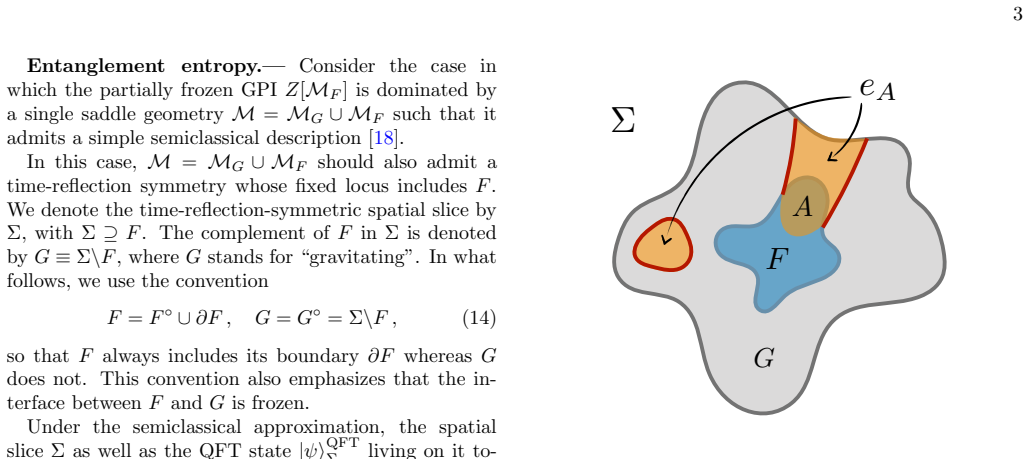
read the original abstract
It is proposed that spatial subregions in quantum gravity can be assigned pure states, rather than mixed reduced density matrices. The state is prepared by a partially frozen gravitational path integral, in which a spacetime subregion containing the spatial subregion is fixed while the field configurations and ambient geometry are summed over. In the semiclassical regime, we further propose a holographic prescription for the entanglement entropy of bipartitions of this state, with a frozen-region analogue of the homology constraint. The prescription satisfies nontrivial self-consistency conditions, including strong subadditivity, complementarity, and entanglement wedge nesting, and reproduces several known entropy formulas in holography and gravity as special cases. The construction suggests an observer-dependent entanglement wedge labeled by the frozen subregion.
Editorial analysis
A structured set of objections, weighed in public.
Referee Report
Summary. The paper proposes that spatial subregions in quantum gravity can be assigned pure states prepared by a partially frozen gravitational path integral, in which a spacetime subregion containing the spatial subregion is fixed while summing over field configurations and ambient geometry. It further proposes a holographic prescription for the entanglement entropy of bipartitions of this state, incorporating a frozen-region analogue of the homology constraint. The prescription is claimed to satisfy strong subadditivity, complementarity, and entanglement wedge nesting, while reproducing several known entropy formulas in holography and gravity as special cases, and suggests an observer-dependent entanglement wedge labeled by the frozen subregion.
Significance. If the central construction holds, the work provides a novel framework for assigning pure states to subregions in quantum gravity, potentially clarifying the status of reduced density matrices and offering a unified holographic prescription that recovers known results as limits. The explicit verification of self-consistency conditions (strong subadditivity, complementarity, entanglement wedge nesting) and the reproduction of known formulas constitute concrete strengths that would make the proposal falsifiable and useful for further development in the field.
major comments (1)
- [Abstract, paragraph 2] Abstract, paragraph 2: The claim that the partially frozen path integral yields a pure state (rather than a mixed state) on the spatial subregion is load-bearing for the entire proposal, yet the manuscript provides no explicit derivation showing why summation over field configurations and ambient geometry within the fixed spacetime subregion produces a pure state; this step requires a concrete argument or calculation to establish purity.
Simulated Author's Rebuttal
We thank the referee for their thorough review and valuable feedback on our manuscript. We address the major comment point by point below and have made revisions to strengthen the presentation of our central construction.
read point-by-point responses
-
Referee: [Abstract, paragraph 2] Abstract, paragraph 2: The claim that the partially frozen path integral yields a pure state (rather than a mixed state) on the spatial subregion is load-bearing for the entire proposal, yet the manuscript provides no explicit derivation showing why summation over field configurations and ambient geometry within the fixed spacetime subregion produces a pure state; this step requires a concrete argument or calculation to establish purity.
Authors: We agree that an explicit argument for the purity of the state is essential and should be provided in the manuscript. In the revised version, we will expand Section 2 to include a detailed explanation: the partially frozen path integral fixes the spacetime subregion, including its boundary, and sums only over configurations inside this fixed region. This is equivalent to preparing a state via a path integral with fixed boundary conditions on the spatial subregion's boundary, without tracing over any external degrees of freedom, thereby yielding a pure state on the subregion. This construction is motivated by the standard definition of pure states in quantum mechanics via path integrals over closed systems. We will also add a brief calculation in a simple toy model (e.g., a free scalar field) to illustrate the purity explicitly. revision: yes
Circularity Check
No significant circularity; derivation is self-contained
full rationale
The paper advances a proposal that spatial subregions are assigned pure states via a partially frozen gravitational path integral, followed by a holographic entropy prescription that is shown to obey listed consistency conditions and recover known formulas as limits. No quoted equations, definitions, or self-citations in the provided text reduce the central construction or its predictions to the input assumptions by construction. The reproduction of known formulas is presented as a consistency check rather than a definitional equivalence, and the core claim remains an independent proposal whose validity rests on the path-integral definition itself.
Axiom & Free-Parameter Ledger
Reference graph
Works this paper leans on
-
[1]
Dirichlet data
appeared on arXiv, discussing a closely related setup. In particular, we expect, for pure gravity without matter QFT, takingM F =F×(infinitesimal interval) in our setup relates it to the “Dirichlet data” setup of [35]. ACKNOWLEDGEMENTS I am grateful to Rapha¨ el Dulac, Elliott Gesteau, Aidan Herderschee, Masamichi Miyaji, Andrew Strominger, Diandian Wang,...
-
[2]
G. ’t Hooft, Dimensional reduction in quantum grav- ity,Conference on Highlights of Particle and Condensed Matter Physics (SALAMFEST) Trieste, Italy, March 8- 12, 1993, Conf. Proc.C930308, 284 (1993), arXiv:gr- qc/9310026 [gr-qc]
arXiv 1993
-
[3]
Susskind, The World as a hologram, J
L. Susskind, The World as a hologram, J. Math. Phys. 36, 6377 (1995), arXiv:hep-th/9409089 [hep-th]
Pith/arXiv arXiv 1995
-
[4]
J. M. Maldacena, The Large N limit of superconfor- mal field theories and supergravity, Int. J. Theor. Phys. 38, 1113 (1999), [Adv. Theor. Math. Phys.2,231(1998)], arXiv:hep-th/9711200 [hep-th]
Pith/arXiv arXiv 1999
-
[5]
S. Ryu and T. Takayanagi, Holographic derivation of en- tanglement entropy from AdS/CFT, Phys. Rev. Lett.96, 181602 (2006), arXiv:hep-th/0603001 [hep-th]
Pith/arXiv arXiv 2006
- [6]
-
[7]
Y. Chen, V. Gorbenko, and J. Maldacena, Bra-ket worm- holes in gravitationally prepared states, JHEP02, 009, arXiv:2007.16091 [hep-th]
arXiv 2007
-
[8]
Note that although the analyses performed in [6] do not require the ensemble average, the authors are open to this possibility, and it may in general be necessary to avoid the factorization puzzle [? ?], so we take this more general choice
- [9]
-
[10]
X. Dong, X.-L. Qi, Z. Shangnan, and Z. Yang, Effective entropy of quantum fields coupled with gravity, JHEP 10, 052, arXiv:2007.02987 [hep-th]
arXiv 2007
-
[11]
A. Almheiri, T. Hartman, J. Maldacena, E. Shaghou- lian, and A. Tajdini, Replica Wormholes and the Entropy of Hawking Radiation, JHEP05, 013, arXiv:1911.12333 [hep-th]
Pith/arXiv arXiv 1911
-
[12]
G. Penington, S. H. Shenker, D. Stanford, and Z. Yang, Replica wormholes and the black hole interior, JHEP03, 205, arXiv:1911.11977 [hep-th]
Pith/arXiv arXiv 1911
- [13]
-
[14]
S. S. Gubser, I. R. Klebanov, and A. M. Polyakov, Gauge theory correlators from noncritical string theory, Phys. Lett.B428, 105 (1998), arXiv:hep-th/9802109 [hep-th]
Pith/arXiv arXiv 1998
-
[15]
Witten, Anti-de Sitter space and holography, Adv
E. Witten, Anti-de Sitter space and holography, Adv. Theor. Math. Phys.2, 253 (1998), arXiv:hep-th/9802150 [hep-th]
Pith/arXiv arXiv 1998
-
[16]
I. Akal, Y. Kusuki, T. Takayanagi, and Z. Wei, Codi- mension two holography for wedges, Phys. Rev. D102, 6 126007 (2020), arXiv:2007.06800 [hep-th]
arXiv 2020
-
[17]
H. Geng, A. Karch, C. Perez-Pardavila, S. Raju, L. Ran- dall, M. Riojas, and S. Shashi, Jackiw-Teitelboim Grav- ity from the Karch-Randall Braneworld, Phys. Rev. Lett. 129, 231601 (2022), arXiv:2206.04695 [hep-th]
arXiv 2022
-
[18]
Z. Wei, Observers and Timekeepers: From the Page- Wootters Mechanism to the Gravitational Path Integral, (2025), arXiv:2506.21489 [hep-th]
arXiv 2025
-
[19]
This requirement is not satisfied by arbitrary choices of MF . In particular, not all the finite-cutoff DBCs are el- liptic [?], and the corresponding boundary-value prob- lem can suffer from failures of local uniqueness as well as linear obstructions to the existence of solutions. We will however not worry about these cases in this Letter
-
[20]
Wei, in preparation, (2026)
Z. Wei, in preparation, (2026)
2026
-
[21]
A. Lewkowycz and J. Maldacena, Generalized gravita- tional entropy, JHEP08, 090, arXiv:1304.4926 [hep-th]
-
[22]
T. Faulkner, A. Lewkowycz, and J. Maldacena, Quantum corrections to holographic entanglement entropy, JHEP 11, 074, arXiv:1307.2892 [hep-th]
-
[23]
N. Engelhardt and A. C. Wall, Quantum Extremal Sur- faces: Holographic Entanglement Entropy beyond the Classical Regime, JHEP01, 073, arXiv:1408.3203 [hep- th]
-
[24]
M. Headrick and T. Takayanagi, A Holographic proof of the strong subadditivity of entanglement entropy, Phys. Rev.D76, 106013 (2007), arXiv:0704.3719 [hep-th]
Pith/arXiv arXiv 2007
-
[25]
B. Czech, J. L. Karczmarek, F. Nogueira, and M. Van Raamsdonk, The Gravity Dual of a Den- sity Matrix, Class. Quant. Grav.29, 155009 (2012), arXiv:1204.1330 [hep-th]
Pith/arXiv arXiv 2012
-
[26]
G. Penington, Entanglement Wedge Reconstruc- tion and the Information Paradox, JHEP09, 002, arXiv:1905.08255 [hep-th]
Pith/arXiv arXiv 1905
-
[27]
A. Almheiri, N. Engelhardt, D. Marolf, and H. Maxfield, The entropy of bulk quantum fields and the entangle- ment wedge of an evaporating black hole, JHEP12, 063, arXiv:1905.08762 [hep-th]
Pith/arXiv arXiv 1905
-
[28]
A. Almheiri, R. Mahajan, J. Maldacena, and Y. Zhao, The Page curve of Hawking radiation from semiclassical geometry, JHEP03, 149, arXiv:1908.10996 [hep-th]
Pith/arXiv arXiv 1908
-
[29]
Takayanagi, Holographic Dual of BCFT, Phys
T. Takayanagi, Holographic Dual of BCFT, Phys. Rev. Lett.107, 101602 (2011), arXiv:1105.5165 [hep-th]
Pith/arXiv arXiv 2011
-
[30]
M. Fujita, T. Takayanagi, and E. Tonni, Aspects of AdS/BCFT, JHEP11, 043, arXiv:1108.5152 [hep-th]
-
[31]
T. Hartman and J. Maldacena, Time Evolution of En- tanglement Entropy from Black Hole Interiors, JHEP05, 014, arXiv:1303.1080 [hep-th]
-
[32]
R. Bousso and G. Penington, Entanglement wedges for gravitating regions, Phys. Rev. D107, 086002 (2023), arXiv:2208.04993 [hep-th]
arXiv 2023
-
[33]
R. Bousso and G. Penington, Holograms in our world, Phys. Rev. D108, 046007 (2023), arXiv:2302.07892 [hep- th]
arXiv 2023
-
[34]
V. Balasubramanian and C. Cummings, The entropy of finite gravitating regions, (2023), arXiv:2312.08434 [hep- th]
arXiv 2023
-
[35]
S. Kaya, P. Rath, and K. Ritchie, Hollow-grams: gener- alized entanglement wedges from the gravitational path integral, JHEP09, 032, arXiv:2506.10064 [hep-th]
-
[36]
R. Bousso, S. Kaya, G. Lin, and A. Shahbazi- Moghaddam, Quantum State of a Gravitating Region, (2026), arXiv:2605.28958 [hep-th]
Pith/arXiv arXiv 2026
discussion (0)
Sign in with ORCID, Apple, or X to comment. Anyone can read and Pith papers without signing in.