Exploring the synergies of [O\,II]λ 3727 with MUSE spectroscopy in PHANGS H II regions
Pith reviewed 2026-07-02 09:37 UTC · model grok-4.3
The pith
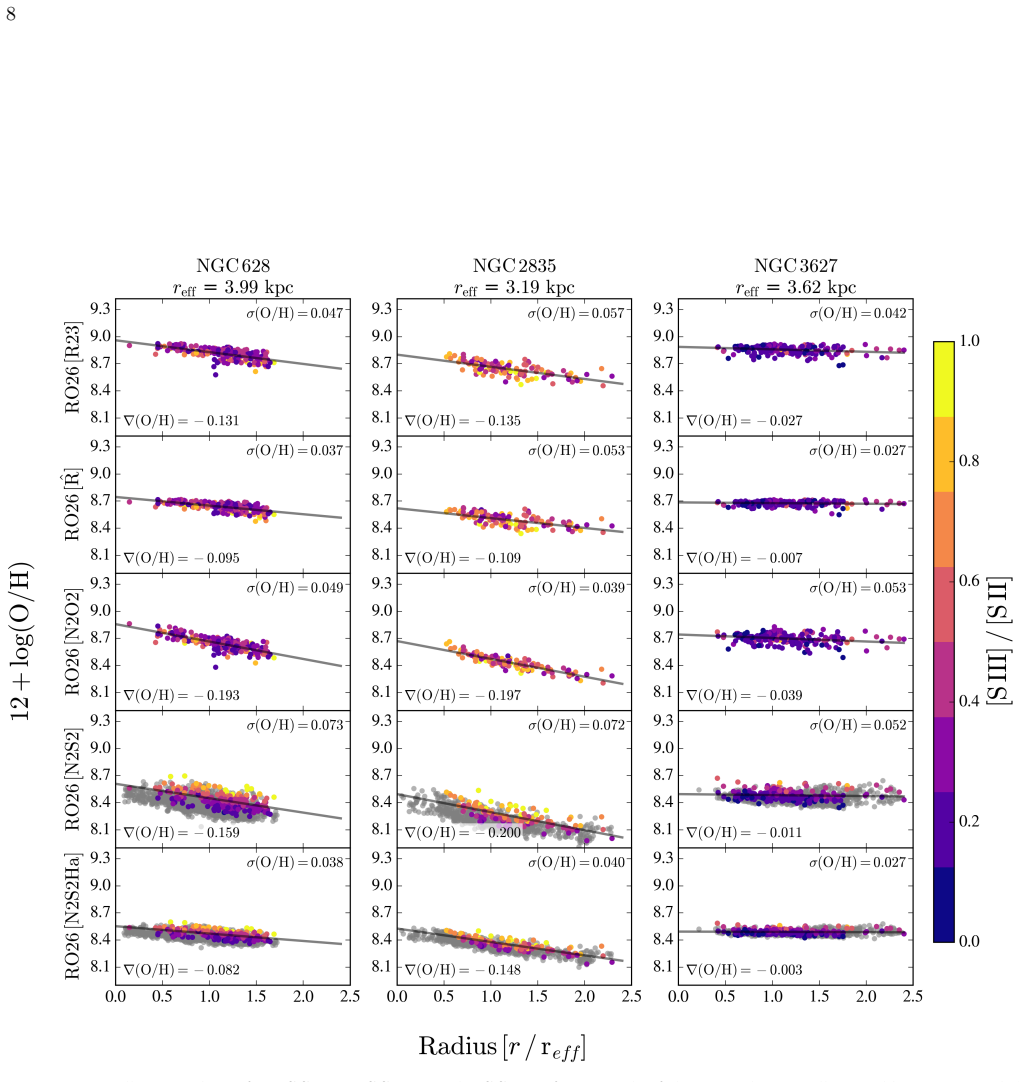
Combining SITELLE [O II] observations with MUSE spectra produces a catalog of 604 nebulae where many strong-line metallicity calibrations show radial gradient scatter below 0.04 dex.
A machine-rendered reading of the paper's core claim, the machinery that carries it, and where it could break.
Core claim
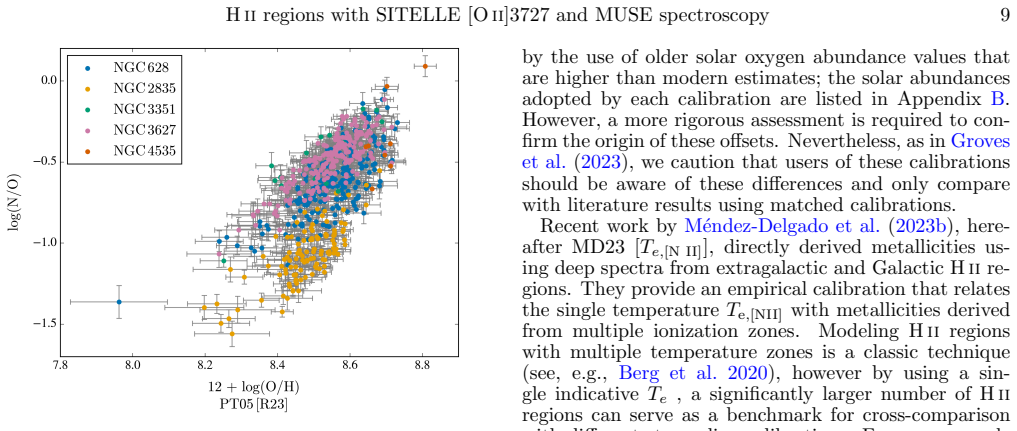
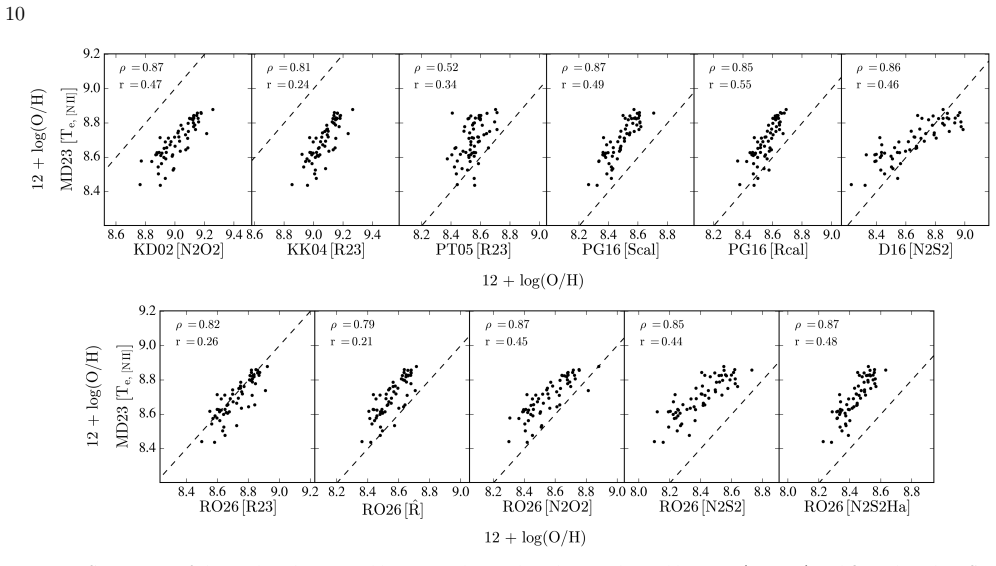
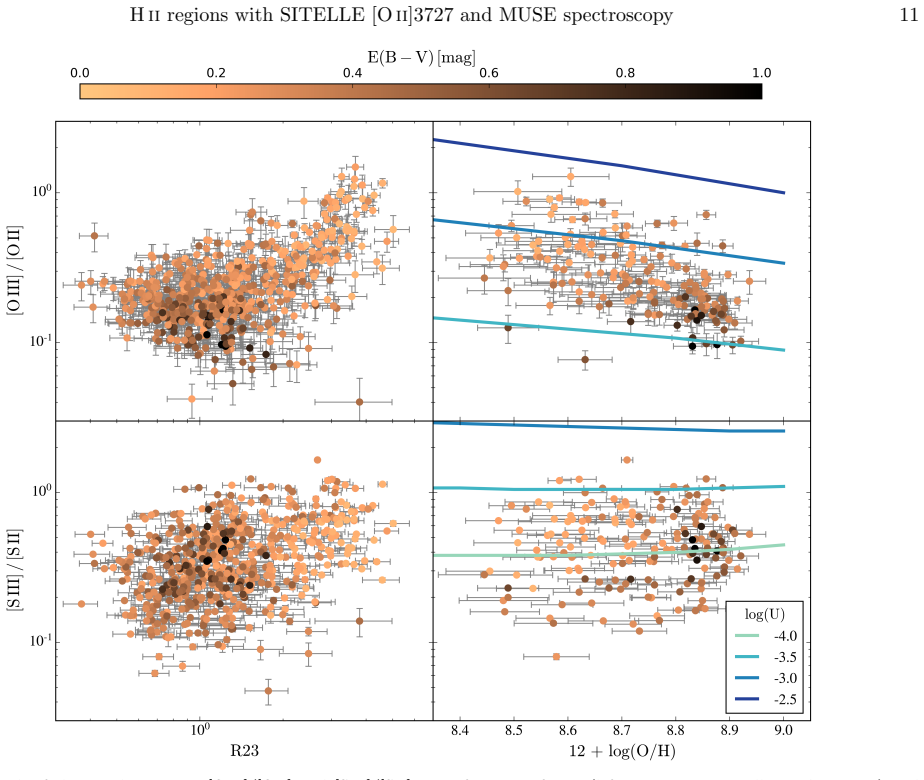
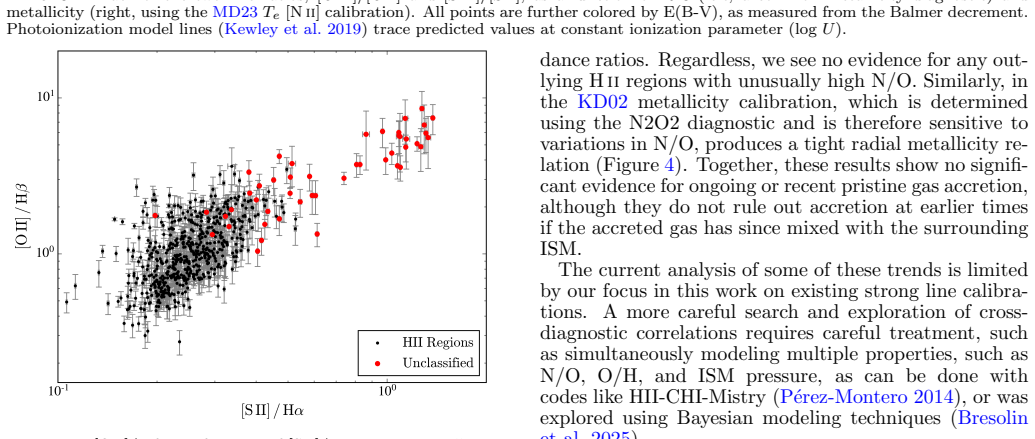
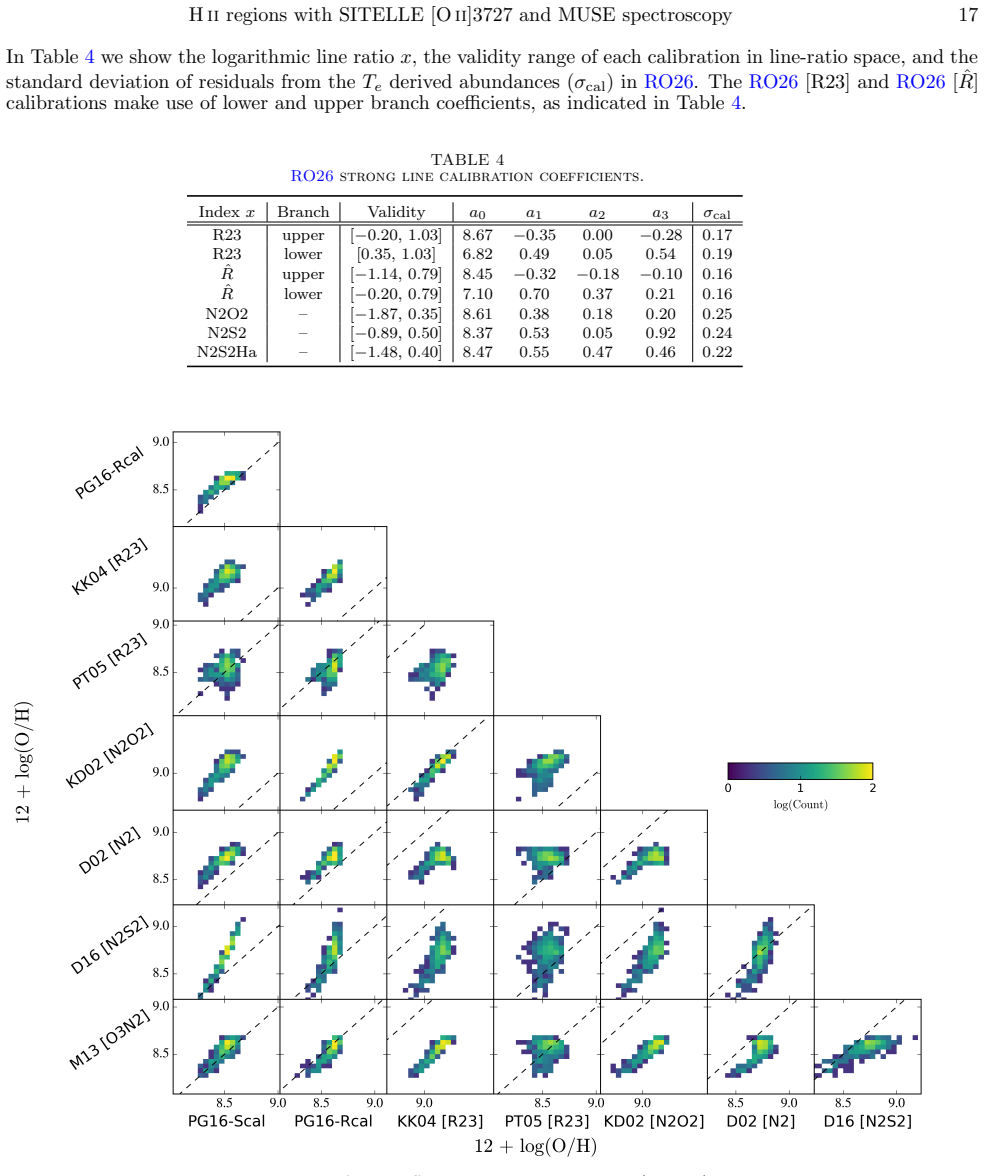
Joining the two datasets yields a homogeneous catalog for 604 ionized nebulae in which known systematic offsets among calibrations appear but many calibrations nevertheless display radial metallicity gradient scatter of only 0.03-0.04 dex; [S III]/[S II] shows minimal secondary dependence on metallicity or extinction and therefore may trace ionization parameter more cleanly than [O III]/[O II]; and no significant outliers appear in O/H or N/O ratios inside the inner disks sampled.
What carries the argument
The homogeneous catalog of emission-line fluxes obtained by combining SITELLE [O II] measurements with MUSE spectroscopy on the same H II regions, which permits side-by-side testing of calibrations and diagnostics.
If this is right
- Many of the tested strong-line calibrations can be treated as interchangeable for determining the shape of radial metallicity gradients.
- [S III]/[S II] can be adopted as a preferred ionization-parameter tracer because it carries less secondary dependence than [O III]/[O II].
- The inner-disk H II regions exhibit internally consistent O/H and N/O abundance patterns with no obvious outliers.
- The released catalog of line fluxes can be used directly for future temperature-based abundance work or refined calibration tests.
Where Pith is reading between the lines
- If the low scatter in gradients is confirmed in additional galaxies, calibration differences may be largely zero-point offsets rather than changes in slope.
- The same combined dataset could be used to test whether the reported consistency in abundances holds at larger galactocentric radii or in galaxies with different star-formation rates.
- Temperature-sensitive lines not covered here could be added later to convert the strong-line results into absolute abundances and check the calibrations against direct methods.
Load-bearing premise
That the [O II] fluxes measured by SITELLE can be added to the MUSE line fluxes without introducing sizable systematic offsets from differences in calibration, aperture, or extinction correction.
What would settle it
A direct comparison that finds metallicity gradients derived from the combined catalog differ by more than 0.1 dex from gradients derived from MUSE lines alone, or that shows [S III]/[S II] varying strongly with extinction after the paper's corrections are applied.
Figures
read the original abstract
Spatially resolved maps of gas-phase metallicity provide key constraints on the chemical enrichment and mixing processes that drive galaxy evolution, but measurements based only on strong lines remain highly uncertain and dependent on emission-line coverage. In this work, we present a joint analysis of SITELLE observations, covering the $[O II]\lambda\lambda3726,3729$ doublet, with PHANGS-MUSE spectroscopy covering 4800-9300 Angstroms, including $H\beta$, $[O III]\lambda4959,5007$, $[N II]\lambda6584$, $H\alpha$, $[S II]\lambda\lambda6716,6731$, and $[S III]\lambda9069$, within five nearby spiral galaxies. By combining these data, we construct a homogeneous catalog of emission-line fluxes for 604 ionized nebulae, 556 of which are classified as H II regions. This enables a comparison of eight widely used strong-line metallicity calibrations, five new strong-line calibrations, and an investigation of ionization-parameter diagnostics. We recover known systematic offsets among calibrations, but also find that many exhibit very low scatter, less than 0.03-0.04 dex, in radial metallicity gradients. We find that $[S III]/[S II]$ exhibits minimal secondary dependence on metallicity or extinction, suggesting that it may be a more robust tracer of ionization parameter than $[O III]/[O II]$. No significant outliers are identified in O/H or N/O within the sampled regions, indicating internally consistent abundance trends across the inner disks probed by our data. We provide a publicly available catalog of all measured emission-line fluxes, designed to support future investigations, including temperature modeling and strong-line abundance calibrations.
Editorial analysis
A structured set of objections, weighed in public.
Referee Report
Summary. The manuscript combines SITELLE observations of the [O II] λλ3726,3729 doublet with PHANGS-MUSE spectroscopy (covering Hβ, [O III], [N II], Hα, [S II], [S III]) across five nearby spiral galaxies. It constructs a homogeneous catalog of emission-line fluxes for 604 ionized nebulae (556 classified as H II regions), compares eight widely used strong-line metallicity calibrations plus five new ones, examines ionization-parameter diagnostics, and reports recovery of known offsets, low scatter (<0.03-0.04 dex) in radial metallicity gradients for many calibrations, minimal secondary dependence for [S III]/[S II], and no significant O/H or N/O outliers. A public catalog is provided.
Significance. If the combined dataset proves homogeneous, the public catalog represents a clear strength for reproducibility and future work on temperature-based abundances or refined calibrations. The reported low scatter in gradients and the comparative robustness of [S III]/[S II] versus [O III]/[O II] would be useful refinements to strong-line methods in resolved extragalactic H II regions.
major comments (2)
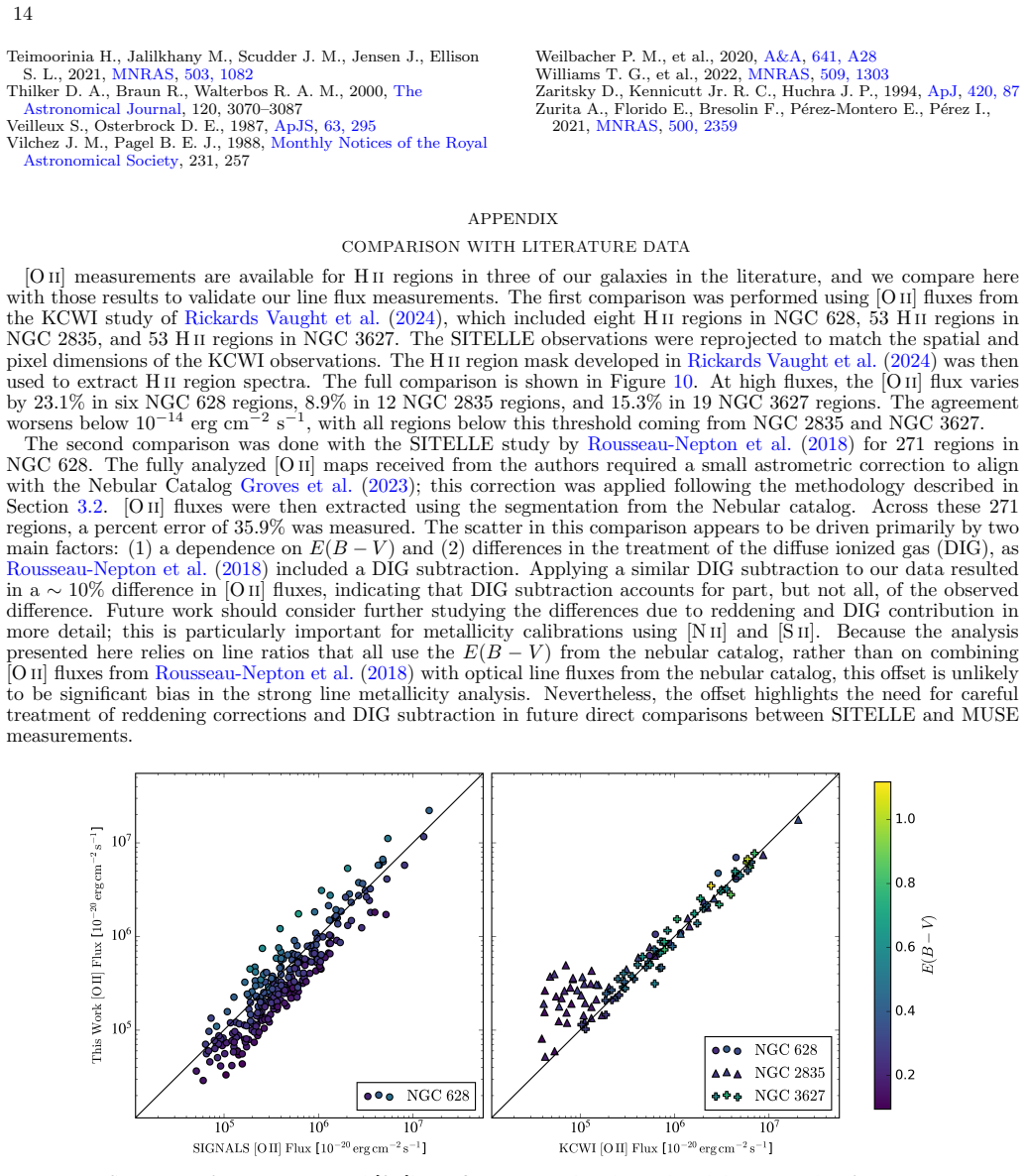
- [Catalog construction and data combination] The construction of the 'homogeneous catalog' of 604 nebulae (abstract) is load-bearing for every quantitative result on scatter, offsets, and diagnostic robustness, yet no quantitative cross-checks for SITELLE-MUSE [O II] flux offsets, aperture mismatches, or differential extinction are described. This directly affects the weakest assumption identified in the stress-test note.
- [Strong-line calibrations section] The five new strong-line calibrations are introduced without details on the fitting procedure, data selection criteria, error propagation, or whether the same 604-nebula sample was used for both calibration and validation (abstract). This raises a potential circularity risk for the reported low-scatter claims.
minor comments (1)
- The abstract would benefit from naming the five galaxies and reporting the number of H II regions per galaxy to allow immediate assessment of sample size and coverage.
Simulated Author's Rebuttal
We thank the referee for their thorough review and valuable suggestions. We address each major comment below and will revise the manuscript to incorporate additional details and clarifications as outlined.
read point-by-point responses
-
Referee: [Catalog construction and data combination] The construction of the 'homogeneous catalog' of 604 nebulae (abstract) is load-bearing for every quantitative result on scatter, offsets, and diagnostic robustness, yet no quantitative cross-checks for SITELLE-MUSE [O II] flux offsets, aperture mismatches, or differential extinction are described. This directly affects the weakest assumption identified in the stress-test note.
Authors: We agree that explicit quantitative cross-checks are essential to support the homogeneity of the catalog. Although some internal consistency checks were performed during data reduction, they were not fully documented in the submitted manuscript. In the revised version, we will add a new subsection (likely in Section 3) that includes direct comparisons of [O II] fluxes from SITELLE and MUSE for overlapping regions, quantitative assessments of aperture mismatch effects, and evaluations of differential extinction using available lines. This will directly address the concern and bolster confidence in the results. revision: yes
-
Referee: [Strong-line calibrations section] The five new strong-line calibrations are introduced without details on the fitting procedure, data selection criteria, error propagation, or whether the same 604-nebula sample was used for both calibration and validation (abstract). This raises a potential circularity risk for the reported low-scatter claims.
Authors: The omission of detailed methodology for the new calibrations was an oversight in the original submission. The five new calibrations were fitted using the full 604-nebula sample. To mitigate circularity concerns, we will expand the relevant section to fully describe the fitting procedure, data selection criteria, and error propagation methods. Additionally, we will clarify that the primary low-scatter results (<0.03-0.04 dex) refer to the eight widely used calibrations, while the new ones are exploratory. If the referee deems it necessary, we can include a cross-validation analysis in the revision. revision: yes
Circularity Check
No circularity; empirical catalog construction and calibration comparisons are independent
full rationale
The paper constructs an observational catalog by combining SITELLE [O II] and MUSE data for 604 nebulae, then empirically compares eight literature strong-line calibrations plus five new ones, reporting measured scatter in gradients and diagnostic trends. No step reduces a claimed result to its own inputs by construction: the new calibrations are additional outputs rather than load-bearing premises, the homogeneity of the catalog is an explicit assumption (not a derived equivalence), and all quantitative findings (0.03-0.04 dex scatter, [S III]/[S II] robustness) are direct measurements on the combined data against external benchmarks. The derivation chain is self-contained against the new observations and does not invoke self-citation chains or fitted parameters renamed as predictions.
Axiom & Free-Parameter Ledger
Reference graph
Works this paper leans on
-
[1]
The data processing pipeline for the MUSE instrument. , keywords =. doi:10.1051/0004-6361/202037855 , archivePrefix =. 2006.08638 , primaryClass =
-
[2]
Conversions between gas-phase metallicities in MaNGA. , keywords =. doi:10.1093/mnras/stab2339 , archivePrefix =. 2108.04934 , primaryClass =
-
[3]
The MUSE Atlas of Disks (MAD): resolving star formation rates and gas metallicities on <100 pc scales. , keywords =. doi:10.1093/mnras/stz194 , archivePrefix =. 1901.04493 , primaryClass =
work page internal anchor Pith review Pith/arXiv arXiv doi:10.1093/mnras/stz194 1901
-
[4]
H II regions in the CALIFA survey: I. catalogue presentation. , keywords =. doi:10.1093/mnras/staa782 , archivePrefix =. 2003.07865 , primaryClass =
-
[5]
The 2D metallicity distribution and mixing scales of nearby galaxies. , keywords =. doi:10.1093/mnras/stab3082 , archivePrefix =. 2110.10697 , primaryClass =
-
[6]
The Abundance Properties of Nearby Late-type Galaxies. I. The Data. , keywords =. doi:10.1088/0004-6256/147/6/131 , archivePrefix =. 1403.5461 , primaryClass =
work page internal anchor Pith review Pith/arXiv arXiv doi:10.1088/0004-6256/147/6/131
-
[7]
Arm-interarm gas abundance variations explored with MUSE: the role of spiral structure in the chemical enrichment of galaxies. , keywords =. doi:10.1093/mnras/staa088 , archivePrefix =. 2001.03450 , primaryClass =
-
[8]
doi:10.1007/978-3-642-22491-1 , adsurl =
Chemical Evolution of Galaxies. doi:10.1007/978-3-642-22491-1 , adsurl =
-
[9]
Collision and Radiative Rates for Infrared to Extreme Ultraviolet Lines of S III. , keywords =. doi:10.3847/1538-4365/ab17e1 , adsurl =
-
[10]
Astrophysics of gaseous nebulae and active galactic nuclei
-
[11]
Ground-based and Airborne Instrumentation for Astronomy IV , year = 2012, editor =
Final design of SITELLE: a wide-field imaging Fourier transform spectrometer for the Canada-France-Hawaii Telescope. Ground-based and Airborne Instrumentation for Astronomy IV , year = 2012, editor =. doi:10.1117/12.926782 , adsurl =
-
[12]
The host galaxies and classification of active galactic nuclei. , keywords =. doi:10.1111/j.1365-2966.2006.10859.x , archivePrefix =. astro-ph/0605681 , primaryClass =
-
[14]
New empirical metallicity relations for the local and high-redshift universe
The DESIRED strong-line calibrations: I. New empirical metallicity relations for the local and high-redshift universe. arXiv e-prints , keywords =
-
[15]
What Can We Learn from the Nitrogen Abundance of High-z Galaxies?. , keywords =. doi:10.3847/1538-4357/adb5f3 , archivePrefix =. 2412.06517 , primaryClass =
-
[16]
SDSS IV MaNGA: Metallicity and ionisation parameter in local star-forming galaxies from Bayesian fitting to photoionisation models. , keywords =. doi:10.1051/0004-6361/201937203 , archivePrefix =. 2002.05744 , primaryClass =
-
[17]
Chemodynamic evidence of pristine gas accretion in the void galaxy VGS 12. , keywords =. doi:10.1051/0004-6361/202557058 , archivePrefix =. 2511.00235 , primaryClass =
-
[18]
A Machine Learning Artificial Neural Network Calibration of the Strong-Line Oxygen Abundance
A machine learning artificial neural network calibration of the strong-line oxygen abundance. , keywords =. doi:10.1093/mnras/stz649 , archivePrefix =. 1903.01506 , primaryClass =
work page internal anchor Pith review Pith/arXiv arXiv doi:10.1093/mnras/stz649 1903
-
[19]
Deriving model-based T$_e$-consistent chemical abundances in ionised gaseous nebulae
Deriving model-based T _ e -consistent chemical abundances in ionized gaseous nebulae. , keywords =. doi:10.1093/mnras/stu753 , archivePrefix =. 1404.3936 , primaryClass =
work page internal anchor Pith review Pith/arXiv arXiv doi:10.1093/mnras/stu753
-
[20]
Metallicity, Ionization Parameter, and Pressure Variations of H II Regions in the TYPHOON Spiral Galaxies: NGC 1566, NGC 2835, NGC 3521, NGC 5068, NGC 5236, and NGC 7793. , keywords =. doi:10.3847/1538-4357/ac5ab2 , archivePrefix =. 2203.02522 , primaryClass =
-
[21]
SIGNALS: I. Survey description. , keywords =. doi:10.1093/mnras/stz2455 , archivePrefix =. 1908.09017 , primaryClass =
-
[22]
The impact of the nitrogen-to-oxygen ratio on ionized nebula diagnostics based on [NII] emission lines. , keywords =. doi:10.1111/j.1365-2966.2009.15145.x , archivePrefix =. 0905.4621 , primaryClass =
-
[23]
IZI: Inferring the Gas Phase Metallicity (Z) and Ionization Parameter (q) of Ionized Nebulae Using Bayesian Statistics. , keywords =. doi:10.1088/0004-637X/798/2/99 , archivePrefix =. 1410.8146 , primaryClass =
work page internal anchor Pith review Pith/arXiv arXiv doi:10.1088/0004-637x/798/2/99
-
[24]
Chemo-spectrophotometric evolution of spiral galaxies - I. The model and the Milky Way. , keywords =. doi:10.1046/j.1365-8711.1999.02699.x , archivePrefix =. astro-ph/9902148 , primaryClass =
-
[25]
The SAMI Galaxy Survey: Spatially Resolved Metallicity and Ionization Mapping
The SAMI Galaxy Survey: Spatially resolved metallicity and ionization mapping. , keywords =. doi:10.1093/mnras/sty1782 , archivePrefix =. 1807.01522 , primaryClass =
work page internal anchor Pith review Pith/arXiv arXiv doi:10.1093/mnras/sty1782
-
[26]
SDSS IV MaNGA - Metallicity and nitrogen abundance gradients in local galaxies
SDSS IV MaNGA - metallicity and nitrogen abundance gradients in local galaxies. , keywords =. doi:10.1093/mnras/stx789 , archivePrefix =. 1703.03813 , primaryClass =
work page internal anchor Pith review Pith/arXiv arXiv doi:10.1093/mnras/stx789
-
[27]
The VIRUS-P Exploration of Nearby Galaxies (VENGA): spatially resolved gas-phase metallicity distributions in barred and unbarred spirals. , keywords =. doi:10.1093/mnras/stw1422 , archivePrefix =. 1606.05713 , primaryClass =
work page internal anchor Pith review Pith/arXiv arXiv doi:10.1093/mnras/stw1422
-
[28]
A characteristic oxygen abundance gradient in galaxy disks unveiled with CALIFA
A characteristic oxygen abundance gradient in galaxy disks unveiled with CALIFA. , keywords =. doi:10.1051/0004-6361/201322343 , archivePrefix =. 1311.7052 , primaryClass =
work page internal anchor Pith review Pith/arXiv arXiv doi:10.1051/0004-6361/201322343
-
[29]
H II Regions and the Abundance Properties of Spiral Galaxies. , keywords =. doi:10.1086/173544 , adsurl =
-
[30]
The Composition Gradient in M101 Revisited. I. H II Region Spectra and Excitation Properties. , keywords =. doi:10.1086/176675 , adsurl =
-
[31]
SIGNALS on the mixing of oxygen and nitrogen in the spiral galaxy NGC 6946. , keywords =. doi:10.1093/mnras/staf510 , archivePrefix =. 2502.00649 , primaryClass =
-
[32]
Anomalously low metallicity regions in MaNGA star-forming galaxies: Accretion Caught in Action?
Anomalously Low-metallicity Regions in MaNGA Star-forming Galaxies: Accretion Caught in Action?. , keywords =. doi:10.3847/1538-4357/aaf7a3 , archivePrefix =. 1812.04614 , primaryClass =
work page internal anchor Pith review Pith/arXiv arXiv doi:10.3847/1538-4357/aaf7a3
-
[33]
SIGNALS of Giant HII Regions: A Spatially Resolved Analysis of NGC 604. arXiv e-prints , keywords =. doi:10.48550/arXiv.2510.03144 , archivePrefix =. 2510.03144 , primaryClass =
-
[34]
De Re Metallica: The cosmic chemical evolution of galaxies
De re metallica: the cosmic chemical evolution of galaxies. , keywords =. doi:10.1007/s00159-018-0112-2 , archivePrefix =. 1811.09642 , primaryClass =
work page internal anchor Pith review Pith/arXiv arXiv doi:10.1007/s00159-018-0112-2
-
[35]
Measuring the mixing scale of the ISM within nearby spiral galaxies. , keywords =. doi:10.1093/mnras/staa2743 , archivePrefix =. 2009.02342 , primaryClass =
-
[36]
CHAOS IV: Gas-phase Abundance Trends from the First Four CHAOS Galaxies. , keywords =. doi:10.3847/1538-4357/ab7eab , archivePrefix =. 2001.05002 , primaryClass =
-
[37]
Discovery of 2200 new supernova remnants in 19 nearby star-forming galaxies with MUSE spectroscopy. , keywords =. doi:10.1051/0004-6361/202450730 , archivePrefix =. 2405.08974 , primaryClass =
-
[38]
Temperature-based radial metallicity gradients in nearby galaxies. , keywords =. doi:10.1051/0004-6361/202556017 , archivePrefix =. 2507.20744 , primaryClass =
-
[39]
Investigating the Drivers of Electron Temperature Variations in H II Regions with Keck-KCWI and VLT-MUSE. , keywords =. doi:10.3847/1538-4357/ad303c , archivePrefix =. 2309.17440 , primaryClass =
-
[40]
Metallicity calibrations based on auroral lines from PHANGS MUSE data. , keywords =. doi:10.1051/0004-6361/202451007 , archivePrefix =. 2410.00106 , primaryClass =
-
[41]
Probing the chemo-dynamical evolution of disc galaxies
The PHANGS-MUSE survey. Probing the chemo-dynamical evolution of disc galaxies. , keywords =. doi:10.1051/0004-6361/202141727 , archivePrefix =. 2110.03708 , primaryClass =
-
[42]
MARTA: Temperature-temperature relationships and strong-line metallicity calibrations from multiple auroral lines detections at cosmic noon. arXiv e-prints , keywords =. doi:10.48550/arXiv.2504.03839 , archivePrefix =. 2504.03839 , primaryClass =
-
[43]
PHANGS-MUSE: The H II region luminosity function of local star-forming galaxies. , keywords =. doi:10.1051/0004-6361/202141907 , archivePrefix =. 2111.09362 , primaryClass =
-
[44]
Pilyugin, L. S. and Grebel, E. K. , year=. New calibrations for abundance determinations in HII regions , volume=. Monthly Notices of the Royal Astronomical Society , publisher=. doi:10.1093/mnras/stw238 , number=
-
[45]
The host galaxies of active galactic nuclei. , keywords =. doi:10.1111/j.1365-2966.2003.07154.x , archivePrefix =. astro-ph/0304239 , primaryClass =
-
[46]
A Multi Unit Spectroscopic Explorer - MUSE. 2005
2005
-
[47]
Astronomical Data Analysis Software an Systems XXIV (ADASS XXIV) , year = 2015, editor =
ORBS, ORCS, OACS, a Software Suite for Data Reduction and Analysis of the Hyperspectral Imagers SITELLE and SpIOMM. Astronomical Data Analysis Software an Systems XXIV (ADASS XXIV) , year = 2015, editor =
2015
-
[48]
Using Strong Lines to Estimate Abundances in Extragalactic HII Regions and Starburst Galaxies
Using Strong Lines to Estimate Abundances in Extragalactic H II Regions and Starburst Galaxies. , keywords =. doi:10.1086/341326 , archivePrefix =. astro-ph/0206495 , primaryClass =
work page internal anchor Pith review Pith/arXiv arXiv doi:10.1086/341326
-
[49]
and Rosolowsky, Erik and Nofech, Joseph and Schinnerer, Eva and Leroy, Adam K
Lang, Philipp and Meidt, Sharon E. and Rosolowsky, Erik and Nofech, Joseph and Schinnerer, Eva and Leroy, Adam K. and Emsellem, Eric and Pessa, Ismael and Glover, Simon C. O. and Groves, Brent and Hughes, Annie and Kruijssen, J. M. Diederik and Querejeta, Miguel and Schruba, Andreas and Bigiel, Frank and Blanc, Guillermo A. and Chevance, Mélanie and Colom...
-
[50]
R v-dependent Optical and Near-Ultraviolet Extinction. , keywords =. doi:10.1086/173713 , adsurl =
-
[51]
PyNeb Reference Manual. 2022
2022
-
[52]
Luridiana, V. and Morisset, C. and Shaw, R. A. , year=. PyNeb: a new tool for analyzing emission lines: I. Code description and validation of results , volume=. doi:10.1051/0004-6361/201323152 , journal=
-
[53]
Astrophysics 0f Gaseous Nebulae and Active Galactic Nuclei. 2006
2006
-
[54]
The PHANGS–MUSE nebular catalogue , volume=
Groves, B and Kreckel, K and Santoro, F and Belfiore, F and Zavodnik, E and Congiu, E and Egorov, O V and Emsellem, E and Grasha, K and Leroy, A and Scheuermann, F and Schinnerer, E and Watkins, E J and Barnes, A T and Bigiel, F and Dale, D A and Glover, S C O and Pessa, I and Sanchez-Blazquez, P and Williams, T G , year=. The PHANGS–MUSE nebular catalogu...
-
[55]
and Haberland, Matt and Reddy, Tyler and Cournapeau, David and Burovski, Evgeni and Peterson, Pearu and Weckesser, Warren and Bright, Jonathan and
Virtanen, Pauli and Gommers, Ralf and Oliphant, Travis E. and Haberland, Matt and Reddy, Tyler and Cournapeau, David and Burovski, Evgeni and Peterson, Pearu and Weckesser, Warren and Bright, Jonathan and. Nature Methods , year =
-
[56]
Binette, L. and Matadamas, R. and Hägele, G. F. and Nicholls, D. C. and Magris C., G. and Peña-Guerrero, M. Á. and Morisset, C. and Rodríguez-González, A. , year=. Discrepancies between the [OIII] and [SIII] temperatures in HII regions , volume=. doi:10.1051/0004-6361/201219515 , journal=
-
[57]
Bresolin, Fabio and Garnett, Donald R. and Kennicutt, Jr., Robert C. , year=. Abundances of Metal‐rich H<scp>ii</scp>Regions in M51 , volume=. The Astrophysical Journal , publisher=. doi:10.1086/424377 , number=
-
[58]
The effects of cluster environment on the chemical evolution of galaxies - II. NGC 4254. , year = 1994, month = jan, volume =. doi:10.1093/mnras/266.2.421 , adsurl =
-
[59]
and Braun, Robert and Walterbos, René A
Thilker, David A. and Braun, Robert and Walterbos, René A. M. , year=. HII[CLC]phot[/CLC]: Automated Photometry of H [CSC]ii[/CSC] Regions Applied to M51 , volume=. The Astronomical Journal , publisher=. doi:10.1086/316852 , number=
-
[60]
Imaging spectroscopy of 4285 H II region candidates
NGC628 with SITELLE: I. Imaging spectroscopy of 4285 H II region candidates. , keywords =. doi:10.1093/mnras/sty477 , archivePrefix =. 1704.05121 , primaryClass =
-
[61]
astropy/photutils: 1.8.0 , month = may, year = 2023, publisher =
Larry Bradley and Brigitta Sip. astropy/photutils: 1.8.0 , month = may, year = 2023, publisher =. doi:10.5281/zenodo.7946442 , url =
-
[62]
Optimal fitting of Gaussian-apodized or under-resolved emission lines in Fourier transform spectra providing new insights on the velocity structure of NGC 6720. , keywords =. doi:10.1093/mnras/stw2315 , archivePrefix =. 1608.05854 , primaryClass =
work page internal anchor Pith review Pith/arXiv arXiv doi:10.1093/mnras/stw2315
-
[63]
HyperLEDA. III. The catalogue of extragalactic distances. , keywords =. doi:10.1051/0004-6361/201423496 , archivePrefix =. 1408.3476 , primaryClass =
work page internal anchor Pith review Pith/arXiv arXiv doi:10.1051/0004-6361/201423496
-
[64]
Distances to PHANGS galaxies: New tip of the red giant branch measurements and adopted distances. , keywords =. doi:10.1093/mnras/staa3668 , archivePrefix =. 2012.00757 , primaryClass =
-
[65]
Leroy, Adam K. and Schinnerer, Eva and Hughes, Annie and Rosolowsky, Erik and Pety, Jérôme and Schruba, Andreas and Usero, Antonio and Blanc, Guillermo A. and Chevance, Mélanie and Emsellem, Eric and Faesi, Christopher M. and Herrera, Cinthya N. and Liu, Daizhong and Meidt, Sharon E. and Querejeta, Miguel and Saito, Toshiki and Sandstrom, Karin M. and Sun...
-
[66]
Measuring Reddening with SDSS Stellar Spectra and Recalibrating SFD
Measuring Reddening with Sloan Digital Sky Survey Stellar Spectra and Recalibrating SFD. , keywords =. doi:10.1088/0004-637X/737/2/103 , archivePrefix =. 1012.4804 , primaryClass =
work page internal anchor Pith review Pith/arXiv arXiv doi:10.1088/0004-637x/737/2/103
-
[67]
The abundance discrepancy in ionized nebulae: which are the correct abundances?. arXiv e-prints , keywords =. doi:10.48550/arXiv.2311.10280 , archivePrefix =. 2311.10280 , primaryClass =
-
[68]
[OIII]/[NII] as an abundance indicator at high redshift. , keywords =. doi:10.1111/j.1365-2966.2004.07591.x , archivePrefix =. astro-ph/0401128 , primaryClass =
-
[69]
Metallicities of 0.3<z<1.0 Galaxies in the GOODS-North Field
Metallicities of 0.3<z<1.0 Galaxies in the GOODS-North Field. , keywords =. doi:10.1086/425299 , archivePrefix =. astro-ph/0408128 , primaryClass =
work page internal anchor Pith review Pith/arXiv arXiv doi:10.1086/425299
-
[70]
Direct Gas-phase Metallicity in Local Analogs of High-redshift Galaxies: Empirical Metallicity Calibrations for High-redshift Star-forming Galaxies. , keywords =. doi:10.3847/1538-4357/aabd74 , archivePrefix =. 1805.08224 , primaryClass =
-
[71]
Understanding Galaxy Evolution Through Emission Lines. , keywords =. doi:10.1146/annurev-astro-081817-051832 , archivePrefix =. 1910.09730 , primaryClass =
-
[72]
Metallicity Calibrations and the Mass-Metallicity Relation for Star-Forming Galaxies
Metallicity Calibrations and the Mass-Metallicity Relation for Star-forming Galaxies. , keywords =. doi:10.1086/587500 , archivePrefix =. 0801.1849 , primaryClass =
work page internal anchor Pith review Pith/arXiv arXiv doi:10.1086/587500
-
[73]
Charles R. Harris and K. Jarrod Millman and St. Array programming with. 2020 , month = sep, journal =. doi:10.1038/s41586-020-2649-2 , publisher =
-
[74]
Comparing the pre-SNe feedback and environmental pressures for 6000 H II regions across 19 nearby spiral galaxies. , keywords =. doi:10.1093/mnras/stab2958 , archivePrefix =. 2110.05492 , primaryClass =
-
[75]
The chemical composition of metal-poor emission-line galaxies in the Data Release 3 of the Sloan Digital Sky Survey. , keywords =. doi:10.1051/0004-6361:20053763 , archivePrefix =. astro-ph/0511644 , primaryClass =
work page internal anchor Pith review Pith/arXiv arXiv doi:10.1051/0004-6361:20053763
-
[76]
A reassessment of strong line metallicity conversions in the machine learning era. , keywords =. doi:10.1093/mnras/stab466 , archivePrefix =. 2102.07058 , primaryClass =
-
[77]
The O3N2 and N2 abundance indicators revisited: improved calibrations based on CALIFA and T _ e -based literature data. , keywords =. doi:10.1051/0004-6361/201321956 , archivePrefix =. 1307.5316 , primaryClass =
work page internal anchor Pith review Pith/arXiv arXiv doi:10.1051/0004-6361/201321956
-
[78]
Chemical abundances in high-redshift galaxies: A powerful new emission line diagnostic
Chemical abundances in high-redshift galaxies: a powerful new emission line diagnostic. , keywords =. doi:10.1007/s10509-016-2657-8 , archivePrefix =. 1601.01337 , primaryClass =
work page internal anchor Pith review Pith/arXiv arXiv doi:10.1007/s10509-016-2657-8
-
[79]
On the electron temperatures in high-metallicity HII regions. , keywords =. doi:10.1111/j.1365-2966.2009.15182.x , archivePrefix =. 0907.0084 , primaryClass =
-
[80]
A geostatistical analysis of multiscale metallicity variations in galaxies - I. Introduction and comparison of high-resolution metallicity maps to an analytical metal transport model. , keywords =. doi:10.1093/mnras/stab2554 , archivePrefix =. 2109.03390 , primaryClass =
-
[81]
Temperature inhomogeneities cause the abundance discrepancy in H II regions. , keywords =. doi:10.1038/s41586-023-05956-2 , archivePrefix =. 2305.11578 , primaryClass =
discussion (0)
Sign in with ORCID, Apple, or X to comment. Anyone can read and Pith papers without signing in.