REVIEW 4 major objections 5 minor 3 cited by
Diffusion Autoencoders are Scalable Image Tokenizers
T0 review · 4 major / 5 minor · reviewed 2026-08-09 · deepseek-v4-flash
Pith's one-line read This paper claims that a single diffusion L2 loss—Flow Matching, an evidence-lower-bound objective—can train scalable image tokenizers, and that these tokenizers match or outperform the standard GAN-LPIPS tokenizer (GLPTo) for both image…
desk verdict DiTo's real contribution is a simpler self-supervised tokenizer with competitive generation FID; the 'better reconstruction' claim rests on a human eval that is statistically a tie. read the letter →
The pith
A machine-rendered reading of the paper's core claim, the machinery that carries it, and where it could break.
The reading
What carries the argument
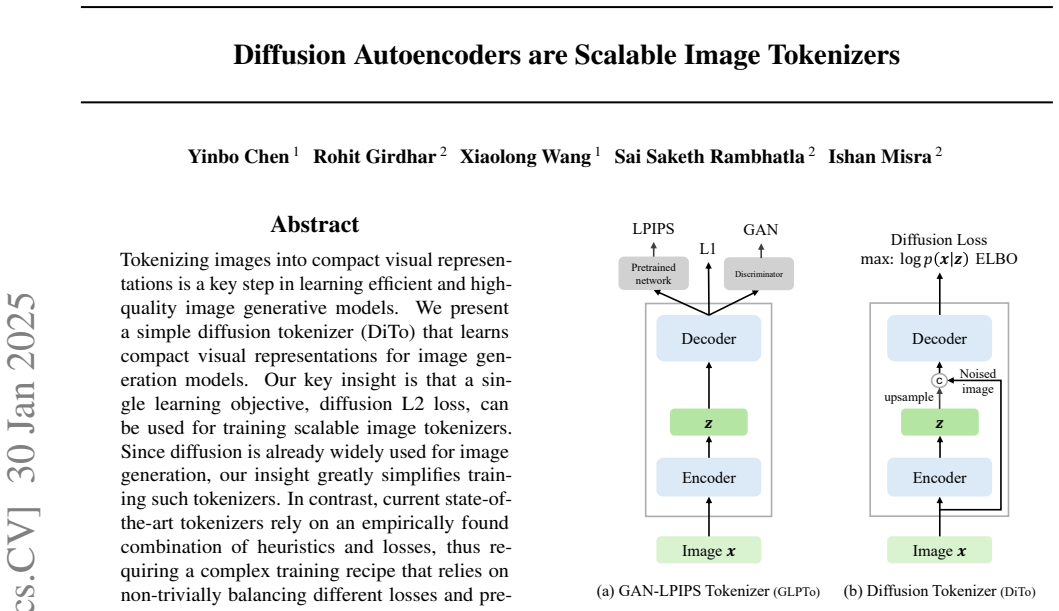
The central object is the diffusion tokenizer: an encoder plus a diffusion decoder trained with a single $L^2$ Flow Matching loss, which the paper justifies as an ELBO (evidence lower bound) maximization objective. The decoder is a convolutional UNet with timestep conditioning that takes the upsampled latent $z$ as a condition and denoises $x_t$ toward $x$; at inference it samples the reconstruction with an Euler ODE solver. Two design choices carry the argument: using an ELBO-form objective (Flow Matching or v-prediction with cosine schedule) rather than non-ELBO alternatives such as $\epsilon$-prediction or EDM, which cause color shifts in jointly trained latents; and noise synchronization, which during training noises $z$ at a random time $\tau$ with probability 0.1 and asks the decoder to denoise pixel noises from $t \in [\tau,1]$, aligning the latent-space diffusion path with the pixel-space path. DiTo also replaces the KL regularizer on $z$ with LayerNorm.
What would settle it
A direct test: collect more human preferences between DiTo-XL and GLPTo-XL at both 256px and 512px; if DiTo no longer wins at either resolution, or if a text-reading metric on symbol-heavy crops shows no advantage, the reconstruction claim fails. For the generation claim, retrain a DiT-XL/2 on DiTo-XL latents with and without noise synchronization over multiple seeds and check whether the gFID 6.29 versus 7.49 improvement reproduces within noise.
Extended reading notes
Core claim
DiTo is a diffusion autoencoder trained jointly from scratch: an encoder maps an image $x$ to a compact latent $z$, and a decoder models $p(x|z)$ using a Flow Matching objective, which the paper connects to ELBO theory. The discovery is that this single L2 loss learns latents that are competitive with or better than the GAN-LPIPS recipe. At the XL scale, DiTo's reconstruction FID at 5K samples is 7.95 versus GLPTo-XL's 4.14, yet human side-by-side comparisons favor DiTo 52.44% when ties are counted as half, and DiTo-XL has the best PSNR and SSIM among the compared tokenizers; adding the LPIPS loss already used in GLPTo gives DiTo-XL the best rFID (3.53). On generation, a DiT-XL/2 trained on DiTo latents with noise synchronization reaches gFID 6.29 versus 7.49 for the same generator trained on GLPTo-XL latents. The paper also reports that DiTo's reconstruction quality keeps improving as the decoder grows, with no loss-weight rebalancing needed.
Load-bearing premise
The load-bearing premise is that side-by-side human preference is the right test of reconstruction quality when it conflicts with reconstruction FID, because DiTo-XL's rFID@5K (7.95) is nearly double GLPTo-XL's (4.14) while the paper's better-reconstruction claim rests on a 52.44% preference rate.
Editorial extensions
If this is right
- Tokenizer training can use a single self-supervised diffusion L2 loss, removing the need to tune weights among L1, LPIPS, and GAN losses.
- Scaling up the diffusion decoder improves reconstruction faithfulness and image-generation quality without rebalancing loss hyperparameters.
- Latent diffusion models trained on DiTo latents with noise synchronization outperform those trained on GLPTo-XL latents (gFID 6.29 versus 7.49).
- Using ELBO-form diffusion objectives such as Flow Matching matters for learning the latent representation itself, not just for decoding.
- DiTo transfers to higher-resolution inputs zero-shot: the rFID gap versus GLPTo narrows from 7.95 versus 4.14 at 256 pixels to 2.32 versus 2.13 at 512 pixels.
Reading between the lines
- If the single-loss recipe holds, the same diffusion objective could plausibly train tokenizers for video, audio, and other continuous signals, since the loss itself is modality-agnostic.
- The human-preference result suggests that reconstruction FID, computed in a supervised feature space, may be a misleading yardstick for tokenizer quality; preference tests or task-specific metrics could become the primary evidence.
- Noise synchronization is a transferable idea for any latent diffusion pipeline: aligning how noise destroys latents with how it destroys pixels could improve other autoencoder-plus-diffusion stacks.
- DiTo's zero-shot resolution generalization hints that fully convolutional diffusion decoders may eventually let one tokenizer serve multiple resolutions without retraining.
Signed reviews
Editorial analysis
A structured set of objections, weighed in public.
Referee Report
Summary. The paper proposes DiTo, a diffusion autoencoder image tokenizer trained with a single Flow Matching diffusion L2 loss, without GAN or perceptual losses. The encoder is the standard LDM encoder, and the decoder is a diffusion UNet conditioned on the latent. The authors argue that a single ELBO-style diffusion objective is sufficient to learn competitive image tokens, and they introduce a noise-synchronization regularization to improve downstream latent diffusion training. They compare DiTo to an LDM-style GAN-LPIPS tokenizer (GLPTo) at three scales (B, L, XL) for reconstruction and for training a DiT latent generator, reporting competitive or better rFID/gFID and a human-preference study. The paper includes theory grounding via the Kingma-Gao ELBO result, ablations of training objectives, LayerNorm versus KL regularization, and a zero-shot higher-resolution evaluation.
Significance. If the central claim holds, a simple self-supervised diffusion objective can replace the complex GAN-LPIPS recipe used by most current latent image/video models, simplifying tokenizer training and removing dependence on pretrained supervised features. The paper is well grounded theoretically, releases code, and evaluates at nontrivial scales. Its strengths include the clean architecture, the connection to ELBO theory, the LayerNorm analysis, and the honest reporting of rFID gaps. However, the empirical support for the headline 'better reconstruction' claim is fragile: the only direct evidence in the self-supervised setting is a human-preference result at XL that is statistically indistinguishable from a tie and conflicts with the reported rFID and LPIPS/IS numbers. The generation results are promising but are reported without repeated runs. The core idea is valuable, but the claims need to be tightened and supported by additional statistical evidence.
major comments (4)
- [Section 5.1, Figure 4 and Table 4] The claim that DiTo-XL achieves better reconstruction than GLPTo-XL is based on a human-preference rate of 52.44% when ties are counted as half, from 900 MTurk comparisons. With N=900, the standard error of this proportion is about 1.67 percentage points, so the 95% confidence interval is approximately [49.2%, 55.7%] and includes 50%; the result is statistically indistinguishable from a tie. This matters because the authors explicitly argue that FID is not aligned with human judgment, making the human protocol the load-bearing evidence for the better-reconstruction claim. As reported, the protocol cannot carry that claim. I recommend reporting confidence intervals or pairwise significance tests, increasing the number of comparisons, and providing a robustness analysis with respect to how ties are handled. Without this, the claim should be moderated to 'competitive' rather than 'better.'
- [Section 5.2, Table 2] The generation results are based on a single training run of each DiT model. The differences in gFID@50K (7.49 for GLPTo-XL, 7.57 for DiTo-XL, 6.29 for DiTo-XL with noise sync) are small relative to typical run-to-run variance for large generative models. Without multiple seeds or at least a measure of variance, the statement that noise synchronization 'outperforms' GLPTo is not established. Please report multiple runs with error bars or clearly label these as single-run comparisons and adjust the wording accordingly.
- [Section 4, Noise synchronization] Noise synchronization is presented as a key contribution, but the paper does not ablate its design choices: the probability p=0.1, the sampling range of tau, and the exact conditioning of the decoder on z_tau with t in [tau,1]. It is therefore unclear whether the gFID improvement in Table 2 is attributable to the proposed regularization or to a particular choice of hyperparameters. Please provide an ablation of p and tau, and clarify the notation around 'x_tau...1' and the used loss, as the current description is difficult to follow.
- [Section 5.3, Figure 5] The comparison of ELBO versus non-ELBO diffusion objectives (Flow Matching, v-prediction cosine, epsilon-prediction, EDM) is reported only with qualitative examples. The paper claims that non-ELBO objectives lead to suboptimal latent representations, but no quantitative rFID or generation numbers are given for these variants. Please add quantitative results to support the claim that the ELBO-form objective is important for learning useful latents, especially since this is one of the primary design justifications.
minor comments (5)
- [Abstract and Conclusion] The phrase 'competitive or better quality' should be qualified in light of the statistical evidence; the current wording overstates the reconstruction result.
- [Table 1] The row labeled 'Supervised (Rombach et al., 2022)' is ambiguous; please clarify that this is the original Stable Diffusion tokenizer, presumably evaluated under the same protocol, and note any differences in training data.
- [Figure 4] The preference plot would benefit from error bars or confidence intervals; as it stands, the reader cannot assess the uncertainty of the 52.44% point estimate.
- [Appendix E, Equations (10)--(13)] The derivation of the sample prediction x-bar_theta is concise but would be easier to follow if the matrix inverse and the use of the L2-optimal network prediction were motivated more explicitly.
- [Appendix F, Table 8] Please state whether the 512x512 rFID evaluation is performed on the same validation image set as the 256x256 evaluation, since the zero-shot generalization claim depends on the comparability of the image distributions.
Circularity Check
No significant circularity: DiTo's central claim is empirically tested against an external baseline, and its theoretical grounding rests on an external ELBO result rather than on the paper's own conclusions.
full rationale
The paper's derivation chain is not circular in any load-bearing way. DiTo is defined by a single diffusion L2 (flow matching) objective, and its reconstruction and generation performance are measured against GLPTo, a baseline re-implemented by the authors with matched architecture and data. The claimed theoretical justification comes from Kingma & Gao's external ELBO equivalence for diffusion objectives; the paper does not derive that equivalence itself or import a uniqueness result from its own prior work. The proposed components — LayerNorm on the latent and noise synchronization — are presented as design choices and evaluated through ablations (Tables 5, 2), not derived from the target results. The only self-citation of note is Girdhar et al. 2023 in the passage arguing that automated metrics such as FID do not correlate well with human judgment; this citation is accompanied by external references (Podell et al., Borji, Jayasumana et al.) and is used to motivate human evaluation rather than to prove a core equation. The paper's human-preference-based claim that DiTo-XL achieves better reconstruction than GLPTo-XL is statistically fragile (52.44% with ties split, N=900, consistent with chance), but this is an evidence-quality and correctness concern, not a circularity of definition or fitting. No equation in the paper reduces to a fitted constant, and no prediction is equivalent to its training input by construction. Overall, the core contribution is an empirical architecture and training-objective study with independent baseline comparisons, so circularity is minimal.
Assumptions & free parameters
free parameters (2)
- Noise synchronization probability p =
0.1
- LPIPS loss weight (DiTo+LPIPS variant) =
0.5
assumptions (4)
- standard math Kingma and Gao (2024): flow matching and v-prediction with cosine schedule are ELBO objectives with data augmentation.
- domain assumption The diffusion decoder can learn the conditional distribution p(x|z) using the flow matching objective with the given noise schedule and v-prediction.
- domain assumption Human preference is the appropriate arbiter of reconstruction quality when it conflicts with rFID.
- domain assumption LayerNorm on the latent prevents collapse and is compatible with downstream latent diffusion training.
Cite this review
Pith. "Pith review of Diffusion Autoencoders are Scalable Image Tokenizers." pith.science (2026). https://pith.science/paper/N7WHLAN2
@misc{pith2026250118593,
  author       = {Pith},
  title        = {Pith review of: Diffusion Autoencoders are Scalable Image Tokenizers},
  year         = {2026},
  howpublished = {\url{https://pith.science/paper/N7WHLAN2}},
  note         = {Machine review of arXiv:2501.18593}
}
read the original abstract
Tokenizing images into compact visual representations is a key step in learning efficient and high-quality image generative models. We present a simple diffusion tokenizer (DiTo) that learns compact visual representations for image generation models. Our key insight is that a single learning objective, diffusion L2 loss, can be used for training scalable image tokenizers. Since diffusion is already widely used for image generation, our insight greatly simplifies training such tokenizers. In contrast, current state-of-the-art tokenizers rely on an empirically found combination of heuristics and losses, thus requiring a complex training recipe that relies on non-trivially balancing different losses and pretrained supervised models. We show design decisions, along with theoretical grounding, that enable us to scale DiTo for learning competitive image representations. Our results show that DiTo is a simpler, scalable, and self-supervised alternative to the current state-of-the-art image tokenizer which is supervised. DiTo achieves competitive or better quality than state-of-the-art in image reconstruction and downstream image generation tasks.
Figures


Figures from the paper (8 more)


Forward citations
Cited by 3 Pith papers
-
D-AR: Diffusion via Autoregressive Models
D-AR recasts pixel-space diffusion as vanilla autoregressive next-token prediction using a diffusion-ordered discrete tokenizer, reaching 2.09 FID on ImageNet 256x256 with a 775M Llama backbone.
-
SSDD: Single-Step Diffusion Decoder for Efficient Image Tokenization
A GAN-free, single-step distilled diffusion decoder that reconstructs images from latent codes with better perceptual FID than KL-VAE at higher throughput.
-
3D Shape Tokenization via Latent Flow Matching
Shape Tokens, a compact continuous 3D latent learned by fitting each shape's surface density with flow matching, match specialized baselines across reconstruction, CLIP, generation, and ray intersection tasks.
Reference graph
Works this paper leans on
-
[1]
write newline
" write newline "" before.all 'output.state := FUNCTION n.dashify 't := "" t empty not t #1 #1 substring "-" = t #1 #2 substring "--" = not "--" * t #2 global.max substring 't := t #1 #1 substring "-" = "-" * t #2 global.max substring 't := while if t #1 #1 substring * t #2 global.max substring 't := if while FUNCTION format.date year duplicate empty "emp...
-
[2]
Albergo, M. S. and Vanden-Eijnden, E. Building normalizing flows with stochastic interpolants. arXiv preprint arXiv:2209.15571, 2022
arXiv 2022
-
[3]
Ba, J. L., Kiros, J. R., and Hinton, G. E. Layer normalization, 2016. URL https://arxiv.org/abs/1607.06450
arXiv 2016
-
[4]
BEiT : B ert pre-training of image transformers
Bao, H., Dong, L., and Wei, F. BEiT : B ert pre-training of image transformers. In ICLR, 2022
work page 2022
-
[5]
Improving image generation with better captions
Betker, J., Goh, G., Jing, L., Brooks, T., Wang, J., Li, L., Ouyang, L., Zhuang, J., Lee, J., Guo, Y., et al. Improving image generation with better captions. Computer Science. https://cdn. openai. com/papers/dall-e-3. pdf, 2 0 (3): 0 8, 2023
2023
-
[6]
Birodkar, V., Barcik, G., Lyon, J., Ioffe, S., Minnen, D., and Dillon, J. V. Sample what you cant compress, 2024. URL https://arxiv.org/abs/2409.02529
arXiv 2024
-
[7]
Blattmann, A., Rombach, R., Ling, H., Dockhorn, T., Kim, S. W., Fidler, S., and Kreis, K. Align your latents: High-resolution video synthesis with latent diffusion models. In CVPR, 2023
work page 2023
-
[8]
Pros and cons of gan evaluation measures
Borji, A. Pros and cons of gan evaluation measures. Computer vision and image understanding, 179: 0 41--65, 2019
work page 2019
Show all 68 references
-
[9]
Pros and cons of gan evaluation measures: New developments
Borji, A. Pros and cons of gan evaluation measures: New developments. Computer Vision and Image Understanding, 215: 0 103329, 2022
2022
-
[10]
Emerging properties in self-supervised vision transformers
Caron, M., Touvron, H., Misra, I., J\'egou, H., Mairal, J., Bojanowski, P., and Joulin, A. Emerging properties in self-supervised vision transformers. In ICCV, 2021
2021
-
[11]
A simple framework for contrastive learning of visual representations
Chen, T., Kornblith, S., Norouzi, M., and Hinton, G. A simple framework for contrastive learning of visual representations. In ICML, 2020
2020
-
[12]
Image neural field diffusion models
Chen, Y., Wang, O., Zhang, R., Shechtman, E., Wang, X., and Gharbi, M. Image neural field diffusion models. In Proceedings of the IEEE/CVF Conference on Computer Vision and Pattern Recognition, pp.\ 8007--8017, 2024
2024
-
[13]
Emu: Enhancing image generation models using photogenic needles in a haystack
Dai, X., Hou, J., Ma, C.-Y., Tsai, S., Wang, J., Wang, R., Zhang, P., Vandenhende, S., Wang, X., Dubey, A., et al. Emu: Enhancing image generation models using photogenic needles in a haystack. arXiv preprint arXiv:2309.15807, 2023
2023 arXiv
-
[14]
Imagenet: A large-scale hierarchical image database
Deng, J., Dong, W., Socher, R., Li, L.-J., Li, K., and Fei-Fei, L. Imagenet: A large-scale hierarchical image database. In 2009 IEEE conference on computer vision and pattern recognition, pp.\ 248--255. Ieee, 2009
2009
-
[15]
and Nichol, A
Dhariwal, P. and Nichol, A. Diffusion models beat gans on image synthesis. Advances in neural information processing systems, 34: 0 8780--8794, 2021
2021
-
[16]
Adversarial feature learning
Donahue, J., Krahenb \"u hl, P., and Darrell, T. Adversarial feature learning. In ICLR, 2016
2016
-
[17]
Taming transformers for high-resolution image synthesis
Esser, P., Rombach, R., and Ommer, B. Taming transformers for high-resolution image synthesis. In Proceedings of the IEEE/CVF conference on computer vision and pattern recognition, pp.\ 12873--12883, 2021
2021
-
[18]
S., Shah, A., Yin, X., Parikh, D., and Misra, I
Girdhar, R., Singh, M., Brown, A., Duval, Q., Azadi, S., Rambhatla, S. S., Shah, A., Yin, X., Parikh, D., and Misra, I. Emu video: Factorizing text-to-video generation by explicit image conditioning. arXiv preprint arXiv:2311.10709, 2023
2023 arXiv
-
[19]
Generative adversarial networks
Goodfellow, I., Pouget-Abadie, J., Mirza, M., Xu, B., Warde-Farley, D., Ozair, S., Courville, A., and Bengio, Y. Generative adversarial networks. Communications of the ACM, 63 0 (11): 0 139--144, 2020
2020
-
[20]
Bootstrap your own latent-a new approach to self-supervised learning
Grill, J.-B., Strub, F., Altch \'e , F., Tallec, C., Richemond, P., Buchatskaya, E., Doersch, C., Avila Pires, B., Guo, Z., Gheshlaghi Azar, M., et al. Bootstrap your own latent-a new approach to self-supervised learning. NeurIPS, 2020
2020
-
[21]
Momentum contrast for unsupervised visual representation learning
He, K., Fan, H., Wu, Y., Xie, S., and Girshick, R. Momentum contrast for unsupervised visual representation learning. In CVPR, 2020
2020
-
[22]
Masked autoencoders are scalable vision learners
He, K., Chen, X., Xie, S., Li, Y., Doll \'a r, P., and Girshick, R. Masked autoencoders are scalable vision learners. In CVPR, 2022
2022
-
[23]
Gans trained by a two time-scale update rule converge to a local nash equilibrium
Heusel, M., Ramsauer, H., Unterthiner, T., Nessler, B., and Hochreiter, S. Gans trained by a two time-scale update rule converge to a local nash equilibrium. Advances in neural information processing systems, 30, 2017
2017
-
[24]
Denoising diffusion probabilistic models
Ho, J., Jain, A., and Abbeel, P. Denoising diffusion probabilistic models. Advances in neural information processing systems, 33: 0 6840--6851, 2020
2020
-
[25]
Rethinking fid: Towards a better evaluation metric for image generation
Jayasumana, S., Ramalingam, S., Veit, A., Glasner, D., Chakrabarti, A., and Kumar, S. Rethinking fid: Towards a better evaluation metric for image generation. In Proceedings of the IEEE/CVF Conference on Computer Vision and Pattern Recognition, pp.\ 9307--9315, 2024
2024
-
[26]
Elucidating the design space of diffusion-based generative models
Karras, T., Aittala, M., Aila, T., and Laine, S. Elucidating the design space of diffusion-based generative models. In Oh, A. H., Agarwal, A., Belgrave, D., and Cho, K. (eds.), Advances in Neural Information Processing Systems, 2022. URL https://openreview.net/forum?id=k7FuTOWMOc7
2022
-
[27]
Analyzing and improving the training dynamics of diffusion models
Karras, T., Aittala, M., Lehtinen, J., Hellsten, J., Aila, T., and Laine, S. Analyzing and improving the training dynamics of diffusion models. In Proceedings of the IEEE/CVF Conference on Computer Vision and Pattern Recognition, pp.\ 24174--24184, 2024
2024
-
[28]
and Gao, R
Kingma, D. and Gao, R. Understanding diffusion objectives as the elbo with simple data augmentation. Advances in Neural Information Processing Systems, 36, 2024
2024
-
[29]
Photo-realistic single image super-resolution using a generative adversarial network
Ledig, C., Theis, L., Husz \'a r, F., Caballero, J., Cunningham, A., Acosta, A., Aitken, A., Tejani, A., Totz, J., Wang, Z., et al. Photo-realistic single image super-resolution using a generative adversarial network. In Proceedings of the IEEE conference on computer vision an...
2017
-
[30]
Autoregressive image generation without vector quantization
Li, T., Tian, Y., Li, H., Deng, M., and He, K. Autoregressive image generation without vector quantization. arXiv preprint arXiv:2406.11838, 2024
2024 arXiv
-
[31]
Lipman, Y., Chen, R. T. Q., Ben-Hamu, H., Nickel, M., and Le, M. Flow matching for generative modeling. In The Eleventh International Conference on Learning Representations, 2023. URL https://openreview.net/forum?id=PqvMRDCJT9t
2023
-
[32]
Flow straight and fast: Learning to generate and transfer data with rectified flow
Liu, X., Gong, C., and Liu, Q. Flow straight and fast: Learning to generate and transfer data with rectified flow. arXiv preprint arXiv:2209.03003, 2022
2022 arXiv
-
[33]
and Hutter, F
Loshchilov, I. and Hutter, F. Decoupled weight decay regularization. In International Conference on Learning Representations, 2019. URL https://openreview.net/forum?id=Bkg6RiCqY7
2019
-
[34]
and Song, Y
Lu, C. and Song, Y. Simplifying, stabilizing and scaling continuous-time consistency models. arXiv preprint arXiv:2410.11081, 2024
2024 arXiv
-
[35]
Dpm-solver: A fast ode solver for diffusion probabilistic model sampling in around 10 steps
Lu, C., Zhou, Y., Bao, F., Chen, J., Li, C., and Zhu, J. Dpm-solver: A fast ode solver for diffusion probabilistic model sampling in around 10 steps. Advances in Neural Information Processing Systems, 35: 0 5775--5787, 2022
2022
-
[36]
Stacked convolutional auto-encoders for hierarchical feature extraction
Masci, J., Meier, U., Cires, D., and Schmidhuber, J. Stacked convolutional auto-encoders for hierarchical feature extraction. In ICANN, pp.\ 52--59, 2011
2011
-
[37]
and Maaten, L
Misra, I. and Maaten, L. v. d. Self-supervised learning of pretext-invariant representations. In CVPR, 2020
2020
-
[38]
Glide: Towards photorealistic image generation and editing with text-guided diffusion models
Nichol, A., Dhariwal, P., Ramesh, A., Shyam, P., Mishkin, P., McGrew, B., Sutskever, I., and Chen, M. Glide: Towards photorealistic image generation and editing with text-guided diffusion models. arXiv preprint arXiv:2112.10741, 2021
2021 arXiv
-
[39]
Nichol, A. Q. and Dhariwal, P. Improved denoising diffusion probabilistic models. In International conference on machine learning, pp.\ 8162--8171. PMLR, 2021
2021
-
[40]
Oord, A. v. d., Li, Y., and Vinyals, O. Representation learning with contrastive predictive coding. In NeurIPS, 2018
2018
-
[41]
Diffuse VAE : Efficient, controllable and high-fidelity generation from low-dimensional latents
Pandey, K., Mukherjee, A., Rai, P., and Kumar, A. Diffuse VAE : Efficient, controllable and high-fidelity generation from low-dimensional latents. Transactions on Machine Learning Research, 2022. ISSN 2835-8856. URL https://openreview.net/forum?id=ygoNPRiLxw
2022
-
[42]
and Xie, S
Peebles, W. and Xie, S. Scalable diffusion models with transformers. In Proceedings of the IEEE/CVF International Conference on Computer Vision, pp.\ 4195--4205, 2023
2023
-
[43]
L., Pal, C., and Aubreville, M
Pernias, P., Rampas, D., Richter, M. L., Pal, C., and Aubreville, M. W\"urstchen: An efficient architecture for large-scale text-to-image diffusion models. In The Twelfth International Conference on Learning Representations, 2024. URL https://openreview.net/forum?id=gU58d5QeGv
2024
-
[44]
SDXL : Improving latent diffusion models for high-resolution image synthesis
Podell, D., English, Z., Lacey, K., Blattmann, A., Dockhorn, T., M \"u ller, J., Penna, J., and Rombach, R. SDXL : Improving latent diffusion models for high-resolution image synthesis. In The Twelfth International Conference on Learning Representations, 2024. URL https://open...
2024
-
[45]
Movie gen: A cast of media foundation models
Polyak, A., Zohar, A., Brown, A., Tjandra, A., Sinha, A., Lee, A., Vyas, A., Shi, B., Ma, C.-Y., Chuang, C.-Y., et al. Movie gen: A cast of media foundation models. arXiv preprint arXiv:2410.13720, 2024
2024 arXiv
-
[46]
Diffusion autoencoders: Toward a meaningful and decodable representation
Preechakul, K., Chatthee, N., Wizadwongsa, S., and Suwajanakorn, S. Diffusion autoencoders: Toward a meaningful and decodable representation. In Proceedings of the IEEE/CVF conference on computer vision and pattern recognition, pp.\ 10619--10629, 2022
2022
-
[47]
Hierarchical text-conditional image generation with clip latents
Ramesh, A., Dhariwal, P., Nichol, A., Chu, C., and Chen, M. Hierarchical text-conditional image generation with clip latents. arXiv preprint arXiv:2204.06125, 1 0 (2): 0 3, 2022
2022 arXiv
-
[48]
Unsupervised learning of invariant feature hierarchies with applications to object recognition
Ranzato, M., Huang, F.-J., Boureau, Y.-L., and LeCun, Y. Unsupervised learning of invariant feature hierarchies with applications to object recognition. In CVPR, 2007
2007
-
[49]
High-resolution image synthesis with latent diffusion models
Rombach, R., Blattmann, A., Lorenz, D., Esser, P., and Ommer, B. High-resolution image synthesis with latent diffusion models. In Proceedings of the IEEE/CVF conference on computer vision and pattern recognition, pp.\ 10684--10695, 2022
2022
-
[50]
and Hinton, G
Salakhutdinov, R. and Hinton, G. Deep B oltzmann machines. In AI-STATS , 2009
2009
-
[51]
and Ho, J
Salimans, T. and Ho, J. Progressive distillation for fast sampling of diffusion models. In International Conference on Learning Representations, 2022. URL https://openreview.net/forum?id=TIdIXIpzhoI
2022
-
[52]
Multistep distillation of diffusion models via moment matching
Salimans, T., Mensink, T., Heek, J., and Hoogeboom, E. Multistep distillation of diffusion models via moment matching. arXiv preprint arXiv:2406.04103, 2024
2024 arXiv
-
[53]
Deep unsupervised learning using nonequilibrium thermodynamics
Sohl-Dickstein, J., Weiss, E., Maheswaranathan, N., and Ganguli, S. Deep unsupervised learning using nonequilibrium thermodynamics. In International conference on machine learning, pp.\ 2256--2265. PMLR, 2015
2015
-
[54]
Denoising diffusion implicit models
Song, J., Meng, C., and Ermon, S. Denoising diffusion implicit models. In International Conference on Learning Representations, 2021 a . URL https://openreview.net/forum?id=St1giarCHLP
2021
-
[55]
and Dhariwal, P
Song, Y. and Dhariwal, P. Improved techniques for training consistency models. In The Twelfth International Conference on Learning Representations, 2024. URL https://openreview.net/forum?id=WNzy9bRDvG
2024
-
[56]
and Ermon, S
Song, Y. and Ermon, S. Generative modeling by estimating gradients of the data distribution. Advances in neural information processing systems, 32, 2019
2019
-
[57]
P., Kumar, A., Ermon, S., and Poole, B
Song, Y., Sohl-Dickstein, J., Kingma, D. P., Kumar, A., Ermon, S., and Poole, B. Score-based generative modeling through stochastic differential equations. arXiv preprint arXiv:2011.13456, 2020
2011 arXiv
-
[58]
P., Kumar, A., Ermon, S., and Poole, B
Song, Y., Sohl-Dickstein, J., Kingma, D. P., Kumar, A., Ermon, S., and Poole, B. Score-based generative modeling through stochastic differential equations. In International Conference on Learning Representations, 2021 b . URL https://openreview.net/forum?id=PxTIG12RRHS
2021
-
[59]
Consistency models
Song, Y., Dhariwal, P., Chen, M., and Sutskever, I. Consistency models. In Proceedings of the 40th International Conference on Machine Learning, ICML'23. JMLR.org, 2023
2023
-
[60]
Extracting and composing robust features with denoising autoencoders
Vincent, P., Larochelle, H., Bengio, Y., and Manzagol, P.-A. Extracting and composing robust features with denoising autoencoders. In ICML, 2008
2008
-
[61]
Esrgan: Enhanced super-resolution generative adversarial networks
Wang, X., Yu, K., Wu, S., Gu, J., Liu, Y., Dong, C., Qiao, Y., and Change Loy, C. Esrgan: Enhanced super-resolution generative adversarial networks. In Proceedings of the European conference on computer vision (ECCV) workshops, pp.\ 0--0, 2018
2018
-
[62]
Real-esrgan: Training real-world blind super-resolution with pure synthetic data
Wang, X., Xie, L., Dong, C., and Shan, Y. Real-esrgan: Training real-world blind super-resolution with pure synthetic data. In Proceedings of the IEEE/CVF international conference on computer vision, pp.\ 1905--1914, 2021
1905
-
[63]
P., Hou, T., Wu, Y
Xie, S., Xiao, Z., Kingma, D. P., Hou, T., Wu, Y. N., Murphy, K. P., Salimans, T., Poole, B., and Gao, R. Em distillation for one-step diffusion models. arXiv preprint arXiv:2405.16852, 2024
2024 arXiv
-
[64]
Yin, T., Gharbi, M., Park, T., Zhang, R., Shechtman, E., Durand, F., and Freeman, W. T. Improved distribution matching distillation for fast image synthesis. In NeurIPS, 2024 a
2024
-
[65]
T., and Park, T
Yin, T., Gharbi, M., Zhang, R., Shechtman, E., Durand, F., Freeman, W. T., and Park, T. One-step diffusion with distribution matching distillation. In CVPR, 2024 b
2024
-
[66]
Y., Luong, T., Baid, G., Wang, Z., Vasudevan, V., Ku, A., Yang, Y., Ayan, B
Yu, J., Xu, Y., Koh, J. Y., Luong, T., Baid, G., Wang, Z., Vasudevan, V., Ku, A., Yang, Y., Ayan, B. K., et al. Scaling autoregressive models for content-rich text-to-image generation. arXiv preprint arXiv:2206.10789, 2022
2022 arXiv
-
[67]
A., Shechtman, E., and Wang, O
Zhang, R., Isola, P., Efros, A. A., Shechtman, E., and Wang, O. The unreasonable effectiveness of deep features as a perceptual metric. In CVPR, 2018
2018
-
[68]
-vae: Denoising as visual decoding, 2024
Zhao, L., Woo, S., Wan, Z., Li, Y., Zhang, H., Gong, B., Adam, H., Jia, X., and Liu, T. -vae: Denoising as visual decoding, 2024. URL https://arxiv.org/abs/2410.04081
2024 arXiv
Reviewed August 9, 2026 · model on record in the stance chip above.
Discussion (0). Continue with ORCID to comment.