REVIEW 2 major objections 5 minor
Symmetry-breaking measurements drive a U(1)-symmetric monitored circuit into the same measurement-induced criticality as a circuit with no symmetry at all.
Reviewed by Pith at T0; open to challenge. T0 means a machine referee read the full paper against a public rubric. the ladder, T0–T4 →
T0 review · grok-4.5
2026-07-10 04:41 UTC pith:NACJYPCR
load-bearing objection Clean proof that symmetry-breaking measurements kill charge sharpening and push the MIPT into the ordinary non-symmetric class; numerics back it up. the 2 major comments →
Universality of Measurement-Induced Criticality under Symmetry-Breaking Measurements
The pith
A machine-rendered reading of the paper's core claim, the machinery that carries it, and where it could break.
Core claim
At the measurement-induced phase transition of a U(1)-symmetric random circuit, local projective measurements that break the U(1) symmetry are a relevant perturbation. They drive the entanglement critical point into the same universality class as the corresponding non-symmetric monitored circuit, and they keep the charge correlation length finite at every measurement rate, eliminating the charge-sharpening transition that appears when measurements preserve the symmetry.
What carries the argument
The large-d replica mapping of the trajectory-averaged entanglement entropy onto a two-dimensional classical statistical model whose charge sector is a symmetric simple exclusion process with disordered defects that create and annihilate charge; the finite correlation length of that process is proved by bounding the survival probability of a Brownian particle that is annihilated by every measurement.
Load-bearing premise
That the large-dimension mapping continues to fix the universality class at ordinary qubit dimension, so that the modest system sizes already show the asymptotic non-symmetric exponents rather than a long crossover controlled by a still-large charge correlation length.
What would settle it
A finite-size scaling analysis of the same U(1)-symmetric Haar circuit at d=1, but with measurements only weakly tilted away from the charge-preserving Z basis, that yields a distinct Rényi-index dependence of the critical entanglement coefficient α(n) incompatible with the non-symmetric Haar values, or a clear charge-sharpening signature at intermediate measurement rates.
Editorial analysis
A structured set of objections, weighed in public.
Referee Report
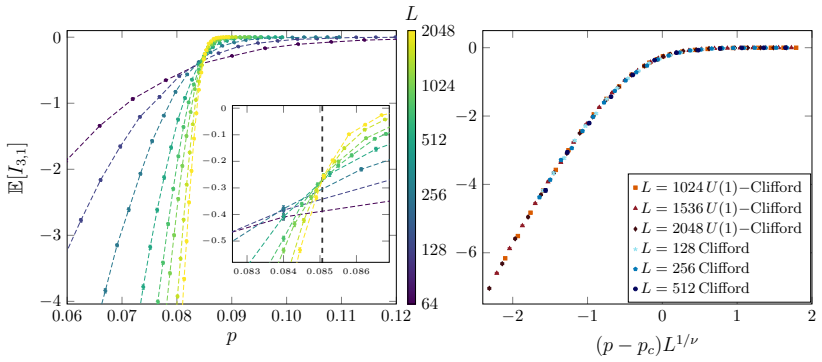
Summary. The manuscript studies measurement-induced phase transitions (MIPTs) in U(1)-symmetric random circuits when local projective measurements explicitly break the conservation law. The central claim is that such measurements are a relevant perturbation: at large scales the entanglement transition belongs to the same universality class as the corresponding non-symmetric monitored circuit, and the charge correlation length remains finite for any measurement rate p>0, ruling out a charge-sharpening transition. In the large-d limit the trajectory-averaged entanglement is mapped via the replica trick and Weingarten calculus to a classical statistical model whose charge sector is a symmetric simple exclusion process with disordered defects; a dual Brownian representation then yields an almost-sure exponential decay of charge correlators. Finite-d support is provided by finite-size scaling of the tripartite mutual information and Rényi-index dependence of the critical entanglement for both U(1)-Haar (L≤24) and U(1)-Clifford (L≤2048) circuits, with critical parameters and scaling functions matching the non-symmetric literature values rather than the symmetry-preserving ones.
Significance. The result cleanly settles a natural question left open by the symmetry-preserving literature (Agrawal et al., Barratt et al.): whether breaking the conservation law only in the measurement channel is enough to restore the generic MIPT universality class. The large-d argument is self-contained and rigorous—the survival-probability bound EX[CX]≤(1/4)(1−p)2t together with Markov and Borel–Cantelli (App. A) is a genuine proof that charge correlations cannot diverge. The Clifford numerics reach L=2048 and produce a clean data collapse onto the non-symmetric scaling function after a single non-universal rescaling, which is strong independent evidence. The observation that U(1)-Clifford circuits have no MIPT under symmetry-preserving measurements but acquire one under symmetry-breaking measurements is a sharp, falsifiable prediction. These strengths make the paper a solid contribution to the theory of monitored circuits.
major comments (2)
- Sec. 4 and Fig. 4: the strongest finite-d diagnostic is the Rényi-index dependence α(n)=a(1+1/n)+b, which matches the non-symmetric Haar values of Zabalo et al. rather than the U(1)-preserving values of Agrawal et al. With only L≤24 the logarithmic window is short; the manuscript should report the systematic uncertainty on a and b under variation of Lmin (analogous to the App. C analysis already performed for pc and ν) so that the reader can judge how robust the discrimination between the two universality classes remains.
- Sec. 3.4 and App. A.2: the analytic bound on the typical charge correlation length is derived for the large-d SSEP. The manuscript correctly notes that a parametrically large ξ(θ) for nearly symmetry-preserving measurements can produce long crossovers at finite d. A short quantitative estimate (even a rough scaling argument) of the system size needed to exit that crossover for the Haar d=1 data would strengthen the claim that L=24 already probes the asymptotic non-symmetric fixed point rather than an intermediate regime.
minor comments (5)
- Fig. 1 caption and Sec. 2: the local Hilbert space is C2⊗Cd; it would help the reader if the figure explicitly labels which factor is measured in the X basis and which is measured in a fixed qudit basis.
- Eq. (24) and the surrounding text: the measurement operator M is written without the conventional probability-conserving normalization; a one-sentence reminder that the 2^{NX} factor is restored when computing expectation values would avoid confusion for readers less familiar with the disordered SSEP literature.
- App. C: the two fitting procedures (polynomial collapse and cost-function minimization) are carefully documented; adding the numerical value of the minimal cost S(p∗c,ν∗) for the Clifford data would make the quality of the collapse more transparent.
- References: the recent works on noise as a symmetry-breaking field (e.g. Dias et al., Liu et al.) are cited in the discussion of random measurement bases; a brief cross-reference in Sec. 3.4 would better situate App. B within that literature.
- Typographical: “themeasurement-inducedphasetransition” (abstract) and a few missing spaces after commas in the large-d section should be cleaned up.
Circularity Check
No significant circularity: large-d charge-correlation bound is derived from the SSEP transfer matrix and measurement operator; finite-d exponents are compared to independent external literature values.
full rationale
The central analytic claim (finite charge correlation length for any p>0, ruling out charge sharpening) follows by direct calculation from the one-replica SSEP transfer matrix (Eq. 23/38) and the X-measurement operator (Eq. 24/39). The dual Brownian representation yields the average bound EX[CX(z,t)]≤(1/4)(1-p)2t (Eq. 29/A.54) and, via Markov + Borel–Cantelli, the almost-sure liminf bound (Eqs. A.55–A.58). These steps do not invoke fitted parameters, self-referential definitions, or load-bearing self-citations; they are first-principles consequences of the model constructed in Sec. 3. At finite d the extracted ν and α(n) coefficients are compared to published non-symmetric Haar/Clifford values (Zabalo et al., Gullans–Huse) rather than being forced by construction from the present data. Self-citations are limited to standard technical tools (Weingarten calculus, Stim) that are externally verified and not used to close a logical loop. The derivation chain is therefore self-contained against external benchmarks.
Axiom & Free-Parameter Ledger
free parameters (4)
- pc (Haar d=1) =
0.143(3)
- ν (Haar d=1) =
1.3(2)
- pc (U(1) Clifford) =
0.0851(1)
- ν (U(1) Clifford) =
1.27(3)
axioms (4)
- domain assumption In the d→∞ limit the averaged replicated Haar gate reduces to the projector given by Weingarten calculus (Eq. 13), and unmeasured bonds force identical permutations.
- domain assumption The replica limit k→0 of the Rényi entropy can be taken inside the statistical model, yielding a Q=1 classical partition function.
- domain assumption The dynamical exponent of the MIPT is z=1, so that steady-state data can be taken at t∝L.
- standard math Two-dimensional bond percolation has pc=1/2 and ν=4/3.
read the original abstract
We study the critical properties of random quantum circuits with a $U(1)$ symmetry subject to local projective measurements that explicitly break this symmetry. We find that, at the measurement-induced phase transition, symmetry-breaking measurements act as a relevant perturbation at large scales, leading to the same universal critical properties as the corresponding monitored random circuit with non-symmetric unitary dynamics. In particular, we consider monitored $U(1)$-symmetric Haar-random circuits in the limit of large local Hilbert-space dimension, where the trajectory-averaged entanglement entropy can be exactly obtained in terms of a classical statistical mechanics model. In this model, the charge associated with the conservation law follows a symmetric simple exclusion process, in which symmetry-breaking measurements correspond to disordered defects that create and destroy charges. We prove that the charge correlation length remains finite for any measurement rate, ruling out a charge-sharpening transition, in contrast to the case of symmetry-preserving measurements. We further support our predictions at finite local Hilbert-space dimension through numerical finite-size scaling analyses of the entanglement transition in monitored $U(1)$-symmetric Haar and stabilizer random circuits.
Figures




discussion (0)
Sign in with ORCID, Apple, or X to comment. Anyone can read and Pith papers without signing in.