REVIEW 2 major objections 4 minor 50 references
A large multimodal model builds a channel-capacity map from RGB-D and maps so handovers can be decided proactively, raising average capacity about 45% over 5G NR in dense mmWave simulations.
Reviewed by Pith at T0; open to challenge. T0 means a machine referee read the full paper against a public rubric. the ladder, T0–T4 →
T0 review · grok-4.5
2026-07-14 15:38 UTC pith:NAVP3MTE
load-bearing objection Solid systems paper that turns an LMM into a joint trajectory/CCM/blockage engine for proactive UDN handover; gains are large in Sionna but rest on same-sim fine-tuning. the 2 major comments →
Large Multimodal Model-Based Environment-Aware Mobility Management
The pith
A machine-rendered reading of the paper's core claim, the machinery that carries it, and where it could break.
Core claim
An LMM that jointly reasons over BEV maps, SBS-view RGB-D images and historical positions can construct a channel capacity map accurate enough that future capacities predicted from it, after blockage refinement, let dynamic programming select proactive handovers whose cumulative capacity substantially exceeds both reactive 5G NR and prior RF-only or vision-aided proactive schemes.
What carries the argument
Channel capacity map (CCM): the learned end-to-end mapping from UE position, SBS position and reflector geometry (implicitly encoded in a BEV image) to the static ideal and NLoS channel capacities; once built, it supplies the future rates that the DP handover optimizer maximizes.
Load-bearing premise
That a surrogate CCM fine-tuned from simulated BEV images and ray-tracing data remains accurate enough in real deployments that predicted capacities can safely replace live measurements for handover decisions.
What would settle it
Deploy the identical LMM-EMM pipeline on a live outdoor UDN testbed with measured RGB-D, GNSS trajectories and real mmWave CSI; if the measured average capacity gain over 5G NR handover falls well below the simulated 45% (or if CCM NMSE collapses under material or small-object mismatch), the central claim is falsified.
Editorial analysis
A structured set of objections, weighed in public.
Referee Report
Summary. The paper proposes LMM-EMM for proactive mobility management in mmWave UDNs. An LMM (LLaVA-1.5-7B with LoRA) processes BEV maps and SBS-view RGB-D images to predict UE trajectories, infer multipath geometry, and construct a surrogate channel capacity map (CCM) ˜f_ccm (Eq. 26) that maps positions to ideal/NLoS capacities. Dynamic blockages are predicted from object trajectories; future capacities feed a DP solver (Eqs. 33–37) that maximizes cumulative effective capacity while penalizing handovers via µ. Simulations in Sionna RT claim ~45% average capacity gain over 5G NR and 15–21% over LSTM/DRL baselines at SNR=15 dB (Figs. 16–20), with supporting ablations on noise, material mismatch, soft blockage, and lightweight backbones.
Significance. If the gains transfer beyond the training simulator, the work would be a meaningful advance for environment-aware 6G mobility: it cleanly derives the piecewise-continuous CCM from geometric multipath parameters (Lemma 1, Remarks 1–3, Eqs. 4–18), formulates a proper cumulative-capacity DP problem that accounts for handover cost, and supplies unusually thorough sensitivity tables (I–III) plus multi-layout results (urban/suburban/highway/indoor). The latency analysis (Sec. IV-A) showing end-to-end delay under beam coherence time and the practical-issue discussion (noisy sensing, FoV, soft blockage) are concrete strengths that go beyond typical DL-handover papers.
major comments (2)
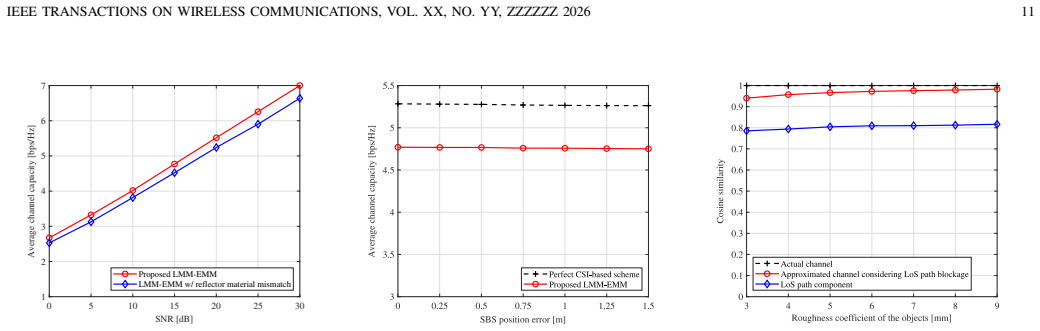
- [Sec. V-B, Eq. (26), Table II] Sec. V-B and Eq. (26): the surrogate CCM is obtained by supervised fine-tuning on 16 k/2 k/2 k samples generated by the identical Sionna RT + 3GPP TR 38.901 pipeline used for every evaluation scenario (Figs. 13, 16–22 and Tables I–III). This creates train–test distribution circularity. Table II already shows that additive CCM noise of variance 3 bps/Hz drops average capacity from 4.770 to 4.554 bps/Hz—the largest degradation among modules—yet all material-mismatch (Fig. 10), soft-blockage (Fig. 12) and small-object (Table III) ablations remain inside the same generative model. The central 45 %/21 %/15 % claims therefore rest on an untested assumption that ˜f_ccm recovers real multipath geometry (Eqs. 4–7). Either a cross-simulator or measurement-based validation, or a substantially expanded sim-to-real discussion quantifying the expected gap, is required before the gains can be regarded
- [Remark 3, Eq. (18), Sec. III-B] Remark 3 / Eq. (18) and Sec. III-B: the claim that a BEV image alone is a faithful surrogate for the full reflector set E (including Fresnel coefficients, roughness and permittivity that enter the LSFCs) is load-bearing for replacing real-time measurements by predicted capacities. The paper itself reports a 5.2 % capacity drop under material mismatch (Fig. 10) and only cosine similarity >0.93 under soft blockage (Fig. 12). Because the DP solution (Eqs. 35–37) is driven by these predicted capacities, an explicit bound or Monte-Carlo quantification of how CCM approximation error propagates into the optimality gap of the chosen SBS sequence is missing and necessary to support the “substantial” improvement language in the abstract and Sec. V.
minor comments (4)
- [Fig. 1] Fig. 1 caption contains the typo “Handover dicision”; correct to “decision”.
- [Sec. III-B] The instruction-prompt examples in Fig. 6 and Sec. III are helpful, but it is never stated how continuous capacity values are extracted from the LMM’s free-text response (regression head, constrained decoding, or post-processing). A short clarification would aid reproducibility.
- [Eq. (20)] Notation for time windows (Tw, Tp) and the handover indicator 1_ho is introduced cleanly, yet the effective-capacity expression (Eq. 20) re-uses m^(t-1:t) without restating the domain; a one-line reminder would improve readability.
- [Sec. I, Sec. II-D] Related-work discussion of channel-knowledge maps (Zeng et al.) and recent vision-aided handover papers is present but could more explicitly contrast the LMM’s shared environmental embedding against task-specific CNN/LSTM pipelines.
Circularity Check
Mild train-test circularity from fine-tuning LMM CCM surrogate on the identical Sionna RT ray-tracer used for all evaluation; no definitional or self-citation forcing of the central capacity gains.
specific steps
-
fitted input called prediction
[Sec. III-B Eq. (26) + Sec. V-B (dataset generation and SFT) + Table II]
"we learn a surrogate function ˜f_ccm that takes the BEV map image, which implicitly encodes E: (R_ideal(m), R_nlos(m)) = ˜f_ccm(p_ue, p_sbs,m, I_bev). ... For LMM fine-tuning, we employ supervised fine-tuning (SFT) in which the LMM is trained on input–output pairs generated by a real-world wireless simulator (NVIDIA Sionna RT) ... The generated dataset for fine-tuning contains N_train=16000, N_val=2000, and N_test=2000 samples ... When the noise with a variance of 3 bps/Hz is added to the CCM estimation, the cumulative capacity per unit bandwidth decreases to 4.554 bps/Hz"
The surrogate CCM is fitted by LoRA SFT exclusively to (position, capacity) pairs produced by the identical Sionna RT + 3GPP ray-tracer that later generates all test trajectories, urban/suburban layouts, material-mismatch ablations and capacity numbers. Consequently the reported NMSE and the end-to-end capacity gains that rely on those predicted capacities are statistically forced inside the training generative model; they do not constitute an independent prediction of real multipath geometry outside that simulator. (Held-out split and external baselines keep the circularity mild rather than definitional.)
full rationale
The paper's derivation chain is self-contained and non-circular in the strong sense: Lemma 1 and Remarks 1-3 derive that ideal/NLoS capacities are functions of LSFCs (hence of geometry E) under large-N and geometric multipath assumptions, with standard proofs; the surrogate ˜f_ccm of Eq. (26) is then an explicit LMM approximation of that mapping, trained by LoRA SFT on held-out Sionna pairs and used for trajectory-conditioned prediction + DP on the external cumulative-R_eff objective (23). End-to-end gains (Figs. 16-20, ~45% vs 5G NR, 15-21% vs LSTM/DRL) are measured against independent baselines that do not share LMM weights or the CCM fit. The only mild circularity is that all 16k/2k/2k samples, urban/suburban layouts, material-mismatch and small-object ablations, and few-shot adaptations remain inside the same generative model (Sionna RT + 3GPP TR 38.901) used for fine-tuning; thus reported CCM NMSE and capacity numbers cannot falsify the surrogate outside that simulator. This is ordinary ML-sim practice, not a definitional reduction or load-bearing self-citation uniqueness claim, so score remains low (2). No self-definitional equations, no uniqueness theorems imported from the authors' prior work to force the result, and no renaming of known patterns.
Axiom & Free-Parameter Ledger
free parameters (4)
- LoRA rank r =
16
- prediction horizon Tp and observation window Tw =
5
- handover cost coefficient mu =
tau_ho=36 ms (default)
- learning rate schedule =
1e-4
axioms (4)
- standard math When N is large, MISO capacity reduces to a function of large-scale fading coefficients only (Lemma 1 / law of large numbers).
- domain assumption Static channel capacities are fully determined by UE position, SBS position and reflector geometry E (Remark 3).
- ad hoc to paper BEV map images plus LMM reasoning can serve as a faithful surrogate for the true reflector set E (Eq. 26).
- domain assumption Hard LoS/NLoS indicator plus specular reflection model is adequate for mmWave capacity comparison (soft-blockage discussion in Sec. IV).
invented entities (1)
-
channel capacity map (CCM)
no independent evidence
read the original abstract
Recently, large language models (LLMs) have been successfully adopted in various fields, including wireless communications, robotics, and autonomous vehicles, owing to their outstanding adaptability and reasoning abilities. Despite their huge potential, the application of LLMs for mobility management is relatively scarce since it requires not only analyzing wireless measurements but also predicting dynamic user trajectories and making real-time handover decisions across densely deployed small base stations (SBSs). In this paper, we propose an environment-aware mobility management scheme based on large multimodal models (LMMs), which extend capabilities of LLMs to process multimodal sensing data. By leveraging LMMs, the proposed scheme extracts contextual information on the surrounding environments from RGB-D images to capture user equipment (UE) mobility patterns and identify signal reflections and blockages caused by static reflectors and dynamic obstacles. Using the extracted environmental information, the proposed scheme learns the intrinsic mapping from UE and SBS positions to channel capacity, referred to as channel capacity map (CCM), from which future channel capacities along UE trajectories are predicted. Based on the predicted channel capacities, we determine proactive handover decisions maximizing the cumulative channel capacities. Simulation results demonstrate that the proposed scheme achieves substantial channel capacity improvements over conventional deep learning (DL)-based approaches.
Figures




Reference graph
Works this paper leans on
-
[1]
Language models are few-shot learners,
T. Brown, B. Mann, N. Ryder, M. Subbiah, J. D. Kaplan, P. Dhariwal, A. Neelakantan, P. Shyam, G. Sastry, A. Askellet al., “Language models are few-shot learners,” inProc. Adv. Neural Inf. Process. Syst. (NeurIPS), vol. 33, 2020, pp. 1877–1901
2020
-
[2]
Visual instruction tuning,
H. Liu, C. Li, Q. Wu, and Y . J. Lee, “Visual instruction tuning,” inProc. Adv. Neural Inf. Process. Syst. (NeurIPS), vol. 36, 2023, pp. 34 892– 34 916
2023
-
[3]
Chain-of-thought prompting elicits reasoning in large language models,
J. Wei, X. Wang, D. Schuurmans, M. Bosma, F. Xia, E. Chi, Q. V . Le, D. Zhouet al., “Chain-of-thought prompting elicits reasoning in large language models,” inProc. Adv. Neural Inf. Process. Syst. (NeurIPS), vol. 35, 2022, pp. 24 824–24 837
2022
-
[4]
Large language models for telecom: Forthcoming impact on the indus- try,
A. Maatouk, N. Piovesan, F. Ayed, A. De Domenico, and M. Debbah, “Large language models for telecom: Forthcoming impact on the indus- try,”IEEE Commun. Mag., vol. 63, no. 1, pp. 62–68, 2025
2025
-
[5]
Large multimodal model-empowered task-oriented autonomous communications: Design methodology and implementation challenges,
H. J. Yang, H. Kim, H. Noh, S. Kim, and B. Shim, “Large multimodal model-empowered task-oriented autonomous communications: Design methodology and implementation challenges,”IEEE Veh. Technol. Mag., 2026. IEEE TRANSACTIONS ON WIRELESS COMMUNICATIONS, VOL. XX, NO. YY , ZZZZZZ 2026 16
2026
-
[6]
Sensing and computer vision-aided mobility management for 6G millimeter and terahertz communication systems,
Y . Ahn, J. Kim, S. Kim, S. Kim, and B. Shim, “Sensing and computer vision-aided mobility management for 6G millimeter and terahertz communication systems,”IEEE Trans. Commun., vol. 72, no. 10, pp. 6044–6058, 2024
2024
-
[7]
Energy-efficient user association in mmWave/THz ultra-dense network via multi-agent deep reinforce- ment learning,
J. Moon, S. Kim, H. Ju, and B. Shim, “Energy-efficient user association in mmWave/THz ultra-dense network via multi-agent deep reinforce- ment learning,”IEEE Trans. Green Commun. Netw., vol. 7, no. 2, pp. 692–706, 2023
2023
-
[8]
Efficient channel probing and phase shift control for mmWave reconfigurable intelligent surface-aided communi- cations,
S. Kim, J. Wu, and B. Shim, “Efficient channel probing and phase shift control for mmWave reconfigurable intelligent surface-aided communi- cations,”IEEE Trans. Wireless Commun., vol. 23, no. 1, pp. 231–246, 2023
2023
-
[9]
Ultra-dense networks: A survey,
M. Kamel, W. Hamouda, and A. Youssef, “Ultra-dense networks: A survey,”IEEE Commun. Surveys Tuts., vol. 18, no. 4, pp. 2522–2545, 2016. [10]Radio Resource Control (RRC), 3rd Generation Partnership Project 3GPP™ TS 38.331 V18.4.0, Dec. 2024, Release 18
2016
-
[10]
A statistical theory of mobile-radio reception,
R. H. Clarke, “A statistical theory of mobile-radio reception,”Bell Sys. Technol. J., vol. 47, no. 6, pp. 957–1000, 1968
1968
-
[11]
Machine learning-based handovers for sub-6 GHz and mmWave integrated vehicular networks,
L. Yan, H. Ding, L. Zhang, J. Liu, X. Fang, Y . Fang, M. Xiao, and X. Huang, “Machine learning-based handovers for sub-6 GHz and mmWave integrated vehicular networks,”IEEE Trans. Wireless Commun., vol. 18, no. 10, pp. 4873–4885, 2019
2019
-
[12]
Multi-cell multi-beam prediction us- ing auto-encoder LSTM for mmWave systems,
S. H. A. Shah and S. Rangan, “Multi-cell multi-beam prediction us- ing auto-encoder LSTM for mmWave systems,”IEEE Trans. Wireless Commun., vol. 21, no. 12, pp. 10 366–10 380, 2022
2022
-
[13]
Mobility management paradigm shift: from reactive to proactive handover using AI/ML,
H.-S. Park, H. Kim, C. Lee, and H. Lee, “Mobility management paradigm shift: from reactive to proactive handover using AI/ML,”IEEE Netw., vol. 38, no. 2, pp. 18–25, 2024
2024
-
[14]
Enabling efficient blockage-aware handover in RIS-assisted mmWave cellular networks,
L. Jiao, P. Wang, A. Alipour-Fanid, H. Zeng, and K. Zeng, “Enabling efficient blockage-aware handover in RIS-assisted mmWave cellular networks,”IEEE Trans. Wireless Commun., vol. 21, no. 4, pp. 2243– 2257, 2021
2021
-
[15]
Self-adapting handover parameters optimization for SDN- enabled UDN,
W. Huang, M. Wu, Z. Yang, K. Sun, H. Zhang, and A. Nal- lanathan, “Self-adapting handover parameters optimization for SDN- enabled UDN,”IEEE Trans. Wireless Commun., vol. 21, no. 8, pp. 6434–6447, 2022
2022
-
[16]
Proactive handover type prediction and parameter optimization based on machine learning,
K. Sun, Q. Han, Z. Yang, W. Huang, H. Zhang, and V . C. Leung, “Proactive handover type prediction and parameter optimization based on machine learning,”IEEE Trans. Wireless Commun., vol. 24, no. 4, pp. 3515–3528, 2025
2025
-
[17]
Role of sensing and computer vision in 6G wireless communications,
S. Kim, J. Moon, J. Kim, Y . Ahn, D. Kim, S. Kim, K. Shim, and B. Shim, “Role of sensing and computer vision in 6G wireless communications,” IEEE Wireless Commun., vol. 31, no. 5, pp. 264–271, 2024
2024
-
[18]
Vision-aided 6G wireless communications: Blockage prediction and proactive handoff,
G. Charan, M. Alrabeiah, and A. Alkhateeb, “Vision-aided 6G wireless communications: Blockage prediction and proactive handoff,”IEEE Trans. Veh. Technol., vol. 70, no. 10, pp. 10 193–10 208, 2021
2021
-
[19]
Radar aided proactive blockage pre- diction in real-world millimeter wave systems,
U. Demirhan and A. Alkhateeb, “Radar aided proactive blockage pre- diction in real-world millimeter wave systems,” inProc. IEEE Int. Conf. Commun. (ICC), 2022, pp. 4547–4552
2022
-
[20]
Vision-aided blockage prediction and proactive handover for indoor mmWave and terahertz communica- tions,
Y . Liu, J. Wu, S. Kim, and B. Shim, “Vision-aided blockage prediction and proactive handover for indoor mmWave and terahertz communica- tions,” inProc. IEEE Global Commun. Conf. (GLOBECOM), 2023, pp. 7411–7416
2023
-
[21]
Joint sensing, communication, and AI: A trifecta for resilient THz user experiences,
C. Chaccour, W. Saad, M. Debbah, and H. V . Poor, “Joint sensing, communication, and AI: A trifecta for resilient THz user experiences,” IEEE Trans. Wireless Commun., vol. 23, no. 9, pp. 11 444–11 460, 2024
2024
-
[22]
Networked ISAC based UA V tracking and handover towards low-altitude economy,
Y . Feng, C. Zhao, H. Luo, F. Gao, F. Liu, and S. Jin, “Networked ISAC based UA V tracking and handover towards low-altitude economy,”IEEE Trans. Wireless Commun., vol. 24, no. 9, pp. 7670–7685, 2025
2025
-
[23]
A non-stochastic learning approach to energy efficient mobility management,
C. Shen, C. Tekin, and M. van der Schaar, “A non-stochastic learning approach to energy efficient mobility management,”IEEE J. Sel. Areas Commun., vol. 34, no. 12, pp. 3854–3868, 2016
2016
-
[24]
Capacity of MIMO systems based on measured wireless channels,
A. F. Molisch, M. Steinbauer, M. Toeltsch, E. Bonek, and R. S. Thoma, “Capacity of MIMO systems based on measured wireless channels,” IEEE J. Sel. Areas Commun., vol. 20, no. 3, pp. 561–569, 2002
2002
-
[25]
Utilizing large language models for advanced optimization and intelligent management in space-air-ground integrated networks,
J. Tang, F. Tang, S. Long, M. Zhao, and N. Kato, “Utilizing large language models for advanced optimization and intelligent management in space-air-ground integrated networks,”IEEE Netw., vol. 39, no. 5, pp. 173–181, 2024
2024
-
[26]
Characterizing the impact of dif- fuse scattering in urban millimeter-wave deployments,
D. Solomitckii, Q. C. Li, T. Balercia, C. R. Da Silva, S. Talwar, S. Andreev, and Y . Koucheryavy, “Characterizing the impact of dif- fuse scattering in urban millimeter-wave deployments,”IEEE Wireless Commun. Lett., vol. 5, no. 4, pp. 432–435, 2016
2016
-
[27]
Large multimodal model-based environment-aware channel estimation,
S. Kim, S. Jeong, J. Wu, B. Shim, and M. Z. Win, “Large multimodal model-based environment-aware channel estimation,”IEEE J. Sel. Areas Commun., vol. 43, no. 12, pp. 4059–4075, 2025
2025
-
[28]
Transformer-assisted parametric CSI feedback for mmWave massive MIMO systems,
H. Ju, S. Jeong, S. Kim, B. Lee, and B. Shim, “Transformer-assisted parametric CSI feedback for mmWave massive MIMO systems,”IEEE Trans. Wireless Commun., vol. 23, no. 12, pp. 18 774–18 787, 2024. [30]Evolved Universal Terrestrial Radio Access Network (E-UTRAN); X2 Application Protocol (X2AP), 3rd Generation Partnership Project 3GPP™ TS 36.423 V18.4.0, Ma...
2024
-
[29]
Channel prediction using adaptive bidirectional GRU for underwater MIMO communica- tions,
X. Hu, Y . Huo, X. Dong, F.-Y . Wu, and A. Huang, “Channel prediction using adaptive bidirectional GRU for underwater MIMO communica- tions,”IEEE Internet Things J., vol. 11, no. 2, pp. 3250–3263, 2023
2023
-
[30]
Proactive mobility management with trajectory prediction based on virtual cells in ultra-dense networks,
Q. Liu, G. Chuai, J. Wang, and J. Pan, “Proactive mobility management with trajectory prediction based on virtual cells in ultra-dense networks,” IEEE Trans. Veh. Technol., vol. 69, no. 8, pp. 8832–8842, 2020
2020
-
[31]
A tutorial on 5G positioning,
L. Italiano, B. C. Tedeschini, M. Brambilla, H. Huang, M. Nicoli, and H. Wymeersch, “A tutorial on 5G positioning,”IEEE Commun. Surveys Tuts., vol. 27, no. 3, pp. 1488–1535, 2024
2024
-
[32]
Vision-aided positioning and beam focusing for 6G terahertz communications,
S. Kim, J. Moon, J. Wu, B. Shim, and M. Z. Win, “Vision-aided positioning and beam focusing for 6G terahertz communications,”IEEE J. Sel. Areas Commun., vol. 42, no. 9, pp. 2503–2519, 2024
2024
-
[33]
A tutorial on environment-aware communications via channel knowledge map for 6G,
Y . Zeng, J. Chen, J. Xu, D. Wu, X. Xu, S. Jin, X. Gao, D. Gesbert, S. Cui, and R. Zhang, “A tutorial on environment-aware communications via channel knowledge map for 6G,”IEEE Commun. Surveys Tuts., vol. 26, no. 3, pp. 1478–1519, 2024
2024
-
[34]
Traj-LLM: A new exploration for empowering trajectory prediction with pre-trained large language models,
Z. Lan, L. Liu, B. Fan, Y . Lv, Y . Ren, and Z. Cui, “Traj-LLM: A new exploration for empowering trajectory prediction with pre-trained large language models,”IEEE Trans. Intell. Veh., vol. 10, no. 2, pp. 794–807, 2025
2025
-
[35]
Deep learning- based NLoS localization using geometric map image,
I. Keum, J. Son, H. Kim, J. Moon, and B. Shim, “Deep learning- based NLoS localization using geometric map image,”IEEE Trans. Veh. Technol., 2025
2025
-
[36]
A time series is worth 64 words: Long-term forecasting with transformers,
Y . Nie, N. H. Nguyen, P. Sinthong, and J. Kalagnanam, “A time series is worth 64 words: Long-term forecasting with transformers,” inProc. Int. Conf. Learn. Representations (ICLR), 2023
2023
-
[37]
Large multimodal model-based environment-aware beam management,
S. Kim, S. Saha, S. Jeong, B. Shim, and M. Z. Win, “Large multimodal model-based environment-aware beam management,”IEEE J. Sel. Areas Commun., vol. 44, pp. 991–1007, 2026
2026
-
[38]
Dynamic programming,
R. Bellman, “Dynamic programming,”Science, vol. 153, no. 3731, pp. 34–37, 1966
1966
-
[39]
The impact of beamwidth on temporal channel variation in vehicular channels and its implications,
V . Va, J. Choi, and R. W. Heath, “The impact of beamwidth on temporal channel variation in vehicular channels and its implications,”IEEE Trans. Veh. Technol., vol. 66, no. 6, pp. 5014–5029, 2016
2016
-
[40]
Multi- weather image restoration via domain translation,
P. W. Patil, S. Gupta, S. Rana, S. Venkatesh, and S. Murala, “Multi- weather image restoration via domain translation,” inProc. Int. Conf. Comput. Vis. (ICCV), 2023, pp. 21 696–21 705
2023
-
[41]
Openstreetmap: User-generated street maps,
M. Haklay and P. Weber, “Openstreetmap: User-generated street maps,” IEEE Pervasive Comput., vol. 7, no. 4, pp. 12–18, 2008. [44]SMPTE Engineering Guideline - SD-SDI and HD-SDI Standards Roadmap, IEEE Standard EG 2111-1:2021, 2021
2008
-
[42]
Millimeter- wave human blockage at 73 ghz with a simple double knife-edge diffraction model and extension for directional antennas,
G. R. MacCartney, S. Deng, S. Sun, and T. S. Rappaport, “Millimeter- wave human blockage at 73 ghz with a simple double knife-edge diffraction model and extension for directional antennas,” inIEEE Veh. Technol. Conf. (VTC-Fall), 2016
2016
-
[43]
Sionna RT: Differentiable ray tracing for radio propagation modeling,
J. Hoydis, F. A ¨ıt Aoudia, S. Cammerer, M. Nimier-David, N. Binder, G. Marcus, and A. Keller, “Sionna RT: Differentiable ray tracing for radio propagation modeling,” inProc. IEEE Global Commun. Conf. Workshops (GC Wkshps), 2023, pp. 317–321. [47]Study on channel model for frequencies from 0.5 to 100 GHz, 3rd Generation Partnership Project 3GPP™ TR 38.901...
2023
-
[44]
LoRA: Low-rank adaptation of large language models,
E. J. Hu, Y . Shen, P. Wallis, Z. Allen-Zhu, Y . Li, S. Wang, L. Wang, W. Chenet al., “LoRA: Low-rank adaptation of large language models,” inProc. Int. Conf. Learn. Representations (ICLR), 2022
2022
-
[45]
Toward environment-aware 6G communications via channel knowledge map,
Y . Zeng and X. Xu, “Toward environment-aware 6G communications via channel knowledge map,”IEEE Wireless Commun., vol. 28, no. 3, pp. 84–91, 2021
2021
-
[46]
Mobilevlm: A fast, strong and open vision language assistant for mobile devices,
X. Chuet al., “Mobilevlm: A fast, strong and open vision language assistant for mobile devices,”arXiv preprint arXiv:2312.16886, 2023
Pith/arXiv arXiv 2023
-
[47]
Tinyllava: A framework of small-scale large multimodal models,
B. Zhouet al., “Tinyllava: A framework of small-scale large multimodal models,”arXiv preprint arXiv:2402.14289, 2024
Pith/arXiv arXiv 2024
-
[48]
Proactive received power prediction using machine learning and depth images for mmWave networks,
T. Nishioet al., “Proactive received power prediction using machine learning and depth images for mmWave networks,”IEEE J. Sel. Areas Commun., vol. 37, no. 11, pp. 2413–2427, 2019
2019
-
[49]
Deep learning for mmWave beam and blockage prediction using sub-6 GHz channels,
M. Alrabeiah and A. Alkhateeb, “Deep learning for mmWave beam and blockage prediction using sub-6 GHz channels,”IEEE Trans. Commun., vol. 68, no. 9, pp. 5504–5518, 2020
2020
-
[50]
Efficient large multi-modal models via visual context compression,
J. Chen, L. Ye, J. He, Z.-Y . Wang, D. Khashabi, and A. Yuille, “Efficient large multi-modal models via visual context compression,” inProc. Adv. Neural Inf. Process. Syst. (NeurIPS), vol. 37, 2024, pp. 73 986–74 007. IEEE TRANSACTIONS ON WIRELESS COMMUNICATIONS, VOL. XX, NO. YY , ZZZZZZ 2026 17 Seokhyun Jeong(Student Member, IEEE) received the B.S. degre...
2024
discussion (0)
Sign in with ORCID, Apple, or X to comment. Anyone can read and Pith papers without signing in.