Determining the Spin-Analyzing Powers via Invariants of the Spin Correlation Matrices and Probing the Bell Non-Locality at the Lepton Colliders
Pith reviewed 2026-05-14 18:22 UTC · model grok-4.3
The pith
The trace of the spin correlation matrix is invariant under basis rotations in two-fermion production at lepton colliders.
A machine-rendered reading of the paper's core claim, the machinery that carries it, and where it could break.
Core claim
We prove that Tr[C] of the spin correlation matrix C is an invariant quantity, and is invariant under basis rotations. Thus, for the exchanges of one mediator such as scalar and gauge boson, we can determine the product of the spin-analyzing powers for Fa Fb via Tr[C], and reconstruct the spin correlation matrix. With the CHSH-Horodecki criterion, we can probe the Bell non-locality, and evade the no-go theorem. To be concrete, we study the Bell non-locality for the Lambda anti-Lambda productions and decays at the BESIII experiment. In addition, the invariant Tr[C] is a new physics observable to probe the new physics beyond the Standard Model and study the SM precision measurements. Moreover,
What carries the argument
The trace Tr[C] of the spin correlation matrix C, which remains unchanged under rotations of the spin basis and thereby encodes the product of spin-analyzing powers.
If this is right
- The product of spin-analyzing powers for any fermion pair produced via single-mediator exchange can be extracted without reference to a particular spin basis.
- The full spin correlation matrix can be reconstructed once the invariant trace is known.
- Bell non-locality tests via the CHSH-Horodecki criterion become feasible for Lambda anti-Lambda production at BESIII.
- Deviations of the measured trace from its Standard Model prediction constitute a new observable for beyond-Standard-Model effects in fermion-pair processes.
Where Pith is reading between the lines
- If the trace invariance holds, analogous invariants may exist for higher-multiplicity spin correlations at future lepton colliders.
- The same construction could be applied at hadron colliders whenever a single-mediator channel dominates the production amplitude.
- Comparison of the trace across different final states could distinguish scalar versus vector mediator contributions in new-physics models.
Load-bearing premise
The spin is defined via Lorentz symmetry or the spin density matrix carries an implicit symmetry that renders the trace invariant.
What would settle it
A measurement of the spin correlation matrix for Lambda anti-Lambda pairs at BESIII in which Tr[C] changes when the analysis basis is rotated, or in which the extracted product of analyzing powers disagrees with an independent determination, would falsify the invariance.
Figures

read the original abstract
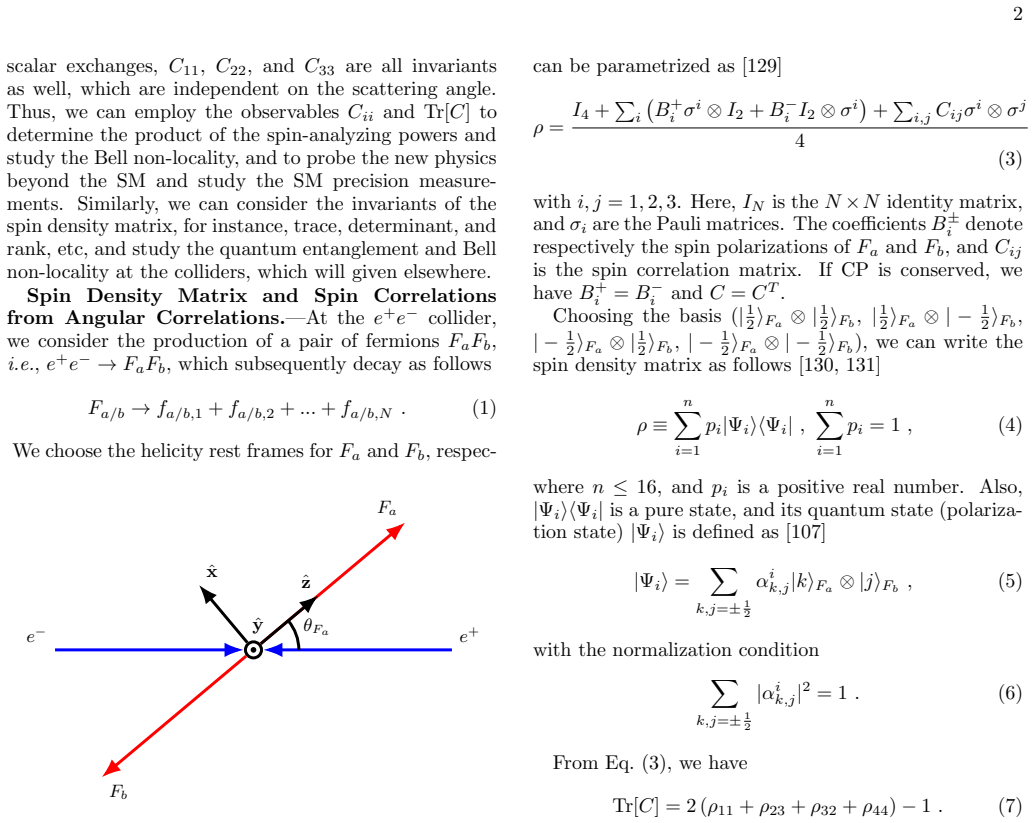
We consider the two-fermion $F_a F_b$ productions and decays via one mediator exchange at the $e^+e^-$ collider. With the assumption that the spin is defined via the Lorentz symmetry, or considering the implicit symmetry in the spin density matrix, we prove that the trace ${\rm Tr} [C]$ of the spin correlation matrix $C$ is an invariant quantity, and is invariant under basis rotations. Thus, for the exchanges of one mediator such as scalar and gauge boson, we can determine the product of the spin-analyzing powers for $F_a F_b$ via ${\rm Tr} [C]$, and reconstruct the spin correlation matrix. With the CHSH-Horodecki criterion, we can probe the Bell non-locality, and evade the no-go theorem. To be concrete, we study the Bell non-locality for the $\Lambda \bar \Lambda$ productions and decays at the BESIII experiment. In addition, the invariant ${\rm Tr} [C]$ is a new physics observable to probe the new physics beyond the Standard Model (SM) and study the SM precision measurements. Moreover, for the scalar exchanges, we discuss the general invariants of the spin correlation matrices and the related phenomenological consequences.
Editorial analysis
A structured set of objections, weighed in public.
Referee Report
Summary. The manuscript presents a method for determining the product of spin-analyzing powers in two-fermion productions via single mediator exchange at e+e- colliders. It claims to prove that the trace Tr[C] of the spin correlation matrix C is an invariant under basis rotations, assuming spin is defined via Lorentz symmetry or implicit symmetry in the spin density matrix. This allows reconstruction of the spin correlation matrix and probing Bell non-locality with the CHSH-Horodecki criterion, illustrated with ΛΛbar at BESIII, and positions Tr[C] as a new physics observable. General invariants for scalar exchanges are also discussed.
Significance. If the central invariance result holds, the paper offers a significant advance in collider-based studies of spin correlations and quantum non-locality. It provides a basis-independent observable that could enable precise measurements of spin-analyzing powers and tests of Bell inequalities in relativistic regimes, with potential applications to new physics searches beyond the Standard Model. The explicit example at BESIII adds phenomenological relevance.
major comments (2)
- [Abstract] Abstract: The central claim that Tr[C] is invariant under basis rotations (allowing extraction of the product of spin-analyzing powers Fa Fb and reconstruction of C) rests on the unexamined assumption that spin is defined via Lorentz symmetry or implicit symmetry in the density matrix. The full derivation of this invariance must be supplied explicitly, as the abstract only asserts it; without it, the support for the load-bearing step cannot be verified.
- [Bell non-locality and reconstruction discussion] The reconstruction of C and application of the Horodecki criterion for Bell non-locality: Local rotations of quantization axes in the boosted rest frames may introduce momentum-dependent phases or chiral projections from the mediator vertex that prevent C from transforming as a pure orthogonal matrix. This would mean Tr[C] extracted from measured decay angles does not equal the theory value independent of basis choice, undermining the claimed invariance and the ability to evade no-go theorems.
minor comments (1)
- [Notation and definitions] Add a dedicated preliminary section defining the spin density matrix, the correlation matrix C, and the analyzing powers Fa, Fb with explicit notation to improve clarity for readers.
Simulated Author's Rebuttal
We thank the referee for the careful reading and constructive comments on our manuscript. We address each major comment point by point below and have prepared corresponding revisions to strengthen the presentation.
read point-by-point responses
-
Referee: [Abstract] Abstract: The central claim that Tr[C] is invariant under basis rotations (allowing extraction of the product of spin-analyzing powers Fa Fb and reconstruction of C) rests on the unexamined assumption that spin is defined via Lorentz symmetry or implicit symmetry in the density matrix. The full derivation of this invariance must be supplied explicitly, as the abstract only asserts it; without it, the support for the load-bearing step cannot be verified.
Authors: We agree that the derivation of the invariance of Tr[C] must be supplied explicitly. In the revised manuscript we will add a dedicated subsection (or appendix) that starts from the definition of the spin density matrix under Lorentz symmetry, introduces the orthogonal basis transformation R, derives C' = R C R^T, and shows Tr[C'] = Tr[C] directly. This will make the central step fully verifiable and support the extraction of the product of spin-analyzing powers. revision: yes
-
Referee: [Bell non-locality and reconstruction discussion] The reconstruction of C and application of the Horodecki criterion for Bell non-locality: Local rotations of quantization axes in the boosted rest frames may introduce momentum-dependent phases or chiral projections from the mediator vertex that prevent C from transforming as a pure orthogonal matrix. This would mean Tr[C] extracted from measured decay angles does not equal the theory value independent of basis choice, undermining the claimed invariance and the ability to evade no-go theorems.
Authors: We appreciate the referee's concern about possible momentum-dependent phases or chiral projections in boosted frames. Under the Lorentz-symmetric definition of spin used in the paper, any such phases arising from the mediator vertex or boosts are absorbed into the production amplitudes and cancel in the bilinear spin correlations that define C. Consequently C transforms as a real orthogonal matrix, Tr[C] remains invariant, and the Horodecki criterion can still be applied. We will insert a clarifying paragraph in the revised text explaining this cancellation explicitly, thereby preserving the claimed reconstruction and the evasion of no-go theorems. revision: partial
Circularity Check
No circularity: Tr[C] invariance derived from Lorentz symmetry assumption without reduction to inputs
full rationale
The paper states it proves Tr[C] is invariant under basis rotations from the assumption that spin is defined via Lorentz symmetry or implicit symmetry in the spin density matrix. This is a direct symmetry argument rather than a self-definitional fit, a renamed known result, or a load-bearing self-citation. No equations reduce the claimed invariant or the product of spin-analyzing powers to fitted parameters or prior author results by construction. The subsequent reconstruction of C and application of the CHSH-Horodecki criterion follow from this independent step. The derivation chain is self-contained against external benchmarks.
Axiom & Free-Parameter Ledger
axioms (1)
- domain assumption Spin is defined via the Lorentz symmetry or implicit symmetry in the spin density matrix
Forward citations
Cited by 1 Pith paper
-
Controlling Quantum discord and steering in Electron-Positron Annihilation Using Polarized Beams
Polarized lepton beams control quantum discord and steering in hyperon-antihyperon pairs from e+e- annihilation, with discord persisting in separable states via transverse polarization.
Reference graph
Works this paper leans on
-
[1]
A LHVT with a set of local hidden variables
-
[2]
Special relativity and Poincar´ e-invariance hold
-
[3]
The decays ofF a andF b are independent of each other. 3
-
[4]
And thus the spins play the role of hidden variables
The spin for each particle is an element of reality in the sense of Einstein-Podolsky-Rosen [1],i.e., a vector with a definite orientation. And thus the spins play the role of hidden variables
-
[5]
With these assumptions, we can obtain the same rela- tions as given in Eq
If the particlesF a andF b have spins ˆsa and ˆsb, the probability distributions (in their rest frames) of the momenta of the daughter particlesf a,1 and fb,1 are always the same and depend only on⃗ sa and ⃗ sb, respectively. With these assumptions, we can obtain the same rela- tions as given in Eq. (9). However, the key difference is that we now have−3≤α...
-
[6]
Can quantum mechanical description of physical real- ity be considered complete?Phys
Albert Einstein, Boris Podolsky, and Nathan Rosen. Can quantum mechanical description of physical real- ity be considered complete?Phys. Rev., 47:777–780, 1935
work page 1935
-
[7]
E. Schr¨ odinger. Discussion of Probability Relations be- tween Separated Systems.Math. Proc. Cambridge Phil. Soc., 31(4):555–563, 1935
work page 1935
-
[8]
J. S. Bell. On the Einstein-Podolsky-Rosen paradox. Physics Physique Fizika, 1:195–200, 1964
work page 1964
-
[9]
John F. Clauser, Michael A. Horne, Abner Shimony, and Richard A. Holt. Proposed experiment to test local hidden variable theories.Phys. Rev. Lett., 23:880–884, 1969
work page 1969
-
[10]
R. Horodecki, P. Horodecki, and M. Horodecki. Violat- ing Bell inequality by mixed spin-1/2 states: necessary and sufficient condition.Phys. Lett. A, 200(5):340–344, 1995
work page 1995
-
[11]
Stuart J. Freedman and John F. Clauser. Experimen- tal Test of Local Hidden-Variable Theories.Phys. Rev. Lett., 28:938–941, 1972
work page 1972
-
[12]
John F. Clauser and Abner Shimony. Bell’s theorem: Experimental tests and implications.Rept. Prog. Phys., 41:1881–1927, 1978
work page 1927
-
[13]
Alain Aspect, Philippe Grangier, and Gerard Roger. Experimental realization of Einstein-Podolsky-Rosen- Bohm Gedankenexperiment: A New violation of Bell’s inequalities.Phys. Rev. Lett., 49:91–97, 1982
work page 1982
-
[14]
Experimental Tests of Realistic Local Theories via Bell’s Theorem.Phys
Alain Aspect, Philippe Grangier, and Gerard Roger. Experimental Tests of Realistic Local Theories via Bell’s Theorem.Phys. Rev. Lett., 47:460–6443, 1981
work page 1981
-
[15]
Ex- perimental test of Bell’s inequalities using time varying analyzers.Phys
Alain Aspect, Jean Dalibard, and Gerard Roger. Ex- perimental test of Bell’s inequalities using time varying analyzers.Phys. Rev. Lett., 49:1804–1807, 1982
work page 1982
-
[16]
Violation of Bell’s inequality under strict Einstein locality condi- tions.Phys
Gregor Weihs, Thomas Jennewein, Christoph Simon, Harald Weinfurter, and Anton Zeilinger. Violation of Bell’s inequality under strict Einstein locality condi- tions.Phys. Rev. Lett., 81:5039–5043, 1998
work page 1998
- [17]
-
[18]
Research on hidden variable theories: A review of recent progresses.Phys
Marco Genovese. Research on hidden variable theories: A review of recent progresses.Phys. Rept., 413:319–396, 2005
work page 2005
-
[19]
Satellite-based entanglement distribu- tion over 1200 kilometers.Science, 356(6343):aan3211, 2017
Juan Yin et al. Satellite-based entanglement distribu- tion over 1200 kilometers.Science, 356(6343):aan3211, 2017
work page 2017
-
[20]
C. Abell´ an et al. Challenging local realism with human choices.Nature, 557(7704):212–216, 2018
work page 2018
-
[21]
Richard Jozsa and Noah Linden. On the role of en- tanglement in quantum-computational speed-up — Pro- ceedings of the Royal Society of London. Series A: Math- ematical, Physical and Engineering Sciences.Proc. Roy. Soc. Lond. A, Volume 459(Issue 2036):2011–2032, 2003
work page 2036
-
[22]
Entanglement as a Precondition for Se- cure Quantum Key Distribution.Phys
Marcos Curty, Maciej Lewenstein, and Norbert L¨ utkenhaus. Entanglement as a Precondition for Se- cure Quantum Key Distribution.Phys. Rev. Lett., 92(21):217903, 2004
work page 2004
- [23]
-
[24]
Decay correlations in e+ e- —>tau+ tau- as a test of quantum mechanics.Phys
Paolo Privitera. Decay correlations in e+ e- —>tau+ tau- as a test of quantum mechanics.Phys. Lett. B, 275:172–180, 1992
work page 1992
-
[25]
S. A. Abel, M. Dittmar, and Herbert K. Dreiner. Testing locality at colliders via Bell’s inequality?Phys. Lett. B, 280:304–312, 1992
work page 1992
-
[26]
Herbert K. Dreiner. Bell’s inequality and tau physics at LEP. In2nd Workshop on Tau Lepton Physics, 10 1992
work page 1992
-
[27]
F. Benatti and R. Floreanini. Bell’s locality andε’/ε. Phys. Rev. D, 57(3):R1332, 1998
work page 1998
-
[28]
F. Benatti and R. Floreanini. Dissipative contributions to epsilon-prime / epsilon.Mod. Phys. Lett. A, 14:1519– 1530, 1999
work page 1999
-
[29]
Direct CP vio- lation as a test of quantum mechanics.Eur
Fabio Benatti and Roberto Floreanini. Direct CP vio- lation as a test of quantum mechanics.Eur. Phys. J. C, 13:267–273, 2000
work page 2000
-
[30]
R. A. Bertlmann, W. Grimus, and B. C. Hiesmayr. Bell inequality and CP violation in the neutral kaon system. Phys. Lett. A, 289:21–26, 2001
work page 2001
-
[31]
Observation of Bell inequality violation in B mesons.J
Apollo Go. Observation of Bell inequality violation in B mesons.J. Mod. Opt., 51:991, 2004
work page 2004
-
[32]
Quantum correlations in B and K meson systems.Eur
Subhashish Banerjee, Ashutosh Kumar Alok, and Richard MacKenzie. Quantum correlations in B and K meson systems.Eur. Phys. J. Plus, 131(5):129, 2016
work page 2016
-
[33]
A. Acin, J. I. Latorre, and P. Pascual. Three party en- tanglement from positronium.Phys. Rev. A, 63:042107, 2001
work page 2001
-
[34]
New Probabilities of Test- 6 ing Local Realism in High Energy Physics.Phys
Junli Li and Cong-Feng Qiao. New Probabilities of Test- 6 ing Local Realism in High Energy Physics.Phys. Lett. A, 373:4311, 2009
work page 2009
-
[35]
S. P. Baranov. Bell’s inequality in charmonium decays eta(c)→Lambda Anti-lambda, chi(c)→Lambda Anti- lambda and J/psi→Lambda Anti-lambda.J. Phys. G, 35:075002, 2008
work page 2008
-
[36]
Testing Bell’s Inequality using Charmonium Decays
Shion Chen, Y¯ uki Nakaguchi, and Sachio Komamiya. Testing Bell’s Inequality using Charmonium Decays. PTEP, 2013(6):063A01, 2013
work page 2013
-
[37]
Nonlocal correlation of spin in high energy physics.Phys
Chen Qian, Jun-Li Li, Abdul Sattar Khan, and Cong- Feng Qiao. Nonlocal correlation of spin in high energy physics.Phys. Rev. D, 101(11):116004, 2020
work page 2020
-
[38]
Subhashish Banerjee, Ashutosh Kumar Alok, R. Srikanth, and Beatrix C. Hiesmayr. A quan- tum information theoretic analysis of three flavor neutrino oscillations.Eur. Phys. J. C, 75(10):487, 2015
work page 2015
-
[39]
N. Yongram and E. B. Manoukian. Quantum field the- ory analysis of polarizations correlations, entanglement and Bell’s inequality: explicit processes.Fortsch. Phys., 61:668–684, 2013
work page 2013
-
[40]
Latorre, Juan Rojo, and Luca Rottoli
Alba Cervera-Lierta, Jos´ e I. Latorre, Juan Rojo, and Luca Rottoli. Maximal Entanglement in High Energy Physics.SciPost Phys., 3:036, 2017
work page 2017
-
[41]
Entangle- ment and quantum tomography with top quarks at the LHC.Eur
Yoav Afik and Juan Ram´ on Mu˜ noz de Nova. Entangle- ment and quantum tomography with top quarks at the LHC.Eur. Phys. J. Plus, 136(9):907, 2021
work page 2021
-
[42]
Georges Aad et al. Observation of quantum entangle- ment with top quarks at the ATLAS detector.Nature, 633(8030):542–547, 2024
work page 2024
-
[43]
Aram Hayrapetyan et al. Observation of quantum entanglement in top quark pair production in pro- ton–proton collisions at √s= 13 TeV.Rept. Prog. Phys., 87(11):117801, 2024
work page 2024
-
[44]
M. Fabbrichesi, R. Floreanini, and G. Panizzo. Test- ing Bell Inequalities at the LHC with Top-Quark Pairs. Phys. Rev. Lett., 127(16):161801, 2021
work page 2021
-
[45]
Quantum SMEFT tomography: Top quark pair production at the LHC.Phys
Rafael Aoude, Eric Madge, Fabio Maltoni, and Luca Mantani. Quantum SMEFT tomography: Top quark pair production at the LHC.Phys. Rev. D, 106(5):055007, 2022
work page 2022
-
[46]
Quantum Discord and Steering in Top Quarks at the LHC.Phys
Yoav Afik and Juan Ram´ on Mu˜ noz de Nova. Quantum Discord and Steering in Top Quarks at the LHC.Phys. Rev. Lett., 130(22):221801, 2023
work page 2023
-
[47]
Constraining new physics in entangled two- qubit systems: top-quark, tau-lepton and photon pairs
Marco Fabbrichesi, Roberto Floreanini, and Emidio Gabrielli. Constraining new physics in entangled two- qubit systems: top-quark, tau-lepton and photon pairs. Eur. Phys. J. C, 83(2):162, 2023
work page 2023
-
[48]
M. Fabbrichesi, R. Floreanini, E. Gabrielli, and L. Mar- zola. Bell inequality is violated in B0→J/ψK*(892)0 decays.Phys. Rev. D, 109(3):L031104, 2024
work page 2024
-
[49]
Probing entanglement and testing Bell inequality violation with e+e-→τ+τ- at Belle II
Karl Ehat¨ aht, Marco Fabbrichesi, Luca Marzola, and Christian Veelken. Probing entanglement and testing Bell inequality violation with e+e-→τ+τ- at Belle II. Phys. Rev. D, 109(3):032005, 2024
work page 2024
-
[50]
Alan J. Barr. Testing Bell inequalities in Higgs boson decays.Phys. Lett. B, 825:136866, 2022
work page 2022
-
[51]
Barr, Pawel Caban, and Jakub Rembieli´ nski
Alan J. Barr, Pawel Caban, and Jakub Rembieli´ nski. Bell-type inequalities for systems of relativistic vector bosons.Quantum, 7:1070, 2023
work page 2023
-
[52]
J. A. Aguilar-Saavedra, A. Bernal, J. A. Casas, and J. M. Moreno. Testing entanglement and Bell inequali- ties in H→ZZ.Phys. Rev. D, 107(1):016012, 2023
work page 2023
-
[53]
Marco Fabbrichesi, Roberto Floreanini, Emidio Gabrielli, and Luca Marzola. Bell inequalities and quantum entanglement in weak gauge boson production at the LHC and future colliders.Eur. Phys. J. C, 83(9):823, 2023
work page 2023
-
[54]
Quantum tops at the LHC: from entanglement to Bell inequalities.Eur
Claudio Severi, Cristian Degli Esposti Boschi, Fabio Maltoni, and Maximiliano Sioli. Quantum tops at the LHC: from entanglement to Bell inequalities.Eur. Phys. J. C, 82(4):285, 2022
work page 2022
- [55]
-
[56]
J. A. Aguilar-Saavedra and J. A. Casas. Improved tests of entanglement and Bell inequalities with LHC tops. Eur. Phys. J. C, 82(8):666, 2022
work page 2022
-
[57]
Quantum information with top quarks in QCD.Quantum, 6:820, 2022
Yoav Afik and Juan Ram´ on Mu˜ noz de Nova. Quantum information with top quarks in QCD.Quantum, 6:820, 2022
work page 2022
-
[58]
Wenjie Gong, Ganesh Parida, Zhoudunming Tu, and Raju Venugopalan. Measurement of Bell-type inequal- ities and quantum entanglement from Λ-hyperon spin correlations at high energy colliders.Phys. Rev. D, 106(3):L031501, 2022
work page 2022
-
[59]
J. A. Aguilar-Saavedra. Postdecay quantum entan- glement in top pair production.Phys. Rev. D, 108(7):076025, 2023
work page 2023
-
[60]
J. A. Aguilar-Saavedra and J. A. Casas. Entanglement Autodistillation from Particle Decays.Phys. Rev. Lett., 133(11):111801, 2024
work page 2024
-
[61]
Chris D. White and Martin J. White. Magic states of top quarks.Phys. Rev. D, 110(11):116016, 2024
work page 2024
-
[62]
Measuring quantum discord at the LHC.JHEP, 05:081, 2025
Tao Han, Matthew Low, Navin McGinnis, and Shufang Su. Measuring quantum discord at the LHC.JHEP, 05:081, 2025
work page 2025
-
[63]
Trace distance between density matrices: A nifty tool in new-physics searches.Phys
Marco Fabbrichesi, Matthew Low, and Luca Marzola. Trace distance between density matrices: A nifty tool in new-physics searches.Phys. Rev. D, 112(1):013003, 2025
work page 2025
-
[64]
Barr, and Agnieszka Wierzchucka
Rachel Ashby-Pickering, Alan J. Barr, and Agnieszka Wierzchucka. Quantum state tomography, entangle- ment detection and Bell violation prospects in weak de- cays of massive particles.JHEP, 05:020, 2023
work page 2023
-
[65]
J. A. Aguilar-Saavedra. Laboratory-frame tests of quantum entanglement in H→WW.Phys. Rev. D, 107(7):076016, 2023
work page 2023
-
[66]
Quantum information and CP measurement in H→τ+τ- at future lepton colliders.Phys
Mohammad Mahdi Altakach, Priyanka Lamba, Fabio Maltoni, Kentarou Mawatari, and Kazuki Saku- rai. Quantum information and CP measurement in H→τ+τ- at future lepton colliders.Phys. Rev. D, 107(9):093002, 2023
work page 2023
-
[67]
Probing new physics through entanglement in diboson production.JHEP, 12:017, 2023
Rafael Aoude, Eric Madge, Fabio Maltoni, and Luca Mantani. Probing new physics through entanglement in diboson production.JHEP, 12:017, 2023
work page 2023
-
[68]
R. A. Morales. Exploring Bell inequalities and quantum entanglement in vector boson scattering.Eur. Phys. J. Plus, 138(12):1157, 2023
work page 2023
-
[69]
Entanglement and Bell inequalities violation inH→ZZwith anomalous coupling.Eur
Alexander Bernal, Pawe l Caban, and Jakub Rem- bieli´ nski. Entanglement and Bell inequalities violation inH→ZZwith anomalous coupling.Eur. Phys. J. C, 83(11):1050, 2023
work page 2023
-
[70]
New observables for testing Bell inequalities in W boson pair production.Phys
Qi Bi, Qing-Hong Cao, Kun Cheng, and Hao Zhang. New observables for testing Bell inequalities in W boson pair production.Phys. Rev. D, 109(3):036022, 2024
work page 2024
-
[71]
Entanglement and Bell inequal- 7 ities with boosted tt¯.Phys
Zhongtian Dong, Dorival Gon¸ calves, Kyoungchul Kong, and Alberto Navarro. Entanglement and Bell inequal- 7 ities with boosted tt¯.Phys. Rev. D, 109(11):115023, 2024
work page 2024
-
[72]
Testing Bell inequality through h→τ τat CEPC*.Chin
Kai Ma and Tong Li. Testing Bell inequality through h→τ τat CEPC*.Chin. Phys. C, 48(10):103105, 2024
work page 2024
-
[73]
Three-Body Entanglement in Particle Decays.Phys
Kazuki Sakurai and Michael Spannowsky. Three-Body Entanglement in Particle Decays.Phys. Rev. Lett., 132(15):151602, 2024
work page 2024
-
[74]
Quantum tomography of helicity states for general scattering processes.Phys
Alexander Bernal. Quantum tomography of helicity states for general scattering processes.Phys. Rev. D, 109(11):116007, 2024
work page 2024
-
[75]
Quan- tum entanglement and Bell inequality violation in semi- leptonic top decays.JHEP, 07:192, 2024
Tao Han, Matthew Low, and Tong Arthur Wu. Quan- tum entanglement and Bell inequality violation in semi- leptonic top decays.JHEP, 07:192, 2024
work page 2024
-
[76]
Kun Cheng, Tao Han, and Matthew Low. Optimizing fictitious states for Bell inequality violation in bipar- tite qubit systems with applications to the tt¯system. Phys. Rev. D, 109(11):116005, 2024
work page 2024
-
[77]
J. A. Aguilar-Saavedra. A closer look at post-decayt ¯t entanglement.Phys. Rev. D, 109(9):096027, 2024
work page 2024
-
[78]
J. A. Aguilar-Saavedra. Full quantum tomography of top quark decays.Phys. Lett. B, 855:138849, 2024
work page 2024
-
[79]
J. A. Aguilar-Saavedra. Tripartite entanglement in H→ZZ,WW decays.Phys. Rev. D, 109(11):113004, 2024
work page 2024
-
[80]
New physics in spin entanglement.Eur
Mateusz Duch, Alessandro Strumia, and Arsenii Titov. New physics in spin entanglement.Eur. Phys. J. C, 85(2):151, 2025
work page 2025
discussion (0)
Sign in with ORCID, Apple, or X to comment. Anyone can read and Pith papers without signing in.