REVIEW 3 major objections 4 minor 36 references
Cavity electromechanics with parametric mechanical driving
T0 review · 3 major / 4 minor · reviewed 2026-08-14 · deepseek-v4-flash
Pith's one-line read By parametrically pumping a nanobeam's spring, a cavity electromechanical system becomes a phase-sensitive microwave amplifier compatible with simultaneous mechanical cooling.
desk verdict Worth refereeing: first direct electrostatic parametric mechanical drive in cavity electromechanics, but the printed Eq. (2) for mechanical gain is missing the instability denominator and cannot reproduce the reported 22 dB. read the letter →
The pith
A machine-rendered reading of the paper's core claim, the machinery that carries it, and where it could break.
The reading
What carries the argument
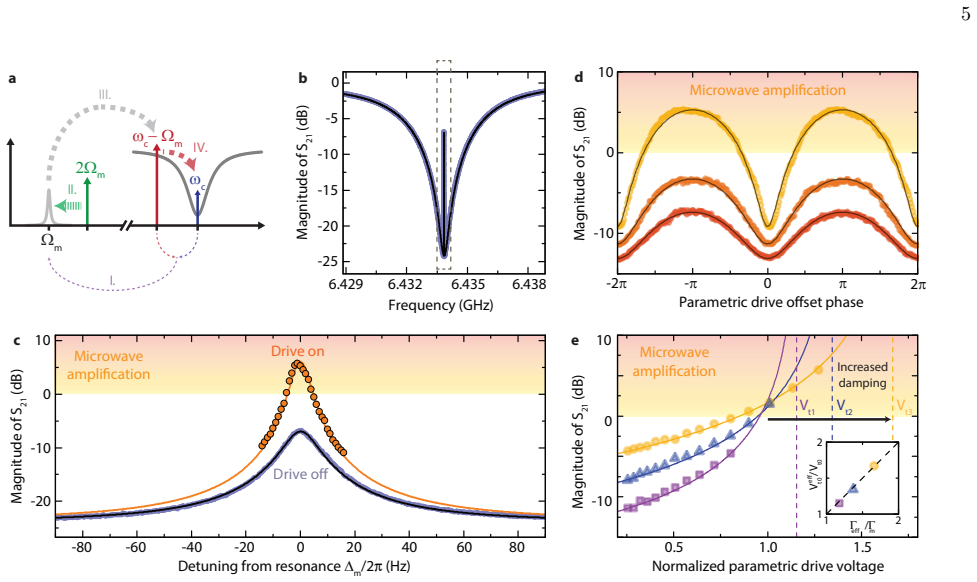
The load-bearing object is the parametrically modulated harmonic oscillator, written as $\ddot{x} + \Gamma_m \dot{x} + (1/m)(k_0 + k_p \sin 2\Omega t)x = (F_0/m)\cos(\Omega t + \varphi_p)$, which describes a beam whose electrostatic spring constant is modulated at twice the near-resonant drive frequency. The same equation yields the mechanical gain formula, the instability threshold voltage $V_t$, and, after coupling to the cavity field, the parametrically enhanced cooperativity $C_p = C/(1 - V_{2\Omega}/V_t^{\mathrm{eff}})$ that renormalizes the usual optomechanically induced transparency transmission curve. In other words, the parametric pump appears as a simple renormalization of the optomechanical cooperativity, which is what makes the microwave amplifier's tuning and threshold behavior transparent.
What would settle it
Measure the average phonon number of the nanobeam with the red-sideband cooling tone on, with the parametric pump off and then with the parametric drive near the instability threshold. If the phonon number rises substantially under pumping, or if the amplifier's added noise exceeds the quantum limit for a phase-sensitive gain $G$ at the corresponding cooperativity, the noiseless-pump assumption fails and the scheme cannot reach quantum-limited operation.
Extended reading notes
Core claim
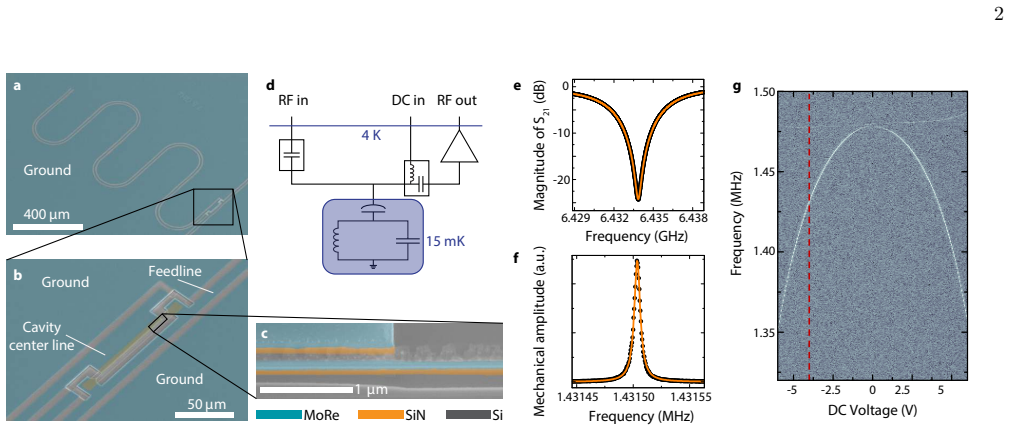
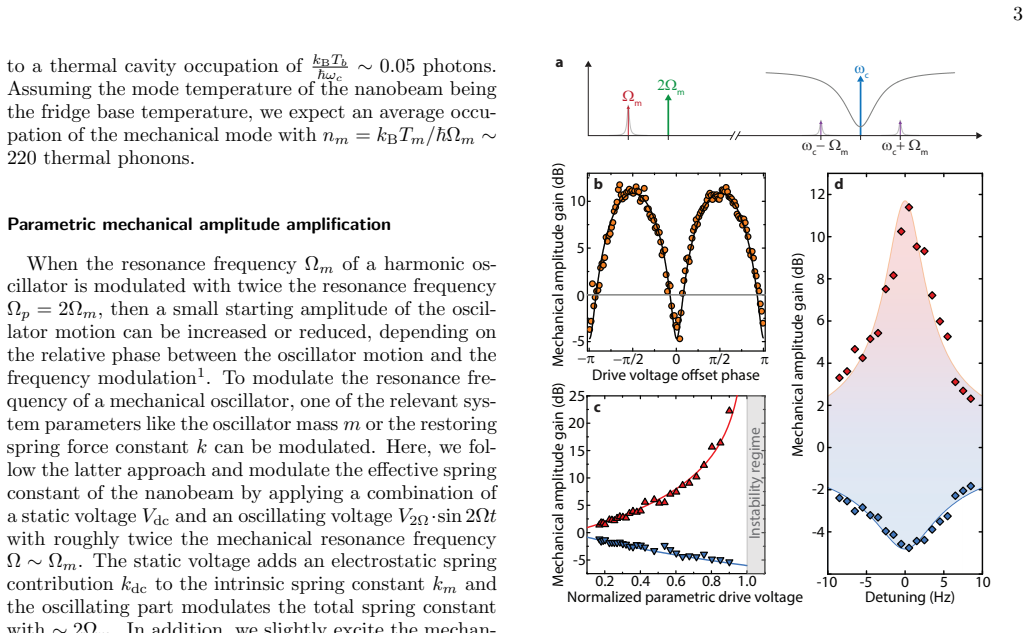
The central claim is that parametric modulation of a nanobeam's resonance frequency is a working route to phase-sensitive amplification of intracavity microwaves. The experiment uses a superconducting quarter-wave cavity whose coupling capacitance contains a metallized silicon-nitride nanobeam; a static voltage plus a small $2\Omega_m$ tone modulates the electrostatic spring, so the beam obeys $\ddot{x} + \Gamma_m \dot{x} + (1/m)(k_0 + k_p \sin 2\Omega t)x = (F_0/m)\cos(\Omega t + \varphi_p)$. From this equation the experiment reproduces the phase-sensitive mechanical gain formula, reaching about 22 dB on resonance near the parametric instability threshold, and it records thermomechanical noise squeezing with variance factor $s=0.49$. With a strong red-sideband drive and a weak probe near the cavity resonance, the optomechanically induced transparency window turns into gain: the probe transmission exceeds unity by up to about 7 dB, with gain controlled by the parametric drive voltage through the enhanced cooperativity $C_p = C/(1 - V_{2\Omega}/V_t^{\mathrm{eff}})$. Because the pump is near 1.4 MHz while the signal is near 6.4 GHz, and because the red-sideband cooling tone can remain on, the authors argue this configuration is a mechanical-parametric microwave amplifier that is compatible with simultaneous cooling and, in an optimized device, with quantum-limited operation.
Load-bearing premise
The quantum-limited promise of the scheme rests on the assumption that the electrostatic parametric drive is a noiseless, classical modulation of the beam's spring constant, so the mechanical mode can be pumped and red-sideband-cooled at the same time without extra heating or added noise.
Editorial extensions
If this is right
- The red-sideband cooling tone and the parametric pump can be applied simultaneously, so microwave gain does not require the blue-sideband drive that heats the mechanical mode in conventional optomechanical amplifiers.
- The microwave gain is phase-sensitive with $2\pi$ periodicity and can be tuned from deamplification below unity to amplification above unity by changing the phase and amplitude of the mechanical pump.
- Increasing the red-sideband drive power raises the parametric instability threshold through optical damping and a power-dependent intrinsic damping, providing a control knob for stable high-gain operation.
- In an optimized device, the authors expect the mechanical mode to be coolable to its ground state while being pumped, making the amplifier a candidate for near-quantum-limited phase-sensitive microwave amplification.
- The platform enables photon-bath engineering of microwave cavities, including the effective-negative-temperature regimes for cavity photons predicted for parametrically pumped optomechanical systems.
Reading between the lines
- [Editorial inference] If the parametric drive is truly noiseless, the amplifier's added noise in the amplified quadrature should be set by the cooled mechanical bath rather than by the pump; a direct test is to measure the mechanical occupation during simultaneous pumping and cooling, which the paper does not report.
- [Editorial inference] The gain formula $C_p = C/(1 - V_{2\Omega}/V_t^{\mathrm{eff}})$ makes this system the mechanical analogue of a degenerate parametric amplifier; adding a second mechanical mode or pump phase could turn it into a phase-preserving amplifier or a backaction-evading measurement of one microwave quadrature.
- [Editorial inference] The observed squeezing factor $s=0.49$ and the gain limit at $V_{2\Omega} \approx 0.9\,V_t$ appear dominated by slow mechanical frequency fluctuations and amplifier noise rather than by the parametric mechanism, so stabilizing the beam's frequency or increasing its quality factor should allow deeper squeezing and gain closer to threshold.
- [Editorial inference] Because the pump sits near 1.4 MHz while the processed microwaves sit near 6.4 GHz, the pump's own quantum noise is negligible at the signal frequency; this is the physical reason simultaneous cooling and amplification can coexist, and it suggests low-frequency phononic pumps as a general route to low-added-noise microwave processing.
Signed reviews
Editorial analysis
A structured set of objections, weighed in public.
Referee Report
Summary. This manuscript reports experiments on a MoRe/SiN nanobeam capacitively coupled to a superconducting microwave cavity, with direct electrostatic parametric driving of the mechanical resonance frequency. The authors demonstrate phase-sensitive mechanical amplitude amplification, observe thermomechanical quadrature squeezing with a reported factor s = 0.49, and show phase-sensitive gain of a microwave probe in an optomechanically induced transparency (OMIT) configuration with a red-sideband drive. The theoretical framework combines a Rugar-Gruetter-type parametric oscillator with linearized optomechanics, and the microwave-amplifier theory in SM S10 contains the correct 1 - B^2 denominator that produces threshold-divergent gain. The paper is clearly written and the experiments appear carefully done, but several load-bearing printed equations and one key quantitative claim need correction or additional support before the results are fully reproducible.
Significance. If the central claims hold, the work adds a useful new capability to microwave optomechanics: a low-frequency mechanical parametric pump that can act as a phase-sensitive microwave amplifier while a red-sideband tone simultaneously cools the mechanical mode. This combination is potentially relevant for quantum-limited microwave devices, and the paper contains an explicit analytic model and quantitative fits rather than a purely empirical report. The independent extraction of most cavity and optomechanical parameters, the explicit derivation in SM S10, and the honest statements in the SM about processing dependence and linewidth modeling are strengths. The main weaknesses are the incorrect printed gain formula in the main text and SM, the processing-dependent squeezing factor, and the untested assumption that the parametric pump is noiseless, each of which needs to be addressed before the claims are fully reliable.
major comments (3)
- [Main text, Eq. (2); SM S7, Eqs. (S81)-(S89); SM S8, Eq. (S91)] The printed expression for the parametric amplitude gain is missing the instability denominator. As written, Eq. (2) (and correspondingly SM Eqs. (S83) and (S88)) gives Gp = sqrt[cos^2(phi+phi_p)(1+V2Omega/Vt)^2 + sin^2(phi+phi_p)(1-V2Omega/Vt)^2], whose maximum below threshold is 1 + V2Omega/Vt, i.e. at most 6 dB, with no divergence at threshold. This is inconsistent with the reported approximately 22 dB maximum gain at V2Omega = 0.9 Vt0 in Fig. 2c and with the threshold divergence. The full solution in SM Eqs. (S81)-(S82) contains the denominator 1 - (V2Omega/Vt)^2, and SM Eq. (S89) states the correct limits Gmax = 1/(1 - V2Omega/Vt) and Gmin = 1/(1 + V2Omega/Vt). The fit function in SM S8, Eq. (S91), is also printed without the denominator, even though Eq. (S92) extracts Gmax = 1/(1 - alpha4) and Gmin = 1/(1 + alpha4); as printed, the extrema of that fit function are 1 +/- alpha4. This is a load-bearing inconsistency because a reader cannot reproduce the quantitative gain curves from the stated equations. The authors should correct Eq. (2), SM Eqs. (S83) and (S88), and SM Eq. (S91), and confirm that the data analysis used the correct denominator-containing expression.
- [Main text, Eq. (5) and Fig. 3; SM Sec. S9B] The headline squeezing factor s = 0.49 is not robust as reported. SM S9B explicitly states that 'the squeezing factor depends on the chosen data processing values for the averaging,' yet the main text quotes a single number and Fig. 3c contains no error bars or indication of the processing window. The variance subtraction in Eq. (5) also leaves the sensitivity to the amplifier-noise estimate sigma^2_amp unspecified. The authors should provide the range of s over reasonable processing choices, quantify uncertainties, and show representative data with error bars. Without this, the noise-squeezing claim is not quantitatively reproducible.
- [SM Sec. S7, Eq. (S71); Abstract; Conclusion] The quantum-limited-reach claim rests on the assumption that the parametric pump is a noiseless classical spring modulation. Eq. (S71) contains no pump-induced noise or heating term, and the paper does not measure the mechanical occupation during simultaneous red-sideband drive and parametric pumping. Because the parametric drive is applied through the same feedline that carries the microwave fields and could in principle heat or add noise to the beam, the statement that the technique 'allows for simultaneous cooling ... potentially enables this type of optomechanical microwave amplifier to be quantum-limited' is currently an untested premise. The authors should either measure the mechanical occupation under simultaneous cooling and pumping, or explicitly restrict the conclusion to the demonstrated classical amplification and label the quantum-limited extension as an assumption.
minor comments (4)
- [SM Sec. S5A] The effective mass and spring constant values are inconsistent: the text first quotes km = 1.46 N/m from the mass and resonance frequency, but later states the electrostatic spring constant is calculated 'from our data and km = 1 N/m.' Please reconcile these values and define the effective mass used.
- [Figs. 2-4] Most quantitative figures lack error bars, including the gain-versus-voltage and gain-versus-detuning points in Fig. 2, the squeezing data in Fig. 3, and the microwave-gain data in Fig. 4. Error bars or an explicit statistical-analysis statement should be added.
- [Main text and SM] There are several typographical errors that should be corrected, including 'powerfool' in the abstract, 'mechnaical' in the Conclusion, and 'Supplemetary' in the Results section.
- [SM S6E and main text Fig. 4e] The phrase 'independently obtained system parameters' overstates the situation somewhat, because the phenomenological linewidth model Gamma_m(n_c) in SM S6E uses fitted parameters gamma_1 and gamma_2. Please clarify which parameters are independently measured and which are adjusted.
Circularity Check
One mechanical-gain curve is a fit dressed as theory; the central microwave-amplifier claim is independent.
-
fitted input called prediction
[Main text, Results, 'Parametric mechanical amplitude amplification' (Fig. 2c), and SM Sec. S8, Eqs. (S91)-(S92)]
"To explore the dependence of the amplification on the parametric modulation amplitude V2Ω, we repeat this experiment for different voltages V2Ω and extract maximum and minimum gain by fitting the data with Eq. (2) for Vt = Vt0 and ϕ = 0. The extracted values follow closely the theoretical curves up to a voltage V2Ω≈ 0.9Vt0, above which we are limited by resonance frequency fluctuations of the mechanical resonator."
The 'theoretical curves' in Fig. 2c are Eq. (2) evaluated with the same threshold voltage Vt0 that is obtained by fitting those very phase-sweep data with Eq. (2). SM Sec. S8 uses the same functional form with fit parameter α4, from which Gmax = 1/(1−α4) and Gmin = 1/(1+α4) are derived. Thus the plotted maximum/minimum gain values and the theoretical curve share the same fitted parameter; the points lie on the curve by construction, not by independent prediction. The phase and detuning dependences are still nontrivial tests, but the resonant gain-vs-pump-amplitude curve is a consistency check presented as a theoretical curve.
full rationale
The central derivation is not circular. SM S7 solves the parametrically modulated harmonic-oscillator equation, a direct generalization of Rugar-Gruetter, to obtain the mechanical gain, and SM S10 solves the linearized optomechanical equations including the parametric pump to obtain the microwave transmission formulas (Eqs. S100-S107). These are analytic derivations, not fits. The microwave-amplifier curves are said to use independently extracted parameters (cavity linewidths, g0/C from OMIT, Γm(nc) from a phenomenological model, Vt0 from the mechanical experiment), and the threshold-voltage shift with Γeff is a cross-check rather than a tautology. No load-bearing self-citation is present: the authors' prior work is cited only for device material and electrostatic-tuning context. The one genuine by-construction element is the resonant mechanical gain-vs-V2Ω curve, where Vt0 is fit from the same data that are then claimed to 'follow' the theoretical curve; this is a fitted input presented as a theory curve, but it does not affect the independent microwave demonstration. Separately, the printed Eq. (2) and SM Eq. (S88) are internally inconsistent with the stated Gmax = 1/(1−r) and with the reported ~22 dB gain (the printed expression lacks the denominator and swaps quadratures); this is an algebraic error, not a circularity.
Assumptions & free parameters
free parameters (4)
- Parametric threshold voltage Vt0 =
not quoted; extracted from fits in Fig. 2c and used to normalize V2Omega/Vt
- Phenomenological linewidth parameters gamma1, gamma2 =
not quoted; 'adjusted to best describe the experimental data' (SM S6E)
- Optomechanical coupling rate g =
2*pi*2.7 kHz for highest-power OMIT fit (Fig. S6)
- Cooperativity C per sideband drive power =
C approx 0.16, 0.28, 0.5 for the three powers in Fig. 4e
assumptions (6)
- domain assumption The cavity and mechanics are described by linearized classical equations of motion around a steady state (SM S6C).
- domain assumption The optomechanical coupling is purely dispersive; dissipative coupling is negligible (g_kappa/g_omega approx 0.08, SM S6B).
- domain assumption The mechanical element is a single harmonic oscillator with electrostatic spring modulation; higher-order terms in the voltage expansion are neglected (SM S7, Eqs. S68-S70).
- standard math Rotating-wave approximation and high-Q approximation hold (SM S7, S10).
- ad hoc to paper The parametric pump is a noiseless classical spring modulation; no additional mechanical noise is introduced by the pump (equation of motion S71 has no noise term).
- domain assumption The mechanical mode is initially thermalized at the fridge base temperature Tb = 15 mK (main text).
Cite this review
Pith. "Pith review of Cavity electromechanics with parametric mechanical driving." pith.science (2026). https://pith.science/paper/NEFXH7FP
@misc{pith2026190808496,
  author       = {Pith},
  title        = {Pith review of: Cavity electromechanics with parametric mechanical driving},
  year         = {2026},
  howpublished = {\url{https://pith.science/paper/NEFXH7FP}},
  note         = {Machine review of arXiv:1908.08496}
}
read the original abstract
Microwave optomechanical circuits have been demonstrated in the past years to be extremely powerfool tools for both, exploring fundamental physics of macroscopic mechanical oscillators as well as being promising candidates for novel on-chip quantum limited microwave devices. In most experiments so far, the mechanical oscillator is either used as a passive device element and its displacement is detected using the superconducting cavity or manipulated by intracavity fields. Here, we explore the possibility to directly and parametrically manipulate the mechanical nanobeam resonator of a cavity electromechanical system, which provides additional functionality to the toolbox of microwave optomechanical devices. In addition to using the cavity as an interferometer to detect parametrically modulated mechanical displacement and squeezed thermomechanical motion, we demonstrate that parametric modulation of the nanobeam resonance frequency can realize a phase-sensitive parametric amplifier for intracavity microwave photons. In contrast to many other microwave amplification schemes using electromechanical circuits, the presented technique allows for simultaneous cooling of the mechanical element, which potentially enables this type of optomechanical microwave amplifier to be quantum-limited.
Figures

Figures from the paper (1 more)
Reference graph
Works this paper leans on
-
[1]
author A. Wallraff , author D. I. Schuster , author A. Blais , author L. Frunzio , author R.-S. Huang , author J. Majer , author S. Kumar , author S. M. Girvin , and author R. J. Schoelkopf , journal Nature volume 431 , pages 162 ( year 2004 )
work page 2004
-
[2]
author L. DiCarlo , author J. M. Chow , author J. M. Gambetta , author Lev S. Bishop , author B. R. Johnson , author D. I. Schuster , author J. Majer , author A. Blais , author L. Frunzio , author S. M. Girvin , and author R. J. Schoelkopf , journal Nature volume 460 , pages 240 ( year 2009 )
work page 2009
-
[3]
author R. Barends , author A. Shabani , author L. Lamata , author J. Kelly , author A. Mezzacapo , author U. Las Heras , author R. Babbush , author A. G. Fowler , author B. Campbell , author Yu Chen , author Z. Chen , author B. Chiaro , author A. Dunsworth , author E. Jeffrey , author E. Lucero , author A. Megrant , author J. Y. Mutus , author M. Neeley ,...
work page 2016
-
[4]
author D. I. Schuster , author A. A. Houck , author J. A. Schreier , author A. Wallraff , author J. M. Gambetta , author A. Blais , author L. Frunzio , author J. Majer , author B. Johnson , author M. H. Devoret , author S. M. Girvin , and author R. J. Schoelkopf , journal Nature volume 445 , pages 515 ( year 2007 )
work page 2007
-
[5]
author M. Hofheinz , author E. M. Weig , author M. Ansmann , author R. C. Bialczak , author E. Lucero , author M. Neeley , author A. D. O'Connell , author H. Wang , author J. M. Martinis , and author A. N. Cleland , journal Nature volume 454 , pages 310 ( year 2008 )
work page 2008
-
[6]
author S. J. Bosman , author M. F. Gely , author V. Singh , author A. Bruno , author D. Bothner , and author G. A. Steele , journal npj Quantum Information volume 3 , pages 46 ( year 2017 )
work page 2017
-
[7]
author N. K. Langford , author R. Sagastizabal , author M. Kounalakis , author C. Dickel , author A. Bruno , author F. Luthi , author D. J. Thoen , author A. Endo , and author L. DiCarlo , journal Nature Communications volume 8 , pages 1715 ( year 2017 )
work page 2017
-
[8]
author M. F. Gely , author M. Kounalakis , author C. Dickel , author J. Dalle , author R. Vatr\'e , author B. Baker , author M. D. Jenkins , and author G. A. Steele , journal Science volume 363 , pages 1072 ( year 2019 )
work page 2019
Show all 36 references
-
[9]
author P. K. Day , author H. G. LeDuc , author B. A. Mazin , author A. Vayonakis , and author J. Zmuidzinas , journal Nature volume 425 , pages 817 ( year 2003 )
2003
-
[10]
author C. A. Regal , author J. D. Teufel , and author K. W. Lehnert , journal Nature Physics volume 4 , pages 555 ( year 2008 )
2008
-
[11]
author J. D. Teufel , author T. Donner , author D. Li , author J. W. Harlow , author M. S. Allman , author K. Cicak , author A. J. Sirois , author J. D. Whittaker , author K. W. Lehnert , and author R. W. Simmonds , journal Nature volume 475 , pages 359 ( year 2011 )
2011
-
[12]
Aspelmeyer , author T
author M. Aspelmeyer , author T. J. Kippenberg , and author F. Marquardt , journal Rev. Mod. Phys. volume 86 , pages 1391 ( year 2014 )
2014
-
[13]
author J. D. Teufel , author D. Li , author M. S. Allman , author K. Cicak , author A. J. Sirois , author J. D. Whittaker , and author R. W. Simmonds , journal Nature volume 471 , pages 204 ( year 2011 )
2011
-
[14]
author E. E. Wollman , author C. U. Lei , author A. J. Weinstein , author J. Suh , author A. Kronwald , author F. Marquardt , author A. A. Clerk , and author K. C. Schwab , journal Science volume 349 , pages 952 ( year 2015 )
2015
-
[15]
agg , author M. Brandt , author F. Massel , and author M. A. Sillanp\
author J.-M. Pirkkalainen , author E. Damsk\"agg , author M. Brandt , author F. Massel , and author M. A. Sillanp\"a\"a , journal Physical Review Letters volume 115 , pages 243601 ( year 2015 )
2015
-
[16]
author A. P. Reed , author K. H. Mayer , author J. D. Teufel , author L. D. Burkhart , author W. Pfaff , author M. Reagor , author L. Sletten , author X. Ma , author R. J. Schoelkopf , author E. Knill , and author K. W. Lehnert , journal Nature Physics volume 13 , pages 1163 (...
2017
-
[17]
agg , author J.-M. Pirkkalainen , author M. Asjad , author A. A. Clerk , author F. Massel , author M. J. Woolley , and author M. A. Sillanp\
author C. F. Ockeloen-Korppi , author E. Damsk\"agg , author J.-M. Pirkkalainen , author M. Asjad , author A. A. Clerk , author F. Massel , author M. J. Woolley , and author M. A. Sillanp\"a\"a , journal Nature volume 556 , pages 478 ( year 2018 )
2018
-
[18]
Metelmann , and author A
author A. Metelmann , and author A. A. Clerk , journal Physical Review Letters volume 112 , pages 133904 ( year 2014 )
2014
-
[19]
Nunnenkamp , author V
author A. Nunnenkamp , author V. Sudhir , author A. K. Feofanov , author A. Roulet , and author T. J. Kippenberg , journal Physical Review Letters volume 113 , pages 023604 ( year 2014 )
2014
-
[20]
author L. D. T\'oth , author N. R. Bernier , author A. Nunnenkamp , author A. K. Feofanov , and author T. J. Kippenberg , journal Nature Physics volume 13 , pages 787 ( year 2017 )
2017
-
[21]
a , author J.-M. Pirkkalainen , author S. U. Cho , author H. Saloniemi , author P. J. Hakonen , and author M. A. Sillanp\
author F. Massel , author T. T. Heikkil\"a , author J.-M. Pirkkalainen , author S. U. Cho , author H. Saloniemi , author P. J. Hakonen , and author M. A. Sillanp\"a\"a , journal Nature volume 480 , pages 351 ( year 2011 )
2011
-
[22]
Malz , author L
author D. Malz , author L. D. T\'oth , author N. R. Bernier , author A. F. Feofanov , author T. J. Kippenberg , and author A. Nunnenkamp , journal Phys. Rev. Lett. volume 120 , pages 023601 ( year 2018 )
2018
-
[23]
author N. R. Bernier , author L. D. Toth , author A. Koottandavida , author M. A. Ioannou , author D. Malz , author A. Nunnenkamp , author A. K. Feofanov , and author T. J. Kippenberg , journal Nature Communications volume 8 , pages 604 ( year 2017 )
2017
-
[24]
Barzanjeh , author M
author S. Barzanjeh , author M. Wulf , author M. Peruzzo , author M. Kalaee , author P. B. Dieterle , author O. Painter , and author J. M. Fink , journal Nature Communications volume 8 , pages 953 ( year 2017 )
2017
-
[25]
agg , author J.-M. Pirkkalainen , author T. T. Heikkil\
author C. F Ockeloen-Korppi , author E. Damsk\"agg , author J.-M. Pirkkalainen , author T. T. Heikkil\"a , author F. Massel , and author M. A. Sillanp\"a\"a , journal Physical Review X volume 6 , pages 041024 ( year 2016 )
2016
-
[26]
author B. A. Levitan , author A. Metelmann , and author A. A. Clerk , journal New J. Phys. volume 18 , pages 093014 ( year 2016 )
2016
-
[27]
Lemonde , author N
author M.-A. Lemonde , author N. Didier , and author A. A. Clerk , journal Nature Communications volume 7 , pages 11338 ( year 2016 )
2016
-
[28]
Qvarfort , author A
author S. Qvarfort , author A. Serafini , author A. Xuereb , author D. Braun , author D. R\"atzel , and author D. E. Bruschi , journal arxiv:1908.00790 ( year 2019 )
1908 arXiv
-
[29]
Weber , author J
author P. Weber , author J. G\"uttinger , author I. Tsioutsios , author D. E. Chang , and author A. Bachtold , journal Nano Lett. volume 14 , pages 2854 ( year 2014 )
2014
-
[30]
Singh , author S
author V. Singh , author S. J. Bosman , author B. H. Schneider , author Ya. M. Blanter , author A. Castellanos-Gomez , and author G. A. Steele , journal Nature Nanotechnology volume 9 , pages 820 ( year 2014 )
2014
-
[31]
author R. W. Andrews , author A. P. Reed , author K. Cicak , author J. D. Teufel , and author K. W. Lehnert , journal Nature Communications volume 6 , pages 10021 ( year 2015 )
2015
-
[32]
Singh , author B
author V. Singh , author B. H. Schneider , author S. J. Bosman , author E. P. J. Merkx , and author G. A. Steele , journal Appl. Phys. Lett. volume 105 , pages 222601 ( year 2014 )
2014
-
[33]
Rugar and author P
author D. Rugar and author P. Gr\"utter , journal Phys. Rev. Lett. volume 67 , pages 699 ( year 1991 )
1991
-
[34]
author G. S. Agarwal , and author S. Huang , journal Physical Review A volume 81 , pages 041803(R) ( year 2010 )
2010
-
[35]
Weis , author R
author S. Weis , author R. Rivi\`ere , author S. Del\'eglise , author E. Gavartin , author O. Arcizet , author A. Schliesser , and author T. J. Kippenberg , journal Science volume 330 , pages 1520 ( year 2010 )
2010
-
[36]
Rugar and author P
author D. Rugar and author P. Gr\"utter , Mechanical Parametric Amplification and Thermomechanical Noise Squeezing, journal Phys. Rev. Lett. volume 67 , pages 699 ( year 1991 )
1991
Reviewed August 14, 2026 · model on record in the stance chip above.
Discussion (0). Continue with ORCID to comment.