Formation of a nuclear star cluster through the inspiral of globular clusters: A case study of the dwarf elliptical galaxy UGC 7346
Pith reviewed 2026-05-20 04:34 UTC · model grok-4.3
The pith
N-body simulations show globular cluster inspiral forms a nuclear star cluster of 4.1-4.5 x 10^5 solar masses in UGC 7346 within 1.5 Gyr.
A machine-rendered reading of the paper's core claim, the machinery that carries it, and where it could break.
Core claim
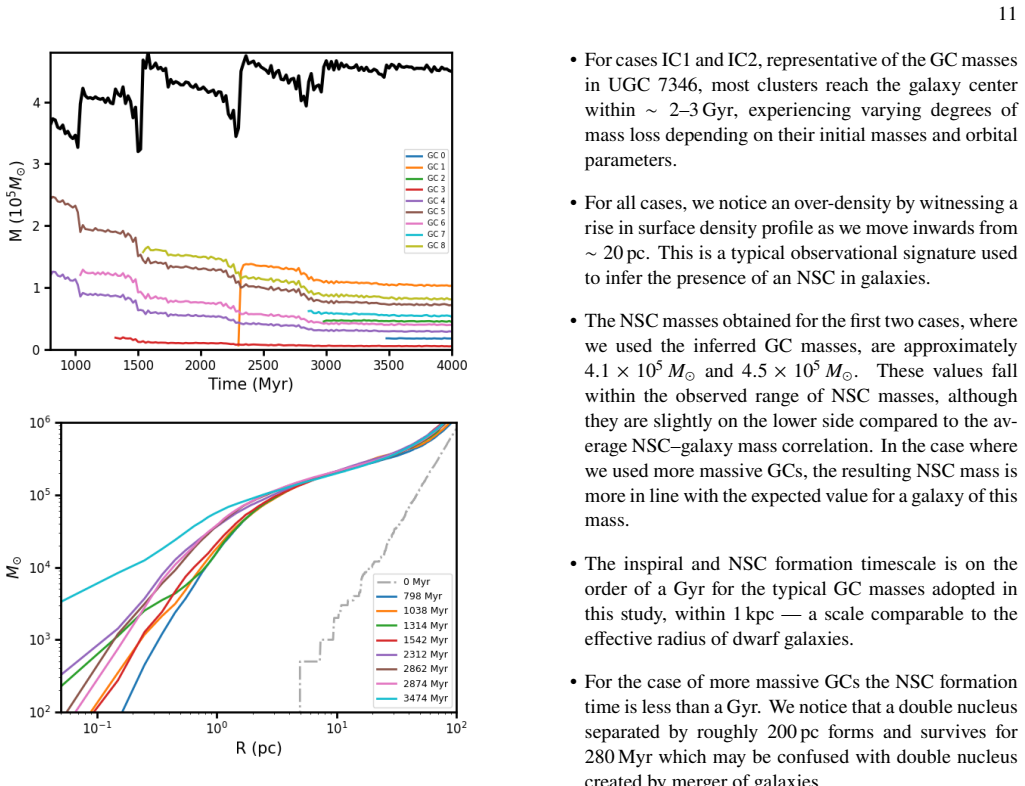
Our simulations indicate that GC inspiral leads to the formation of a central stellar over-density relative to the background profile of the host galaxy within ∼1.5 Gyr, corresponding to a NSC with a typical mass of (4.1-4.5)×10^5 M⊙. Several key structural parameters of the newly formed NSC, including the Sérsic index, effective radius, and central stellar density, lie well within the range observed for NSCs. We also test a hypothetical scenario in which some of the infalling GCs have larger masses (M ∼ 10^6 M⊙), resulting in the formation of a more massive NSC whose mass and size are more consistent with observations. Our results suggest that inspiral of GCs is a viable channel for assemb
What carries the argument
Direct N-body simulations tracking the inspiral of multiple globular clusters under dynamical friction in a fixed galactic potential.
Load-bearing premise
The modeling assumes that the nine globular clusters have initial conditions consistent with the observed system near the photometric center and that the galactic potential remains static and unperturbed during the inspiral process.
What would settle it
If high-resolution imaging of UGC 7346 in the next few Gyr shows no development of a central stellar over-density or nuclear star cluster, this would contradict the simulation predictions.
Figures




read the original abstract
Nuclear star clusters (NSCs) are dense stellar environments located in the center of most galaxies. NSCs are thought to form through two primary methods; through the inspiral of globular clusters (GCs) to the galactic center due to dynamical friction, and through in-situ star formation. Recent observations of dwarf elliptical galaxy UGC 7346 suggest that it might be undergoing NSC formation due to the presence of multiple GCs near its photometric center. We perform direct N-body simulations of nine GCs belonging to UGC 7346's GC system to investigate whether their eventual infall to the galactic center would result in the formation of a NSC. Our simulations indicate that GC inspiral leads to the formation of a central stellar over-density relative to the background profile of the host galaxy within $\sim$1.5 Gyr, corresponding to a NSC with a typical mass of $(4.1\text{-}4.5)\times 10^5 M_{\odot}$. Several key structural parameters of the newly formed NSC, including the S\'ersic index, effective radius, and central stellar density, lie well within the range observed for NSCs. We also test a hypothetical scenario in which some of the infalling GCs have larger masses ($M \sim 10^6 M_{\odot}$), resulting in the formation of a more massive NSC whose mass and size are more consistent with observations. Our results suggest that inspiral of GCs is a viable channel for assembling a significant mass in the shape of NSC in the center of dwarf galaxies and that UGC 7346 will host a NSC at its center in about 2-3 Gyr.
Editorial analysis
A structured set of objections, weighed in public.
Referee Report
Summary. The manuscript reports direct N-body simulations of the nine observed globular clusters in the dwarf elliptical galaxy UGC 7346. The simulations demonstrate that dynamical-friction-driven inspiral assembles a central stellar overdensity with mass (4.1–4.5)×10^5 M⊙ within ∼1.5 Gyr; the resulting structure has Sérsic index, effective radius, and central density consistent with observed nuclear star clusters. A secondary experiment with more massive clusters is also presented, and the authors conclude that UGC 7346 will host a NSC within 2–3 Gyr.
Significance. If the numerical results survive relaxation of the static-potential assumption, the work supplies concrete, forward-modeling evidence that the globular-cluster inspiral channel can build a substantial fraction of an NSC in a low-mass dwarf galaxy on a Gyr timescale. The use of observationally motivated initial conditions and direct N-body integration (rather than analytic or semi-analytic approximations) constitutes a clear methodological strength and yields falsifiable predictions for the future state of UGC 7346.
major comments (1)
- [Methods (galactic potential and N-body setup)] The simulations adopt a fixed, analytic galactic potential that is neither perturbed nor heated by the infalling clusters (Methods section on galactic potential and initial conditions). In a dwarf elliptical the total GC mass is comparable to the enclosed stellar mass within the GC orbits; a live stellar component would absorb orbital energy, modify the local density gradient, and likely lengthen the inspiral time or reduce the final central density contrast. Because only the static case is reported, it is unclear whether the quoted NSC mass and 1.5 Gyr formation timescale remain robust when this load-bearing assumption is relaxed.
minor comments (2)
- [Results] The abstract and results section would benefit from an explicit statement of the number of particles per GC and the softening length used, to allow readers to assess two-body relaxation effects.
- [Figures] Figure captions should clarify whether the plotted density profiles are time-averaged or instantaneous at t = 1.5 Gyr.
Simulated Author's Rebuttal
We thank the referee for their constructive and detailed review of our manuscript. We address the major comment point by point below, acknowledging the limitations of our modeling approach while defending the robustness of our qualitative conclusions where supported by the simulations.
read point-by-point responses
-
Referee: The simulations adopt a fixed, analytic galactic potential that is neither perturbed nor heated by the infalling clusters (Methods section on galactic potential and initial conditions). In a dwarf elliptical the total GC mass is comparable to the enclosed stellar mass within the GC orbits; a live stellar component would absorb orbital energy, modify the local density gradient, and likely lengthen the inspiral time or reduce the final central density contrast. Because only the static case is reported, it is unclear whether the quoted NSC mass and 1.5 Gyr formation timescale remain robust when this load-bearing assumption is relaxed.
Authors: We agree that the static analytic potential is a significant simplifying assumption that neglects the dynamical response of the host galaxy's stars to the infalling clusters. This choice was made to enable direct N-body integration of the nine observed GCs while isolating the role of dynamical friction, as detailed in the Methods. The combined GC mass in our models is approximately 4.5×10^5 M⊙, which is indeed comparable to the enclosed stellar mass in the inner regions of this low-mass dwarf. A live potential would allow energy transfer to the background stars, likely moderating the central density buildup. In the revised manuscript we have added explicit discussion of this limitation in the Methods section and a new paragraph in the Discussion, framing the reported 1.5 Gyr timescale as a lower limit and noting that the actual inspiral could be modestly longer while still occurring within a few Gyr. The structural parameters of the resulting overdensity remain consistent with observed NSCs even under this caveat. revision: partial
- Quantitative assessment of the precise changes to inspiral timescale and final NSC mass and density contrast that would arise in a fully live galactic potential.
Circularity Check
No circularity detected in simulation-based results
full rationale
The paper reports forward N-body simulation outcomes for GC inspiral under observed initial conditions and a static analytic potential. The central result (central over-density forming a NSC of mass (4.1-4.5)×10^5 M⊙ within ~1.5 Gyr) is produced by numerical integration of the equations of motion; it is not obtained by fitting parameters to a subset of data and then predicting a related quantity, nor by any self-definitional equation, self-citation chain, or imported uniqueness theorem. No equations or ansatzes in the abstract or described setup reduce the output to the inputs by construction. This is a standard simulation study whose results are independent of the circularity patterns listed.
Axiom & Free-Parameter Ledger
free parameters (2)
- Masses, positions, and velocities of the nine GCs
- Parameters of the host galaxy potential
axioms (2)
- domain assumption Dynamical friction drives the inspiral of globular clusters toward the galactic center
- domain assumption The galactic potential is static and approximately spherical over the simulation timescale
Reference graph
Works this paper leans on
-
[1]
Living Reviews in Relativity , keywords =
Amaro-Seoane, P., Andrews, J., Arca Sedda, M., et al. 2023, Living Reviews in Relativity, 26, 2, doi: 10.1007/s41114-022-00041-y
-
[2]
2013, The Astrophysical Journal, 763, 62, doi: 10.1088/0004-637X/763/1/62
Antonini, F. 2013, The Astrophysical Journal, 763, 62, doi: 10.1088/0004-637X/763/1/62
-
[3]
2015, The Astrophysical Journal, 812, 72, doi: 10.1088/0004-637X/812/1/72
Antonini, F., Barausse, E., & Silk, J. 2015, The Astrophysical Journal, 812, 72, doi: 10.1088/0004-637X/812/1/72
-
[4]
2012, The Astrophysical Journal, 750, 111, doi: 10.1088/0004-637X/750/2/111
Merritt, D. 2012, The Astrophysical Journal, 750, 111, doi: 10.1088/0004-637X/750/2/111
-
[5]
2017, Monthly Notices of the Royal Astronomical Society, 464, 3060, doi: 10.1093/mnras/stw2483
Arca-Sedda, M., & Capuzzo-Dolcetta, R. 2017, Monthly Notices of the Royal Astronomical Society, 464, 3060, doi: 10.1093/mnras/stw2483
-
[6]
2015, The Astrophysical Journal, 806, 220, doi: 10.1088/0004-637X/806/2/220
Arca-Sedda, M., Capuzzo-Dolcetta, R., Antonini, F., & Seth, A. 2015, The Astrophysical Journal, 806, 220, doi: 10.1088/0004-637X/806/2/220
-
[7]
2023, The Astrophysical Journal, 958, 100, doi: 10.3847/1538-4357/ace341
Ashok, A., Seth, A., Erwin, P., et al. 2023, The Astrophysical Journal, 958, 100, doi: 10.3847/1538-4357/ace341
-
[8]
Askar, A., Baldassare, V. F., & Mezcua, M. 2023, arXiv e-prints, arXiv:2311.12118, doi: 10.48550/arXiv.2311.12118
-
[9]
Baumgardt, H., Sollima, A., & Hilker, M. 2020, Publications of the Astronomical Society of Australia, 37, e046, doi: 10.1017/pasa.2020.38 Benítez-Llambay, A., Navarro, J. F., Abadi, M. G., et al. 2016, Monthly Notices of the Royal Astronomical Society, 456, 1185, doi: 10.1093/mnras/stv2722 Berczik,P.,Spurzem, R.,Zhong,S.,etal. 2013,inLectureNotes in Compu...
-
[10]
Berczik, P., Nitadori, K., Zhong, S., et al. 2011, in International conference on High Performance Computing, Kyiv, Ukraine, October 8-10, 2011., p. 8-18, 8–18
work page 2011
-
[11]
Colpi, M., Danzmann, K., Hewitson, M., et al. 2024, arXiv e-prints, arXiv:2402.07571, doi: 10.48550/arXiv.2402.07571 Côté, P., Piatek, S., Ferrarese, L., et al. 2006, The Astrophysical Journal Supplement Series, 165, 57, doi: 10.48550/arXiv.astro-ph/0603252 Di Cintio, A., Brook, C. B., Dutton, A. A., et al. 2014, Monthly Notices of the Royal Astronomical ...
work page internal anchor Pith review Pith/arXiv arXiv doi:10.48550/arxiv.2402.07571 2024
-
[12]
Erwin, P., & Gadotti, D. A. 2012, Advances in Astronomy, 2012, 946368, doi: 10.1155/2012/946368
-
[13]
2022, Astronomy & Astrophysics, 658, A172, doi: 10.1051/0004-6361/202039778
Fahrion, K., Leaman, R., Lyubenova, M., & van de Ven, G. 2022, Astronomy & Astrophysics, 658, A172, doi: 10.1051/0004-6361/202039778
-
[14]
2020, Astronomy & Astrophysics, 634, A53, doi: 10.1051/0004-6361/201937120
Fahrion, K., Müller, O., Rejkuba, M., et al. 2020, Astronomy & Astrophysics, 634, A53, doi: 10.1051/0004-6361/201937120
-
[15]
2021, Astronomy & Astrophysics, 650, A137, doi: 10.1051/0004-6361/202140644
Fahrion, K., Lyubenova, M., Van De Ven, G., et al. 2021, Astronomy & Astrophysics, 650, A137, doi: 10.1051/0004-6361/202140644
-
[16]
Ferguson, H. C., & Sandage, A. 1989, Astrophysical Journal, Part 2-Letters (ISSN 0004-637X), vol. 346, Nov. 15, 1989, p. L53-L56., 346, L53
work page 1989
-
[17]
Georgiev, I. Y., & Böker, T. 2014, Monthly Notices of the Royal Astronomical Society, 441, 3570, doi: 10.1093/mnras/stu797
-
[18]
Y., Böker, T., Leigh, N., Lützgendorf, N., & Neumayer, N
Georgiev, I. Y., Böker, T., Leigh, N., Lützgendorf, N., & Neumayer, N. 2016, Monthly Notices of the Royal Astronomical Society, 457, 2122, doi: 10.1093/mnras/stw093
-
[19]
Georgiev, I. Y., Hilker, M., Puzia, T. H., Goudfrooij, P., & Baumgardt,H.2009,MonthlyNoticesoftheRoyalAstronomical Society, 396, 1075, doi: 10.1111/j.1365-2966.2009.14776.x
-
[20]
Monthly Notices of the Royal Astronomical Society , author =
Gieles, M., & Zocchi, A. 2015, Monthly Notices of the Royal Astronomical Society, 454, 576, doi: 10.1093/mnras/stv1848
-
[21]
Graham, A. W., & Guzmán, R. 2003, AJ, 125, 2936, doi: 10.1086/374992
-
[22]
Gray, E. I., Read, J. I., Taylor, E., et al. 2025, MNRAS, 539, 1167, doi: 10.1093/mnras/staf521
-
[23]
2018, ApJ, 855, 129, doi: 10.3847/1538-4357/aab0a5
Hayasaki, K., Zhong, S., Li, S., Berczik, P., & Spurzem, R. 2018, ApJ, 855, 129, doi: 10.3847/1538-4357/aab0a5
-
[24]
2025, arXiv e-prints, arXiv:2508.14253, doi: 10.48550/arXiv.2508.14253
Holley-Bockelmann, K., Khan, F., Williams, I., et al. 2025, arXiv e-prints, arXiv:2508.14253, doi: 10.48550/arXiv.2508.14253
-
[25]
Hoyer, N., Neumayer, N., Seth, A. C., Georgiev, I. Y., & Greene, J. E. 2023, Monthly Notices of the Royal Astronomical Society, 520, 4664 Jordán, A., Côté, P., Blakeslee, J. P., et al. 2005, The Astrophysical Journal, 634, 1002, doi: 10.1086/497092
-
[26]
Kacharov, N., Neumayer, N., Seth, A. C., et al. 2018, Monthly Notices of the Royal Astronomical Society, 480, 1973, doi: 10.1093/mnras/sty1985
-
[27]
2018, The Astrophysical Journal, 868, 134, doi: 10.3847/1538-4357/aaeacf
Kaur, K., & Sridhar, S. 2018, The Astrophysical Journal, 868, 134, doi: 10.3847/1538-4357/aaeacf
-
[28]
Khan, F. M., Berczik, P., & Just, A. 2018, A&A, 615, A71, doi: 10.1051/0004-6361/201730489
-
[29]
M., Berczik, P., Sobolenko, M., et al
Khan, F. M., Berczik, P., Sobolenko, M., et al. 2025a, arXiv e-prints, arXiv:2512.11038, doi: 10.48550/arXiv.2512.11038
-
[30]
Khan, F. M., Davis, B. L., Macciò, A. V., & Holley-Bockelmann, K. 2025b, ApJL, 986, L1, doi: 10.3847/2041-8213/adda4c
-
[31]
Khan, F. M., & Holley-Bockelmann, K. 2021, MNRAS, 508, 1174, doi: 10.1093/mnras/stab2646
-
[32]
M., Preto, M., Berczik, P., et al
Khan, F. M., Preto, M., Berczik, P., et al. 2012, ApJ, 749, 147, doi: 10.1088/0004-637X/749/2/147
-
[33]
King, I. R. 1966, Astronomical Journal, Vol. 71, p. 64 (1966), 71, 64
work page 1966
-
[34]
Li, B., Holley-Bockelmann, K., & Khan, F. M. 2015, ApJ, 811, 25, doi: 10.1088/0004-637X/811/1/25 15
-
[35]
K., Berczik, P., Chen, X., & Spurzem, R
Li, S., Liu, F. K., Berczik, P., Chen, X., & Spurzem, R. 2012, ApJ, 748, 65, doi: 10.1088/0004-637X/748/1/65
-
[36]
Lisker, T., Glatt, K., Westera, P., & Grebel, E. K. 2006, The Astronomical Journal, 132, 2432, doi: 10.48550/arXiv.astro-ph/0608294
work page internal anchor Pith review Pith/arXiv arXiv doi:10.48550/arxiv.astro-ph/0608294 2006
-
[37]
Lisker, T., Grebel, E. K., Binggeli, B., & Glatt, K. 2007, The Astrophysical Journal, 660, 1186, doi: 10.1086/513090
-
[38]
1982, Astronomy and Astrophysics, vol
Loose, H., Kruegel, E., & Tutukov, A. 1982, Astronomy and Astrophysics, vol. 105, no. 2, Jan. 1982, p. 342-350. Research supported by the Deutsche Forschungsgemeinschaft., 105, 342
work page 1982
-
[39]
Ultraluminous Starbursts in Major Mergers
Mihos, C., & Hernquist, L. 1994, arXiv preprint astro-ph/9405039, doi: 10.1086/187460
work page internal anchor Pith review Pith/arXiv arXiv doi:10.1086/187460 1994
-
[41]
Moreno-Hilario, E., Martinez-Medina, L. A., Li, H., Souza, S. O., & Pérez-Villegas, A. 2024, Monthly Notices of the Royal Astronomical Society, 527, 2765, doi: 10.1093/mnras/stad3306
-
[42]
2020, The Astronomy and Astrophysics Review, 28, 4, doi: 10.1007/s00159-020-00125-0
Neumayer, N., Seth, A., & Böker, T. 2020, The Astronomy and Astrophysics Review, 28, 4, doi: 10.1007/s00159-020-00125-0
-
[43]
Nguyen, D. D., Seth, A. C., den Brok, M., et al. 2017, ApJ, 836, 237, doi: 10.3847/1538-4357/aa5cb4
-
[44]
The Astrophysical Journal , author =
Nguyen, D. D., Seth, A. C., Neumayer, N., et al. 2019, ApJ, 872, 104, doi: 10.3847/1538-4357/aafe7a
-
[45]
2000, The Astrophysical Journal, 543, 620, doi: 10.1086/317118
Oh, K., & Lin, D. 2000, The Astrophysical Journal, 543, 620, doi: 10.1086/317118
-
[46]
Oh, S.-H., Hunter, D. A., Brinks, E., et al. 2015, The Astronomical Journal, 149, 180, doi: 10.1088/0004-6256/149/6/180 Ordenes-Briceño, Y., Puzia, T. H., Eigenthaler, P., et al. 2018, The Astrophysical Journal, 860, 4, doi: 10.3847/1538-4357/aac1b8
-
[47]
Paudel, S., Sabiu, C. G., Yoon, S.-J., et al. 2025, arXiv e-prints, arXiv:2511.21010, doi: 10.48550/arXiv.2511.21010
-
[48]
2020, The Astrophysical Journal, 900, 32, doi: 10.3847/1538-4357/abaaa7
Pechetti, R., Seth, A., Neumayer, N., et al. 2020, The Astrophysical Journal, 900, 32, doi: 10.3847/1538-4357/abaaa7
-
[49]
1997, Astronomy and Astrophysics, v
Prugniel, P., & Simien, F. 1997, Astronomy and Astrophysics, v. 321, p. 111-122, 321, 111
work page 1997
-
[50]
Read, J. I., Agertz, O., & Collins, M. L. M. 2016, Monthly Notices of the Royal Astronomical Society, 459, 2573, doi: 10.1093/mnras/stw713 Román, J., Sánchez-Alarcón, P., Knapen, J., & Peletier, R. 2023, Astronomy & Astrophysics, 671, L7, doi: 10.1051/0004-6361/202345928 Sánchez-Janssen, R., Côté, P., Ferrarese, L., et al. 2019, The Astrophysical Journal,...
-
[51]
2007, Astronomy & Astrophysics, 462, L27, doi: https://doi.org/10.1051/0004-6361:20066711
Schinnerer, E., Böker, T., Emsellem, E., & Downes, D. 2007, Astronomy & Astrophysics, 462, L27, doi: https://doi.org/10.1051/0004-6361:20066711
-
[52]
Scott, N., & Graham, A. W. 2013, ApJ, 763, 76, doi: 10.1088/0004-637X/763/2/76
-
[53]
2017, The Astrophysical Journal, 849, 55, doi: 10.3847/1538-4357/aa8a78 Terzić, B., & Graham, A
Spengler, C., Côté, P., Roediger, J., et al. 2017, The Astrophysical Journal, 849, 55, doi: 10.3847/1538-4357/aa8a78 Terzić, B., & Graham, A. W. 2005, MNRAS, 362, 197, doi: 10.1111/j.1365-2966.2005.09269.x Tollet, É., Macciò, A. V., Dutton, A. A., et al. 2016, Monthly Notices of the Royal Astronomical Society, 456, 3542, doi: 10.1093/mnras/stv2856
-
[54]
D., Ostriker, J., & Spitzer Jr, L
Tremaine, S. D., Ostriker, J., & Spitzer Jr, L. 1975, Astrophysical Journal, vol. 196, Mar. 1, 1975, pt. 1, p. 407-411., 196, 407
work page 1975
-
[55]
2017, Astronomy & Astrophysics, 606, A135, doi: 10.1051/0004-6361/201730897
Urich, L., Lisker, T., Janz, J., et al. 2017, Astronomy & Astrophysics, 606, A135, doi: 10.1051/0004-6361/201730897
-
[56]
2019, MNRAS, 482, 1525, doi: 10.1093/mnras/sty2672
Vasiliev, E. 2019, Monthly Notices of the Royal Astronomical Society, 482, 1525, doi: 10.1093/mnras/sty2672
-
[57]
2021, MNRAS, 505, 5978, doi: 10.1093/mnras/stab1475
Vasiliev, E., & Baumgardt, H. 2021, MNRAS, 505, 5978, doi: 10.1093/mnras/stab1475
-
[58]
Vitral, E., & Mamon, G. A. 2020, Astronomy & Astrophysics, 635, A20, doi: 10.1051/0004-6361/201937202 Walcher,C.J.,VanDerMarel,R.,McLaughlin,D.,etal.2005,The Astrophysical Journal, 618, 237, doi: 10.1086/425977
-
[59]
Wang, L., Berczik, P., Spurzem, R., & Kouwenhoven, M. B. N. 2014, ApJ, 780, 164, doi: 10.1088/0004-637X/780/2/164
discussion (0)
Sign in with ORCID, Apple, or X to comment. Anyone can read and Pith papers without signing in.