REVIEW 3 major objections 5 minor 36 references
Stop Guessing: Optimizing Goalkeeper Policies for Soccer Penalty Kicks
T0 review · 3 major / 5 minor · reviewed 2026-08-07 · deepseek-v4-flash
Pith's one-line read The paper argues that goalkeeper penalty strategy should be chosen per goalkeeper, not per generic game-theoretic optimum, because a keeper's physical dive range and ability to guess the right corner determine which policy works.
desk verdict A genuinely useful simulation framework for goalkeeper penalty policies, with one headline claim that needs an 'upper bound under non-reactive takers' asterisk. read the letter →
The pith
A machine-rendered reading of the paper's core claim, the machinery that carries it, and where it could break.
The reading
What carries the argument
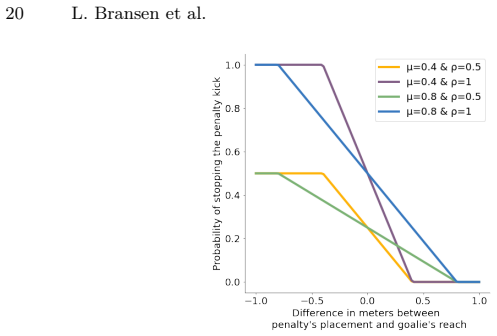
The central object is the goalkeeper policy π, a rule that fixes initial lineup, dive timing, and dive direction. The argument is carried by Equation 2, which converts a Euclidean distance between the keeper's starting point and the ball's crossing point into a save probability given a correct-corner dive: zero beyond reach plus a tolerance µ, ρ within reach minus µ, and linearly interpolated in between, with ρ=0.7 and µ=0.7 m fitted to data. Around this sit two learned models — a direction classifier (natural corner, non-natural corner, center) and a distance regressor — that let a policy be 'educated' by predicting where the kick will go and whether a late dive can reach it. This machinery lets the same historical kicks be replayed under any keeper's dive ranges, which is what makes per-keeper policy comparison possible.
What would settle it
Collect data with the goalkeeper's starting position and ball end coordinates. If, at fixed within-reach distance, save rates differ by ball speed or kick height, Equation 2 is falsified. Or, if the fraction of kicks aimed at the shaded corner drops when the keeper moves off center, the estimated 0.5 to 3 percentage point benefit is overestimated.
Extended reading notes
Core claim
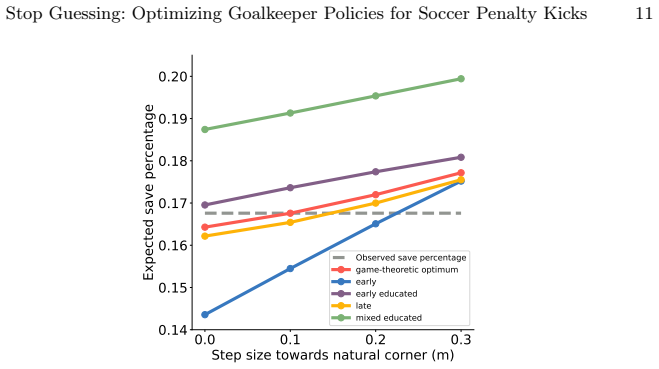
On the paper's own terms, the discovery is that the best policy for a specific goalkeeper depends on their action capacities, and aligning slightly off center increases the chance of saving a kick. The claim is established through a player-agnostic simulation framework: for each historical kick, the probability of a save is the probability of diving to the correct corner times the probability of stopping the kick given a correct-corner dive, where the second factor is a piecewise-linear function of the Euclidean distance between the goalkeeper's starting point and the ball's crossing point, controlled by a reach radius, a tolerance, and a within-reach save probability. Evaluated over 7,872 penalties, the framework finds no universally best policy: a keeper who can dive late should usually use the mixed educated policy, a keeper who cannot should use the early educated policy, and the aggregate game-theoretic optimum is beaten by policies that respect the keeper's actual range.
Load-bearing premise
The framework assumes both that save probability given a correct-corner dive depends only on the distance between the keeper's starting point and the ball's crossing point through a fitted curve (Equation 2), and that takers do not re-aim when the keeper stands visibly off center; if either fails, the policy rankings and the shading benefit change.
Editorial extensions
If this is right
- For a keeper who can dive late, the mixed educated policy is the best of the four considered; for a keeper who cannot dive late, early educated beats plain early.
- Shading 0.1 to 0.3 m toward the kicker's natural corner raises expected save percentage by 0.5 to 3 percentage points on on-target kicks, assuming the taker does not change aim in response.
- The aggregate game-theoretic optimum, which says to dive late 87.1% of the time, is not a reliable individual recommendation because many keepers lack the late-dive range to execute it.
- Shootout selection differs from in-game selection: a keeper with a strong early dive but no late dive looks better in shootouts because shootout takers use keeper-dependent kicks less often (15.1% versus 21.2%).
Reading between the lines
- Editorial inference: if ball speed and kick height were recorded, the distance-only save curve in Equation 2 could be re-estimated as a conditional surface; a testable prediction is that the fitted tolerance µ shrinks once those covariates are included.
- Editorial inference: the shading result could be coupled to the taker-response studies the paper cites, yielding an equilibrium offset at which the keeper gains from better reach without the taker shifting aim; the paper stops at the no-response case.
- Editorial inference: the framework can be run in reverse as a training diagnostic, identifying which dive range (early or late) the recommended policy is most sensitive to, so coaches can target that range in drills.
Editorial analysis
A structured set of objections, weighed in public.
Referee Report
Summary. The paper proposes a simulation framework for evaluating goalkeeper policies in soccer penalty kicks, using a merged dataset of 7,872 penalties annotated with kicker/goalkeeper strategies. The framework learns a direction model and a distance model, defines four policies (late, early, early educated, mixed educated), and evaluates them under varying goalkeeper dive ranges and initial positions. The main claims are that the optimal policy depends on a goalkeeper's action capacities and that aligning slightly off-center increases expected save percentage. The paper also demonstrates practical use cases such as selecting a goalkeeper for shootouts and generating taker-specific advice.
Significance. The work is valuable for sports analytics because it addresses the interaction between kickers and goalkeepers, incorporates action capacities, and provides a player-agnostic simulation framework with nested cross-validation for the learned models. The use of expert-annotated strategies and the practical use cases are strengths. However, the headline off-center claim rests on an unmodeled taker-response assumption, and the physical save model's parameters are fitted in-sample, which limits the strength of the quantitative conclusions until these are addressed.
major comments (3)
- [Section 5.2, Figure 2] The off-center benefit is computed by evaluating historical end coordinates of kicks taken when goalkeepers stood centered, with only the distance term in Eq. (2) changing. The manuscript itself cites evidence [21,25,31] that takers adjust their aim when the goalkeeper is visibly off-center, so the 0.5–3 percentage point gain is an upper bound under a zero-response assumption. A sensitivity analysis that models taker re-aiming (or at least varies the assumed response rate) is needed to substantiate the claim that aligning off-center increases save percentage; otherwise the claim should be explicitly reframed as an upper bound.
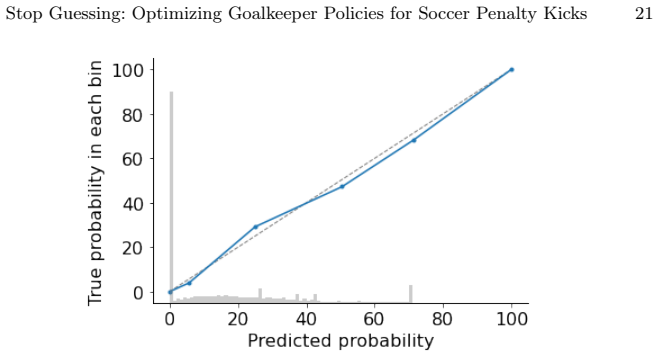
- [Appendix C and Section 5] The parameters ρ, μ, r_early, and r_late in Eq. (2) are fitted by grid search on the same dataset used for policy evaluation in Sections 5.1 and 5.2. Because these parameters directly determine p(s|k,c,π,gk), the reported expected save percentages are in-sample and may be optimistically biased. The calibration plot in Figure 6 is also on the same data. A nested or held-out calibration procedure, or at least a report of how sensitive the policy rankings are to variations in these parameters, is required to support the quantitative comparisons.
- [Section 4.1, Section 5.1, Figure 1] The mixed educated policy is defined to dive late exactly when the predicted kick distance is within the goalkeeper's late range. Its superiority over always-late or always-early policies, while expected under this decision rule, is partly by construction rather than an empirical discovery. The paper should benchmark the mixed educated policy against an oracle policy that uses true distances (or a policy that uses the distance model with an alternative threshold) to quantify the cost of distance prediction error, especially given that the distance model's accuracy is only slightly above baselines (Figure 3).
minor comments (5)
- [Section 5.4, Table 2] The text for Use Case 2 is inconsistent with the table: it says GK2 is expected to stop 18.4% but the table reports 0.187, and it says GK1 and GK3 save '17.4% (GK1) and 17.5% (GK2)' under the mixed policy, whereas the table shows GK3, not GK2, at 0.178; the corresponding percentages in the text should be corrected.
- [Section 4.2] The word 'emperical' should be 'empirical'.
- [Appendix C] The phrase 'proabily estimation task' should be 'probability estimation task'.
- [Appendix A.3] The similarity measure is referred to as 'Ratfcliff-Obershelp' but should be 'Ratcliff-Obershelp'.
- [General notation] The notation d(locs, ke)(π) in and around Eq. (2) is confusing because the policy argument appears as a function on the distance; consider using r_π(gk) or an explicit subscript to denote the dive range for policy π.
Circularity Check
No significant circularity: the paper's claims are explicit simulation outputs of a stated model, with the key limitation acknowledged by the authors.
full rationale
The paper is an explicit simulation study. Eq. (2) defines p(s|k,c,π,gk) as a piecewise-linear decreasing function of the distance between the goalkeeper's starting location and the ball's crossing point; the off-center evaluation in §5.2 re-evaluates this function with a shifted starting location. The reported 0.5–3 percentage point benefit is therefore a consequence of the model assumption, but it is not a circular derivation: Eq. (2) is not defined in terms of the policy rankings or the off-center conclusion, and the paper does not present the result as an independent empirical measurement. The parameters ρ=0.7, μ=0.7 and the dive ranges are fitted in Appendix C on the same dataset, which limits external validity and makes the counterfactual dependent on the fitted distance–save relationship; this is a correctness/robustness concern, not a self-referential reduction. Similarly, the mixed-educated policy's definition — dive late when the predicted distance is within the late range — makes its strong performance under Eq. (2) unsurprising, but §5.1 presents this as a simulation comparison rather than an independent discovery. The authors explicitly flag the most important threat to the off-center claim in §5.2: 'players may change their penalty direction based on the positioning of the goalkeeper,' citing [21,31,25]; this is a stated limitation rather than a hidden circular step. The only self-citation ([6]) appears in related work and is not load-bearing. No step in the derivation chain reduces to its own input by construction.
Assumptions & free parameters
free parameters (4)
- ρ (within-reach save probability) =
0.7
- µ (distance tolerance/uncertainty) =
0.7 m
- r_early (early dive range) =
3.1 m
- r_late (late dive range) =
2.8 m
assumptions (6)
- standard math Minimax theorem for finite zero-sum games
- domain assumption Penalty kick can be modeled as a zero-sum game with the specified action sets (kicker: N, C, NN, Dep; keeper: N, Late, NN)
- domain assumption Save probability given correct corner depends only on Euclidean distance between goalkeeper start and ball crossing point, via Eq. 2 with fitted parameters
- domain assumption Goalkeeper starts at the center of the goal when computing distances
- ad hoc to paper Taker direction distribution is unaffected by goalkeeper initial position in the off-center analysis
- domain assumption Keeper-dependent takers' outcomes can be summarized by the empirical probability of guessing the correct corner
Cite this review
Pith. "Pith review of Stop Guessing: Optimizing Goalkeeper Policies for Soccer Penalty Kicks." pith.science (2026). https://pith.science/paper/NGIPTATR
@misc{pith2026250524629,
  author       = {Pith},
  title        = {Pith review of: Stop Guessing: Optimizing Goalkeeper Policies for Soccer Penalty Kicks},
  year         = {2026},
  howpublished = {\url{https://pith.science/paper/NGIPTATR}},
  note         = {Machine review of arXiv:2505.24629}
}
read the original abstract
Penalties are fraught and game-changing moments in soccer games that teams explicitly prepare for. Consequently, there has been substantial interest in analyzing them in order to provide advice to practitioners. From a data science perspective, such analyses suffer from a significant limitation: they make the unrealistic simplifying assumption that goalkeepers and takers select their action -- where to dive and where to the place the kick -- independently of each other. In reality, the choices that some goalkeepers make depend on the taker's movements and vice-versa. This adds substantial complexity to the problem because not all players have the same action capacities, that is, only some players are capable of basing their decisions on their opponent's movements. However, the small sample sizes on the player level mean that one may have limited insights into a specific opponent's capacities. We address these challenges by developing a player-agnostic simulation framework that can evaluate the efficacy of different goalkeeper strategies. It considers a rich set of choices and incorporates information about a goalkeeper's skills. Our work is grounded in a large dataset of penalties that were annotated by penalty experts and include aspects of both kicker and goalkeeper strategies. We show how our framework can be used to optimize goalkeeper policies in real-world situations.
Figures


Figures from the paper (4 more)


Reference graph
Works this paper leans on
-
[1]
International Journal of Performance Analysis in Sport16, 508–522 (08 2016)
Almeida, C., Volossovitch, A., Duarte, R.: Penalty kick outcomes in UEFA club competitions (2010-2015): The roles of situational, individual and performance factors. International Journal of Performance Analysis in Sport16, 508–522 (08 2016)
work page 2010
-
[2]
American Economic Review 100(5), 2548–64 (December 2010)
Apesteguia, J., Palacios-Huerta, I.: Psychological pressure in competitive envi- ronments: Evidence from a randomized natural experiment. American Economic Review 100(5), 2548–64 (December 2010)
work page 2010
-
[3]
Azar, O.H., Bar-Eli, M.: Do soccer players play the mixed-strategy Nash equilib- rium? Applied Economics43(25), 3591–3601 (2011)
work page 2011
-
[4]
Soccer and Society10 (03 2009)
Bar-Eli, M., Azar, O.: Penalty kicks in soccer: An empirical analysis of shooting strategies and goalkeepers’ preferences. Soccer and Society10 (03 2009)
work page 2009
-
[5]
Journal of Economic Psychology 28, 606–621 (10 2007)
Bar-Eli, M., Azar, O., Ritov, I., Keidar-Levin, Y., Schein, G.: Action bias among elite soccer goalkeepers: The case of penalty kicks. Journal of Economic Psychology 28, 606–621 (10 2007)
work page 2007
-
[6]
In: Proceedings of the Sports Tomorrow Congress 2021 (2021)
Bransen, L., Davis, J.: Predicting football penalty directions using in-match per- formance indicators. In: Proceedings of the Sports Tomorrow Congress 2021 (2021)
work page 2021
-
[7]
International Journal of Performance Analysis in Sport22, 571 – 582 (2022)
Buscà, B., Hileno, R., Nadal, B., Serna, J.: Prediction of the penalty kick direction in men’s soccer. International Journal of Performance Analysis in Sport22, 571 – 582 (2022)
work page 2022
-
[8]
Chen, T., Guestrin, C.: XGBoost: A scalable tree boosting system. In: Proceedings of the 22nd ACM SIGKDD International Conference on Knowledge Discovery and Data Mining. pp. 785–794 (2016)
work page 2016
Show all 36 references
-
[9]
American Economic Review 92(4), 1138–1151 (2002)
Chiappori, P.A., Levitt, S., Groseclose, T.: Testing mixed-strategy equilibria when players are heterogeneous: The case of penalty kicks in soccer. American Economic Review 92(4), 1138–1151 (2002). https://doi.org/10.1257/00028280260344678
2002 doi
-
[10]
Percep- tion 39, 1111–24 (08 2010)
Dicks, M., Button, C., Davids, K.: Availability of advance visual information con- strains association-football goalkeeping performance during penalty kicks. Percep- tion 39, 1111–24 (08 2010)
2010
-
[11]
Attention, Perception & Psychophysics72, 706–20 (04 2010)
Dicks, M., Button, C., Davids, K.: Examination of gaze behaviors under in situ and video simulation task constraints reveals differences in information pickup for perception and action. Attention, Perception & Psychophysics72, 706–20 (04 2010)
2010
-
[12]
Ecological Psy- chology 19, 383 – 410 (2007)
Fajen, B.R.: Affordance-based control of visually guided action. Ecological Psy- chology 19, 383 – 410 (2007)
2007
-
[13]
FIFA: Laws of the game 2022/2023 (2022), https://www.theifab.com/laws-of-the- game-documents/
2022
-
[14]
International Journal of Perfor- mance Analysis in Sport21, 139 – 155 (2020)
Horn, M., de Waal, S.J., Kraak, W.: In-match penalty kick analysis of the 2009/10 to 2018/19 english premier league competition. International Journal of Perfor- mance Analysis in Sport21, 139 – 155 (2020)
2020
-
[15]
Scandinavian Journal of Medicine & Science in Sports28 (08 2018)
Hunter,A.,Angilletta,M.,Wilson,R.:Behaviorsofshooterandgoalkeeperinteract to determine the outcome of soccer penalties. Scandinavian Journal of Medicine & Science in Sports28 (08 2018)
2018
-
[16]
Journal of Biomechanics141, 111208 (06 2022) 16 L
Hunter, A., Pavlic, T., Angilletta, M., Wilson, R.: Identifying the best strategy for soccer penalty success: A predictive model for optimising behavioural and biome- chanical trade-offs. Journal of Biomechanics141, 111208 (06 2022) 16 L. Bransen et al
2022
-
[17]
Journal of Sports Sciences 37, 1–9 (07 2018)
Ibrahim, R., Kingma, I., de Boode, V., Faber, G., Van Dieen, J.: Kinematic and ki- netic analysis of the goalkeeper’s diving save in football. Journal of Sports Sciences 37, 1–9 (07 2018)
2018
-
[18]
Journal of Applied Sport Psychology24, 73–91 (01 2012)
Jordet, G., Elferink-Gemser, M.: Stress, coping, and emotions on the world stage: The experience of participating in a major soccer tournament penalty shootout. Journal of Applied Sport Psychology24, 73–91 (01 2012)
2012
-
[19]
Science and foot- ball pp
Kuhn, W.: Penalty-kick strategies for shooters and goalkeepers. Science and foot- ball pp. 489–492 (1988)
1988
-
[20]
Journal of sports sciences 16 3, 211–34 (1998)
Lees, A., Nolan, L.: The biomechanics of soccer: a review. Journal of sports sciences 16 3, 211–34 (1998)
1998
-
[21]
Psychological Science18, 222–3 (04 2007)
Masters, R., Kamp, J., Jackson, R.: Imperceptibly off-center goalkeepers influence penalty-kick direction in soccer. Psychological Science18, 222–3 (04 2007)
2007
-
[22]
Princeton University Press (1947)
von Neumann, J., Morgenstern, O.: Theory of Games and Economic Behavior. Princeton University Press (1947)
1947
-
[23]
Journal of Sports Sciences (06 2014)
Noël, B., Furley, P., Kamp, J., Dicks, M., Memmert, D., Francis, T.: The devel- opment of a method for identifying penalty kick strategies in association football. Journal of Sports Sciences (06 2014)
2014
-
[24]
Frontiers in Psychology12 (2021)
Noël, B., van der Kamp, J., Klatt, S.: The interplay of goalkeepers and penalty takers affects their chances of success. Frontiers in Psychology12 (2021)
2021
-
[25]
PLOS ONE10 (08 2015)
Noël, B., van der Kamp, J., Memmert, D.: Implicit goalkeeper influences on goal side selection in representative penalty kicking tasks. PLOS ONE10 (08 2015)
2015
-
[26]
Review of Economic Studies70, 395–415 (02 2003)
Palacios-Huerta, I.: Professionals play minimax. Review of Economic Studies70, 395–415 (02 2003)
2003
-
[27]
Ergonomics48, 1686–97 (2005)
Savelsbergh, G., van der Kamp, J., Williams, A., Ward, P.: Anticipation and visual search behaviour in expert soccer goalkeepers. Ergonomics48, 1686–97 (2005)
2005
-
[28]
Journal of Sports Sciences41(7), 668–676 (2023)
Secco Faquin, B., Teixeira, L.A., Coelho Candido, C.R., Boari Coelho, D., Bayeux Dascal, J., Alves Okazaki, V.H.: Prediction of ball direction in soccer penalty through kinematic analysis of the kicker. Journal of Sports Sciences41(7), 668–676 (2023)
2023
-
[29]
Tuyls, K.e.a.: Game plan: What AI can do for football, and what football can do for AI. J. Artif. Int. Res.71, 41–88 (sep 2021)
2021
-
[30]
Journal of Sports Sciences24(05), 467–477 (2006)
Van Der Kamp, J.: A field simulation study of the effectiveness of penalty kick strategies in soccer: late alterations of kick direction increase errors and reduce accuracy. Journal of Sports Sciences24(05), 467–477 (2006)
2006
-
[31]
Journal of Cognitive Psychology24 (12 2012)
Weigelt, M., Memmert, D., Schack, T.: Kick it like Ballack: The effects of goal- keeping gestures on goal-side selection in experienced soccer players and soccer novices. Journal of Cognitive Psychology24 (12 2012)
2012
-
[32]
Wood, G., Jordet, G., Wilson, M.R.: On winning the “lottery”: Psychological prepa- rationforfootballpenaltyshoot-outs.JournalofSportsSciences 33(17),1758–1765 (2015)
2015
-
[33]
Zheng, R., Reus, C., Kamp, J.: Goalkeeping in the soccer penalty kick: The dive is coordinated to the kicker’s non-kicking leg placement, irrespective of time con- straints. Human Movement Science76, 102763 (04 2021) Stop Guessing: Optimizing Goalkeeper Policies for Soccer Pen...
2021
-
[34]
kicker strategy (independent versus dependent kick)
-
[35]
goalkeeper dive direction (left, center, or right)
-
[36]
However, Sections 2 and 3 contain useful aggregate infor- mation about kicker strategy and dive timing
goalkeeper timing (early versus late dive) Annotating this requires trained analysts who can identify the differences be- tween the strategies. However, Sections 2 and 3 contain useful aggregate infor- mation about kicker strategy and dive timing
Reviewed August 7, 2026 · model on record in the stance chip above.
Discussion (0). Sign in to comment.