Axial-Vector Lattice Benchmarks Reveal a Common Medium Response of Meson Screening in Hot QCD
Pith reviewed 2026-06-26 01:46 UTC · model grok-4.3
The pith
One axial-vector lattice point fixes the medium response for meson screening masses across flavors in hot QCD
A machine-rendered reading of the paper's core claim, the machinery that carries it, and where it could break.
Core claim
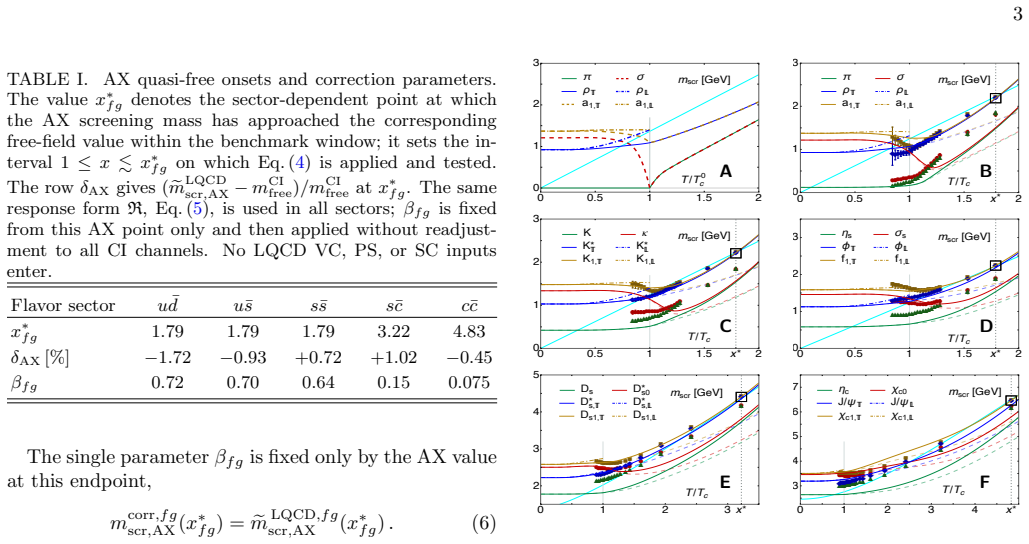
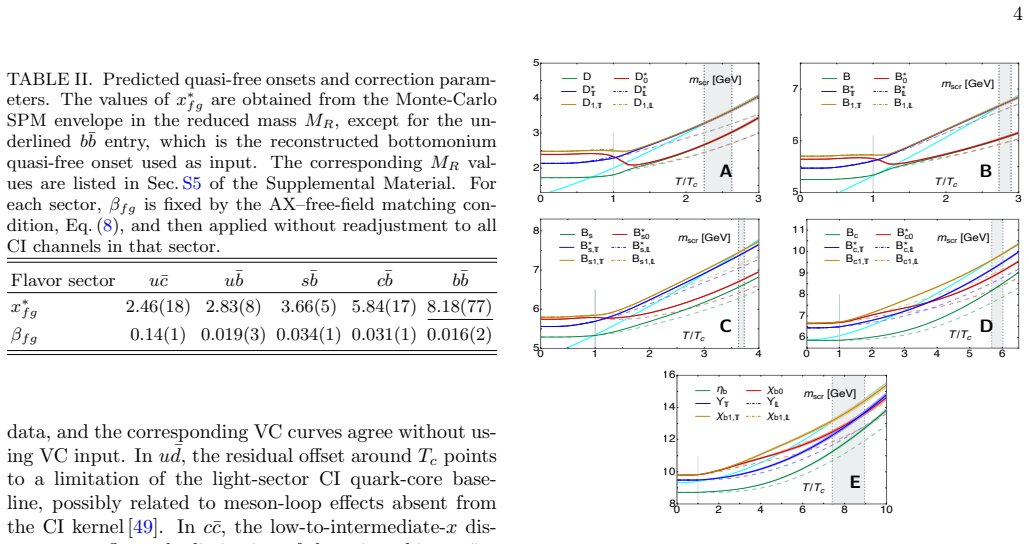
Combining lattice-QCD benchmarks with a symmetry-preserving Dyson-Schwinger baseline identifies a flavor-dependent axial-vector quasi-free onset and a finite-interval medium response. One axial-vector point fixes the response; remaining axial-vector data test it, and vector screening masses validate it without input. The framework predicts light-charm and bottom-containing spectra; its pseudoscalar-scalar extension gives conservative lower estimates for ordinary chiral partners.
What carries the argument
Symmetry-preserving Dyson-Schwinger equations calibrated at a single axial-vector lattice point to determine the temperature-dependent medium response
If this is right
- The calibrated response predicts screening masses for light-charm and bottom-containing mesons.
- The pseudoscalar-scalar extension supplies conservative lower estimates for ordinary chiral partners.
- Vector screening masses are reproduced without any further lattice input or parameter tuning.
Where Pith is reading between the lines
- If the common response holds, the same single-point calibration could be reused to estimate other thermodynamic quantities in hot QCD.
- Future lattice results on bottom-quark screening masses would provide a direct test of the flavor dependence.
- The finite response interval may mark a characteristic temperature window separating hadronic from partonic screening behavior across flavors.
Load-bearing premise
The symmetry-preserving Dyson-Schwinger equations, once calibrated at a single axial-vector lattice point, correctly capture the temperature-dependent medium response for all other channels and flavors without additional adjustments.
What would settle it
An independent calculation of vector screening masses at a temperature inside the claimed medium-response interval that deviates from the predicted values would falsify the claim.
Figures
read the original abstract
Meson screening masses trace the dissolution of hadronic correlations in hot QCD. Combining lattice-QCD benchmarks with a symmetry-preserving Dyson--Schwinger baseline, we identify a flavor-dependent axial-vector quasi-free onset and a finite-interval medium response. One axial-vector point fixes the response; remaining axial-vector data test it, and vector screening masses validate it without input. The framework predicts light-charm and bottom-containing spectra; its pseudoscalar--scalar extension gives conservative lower estimates for ordinary chiral partners.
Editorial analysis
A structured set of objections, weighed in public.
Referee Report
Summary. The paper combines lattice-QCD benchmarks on meson screening masses with a symmetry-preserving Dyson-Schwinger equation (DSE) baseline to model the temperature-dependent medium response in hot QCD. It identifies a flavor-dependent axial-vector quasi-free onset together with a finite-interval medium response. The central procedure uses one axial-vector lattice datum to fix the response function; the remaining axial-vector points serve as tests, while vector-channel screening masses provide an input-free validation. The framework is then used to predict light-charm and bottom-containing spectra and to supply conservative lower bounds on pseudoscalar-scalar chiral-partner masses.
Significance. If the central claim is substantiated, the work supplies a concrete, minimally parameterized bridge between lattice data and continuum methods for the dissolution of hadronic correlations above the crossover. The single-point calibration followed by cross-channel validation without further tuning, together with explicit predictions for unmeasured flavor combinations, would constitute a useful phenomenological tool for heavy-ion phenomenology and could be tested against forthcoming lattice results on vector and heavy-quark channels.
major comments (1)
- The manuscript does not demonstrate that the chosen DSE truncation (gluon propagator, vertex ansatz, and any explicit temperature dependence) contains precisely one adjustable quantity after the single axial-vector calibration point is imposed. Without an explicit count of free functions or parameters in the truncation (e.g., in the section describing the DSE setup), the subsequent agreement with vector screening masses cannot be unambiguously interpreted as an out-of-sample validation rather than a consequence of residual freedom in the ansatz.
minor comments (1)
- The abstract and introduction would benefit from a concise statement of the precise functional form adopted for the medium response (e.g., its temperature dependence and flavor scaling) so that readers can immediately assess the number of parameters involved.
Simulated Author's Rebuttal
We thank the referee for the thoughtful review and the recommendation for major revision. The primary concern is the need for an explicit demonstration of the parameter count in the DSE truncation. We address this below and will revise the manuscript to include a clear enumeration of free parameters and functions.
read point-by-point responses
-
Referee: The manuscript does not demonstrate that the chosen DSE truncation (gluon propagator, vertex ansatz, and any explicit temperature dependence) contains precisely one adjustable quantity after the single axial-vector calibration point is imposed. Without an explicit count of free functions or parameters in the truncation (e.g., in the section describing the DSE setup), the subsequent agreement with vector screening masses cannot be unambiguously interpreted as an out-of-sample validation rather than a consequence of residual freedom in the ansatz.
Authors: We acknowledge that an explicit count of parameters would enhance clarity. The gluon propagator is fixed by lattice input without adjustable parameters. The vertex is the symmetry-preserving Ball-Chiu construction, which introduces no free functions. Temperature dependence is incorporated solely via the medium response function, which is calibrated at one axial-vector point. Thus, after this calibration, there are no remaining adjustable quantities. We will add a paragraph in the DSE setup section explicitly listing these elements to demonstrate that the vector-channel results are indeed out-of-sample validations. This change will be implemented in the revised version. revision: yes
Circularity Check
No significant circularity; calibration on external lattice data with out-of-sample validation
full rationale
The described procedure fixes a single response parameter using one axial-vector lattice datum and then tests the remainder of the axial-vector data plus vector channels with no further input. This constitutes standard model calibration against external benchmarks followed by cross-validation, not a reduction of the output to the input by construction. The symmetry-preserving DSE baseline supplies independent dynamical content (gluon propagator, vertex structure, and flavor dependence) whose form is not redefined by the single-point fit. No self-citation chain, ansatz smuggling, or renaming of known results is exhibited in the abstract or reader summary. The vector-channel validation without input further indicates that the central claim retains independent predictive content.
Axiom & Free-Parameter Ledger
free parameters (1)
- axial-vector response calibration point
axioms (2)
- domain assumption Symmetry-preserving Dyson-Schwinger equations provide a reliable baseline for temperature-dependent meson properties in hot QCD.
- domain assumption Lattice QCD benchmarks accurately represent the true screening masses for the mesons considered.
Reference graph
Works this paper leans on
-
[1]
Y. Aoki, G. Endrodi, Z. Fodor, S. D. Katz and K. K. Sz- abo, Nature443, 675-678 (2006)
2006
-
[2]
Bazavov and J
A. Bazavov and J. H. Weber, Prog. Part. Nucl. Phys. 116, 103823 (2021)
2021
-
[3]
D. J. Gross, R. D. Pisarski and L. G. Yaffe, Rev. Mod. Phys.53, 43 (1981)
1981
-
[4]
Braaten and A
E. Braaten and A. Nieto, Phys. Rev. D53, 3421-3437 (1996)
1996
-
[5]
D. Bala, O. Kaczmarek, P. Petreczky, S. Sharma and S. Tah, Phys. Rev. Lett.135, no.1, 012301 (2025)
2025
-
[6]
Cheng, S
M. Cheng, S. Datta, A. Francis, J. van der Heide, C. Jung, O. Kaczmarek, F. Karsch, E. Laermann, R. D. Mawhinney and C. Miao,et al.Eur. Phys. J. C 71, 1564 (2011)
2011
-
[7]
Bazavov, F
A. Bazavov, F. Karsch, Y. Maezawa, S. Mukherjee and P. Petreczky, Phys. Rev. D91, no.5, 054503 (2015)
2015
-
[8]
Bazavov, S
A. Bazavov, S. Dentinger, H. T. Ding, P. Hegde, O. Kacz- marek, F. Karsch, E. Laermann, A. Lahiri, S. Mukher- jee and H. Ohno,et al.Phys. Rev. D100, no.9, 094510 (2019)
2019
-
[9]
Petreczky, S
P. Petreczky, S. Sharma and J. H. Weber, Phys. Rev. D 104, no.5, 054511 (2021)
2021
-
[10]
Aokiet al.[JLQCD], Phys
Y. Aokiet al.[JLQCD], Phys. Rev. D111, no.11, 114506 (2025)
2025
-
[11]
Kaczmarek, Lect
O. Kaczmarek, Lect. Notes Phys.999, 281-305 (2022)
2022
-
[12]
B. B. Brandt, A. Francis, M. Laine and H. B. Meyer, JHEP05, 117 (2014)
2014
-
[13]
Chatrchyanet al.[CMS], Phys
S. Chatrchyanet al.[CMS], Phys. Rev. Lett.109, 222301 (2012) [erratum: Phys. Rev. Lett.120, no.19, 199903 (2018)]
2012
-
[14]
Matsui and H
T. Matsui and H. Satz, Phys. Lett. B178, 416-422 (1986)
1986
-
[15]
R. Rapp, D. Blaschke and P. Crochet, Prog. Part. Nucl. Phys.65, 209-266 (2010)
2010
-
[16]
R. L. Thews, M. Schroedter and J. Rafelski, Phys. Rev. C63, 054905 (2001)
2001
-
[17]
Greco, C
V. Greco, C. M. Ko and R. Rapp, Phys. Lett. B595, 202-208 (2004)
2004
-
[18]
M. He, R. J. Fries and R. Rapp, Phys. Rev. C86, 014903 (2012)
2012
-
[19]
C. D. Roberts and A. G. Williams, Prog. Part. Nucl. Phys.33, 477-575 (1994)
1994
-
[20]
C. D. Roberts and S. M. Schmidt, Prog. Part. Nucl. Phys. 45, S1-S103 (2000)
2000
-
[21]
Eichmann, H
G. Eichmann, H. Sanchis-Alepuz, R. Williams, R. Alkofer and C. S. Fischer, Prog. Part. Nucl. Phys.91, 1-100 (2016)
2016
-
[22]
C. S. Fischer, Prog. Part. Nucl. Phys.105, 1-60 (2019)
2019
-
[23]
Maris, C
P. Maris, C. D. Roberts, S. M. Schmidt and P. C. Tandy, Phys. Rev. C63, 025202 (2001)
2001
-
[24]
Blaschke, G
D. Blaschke, G. Burau, Y. L. Kalinovsky, P. Maris and P. C. Tandy, Int. J. Mod. Phys. A16, 2267-2291 (2001)
2001
-
[25]
Gao and M
F. Gao and M. Ding, Eur. Phys. J. C80, no.12, 1171 (2020)
2020
-
[26]
K. l. Wang, Y. x. Liu, L. Chang, C. D. Roberts and S. M. Schmidt, Phys. Rev. D87, no.7, 074038 (2013)
2013
-
[27]
C. Chen, F. Gao and S. x. Qin, Phys. Rev. D112, no.1, 014022 (2025)
2025
-
[28]
Schlessinger and C
L. Schlessinger and C. Schwartz, Phys. Rev. Lett.16, 1173-1174 (1966)
1966
-
[29]
Schlessinger, Phys
L. Schlessinger, Phys. Rev.167, no.5, 1411 (1968)
1968
-
[30]
R. A. Tripolt, I. Haritan, J. Wambach and N. Moiseyev, Phys. Lett. B774, 411-416 (2017)
2017
-
[31]
C. Chen, Y. Lu, D. Binosi, C. D. Roberts, J. Rodr´ ıguez- Quintero and J. Segovia, Phys. Rev. D99, no.3, 034013 (2019)
2019
-
[32]
Z. F. Cui, C. Chen, D. Binosi, F. de Soto, C. D. Roberts, J. Rodr´ ıguez-Quintero, S. M. Schmidt and J. Segovia, Phys. Rev. D102, no.1, 014043 (2020)
2020
-
[33]
Z. F. Cui, D. Binosi, C. D. Roberts and S. M. Schmidt, Phys. Rev. Lett.127, no.9, 092001 (2021)
2021
-
[34]
H. J. Munczek, Phys. Rev. D52, 4736-4740 (1995)
1995
-
[35]
Bender, C
A. Bender, C. D. Roberts and L. Von Smekal, Phys. Lett. B380, 7-12 (1996)
1996
-
[36]
Chang and C
L. Chang and C. D. Roberts, Phys. Rev. Lett.103, 081601 (2009)
2009
-
[37]
C. S. Fischer and R. Williams, Phys. Rev. Lett.103, 122001 (2009)
2009
-
[38]
Williams, C
R. Williams, C. S. Fischer and W. Heupel, Phys. Rev. D 93, no.3, 034026 (2016)
2016
-
[39]
S. X. Qin and C. D. Roberts, Chin. Phys. Lett.38, no.7, 071201 (2021)
2021
-
[40]
M. S. Bhagwat, L. Chang, Y. X. Liu, C. D. Roberts and P. C. Tandy, Phys. Rev. C76, 045203 (2007)
2007
-
[41]
M. Ding, K. Raya, A. Bashir, D. Binosi, L. Chang, M. Chen and C. D. Roberts, Phys. Rev. D99, no.1, 014014 (2019)
2019
-
[42]
Binosi, C
D. Binosi, C. Mezrag, J. Papavassiliou, C. D. Roberts and J. Rodriguez-Quintero, Phys. Rev. D96, no.5, 054026 (2017)
2017
-
[43]
Ebert, T
D. Ebert, T. Feldmann and H. Reinhardt, Phys. Lett. B 388, 154-160 (1996)
1996
-
[44]
Krein, C
G. Krein, C. D. Roberts and A. G. Williams, Int. J. Mod. Phys. A7, 5607-5624 (1992)
1992
-
[45]
P. L. Yin, Z. F. Cui, C. D. Roberts and J. Segovia, Eur. Phys. J. C81, no.4, 327 (2021)
2021
-
[46]
Bazavov, T
A. Bazavov, T. Bhattacharya, M. Cheng, C. DeTar, H. T. Ding, S. Gottlieb, R. Gupta, P. Hegde, U. M. Heller and F. Karsch,et al.Phys. Rev. D85, 054503 (2012)
2012
-
[47]
Fukushima and C
K. Fukushima and C. Sasaki, Prog. Part. Nucl. Phys.72, 99-154 (2013)
2013
-
[48]
Buballa, Phys
M. Buballa, Phys. Rept.407, 205-376 (2005)
2005
-
[49]
C. Chen, L. Chang, C. D. Roberts, S. Wan and D. J. Wil- son, Few Body Syst.53, 293-326 (2012)
2012
-
[50]
Y. Lu, C. Chen, C. D. Roberts, J. Segovia, S. S. Xu and H. S. Zong, Phys. Rev. C96, no.1, 015208 (2017)
2017
-
[51]
P. L. Yin, C. Chen, G. Krein, C. D. Roberts, J. Segovia and S. S. Xu, Phys. Rev. D100, no.3, 034008 (2019)
2019
-
[52]
Cheng, F
P. Cheng, F. E. Serna, Z. Q. Yao, C. Chen, Z. F. Cui and C. D. Roberts, Phys. Rev. D106, no.5, 054031 (2022)
2022
-
[53]
Navaset al.[Particle Data Group], Phys
S. Navaset al.[Particle Data Group], Phys. Rev. D110, no.3, 030001 (2024)
2024
-
[54]
Mathur, M
N. Mathur, M. Padmanath and S. Mondal, Phys. Rev. Lett.121, no.20, 202002 (2018)
2018
-
[55]
R. J. Dowdall, C. T. H. Davies, G. P. Lepage and C. Mc- Neile, Phys. Rev. D88, 074504 (2013). 7 SUPPLEMENT AL MA TERIAL S1. DYSON–SCHWINGER FRAMEWORK At finite temperatureT, the Bethe–Salpeter amplitude (BSA) Γ J P [f¯g](pωp , P0) for a meson composed of a valence quark of flavorfand a valence antiquark of flavor ¯gis obtained from the homogeneous Bethe–S...
2013
discussion (0)
Sign in with ORCID, Apple, or X to comment. Anyone can read and Pith papers without signing in.