REVIEW 2 major objections 8 minor 61 references
The paper asks whether a pretrained image-editing model can serve as a common numerical simulator, and reports that it can — for ten physics tasks, with scalar parameters injected through small adapters, while chaotic long-horizon predictio
Reviewed by Pith at T0; open to challenge. T0 means a machine referee read the full paper against a public rubric. the ladder, T0–T4 →
T0 review · deepseek-v4-flash
2026-08-01 14:17 UTC pith:NITYVJ5T
load-bearing objection Broad, honest capability probe of a FLUX image-editing backbone as a common interface for PDEs — but target-derived per-sample normalization in four tasks weakens the physical-inputs-alone claim, and the KS failure analysis is the strongest evidence in the paper. the 2 major comments →
Image Editing Models are Numerical Solvers
The pith
A machine-rendered reading of the paper's core claim, the machinery that carries it, and where it could break.
Core claim
The central discovery is that a frozen pretrained image-editing model, adapted with low-rank updates and scalar conditioning, can serve as a common solver interface for heterogeneous physics once inputs and outputs are rendered into images. For each task the paper defines a deterministic encoding — coefficient and forcing maps for elliptic problems, space-time images for one-dimensional evolution, direction-and-speed RGB maps for flows, masks and scalar loads for elasticity and fracture — and trains a small adapter set per equation using solver-generated supervision. The same protocol yields held-out predictions across all ten tasks. The paper also documents the boundary of the approach in a
What carries the argument
The driving mechanism is the visual encoding combined with scalar-conditioned adaptation. Physical instances become condition images: multiple coefficient channels for elliptic equations, time-as-vertical-axis diagrams for one-dimensional evolution, direction-and-speed color maps for flows, and masks plus scalar loads for mechanics. Scalar parameters such as diffusivity, viscosity, material constants, and applied loads are injected into each transformer block through adaptive normalization that starts zero-initiated, so the pretrained model is gently redirected rather than overwritten. Low-rank adapters — small trainable matrices added to attention projections — let the frozen image-editing
Load-bearing premise
In several experiments the color scale used to render the target solution is set by a statistic of that same solution (its maximum absolute value or 99th percentile), and the paper does not specify how a deployed model would obtain this scale without already knowing the answer; if the scale is taken from the ground truth, the positive results do not establish a mapping from physical inputs alone.
What would settle it
Take a held-out sample from the heat, Burgers, or elasticity experiments and re-render the condition images using a color range fixed by a global dataset statistic or by a range estimated from the inputs alone, then compare the model's prediction to the solver's solution. If accuracy collapses to near-random, the reported success depended on the per-sample normalization scale computed from the target solution.
If this is right
- A single pretrained image-editing architecture, with per-task low-rank adapters and scalar conditioning, can represent solution operators for elliptic PDEs, heat and Burgers evolution, complex Ginzburg-Landau dynamics, Navier-Stokes prediction, potential flow, elasticity, eikonal travel time, phase-field fracture, and entropic optimal transport.
- Time-dependent one-dimensional problems can be treated as image-to-image translation by rendering the entire trajectory as a space-time image, with the initial condition repeated as the condition image.
- Material and loading parameters can enter through a small scalar-conditioning pathway, so each adapter covers a parameter family rather than a single isolated instance.
- The same training protocol transfers across heterogeneous tasks without task-specific architectural changes, supporting the paper's common-interface claim.
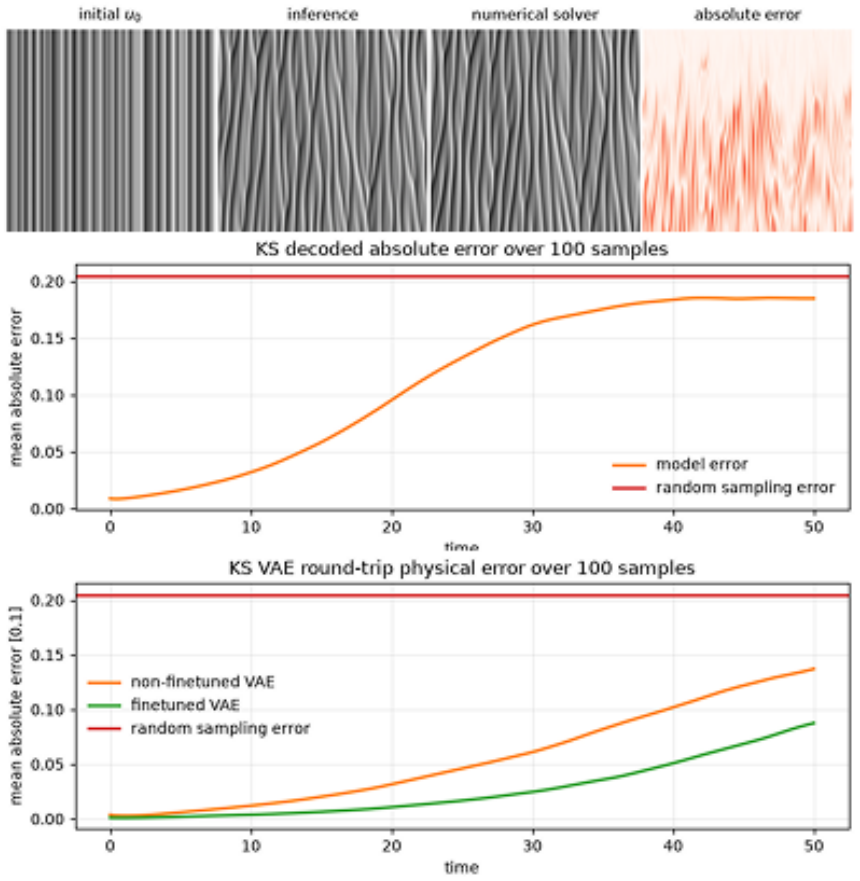
- The approach is not a replacement for specialized solvers: accuracy, conservation, and stability are not guaranteed, and the chaotic Kuramoto-Sivashinsky experiment fails because encoder round-trip error of about two percent plus condition-token drift are exponentially amplified.
Where Pith is reading between the lines
- The per-sample scale issue points to a concrete repair the paper only gestures at: supply the normalizing range as an extra scalar conditioner, so output-magnitude information enters the model legitimately rather than through the target image.
- The attribution of chaotic failure to latent compression suggests a testable diagnostic: replace the compressed latent encoder with a near-lossless or pixel-space representation and measure whether the Kuramoto-Sivashinsky prediction horizon extends.
- Because each equation currently needs its own adapter set, a natural next step is a single multi-task checkpoint in which the conditioning images themselves specify which equation to solve; the paper names shared training only as future work.
- The same visual interface could be used as a solver-conditioned refinement layer: a coarse numerical solution as input image and the editor as a corrector or super-resolver, with chaotic dynamics again the limiting case.
Editorial analysis
A structured set of objections, weighed in public.
Referee Report
Summary. The paper proposes using a pretrained FLUX-family image-editing model, fine-tuned per task with LoRA and AdaLN-Zero scalar conditioning, as a common interface for numerical simulation. For each task, physical inputs are rendered into conditioning images and solutions into target images; the model is trained on solver-generated data and evaluated with held-out samples. The paper reports qualitative success on ten tasks (elliptic PDEs, heat, Burgers, CGLE, Navier-Stokes, potential flow, elasticity, eikonal, phase-field fracture, entropic optimal transport) and a failure on Kuramoto-Sivashinsky, which it analyzes as VAE compression and condition-token drift amplified by chaos. The paper explicitly frames itself as a capability study rather than a solver replacement.
Significance. The idea is appealing and the breadth is a strength: it tests one backbone across heterogeneous static and time-dependent problems, and the negative KS result is reported honestly with a quantitative error-attribution experiment. The paper also provides detailed solver and training appendices. However, the central capability claim is currently supported mainly by visual samples. Two issues are load-bearing: (i) in four tasks the condition images are normalized with a per-sample scale derived from the target solution, so the mapping is not from physical inputs alone; (ii) no aggregate error statistics are reported for the successful tasks. If these are fixed, the result would be a solid capability study; as written, the evidence does not establish the abstract's claim.
major comments (2)
- [§3.3, §3.4, §3.5, §3.8] For heat (§3.3), Burgers (§3.5), CGLE (§3.4), and elasticity (§3.8), the condition images are normalized with a per-sample scale computed from the target solution (e.g., 'the largest magnitude in the forcing or solution', 'the maximum absolute value of the trajectory', a shared per-sample magnitude scale, or the per-sample 99th percentile of von Mises stress). At inference this scale is not a conditioning input (only κ; c1/c3; ν/ρ; λ/μ/σ are provided). Thus the same normalized condition image is compatible with arbitrarily many physical input scales, and the output can be de-normalized only using ground-truth target statistics. The reported positive results are therefore not a map from physical inputs to physical solutions; they are a normalized-image-to-normalized-image map plus an oracle scale. The §4 limitation discusses scale-aware encodings only as future work. The authors should ei
- [§3.2–§3.11] No quantitative aggregate evaluation is reported for the successful tasks. Figures 1–10 show error maps but no error magnitudes, test-set sizes, or summary statistics; the only numeric error curve is for the failed KS experiment (Fig. 11). For a capability claim that the model 'can represent' these mappings, the paper must report held-out error statistics (e.g., RMSE, relative L2, or per-task error percentiles) in physical units, not only visually selected panels. Without such metrics, the claim is not quantitatively supported.
minor comments (8)
- [Title/Abstract] The arXiv title says 'Numerical Solvers' while the full text title says 'Numerical Simulators'. Please unify the terminology.
- [Figures 1–10] The error maps lack numeric colorbars, making it impossible to assess absolute error levels. Add a scale or colorbar legend.
- [§3.4] The 'per-sample magnitude scale' for CGLE is ambiguous; specify whether it is computed from the initial condition, the full trajectory, or both.
- [§3.6] Density ρ is included as a conditioning variable but the text states it cancels from the unforced Navier-Stokes dynamics. Remove it or explicitly analyze whether the model learns the intended invariance.
- [§4] The '2% reconstruction error' and '10% by t=5.9' figures are percentages without a metric definition. Specify the norm or relative-error measure used.
- [§3.11 / Eq. (14)] The path-averaged cost bar{c}_{ij} is not precisely defined; clarify how the 'average sampled cost field along the line segment' is computed.
- [General] The repeated 'In laymen's terms' paragraphs are informal and interrupt the technical presentation; consider moving them to figure captions or an appendix.
- [General] No code or data availability statement is provided. For a reproducibility-focused capability study, a release plan would be helpful.
Circularity Check
Per-sample target-derived color normalization in heat, Burgers, and CGLE makes condition images depend on the solution, so the claimed physical-input-to-solution mapping is only partially established.
specific steps
-
self definitional
[Section 3.3, 'Image encoding']
"All three images share a symmetric per-sample color range determined by the largest magnitude in the forcing or solution."
The conditioning images (initial condition and forcing) are normalized by a scale that is defined using the target solution's magnitude. Since the only scalar condition is κ and no scale is supplied, the normalized condition image does not determine the physical amplitude of the solution. Any conversion of the model's normalized output to the displayed physical field must use the ground-truth solution's magnitude, so the reported input-to-solution mapping is not established from physical inputs alone.
-
self definitional
[Section 3.5, 'Image encoding']
"Initial and target images share a symmetric per-sample color range given by the maximum absolute value of the trajectory."
The initial-condition image is defined as u0 divided by the maximum absolute value of the whole solution trajectory, i.e. by a statistic of the target being predicted. At inference this scale is not available from u0 alone; the same normalized initial image is compatible with arbitrarily different physical trajectories. Recovering the physical 'model inference' field requires the target trajectory's maximum, so the positive result reduces to a conditional mapping from (initial condition, oracle scale) to a normalized field.
-
self definitional
[Section 3.4, 'Image encoding']
"Condition and solution share a per-sample magnitude scale to map to 0-1"
The repeated initial-field condition is normalized by a per-sample magnitude scale taken from the solution trajectory. Since the experiment fixes c1 and c3 and no scale is given to the model, the normalized condition loses the physical amplitude of A; converting the generated brightness back to a physical complex field requires the trajectory's magnitude statistic. Thus the claimed prediction is from (initial field plus target-derived scale), not from the initial field alone.
full rationale
The paper is a capability study, and most of its experiments (elliptic PDEs, Navier-Stokes, potential flow, eikonal, phase-field fracture, entropic optimal transport) use fixed, input-independent color ranges; those results are not circular. However, the heat, Burgers, and complex Ginzburg-Landau experiments define the shared per-sample color scale using a statistic of the target solution (largest magnitude in forcing-or-solution, maximum absolute value of trajectory, per-sample magnitude scale). In each of these cases the condition image cannot be constructed without knowing the solution, and the model is not given the scale as a conditioning parameter. The paper's own Limitations section acknowledges this only partially: '...generalizing this could alleviate this problem if the associated scale were supplied as an additional conditioning parameter' — confirming that the scale is not supplied. Consequently, the broad claim that a pretrained image model maps physical inputs to physical solutions is undercut for a substantial subset of the reported tasks. The failure is not a self-citation or uniqueness-import issue; it is a target-derived normalization issue, which is a partial circularity rather than a complete collapse of the study.
Axiom & Free-Parameter Ledger
free parameters (2)
- per-sample normalization scale =
1/max|u| for heat/Burgers; common max magnitude for CGLE; 99th-percentile clip for elasticity stress
- color-range endpoints and gamma/midpoint constants =
e.g., slowness [0.05,1], travel time [0,0.75] gamma 0.6 midpoint 1.5; OT log-density [-33.6728,-9.1528], potential [-0.4
axioms (4)
- domain assumption The pretrained FLUX.2-klein-4B model and its frozen VAE provide a latent space and inductive bias adequate for physics-field rendering.
- domain assumption The solver-generated supervision (finite differences, spectral, FEM, fast marching, Sinkhorn) is accurate at the stated resolutions.
- ad hoc to paper The per-sample normalization scale is either unnecessary or recoverable at inference without the target solution.
- domain assumption 256×256 image resolution and four-step distilled sampling preserve enough information for the studied problems.
read the original abstract
We investigate whether a pretrained generative image-editing model can provide a common interface for numerical simulation. Physical inputs and solutions are rendered as images, while scalar quantities such as material properties, diffusivity, and loading parameters enter through lightweight adapters. Using established numerical and analytic solvers for supervision, we apply the same architecture and training protocol to heterogeneous elliptic equations, forced heat and Burgers evolution, complex Ginzburg-Landau dynamics, two-dimensional Navier-Stokes prediction, potential flow, elasticity, eikonal travel time, phase-field fracture, and entropic optimal transport. The results show that a pretrained image model can represent diverse static and time-dependent physical mappings, including unstable and shock-like behavior, when each task is expressed through a suitable visual encoding. This work is a capability study rather than an attempt to surpass specialized solvers. It also identifies fundamental constraints: image and latent representations complicate numerical range selection and direct enforcement of governing equations or invariants, while a failed Kuramoto-Sivashinsky experiment indicates that representation errors prevent meaningful long-horizon simulation of chaotic systems.
Figures



Reference graph
Works this paper leans on
-
[1]
Igor S. Aranson and Lorenz Kramer. The world of the complex Ginzburg-Landau equation.Reviews of Modern Physics, 74(1):99–143, 2002.https://doi.org/10.1103/RevModPhys.74.99
-
[2]
Wasserstein generative adversarial networks
Martin Arjovsky, Soumith Chintala, and L´ eon Bottou. Wasserstein generative adversarial networks. InProceedings of the 34th International Conference on Machine Learning, volume 70 ofProceedings of Machine Learning Research, pages 214–223. PMLR, 2017.https://proceedings.mlr.press/v70/ arjovsky17a.html
2017
-
[4]
FLUX.1 [dev], 2024
Black Forest Labs. FLUX.1 [dev], 2024. Official model card,https://huggingface.co/ black-forest-labs/FLUX.1-dev
2024
-
[5]
FLUX.2 [klein] 4B, 2026
Black Forest Labs. FLUX.2 [klein] 4B, 2026. Official model card, accessed 2026-07-08,https:// huggingface.co/black-forest-labs/FLUX.2-klein-4B
2026
-
[6]
Black Forest Labs, Stephen Batifol, Andreas Blattmann, Frederic Boesel, Saksham Consul, Cyril Diagne, Tim Dockhorn, Jack English, Zion English, Patrick Esser, Sumith Kulal, Kyle Lacey, Yam Levi, Cheng Li, Dominik Lorenz, Jonas M¨ uller, Dustin Podell, Robin Rombach, Harry Saini, Axel Sauer, and Luke Smith. FLUX.1 Kontext: Flow matching for in-context imag...
Pith/arXiv arXiv 2025
-
[8]
J. M. Burgers. A mathematical model illustrating the theory of turbulence.Advances in Applied Mechanics, 1:171–199, 1948.https://doi.org/10.1016/S0065-2156(08)70100-5. 24
-
[9]
S. M. Cox and P. C. Matthews. Exponential time differencing for stiff systems.Journal of Computational Physics, 176(2):430–455, 2002.https://doi.org/10.1006/jcph.2002.6995
arXiv 2002
-
[10]
Sinkhorn distances: Lightspeed computation of optimal transport
Marco Cuturi. Sinkhorn distances: Lightspeed computation of optimal transport. InAdvances in Neural Information Processing Systems, volume 26, 2013.https://proceedings.neurips.cc/paper/2013/ hash/af21d0c97db2e27e13572cbf59eb343d-Abstract.html
2013
-
[11]
Davidchack, and Evangelos Siminos
Predrag Cvitanovi´ c, Ruslan L. Davidchack, and Evangelos Siminos. On the state space geometry of the Kuramoto-Sivashinsky flow in a periodic domain.SIAM Journal on Applied Dynamical Systems, 9(1):1–33, 2010.https://doi.org/10.1137/070705623
-
[12]
Jean-Pierre Eckmann and David Ruelle. Ergodic theory of chaos and strange attractors.Reviews of Modern Physics, 57(3):617–656, 1985.https://doi.org/10.1103/RevModPhys.57.617
-
[13]
Scaling rectified flow transformers for high- resolution image synthesis
Patrick Esser, Sumith Kulal, Andreas Blattmann, Rahim Entezari, Jonas M¨ uller, Harry Saini, Yam Levi, Dominik Lorenz, Axel Sauer, Frederic Boesel, Dustin Podell, Tim Dockhorn, Zion English, Kyle Lacey, Alex Goodwin, Yannik Marek, and Robin Rombach. Scaling rectified flow transformers for high- resolution image synthesis. InProceedings of the 41st Interna...
2024
-
[14]
Interpolating between optimal transport and MMD using sinkhorn divergences
Jean Feydy, Thibault S´ ejourn´ e, Fran¸ cois-Xavier Vialard, Shun-ichi Amari, Alain Trouv´ e, and Gabriel Peyr´ e. Interpolating between optimal transport and MMD using sinkhorn divergences. InProceedings of the Twenty-Second International Conference on Artificial Intelligence and Statistics, volume 89, pages 2681–2690. PMLR, 2019.https://proceedings.mlr...
2019
-
[15]
Goodfellow, Jean Pouget-Abadie, Mehdi Mirza, Bing Xu, David Warde-Farley, Sherjil Ozair, Aaron Courville, and Yoshua Bengio
Ian J. Goodfellow, Jean Pouget-Abadie, Mehdi Mirza, Bing Xu, David Warde-Farley, Sherjil Ozair, Aaron Courville, and Yoshua Bengio. Generative adversarial nets. InAdvances in Neural Information Processing Systems, volume 27, pages 2672–2680, 2014.https://proceedings.neurips.cc/paper_ files/paper/2014/hash/f033ed80deb0234979a61f95710dbe25-Abstract.html
2014
-
[16]
Sigal Gottlieb and Chi-Wang Shu. Total variation diminishing Runge-Kutta schemes.Mathematics of Computation, 67(221):73–85, 1998.https://doi.org/10.1090/S0025-5718-98-00913-2
-
[17]
Prompt- to-prompt image editing with cross-attention control
Amir Hertz, Ron Mokady, Jay Tenenbaum, Kfir Aberman, Yael Pritch, and Daniel Cohen-Or. Prompt- to-prompt image editing with cross-attention control. InInternational Conference on Learning Repre- sentations, 2023.https://arxiv.org/abs/2208.01626
Pith/arXiv arXiv 2023
-
[18]
J. L. Hess and A. M. O. Smith. Calculation of potential flow about arbitrary bodies.Progress in Aerospace Sciences, 8:1–138, 1967.https://doi.org/10.1016/0376-0421(67)90003-6
-
[19]
Denoising diffusion probabilistic models
Jonathan Ho, Ajay Jain, and Pieter Abbeel. Denoising diffusion probabilistic models. InAdvances in Neural Information Processing Systems, volume 33, pages 6840–6851, 2020.https://arxiv.org/abs/ 2006.11239
Pith/arXiv arXiv 2020
-
[20]
Hu, Yelong Shen, Phillip Wallis, Zeyuan Allen-Zhu, Yuanzhi Li, Shean Wang, Lu Wang, and Weizhu Chen
Edward J. Hu, Yelong Shen, Phillip Wallis, Zeyuan Allen-Zhu, Yuanzhi Li, Shean Wang, Lu Wang, and Weizhu Chen. LoRA: Low-rank adaptation of large language models. InInternational Conference on Learning Representations, 2022.https://arxiv.org/abs/2106.09685
Pith/arXiv arXiv 2022
-
[21]
DiffusionPDE: Generative PDE- solving under partial observation
Jiahe Huang, Guandao Yang, Zichen Wang, and Jeong Joon Park. DiffusionPDE: Generative PDE- solving under partial observation. InAdvances in Neural Information Processing Systems, 2024.https: //arxiv.org/abs/2406.17763
Pith/arXiv arXiv 2024
-
[22]
Phillip Isola, Jun-Yan Zhu, Tinghui Zhou, and Alexei A. Efros. Image-to-image translation with condi- tional adversarial networks. InProceedings of the IEEE Conference on Computer Vision and Pattern Recognition, pages 1125–1134, 2017.https://doi.org/10.1109/CVPR.2017.632
-
[23]
Guang-Shan Jiang and Chi-Wang Shu. Efficient implementation of weighted ENO schemes.Journal of Computational Physics, 126(1):202–228, 1996.https://doi.org/10.1006/jcph.1996.0130. 25
arXiv 1996
-
[24]
A style-based generator architecture for generative ad- versarial networks
Tero Karras, Samuli Laine, and Timo Aila. A style-based generator architecture for generative ad- versarial networks. InProceedings of the IEEE/CVF Conference on Computer Vision and Pattern Recognition, pages 4401–4410, 2019.https://doi.org/10.1109/CVPR.2019.00453
arXiv 2019
-
[25]
Diederik P. Kingma and Max Welling. Auto-encoding variational bayes. InInternational Conference on Learning Representations, 2014.https://arxiv.org/abs/1312.6114
Pith/arXiv arXiv 2014
-
[26]
Nikola Kovachki, Zongyi Li, Burigede Liu, Kamyar Azizzadenesheli, Kaushik Bhattacharya, An- drew Stuart, and Anima Anandkumar. Neural operator: Learning maps between function spaces with applications to PDEs.Journal of Machine Learning Research, 24(89):1–97, 2023.https: //www.jmlr.org/papers/v24/21-1524.html
2023
-
[27]
Randall J. LeVeque.Finite Difference Methods for Ordinary and Partial Differential Equations: Steady- State and Time-Dependent Problems. Society for Industrial and Applied Mathematics, 2007.https: //doi.org/10.1137/1.9780898717839
-
[28]
Edward Li, Zichen Wang, Jiahe Huang, and Jeong Joon Park. VideoPDE: Unified generative PDE solving via video inpainting diffusion models, 2025.https://arxiv.org/abs/2506.13754
Pith/arXiv arXiv 2025
-
[29]
Fourier neural operator for parametric partial differential equations
Zongyi Li, Nikola Kovachki, Kamyar Azizzadenesheli, Burigede Liu, Kaushik Bhattacharya, Andrew Stuart, and Anima Anandkumar. Fourier neural operator for parametric partial differential equations. InInternational Conference on Learning Representations, 2021.https://arxiv.org/abs/2010.08895
Pith/arXiv arXiv 2021
-
[30]
Yaron Lipman, Ricky T. Q. Chen, Heli Ben-Hamu, Maximilian Nickel, and Matt Le. Flow matching for generative modeling. InInternational Conference on Learning Representations, 2023.https://arxiv. org/abs/2210.02747
Pith/arXiv arXiv 2023
-
[31]
Flow straight and fast: Learning to generate and transfer data with rectified flow
Xingchao Liu, Chengyue Gong, and Qiang Liu. Flow straight and fast: Learning to generate and transfer data with rectified flow. InInternational Conference on Learning Representations, 2023.https: //openreview.net/forum?id=XVjTT1nw5z
2023
-
[32]
PDE-Net: Learning PDEs from data
Zichao Long, Yiping Lu, Xianzhong Ma, and Bin Dong. PDE-Net: Learning PDEs from data. In Proceedings of the 35th International Conference on Machine Learning, volume 80 ofProceedings of Machine Learning Research, pages 3208–3216. PMLR, 2018.https://proceedings.mlr.press/v80/ long18a.html
2018
-
[33]
Decoupled weight decay regularization
Ilya Loshchilov and Frank Hutter. Decoupled weight decay regularization. InInternational Conference on Learning Representations, 2019.https://arxiv.org/abs/1711.05101
Pith/arXiv arXiv 2019
-
[34]
Lu Lu, Pengzhan Jin, Guofei Pang, Zhongqiang Zhang, and George Em Karniadakis. Learning nonlinear operators via DeepONet based on the universal approximation theorem of operators.Nature Machine Intelligence, 3(3):218–229, 2021.https://doi.org/10.1038/s42256-021-00302-5
-
[36]
Majda and Andrea L
Andrew J. Majda and Andrea L. Bertozzi.Vorticity and Incompressible Flow, volume 27 ofCam- bridge Texts in Applied Mathematics. Cambridge University Press, 2002.https://doi.org/10.1017/ CBO9780511613203
2002
-
[37]
SDEdit: Guided image synthesis and editing with stochastic differential equations
Chenlin Meng, Yutong He, Yang Song, Jiaming Song, Jiajun Wu, Jun-Yan Zhu, and Stefano Ermon. SDEdit: Guided image synthesis and editing with stochastic differential equations. InInternational Conference on Learning Representations, 2022.https://arxiv.org/abs/2108.01073
Pith/arXiv arXiv 2022
-
[38]
Christian Miehe, Martina Hofacker, and Fabian Welschinger. A phase field model for rate-independent crack propagation: Robust algorithmic implementation based on operator splits.Computer Methods in Applied Mechanics and Engineering, 199(45–48):2765–2778, 2010.https://doi.org/10.1016/j.cma. 2010.04.011. 26
doi:10.1016/j.cma 2010
-
[39]
T. N. Narasimhan. Laplace equation and faraday’s lines of force.Water Resources Research, 44(9):W09412, 2008.https://doi.org/10.1029/2007WR006221
-
[40]
PhysiX: A foundation model for physics simulations, 2025.https://arxiv.org/abs/2506.17774
Tung Nguyen, Arsh Koneru, Shufan Li, and Aditya Grover. PhysiX: A foundation model for physics simulations, 2025.https://arxiv.org/abs/2506.17774
Pith/arXiv arXiv 2025
-
[41]
Robert L. Nowack. Wavefronts and solutions of the eikonal equation.Geophysical Journal International, 110(1):55–62, 1992.https://doi.org/10.1111/j.1365-246X.1992.tb00712.x
-
[42]
StyleCLIP: Text- driven manipulation of StyleGAN imagery
Or Patashnik, Zongze Wu, Eli Shechtman, Daniel Cohen-Or, and Dani Lischinski. StyleCLIP: Text- driven manipulation of StyleGAN imagery. InProceedings of the IEEE/CVF International Conference on Computer Vision, pages 2085–2094, 2021.https://doi.org/10.1109/ICCV48922.2021.00209
arXiv 2085
-
[43]
Scalable diffusion models with transformers
William Peebles and Saining Xie. Scalable diffusion models with transformers. InProceedings of the IEEE/CVF International Conference on Computer Vision, pages 4195–4205, 2023.https://doi.org/ 10.1109/ICCV51070.2023.00387
arXiv 2023
-
[44]
Kraus, Siddhartha Mishra, and Bernd Bickel
Janne Perini, Rafael Bischof, Moab Arar, Ay¸ ca Duran, Michael A. Kraus, Siddhartha Mishra, and Bernd Bickel. Pretrained video models as differentiable physics simulators for urban wind flows, 2026. https://arxiv.org/abs/2603.21210
Pith/arXiv arXiv 2026
-
[45]
Springer, 2002.https://doi.org/10.1007/978-1-4757-6557-1
Roger Peyret.Spectral Methods for Incompressible Viscous Flow, volume 148 ofApplied Mathematical Sciences. Springer, 2002.https://doi.org/10.1007/978-1-4757-6557-1
-
[46]
Tobias Pfaff, Meire Fortunato, Alvaro Sanchez-Gonzalez, and Peter W. Battaglia. Learning mesh- based simulation with graph networks. InInternational Conference on Learning Representations, 2021. https://arxiv.org/abs/2010.03409
Pith/arXiv arXiv 2021
-
[47]
Maziar Raissi, Paris Perdikaris, and George Em Karniadakis. Physics-informed neural networks: A deep learning framework for solving forward and inverse problems involving nonlinear partial differential equations.Journal of Computational Physics, 378:686–707, 2019.https://doi.org/10.1016/j.jcp. 2018.10.045
doi:10.1016/j.jcp 2019
-
[48]
High- resolution image synthesis with latent diffusion models
Robin Rombach, Andreas Blattmann, Dominik Lorenz, Patrick Esser, and Bj¨ orn Ommer. High- resolution image synthesis with latent diffusion models. InProceedings of the IEEE/CVF Conference on Computer Vision and Pattern Recognition, pages 10684–10695, 2022.https://doi.org/10.1109/ CVPR52688.2022.01042
arXiv 2022
-
[49]
Sadd.Elasticity: Theory, Applications, and Numerics
Martin H. Sadd.Elasticity: Theory, Applications, and Numerics. Academic Press, 4 edition, 2020. https://doi.org/10.1016/C2017-0-03720-5
-
[50]
Progressive distillation for fast sampling of diffusion models
Tim Salimans and Jonathan Ho. Progressive distillation for fast sampling of diffusion models. In International Conference on Learning Representations, 2022.https://arxiv.org/abs/2202.00512
Pith/arXiv arXiv 2022
-
[51]
Battaglia
Alvaro Sanchez-Gonzalez, Jonathan Godwin, Tobias Pfaff, Rex Ying, Jure Leskovec, and Peter W. Battaglia. Learning to simulate complex physics with graph networks. InProceedings of the 37th Inter- national Conference on Machine Learning, volume 119 ofProceedings of Machine Learning Research, pages 8459–8468. PMLR, 2020.https://proceedings.mlr.press/v119/sa...
2020
-
[52]
J. A. Sethian. A fast marching level set method for monotonically advancing fronts.Proceedings of the National Academy of Sciences, 93(4):1591–1595, 1996.https://doi.org/10.1073/pnas.93.4.1591
-
[53]
Amrit Sharma and Durga Jang K.C. Burgers’ equation and traffic flow.Journal of the Institute of Engineering, 17(1):1–7, 2023.https://doi.org/10.3126/jie.v17i1.64583
-
[54]
Interpreting the latent space of GANs for semantic face editing
Yujun Shen, Jinjin Gu, Xiaoou Tang, and Bolei Zhou. Interpreting the latent space of GANs for semantic face editing. InProceedings of the IEEE/CVF Conference on Computer Vision and Pattern Recognition, pages 9243–9252, 2020.https://doi.org/10.1109/CVPR42600.2020.00926. 27
arXiv 2020
-
[55]
Efficient implementation of essentially non-oscillatory shock- capturing schemes.Journal of Computational Physics, 77(2):439–471, 1988.https://doi.org/10
Chi-Wang Shu and Stanley Osher. Efficient implementation of essentially non-oscillatory shock- capturing schemes.Journal of Computational Physics, 77(2):439–471, 1988.https://doi.org/10. 1016/0021-9991(88)90177-5
1988
-
[56]
Dule Shu, Zijie Li, and Amir Barati Farimani. A physics-informed diffusion model for high-fidelity flow field reconstruction.Journal of Computational Physics, 478:111972, 2023.https://doi.org/10.1016/ j.jcp.2023.111972
arXiv 2023
-
[57]
Consistency models
Yang Song, Prafulla Dhariwal, Mark Chen, and Ilya Sutskever. Consistency models. InProceedings of the 40th International Conference on Machine Learning, volume 202 ofProceedings of Machine Learning Research, pages 32211–32252. PMLR, 2023.https://proceedings.mlr.press/v202/song23a.html
2023
-
[58]
Kingma, Abhishek Kumar, Stefano Ermon, and Ben Poole
Yang Song, Jascha Sohl-Dickstein, Diederik P. Kingma, Abhishek Kumar, Stefano Ermon, and Ben Poole. Score-based generative modeling through stochastic differential equations. InInternational Conference on Learning Representations, 2021.https://arxiv.org/abs/2011.13456
Pith/arXiv arXiv 2021
-
[59]
Omer Tov, Yuval Alaluf, Yotam Nitzan, Or Patashnik, and Daniel Cohen-Or. Designing an encoder for StyleGAN image manipulation.ACM Transactions on Graphics, 40(4):133:1–133:14, 2021.https: //doi.org/10.1145/3450626.3459838
arXiv 2021
-
[60]
M. J. Turner, R. W. Clough, H. C. Martin, and L. J. Topp. Stiffness and deflection analysis of complex structures.Journal of the Aeronautical Sciences, 23(9):805–823, 1956.https://doi.org/10.2514/8. 3664
work page doi:10.2514/8 1956
-
[61]
Sifan Wang, Yujun Teng, and Paris Perdikaris. Understanding and mitigating gradient flow pathologies in physics-informed neural networks.SIAM Journal on Scientific Computing, 43(5):A3055–A3081, 2021. https://doi.org/10.1137/20M1318043
-
[62]
Paint by example: Exemplar-based image editing with diffusion models
Binxin Yang, Shuyang Gu, Bo Zhang, Ting Zhang, Xuejin Chen, Xiaoyan Sun, Dong Chen, and Fang Wen. Paint by example: Exemplar-based image editing with diffusion models. InProceedings of the IEEE/CVF Conference on Computer Vision and Pattern Recognition, pages 18381–18391, 2023.https: //doi.org/10.1109/CVPR52729.2023.01763
arXiv 2023
-
[63]
Jun-Yan Zhu, Taesung Park, Phillip Isola, and Alexei A. Efros. Unpaired image-to-image translation using cycle-consistent adversarial networks. InProceedings of the IEEE International Conference on Computer Vision, pages 2223–2232, 2017.https://doi.org/10.1109/ICCV.2017.244. 28 A Implementation and Simulator Details A.1 Model adaptation and training Figur...
-
[64]
Normalized scalar parameters pass through a linear 64-dimensional projection, SiLU, and a 6d DiT projection
rank and scaling are both 16. Normalized scalar parameters pass through a linear 64-dimensional projection, SiLU, and a 6d DiT projection. Microbatches of 2 and two-step accumulation give an effective batch size of 4; training lasts 10,000 optimizer steps. Images are encoded with the frozen V AE posterior mode, patchified, normalized with stored V AE batc...
2048
discussion (0)
Sign in with ORCID, Apple, or X to comment. Anyone can read and Pith papers without signing in.