REVIEW 3 major objections 2 minor 1 cited by
A fine-tuned video diffusion model becomes a fast, differentiable surrogate for urban wind CFD, generating full rollouts in under a second and enabling gradient-based building layout optimization for safety and comfort.
Reviewed by Pith at T0; open to challenge. T0 means a machine referee read the full paper against a public rubric. the ladder, T0–T4 →
T0 review · grok-4.5
2026-07-13 20:57 UTC pith:4SUIERWF
load-bearing objection Abstract-only read of a solid-looking video-diffusion CFD surrogate; full text is the wrong paper, so claims stay unverified. the 3 major comments →
Pretrained Video Models as Differentiable Physics Simulators for Urban Wind Flows
The pith
A machine-rendered reading of the paper's core claim, the machinery that carries it, and where it could break.
Core claim
WinDiNet, obtained by fine-tuning a 2B-parameter latent video transformer on 10,000 procedurally generated 2D urban CFD simulations and adapting the decoder with a physics-informed loss, generates accurate 112-frame wind rollouts in under a second, beats purpose-built neural PDE solvers, and, being fully differentiable, supports direct gradient-based optimization of building positions that measurably improve wind safety and pedestrian comfort when verified by ground-truth CFD.
What carries the argument
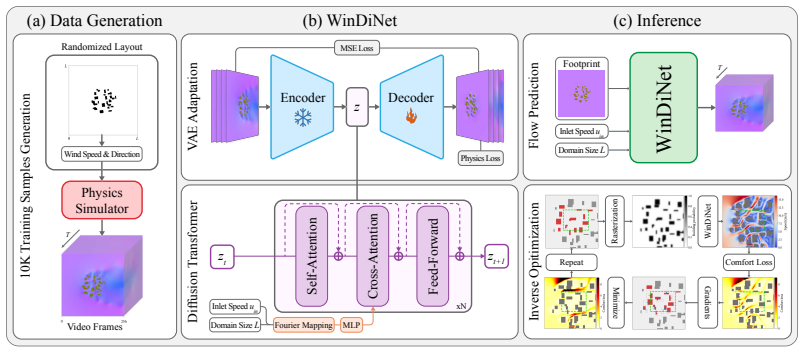
WinDiNet: a fine-tuned latent video diffusion transformer (starting from LTX-Video) whose conditioning, training regime, and physics-informed VAE decoder together turn a generative video model into a fast, end-to-end differentiable surrogate for time-resolved 2D urban wind flow.
Load-bearing premise
That training only on 2D incompressible CFD over synthetic building footprints, with the chosen conditioning and physics-informed decoder, is faithful enough for the surrogate to stay accurate when the optimizer later rearranges multi-inlet layouts that are then checked by real CFD.
What would settle it
Take a multi-objective, multi-inlet layout produced by the gradient optimizer, re-simulate it with high-fidelity CFD, and check whether the predicted improvements in safety and pedestrian-comfort metrics disappear or reverse; if they systematically fail to hold, the surrogate claim collapses.
If this is right
- Urban designers can explore hundreds of building footprints in the time once required for a single CFD run.
- Gradient-based inverse design becomes practical for multi-objective wind criteria without hand-crafted adjoint solvers.
- Pretrained video models can serve as drop-in differentiable physics engines for other time-resolved flow problems once fine-tuned on domain data.
- Layout optimizations found by the surrogate can be trusted enough to be confirmed, rather than discovered, by expensive CFD.
Where Pith is reading between the lines
- The same fine-tuning recipe might transfer to 3D urban wind or indoor ventilation if suitable CFD corpora become available.
- Because the model is a generative video prior, it may also support uncertainty quantification or ensemble forecasts of wind extremes without extra architecture.
- Coupling the differentiable surrogate to structural or energy objectives could yield joint optimization of wind comfort and building performance.
Editorial analysis
A structured set of objections, weighed in public.
Referee Report
Summary. The submission claims to introduce WinDiNet, a 2B-parameter latent video diffusion model (fine-tuned from LTX-Video on 10,000 2D incompressible CFD simulations of procedural building layouts) that acts as a fast, end-to-end differentiable surrogate for time-resolved urban wind flow. The abstract asserts sub-second 112-frame rollouts, outperformance of purpose-built neural PDE solvers after a study of training regimes, conditioning, and a physics-informed decoder loss, and gradient-based inverse optimization of building positions for wind safety and pedestrian comfort, with gains confirmed by ground-truth CFD on single- and multi-inlet layouts. The body of the provided manuscript, however, is an unrelated survey on security and privacy in O-RAN for 6G (arXiv-style content on threats, STRIDE, SAGIN, standardization, etc.), so none of the WinDiNet methods, experiments, or results are present for review.
Significance. If the abstract claims were substantiated, the work would be significant: repurposing a large pretrained video diffusion model as a differentiable CFD surrogate for urban wind, with demonstrated inverse design confirmed by CFD, would be a strong contribution at the intersection of generative models, neural PDE solvers, and computational design. The combination of long-horizon rollouts, systematic ablation of conditioning/VAE strategies, and multi-objective layout optimization is of clear interest. Those strengths cannot be credited on the present manuscript because the scientific content of WinDiNet is missing.
major comments (3)
- Manuscript mismatch: the title, abstract, and paper_id (2603.21210) describe WinDiNet (video diffusion as urban wind CFD surrogate), but the full text is a different paper—a comprehensive survey of O-RAN security and privacy for 6G. No methods, architecture details, training protocol, baselines, tables, figures, or CFD validation for WinDiNet appear. The central claims cannot be evaluated.
- Abstract-only quantitative claims are uncheckable. Assertions that the model 'outperforms purpose-built neural PDE solvers,' generates 112-frame rollouts 'in under a second,' and that optimized layouts yield CFD-confirmed improvements lack error metrics, baseline names/numbers, objective definitions, and multi-inlet validation details. Without the actual experimental sections, these load-bearing claims cannot be verified or stress-tested.
- The weakest scientific assumption visible from the abstract—that 2D incompressible CFD on procedurally generated footprints (plus the chosen conditioning and physics-informed decoder loss) is faithful enough for multi-inlet, multi-objective optimization later re-validated by CFD—cannot be assessed. There is no evidence in the supplied text of held-out layout distributions, 3D or real-city transfer, or failure modes of the surrogate under optimization.
minor comments (2)
- Even the abstract would benefit from naming the neural PDE baselines, reporting at least one primary error metric (e.g., relative L2 or comfort-index error), and stating the optimization objectives quantitatively.
- The O-RAN body text (wrong paper) is itself a long survey with many tables and acronyms; it is irrelevant to the WinDiNet submission and should not be part of this manuscript.
Circularity Check
No circularity: empirical fine-tuning of a video diffusion model on CFD data, with held-out evaluation and independent CFD re-validation of optimized layouts; no derivation reduces to its inputs by construction.
full rationale
The provided abstract describes a standard empirical ML pipeline: start from a pretrained latent video transformer (LTX-Video), fine-tune on 10 000 procedurally generated 2D incompressible CFD simulations, ablate training/conditioning/VAE choices (including a physics-informed decoder loss), report outperformance versus purpose-built neural PDE solvers, generate 112-frame rollouts, and use end-to-end differentiability for gradient-based building-layout optimization whose improvements are re-confirmed by ground-truth CFD. None of these steps is self-definitional, a fitted parameter renamed as a prediction, a load-bearing self-citation of an unverified uniqueness theorem, an ansatz smuggled via prior author work, or a renaming of a known result. The full manuscript text supplied in the cache is an unrelated O-RAN security survey (arXiv 2603.21211), so no equations or derivation chain from the claimed WinDiNet paper can be inspected; on the abstract alone the work is self-contained against external CFD benchmarks and exhibits no circular reduction. Ordinary train/test design (procedural generator for both training and later optimization cases) is not definitional circularity.
Axiom & Free-Parameter Ledger
free parameters (2)
- fine-tuning hyperparameters and VAE adaptation choices
- procedural building-layout generator parameters
axioms (2)
- domain assumption 2D incompressible Navier–Stokes CFD on the chosen mesh and Reynolds regime is a valid proxy for the urban pedestrian-wind phenomena of interest
- ad hoc to paper A latent video diffusion model pretrained on natural video can be adapted into a stable long-horizon fluid rollout via the described fine-tuning
invented entities (1)
-
WinDiNet
no independent evidence
read the original abstract
Designing urban spaces that provide pedestrian wind comfort and safety requires time-resolved Computational Fluid Dynamics (CFD) simulations, but their current computational cost makes extensive design exploration impractical. We introduce WinDiNet (Wind Diffusion Network), a pretrained video diffusion model that is repurposed as a fast, differentiable surrogate for this task. Starting from LTX-Video, a 2B-parameter latent video transformer, we fine-tune on 10,000 2D incompressible CFD simulations over procedurally generated building layouts. A systematic study of training regimes, conditioning mechanisms, and VAE adaptation strategies, including a physics-informed decoder loss, identifies a configuration that outperforms purpose-built neural PDE solvers. The resulting model generates full 112-frame rollouts in under a second. As the surrogate is end-to-end differentiable, it doubles as a physics simulator for gradient-based inverse optimization: given an urban footprint layout, we optimize building positions directly through backpropagation to improve wind safety as well as pedestrian wind comfort. Experiments on single- and multi-inlet layouts show that the optimizer discovers effective layouts even under challenging multi-objective configurations, with all improvements confirmed by ground-truth CFD simulations.
Figures



Forward citations
Cited by 1 Pith paper
-
Image Editing Models are Numerical Solvers
A FLUX image editor, adapted per task, maps rendered inputs to rendered solutions across ten numerical problems, but several encodings leak the target's scale and the model cannot track chaotic Kuramoto-Sivashinsky dynamics.
Reference graph
Works this paper leans on
-
[1]
Vehicular intelligence in 6g: Networking, communications, and computing,
H. Guo, X. Zhou, J. Liu, and Y . Zhang, “Vehicular intelligence in 6g: Networking, communications, and computing,”Vehicular Communica- tions, vol. 33, p. 100399, 2022
2022
-
[2]
Industry 5.0: A survey on enabling technologies and potential applications,
P. K. R. Maddikunta, V . Q. Pham, B. Prabadevi, N. Deepa, K. Dev, T. Gadekallu, R. Ruby, and M. Liyanage, “Industry 5.0: A survey on enabling technologies and potential applications,”J. Ind. Inf. Integr., vol. 26, p. 100257, 2021
2021
-
[3]
High-performance medicine: the convergence of human and artificial intelligence,
E. Topol, “High-performance medicine: the convergence of human and artificial intelligence,”Nature Medicine, vol. 25, pp. 44 – 56, 2019
2019
-
[4]
The role of 5g technologies in a smart city: The case for intelligent transportation system,
A. Gohar and G. Nencioni, “The role of 5g technologies in a smart city: The case for intelligent transportation system,”Sustainability, vol. 13, no. 9, p. 5188, 2021
2021
-
[5]
Future (post-covid) digital, smart and sustainable cities in the wake of 6g: Digital twins, immersive realities and new urban economies,
Z. Allam and D. S. Jones, “Future (post-covid) digital, smart and sustainable cities in the wake of 6g: Digital twins, immersive realities and new urban economies,”Land use policy, vol. 101, p. 105201, 2021
2021
-
[6]
M.2160-0, Nov
ITU-R,Framework and overall objectives of the future development of IMT for 2030 and beyond, International Telecommunication Union (ITU) Std. M.2160-0, Nov. 2023. [Online]. Available: https://www.itu.int/rec/R-REC-M.2160-0-202311-I
2030
-
[7]
Mobility management in third-generation all-ip networks,
F. Chiussi, D. A. Khotimsky, and S. Krishnan, “Mobility management in third-generation all-ip networks,”IEEE Commun. Mag., vol. 40, pp. 124–135, 2002
2002
-
[8]
An introduction to orthogonal frequency division multi- plexing,
M. Oltean, “An introduction to orthogonal frequency division multi- plexing,” 2004
2004
-
[9]
Future wireless spectrum below 6 ghz: A uk perspective,
M. M. Kassem and M. K. Marina, “Future wireless spectrum below 6 ghz: A uk perspective,” in2015 IEEE international symposium on dynamic spectrum access networks (DySPAN). IEEE, 2015, pp. 59–70
2015
-
[10]
A survey on low latency towards 5g: Ran, core network and caching solutions,
I. Parvez, A. Rahmati, I. Guvenc, A. I. Sarwat, and H. Dai, “A survey on low latency towards 5g: Ran, core network and caching solutions,” IEEE Communications Surveys & Tutorials, vol. 20, no. 4, pp. 3098– 3130, 2018
2018
-
[11]
Cloud ran for mobile networks—a technology overview,
A. Checko, H. L. Christiansen, Y . Yan, L. Scolari, G. Kardaras, M. S. Berger, and L. Dittmann, “Cloud ran for mobile networks—a technology overview,”IEEE Communications surveys & tutorials, vol. 17, no. 1, pp. 405–426, 2014
2014
-
[12]
Intelligent O-RAN for Beyond 5G and 6G Wireless Networks,
S. Niknam, A. Roy, H. S. Dhillon, S. Singh, R. Banerji, J. H. Reed, N. Saxena, and S. Yoon, “Intelligent O-RAN for Beyond 5G and 6G Wireless Networks,” in2022 IEEE GLOBECOM Workshops, GC Wkshps 2022 - Proceedings, 2022. 34
2022
-
[13]
(2023) Open ran update
5G Americas. (2023) Open ran update. Accessed: 2024-03-11. [Online]. Available: https://www.5gamericas.org/open-ran-update/
2023
-
[14]
A survey of continuous integration, continuous delivery and continuos deployment
S. Bobrovskis and A. Jurenoks, “A survey of continuous integration, continuous delivery and continuos deployment.” inBIR workshops, 2018, pp. 314–322
2018
-
[15]
In- telligence and Learning in O-RAN for Data-Driven NextG Cellular Networks,
L. Bonati, S. D’Oro, M. Polese, S. Basagni, and T. Melodia, “In- telligence and Learning in O-RAN for Data-Driven NextG Cellular Networks,”IEEE Communications Magazine, vol. 59, no. 10, 2021
2021
-
[16]
Peeking Inside the Black-Box: A Survey on Explainable Artificial Intelligence (XAI),
A. Adadi and M. Berrada, “Peeking Inside the Black-Box: A Survey on Explainable Artificial Intelligence (XAI),”IEEE Access, vol. 6, 2018
2018
-
[17]
A survey and taxonomy of dos attacks in cloud computing,
M. Masdari and M. Jalali, “A survey and taxonomy of dos attacks in cloud computing,”Security and Communication Networks, vol. 9, no. 16, pp. 3724–3751, 2016
2016
-
[18]
Classification of spoofing attack types,
J. R. Van Der Merwe, X. Zubizarreta, I. Luk ˇcin, A. R ¨ugamer, and W. Felber, “Classification of spoofing attack types,” in2018 European Navigation Conference (ENC). IEEE, 2018, pp. 91–99
2018
-
[19]
Detecting malicious data injections in wireless sensor networks: A survey,
V . P. Illiano and E. C. Lupu, “Detecting malicious data injections in wireless sensor networks: A survey,”ACM Computing Surveys (CSUR), vol. 48, no. 2, pp. 1–33, 2015
2015
-
[20]
Evaluating the Security of Open Radio Access Networks,
D. Mimran, R. Bitton, Y . Kfir, E. Klevansky, O. Brodt, H. Lehmann, Y . Elovici, and A. Shabtai, “Evaluating the Security of Open Radio Access Networks,”arXiv, 2022
2022
-
[21]
5g ran risk analysis,
Federal Office for Information Security (BSI), “5g ran risk analysis,” Federal Office for Information Security, Tech. Rep., 2023, accessed: 2024-01-07. [Online]. Available: https://www.bsi.bund.de/SharedDocs/Downloads/EN/BSI/Publications/ Studies/5G/5GRAN-Risk-Analysis.pdf? blob=publicationFile&v=5
2023
-
[22]
Report on the cybersecurity of open ran,
N. C. Group, “Report on the cybersecurity of open ran,” https://d110erj175o600.cloudfront.net/wp-content/uploads/2022/ 05/11160610/OPEN.pdf, NIS Cooperation Group, Tech. Rep., 2022, accessed: 2024-01-07
2022
-
[23]
Open radio access network security considerations,
Cybersecurity and Infrastructure Security Agency (CISA), “Open radio access network security considerations,” Cybersecurity and Infrastruc- ture Security Agency, Tech. Rep., 2022, accessed: 2024-01-07. [On- line]. Available: https://www.cisa.gov/sites/default/files/publications/ open-radio-access-network-security-considerations 508.pdf
2022
-
[24]
“open” telecom networks (open ran),
F. I. of International Relations (IFRI), ““open” telecom networks (open ran),” French Institute of International Relations (IFRI), Tech. Rep., 2022, accessed: 2024-01-07. [Online]. Available: https://www. ifri.org/sites/default/files/atoms/files/velliet open ran 2022 us.pdf
2022
-
[25]
5g open ran white paper,
NTT DOCOMO, “5g open ran white paper,” NTT DOCOMO, Tech. Rep., 2023, accessed: 2024-01-07. [Online]. Available: https://www.docomo.ne.jp/english/binary/pdf/corporate/technology/ whitepaper 5g open ran/OREC WP 20230517095959.pdf
2023
-
[26]
Open ran security report,
National Telecommunications and Information Administration, “Open ran security report,” National Telecommunications and Information Administration, Tech. Rep., 2023, accessed: 2024- 01-07. [Online]. Available: https://www.ntia.gov/sites/default/files/ publications/open ran security report full report 0.pdf
2023
-
[27]
Open RAN security: Challenges and opportunities,
M. Liyanage, A. Braeken, S. Shahabuddin, and P. Ranaweera, “Open RAN security: Challenges and opportunities,” 2023
2023
-
[28]
A brief survey of open radio access network (o-ran) security,
Y .-Z. Chen, T. Y .-H. Chen, P.-J. Su, and C.-T. Liu, “A brief survey of open radio access network (o-ran) security,” 2023. [Online]. Available: https://arxiv.org/abs/2311.02311
Pith/arXiv arXiv 2023
-
[29]
O-RAN: Disrupting the Virtualized RAN Ecosystem,
A. Garcia-Saavedra and X. Costa-Perez, “O-RAN: Disrupting the Virtualized RAN Ecosystem,”IEEE Communications Standards Mag- azine, vol. 5, no. 4, 2021
2021
-
[30]
xRAN Forum Merges With C-RAN Alliance to Form ORAN Alliance,
xRAN Forum, “xRAN Forum Merges With C-RAN Alliance to Form ORAN Alliance,” 2018. [Online]. Available: https://www.businesswire. com/news/home/20180227005673/en/
arXiv 2018
-
[31]
Under- standing O-RAN: Architecture, Interfaces, Algorithms, Security, and Research Challenges,
M. Polese, L. Bonati, S. D’Oro, S. Basagni, and T. Melodia, “Under- standing O-RAN: Architecture, Interfaces, Algorithms, Security, and Research Challenges,”IEEE Communications Surveys and Tutorials, vol. 25, no. 2, 2023
2023
-
[32]
A survey of the functional splits proposed for 5g mobile crosshaul networks,
L. M. P. Larsen, A. Checko, and H. Christiansen, “A survey of the functional splits proposed for 5g mobile crosshaul networks,”IEEE Communications Surveys & Tutorials, vol. 21, pp. 146–172, 2019
2019
-
[33]
Nuberu: Reliable ran virtualization in shared platforms,
G. Garcia-Aviles, A. Garcia-Saavedra, M. Gramaglia, X. Costa-Perez, P. Serrano, and A. Banchs, “Nuberu: Reliable ran virtualization in shared platforms,” inProceedings of the 27th Annual International Conference on Mobile Computing and Networking, 2021, pp. 749–761
2021
-
[34]
Energy efficiency benefits of ran-as-a-service concept for a cloud-based 5g mobile network infrastructure,
D. Sabella, A. De Domenico, E. Katranaras, M. A. Imran, M. Di Giro- lamo, U. Salim, M. Lalam, K. Samdanis, and A. Maeder, “Energy efficiency benefits of ran-as-a-service concept for a cloud-based 5g mobile network infrastructure,”IEEE Access, vol. 2, pp. 1586–1597, 2014
2014
-
[35]
IAFI 5D44 IMT2030 Framework input Final,
International Telecommunication Union Radiocommunication Sector, “IAFI 5D44 IMT2030 Framework input Final,” 2023. [Online]. Available: https://itu-apt.org/system/static/uploads/contribution/IAFI% 205D44%20IMT2030%20Framework%20input%20Final.pdf
2023
-
[36]
M.2083-0, Sep
ITU-R,Future development of IMT for 2020 and beyond, International Telecommunication Union (ITU) Std. M.2083-0, Sep. 2015. [Online]. Available: https://www.itu.int/rec/R-REC-M.2083-0-201509-I
2020
-
[37]
From 4g to 5g: Self-organized network management meets machine learning,
J. Moysen and L. Giupponi, “From 4g to 5g: Self-organized network management meets machine learning,”Computer Communications, vol. 129, pp. 248–268, 2018
2018
-
[38]
6g wireless networks: Vision, requirements, archi- tecture, and key technologies,
Z. Zhang, Y . Xiao, Z. Ma, M. Xiao, Z. Ding, X. Lei, G. K. Karagian- nidis, and P. Fan, “6g wireless networks: Vision, requirements, archi- tecture, and key technologies,”IEEE vehicular technology magazine, vol. 14, no. 3, pp. 28–41, 2019
2019
-
[39]
Space-air-ground inte- grated network: A survey,
J. Liu, Y . Shi, Z. M. Fadlullah, and N. Kato, “Space-air-ground inte- grated network: A survey,”IEEE Communications Surveys & Tutorials, vol. 20, no. 4, pp. 2714–2741, 2018
2018
-
[40]
A vision of 6g wireless systems: Applications, trends, technologies, and open research problems,
W. Saad, M. Bennis, and M. Chen, “A vision of 6g wireless systems: Applications, trends, technologies, and open research problems,”IEEE network, vol. 34, no. 3, pp. 134–142, 2019
2019
-
[41]
Release 15 Description; Summary of Rel-15 Work Items,
3rd Generation Partnership Project (3GPP), “Release 15 Description; Summary of Rel-15 Work Items,” https://www.3gpp.org/specifications/ releases/release-15, 2019, accessed: 2025-11-22
2019
-
[42]
Release 16 Description; Summary of Rel-16 Work Items,
——, “Release 16 Description; Summary of Rel-16 Work Items,” https://www.3gpp.org/specifications/releases/release-16, 2020, accessed: 2025-11-22
2020
-
[43]
The architecture of ai and communication integration towards 6g: An o-ran evolution,
Z. Li, Q. Wang, Y . Wang, and T. Chen, “The architecture of ai and communication integration towards 6g: An o-ran evolution,” in Proceedings of the 30th Annual International Conference on Mobile Computing and Networking, 2024, pp. 2329–2334
2024
-
[44]
Edgeric: Empowering realtime intelligent optimization and control in nextg networks,
W.-H. Ko, U. Dinesha, U. Ghosh, S. Shakkottai, D. Bharadia, and R. Wu, “Edgeric: Empowering realtime intelligent optimization and control in nextg networks,”arXivorg, no. 2304.11199., 2023
Pith/arXiv arXiv 2023
-
[45]
O-ran based non- terrestrial networks: Trends and challenges,
R. Campana, C. Amatetti, and A. Vanelli-Coralli, “O-ran based non- terrestrial networks: Trends and challenges,” in2023 Joint European Conference on Networks and Communications & 6G Summit (Eu- CNC/6G Summit), 2023, pp. 264–269
2023
-
[46]
Handover challenges in disaggregated open ran for leo satellites: tradeoff between handover delay and onboard processing,
S. S. S. G. Seeram, L. Feltrin, M. Ozger, S. Zhang, and C. Cavdar, “Handover challenges in disaggregated open ran for leo satellites: tradeoff between handover delay and onboard processing,”Frontiers in Space Technologies, vol. 6, p. 1580005, 2025
2025
-
[47]
Accelerating vran and o- ran with simd: Architectural perspectives and performance evaluation,
J. Park, C.-B. Chae, and R. W. Heath Jr, “Accelerating vran and o- ran with simd: Architectural perspectives and performance evaluation,” arXiv preprint arXiv:2510.07843, 2025
Pith/arXiv arXiv 2025
-
[48]
Cloudric: Open radio access network (o-ran) virtualization with shared heterogeneous computing,
L. L. Schiavo, G. Garcia-Aviles, A. Garcia-Saavedra, M. Gramaglia, M. Fiore, A. Banchs, and X. Costa-Perez, “Cloudric: Open radio access network (o-ran) virtualization with shared heterogeneous computing,” inProceedings of the 30th Annual International Conference on Mobile Computing and Networking, 2024, pp. 558–572
2024
-
[49]
ngrg introduction,
O.-R. Alliance, “ngrg introduction,” Nov. 2023, accessed: 2025- 03-26. [Online]. Available: https://public.o-ran.org/display/NGRG/ Introduction
2023
-
[50]
Toward Next Generation Open Radio Access Networks: What O-RAN Can and Cannot Do!
A. S. Abdalla, P. S. Upadhyaya, V . K. Shah, and V . Marojevic, “Toward Next Generation Open Radio Access Networks: What O-RAN Can and Cannot Do!”IEEE Network, vol. 36, no. 6, 2022
2022
-
[51]
Evolution Toward the Next Generation Radio Access Network,
W. Diego, “Evolution Toward the Next Generation Radio Access Network,” inIFIP Networking 2020 Conference and Workshops, Net- working 2020, 2020
2020
-
[52]
The Evolution of Radio Access Network Towards Open-RAN: Challenges and Opportunities,
S. K. Singh, R. Singh, and B. Kumbhani, “The Evolution of Radio Access Network Towards Open-RAN: Challenges and Opportunities,” in2020 IEEE Wireless Communications and Networking Conference Workshops, WCNCW 2020 - Proceedings, 2020
2020
-
[53]
AutoMEC: LSTM- based User Mobility Prediction for Service Management in Distributed MEC Resources,
U. Fattore, M. Liebsch, B. Brik, and A. Ksentini, “AutoMEC: LSTM- based User Mobility Prediction for Service Management in Distributed MEC Resources,” inMSWiM 2020 - Proceedings of the 23rd Inter- national ACM Conference on Modeling, Analysis and Simulation of Wireless and Mobile Systems, 2020
2020
-
[54]
Service-Oriented MEC Applications Placement in a Federated Edge Cloud Architecture,
B. Brik, P. A. Frangoudis, and A. Ksentini, “Service-Oriented MEC Applications Placement in a Federated Edge Cloud Architecture,” in IEEE International Conference on Communications, vol. 2020-June, 2020
2020
-
[55]
A perspective of O-RAN integration with MEC, SON, and network slicing in the 5G era,
Chih-Lin, S. Kuklinski, T. C. Chen, and L. L. Ladid, “A perspective of O-RAN integration with MEC, SON, and network slicing in the 5G era,” 2020
2020
-
[56]
Toward Optimal MEC Resource Dimen- sioning for a Vehicle Collision Avoidance System: A Deep Learning Approach,
B. Brik and A. Ksentini, “Toward Optimal MEC Resource Dimen- sioning for a Vehicle Collision Avoidance System: A Deep Learning Approach,”IEEE Network, vol. 35, no. 3, 2021. 35
2021
-
[57]
(2024) O-ran specifications
O-RAN Alliance. (2024) O-ran specifications. Accessed: 2025-07-
2024
-
[58]
Available: https://orandownloadsweb.azurewebsites.net/ specifications
[Online]. Available: https://orandownloadsweb.azurewebsites.net/ specifications
-
[59]
Security require- ments and challenges of 6g technologies and applications,
S. A. Abdel Hakeem, H. H. Hussein, and H. Kim, “Security require- ments and challenges of 6g technologies and applications,”Sensors, vol. 22, no. 5, p. 1969, 2022
1969
-
[60]
A comprehensive survey on 6g-security: Physical connection and service layers,
M. M. Saeed, R. A. Saeed, M. K. Hasan, E. S. Ali, T. Mazha, T. Shahzad, S. Khan, and H. Hamam, “A comprehensive survey on 6g-security: Physical connection and service layers,”Discover Internet of Things, vol. 5, no. 1, p. 28, 2025
2025
-
[61]
Security of Open Radio Access Networks,
D. Mimran, R. Bitton, Y . Kfir, E. Klevansky, O. Brodt, H. Lehmann, Y . Elovici, and A. Shabtai, “Security of Open Radio Access Networks,” Computers and Security, vol. 122, 2022
2022
-
[62]
Security architecture and procedures for the 5G System,
3rd Generation Partnership Project (3GPP), “Security architecture and procedures for the 5G System,” 3GPP, Technical Specification (TS) 33.501, Sep. 2024, version 18.7.0, Release 18. [Online]. Available: https://www.3gpp.org/ftp/Specs/archive/33 series/33.501/
2024
-
[63]
Security analysis of critical 5g interfaces,
M. Mahyoub, A. AbdulGhaffar, E. Alalade, E. Ndubisi, and A. Ma- trawy, “Security analysis of critical 5g interfaces,”IEEE Communica- tions Surveys & Tutorials, vol. 26, no. 4, pp. 2382–2410, 2024
2024
-
[64]
The threats to our products,
L. Kohnfelder and P. Garg, “The threats to our products,”Microsoft Security Development Blog, 1999
1999
-
[65]
SMDFbs: Specification-Based Misbehavior Detection for False Base Stations,
H. Park, P. V . B. Astillo, Y . Ko, Y . Park, T. Kim, and I. You, “SMDFbs: Specification-Based Misbehavior Detection for False Base Stations,”Sensors, vol. 23, no. 23, 2023. [Online]. Available: https://www.mdpi.com/1424-8220/23/23/9504
2023
-
[66]
Open-ran security in 5g,
O.-R. P. Coalition, “Open-ran security in 5g,” 2021. [Online]. Available: https://www.openranpolicy.org/wp-content/uploads/2021/04/ Open-RAN-Security-in-5G-4.29.21.pdf
2021
-
[67]
Transport Security Considerations for the Open-RAN Fronthaul,
D. Dik and M. S. Berger, “Transport Security Considerations for the Open-RAN Fronthaul,” inProceedings - 2021 IEEE 4th 5G World Forum, 5GWF 2021, 2021
2021
-
[68]
The o-ran alliance security task group tackles security challenges on all o-ran interfaces and components,
O. Alliance, “The o-ran alliance security task group tackles security challenges on all o-ran interfaces and components,” 2021
2021
-
[69]
Open ran security,
Ericsson, “Open ran security,” 2023. [Online]. Avail- able: https://www.ericsson.com/4ae256/assets/local/reports-papers/ further-insights/doc/open-ran-security.pdf
2023
-
[70]
Membership Inference Attacks on Machine Learning: A Survey,
H. Hu, Z. Salcic, L. Sun, G. Dobbie, P. S. Yu, and X. Zhang, “Membership Inference Attacks on Machine Learning: A Survey,” ACM Computing Surveys, vol. 54, no. 11s, 2022
2022
-
[71]
Adversarial Machine Learning for Flooding Attacks on 5G Radio Access Network Slicing,
Y . Shi and Y . E. Sagduyu, “Adversarial Machine Learning for Flooding Attacks on 5G Radio Access Network Slicing,” in2021 IEEE Inter- national Conference on Communications Workshops, ICC Workshops 2021 - Proceedings, 2021
2021
-
[72]
Multi-Agent Team Learning in Virtualized Open Radio Access Networks (O-RAN),
P. E. Iturria-Rivera, H. Zhang, H. Zhou, S. Mollahasani, and M. Erol- Kantarci, “Multi-Agent Team Learning in Virtualized Open Radio Access Networks (O-RAN),”Sensors, vol. 22, no. 14, 2022
2022
-
[73]
Analysis of security at the near-real-time ric xapps based on o-ran-defined use cases,
Z. SHAHBAZI, “Analysis of security at the near-real-time ric xapps based on o-ran-defined use cases,” 2022
2022
-
[74]
General data protection regulation (gdpr),
G. D. P. Regulation, “General data protection regulation (gdpr),” Intersoft Consulting, Accessed in October, vol. 24, no. 1, 2018
2018
-
[75]
Open or not open: Are conventional radio access networks more secure and trustworthy than open-ran?
F. Klement, S. Katzenbeisser, V . Ulitzsch, J. Kr ¨amer, S. Stanczak, Z. Utkovski, I. Bjelakovic, and G. Wunder, “Open or not open: Are conventional radio access networks more secure and trustworthy than open-ran?”arXiv preprint arXiv:2204.12227, 2022
Pith/arXiv arXiv 2022
-
[76]
Towards a 5g security architecture: Articulating software- defined security and security as a service,
G. Blanc, N. Kheir, D. Ayed, V . Lefebvre, E. M. de Oca, and P. Bisson, “Towards a 5g security architecture: Articulating software- defined security and security as a service,” inProceedings of the 13th International Conference on Availability, Reliability and Security, 2018, pp. 1–8
2018
-
[77]
Survey on Multi-Access Edge Computing Security and Privacy,
P. Ranaweera, A. D. Jurcut, and M. Liyanage, “Survey on Multi-Access Edge Computing Security and Privacy,” 2021
2021
-
[78]
A misuse pattern for nfv based on privilege escalation,
A. K. Alnaim, A. M. Alwakeel, and E. B. Fernandez, “A misuse pattern for nfv based on privilege escalation,” inProceedings of the 8th Asian Conference on Pattern Languages of Programs, 2019
2019
-
[79]
PrivGuard: Protecting Sensitive Kernel Data from Privilege Escalation Attacks,
W. Qiang, J. Yang, H. Jin, and X. Shi, “PrivGuard: Protecting Sensitive Kernel Data from Privilege Escalation Attacks,”IEEE Access, vol. 6, 2018
2018
-
[80]
A survey on security in network functions vir- tualization,
W. Yang and C. Fung, “A survey on security in network functions vir- tualization,” inIEEE NETSOFT 2016 - 2016 IEEE NetSoft Conference and Workshops: Software-Defined Infrastructure for Networks, Clouds, IoT and Services, 2016
2016
discussion (0)
Sign in with ORCID, Apple, or X to comment. Anyone can read and Pith papers without signing in.