REVIEW 6 minor 12 references
This paper shows that coupling a camera-fault belief with a compute-contention belief in a noisy-OR router can cut deadline-miss rates by 1.1 to 9.4 percentage points when both stressors co-occur, but finds no evidence that such coupling oc
Reviewed by Pith at T0; open to challenge. T0 means a machine referee read the full paper against a public rubric. the ladder, T0–T4 →
A belief-space router coupling sensor-fault and compute-contention estimates cuts deadline misses under imposed coupling but finds no natural coupling in real adverse-weather data.
T0 review reviewed 2026-08-04 challenge →
load-bearing objection A carefully scoped proof of mechanism for coupling sensor-fault and compute-contention beliefs in perception routing, with unusually honest null results; the main caveat is that the headline benefit lives entirely in an imposed-coupling regime.
Belief-Space Perception Routing under Coupled Sensor Faults and Compute Contention
The pith
A machine-rendered reading of the paper's core claim, the machinery that carries it, and where it could break.
The reading
Core claim
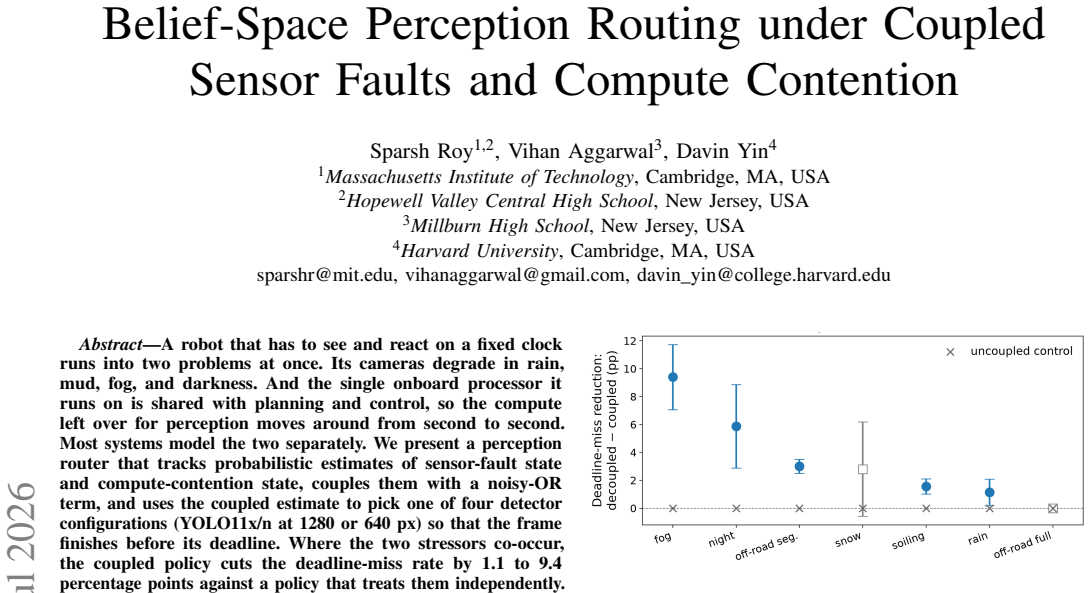
The central claim is that the sensor-fault belief carries usable information about future compute contention, so that mixing the two with a noisy-OR (pt_cont = 1 − (1 − b_c)(1 − κ b_f)) reduces deadline misses wherever the two stressors actually co-occur. The benefit appears only under an imposed coupling: a threshold rule on the same coupled features matches the noisy-OR, an oracle with the true contention state does not outperform it, and every uncoupled control sits at exactly 0.0 percentage points. On real, un-manipulated adverse-weather sequences, the measured coupling is effectively absent (de-circularized reduction ≈ 0.0 pp in all 24 sequence-proxy tests after correction and replicati
What carries the argument
The central object is the coupled belief state: a four-state switching hidden Markov model per image channel for sensor fault (nominal, degrading, faulted, recovering) plus a two-state HMM for compute contention (nominal, contended), combined by the noisy-OR coupling term pt_cont = 1 − (1 − b_c)(1 − κ b_f) with a single fitted coefficient κ. The router chooses, among four detector configurations ordered by cost, the most accurate one whose median latency in the predicted contention state still meets a self-calibrated deadline. The coupling term is what carries the argument; replacing the noisy-OR with a simple threshold rule on the same beliefs changes nothing.
Load-bearing premise
The headline benefit is measured under a deadline calibrated to the median latency of the reference detector under nominal load and under a contention schedule that is conditioned on the ground-truth fault state; if a real deployment has looser deadlines or its contention is not driven by the same fault-state signal, the measured 1.1–9.4 pp reductions would not transfer.
What would settle it
Run the released evaluation pipeline on a real, un-manipulated deployment: record per-frame latency and a fault signal (e.g., soiling mask or blur metric) over a route that genuinely combines adverse weather with variable compute load, using a workload proxy independent of the fault signal. If the de-circularized deadline-miss reduction is significantly greater than zero in a pre-registered test, the paper's null conclusion about naturally occurring coupling is overturned.
If this is right
- A deployment that runs the released evaluation pipeline on its own traces can determine whether its environment contains the coupling, and if it does, the router gives a tunable trade-off between task accuracy and timeliness at microsecond cost.
- The finding that a threshold rule matches the noisy-OR lowers the adoption barrier: any monotone function of the two beliefs yields similar benefit, so calibration cost is minimal.
- Since the router is exactly equivalent to the decoupled baseline when κ = 0 or when no coupling is present, shipping the coupled router is safe even in environments where the null holds.
- The fog result (largest benefit, lowest fault fraction) implies the mechanism pays off most when faults are rare but make the reference detector infeasible at the moment contention arrives.
- The pooled effect across 10 sequences and 6 conditions (mean +3.72 pp, cluster bootstrap [2.41, 5.43], sign test p = 0.001) suggests the mechanism generalizes across routes, though within-condition significance at n = 3 is not reached.
Where Pith is reading between the lines
- A natural next step the authors do not take is to ask whether a chosen route or platform (e.g., one with more aggressive planning during rough terrain) exhibits the coupling; if it does, the measured benefit would likely transfer more strongly than the averaged null suggests.
- The weak correspondence between pseudo-ground-truth and real radar-projected annotations means the accuracy and utility numbers should be re-run with real labels before making deployment choices; the deadline-miss results themselves are timing-only and unaffected.
- The equivalence with a threshold rule suggests that the decision boundary could be learned in a fully online fashion, eliminating the need for offline calibration of κ.
- Because the oracle with true contention state does not beat the coupled policy, the limiting factor is the median-latency feasibility test, not the state estimate; improving that test could yield further gains independently of the coupling.
Editorial analysis
A structured set of objections, weighed in public.
Referee Report
Summary. The paper describes a belief-space perception router for deadline-constrained detector selection on a single shared processor. It maintains a per-channel HMM sensor-fault belief and a two-state HMM compute-contention belief, combines them through a noisy-OR with one estimated coefficient κ, and selects among four YOLO configurations. In an imposed-coupling experiment (contention scheduled conditionally on the ground-truth fault state), the coupled policy cuts deadline-miss rate by 1.1–9.4 percentage points relative to a policy that uses only the contention belief, with intervals excluding zero in five of six conditions, exactly zero in matched uncoupled controls and on a fault-free trajectory, and zero at κ=0. The paper then tests for naturally occurring fault–contention coupling in eight RADIATE sequences with three workload proxies; after Benjamini–Hochberg correction and replication, none of 24 tests confirms it. The authors explicitly scope the routing result as a proof of mechanism and release code and evaluation pipelines.
Significance. The result, if accepted, is a well-controlled proof of mechanism rather than a claim about field deployments. The paper's strongest assets are its internal controls: matched uncoupled schedules at exactly 0.0 pp, κ=0 giving exactly zero, a fault-free negative control, an oracle-contention comparison, moving-block and cluster bootstraps, and a sign test on the pooled effect. The natural-coupling null is reported transparently with multiple-testing correction and replication; the pseudo-GT limitation is disclosed and the headline deadline-miss numbers are timing-only. The threshold-rule equivalence appropriately narrows the contribution. Because the benefit is demonstrated only under an imposed coupling and a self-calibrated deadline, external validity remains open; the paper says so. This is an honest and useful contribution to adaptive perception under deadline constraints.
minor comments (6)
- [Contributions / §III] The contribution list says the HMMs are 'fit without task-specific labels,' but §III states the sensor-fault HMM has 'transitions fit from labeled segments.' Please reconcile: if segment-level fault labels are used, the wording overstates the label-free claim; if not, clarify what the labeled segments are.
- [§VI (cross-sequence consistency)] The sign-test p=0.001 treats the ten sequences as exchangeable, but rain and fog each contribute three sequences from the same condition. The cluster bootstrap is the appropriate generalization statistic. Please either make the cluster-level test primary or add a sentence explaining why the dependence does not affect the sign-test p.
- [§V-A / §VI] Accuracy and on-time utility statements for fog ('gives up task accuracy to buy timeliness') and the 'nonnegative' utility result depend on pseudo-GT whose ranking is shown in §VI not to match real annotations. The caveat is present, but it appears after the claims; consider flagging these as provisional at first use.
- [§III / Eq. (1)] Please state the domain of κ explicitly and note in the equation caption that κ=0 recovers the decoupled policy; the prose says this, but the equation alone is ambiguous. Also define the contention-belief notation b_t^c in the same place.
- [Table I] Clarify whether the 'Off-road, full (clean)' trajectory and the 'Off-road, segment' are disjoint. If the full trajectory includes the rough-terrain segment, the 0.0 fault fraction in the full row needs explanation.
- [§VI (measured coupling)] The measured-coupling check reports that correlation intervals 'sit near zero or on the wrong side' without giving the intervals. For reproducibility, include the interval ranges or a supplementary table.
Circularity Check
No significant circularity; the headline effect is an openly scoped controlled-mechanism result with null checks.
full rationale
The paper's derivation chain is empirical and self-contained. The central comparison—coupled vs. decoupled routing under imposed coupling—is an intervention, not a hidden fit: Section IV states "We impose the coupling between sensor fault and contention experimentally," and the decoupled baseline differs only by dropping the κb_f term in Eq. (1). The paper explicitly verifies that at κ = 0 the coupled policy reduces to the decoupled one, and that all uncoupled controls and the fault-free trajectory give exactly 0.00 pp, so the measured benefit is not an artifact of a built-in bias. The deadline is self-calibrated to create routing pressure and the paper reports the effect's sensitivity to looser deadlines, which is a stated boundary condition rather than a circular premise. The natural-coupling question is addressed directly with "de-circularized" checks: using measured proxies independent of the fault signal, the reduction collapses to about 0.0 pp, and after BH correction and replication 0 of 24 tests find natural coupling. This honest null further rules out circularity. There are no load-bearing self-citations: none of the cited references are by the present authors, and no uniqueness theorem or ansatz is imported from prior work. The pseudo-GT limitation is disclosed and the headline deadline-miss numbers are computed from timing alone. Thus, while the imposed-coupling result is deliberately constructed as a proof of mechanism, it is not equivalent to its own inputs by construction, and the paper does not overclaim field transfer.
Axiom & Free-Parameter Ledger
free parameters (4)
- coupling coefficient κ =
≈0.80
- Sensor-fault HMM parameters
- Contention HMM parameters
- Deadline per device =
211–341 ms
axioms (6)
- domain assumption Per-channel image statistics (Laplacian blur, histogram entropy, optical-flow survival / soiling fraction) are sufficient observations for the four sensor-fault states.
- domain assumption The two-state compute-contention HMM with a median-latency feasibility rule is a faithful model of whether a configuration will meet its deadline.
- ad hoc to paper The imposed coupling schedule (contention conditioned on ground-truth fault state) is a faithful operationalization of the natural coupling the method is meant to exploit.
- ad hoc to paper Five seeds of injected measurement noise on identical frames estimate the uncertainty of the condition-level effect.
- domain assumption IoU-matched agreement with YOLO11x-1280 (pseudo-GT) is a valid ranking for task accuracy.
- standard math Standard statistical tools (HMM forward filtering, noisy-OR algebra, Benjamini-Hochberg, moving-block and cluster bootstraps) are valid in this setting.
Cite this review
Pith. "Pith review of Belief-Space Perception Routing under Coupled Sensor Faults and Compute Contention." pith.science (2026). https://pith.science/paper/NJEVPSL2
@misc{pith2026260800322,
  author       = {Pith},
  title        = {Pith review of: Belief-Space Perception Routing under Coupled Sensor Faults and Compute Contention},
  year         = {2026},
  howpublished = {\url{https://pith.science/paper/NJEVPSL2}},
  note         = {Machine review of arXiv:2608.00322}
}
read the original abstract
A robot that has to see and react on a fixed clock runs into two problems at once. Its cameras degrade in rain, mud, fog, and darkness. And the single onboard processor it runs on is shared with planning and control, so the compute left over for perception moves around from second to second. Most systems model the two separately. We present a perception router that tracks probabilistic estimates of sensor-fault state and compute- contention state, couples them with a noisy-OR term, and uses the coupled estimate to pick one of four detector configurations (YOLO11x/n at 1280 or 640 px) so that the frame finishes before its deadline. Where the two stressors co-occur, the coupled policy cuts the deadline-miss rate by 1.1 to 9.4 percentage points against a policy that treats them independently. The interval excludes zero in five of six conditions, the pooled effect over 10 sequences and 6 conditions has sign-test p = 0.001, and every uncoupled control and the fault-free trajectory sit at exactly 0.0 pp. Routing costs tens of microseconds per frame. We then asked whether the coupling the method exploits arises on its own. Across eight real RADIATE adverse-weather sequences and three workload proxies independent of the fault signal, after Benjamini-Hochberg correction and a replication run, none of 24 tests found it. We report that null and scope the routing result as a proof of mechanism. Whether such coupling occurs in the field is still open, and the released evaluation pipeline lets a deployment settle it on its own traces.
Figures

Reference graph
Works this paper leans on
-
[1]
P. Antonante, H. Nilsen, and L. Carlone, “Monitoring of perception systems: Deterministic, probabilistic, and learning-based fault detection and identification,” arXiv:2205.10906, 2022
Pith/arXiv arXiv 2022
-
[2]
Testing the fault-tolerance of multi-sensor fusion perception in autonomous driving systems,
H. Tian et al., “Testing the fault-tolerance of multi-sensor fusion perception in autonomous driving systems,” inProc. ACM SIGSOFT Int. Symp. Software Testing and Analysis (ISSTA), 2025
2025
-
[3]
BranchyNet: Fast inference via early exiting from deep neural networks,
S. Teerapittayanon, B. McDanel, and H. T. Kung, “BranchyNet: Fast inference via early exiting from deep neural networks,” inProc. Int. Conf. Pattern Recognition (ICPR), 2016
2016
-
[4]
Adaptive inference through early-exit networks: Design, challenges and directions,
S. Laskaridis, A. Kouris, and N. D. Lane, “Adaptive inference through early-exit networks: Design, challenges and directions,” inProc. Int. Workshop on Embedded and Mobile Deep Learning (EMDL), 2021
2021
-
[5]
TartanDrive: A large-scale dataset for learning off-road dynamics models,
S. Triest, M. Sivaprakasam, S. J. Wang, W. Wang, A. M. Johnson, and S. Scherer, “TartanDrive: A large-scale dataset for learning off-road dynamics models,” inProc. IEEE Int. Conf. Robotics and Automation (ICRA), 2022, pp. 2546–2552
2022
-
[6]
RADIATE: A radar dataset for automotive perception in bad weather,
M. Sheeny, E. De Pellegrin, S. Mukherjee, A. Ahrabian, S. Wang, and A. Wallace, “RADIATE: A radar dataset for automotive perception in bad weather,” arXiv:2010.09076, 2021
Pith/arXiv arXiv 2010
-
[7]
WoodScape: A multi-task, multi-camera fisheye dataset for autonomous driving,
S. Yogamani et al., “WoodScape: A multi-task, multi-camera fisheye dataset for autonomous driving,” inProc. IEEE/CVF Int. Conf. Computer Vision (ICCV), 2019, pp. 9308–9318
2019
-
[8]
The RoboDrive Challenge: Drive anytime anywhere in any condition,
L. Kong et al., “The RoboDrive Challenge: Drive anytime anywhere in any condition,” arXiv:2405.08816, 2024
Pith/arXiv arXiv 2024
-
[9]
AD-EE: Early exiting for fast and reliable vision-language models in autonomous driving,
L. Huang, H. Hu, Y . Cui, J. Zuo, S. Wu, N. Guan, and C. J. Xue, “AD-EE: Early exiting for fast and reliable vision-language models in autonomous driving,” arXiv:2506.05404, 2025
arXiv 2025
-
[10]
Choosing smartly: Adaptive multimodal fusion for object detection in changing environments,
O. Mees, A. Eitel, and W. Burgard, “Choosing smartly: Adaptive multimodal fusion for object detection in changing environments,” in Proc. IEEE/RSJ Int. Conf. Intelligent Robots and Systems (IROS), 2016
2016
-
[11]
Dynamic multimodal fusion,
Z. Xue and R. Marculescu, “Dynamic multimodal fusion,” inProc. IEEE/CVF Conf. Computer Vision and Pattern Recognition Workshops (CVPRW), 2023
2023
-
[12]
Y . Zhang et al., “PRAM-R: A perception-reasoning-action-memory framework with LLM-guided modality routing for adaptive autonomous driving,” arXiv:2603.04222, 2026
arXiv 2026
This paper was first reviewed by deepseek-v4-flash on August 4, 2026.
discussion (0)
Sign in with ORCID, Apple, or X to comment. Anyone can read and Pith papers without signing in.