REVIEW 2 major objections 2 minor 18 references
Content-based routing with a norm-blind similarity metric produces representation collapse in any model that uses it.
Reviewed by Pith at T0; open to challenge. T0 means a machine referee read the full paper against a public rubric. the ladder, T0–T4 →
T0 review · grok-4.3
2026-06-26 11:05 UTC pith:NP23AUZZ
load-bearing objection The reframing of softmax as a norm-blind Euclidean router unifies collapse across architectures, but the causal claim hangs on unspecified ablations. the 2 major comments →
All Routes Lead to Collapse
The pith
A machine-rendered reading of the paper's core claim, the machinery that carries it, and where it could break.
Core claim
The pathologies are what content-based routing does under a fixed similarity metric that is blind to key magnitude; softmax attention is Boltzmann-weighted aggregation over Euclidean distances with constant key norms, so its score omits a −∥k∥² term.
What carries the argument
The reframing identity that expresses softmax attention as Boltzmann-weighted aggregation over Euclidean distances whose score omits the −∥k∥² term and is therefore blind to key magnitude.
Load-bearing premise
The observed collapses and concentration are produced by the routing mechanism under a fixed ill-matched similarity metric rather than by incidental model dynamics or training choices.
What would settle it
A router whose similarity score explicitly includes a key-magnitude term exhibits neither concentration nor representation collapse under otherwise identical training conditions.
If this is right
- Any router whose metric is ill-matched to its representations concentrates its routing and collapses the routed representations.
- The same signature appears when routing occurs over tokens, nodes, time steps, or depth.
- Concentration occurs even when keys are norm-normalized, so the effect does not require norm stratification.
- The onset of collapse is set by the strength of the positional brake each router carries alongside its content score.
Where Pith is reading between the lines
- Routers could avoid collapse by adopting a similarity metric that includes the missing magnitude term.
- The same mismatch may affect other aggregation operations that rely on fixed inner-product or distance scores.
- Training dynamics that appear to be model-specific may instead be generic consequences of the routing rule.
Editorial analysis
A structured set of objections, weighed in public.
Referee Report
Summary. The paper claims that attention sinks, representation collapse, and norm stratification are not transformer-specific pathologies but general consequences of content-based routing under any fixed, norm-blind similarity metric. It presents a reframing identity showing that softmax attention is Boltzmann-weighted aggregation over Euclidean distances (with constant key norms), omitting the −∥k∥² term and thus blind to key magnitude. This predicts that any ill-matched router compensates by concentrating routes and collapsing representations. The prediction is tested across softmax attention (nine pretrained transformers), graph attention, selective SSMs, recurrent mixers, and learned residuals; all exhibit the signature. Two within-model ablations are said to isolate the routing mechanism, and the form of collapse is shown to depend on the strength of the positional brake while the mechanism itself does not require norm stratification.
Significance. If the central claim and supporting ablations hold, the work supplies a unified, architecture-agnostic diagnostic for collapse phenomena and a concrete geometric test (mismatch between metric and representation norms) that can be applied to any content-based router. The parameter-free nature of the reframing and the explicit falsifiable prediction across model families are strengths that would make the result broadly useful for both analysis and mitigation.
major comments (2)
- [Abstract / results] Abstract and results sections: the central causal claim—that collapses arise specifically because the router uses an ill-matched, norm-blind metric rather than from incidental training dynamics—rests on two within-model ablations whose designs, metric modifications, quantitative collapse metrics (before/after), and controls are not described. Without these details it is impossible to verify that the ablations isolate the routing mechanism or rule out alternatives such as generic optimization pressure toward low-entropy routing.
- [reframing identity] The reframing identity (softmax as Euclidean Boltzmann aggregation omitting −∥k∥²) is presented as parameter-free, yet the manuscript must explicitly show whether the constant-norm assumption is derived or imposed and whether any auxiliary parameters enter when the identity is applied to non-attention routers (graph attention, SSMs, etc.).
minor comments (2)
- Notation for the positional brake and its strength parameter should be introduced once with a clear equation reference rather than appearing first in the abstract.
- The statement that the mechanism 'does not require norm stratification' would be strengthened by an explicit side-by-side comparison (normalized vs. un-normalized keys) with the same quantitative collapse metric used elsewhere.
Simulated Author's Rebuttal
We thank the referee for the constructive review and for recognizing the potential breadth of the central claim. We address each major comment below with clarifications and commit to revisions that strengthen the manuscript without altering its core arguments.
read point-by-point responses
-
Referee: [Abstract / results] Abstract and results sections: the central causal claim—that collapses arise specifically because the router uses an ill-matched, norm-blind metric rather than from incidental training dynamics—rests on two within-model ablations whose designs, metric modifications, quantitative collapse metrics (before/after), and controls are not described. Without these details it is impossible to verify that the ablations isolate the routing mechanism or rule out alternatives such as generic optimization pressure toward low-entropy routing.
Authors: We agree that the current manuscript provides insufficient detail on the two within-model ablations, making independent verification difficult. In the revised version we will expand the results section to describe: (i) the precise design of each ablation, including the exact metric modifications (e.g., explicit norm-aware scoring or controlled norm stratification); (ii) the quantitative collapse metrics employed together with before-and-after numerical values; and (iii) the controls used to distinguish routing-specific effects from generic low-entropy optimization pressure. These additions will directly address the concern and allow readers to assess whether the ablations isolate the norm-blind routing mechanism. revision: yes
-
Referee: [reframing identity] The reframing identity (softmax as Euclidean Boltzmann aggregation omitting −∥k∥²) is presented as parameter-free, yet the manuscript must explicitly show whether the constant-norm assumption is derived or imposed and whether any auxiliary parameters enter when the identity is applied to non-attention routers (graph attention, SSMs, etc.).
Authors: The constant-norm assumption is imposed as a modeling choice that yields the exact Euclidean-Boltzmann equivalence; it arises by treating ||k|| as constant when expanding the dot-product score, thereby omitting the −∥k∥² term. No auxiliary parameters are introduced. For non-attention routers the same conceptual extension is used without additional parameters: any fixed similarity metric that ignores representation norms is predicted to induce compensatory concentration, and this prediction is tested directly on graph attention, selective SSMs, recurrent mixers, and residuals. We will add an explicit paragraph in the methods or theory section clarifying the derivation and the parameter-free nature of the extension to other routers. revision: yes
Circularity Check
No circularity: mathematical reframing identity is independent, prediction tested empirically
full rationale
The paper's derivation begins with a mathematical identity reframing softmax attention as Boltzmann-weighted aggregation over Euclidean distances (omitting the -||k||^2 term when key norms are constant). This identity follows directly from the definition of the dot product and the softmax function without reference to fitted data or the target collapse behavior. It generates a theoretical prediction about compensation in ill-matched routers, which is then evaluated through direct observation across multiple router types and within-model ablations. No steps reduce by construction to inputs, no parameters are fitted then relabeled as predictions, and no self-citations or ansatzes are invoked as load-bearing. The derivation chain remains self-contained against external mathematical and empirical benchmarks.
Axiom & Free-Parameter Ledger
axioms (1)
- domain assumption softmax attention is Boltzmann-weighted aggregation over Euclidean distances with constant key norms, omitting the −∥k∥² term
Cite this review
Pith. "Pith review of All Routes Lead to Collapse." pith.science (2026). https://pith.science/paper/NP23AUZZ
@misc{pith2026260622325,
  author       = {Pith},
  title        = {Pith review of: All Routes Lead to Collapse},
  year         = {2026},
  howpublished = {\url{https://pith.science/paper/NP23AUZZ}},
  note         = {Machine review of arXiv:2606.22325}
}
read the original abstract
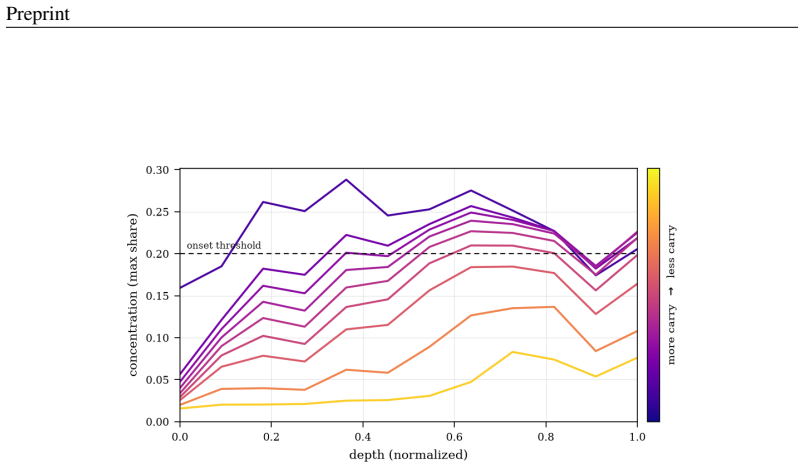
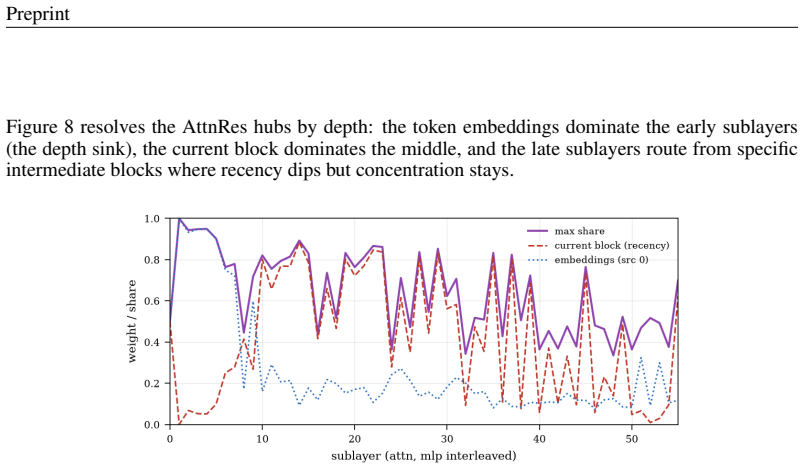
Attention sinks, representation collapse, and norm stratification are treated as transformer-specific pathologies. We show they are not specific to attention: they are what content-based routing does under a fixed similarity metric. We give a reframing identity: softmax attention is Boltzmann-weighted aggregation over Euclidean distances with constant key norms, so its score omits a $-\|k\|^2$ term and is blind to key magnitude. This predicts that any router whose metric is ill-matched to its representations should compensate, by concentrating its routing and collapsing the routed representations. We test it on routers that score and aggregate over different axes: softmax attention over tokens (nine pretrained transformers), graph attention over nodes, a selective state-space model and a recurrent mixer over time, and learned residuals over depth. All develop the same signature, and two within-model ablations show it is caused by the routing mechanism rather than by incidental dynamics. The form is contingent, set by the strength of the positional brake each router carries alongside its content score; we sweep that brake and move the onset across its whole range. The mechanism is not contingent, and it does not require norm stratification: a router with norm-normalized keys concentrates just the same. We do not claim these models implement Riemannian geometry; the geometric view is a diagnostic that names the inadequacy of the flat, norm-blind metric.
Figures



Reference graph
Works this paper leans on
-
[1]
Physical Review , volume=
Information Theory and Statistical Mechanics , author=. Physical Review , volume=. 1957 , publisher=
1957
-
[2]
Advances in Neural Information Processing Systems , volume=
Attention Is All You Need , author=. Advances in Neural Information Processing Systems , volume=
-
[3]
AAAI Conference on Artificial Intelligence , year=
Deeper Insights into Graph Convolutional Networks for Semi-Supervised Learning , author=. AAAI Conference on Artificial Intelligence , year=
-
[4]
International Conference on Learning Representations , year=
Graph Neural Networks Exponentially Lose Expressive Power for Node Classification , author=. International Conference on Learning Representations , year=
-
[5]
arXiv preprint arXiv:2403.01590 , year=
The Hidden Attention of Mamba Models , author=. arXiv preprint arXiv:2403.01590 , year=
-
[6]
RoFormer: Enhanced Transformer with Rotary Position Embedding
RoFormer: Enhanced Transformer with Rotary Position Embedding , author=. arXiv preprint arXiv:2104.09864 , year=
work page internal anchor Pith review Pith/arXiv arXiv
-
[7]
International Conference on Learning Representations , year=
Train Short, Test Long: Attention with Linear Biases Enables Input Length Extrapolation , author=. International Conference on Learning Representations , year=
-
[8]
International Conference on Learning Representations , year=
Outrageously Large Neural Networks: The Sparsely-Gated Mixture-of-Experts Layer , author=. International Conference on Learning Representations , year=
-
[9]
Attention Residuals , author=. arXiv preprint arXiv:2603.15031 , year=
work page internal anchor Pith review Pith/arXiv arXiv
-
[10]
International Conference on Learning Representations , year=
Graph Attention Networks , author=. International Conference on Learning Representations , year=
-
[11]
Mamba: Linear-Time Sequence Modeling with Selective State Spaces
Mamba: Linear-Time Sequence Modeling with Selective State Spaces , author=. arXiv preprint arXiv:2312.00752 , year=
work page internal anchor Pith review Pith/arXiv arXiv
-
[12]
Peng, Bo and Alcaide, Eric and Anthony, Quentin and others , booktitle=
-
[13]
International Conference on Learning Representations , year=
Efficient Streaming Language Models with Attention Sinks , author=. International Conference on Learning Representations , year=
-
[14]
Anthony , booktitle=
Kayyam, Ali and Madan Gopal, Anusha and Lewis, M. Anthony , booktitle=. Do Transformers Need Three Projections? Systematic Study of
-
[15]
Memory Caching:
Behrouz, Ali and Li, Zeman and Deng, Yuan and Zhong, Peilin and Razaviyayn, Meisam and Mirrokni, Vahab , journal=. Memory Caching:
-
[16]
and Shen, Yelong and Wallis, Phillip and Allen-Zhu, Zeyuan and Li, Yuanzhi and Wang, Shean and Wang, Lu and Chen, Weizhu , booktitle=
Hu, Edward J. and Shen, Yelong and Wallis, Phillip and Allen-Zhu, Zeyuan and Li, Yuanzhi and Wang, Shean and Wang, Lu and Chen, Weizhu , booktitle=
-
[17]
Annual Meeting of the Association for Computational Linguistics , year=
Intrinsic Dimensionality Explains the Effectiveness of Language Model Fine-Tuning , author=. Annual Meeting of the Association for Computational Linguistics , year=
-
[18]
International Conference on Machine Learning , year=
Attention is Not All You Need: Pure Attention Loses Rank Doubly Exponentially with Depth , author=. International Conference on Machine Learning , year=
discussion (0)
Sign in with ORCID, Apple, or X to comment. Anyone can read and Pith papers without signing in.