REVIEW 3 major objections 7 minor 65 references
Reviewed by Pith at T0; open to challenge.
T0 means a machine referee read the full paper against a public rubric. The mark states how deep the mechanical check went, never who wrote it. the ladder, T0–T4 →
T0 review · glm-5.2
Neural networks contain recoverable internal circuits
2026-07-09 14:18 UTC pith:NP2VXWY5
load-bearing objection Solid scoping review of mechanistic interpretability; covers the right ground but has a PRISMA compliance gap and some framing asymmetry between abstract and body. the 3 major comments →
Mechanistic Interpretability for Neural Networks: Circuits, Sparse Features and Symbolic Reasoning
The pith
A machine-rendered reading of the paper's core claim, the machinery that carries it, and where it could break.
Core claim
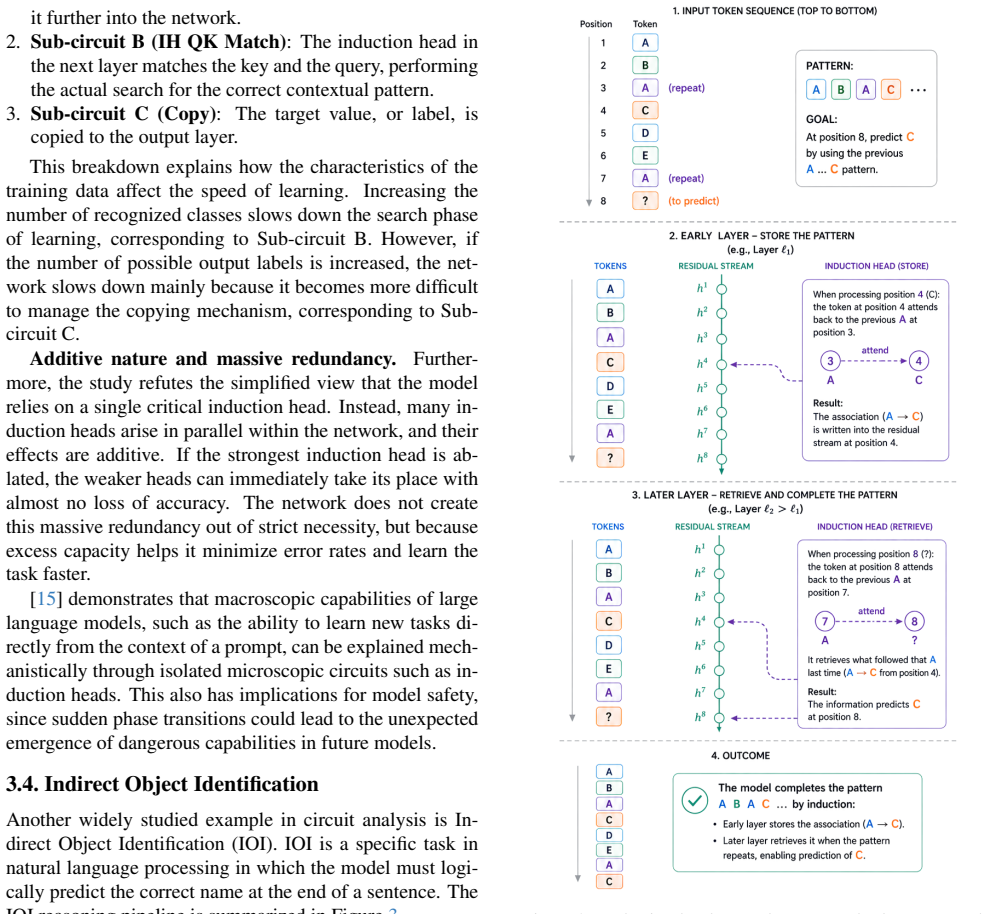
The paper's central claim is that neural networks contain recoverable structure and that at least some internal mechanisms can be identified, tested, and modified. It assembles evidence from circuit analysis (induction heads, indirect object identification), sparse feature decomposition (SAEs extracting monosemantic features from polysemantic neurons), causal intervention (steering vectors changing behavior along linear semantic directions), and neurosymbolic rule extraction to argue that these tools collectively form a maturing toolkit for reverse-engineering model internals. The review frames this as a progression: from saliency maps and attention visualization (which show correlation) to,
What carries the argument
The circuit: a causally identifiable subnetwork of attention heads, MLP layers, and residual-stream pathways responsible for a specific behavior, decomposable via QK/OV circuits, discoverable via ACDC or attribution-based methods, and made interpretable by SAEs that disentangle polysemantic superposition into monosemantic features.
Load-bearing premise
The paper assumes that interpretability tools validated on small models and narrow tasks like induction heads in GPT-2 Small will meaningfully transfer to frontier-scale systems, yet provides no evidence that this premise holds at scale.
What would settle it
Demonstrating that circuit-level mechanisms identified in small models do not correspond to the computational structure of frontier-scale models, or that SAE-extracted features that appear monosemantic on narrow tasks become irreducibly polysemantic or non-causal at scale.
If this is right
- If circuit-level tools scale to frontier models, safety-relevant behaviors like deception, sycophancy, or dangerous capability emergence could be audited and surgically modified before deployment, rather than detected only through behavioral testing.
- The finding that induction heads emerge as sudden phase transitions driven by interacting sub-circuits implies that dangerous capabilities in future models could similarly appear abruptly, making interpretability monitoring during training a safety-critical early-warning system.
- SAE-derived steering vectors that causally control high-level properties like truthfulness or refusal suggest that alignment could eventually be achieved through direct internal representation editing rather than solely through behavioral training methods like RLHF.
- The three-phase language processing structure (input-specific to language-agnostic to output-specific) and the discovery that tokenization fragmentation causes capacity exhaustion in early layers provide a mechanistic explanation for cross-lingual performance gaps that could inform tokenizer design.
- The distinction between mechanistic faithfulness (recovering the actual computation) and behavioral approximation (summarizing the decision boundary) sets a falsifiable boundary: neurosymbolic rules that predict correctly but fail under distribution shift would reveal they captured shortcuts rather than the model's algorithm.
Editorial analysis
A structured set of objections, weighed in public.
Referee Report
Summary. This manuscript is a scoping review of mechanistic interpretability (MI) for neural networks, covering Transformer circuit analysis (QK/OV circuits, induction heads, IOI), sparse autoencoders (SAEs) and transcoders for addressing polysemanticity, steering vectors and causal interventions, and neurosymbolic rule extraction frameworks (NeSyFOLD, NeSyViT). The review follows a PRISMA-ScR methodology and synthesizes approximately 58 references spanning foundational works (2021) through recent preprints (2025-2026). The central claim is that MI has progressed from surface-level explanations toward causal, algorithmic accounts of neural network behavior, and that the surveyed tools collectively form a maturing toolkit for reverse-engineering and controlling model internals.
Significance. The review provides a competent and broad synthesis of a rapidly evolving field. Its strengths include accurate technical descriptions of QK/OV circuit decomposition, SAE architectures (Table 2 is a useful comparison), the distinction between SAEs and transcoders (Section 4.5), and the CAA steering vector formulation (Eq. 1). The discussion of neurosymbolic methods (Section 6) and the explicit acknowledgment that these approximate decision boundaries rather than internal computation (Section 7.3) is a valuable clarification. The paper correctly identifies the scale-transfer gap as a central limitation (Section 7). The PRISMA-ScR framing is appropriate for a scoping review of this nature.
major comments (3)
- Section 2: The manuscript claims PRISMA-ScR compliance but does not include a PRISMA flow diagram, does not report the number of records identified, screened, excluded, or included at each stage, and does not provide the exact search string used. The PRISMA-ScR checklist (Tricco et al., 2018, ref [8]) requires a flow diagram and quantitative reporting of the selection process. Without these elements, the claim of PRISMA-ScR adherence is not substantiated. This is load-bearing for the review's methodological credibility.
- Section 3.6, ref [22]: The citation for Edge Attribution Patching (EAP) is attributed to Zhang et al. (2026), arXiv:2509.21044, titled 'Reinforcement learning fine-tuning enhances activation intensity and diversity in the internal circuitry of LLMs.' This does not appear to be the EAP paper; the original EAP work is by Syed et al. (2023) or Nanda. The reference appears mismatched to the method described in the text, which could mislead readers seeking the primary source.
- Section 4.3: The abstract states that SAEs 'can decompose tangled network activations into distinct, human-interpretable features,' which is stronger than the caveats in Sections 4.3, 4.5, and 7.1 regarding shrinkage, dead features, feature fragmentation, and the gap between SAE-extracted features and ideal supervision dictionaries (ref [58]). The abstract's framing should be softened to match the body's appropriately hedged discussion.
minor comments (7)
- Section 3.1: The phrase 'The method described in the paper addresses this problem by replacing these difficult-to-read MLP layers with multi-layer transcoders (CLT)' is ambiguous — 'the paper' could refer to this manuscript or a cited work. Clarify which work introduced CLTs.
- Section 4.3: The SAE encoder equation uses sigma for the activation function but does not specify which activation (ReLU, TopK, JumpReLU) is the default; Table 2 lists variants but the equation in the text appears to assume a generic nonlinearity.
- Section 5.1: The ActAdd method is described without a formal equation, while CAA receives one (Eq. 1). Adding the ActAdd formulation or a reference to it would improve parallelism.
- Figure 1: The figure caption 'Transformer information flow through the residual stream' is minimal; adding labels for the QK/OV circuits or attention/MLP blocks within the figure would aid readers unfamiliar with the architecture.
- Section 6.1: The rule example 'target(X, kitchen) :- not 3(X), 54(X)' uses kernel numbers as predicates, which is correct but could confuse readers unfamiliar with ASP syntax; a brief note that these are placeholder predicate names would help.
- Several references have 2026 dates (e.g., refs [2], [22], [26], [27], [39], [43], [44], [52]) which appear to be future-dated preprints; verify these are not placeholder dates.
- Section 3.7: 'ALTI algorithm' is introduced without a full citation at the point of first mention; the reference to Ferrando and Voita [23] appears later. Moving the citation forward would help.
Circularity Check
No circularity found — this is a scoping review with no derivations, predictions, or self-citations.
full rationale
This paper is a PRISMA-ScR scoping review that synthesizes external literature on mechanistic interpretability. It contains no novel derivation chain, no fitted parameters, and no predictions that could reduce to inputs by construction. The only equation (Eq. 1, the CAA steering vector formula) is attributed to Panickssery et al. [49], an external citation. A check of all 58 references reveals no self-citations by either author (Sawant or Krejčí). The paper's central claim—that MI has progressed toward causal, algorithmic accounts and that surveyed tools form a maturing toolkit—is a qualitative synthesis claim, not a quantitative result. There is no mechanism by which circularity could arise in such a paper.
Axiom & Free-Parameter Ledger
axioms (4)
- domain assumption Universality Hypothesis: similar neural networks trained on similar data will form similar internal circuits
- domain assumption Linear Representation Hypothesis: high-level semantic concepts are encoded as linear directions or low-dimensional subspaces in activation space
- domain assumption Superposition hypothesis: models represent M concepts using D neurons where M >> D, encoding concepts as nearly-orthogonal directions
- standard math PRISMA-ScR guidelines are appropriate for mapping the MI landscape without critical appraisal of individual study quality
read the original abstract
This article offers a comprehensive overview of mechanistic interpretability, an emerging field that seeks to reverse-engineer the internal algorithms of modern neural networks. While traditional explainable AI methods often stop at surface-level input-output correlations, this approach directly addresses the opaque "black box" nature of machine learning models, which is essential for ensuring safety and auditability in high-stakes deployments. The paper provides a detailed examination of Transformer circuit analysis, exploring how internal components like the residual stream, attention mechanisms, and induction heads drive complex tasks and in-context learning. It subsequently tackles the core challenge of superposition and polysemanticity, demonstrating how tools like Sparse Autoencoders (SAEs) and transcoders can decompose tangled network activations into distinct, human-interpretable features. Furthermore, the paper explores methods for actively controlling and modifying model behavior through steering vectors and causal interventions. Finally, it connects these mechanistic insights with neurosymbolic AI frameworks designed to translate neural representations into explicit, executable logical rules.
Figures



Reference graph
Works this paper leans on
-
[1]
B. Kowalska and H. Kwasnicka, “Unboxing the black box: Mechanistic interpretability for algorithmic understanding of neural networks,” 2025. [Online]. Available: https: //arxiv.org/abs/2511.19265 1
-
[2]
U. Naseem, “Mechanistic interpretability for large language model alignment: Progress, challenges, and future directions,” 2026. [Online]. Available: https://arxiv.org/abs/2602.11180 1
-
[3]
A mathematical framework for transformer circuits,
N. Elhage, N. Nanda, C. Olsson, T. Henighan, N. Joseph, B. Mann, A. Askell, Y . Bai, A. Chen, T. Conerlyet al., “A mathematical framework for transformer circuits,”Trans- former Circuits Thread, vol. 1, no. 1, p. 12, 2021. 1
work page 2021
-
[4]
F. Kares, T. Speith, H. Zhang, and M. Langer, “What makes for a good saliency map? comparing strategies for evaluating saliency maps in explainable ai (xai),” 2025. [Online]. Available: https://arxiv.org/abs/2504.17023 2
work page internal anchor Pith review Pith/arXiv arXiv 2025
-
[5]
A perspective on explainable artificial intelligence methods: Shap and lime,
A. M. Salih, Z. Raisi-Estabragh, I. B. Galazzo, P. Radeva, S. E. Petersen, K. Lekadir, and G. Menegaz, “A perspective on explainable artificial intelligence methods: Shap and lime,”Advanced Intelligent Systems, vol. 7, no. 1, Jun
-
[6]
Available: http://dx.doi.org/10.1002/aisy
[Online]. Available: http://dx.doi.org/10.1002/aisy. 202400304 2, 3
-
[7]
Understanding intermediate layers using linear classifier probes
G. Alain and Y . Bengio, “Understanding intermediate layers using linear classifier probes,” 2018. [Online]. Available: https://arxiv.org/abs/1610.01644 3
work page internal anchor Pith review Pith/arXiv arXiv 2018
-
[8]
Visualizing Attention in Transformer-Based Language Representation Models
J. Vig, “Visualizing attention in transformer-based language representation models,” 2019. [Online]. Available: https: //arxiv.org/abs/1904.02679 3
work page internal anchor Pith review Pith/arXiv arXiv 2019
-
[9]
Prisma extension for scoping reviews (prisma-scr): checklist and explanation,
A. C. Tricco, E. Lillie, W. Zarin, K. K. O’Brien, H. Colquhoun, D. Levac, D. Moher, M. D. Peters, T. Horsley, L. Weekset al., “Prisma extension for scoping reviews (prisma-scr): checklist and explanation,”Annals of Internal Medicine, vol. 169, no. 7, pp. 467–473, 2018. [Online]. Available: https://www.acpjournals.org/doi/10.7326/M18- 0850 3
-
[10]
Scoping studies: towards a methodological framework,
H. Arksey and L. O’malley, “Scoping studies: towards a methodological framework,”International journal of social research methodology, vol. 8, no. 1, pp. 19–32, 2005. 3
work page 2005
-
[11]
Circuit tracing: Revealing compu- tational graphs in language models,
J. Lindsey, W. Gurnee, E. Ameisen, B. Chen, A. Pearce, N. L. Turneret al., “Circuit tracing: Revealing compu- tational graphs in language models,”Transformer Circuits Thread, 2025. [Online]. Available: https://transformer- circuits.pub/2025/attribution-graphs/methods.html 4, 12
work page 2025
-
[12]
Open Problems in Mechanistic Interpretability
L. Sharkey, B. Chughtai, J. Batson, J. Lindsey, J. Wu, L. Bushnaq, N. Goldowsky-Dill, S. Heimersheim, A. Ortega, J. Bloom, S. Biderman, A. Garriga-Alonso, A. Conmy, N. Nanda, J. Rumbelow, M. Wattenberg, N. Schoots, J. Miller, E. J. Michaud, S. Casper, M. Tegmark, W. Saunders, D. Bau, E. Todd, A. Geiger, M. Geva, J. Hoogland, D. Murfet, and T. McGrath, “Op...
work page internal anchor Pith review Pith/arXiv arXiv 2025
-
[13]
N. Nanda and J. Bloom, “Transformerlens,” https://github. com/TransformerLensOrg/TransformerLens, 2022. 4
work page 2022
-
[14]
On the geometry and topology of representations: the manifolds of modular addition,
G. Moisescu-Pareja, G. McCracken, H. Wiltzer, V . L´etourneau, C. Daniels, D. Precup, and J. Love, “On the geometry and topology of representations: the manifolds of modular addition,” 2025. [Online]. Available: https://arxiv.org/abs/2512.25060 5
-
[15]
A. K. Singh, T. Moskovitz, F. Hill, S. C. Chan, and A. M. Saxe, “What needs to go right for an induction head? a mech- anistic study of in-context learning circuits and their forma- tion,”arXiv preprint arXiv:2404.07129, 2024. 5
work page internal anchor Pith review Pith/arXiv arXiv 2024
-
[16]
In-context Learning and Induction Heads
C. Olsson, N. Elhage, N. Nanda, N. Joseph, N. DasSarma, T. Henighan, B. Mann, A. Askell, Y . Bai, A. Chen, T. Conerly, D. Drain, D. Ganguli, Z. Hatfield-Dodds, D. Hernandez, S. Johnston, A. Jones, J. Kernion, L. Lovitt, K. Ndousse, D. Amodei, T. Brown, J. Clark, J. Kaplan, S. McCandlish, and C. Olah, “In-context learning and induction heads,” 2022. [Onlin...
work page internal anchor Pith review Pith/arXiv arXiv 2022
-
[17]
Interpretability in the Wild: a Circuit for Indirect Object Identification in GPT-2 small
K. Wang, A. Variengien, A. Conmy, B. Shlegeris, and J. Steinhardt, “Interpretability in the wild: a circuit for indirect object identification in gpt-2 small,” 2022. [Online]. Available: https://arxiv.org/abs/2211.00593 6
work page internal anchor Pith review Pith/arXiv arXiv 2022
-
[18]
Investigating the Indirect Object Identification circuit in Mamba
D. Ensign and A. Garriga-Alonso, “Investigating the indirect object identification circuit in mamba,” 2024. [Online]. Available: https://arxiv.org/abs/2407.14008 7
work page internal anchor Pith review Pith/arXiv arXiv 2024
-
[19]
Emergence of Minimal Circuits for Indirect Object Identification in Attention-Only Transformers
R. Adhikari, “Emergence of minimal circuits for indirect object identification in attention-only transformers,” 2025. [Online]. Available: https://arxiv.org/abs/2510.25013 7
work page internal anchor Pith review Pith/arXiv arXiv 2025
-
[20]
Towards Automated Circuit Discovery for Mechanistic Interpretability
A. Conmy, A. N. Mavor-Parker, A. Lynch, S. Heimer- sheim, and A. Garriga-Alonso, “Towards automated circuit discovery for mechanistic interpretability,” 2023. [Online]. Available: https://arxiv.org/abs/2304.14997 7
work page internal anchor Pith review Pith/arXiv arXiv 2023
-
[21]
Efficient automated circuit discovery in transformers using contextual decomposition,
A. R. Hsu, G. Zhou, Y . Cherapanamjeri, Y . Huang, A. Y . Odisho, P. R. Carroll, and B. Yu, “Efficient automated circuit discovery in transformers using contextual decomposition,” 18
-
[22]
Efficient Automated Circuit Discovery in Transformers using Contextual Decomposition
[Online]. Available: https://arxiv.org/abs/2407.00886 7
work page internal anchor Pith review Pith/arXiv arXiv
-
[23]
Pahq: Accelerating automated circuit discovery through mixed-precision inference optimization,
X. Wang, S. Yang, L. Wang, L. Zhang, H. Xie, L. Hu, and D. Wang, “Pahq: Accelerating automated circuit discovery through mixed-precision inference optimization,”
-
[24]
Available: https://arxiv.org/abs/2510.23264 7
[Online]. Available: https://arxiv.org/abs/2510.23264 7
-
[25]
H. Zhang, Q. Hao, F. Xu, and Y . Li, “Reinforcement learning fine-tuning enhances activation intensity and diversity in the internal circuitry of llms,” 2026. [Online]. Available: https://arxiv.org/abs/2509.21044 8
-
[26]
Information flow routes: Automatically interpreting language models at scale,
J. Ferrando and E. V oita, “Information flow routes: Automatically interpreting language models at scale,” in Proceedings of the 2024 Conference on Empirical Methods in Natural Language Processing, Y . Al-Onaizan, M. Bansal, and Y .-N. Chen, Eds. Miami, Florida, USA: Association for Computational Linguistics, Nov. 2024, pp. 17 432–17 445. [Online]. Availa...
work page 2024
-
[27]
A Mechanistic Analysis of a Transformer Trained on a Symbolic Multi-Step Reasoning Task
J. Brinkmann, A. Sheshadri, V . Levoso, P. Swoboda, and C. Bartelt, “A mechanistic analysis of a transformer trained on a symbolic multi-step reasoning task,”arXiv preprint arXiv:2402.11917, 2024. 8
work page internal anchor Pith review Pith/arXiv arXiv 2024
-
[28]
Emergent symbolic mechanisms support abstract reasoning in large language models,
Y . Yang, D. I. Campbell, K. Huang, M. Wang, J. D. Cohen, and T. W. Webb, “Emergent symbolic mechanisms support abstract reasoning in large language models,” inProceedings of the 42nd International Conference on Machine Learning (ICML), 2025. 8
work page 2025
-
[29]
Improving Sparse Autoencoder with Dynamic Attention
D. Wang, J. Zhang, D. Su, and H. Huang, “Improving sparse autoencoder with dynamic attention,” 2026. [Online]. Available: https://arxiv.org/abs/2604.14925 9
work page internal anchor Pith review Pith/arXiv arXiv 2026
-
[30]
Mechanistic interpretability with sparse autoencoder neural operators,
B. Tolooshams, A. Shen, and A. Anandkumar, “Mechanistic interpretability with sparse autoencoder neural operators,”
-
[31]
Mechanistic Interpretability with Sparse Autoencoder Neural Operators
[Online]. Available: https://arxiv.org/abs/2509.03738 9
work page internal anchor Pith review Pith/arXiv arXiv
-
[32]
N. Elhage, T. Hume, C. Olsson, N. Schiefer, T. Henighan, S. Kravec, Z. Hatfield-Dodds, R. Lasenby, D. Drain, C. Chenet al., “Toy models of superposition,”arXiv preprint arXiv:2209.10652, 2022. 9
work page internal anchor Pith review Pith/arXiv arXiv 2022
-
[33]
Towards monosemanticity: Decomposing language models with dictionary learning,
T. Bricken, A. Templeton, J. Batson, B. Chen, A. Jermyn, T. Conerly, N. Turner, C. Olsson, S. Douglas, B. McKenzie- Nelson, N. Elhage, S. Hume, J. Knight, B. Shlegeris, N. Ninan, A. Schlatter, C. Olah, and T. Henighan, “Towards monosemanticity: Decomposing language models with dictionary learning,”Transformer Circuits Thread, 2023, anthropic Research. [On...
work page 2023
-
[34]
Finding Neurons in a Haystack: Case Studies with Sparse Probing
W. Gurnee, N. Nanda, M. Pauly, K. Harvey, D. Troitskii, and D. Bertsimas, “Finding neurons in a haystack: Case stud- ies with sparse probing,”arXiv preprint arXiv:2305.01610,
work page internal anchor Pith review Pith/arXiv arXiv
-
[35]
Scaling monosemanticity: Extracting interpretable features from claude 3 sonnet,
A. Templeton, T. Conerly, J. Marcus, J. Lindsay, T. Bricken, B. Chen, A. Pearce, N. Ley, N. Russell, T. Henighan, and C. Olah, “Scaling monosemanticity: Extracting interpretable features from claude 3 sonnet,”Transformer Circuits Thread, 2024, anthropic. [Online]. Available: https://transformer- circuits.pub/2024/scaling-monosemanticity/ 9, 14
work page 2024
-
[36]
Gemma Scope: Open Sparse Autoencoders Everywhere All At Once on Gemma 2
T. Lieberum, S. Rajamanoharan, A. Conmy, L. Smith, N. Sonnerat, V . Varma, J. Kram ´ar, A. Dragan, R. Shah, and N. Nanda, “Gemma scope: Open sparse autoencoders everywhere all at once on gemma 2,” 2024. [Online]. Available: https://arxiv.org/abs/2408.05147 10
work page internal anchor Pith review Pith/arXiv arXiv 2024
-
[37]
arXiv preprint arXiv:2503.05613 (2025)
D. Shu, X. Wu, H. Zhao, D. Rai, Z. Yao, N. Liu, and M. Du, “A survey on sparse autoencoders: Interpreting the internal mechanisms of large language models,” 2025. [Online]. Available: https://arxiv.org/abs/2503.05613 10
-
[38]
Improving Dictionary Learning with Gated Sparse Autoencoders
S. Rajamanoharan, A. Conmy, L. Smith, T. Lieberum, V . Varma, J. Kram´ar, R. Shah, and N. Nanda, “Improving dictionary learning with gated sparse autoencoders,” 2024. [Online]. Available: https://arxiv.org/abs/2404.16014 10
work page internal anchor Pith review Pith/arXiv arXiv 2024
-
[39]
Scaling and evaluating sparse autoencoders
L. Gao, T. D. la Tour, H. Tillman, G. Goh, R. Troll, A. Radford, I. Sutskever, J. Leike, and J. Wu, “Scaling and evaluating sparse autoencoders,” 2024. [Online]. Available: https://arxiv.org/abs/2406.04093 10
work page internal anchor Pith review Pith/arXiv arXiv 2024
-
[40]
B. Bussmann, P. Leask, and N. Nanda, “Batchtopk sparse autoencoders,” 2024. [Online]. Available: https: //arxiv.org/abs/2412.06410 10
work page internal anchor Pith review Pith/arXiv arXiv 2024
-
[41]
Entropy-lens: The information signature of transformer computations,
R. Ali, F. Caso, C. Irwin, and P. Li `o, “Entropy-lens: The information signature of transformer computations,”arXiv preprint arXiv:2502.16570, 2025. 10
-
[42]
Activation oracles: Training and evaluating llms as general-purpose activation explainers,
A. Karvonen, J. Chua, C. Dumas, K. Fraser-Taliente, S. Kantamneni, J. Minder, E. Ong, A. S. Sharma, D. Wen, O. Evans, and S. Marks, “Activation oracles: Training and evaluating llms as general-purpose activation explainers,” Anthropic Alignment Science Blog, 2025, anthropic. [Online]. Available: https://alignment.anthropic.com/2025/ activation-oracles/ 10
work page 2025
-
[43]
Sparse Autoencoders Reveal Interpretable and Steerable Features in VLA Models
A. Swann, L. McGranahan, H. Buurmeijer, M. K. III, and M. Schwager, “Sparse autoencoders reveal interpretable and steerable features in vla models,” 2026. [Online]. Available: https://arxiv.org/abs/2603.19183 11
work page internal anchor Pith review Pith/arXiv arXiv 2026
-
[44]
Sparse feature circuits: Discovering and editing interpretable causal graphs in language models,
S. Marks, C. Rager, E. J. Michaud, Y . Belinkov, D. Bau, and A. Mueller, “Sparse feature circuits: Discovering and editing interpretable causal graphs in language models,”
-
[45]
Sparse Feature Circuits: Discovering and Editing Interpretable Causal Graphs in Language Models
[Online]. Available: https://arxiv.org/abs/2403.19647 11
work page internal anchor Pith review Pith/arXiv arXiv
-
[46]
Evaluating explanation faithfulness in toy models,
C. McDougall, T. Conerly, A. Templeton, J. Lindsey, T. Bricken, B. Chen, A. Pearce, C. Citro, E. Ameisen, A. Jones, H. Cunningham, N. L. Turner, M. MacDiarmid, A. Tamkin, E. Durmus, T. Hume, F. Mosconi, C. D. Freeman, T. R. Sumers, E. Rees, J. Batson, A. Jermyn, S. Carter, C. Olah, and T. Henighan, “Evaluating explanation faithfulness in toy models,”Trans...
work page 2025
-
[47]
Transcoders Find Interpretable LLM Feature Circuits
J. Dunefsky, P. Chlenski, and N. Nanda, “Transcoders find interpretable llm feature circuits,” 2024. [Online]. Available: https://arxiv.org/abs/2406.11944 11
work page internal anchor Pith review Pith/arXiv arXiv 2024
-
[48]
Circuit insights: Towards inter- pretability beyond activations,
E. Golimblevskaia, A. Jain, B. Puri, A. Ibrahim, W. Samek, and S. Lapuschkin, “Circuit insights: Towards inter- pretability beyond activations,” 2026. [Online]. Available: https://arxiv.org/abs/2510.14936 11
-
[49]
Small vectors, big effects: A mechanistic study of rl-induced reasoning via steering vectors,
V . Sinii, N. Balagansky, G. Gerasimov, D. Laptev, Y . Ak- senov, V . Kurochkin, A. Gorbatovski, B. Shaposhnikov, and 19 D. Gavrilov, “Small vectors, big effects: A mechanistic study of rl-induced reasoning via steering vectors,” 2026. [Online]. Available: https://arxiv.org/abs/2509.06608 13
-
[50]
Model whisper: Steering vectors unlock large language models’ potential in test- time,
X. Kang, D. Shi, and L. Chen, “Model whisper: Steering vectors unlock large language models’ potential in test- time,” 2025. [Online]. Available: https://arxiv.org/abs/2512. 04748 13
work page 2025
-
[51]
Toward a Flexible Framework for Linear Representation Hypothesis Using Maximum Likelihood Estimation
T. Nguyen and Y . Leng, “Toward a flexible framework for linear representation hypothesis using maximum likelihood estimation,” 2025. [Online]. Available: https://arxiv.org/abs/ 2502.16385 13
work page internal anchor Pith review Pith/arXiv arXiv 2025
-
[52]
Representation Engineering for Large-Language Models: Survey and Research Challenges
L. Bartoszcze, S. Munshi, B. Sukidi, J. Yen, Z. Yang, D. Williams-King, L. Le, K. Asuzu, and C. Maple, “Representation engineering for large-language models: Survey and research challenges,” 2025. [Online]. Available: https://arxiv.org/abs/2502.17601 13, 14
work page internal anchor Pith review Pith/arXiv arXiv 2025
-
[53]
Steering Language Models With Activation Engineering
A. M. Turner, L. Thiergart, G. Leech, D. Udell, J. J. Vazquez, U. Mini, and M. MacDiarmid, “Steering language models with activation engineering,” 2024. [Online]. Available: https://arxiv.org/abs/2308.10248 13
work page internal anchor Pith review Pith/arXiv arXiv 2024
-
[54]
Steering Llama 2 via Contrastive Activation Addition
N. Panickssery, N. Gabrieli, J. Schulz, M. Tong, E. Hubinger, and A. M. Turner, “Steering llama 2 via contrastive activation addition,” 2024. [Online]. Available: https: //arxiv.org/abs/2312.06681 13
work page internal anchor Pith review Pith/arXiv arXiv 2024
-
[55]
Emotion concepts and their function in a large language model,
N. Sofroniew, J. Lindsey, W. Gurnee, E. Ameisen, B. Chen, A. Pearce, N. L. Turner, C. Citro, D. Abrahams, S. Carter, B. Hosmer, J. Marcus, M. Sklar, A. Templeton, T. Bricken, C. McDougall, H. Cunningham, T. Henighan, A. Jermyn, A. Jones, A. Persic, Z. Qi, T. B. Thompson, S. Zimmerman, K. Rivoire, T. Conerly, C. Olah, and J. Batson, “Emotion concepts and t...
work page 2026
-
[56]
Interpretable Steering of Large Language Models with Feature Guided Activation Additions
S. Soo, C. Guang, W. Teng, C. Balaganesh, T. Guoxian, and Y . Ming, “Interpretable steering of large language models with feature guided activation additions,” 2025. [Online]. Available: https://arxiv.org/abs/2501.09929 14
work page internal anchor Pith review Pith/arXiv arXiv 2025
-
[57]
Dspa: Dynamic sae steering for data-efficient preference alignment,
J. Wedgwood, A. Muhamed, M. T. Diab, and V . Smith, “Dspa: Dynamic sae steering for data-efficient preference alignment,” 2026. [Online]. Available: https://arxiv.org/abs/ 2603.21461 14
-
[58]
Fold-se: An efficient rule-based machine learning algorithm with scalable explainability,
H. Wang and G. Gupta, “Fold-se: An efficient rule-based machine learning algorithm with scalable explainability,”
-
[59]
FOLD-SE: An Efficient Rule-based Machine Learning Algorithm with Scalable Explainability
[Online]. Available: https://arxiv.org/abs/2208.07912 15
work page internal anchor Pith review Pith/arXiv arXiv
-
[60]
Nesyfold: Neurosym- bolic framework for interpretable image classification,
P. Padalkar, H. Wang, and G. Gupta, “Nesyfold: Neurosym- bolic framework for interpretable image classification,”
-
[61]
NeSyFOLD: Neurosymbolic Framework for Interpretable Image Classification
[Online]. Available: https://arxiv.org/abs/2301.12667 15
work page internal anchor Pith review Pith/arXiv arXiv
-
[62]
Theory and Practice of Logic Programming 25(4), 722–738 (2025)
P. Padalkar and G. Gupta, “Symbolic rule extraction from attention-guided sparse representations in vision transformers,”Theory and Practice of Logic Programming, vol. 25, no. 4, pp. 722–738, Jul. 2025. [Online]. Available: http://dx.doi.org/10.1017/S1471068425100318 15
-
[63]
Logic-lm: Empowering large language models with symbolic solvers for faithful logical reasoning,
L. Pan, A. Albalak, X. Wang, and W. Y . Wang, “Logic-lm: Empowering large language models with symbolic solvers for faithful logical reasoning,” inFindings of the Association for Computational Linguistics: EMNLP 2023, 2023. 16
work page 2023
-
[64]
Llms can’t plan, but can help planning in llm-modulo frame- works,
S. Kambhampati, K. Valmeekam, L. Guan, M. Verma, K. Stechly, S. Bhambri, L. Saldyt, and A. Murthy, “Llms can’t plan, but can help planning in llm-modulo frame- works,” inProceedings of the 41st International Conference on Machine Learning (ICML), 2024. 16
work page 2024
-
[65]
Towards Principled Evaluations of Sparse Autoencoders for Interpretability and Control
A. Makelov, G. Lange, and N. Nanda, “Towards principled evaluations of sparse autoencoders for interpretability and control,” 2024. [Online]. Available: https://arxiv.org/abs/ 2405.08366 17 20
work page internal anchor Pith review Pith/arXiv arXiv 2024
discussion (0)
Sign in with ORCID, Apple, or X to comment. Anyone can read and Pith papers without signing in.