REVIEW 3 major objections 6 minor 105 references
Local micromechanics in a mean-field model of glasses reveal key properties of its non-equilibrium RSB phase
T0 review · 3 major / 6 minor · reviewed 2026-07-30 · grok-4.5
Pith's one-line read Local force-monopole responses in a mean-field glass model obey an exact identity that recovers the vibrational spectrum and realizes the effective random potential deep in the non-equilibrium RSB phase.
desk verdict Solid technical advance: monopole identity, VDoS-from-κ reconstruction, and stabilized-sector link to ω_p inside their non-eq RSB model; the cavity-independence assumption is the only real soft spot and is already stress-tested by consequences. read the letter →
The pith
A machine-rendered reading of the paper's core claim, the machinery that carries it, and where it could break.
The reading
What carries the argument
The mean-field monopole-stiffness identity κ_i = [(k_i − J²χ) + ½ x_i²] / (1 + J² χ_SG), obtained from the resolvent of the Hessian via the Schur complement and random-matrix self-consistency. It converts local response data into global susceptibilities, enables spectrum reconstruction, and defines the stabilized sector whose mean stiffness tracks the boson peak.
What would settle it
Compute monopole stiffnesses and global susceptibilities on large quenched samples and test whether the measured κ_i equal the right-hand side of the identity within the predicted N^{-1/5} fluctuations; systematic O(1) deviations at large N would falsify the claim.
Extended reading notes
Core claim
In the non-equilibrium RSB phase of the mean-field glass model, the monopole stiffness satisfies the identity κ_i = [(k_i − J²χ) + ½ x_i²] / (1 + J² χ_SG). The vibrational density of states can be reconstructed from the set {κ_i} alone, and the conditional mean stiffness of the stabilized sector (k_i < J²χ) scales as ⟨κ⟩_st ∼ ω_p², furnishing a concrete micromechanical realization of the collective degrees of freedom of the effective random potential.
Load-bearing premise
The derivation assumes that the diagonal Hessian entries remain statistically uncorrelated with the random off-diagonal couplings after the quench; if those correlations stay finite at large system size, the identity and the spectrum reconstruction both fail.
Editorial extensions
If this is right
- The full nonphononic vibrational spectrum, including the quartic tail and boson-peak scale, is encoded in local monopole-response statistics alone.
- Mesoscopic elasticity (stabilized-sector mean stiffness) varies more strongly with disorder than the global modulus, matching the pattern seen in computer glasses.
- The effective random-potential description remains valid deep inside the non-equilibrium RSB phase even when no equilibrium RS phase exists.
- Force-fluctuation scale Δf satisfies ω_p ∼ (Δf)^{1/3}, linking random forces in the effective potential to the boson peak.
- Models with a softer ω² spectrum (divergent spin-glass susceptibility) cannot support a well-defined local monopole stiffness.
Reading between the lines
- If the same monopole-to-spectrum map holds on sparse graphs, the identity would give a practical diagnostic of RSB-like marginality in finite-connectivity glass models.
- Laboratory 'pinching' protocols that measure local stiffness distributions could test whether real glasses obey ⟨κ⟩_st ∼ ω_BP² without needing full vibrational spectroscopy.
- The stabilized-sector oscillators are natural candidates for the soft spots that control yielding and mechanical memory under cyclic drive already studied in the same model.
Signed reviews
Editorial analysis
A structured set of objections, weighed in public.
Referee Report
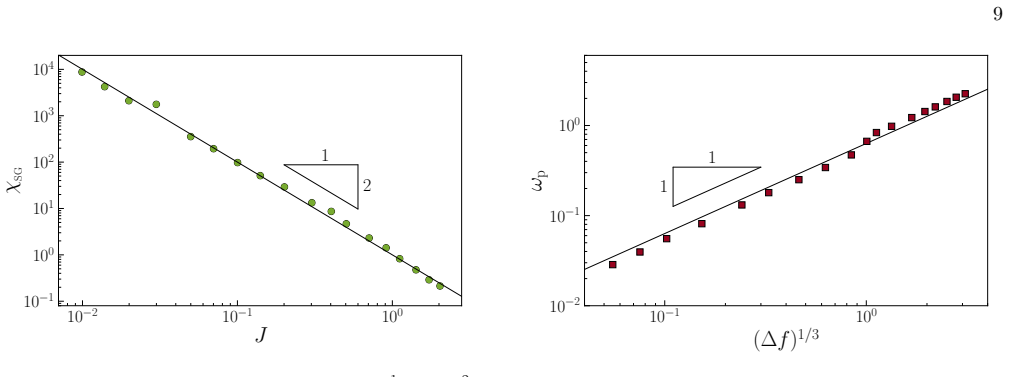
Summary. The manuscript studies a fully-connected mean-field glass Hamiltonian (Eq. 1) in its non-equilibrium RSB phase (instantaneous quench, h=0, gapless p(k)). It defines a local micromechanical observable — the force-monopole stiffness kappa_i = (M^{-1})_{ii}/(M^{-2})_{ii} — as the mean-field analog of the dipole ("pinching") stiffness in finite-dimensional glasses. The central analytic result is the mean-field identity Eq. (6), kappa_i = [(k_i - J^2 chi) + x_i^2/2]/(1 + J^2 chi_SG), derived via Schur complement and GOE averaging, with anomalous finite-N fluctuations predicted to scale as N^{-1/5} (Appendix A, Fig. A1). Corollaries include pairwise and global estimators of chi and chi_SG from kappa statistics alone (Appendix B), a reconstruction of the full VDoS from {kappa_i} validated against direct diagonalization (Fig. 3a), the identification of a "stabilized sector" {k_i < J^2 chi} whose conditional stiffness distribution collapses and whose mean scales as <kappa>_st ~ omega_p^2 (Figs. 4-5), a mesoscopic-vs-global modulus comparison (Fig. 6), and an extended correspondence with the equilibrium effective random potential, including chi_SG ~ J^{-2} (Fig. 7) and omega_p ~ (Delta f)^{1/3} (Fig. 8). Appendix H shows the monopole response is ill-defined in the spherical 3-spin model, supporting the claimed link to the quartic VDoS tail.
Significance. If the identity holds as argued, the paper delivers several genuinely strong results: a parameter-free, asymptotically exact relation between a local response and global susceptibilities; an explicit, testable prediction for anomalous finite-size fluctuations (N^{-1/5}) that is numerically confirmed; a reconstruction of the full VDoS from monopole statistics validated against direct diagonalization on identical disorder realizations (Fig. 3a); a falsifiable scaling bridge (Eq. 9) between mesoscopic stiffness and the boson-peak frequency that is in principle exportable to laboratory glasses; and a clean negative result (Appendix H) delineating when the micromechanical description fails. The work meaningfully clarifies the structure of this mean-field glass model and strengthens its contact with finite-dimensional glass physics.
major comments (3)
- [Appendix A, Eq. (A2)] The derivation replaces the cavity quadratic form Q_i = sum_{j,k != i} J_ij G^{(i)}_{jk} J_ki by (J^2/N) Tr G^{(i)}, assuming no correlation between the diagonal a_i = k_i + x_i^2/2 and the off-diagonal row {J_ij}. At a quenched minimum, however, x_i is a functional of the full coupling matrix including row i, so the assumption is not exact; what Eq. (6) actually requires is conditional self-averaging of Q_i given a_i. The presented checks (Fig. A1 error distribution, Figs. 3a, A3) test consequences of the identity but average over all oscillators. Since the stabilized-sector construction (Sect. VI) and the a_i <-> kappa_i map (Eq. C2) use the identity pointwise, I ask for a direct test of structured bias, e.g., the conditional mean of Delta kappa_i (Eq. A6) versus k_i, or restricted to k_i < J^2 chi. If no bias is found, a short statement to that effect suffices.
- [Appendix A, Eqs. (A3)-(A7) and Fig. A1] The finite-N convergence test of the identity is shown only at J = 0.5. Because chi_SG ~ J^{-2} (Fig. 7), the fluctuation terms O(sqrt(chi_SG/N)) in Eqs. (A3)-(A4) and the extreme-value scale omega_min both worsen as J decreases, while the headline scaling results (Figs. 3-5, 8) extend to J = 0.01 at fixed N = 8192. A Fig. A1-style convergence check at a small J (e.g., 0.05), or N-dependence of the data in Fig. 5, is needed to establish that the N^{-1/5} fluctuation regime, rather than a J-dependent systematic error, controls the small-J points that carry the scaling claims.
- [Sect. VIII, Fig. 7] The claimed correspondence between the monopole identity and the effective potential (that Eqs. (6) and (11) are 'essentially identical') rests on J^2 chi_SG being J-independent, supported only by the numerical line chi_SG = J^{-2} in Fig. 7. The precision, the J-range over which it holds, and its status (exact identity vs. approximate scaling) are not quantified, and no analytic argument (e.g., from marginal stability) is offered. Since this is a central conceptual claim of Sects. VIII-IX, the authors should quantify deviations from chi_SG ~ J^{-2}, state explicitly whether they conjecture it to be exact, and temper the wording if it is only approximate.
minor comments (6)
- [Appendix D; Fig. 3b] The cutoff omega_g is defined operationally by A_g omega^4 / D_G(omega) >= 2 (Appendix D). The slope and quality of the omega_p ~ omega_g relation in Fig. 3b presumably depend on this threshold; please report sensitivity (e.g., thresholds 1.5 and 3) in an inset or supplementary figure.
- [Appendix B, Eq. (B1) and Fig. A2] The pair estimators in Eq. (B1) are singular as kappa_i -> kappa_j, and second moments are computed only from pairs with |kappa_i - kappa_j| > 10^{-2}. Please show that the N^{-1/5} scaling in Fig. A2 is robust to this cutoff and comment on whether p(Delta_chi^{(ij)}) has heavy tails.
- [Sect. IX] The definition delta f_i = (k_i - J^2 chi) x_i + x_i^3/6 is asserted by analogy to v'_eff(x*) = 0. It would help to state explicitly that this follows from mechanical equilibrium, sum_j J_ij x_j = -(k_i x_i + x_i^3/6), so that delta f_i is minus the cavity field including the Onsager-like reaction term J^2 chi x_i.
- [Sect. III, Fig. 1b] Fig. 1b is a schematic 2D embedding of a fully connected model; the caption should state even more explicitly that positions carry no meaning, and the participation number N_e of the response vector z_i should be defined in the main text, not only used.
- [Appendix C; Fig. A3] Please state the convergence criterion and lambda-grid used when iterating Eq. (7) with eta = 10^{-8}, and clarify why Fig. A3 uses M = 200 realizations while M = 2000 is used elsewhere (Appendix G).
- [Throughout] Typos: 'arranging the the remaining oscillators' (Fig. 1 caption); 'the scaling of the the mean' (after Eq. A5); 'degree of freedoms' (abstract and Sect. II); 'mesocopic' (Sect. III); 'two subpopulation' (Sect. VI).
Circularity Check
No significant circularity: the κ identity is re-derived from the Hessian/RMT, and the scaling/reconstruction results are independent numerical checks, not inputs renamed as predictions.
full rationale
The load-bearing mean-field identity (Eq. 6 / App. A) is obtained from the Schur complement of the model Hessian plus a standard GOE cavity average; κ_i is defined operationally from M^{-1} and M^{-2}, while the right-hand side is assembled from diagonals and global traces. That is a derivation under an independence assumption, not a quantity defined in terms of its own target. Spectrum reconstruction (Sect. V, App. C) is a corollary of that identity plus the resolvent self-consistency: once a_i are recovered from {κ_i}, D_G must match the Hessian spectrum if the map is accurate—so Fig. 3a is a consistency test of Eq. 6, not a fitted parameter re-sold as a prediction. ⟨κ⟩_st ∼ ω_p² and χ_SG ∼ J^{-2} are measured on quenched minima and are not imposed by normalization or by the definition of the stabilized sector. Self-citations to the authors’ model and dipole-micromechanics papers supply motivation, the effective-potential analogy, and prior phenomenology; they do not insert a uniqueness theorem or ansatz that forces the new identities. The main scientific risk (conditional diagonal–coupling independence after the quench) is an assumption/correctness issue, not circularity. Score 1 for routine self-citation context only.
Assumptions & free parameters
free parameters (2)
- Operational ω_g threshold (A_g ω^4 / D_G(ω) ≥ 2) =
threshold = 2
- Pair-estimator cutoff |κ_i − κ_j| > 10^{-2} =
10^{-2}
assumptions (5)
- domain assumption Hessian off-diagonal elements are GOE with variance J²/N and statistically uncorrelated with diagonal entries k_i + ½ x_i² at quenched minima.
- domain assumption The model Hamiltonian (Eq. 1) with quartic on-site stabilization and Gaussian couplings is an adequate mean-field caricature of nonphononic glass physics.
- domain assumption Instantaneous athermal energy minimization from near-zero initial conditions samples the relevant non-equilibrium RSB measure (h=0, k_m=0).
- standard math Schur complement / resolvent identities and GOE quadratic-form concentration from random matrix theory.
- domain assumption Positivity of M (local minima) so that κ_i = (M^{-1})_{ii}/(M^{-2})_{ii} is well-defined and positive.
invented entities (2)
-
Force-monopole stiffness κ_i in the fully connected glass model
independent evidence
-
Stabilized sector {i : k_i < J²χ}
Cite this review
Pith. "Pith review of Local micromechanics in a mean-field model of glasses reveal key properties of its non-equilibrium RSB phase." pith.science (2026). https://pith.science/paper/NS7JXLF3
@misc{pith2026260723603,
  author       = {Pith},
  title        = {Pith review of: Local micromechanics in a mean-field model of glasses reveal key properties of its non-equilibrium RSB phase},
  year         = {2026},
  howpublished = {\url{https://pith.science/paper/NS7JXLF3}},
  note         = {Machine review of arXiv:2607.23603}
}
read the original abstract
A recently formulated mean-field model of glasses features an equilibrium, zero-temperature Replica-Symmetry-Breaking (RSB) transition in some parameter range. In this range, the model's solution in the Replica-Symmetric phase is expressed in terms of an effective, self-consistent random potential for uncoupled degree of freedoms, where the transition to the RSB phase is characterized by the emergence of spectral-edge localized modes and a pseudogapped quartic vibrational spectrum, resulting in a finite spin-glass susceptibility. These properties are preserved in numerical solutions of the model under non-equilibrium conditions, i.e., upon an instantaneous quench. Inspired by recent advances in computer glasses, we define a micromechanical response function --- the linear response to local force monopoles --- in the framework of the mean-field model. We establish exact relations between the force monopole stiffness and global susceptibilities, which suggest a close correspondence between the non-equilibrium RSB phase of the model and the above-mentioned effective random potential description. As such, the obtained micromechanical observables constitute a concrete realization of the collective degrees of freedom of the model, offering a bridge between a glassy mean-field model and finite-dimensional glasses. We show that the model's vibrational spectrum can be computed solely from the monopole response statistics and, by employing a marginal stability criterion, we extract a characteristic frequency/stiffness scale of soft glassy modes, which is related to the boson peak in finite-dimensional, laboratory glasses.
Figures


Figures from the paper (3 more)


Reference graph
Works this paper leans on
-
[1]
(6) can be also used to construct pairwise,localestimators of the global suscep- tibilitiesχandχ SG
The pair identities The mean-field identity in Eq. (6) can be also used to construct pairwise,localestimators of the global suscep- tibilitiesχandχ SG . Applying the mean-field identity in Eq. (6) to a pair of oscillators, say thei th andj th ones, and solving the resulting two equations for the unknown susceptibilities, one obtains J 2χ(ij) = ajκi −aiκj ...
-
[2]
The first step is to average the self-consistency Eqs
The global identities Yet another consequence of the mean-field identity is a pair ofglobalidentities relating the inverse moments of the monopole stiffnessκ i to the susceptibilitiesχand χSG . The first step is to average the self-consistency Eqs. (A3)–(A4) over all oscillators. Neglecting the finite- size fluctuations, one obtains χ= 1 a−J 2χ , χ SG = 1...
2000
-
[3]
Goldstein, Viscous liquids and the glass transition: A potential energy barrier picture, J
M. Goldstein, Viscous liquids and the glass transition: A potential energy barrier picture, J. Chem. Phys.51, 3728 (1969)
1969
-
[4]
P. G. Debenedetti and F. H. Stillinger, Supercooled liq- uids and the glass transition, Nature410, 259 (2001)
2001
-
[5]
Cavagna, Supercooled liquids for pedestrians, Phys
A. Cavagna, Supercooled liquids for pedestrians, Phys. Rep.476, 51 (2009)
2009
-
[6]
J. C. Dyre and M. D. Ediger, Physics and chemistry perspectives on three unsolved problems in glass science, Nat. Rev. Phys.8, 383 (2026)
2026
-
[7]
boson peak
W. Schirmacher, G. Diezemann, and C. Ganter, Har- monic vibrational excitations in disordered solids and the “boson peak”, Phys. Rev. Lett.81, 136 (1998)
1998
-
[8]
Schirmacher, G
W. Schirmacher, G. Ruocco, and T. Scopigno, Acoustic attenuation in glasses and its relation with the boson peak, Phys. Rev. Lett.98, 025501 (2007). 16
2007
Show all 105 references
-
[9]
Marruzzo, W
A. Marruzzo, W. Schirmacher, A. Fratalocchi, and G. Ruocco, Heterogeneous shear elasticity of glasses: the origin of the boson peak, Sci. Rep.3, 1407 (2013)
2013
-
[10]
DeGiuli, A
E. DeGiuli, A. Laversanne-Finot, G. D¨ uring, E. Lerner, and M. Wyart, Effects of coordination and pressure on sound attenuation, boson peak and elasticity in amor- phous solids, Soft Matter10, 5628 (2014)
2014
-
[11]
Mizuno and A
H. Mizuno and A. Ikeda, Phonon transport and vibra- tional excitations in amorphous solids, Phys. Rev. E. 98, 062612 (2018)
2018
-
[12]
Moriel, G
A. Moriel, G. Kapteijns, C. Rainone, J. Zylberg, E. Lerner, and E. Bouchbinder, Wave attenuation in glasses: Rayleigh and generalized-rayleigh scattering scaling, J. Chem. Phys.151, 104503 (2019)
2019
-
[13]
Cui and A
B. Cui and A. Zaccone, Analytical prediction of log- arithmic rayleigh scattering in amorphous solids from tensorial heterogeneous elasticity with power-law disor- der, Soft Matter16, 7797 (2020)
2020
-
[14]
Kapteijns, D
G. Kapteijns, D. Richard, E. Bouchbinder, and E. Lerner, Elastic moduli fluctuations predict wave at- tenuation rates in glasses, J. Chem. Phys.154, 081101 (2021)
2021
-
[15]
Baggioli and A
M. Baggioli and A. Zaccone, Theory of sound atten- uation in amorphous solids from nonaffine motions, J. Phys. Condens. Matter34, 215401 (2022)
2022
-
[16]
Vogel and M
F. Vogel and M. Fuchs, Vibrational phenomena in glasses at low temperatures captured by field theory of disordered harmonic oscillators, Phys. Rev. Lett.130, 236101 (2023)
2023
-
[17]
Vogel, P
F. Vogel, P. Baumg¨ artel, G. Szamel, and M. Fuchs, On the euclidean random matrix model of vibrations in glass, Commun. Phys.9, 223 (2026)
2026
-
[18]
Lerner and E
E. Lerner and E. Bouchbinder, Nonlinear phonon dis- persion in disordered solids and non-debye vibrational spectra, arXiv preprint arXiv:2605.04986 (2026)
2026 arXiv
-
[19]
Lerner, G
E. Lerner, G. D¨ uring, and E. Bouchbinder, Statistics and properties of low-frequency vibrational modes in structural glasses, Phys. Rev. Lett.117, 035501 (2016)
2016
-
[20]
Mizuno, H
H. Mizuno, H. Shiba, and A. Ikeda, Continuum limit of the vibrational properties of amorphous solids, Proc. Natl. Acad. Sci. U. S. A.114, E9767 (2017)
2017
-
[21]
Angelani, M
L. Angelani, M. Paoluzzi, G. Parisi, and G. Ruocco, Probing the non-debye low-frequency excitations in glasses through random pinning, Proc. Natl. Acad. Sci. U. S. A.115, 8700 (2018)
2018
-
[22]
L. Wang, A. Ninarello, P. Guan, L. Berthier, G. Sza- mel, and E. Flenner, Low-frequency vibrational modes of stable glasses, Nat. Commun.10, 26 (2019)
2019
-
[23]
Bonfanti, R
S. Bonfanti, R. Guerra, C. Mondal, I. Procaccia, and S. Zapperi, Universal low-frequency vibrational modes in silica glasses, Phys. Rev. Lett.125, 085501 (2020)
2020
-
[24]
Lerner and E
E. Lerner and E. Bouchbinder, Low-energy quasilocal- ized excitations in structural glasses, J. Chem. Phys. 155, 200901 (2021)
2021
-
[25]
L. Wang, D. Xu, S. Zhang, Y. Nie, H. Tong, and N. Xu, Low-frequency non-phononic vibrations of amorphous solids, Rep. Prog. Phys.88, 104601 (2025)
2025
-
[26]
Kobayashi, K
S. Kobayashi, K. Maeda, and S. Takeuchi, Computer simulation of deformation of amorphous Cu57Zr43, Acta Metall.28, 1641 (1980)
1980
-
[27]
M. L. Falk and J. S. Langer, Dynamics of viscoplastic deformation in amorphous solids, Phys. Rev. E57, 7192 (1998)
1998
-
[28]
D. L. Malandro and D. J. Lacks, Relationships of shear- induced changes in the potential energy landscape to the mechanical properties of ductile glasses, J. Chem. Phys. 110, 4593 (1999)
1999
-
[29]
C. E. Maloney and A. Lema ˆ ıtre, Amorphous systems in athermal, quasistatic shear, Phys. Rev. E74, 016118 (2006)
2006
-
[30]
Schuh, T
C. Schuh, T. Hufnagel, and U. Ramamurty, Mechani- cal behavior of amorphous alloys, Acta Mater.55, 4067 (2007)
2007
-
[31]
M. L. Falk and C. E. Maloney, Simulating the mechani- cal response of amorphous solids using atomistic meth- ods, Eur. Phys. J. B75, 405 (2010)
2010
-
[32]
H. G. E. Hentschel, S. Karmakar, E. Lerner, and I. Pro- caccia, Size of plastic events in strained amorphous solids at finite temperatures, Phys. Rev. Lett.104, 025501 (2010)
2010
-
[33]
M. Utz, P. G. Debenedetti, and F. H. Stillinger, Atom- istic simulation of aging and rejuvenation in glasses, Phys. Rev. Lett.84, 1471 (2000)
2000
-
[34]
Varnik, L
F. Varnik, L. Bocquet, and J.-L. Barrat, A study of the static yield stress in a binary lennard-jones glass, J. Chem. Phys.120, 2788 (2004)
2004
-
[35]
Karmakar, E
S. Karmakar, E. Lerner, and I. Procaccia, Statistical physics of the yielding transition in amorphous solids, Phys. Rev. E82, 055103 (2010)
2010
-
[36]
J. Lin, E. Lerner, A. Rosso, and M. Wyart, Scaling de- scription of the yielding transition in soft amorphous solids at zero temperature, Proc. Natl. Acad. Sci. U. S. A.111, 14382 (2014)
2014
-
[37]
Rainone, P
C. Rainone, P. Urbani, H. Yoshino, and F. Zamponi, Following the evolution of hard sphere glasses in infinite dimensions under external perturbations: Compression and shear strain, Phys. Rev. Lett.114, 015701 (2015)
2015
-
[38]
Y. Jin, P. Urbani, F. Zamponi, and H. Yoshino, A stability-reversibility map unifies elasticity, plasticity, yielding, and jamming in hard sphere glasses, Sci. Adv. 4, eaat6387 (2018)
2018
-
[39]
Ozawa, L
M. Ozawa, L. Berthier, G. Biroli, A. Rosso, and G. Tar- jus, Random critical point separates brittle and ductile yielding transitions in amorphous materials, Proc. Natl. Acad. Sci. U. S. A.115, 6656 (2018)
2018
-
[40]
Nicolas, E
A. Nicolas, E. E. Ferrero, K. Martens, and J.-L. Bar- rat, Deformation and flow of amorphous solids: Insights from elastoplastic models, Rev. Mod. Phys.90, 045006 (2018)
2018
-
[41]
Berthier, G
L. Berthier, G. Biroli, L. Manning, and F. Zamponi, Yielding and plasticity in amorphous solids, Nat. Rev. Phys.7, 313 (2025)
2025
-
[42]
Fiocco, G
D. Fiocco, G. Foffi, and S. Sastry, Encoding of mem- ory in sheared amorphous solids, Phys. Rev. Lett.112, 025702 (2014)
2014
-
[43]
Hima Nagamanasa, S
K. Hima Nagamanasa, S. Gokhale, A. K. Sood, and R. Ganapathy, Experimental signatures of a nonequi- librium phase transition governing the yielding of a soft glass, Phys. Rev. E89, 062308 (2014)
2014
-
[44]
Regev, J
I. Regev, J. Weber, C. Reichhardt, K. A. Dahmen, and T. Lookman, Reversibility and criticality in amorphous solids, Nat. Commun.6, 8805 (2015)
2015
-
[45]
Adhikari and S
M. Adhikari and S. Sastry, Memory formation in cycli- cally deformed amorphous solids and sphere assemblies, Eur. Phys. J. E41, 105 (2018)
2018
-
[46]
N. C. Keim, J. D. Paulsen, Z. Zeravcic, S. Sastry, and S. R. Nagel, Memory formation in matter, Rev. Mod. Phys.91, 035002 (2019). 17
2019
-
[47]
Adhikari, R
M. Adhikari, R. Sharma, and S. Karmakar, Encoding fast and fault-tolerant memories in bulk and nanoscale amorphous solids, Phys. Rev. Lett.134, 018202 (2025)
2025
-
[48]
J. D. Paulsen and N. C. Keim, Mechanical memories in solids, from disorder to design, Annu. Rev. Condens. Matter Phys.16, 61 (2025)
2025
-
[49]
Bouchbinder, E
E. Bouchbinder, E. Lerner, C. Rainone, P. Urbani, and F. Zamponi, Low-frequency vibrational spectrum of mean-field disordered systems, Phys. Rev. B103, 174202 (2021)
2021
-
[50]
Rainone, P
C. Rainone, P. Urbani, F. Zamponi, E. Lerner, and E. Bouchbinder, Mean-field model of interacting quasilocalized excitations in glasses, SciPost Phys. Core 4, 008 (2021)
2021
-
[51]
Folena and P
G. Folena and P. Urbani, Marginal stability of soft an- harmonic mean field spin glasses, J. Stat. Mech.2022, 053301 (2022)
2022
-
[52]
Moriel, E
A. Moriel, E. Lerner, and E. Bouchbinder, Boson peak in the vibrational spectra of glasses, Phys. Rev. Res.6, 023053 (2024)
2024
-
[53]
Maimbourg, Two-level systems and harmonic excita- tions in a mean-field anharmonic quantum glass, Phys
T. Maimbourg, Two-level systems and harmonic excita- tions in a mean-field anharmonic quantum glass, Phys. Rev. B.110, 064203 (2024)
2024
-
[54]
M. Suda, E. Lerner, and E. Bouchbinder, Yielding and memory in a driven mean-field model of glasses, Phys. Rev. Lett.135, 258201 (2025)
2025
-
[55]
Lerner and E
E. Lerner and E. Bouchbinder, A characteristic energy scale in glasses, J. Chem. Phys.148, 214502 (2018)
2018
-
[56]
Rainone, E
C. Rainone, E. Bouchbinder, and E. Lerner, Pinching a glass reveals key properties of its soft spots, Proc. Natl. Acad. Sci. U. S. A.117, 5228 (2020)
2020
-
[57]
Rainone, E
C. Rainone, E. Bouchbinder, and E. Lerner, Statistical mechanics of local force dipole responses in computer glasses, J. Chem. Phys.152, 194503 (2020)
2020
-
[58]
Crisanti and H.-J
A. Crisanti and H.-J. Sommers, The spherical p-spin interaction spin glass model: the statics, Z. Physik B 87, 341 (1992)
1992
-
[59]
Cavagna, I
A. Cavagna, I. Giardina, and G. Parisi, Stationary points of the thouless-anderson-palmer free energy, Phys. Rev. B57, 11251 (1998)
1998
-
[60]
Franz, G
S. Franz, G. Parisi, P. Urbani, and F. Zamponi, Uni- versal spectrum of normal modes in low-temperature glasses, Proc. Natl. Acad. Sci. U. S. A.112, 14539 (2015)
2015
-
[61]
Ikeda and M
H. Ikeda and M. Shimada, Vibrational density of states of jammed packing at high dimensions: Mean-field the- ory, Phys. Rev. E.106, 024904 (2022)
2022
-
[62]
V. K. Malinovsky and A. P. Sokolov, The nature of boson peak in raman scattering in glasses, Solid State Commun.57, 757 (1986)
1986
-
[63]
M. A. Ramos, S. Vieira, F. J. Bermejo, J. Dawidowski, H. E. Fischer, H. Schober, M. A. Gonz´ alez, C. K. Loong, and D. L. Price, Quantitative assessment of the effects of orientational and positional disorder on glassy dy- namics, Phys. Rev. Lett.78, 82 (1997)
1997
-
[64]
Nakayama, Boson peak and terahertz frequency dy- namics of vitreous silica, Rep
T. Nakayama, Boson peak and terahertz frequency dy- namics of vitreous silica, Rep. Prog. Phys.65, 1195 (2002)
2002
-
[65]
A. I. Chumakov, I. Sergueev, U. van B¨ urck, W. Schirma- cher, T. Asthalter, R. R¨ uffer, O. Leupold, and W. Petry, Collective nature of the boson peak and universal trans- boson dynamics of glasses, Phys. Rev. Lett.92, 245508 (2004)
2004
-
[66]
anomalies
M. A. Ramos,Low-temperature thermal and vibrational properties of disordered solids: A half-century of uni- versal “anomalies” of glasses, edited by M. A. Ramos (World Scientific Europe, London, England, 2022)
2022
-
[67]
Festi, E
I. Festi, E. Alfinelli, D. Bessas, F. Caporaletti, A. I. Chumakov, M. Moratalla, M. A. Ramos, M. Rodr ´ ıguez- L´ opez, C. Rodr ´ ıguez-Tinoco, J. Rodr ´ ıguez-Viejo, and G. Baldi, Effect of glass stability on the low frequency vibrations of vapor deposited glasses, Phys. Rev....
2026
-
[68]
Gurarie and J
V. Gurarie and J. T. Chalker, Bosonic excitations in random media, Phys. Rev. B68, 134207 (2003)
2003
-
[69]
Parisi, On the origin of the boson peak, J
G. Parisi, On the origin of the boson peak, J. Phys. Condens. Matter15, S765 (2003)
2003
-
[70]
V. L. Gurevich, D. A. Parshin, and H. R. Schober, An- harmonicity, vibrational instability, and the boson peak in glasses, Phys. Rev. B67, 094203 (2003)
2003
-
[71]
D. A. Parshin, H. R. Schober, and V. L. Gurevich, Vi- brational instability, two-level systems, and the boson peak in glasses, Phys. Rev. B76, 064206 (2007)
2007
-
[72]
Lerner and E
E. Lerner and E. Bouchbinder, Boson-peak vibra- tional modes in glasses feature hybridized phononic and quasilocalized excitations, J. Chem. Phys.158, 194503 (2023)
2023
-
[73]
Gonz´ alez-Jim´ enez, T
M. Gonz´ alez-Jim´ enez, T. Barnard, B. A. Russell, N. V. Tukachev, U. Javornik, L.-A. Hayes, A. J. Farrell, S. Guinane, H. M. Senn, A. J. Smith, M. Wilding, G. Mali, M. Nakano, Y. Miyazaki, P. McMillan, G. C. Sosso, and K. Wynne, Understanding the emergence of the boson peak ...
2023
-
[74]
Regev, T
I. Regev, T. Lookman, and C. Reichhardt, Onset of irre- versibility and chaos in amorphous solids under periodic shear, Phys. Rev. E88, 062401 (2013)
2013
-
[75]
Fiocco, G
D. Fiocco, G. Foffi, and S. Sastry, Oscillatory athermal quasistatic deformation of a model glass, Phys. Rev. E 88, 020301 (2013)
2013
-
[76]
Kawasaki and L
T. Kawasaki and L. Berthier, Macroscopic yielding in jammed solids is accompanied by a nonequilibrium first- order transition in particle trajectories, Phys. Rev. E. 94, 022615 (2016)
2016
-
[77]
Leishangthem, A
P. Leishangthem, A. D. S. Parmar, and S. Sastry, The yielding transition in amorphous solids under oscillatory shear deformation, Nat. Commun.8, 14653 (2017)
2017
-
[78]
W.-T. Yeh, M. Ozawa, K. Miyazaki, T. Kawasaki, and L. Berthier, Glass stability changes the nature of yielding under oscillatory shear, Phys. Rev. Lett.124, 225502 (2020)
2020
-
[79]
Bhaumik, G
H. Bhaumik, G. Foffi, and S. Sastry, The role of an- nealing in determining the yielding behavior of glasses under cyclic shear deformation, Proc. Natl. Acad. Sci. U. S. A.118, e2100227118 (2021)
2021
-
[80]
C. Liu, E. E. Ferrero, E. A. Jagla, K. Martens, A. Rosso, and L. Talon, The fate of shear-oscillated amorphous solids, J. Chem. Phys.156, 104902 (2022)
2022
-
[81]
J. T. Parley, S. Sastry, and P. Sollich, Mean-field theory of yielding under oscillatory shear, Phys. Rev. Lett.128, 198001 (2022)
2022
-
[82]
J. T. Parley and P. Sollich, Ductile and brittle yielding of athermal amorphous solids: A mean-field paradigm beyond the random-field ising model, Phys. Rev. E.110, 045002 (2024)
2024
-
[83]
J. O. Cochran, G. L. Callaghan, M. J. G. Caven, and S. M. Fielding, Slow fatigue and highly delayed yielding via shear banding in oscillatory shear, Phys. Rev. Lett. 18 132, 168202 (2024)
2024
-
[84]
Jocteur, S
T. Jocteur, S. Figueiredo, K. Martens, E. Bertin, and R. Mari, Yielding is an absorbing phase transition with vanishing critical fluctuations, Phys. Rev. Lett.132, 268203 (2024)
2024
-
[85]
Tanguy, B
A. Tanguy, B. Mantisi, and M. Tsamados, Vibrational modes as a predictor for plasticity in a model glass, EPL 90, 16004 (2010)
2010
-
[86]
M. L. Manning and A. J. Liu, Vibrational modes iden- tify soft spots in a sheared disordered packing, Phys. Rev. Lett.107, 108302 (2011)
2011
-
[87]
J. Ding, S. Patinet, M. L. Falk, Y. Cheng, and E. Ma, Soft spots and their structural signature in a metallic glass, Proc. Natl. Acad. Sci. U. S. A.111, 14052 (2014)
2014
-
[88]
Patinet, D
S. Patinet, D. Vandembroucq, and M. L. Falk, Connect- ing local yield stresses with plastic activity in amor- phous solids, Phys. Rev. Lett.117, 045501 (2016)
2016
-
[89]
Zylberg, E
J. Zylberg, E. Lerner, Y. Bar-Sinai, and E. Bouchbinder, Local thermal energy as a structural indicator in glasses, Proc. Natl. Acad. Sci. U. S. A.114, 7289 (2017)
2017
-
[90]
Richard, M
D. Richard, M. Ozawa, S. Patinet, E. Stanifer, B. Shang, S. A. Ridout, B. Xu, G. Zhang, P. K. Morse, J.-L. Barrat, L. Berthier, M. L. Falk, P. Guan, A. J. Liu, K. Martens, S. Sastry, D. Vandembroucq, E. Lerner, and M. L. Manning, Predicting plasticity in disordered solids from...
2020
-
[91]
Kapteijns, E
G. Kapteijns, E. Bouchbinder, and E. Lerner, Unified quantifier of mechanical disorder in solids, Phys. Rev. E.104, 035001 (2021)
2021
-
[92]
Kapteijns, D
G. Kapteijns, D. Richard, E. Bouchbinder, T. B. Schrøder, J. C. Dyre, and E. Lerner, Does mesoscopic elasticity control viscous slowing down in glassforming liquids?, J. Chem. Phys.155, 074502 (2021)
2021
-
[93]
J. A. Giannini, D. Richard, M. L. Manning, and E. Lerner, Bond-space operator disentangles quasilocal- ized and phononic modes in structural glasses, Phys. Rev. E.104, 044905 (2021)
2021
-
[94]
Richard, G
D. Richard, G. Kapteijns, and E. Lerner, Detecting low- energy quasilocalized excitations in computer glasses, Phys. Rev. E.108, 044124 (2023)
2023
-
[95]
Gonz´ alez-L´ opez, E
K. Gonz´ alez-L´ opez, E. Bouchbinder, and E. Lerner, Variability of mesoscopic mechanical disorder in disor- dered solids, J. Non Cryst. Solids604, 122137 (2023)
2023
-
[96]
Bun, J.-P
J. Bun, J.-P. Bouchaud, and M. Potters, Cleaning large correlation matrices: Tools from random matrix theory, Phys. Rep.666, 1 (2017)
2017
-
[97]
Kittel,Introduction to Solid State Physics, 8th ed
C. Kittel,Introduction to Solid State Physics, 8th ed. (John Wiley & Sons, Hoboken, NJ, 2004)
2004
-
[98]
J. C. Dyre,Colloquium: The glass transition and elastic models of glass-forming liquids, Rev. Mod. Phys.78, 953 (2006)
2006
-
[99]
M. P. Ciamarra, J. C. Dyre, E. Lerner, and M. Wyart, Theories of the glass transition based on local excita- tions, arXiv [cond-mat.soft] 10.48550/arXiv.2603.05209 (2026)
2026 doi
-
[100]
Baity-Jesi, V
M. Baity-Jesi, V. Mart ´ ın-Mayor, G. Parisi, and S. Perez- Gaviro, Soft modes, localization, and two-level systems in spin glasses, Phys. Rev. Lett.115, 267205 (2015)
2015
-
[101]
Bernaschi, A
M. Bernaschi, A. Billoire, A. Maiorano, G. Parisi, and F. Ricci-Tersenghi, Strong ergodicity breaking in aging of mean-field spin glasses, Proc. Natl. Acad. Sci. U. S. A.117, 17522 (2020)
2020
-
[102]
Franz, C
S. Franz, C. Lupo, F. Nicoletti, G. Parisi, and F. Ricci- Tersenghi, Soft modes in vector spin glass models on sparse random graphs, Phys. Rev. B.111, 014203 (2025)
2025
-
[103]
Derrida, Random-energy model: An exactly solvable model of disordered systems, Phys
B. Derrida, Random-energy model: An exactly solvable model of disordered systems, Phys. Rev. B.24, 2613 (1981)
1981
-
[104]
Castellani and A
T. Castellani and A. Cavagna, Spin-glass theory for pedestrians, J. Stat. Mech.2005, P05012 (2005)
2005
-
[105]
Auffinger, G
A. Auffinger, G. B. Arous, and J. ˇCern´ y, Random ma- trices and complexity of spin glasses, Commun. Pure Appl. Math.66, 165 (2013)
2013
Reviewed July 30, 2026 · model on record in the stance chip above.
Discussion (0). Continue with ORCID to comment.