REVIEW 2 major objections 2 minor 2 references
Ta/W bilayers in magnetic tunnel junctions deliver four times the torque efficiency of pure Ta through orbital Hall contributions from Ta.
Reviewed by Pith at T0; open to challenge. T0 means a machine referee read the full paper against a public rubric. the ladder, T0–T4 →
Ta/W bilayers in SOT-MTJs show enhanced damping-like torque from orbital Hall effect in Ta, yielding larger efficiency than W-only systems, robust PMA, 400°C annealing compatibility, and a demonstrated vertical non-local switching mechanism.
T0 review reviewed 2026-06-29 challenge →
load-bearing objection Ta/W MTJ work shows practical device integration and a non-local switching demo, but the four-fold torque boost attribution to orbital Hall effect from Ta rests on unverified decoupling from resistivity and interface effects. the 2 major comments →
Orbital and Spin-Orbit Torque Interplay in Ta/W-based Magnetic Tunnel Junctions with Vertical Non-local Switching
The pith
A machine-rendered reading of the paper's core claim, the machinery that carries it, and where it could break.
The reading
Core claim
In the Ta(3-30 nm)/W(1-4 nm) system, a large additional spin-orbit torque contribution arises from Ta, amounting to a four-fold increase over the spin Hall effect in Ta alone and attributed to the orbital Hall contribution. This produces larger charge-to-spin conversion efficiency than in W-based SOT systems, together with more robust perpendicular magnetic anisotropy and compatibility with 400°C annealing. Integration into 3-terminal SOT-MTJ devices yields performance levels similar to W-based systems, and a proof-of-concept shows vertical non-local switching of SOT-MTJ using orbital torques that simplifies bottom-pinned SOT-MRAM fabrication.
What carries the argument
The Ta/W bilayer in which the orbital Hall effect in Ta augments spin-orbit torque to raise overall charge-to-spin conversion efficiency.
Load-bearing premise
The four-fold torque increase is produced by the orbital Hall effect inside the Ta layer rather than by interfacial scattering, resistivity variations, or other bilayer effects.
What would settle it
Torque measurements on a series of Ta thicknesses with and without the W layer that show whether the extra efficiency scales exactly with Ta thickness and orbital properties while remaining independent of W thickness or interface quality.
If this is right
- Higher charge-to-spin conversion efficiency becomes available in SOT-MTJ systems than is typical for W-based stacks.
- Perpendicular magnetic anisotropy remains robust under the conditions needed for device integration.
- Annealing compatibility extends to 400°C without loss of performance.
- 3-terminal SOT-MTJ devices reach performance levels comparable to established W-based devices.
- Vertical non-local switching is shown to simplify fabrication of bottom-pinned SOT-MRAM.
Where Pith is reading between the lines
- Orbital contributions from Ta could be combined with other spin Hall materials to reach still higher efficiencies in varied geometries.
- The demonstrated vertical switching scheme may allow simpler stacking or multi-terminal layouts in future memory arrays.
- If the orbital enhancement holds across process variations, it offers a route to lower write currents without changing the magnetic layer stack.
Editorial analysis
A structured set of objections, weighed in public.
Referee Report
Summary. The manuscript studies Ta(3-30 nm)/W(1-4 nm) bilayers in magnetic tunnel junctions and reports that the Ta layer supplies an additional damping-like torque contribution attributed to the orbital Hall effect, producing a four-fold increase in ξ_DL relative to the spin Hall effect in Ta alone. The Ta/W system is claimed to outperform W-based SOT systems in torque efficiency while maintaining robust perpendicular magnetic anisotropy and compatibility with 400°C annealing. The work integrates the bilayer into 3-terminal SOT-MTJ devices showing comparable performance and demonstrates a proof-of-concept for vertical non-local switching.
Significance. If the orbital-Hall attribution is substantiated by controls that isolate it from resistivity contrast and interface scattering, the result would supply a practical route to raise ξ_DL in SOT-MRAM toward the ~80% target while preserving standard back-end compatibility. The annealing tolerance and non-local switching demonstration are concrete device-level strengths.
major comments (2)
- [Torque efficiency extraction / Abstract] The central attribution of the four-fold ξ_DL increase to Ta orbital Hall current (Abstract and torque-extraction section) rests on the assumption that current-density partitioning, Ta/W interface scattering, and W-layer modifications have been fully decoupled. No independent four-probe resistivity measurements on single-layer controls, anomalous-Hall current calibration, or non-orbital underlayer reference series are described; without these the observed boost cannot be assigned specifically to orbital physics rather than conventional bilayer transport effects.
- [Results / Device characterization] The manuscript states measured device metrics and ξ_DL values but supplies no tabulated raw data, error bars, or explicit baseline comparisons against pure-Ta and pure-W reference stacks in the results section; this prevents independent verification of the claimed four-fold enhancement and the superiority over W-based systems.
minor comments (2)
- [Abstract / Methods] Notation for ξ_DL should be defined at first use with the precise definition (e.g., whether it is the effective charge-to-spin conversion efficiency normalized to total current or to layer-specific current).
- [Figure captions] Figure captions for torque and switching data should explicitly state the number of devices measured and the fitting procedure used to extract ξ_DL.
Simulated Author's Rebuttal
We thank the referee for the constructive comments and the opportunity to improve the manuscript. We address each major comment below and will revise the manuscript to incorporate additional data and clarifications where needed.
read point-by-point responses
-
Referee: [Torque efficiency extraction / Abstract] The central attribution of the four-fold ξ_DL increase to Ta orbital Hall current (Abstract and torque-extraction section) rests on the assumption that current-density partitioning, Ta/W interface scattering, and W-layer modifications have been fully decoupled. No independent four-probe resistivity measurements on single-layer controls, anomalous-Hall current calibration, or non-orbital underlayer reference series are described; without these the observed boost cannot be assigned specifically to orbital physics rather than conventional bilayer transport effects.
Authors: We agree that stronger decoupling would better substantiate the orbital Hall attribution. Our current analysis relies on the Ta thickness series (3-30 nm) showing a clear correlation between torque efficiency and the regime where orbital current generation in Ta is expected to dominate, together with comparisons to literature values for pure Ta. However, we acknowledge that independent resistivity measurements on controls would help exclude conventional bilayer transport effects. In the revised manuscript we will add four-probe resistivity data from single-layer Ta and W films, recalculate current partitioning using the measured values, and expand the discussion of why interface scattering alone is unlikely to explain the observed four-fold enhancement. revision: yes
-
Referee: [Results / Device characterization] The manuscript states measured device metrics and ξ_DL values but supplies no tabulated raw data, error bars, or explicit baseline comparisons against pure-Ta and pure-W reference stacks in the results section; this prevents independent verification of the claimed four-fold enhancement and the superiority over W-based systems.
Authors: We agree that the absence of tabulated raw data and explicit baselines limits independent verification. Although the underlying measurements (including multiple devices) were performed and used to derive the reported ξ_DL values, they were not presented in tabular form with error bars or direct side-by-side comparisons. In the revision we will add a summary table of key device metrics with error bars and include explicit baseline comparisons to pure-Ta and pure-W reference stacks in the results section. revision: yes
Circularity Check
No circularity: experimental torque measurements and attribution do not reduce to self-referential fits or citations
full rationale
The paper is an experimental study reporting measured damping-like torque efficiencies (ξ_DL) in Ta/W bilayers, device performance metrics, and an interpretive attribution of a four-fold increase to orbital Hall effect from Ta. No equations, derivations, or 'predictions' are presented that reduce by construction to fitted inputs or self-citations. The abstract and provided text contain no load-bearing self-citations, uniqueness theorems, or ansatzes smuggled via prior work. The central claim rests on experimental comparison rather than deductive closure, making the derivation chain self-contained against external benchmarks.
Axiom & Free-Parameter Ledger
free parameters (1)
- ξ_DL extraction parameters
axioms (1)
- domain assumption Damping-like torque dominates magnetization switching in these three-terminal devices.
Cite this review
Pith. "Pith review of Orbital and Spin-Orbit Torque Interplay in Ta/W-based Magnetic Tunnel Junctions with Vertical Non-local Switching." pith.science (2026). https://pith.science/paper/NT3BEGLH
@misc{pith2026260527215,
  author       = {Pith},
  title        = {Pith review of: Orbital and Spin-Orbit Torque Interplay in Ta/W-based Magnetic Tunnel Junctions with Vertical Non-local Switching},
  year         = {2026},
  howpublished = {\url{https://pith.science/paper/NT3BEGLH}},
  note         = {Machine review of arXiv:2605.27215}
}
abstract
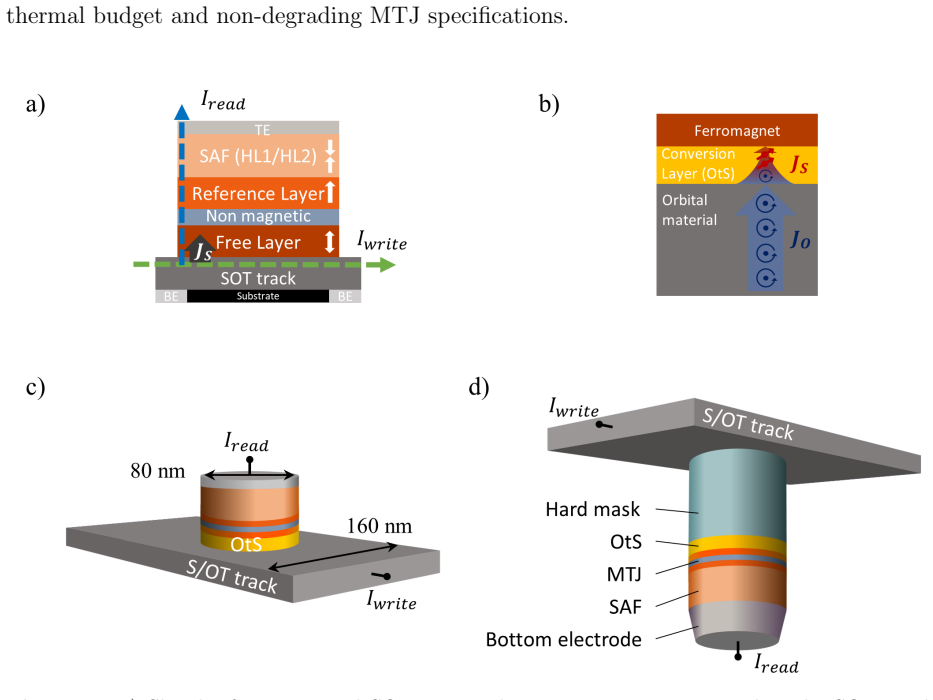
Spin-orbit torque (SOT) enables ultra-fast, energy-efficient magnetization switching, making it a promising mechanism for introducing MRAMs for cache memory applications. However, current SOT-MRAM devices face write efficiency limitations, with charge-to-spin conversion ($\xi_{DL}$) reaching $\sim$ 45\%, far below the projected $\sim$ 80\% needed to comply with the current delivery of advanced transistor nodes. Recent advances in orbital current physics, evidenced in a wide class of materials, offer a path to enhance $\xi_{DL}$. Here, we study the Ta(3-30 nm)\slash W(1-4 nm) system, revealing a large additional spin-orbit torque contribution arising from Ta, a four-fold increase compared to the spin Hall effect in Ta alone, attributed to the orbital Hall contribution. This system exhibits larger $\xi_{DL}$ than W-based SOT systems with more robust perpendicular magnetic anisotropy and compatibility with 400$^\circ$C annealing. Leveraging these advantages, we integrate the Ta/W system into 3-terminal SOT-MTJ devices, showing a level of performance similar to that of W-based systems. Our results show that orbital physics can be easily integrated into SOT-MTJ systems, offering a viable strategy to enhance SOT-MRAM efficiency. In addition, we propose and demonstrate a proof-of-concept for vertical non-local switching of SOT-MTJ using orbital torques, simplifying bottom-pinned SOT-MRAM fabrication.
Figures


Reference graph
Works this paper leans on
-
[1]
Spin-orbit torque switching of magnetic tunnel junctions for memory applications.Journal of Magnetism and Magnetic Materials2022,562, 169692
(1) Krizakova, V.; Perumkunnil, M.; Couet, S.; Gambardella, P.; Garello, K. Spin-orbit torque switching of magnetic tunnel junctions for memory applications.Journal of Magnetism and Magnetic Materials2022,562, 169692. (2) Molas, G.; Nowak, E. Advances in Emerging Memory Technologies: From Data Storage to Artificial Intelligence.Applied Sciences2021,11, 11...
2018
-
[2]
(7) Wang, M.; Cai, W.; Zhu, D.; Wang, Z.; Kan, J.; Zhao, Z.; Cao, K.; Wang, Z.; Zhang, Y.; Zhang, T.; Park, C.; Wang, J.-P.; Fert, A.; Zhao, W. Field-free switching of a perpen- dicular magnetic tunnel junction through the interplay of spin–orbit and spin-transfer torques.Nature Electronics2018,1, 582–588. (8) Shao, Q.; Li, P.; Liu, L.; Yang, H.; Fukami, ...
This paper was first reviewed by grok-4.3 on June 29, 2026.
discussion (0)
Sign in with ORCID, Apple, or X to comment. Anyone can read and Pith papers without signing in.