REVIEW 4 major objections 5 minor 51 references
Towards Verifiability of Total Value Locked (TVL) in Decentralized Finance
T0 review · 4 major / 5 minor · reviewed 2026-08-07 · deepseek-v4-flash
Pith's one-line read The paper argues that published DeFi TVL is only partly verifiable from on-chain data and introduces vTVL, a reconstruction metric showing 23.5% of 400 protocols match nearly perfectly and 46.5% align within an acceptable band.
desk verdict A useful, honest measurement study of how DeFiLlama computes TVL, with a softer vTVL 'verification' result than the abstract suggests. read the letter →
The pith
A machine-rendered reading of the paper's core claim, the machinery that carries it, and where it could break.
The reading
What carries the argument
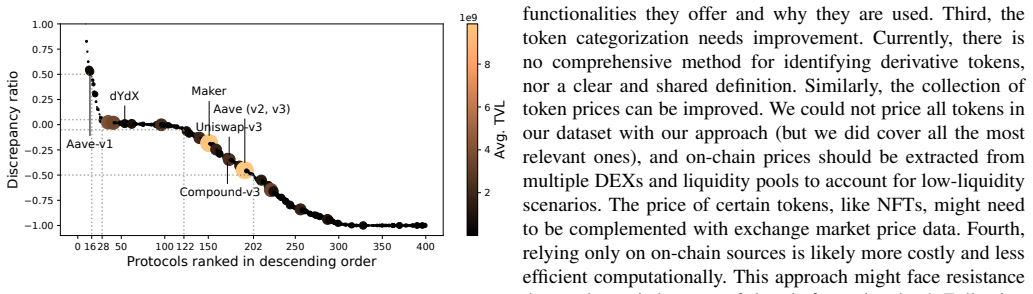
The load-bearing instrument is a proxy-based measurement pipeline that executes the DeFiLlama adapter (plugin) code for each protocol and records all HTTP and JSON-RPC calls, so every interaction with Ethereum nodes and external hosts is observable. On top of that sits the vTVL construction: from the recorded eth_getBalance and balanceOf calls it derives the set of addresses and tokens that contribute to a protocol's TVL, queries their historical balances, prices tokens using Uniswap V2 liquidity pools, and sums the values. The Discrepancy Ratio, the average of vTVL over published TVL minus one, is the paper's yardstick for how much of a reported figure can be reproduced. The regular-expression scan for alternative balance functions (e.g., totalAssets, getTotalPooledEther) is what exposes the 68 non-standard methods that make verification harder.
What would settle it
Pick any protocol from the 46.5% whose vTVL is aligned with published TVL, obtain its plugin-queried address-token list, and re-run the balance queries at each monthly snapshot against an independent Ethereum archive node; if even one major protocol's reconstructed value moves outside the reported +/-0.5 discrepancy band, the vTVL alignment claim for that protocol fails. Alternatively, for a protocol like Maker where vTVL diverges after late 2022, check whether the divergence coincides with plugin calls to an external server or with the API folding in a second protocol, which would identify exactly which assumption broke.
Extended reading notes
Core claim
The paper's central discovery is that TVL's verifiability is empirically low and systematically measurable. By proxying the execution of DeFiLlama's TVL plugins, the authors capture every on-chain and off-chain interaction used to compute TVL for 939 Ethereum protocols. They find that the majority of protocols (78.6%) use standard balance queries, but 68 self-defined functions also feed TVL, 10.5% of protocols rely on external servers, and 240 balance queries are shared across multiple protocols, creating a concrete double-counting risk. The paper then defines vTVL, the value recoverable by replaying only standard balanceOf and eth_getBalance queries on the addresses and tokens the plugins touch, and prices those holdings with Uniswap V2 exchange rates. Comparing vTVL to DeFiLlama's published TVL for 400 protocols, the Discrepancy Ratio is near zero for 23.5% of protocols and aligned within +/-0.5 for 46.5%, while large discrepancies concentrate in smaller protocols. The conclusion is that only part of published TVL is independently verifiable today, and that the rest is not necessarily fraudulent but is beyond what on-chain data alone can confirm.
Load-bearing premise
The vTVL reconstruction assumes that the addresses and tokens the DeFiLlama plugin queries during TVL computation exactly define the protocol's TVL; if a plugin queries addresses that are not locked value, or misses addresses that are, the vTVL estimate drifts from true TVL by an unknown amount.
Editorial extensions
If this is right
- If vTVL were adopted as a standard, independent auditors could recompute a protocol's TVL from a publicly visible address-token list without trusting the aggregator.
- The 240 shared balance queries imply a measurable double-counting risk at the infrastructure level: the paper shows the value in those contract accounts peaked near $16 billion at the end of 2021.
- The decreasing share of alternative balance functions (28.2% in January 2023 to 8.9% in January 2024) suggests that standardization pressure is already shifting TVL computation toward standard on-chain methods.
- The design guidelines - on-chain sources, published contract and token lists, standard balance methods, published token categorizations, and common protocol selection criteria - would make TVL figures reproducible and explainable if aggregators adopted them.
Reading between the lines
- The same proxy-and-replay method could be run continuously on other EVM-compatible chains and on a moving window of plugin commits, turning vTVL from a one-off case study into an automated verifiability monitor for TVL.
- A protocol could game vTVL by including extra low-value addresses in its plugin or by omitting large holdings, so vTVL is best read as a lower bound on what is verifiable, not as proof that unverified value is absent.
- Linking vTVL to the TVR distinction between derivative and non-derivative tokens could yield a verifiable redeemable value metric, addressing both double counting and verifiability in one number.
- The finding that most discrepancy concentrates in small protocols suggests verification effort should be prioritized by TVL size; checking the top protocols would recover most of the ecosystem's verifiable value.
Editorial analysis
A structured set of objections, weighed in public.
Referee Report
Summary. The paper studies how Total Value Locked (TVL) is computed by the DeFiLlama aggregator for 939 Ethereum DeFi protocols. Using a proxying pipeline over the DeFiLlama plugin runtime, it reports that 10.5% of protocols rely at least partly on external servers, that 68 non-standard balance functions are used, and that 240 balance queries are duplicated across protocols. It then introduces verifiable TVL (vTVL), an on-chain reconstruction of TVL using only standard balance queries (eth_getBalance and ERC-20 balanceOf), and reports that in a case study of 400 protocols, vTVL aligns with published TVL within a discrepancy ratio of ±0.5 for 46.5% of protocols and within ±0.05 for 23.5%. The paper concludes with design guidelines for more standardized and verifiable TVL computation.
Significance. If the main claims hold, this is a timely and useful measurement study. Its strengths are concrete: a transparent, repeatable instrumentation pipeline applied across five repository commits; direct observation of external-server dependencies, non-standard balance functions, and duplicate queries; and publicly available code and data. These descriptive findings are valuable regardless of the vTVL caveat. The proposed vTVL metric is a reasonable operationalization of 'verifiable' TVL, but its independence from the aggregator's own address and token selection is the central weak point, and the quantitative headline (46.5% alignment) currently rests on permissive and post hoc choices. The paper's contribution is therefore better characterized as a careful reproducibility analysis of DeFiLlama's TVL pipeline than as independent verification of published TVL.
major comments (4)
- [IV-A, Appendix F, footnote 2] The vTVL reconstruction inherits the address and token sets directly from the DeFiLlama plugin calls: Appendix F states that the authors 'inspect calls that represent balance queries for Ether or tokens, assuming that addresses queried during computation contribute to the project TVL,' and footnote 2 explicitly acknowledges that this assumption may fail. Because the audited system supplies the address set, a match between vTVL and published TVL can indicate faithful reproduction of DeFiLlama's own bookkeeping rather than independent on-chain verification. This directly affects the headline claim that vTVL can 'independently verify just a part of the reported TVL.' The authors should either rephrase vTVL as a plugin-consistent reconstruction, or validate the address lists against an independent source (e.g., protocol documentation, transfer-event analysis, or a second aggregator).
- [IV-B and Appendix F] The 46.5% alignment figure depends on a permissive threshold: a discrepancy ratio within ±0.5 means vTVL is between 50% and 150% of the published value. It also depends on several post hoc filtering choices with no sensitivity analysis: the 20% rolling-average outlier threshold, the minimum of 10,000 price points per token, the manual removal of 80 high-volatility tokens, and the 20 mln USD stablecoin market-cap cutoff. Since vTVL is acknowledged to be an underestimation by construction, the reported breakdown across a single threshold set is hard to interpret. The authors should report how the alignment percentage changes across a range of thresholds and filtering choices, or at minimum provide a distribution of the discrepancy ratios rather than only the two summary intervals.
- [IV-A] The comparison between vTVL and published TVL uses DeFiLlama API values that aggregate several columns ('Ethereum', 'Ethereum-borrowed', 'Ethereum-pool2', 'Ethereum-staking', 'Ethereum-vesting'), while vTVL only captures standard balance queries on addresses obtained from plugin calls. These components need not correspond to the same economic value, and the version mismatches noted in Appendix F (e.g., Aave v2/v3, Uniswap v2/v3) are corrected only ad hoc for a few large protocols. This can bias the discrepancy ratio for a substantial number of protocols. A systematic reconciliation of API columns with the captured on-chain calls, or an explicit statement of which API components are excluded, is needed before the aggregate alignment statistics can be treated as reliable.
- [IV-B] The case study sample is restricted to 400 protocols with at least one recorded eth_getBalance or balanceOf call and available API data. Protocols that rely solely on external hosts, that use only non-standard functions, or that raise errors during collection are excluded from the denominator. As a result, the 46.5% alignment figure describes the subset of protocols already amenable to standard balance queries, not all 939 protocols in the study. The authors should state this clearly and, if possible, report a conservative lower bound for the full population by treating excluded protocols as non-verified.
minor comments (5)
- [III-D] The text says the average Jaccard index 'ranges from 0.93% to 0.89%, 0.86% and 0.81%, respectively'; these are similarity values in [0,1], not percentages, so they should read 0.93, 0.89, 0.86, and 0.81.
- [Figure 4 caption] The caption refers to 'get_ethBalance' queries; the correct RPC method name used elsewhere is 'eth_getBalance'.
- [Figure 2] The figure's internal labels ('729 27 62 1 0 26 72') are visually confusing, especially the '1 0' and '26 72' groupings; a standard flowchart or tree layout with explicit edge labels would make the branching logic clearer.
- [Table I] The last column header 'Returns the . . .' is incomplete in the rendered text; each row should end with a complete phrase, e.g., 'Returns the account balance of another account (owner address).'
- [Appendix F] The appendix is titled 'TVL reconstruction from on-chain data' but the cross-reference in the main text and the internal narrative sometimes refer to 'Section F'; this should be harmonized to Appendix F.
Circularity Check
vTVL reuses DeFiLlama's own address/token selection, so 'independent verification' is partly a self-consistency check; the descriptive findings are unaffected.
-
other
[Section IV-A, Appendix F, footnote 2]
"Having access to the functionalities and accounts queried on-chain through the DeFiLlama infrastructure, we can acquire a set of addresses per protocol containing deposited assets and provide further insights on the TVL associated with each protocol, solely relying on blockchain data (assuming that addresses called during computation contribute to the project TVL). ... While we assume that balances queried during computation directly contribute to the projects TVL, we acknowledge the possibility that they don't."
vTVL is constructed by summing balances only for the addresses and tokens that DeFiLlama's own plugin queries during TVL computation, and the published DeFiLlama TVL is generated from those same plugin queries. The comparison is therefore partly a self-consistency check of the aggregator's address selection rather than an independent determination of which contracts actually hold locked value. If a plugin queries a treasury, an EOA, or a peripheral wrapper, or omits a vault, vTVL inherits that choice, so the 46.5% alignment rate can be read as plugin-replay fidelity.
full rationale
Most of the paper's contribution is not circular. The headline measurements—10.5% of protocols relying on external servers, 68 alternative balance functions, 240 duplicated balance queries, and the decline of non-standard calls over time—are direct observations of instrumented plugin executions and do not depend on any fitted parameter or self-citation. The vTVL case study also does not fit any parameter to the published DeFiLlama TVL: balances are read on-chain and prices are derived from Uniswap V2 liquidity, independently of the API values being compared. However, the vTVL address and token universe is taken from the very DeFiLlama plugin code that produces the published figures (Section IV-A and Appendix F), under the explicit assumption that queried addresses contribute to TVL. This makes the 46.5% alignment partly a measure of whether DeFiLlama's own computation can be replayed with standard balance queries, rather than a fully independent verification of asset lock-up. The paper discloses this assumption in footnote 2, and the independence of balance and price retrieval means the result is not equivalent to its input by construction. No load-bearing self-citation chain or imported uniqueness theorem is present. Overall, the circularity is limited to an overstatement of the word 'independent' in the central claim; the empirical findings and the reconstruction exercise retain substantial independent content.
Assumptions & free parameters
free parameters (5)
- Alignment threshold for 'aligned' vTVL =
discrepancy ratio within ±0.5
- Price outlier removal threshold =
20% deviation from 10-day rolling average
- Minimum price data points per token =
10,000 points
- Manually removed high-volatility tokens =
80 tokens
- Stablecoin market cap cutoff =
20 million USD
assumptions (5)
- domain assumption Addresses queried by the DeFiLlama plugin during TVL computation exactly constitute the protocol's TVL assets
- domain assumption Custom interceptors capture every relevant on-chain and off-chain interaction
- domain assumption Only ERC-20 balanceOf and eth_getBalance count as standard balance queries
- domain assumption DeFiLlama plugins on Ethereum are representative of TVL aggregation generally
- domain assumption Uniswap V2 prices plus Coingecko ETH/USD with cleaning thresholds yield accurate USD values
invented entities (1)
-
verifiable Total Value Locked (vTVL)
independent evidence
Cite this review
Pith. "Pith review of Towards Verifiability of Total Value Locked (TVL) in Decentralized Finance." pith.science (2026). https://pith.science/paper/NVBUMOBZ
@misc{pith2026250514565,
  author       = {Pith},
  title        = {Pith review of: Towards Verifiability of Total Value Locked (TVL) in Decentralized Finance},
  year         = {2026},
  howpublished = {\url{https://pith.science/paper/NVBUMOBZ}},
  note         = {Machine review of arXiv:2505.14565}
}
read the original abstract
Total Value Locked (TVL) aims to measure the aggregate value of cryptoassets deposited in Decentralized Finance (DeFi) protocols. Although blockchain data is public, the way TVL is computed is not well understood. In practice, its calculation on major TVL aggregators relies on self-reports from community members and lacks standardization, making it difficult to verify published figures independently. We thus conduct a systematic study on 939 DeFi projects deployed in Ethereum. We study the methodologies used to compute TVL, examine factors hindering verifiability, and ultimately propose standardization attempts in the field. We find that 10.5% of the protocols rely on external servers; 68 methods alternative to standard balance queries exist, although their use decreased over time; and 240 equal balance queries are repeated on multiple protocols. These findings indicate limits to verifiability and transparency. We thus introduce ``verifiable Total Value Locked'' (vTVL), a metric measuring the TVL that can be verified relying solely on on-chain data and standard balance queries. A case study on 400 protocols shows that our estimations align with published figures for 46.5% of protocols. Informed by these findings, we discuss design guidelines that could facilitate a more verifiable, standardized, and explainable TVL computation.
Figures


Figures from the paper (6 more)



Reference graph
Works this paper leans on
-
[1]
The technology of decentralized finance (defi),
R. Auer, B. Haslhofer, S. Kitzler, P. Saggese, and F. Victor, “The technology of decentralized finance (defi),”Digital Finance, vol. 6, no. 1, pp. 55–95, 2024
work page 2024
-
[2]
GitHub repository - DeFiLlama-Adapters,
DeFiLlama, “GitHub repository - DeFiLlama-Adapters,” available at: https://github.com/DefiLlama/DefiLlama-Adapters
-
[3]
——, “Why we don’t accept APIs,” available at: https://github.com/D efiLlama/DefiLlama-Adapters/discussions/432
-
[4]
Master of anons: How a crypto developer faked a defi ecosystem,
D. Nelson and T. Wang, “Master of anons: How a crypto developer faked a defi ecosystem,” https://www.coindesk.com/layer2/2022/08/04 /master-of-anons-how-a-crypto-developer-faked-a-defi-ecosystem/
work page 2022
-
[5]
Understanding defi through the lens of a production-network model,
J. Chiu, T. Koeppl, H. Yu, and S. Zhang, “Understanding defi through the lens of a production-network model,” Bank of Canada, Tech. Rep., 2023
work page 2023
-
[6]
Data provider defillama de-emphasizes double-counted crypto deposits after saber revelation,
Coindesk, “Data provider defillama de-emphasizes double-counted crypto deposits after saber revelation,” 2022, available at: https://ww w.coindesk.com/business/2022/08/05/data-provider-defillama-de-emp hasizes-double-counted-crypto-deposits-after-saber-revelation/
work page 2022
-
[7]
Understanding total value locked (tvl),
L. Nuzzi, A. L. Calvez, and K. Waters, “Understanding total value locked (tvl),” 2021, available at: https://coinmetrics.substack.com/p/coin-metri cs-state-of-the-network-0c0
work page 2021
-
[8]
Piercing the veil of tvl: Defi reappraised,
Y . Luo, Y . Feng, J. Xu, and P. Tasca, “Piercing the veil of tvl: Defi reappraised,” inInternational Conference on Financial Cryptography and Data Security. Springer, 2025
work page 2025
Show all 51 references
-
[9]
Detecting token systems on ethereum,
M. Fröwis, A. Fuchs, and R. Böhme, “Detecting token systems on ethereum,” inInternational Conference on Financial Cryptography and Data Security. Springer, 2019, pp. 93–112
2019
-
[10]
Identification of token contracts on ethereum: standard compliance and beyond,
M. Di Angelo and G. Salzer, “Identification of token contracts on ethereum: standard compliance and beyond,”International Journal of Data Science and Analytics, vol. 16, no. 3, pp. 333–352, 2023
2023
-
[11]
Sok: A classification frame- work for stablecoin designs,
A. Moin, K. Sekniqi, and E. G. Sirer, “Sok: A classification frame- work for stablecoin designs,” inInternational Conference on Financial Cryptography and Data Security. Springer, 2020, pp. 174–197
2020
-
[12]
Sok: Decentralized exchanges (dex) with automated market maker (amm) protocols,
J. Xu, K. Paruch, S. Cousaert, and Y . Feng, “Sok: Decentralized exchanges (dex) with automated market maker (amm) protocols,”ACM Computing Surveys, vol. 55, no. 11, pp. 1–50, 2023
2023
-
[13]
Defi protocols for loanable funds: Interest rates, liquidity and market efficiency,
L. Gudgeon, S. Werner, D. Perez, and W. J. Knottenbelt, “Defi protocols for loanable funds: Interest rates, liquidity and market efficiency,” in Proceedings of the 2nd ACM Conference on Advances in Financial Technologies, 2020, pp. 92–112
2020
-
[14]
Sok: Yield aggregators in defi,
S. Cousaert, J. Xu, and T. Matsui, “Sok: Yield aggregators in defi,” in 2022 IEEE International Conference on Blockchain and Cryptocurrency (ICBC). IEEE, 2022, pp. 1–14
2022
-
[15]
Leverage staking with liquid staking derivatives (lsds): Opportunities and risks,
X. Xiong, Z. Wang, X. Chen, W. Knottenbelt, and M. Huth, “Leverage staking with liquid staking derivatives (lsds): Opportunities and risks,” arXiv preprint arXiv:2401.08610, 2023
2023 arXiv
-
[16]
A short survey on business models of decentralized finance (defi) protocols,
T. A. Xu and J. Xu, “A short survey on business models of decentralized finance (defi) protocols,” inInternational Conference on Financial Cryptography and Data Security. Springer, 2022, pp. 197–206
2022
-
[17]
DeFi Rankings,
DappRadar, “DeFi Rankings,” available at: https://docs.dappradar.com /rankings/defi-rankings
-
[18]
Total Value Locked (TVL) in DeFi protocols,
Stelareum, “Total Value Locked (TVL) in DeFi protocols,” available at: https://www.stelareum.io/en/defi-tvl.html
-
[19]
DeFiPulse Total Value Locked (TVL) Methodology,
DeFiPulse, “DeFiPulse Total Value Locked (TVL) Methodology,” avail- able at: https://docs.defipulse.com/methodology/tvl
-
[20]
What Total Value Locked (Tvl) and Why Users Monitor This Metric,
Coingecko, “What Total Value Locked (Tvl) and Why Users Monitor This Metric,” see: https://www.coingecko.com/learn/total-value-locked
-
[21]
DeFiLlama website,
DeFiLlama, “DeFiLlama website,” available at: https://defillama.com/
-
[22]
Review of decentralized finance applications and their total value locked,
V . Stepanova and I. Erin, š, “Review of decentralized finance applications and their total value locked,”TEM Journal, vol. 10, no. 1, p. 327, 2021
2021
-
[23]
Return factors of ether cryptocurrency: On chain metrics and defi,
K. Shilov and A. V . Zubarev, “Return factors of ether cryptocurrency: On chain metrics and defi,”Available at SSRN 4432586
-
[24]
Understanding digital bubbles amidst the covid-19 pandemic: Evidence from defi and nfts,
Y . Maouchi, L. Charfeddine, and G. El Montasser, “Understanding digital bubbles amidst the covid-19 pandemic: Evidence from defi and nfts,”Finance Research Letters, vol. 47, p. 102584, 2022
2022
-
[25]
Sok: Decentralized finance (defi) attacks,
L. Zhou, X. Xiong, J. Ernstberger, S. Chaliasos, Z. Wang, Y . Wang, K. Qin, R. Wattenhofer, D. Song, and A. Gervais, “Sok: Decentralized finance (defi) attacks,” in2023 IEEE Symposium on Security and Privacy (SP). IEEE, 2023, pp. 2444–2461
2023
-
[26]
The return of (i) defix,
F. ¸ Soiman, G. Dumas, and S. Jimenez-Garces, “The return of (i) defix,” arXiv preprint arXiv:2204.00251, 2022
2022 arXiv
-
[27]
Towards understanding governance tokens in liquidity mining: a case study of decentralized exchanges,
S. Fan, T. Min, X. Wu, and C. Wei, “Towards understanding governance tokens in liquidity mining: a case study of decentralized exchanges,” World Wide Web, pp. 1–20, 2022
2022
-
[28]
Decentralized finance (defi) projects: A study of key performance indicators in terms of defi protocols’ valuations,
D. Metelski and J. Sobieraj, “Decentralized finance (defi) projects: A study of key performance indicators in terms of defi protocols’ valuations,”International Journal of Financial Studies, vol. 10, no. 4, p. 108, 2022
2022
-
[29]
Decentralized finance: the possibilities of a blockchain “money lego
T. Katona, “Decentralized finance: the possibilities of a blockchain “money lego” system,”Financial and Economic Review, vol. 20, no. 1, pp. 74–102, 2021
2021
-
[30]
Where do defi stablecoins go? a closer look at what defi composability really means,
K. Saengchoteet al., “Where do defi stablecoins go? a closer look at what defi composability really means,”Available at SSRN 3893487, 2021
2021
-
[31]
Ethereum Signature Database,
4byte, “Ethereum Signature Database,” see https://www.4byte.directory
-
[32]
ERC-20: Token Standard Improvement Proposal,
Ethereum.org, “ERC-20: Token Standard Improvement Proposal,” see https://eips.ethereum.org/EIPS/eip-20
-
[33]
Ethereum JSON-RPC API,
——, “Ethereum JSON-RPC API,” see https://ethereum.org/en/develo pers/docs/apis/json-rpc/#eth_getbalance
-
[34]
Functionalities documentation,
Uniswap, “Functionalities documentation,” see https://docs.uniswap.org /contracts/v2/reference/smart-contracts/pair
-
[35]
Factory contract documentation,
——, “Factory contract documentation,” see https://docs.uniswap.org/c ontracts/v2/reference/smart-contracts/factory
-
[36]
AaveV2Provider contract,
Etherscan, “AaveV2Provider contract,” see %https://etherscan.io/addre ss/0x7ac6859e69d6549b39a8367097d7ae5fbff5951e#readContract
-
[37]
Vyper contract,
——, “Vyper contract,” see https://etherscan.io/address/0xba3cfea6514 cf5acddeff3167df0b7a4337751bc#code
-
[38]
Disentangling decentralized finance (defi) compositions,
S. Kitzler, F. Victor, P. Saggese, and B. Haslhofer, “Disentangling decentralized finance (defi) compositions,”ACM Transactions on the Web, vol. 17, no. 2, pp. 1–26, 2023
2023
-
[39]
Mea- surements, analyses, and insights on the entire ethereum blockchain network,
X. T. Lee, A. Khan, S. Sen Gupta, Y . H. Ong, and X. Liu, “Mea- surements, analyses, and insights on the entire ethereum blockchain network,” inProceedings of The Web Conference, 2020, pp. 155–166
2020
-
[40]
Behavior of liquidity providers in decentralized exchanges,
L. Heimbach, Y . Wang, and R. Wattenhofer, “Behavior of liquidity providers in decentralized exchanges,”arXiv preprint arXiv:2105.13822, 2021
2021 arXiv
-
[41]
DeFiLlama, “APIs,” available at: https://defillama.com/docs/api
-
[42]
Defi protocol risks: The paradox of defi,
N. Carter and L. Jeng, “Defi protocol risks: The paradox of defi,” Regtech, suptech and beyond: innovation and technology in financial services” riskbooks–forthcoming, vol. 3, 2021
2021
-
[43]
Stablecoin devaluation risk,
B. Eichengreen, M. T Nguyen, and G. Viswanath-Natraj, “Stablecoin devaluation risk,”WBS Finance Group Research Paper, 2023, available at SSRN: http://dx.doi.org/10.2139/ssrn.4460515
2023 doi
-
[44]
Assessing the solvency of virtual asset service providers: are current standards sufficient?
P. Saggese, E. Segalla, M. Sigmund, B. Raunig, F. Zangerl, and B. Haslhofer, “Assessing the solvency of virtual asset service providers: are current standards sufficient?”Applied Economics, pp. 1–16, 2024
2024
-
[45]
Defi risks and the decentralisation illusion,
J. F. Doerr, A. Kosse, A. Khan, U. Lewrick, B. Mojon, B. Nolens, and T. Rice, “Defi risks and the decentralisation illusion,”BIS Quarterly Review, vol. 21, 2021
2021
-
[46]
Decentralized crypto governance? transparency and concentration in ethereum decision-making,
C. Fracassi, M. Khoja, and F. Schär, “Decentralized crypto governance? transparency and concentration in ethereum decision-making,”Trans- parency and Concentration in Ethereum Decision-Making, 2024
2024
-
[47]
The governance of decentralized autonomous organizations: A study of contributors’ influence, networks, and shifts in voting power,
S. Kitzler, S. Balietti, P. Saggese, B. Haslhofer, and M. Strohmaier, “The governance of decentralized autonomous organizations: A study of contributors’ influence, networks, and shifts in voting power,” in International Conference on Financial Cryptography and Data Security. ...
2024
-
[48]
Scale-free networks are rare,
A. D. Broido and A. Clauset, “Scale-free networks are rare,”Nature communications, vol. 10, no. 1, pp. 1–10, 2019
2019
-
[49]
Power-law distributions in empirical data,
A. Clauset, C. R. Shalizi, and M. E. Newman, “Power-law distributions in empirical data,”SIAM review, vol. 51, no. 4, pp. 661–703, 2009
2009
-
[50]
Top Crypto Categories By Market Cap,
Coingecko, “Top Crypto Categories By Market Cap,” available at: https: //www.coingecko.com/en/categories
-
[51]
Cryptocurrency Sectors by 24h Price Change,
Coinmarketcap, “Cryptocurrency Sectors by 24h Price Change,” avail- able at: https://coinmarketcap.com/cryptocurrency-category/. 9 APPENDIX A. Implementation Details To investigate how TVL is technically computed in practice, we devised a data extraction pipeline that captures...
2021
Reviewed August 7, 2026 · model on record in the stance chip above.
Discussion (0). Continue with ORCID to comment.