REVIEW 2 major objections 6 minor 1 cited by
Reversing pump cycle order changes quantum output in Rydberg atoms
Reviewed by Pith at T0; open to challenge. T0 means a machine referee read the full paper against a public rubric. the ladder, T0–T4 →
T0 review · glm-5.2
2026-07-09 16:52 UTC pith:NY7QKSWL
load-bearing objection First quantum-platform proposal for non-Abelian Thouless pumping, with a practical timing-optimization method, but the geometric interpretation is inferred rather than verified. the 2 major comments →
Non-Abelian Thouless pumping based on the global adiabatic criterion in Rydberg synthetic lattices
The pith
A machine-rendered reading of the paper's core claim, the machinery that carries it, and where it could break.
Core claim
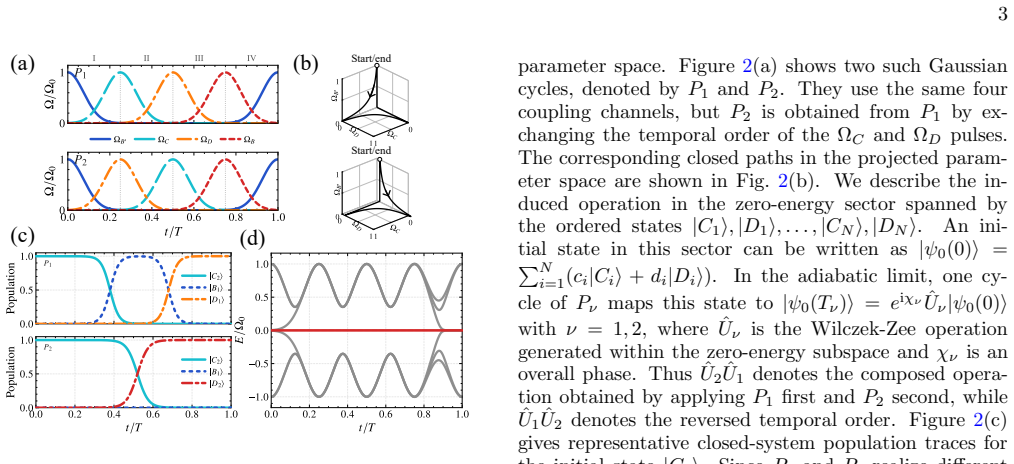
The central claim is that a global adiabatic criterion, derived from a local three-level reduction of the pumping dynamics, can select Gaussian pulse timing for a full twelve-level Rydberg synthetic Lieb lattice such that non-Abelian Thouless pumping produces order-dependent population maps consistent with noncommuting matrix-valued operations, while maintaining higher target-state population than reference schedules under open-system loss and disorder. The GAC works by evaluating the mean and temporal variance of a nonadiabatic coupling factor Q(t), penalizing schedules where leakage is concentrated in sharp peaks.
What carries the argument
Twelve microwave-coupled Rydberg levels of 39K encoding a three-cell Lieb lattice; six degenerate zero-energy states forming the working subspace; two elementary pumping cycles P1 and P2 differing only in the temporal order of two Gaussian pulses; the nonadiabatic factor Q(t) = sum_m |<psi_m|d_t psi_d>| / Delta_E_m measuring leakage from the dark state to bright states; the GAC bound epsilon <= (Delta_E_min * T * sqrt(Q_bar^2 + sigma_Q^2))^2 combining mean and variance of Q(t); Lindblad master equation with state-dependent decay rates from ARC lifetime estimates.
Load-bearing premise
The GAC timing is derived from a single local three-level Lambda-type transfer step and then applied to the full twelve-level system, assuming that the local nonadiabatic factor captures the dominant leakage mechanism of the complete composed pumping sequence. If multi-cell or cross-talk leakage pathways not represented in the local reduction dominate, the locally optimal timing may not be globally optimal.
What would settle it
If an experiment or a more complete simulation shows that the GAC-selected timing does not produce higher target-state population than the reference schedules for the full twelve-level composed cycles, or if the order-dependent population maps are not experimentally distinguishable above noise, the central practical claim would be undermined.
If this is right
- If the GAC timing strategy generalizes beyond the Lieb geometry, it could provide a practical recipe for finite-time holonomic quantum gates in other degenerate-subspace platforms without requiring counterdiabatic auxiliary fields.
- The demonstration that local three-level leakage analysis can guide full twelve-level dynamics suggests a scalable approach to timing design in larger synthetic lattices where full optimization is computationally expensive.
- Experimental realization in cold-atom Rydberg systems would provide the first quantum-platform demonstration of non-Abelian Thouless pumping, previously realized only in classical photonic and acoustic waveguides.
- The order-dependent transfer maps provide a directly measurable population-level signature of noncommuting geometric operations, bypassing the need for phase-sensitive interferometry.
Editorial analysis
A structured set of objections, weighed in public.
Referee Report
Summary. This manuscript proposes a quantum implementation of non-Abelian Thouless pumping in a finite synthetic Lieb lattice encoded in twelve microwave-coupled Rydberg levels of 39K. The bipartite structure of the Lieb lattice yields six degenerate zero-energy states that form the working subspace. Two elementary pumping cycles, differing only in the temporal ordering of two Gaussian pulses, are composed in opposite orders to probe noncommutativity of the resulting Wilczek-Zee holonomies. To address finite-time leakage from the zero-energy subspace to bright states, the authors introduce a global adiabatic criterion (GAC) based on the mean and variance of a nonadiabatic factor derived from a local Lambda-type reduction. The GAC-selected timing is shown to yield higher target-state population than two literature-adapted schedules under Lindblad open-system dynamics with state-dependent Rydberg decay and representative perturbations.
Significance. The proposal of a concrete Rydberg-atom platform for non-Abelian Thouless pumping is timely and addresses a genuine gap, as prior implementations have been in classical wave systems. The GAC provides a practical timing-selection rule within a fixed pulse family without requiring counterdiabatic or auxiliary couplings, which is a useful contribution to finite-time geometric control. The open-system simulations with ARC-estimated lifetimes and perturbation scans lend credibility to the experimental feasibility. The bipartite zero-energy sector derivation is clean and the GAC bound is honestly presented as conservative.
major comments (2)
- Sec. IV and Fig. 4(c,d): The central claim that the distinct projected population maps are 'exactly consistent with noncommuting matrix-valued adiabatic operations' is supported only qualitatively. The finite-time simulations operate at Omega_0 T_total = 300 (T_total ~ 23.9 us), where leakage to bright states and back-action can introduce non-geometric, order-dependent corrections. The manuscript does not compute the adiabatic Wilczek-Zee holonomy matrices U_1, U_2 and compare their predicted population maps to the finite-time simulation results. Without this comparison, the reader cannot verify that the observed noncommutativity is geometric rather than an artifact of order-dependent non-adiabatic transitions. The authors should either (i) compute the ideal adiabatic holonomy matrices and quantitatively compare their projected maps to the finite-time Lindblad results, or (ii) soften the
- Sec. III and Appendix B: The GAC timing selection (alpha = 0.18) is derived from a local three-level Lambda reduction (Eq. B1-B4) and then applied to the full twelve-level system. The assumption that the local nonadiabatic factor Q(t) from a single Lambda-step captures the dominant leakage mechanism of the complete composed pumping sequence is not formally justified. While Fig. 3(d) and Fig. 4(e) provide numerical support, there is no analysis of whether leakage pathways involving multiple cells or bright states not captured by the local reduction could dominate for other parameter regimes. The authors should discuss the scope and limitations of this local-to-global application more explicitly, ideally by identifying which bright states are the dominant leakage channels in the full twelve-level dynamics and confirming that they correspond to the local model.
minor comments (6)
- The abstract's final sentence ('marks a major milestone...paves the way for transformative applications') is disproportionate to the current scope, which is a theoretical proposal with numerical simulations. Consider toning down.
- The abstract says 'exactly consistent with noncommuting matrix-valued adiabatic operations.' Given the finite-time context, 'consistent with' or 'numerically consistent with' is more appropriate.
- The two reference schedules adapted from Refs. [52, 53] are described only briefly. A concise specification of their pulse parameters (alpha values, pulse shapes) in an appendix would improve reproducibility and fairness of the comparison.
- Fig. 2(c): It would help to label which trace corresponds to which state more explicitly in the figure, or to state the color-to-state mapping in the caption text alone.
- Eq. (B4): The factor of sqrt(2) in Q(t) = sqrt(2)|dot(theta)|/Omega_Lambda(t) is not immediately obvious. A brief derivation or reference to its origin would help.
- The paper uses both 'global adiabatic criterion' and 'GAC theory' interchangeably. Standardizing on one term would improve readability.
Circularity Check
GAC derivation is self-contained from first principles; self-citations are contextual, not load-bearing
full rationale
The paper's derivation chain proceeds as follows: (1) The GAC bound (Eq. B16) is derived from the Schrödinger equation via adiabatic expansion, triangle inequality, and Cauchy-Schwarz — all standard mathematical steps with no circular dependency. (2) The timing parameter α=0.18 is selected from the local three-level Λ-model's Q̄ and σ²_Q landscape (Eqs. B1–B4, Fig. 3b–c), which is independent of the full twelve-level simulation. (3) Fig. 3(d) validates this choice on the local step using an independent Lindblad calculation — this is a consistency check, not a self-fulfilling prediction, since P_tar is computed from the master equation, not from Q̄/σ²_Q. (4) The full twelve-level composed-cycle results (Fig. 4) and robustness scans (Fig. 5) are independent numerical simulations using the complete Hamiltonian, not the local reduction. (5) The comparison with literature schedules [52,53] is external. Self-citations [46,47] reference prior GAC work by overlapping authors, but the GAC is fully re-derived in Appendix B, making these citations contextual rather than load-bearing. The skeptic's concern that distinct population maps are not compared to predicted Wilczek-Zee holonomy matrices is a correctness/completeness issue, not circularity — the paper does not derive the maps from the holonomy and then verify them against themselves. No step in the chain reduces to its own inputs by construction. The only minor issue is the self-citation context for the GAC method, but since the derivation is self-contained, this does not raise the score above 1.
Axiom & Free-Parameter Ledger
free parameters (3)
- α (delay parameter) =
0.18
- Ω₀ (peak microwave coupling) =
2π × 2.0 MHz
- T_total (total two-cycle duration) =
≈23.9 µs (Ω₀T_total = 300)
axioms (4)
- domain assumption Rotating-wave approximation validity for microwave-coupled Rydberg transitions
- ad hoc to paper Local Λ-type reduction captures dominant leakage
- domain assumption Markovian Rydberg decay modeled by Lindblad jump operators
- standard math Bipartite structure of the Lieb lattice guarantees 2N zero-energy states
read the original abstract
We study a quantum implementation of non-Abelian Thouless pumping in Lieb lattices using Rydberg synthetic dimensions. The lattice is encoded in twelve selected microwave-coupled Rydberg levels, forming a three-cell structure with six degenerate zero-energy states. These zero-energy states define the working subspace for cyclic modulation of the microwave couplings, while the remaining bright states provide the dominant leakage channels at finite evolution time. To choose the relative timing of the Gaussian pulses, we introduce a global adiabatic criterion (GAC), which evaluates the mean value and temporal fluctuation of a nonadiabatic factor obtained from a representative $\Lambda$-type transfer paradigm. With the resulting timing applied to the full twelve-level pumping dynamics, composing two elementary pumping cycles in opposite temporal orders produces distinct projected population maps. It is exactly consistent with noncommuting matrix-valued adiabatic operations in the zero-energy subspace. We numerically simulate the non-Abelian Thouless pumping using the Lindblad master equation with state-dependent Rydberg loss and representative perturbations. The results show that the GAC-selected timing within the same Gaussian pulse family gives higher target-state population than two literature-adapted Gaussian pulse schedules over the simulated parameter ranges. This quantum implementation of non-Abelian Thouless pumping, enabled by the GAC, marks a major milestone in finite-time geometric control and paves the way for transformative applications in holonomic quantum computing with Rydberg synthetic lattices.
Figures



Forward citations
Cited by 1 Pith paper
-
Non-Abelian holonomic transformations in digitally coupled acoustic waveguides guided by the global adiabatic criterion
GAC-guided power-law coupling halves the active length needed for acoustic Pauli-X and Hadamard holonomic transformations versus a Gaussian reference, and the same phase-stitched device supports unidirectional mode co...
Reference graph
Works this paper leans on
-
[1]
LocalΛ-type adiabatic passages The first transfer step ofP 1 provides a representative local reduction. The relevant sector is{|C 2⟩,|A 2⟩,|B 1⟩}, where the active microwave-induced couplings connect |A2⟩with|C 2⟩through Ω C(t) and|A 2⟩with|B 1⟩through ΩB′(t). In the ordered basis (|C 2⟩,|A 2⟩,|B 1⟩), the local Hamiltonian is ˆHΛ(t) = 0 Ω C(t) 0 ΩC(t)...
-
[2]
Global adiabatic criterion The GAC used for the timing design in Fig. 3 is sum- marized below. The derivation is formulated for a general time-dependent Hamiltonian and is then applied in the main text to the representative local Λ-type transfer step. The quantityεdenotes the total nonadiabatic transition probability from the instantaneous target/dark sta...
-
[3]
D. J. Thouless, Quantization of particle transport, Phys. Rev. B27, 6083 (1983)
work page 1983
-
[4]
Y. E. Kraus, Y. Lahini, Z. Ringel, M. Verbin, and O. Zil- berberg, Topological states and adiabatic pumping in quasicrystals, Phys. Rev. Lett.109, 106402 (2012)
work page 2012
-
[5]
O. Zilberberg, S. Huang, J. Guglielmon, M. Wang, K. P. Chen, Y. E. Kraus, and M. C. Rechtsman, Photonic topo- logical boundary pumping as a probe of 4D quantum Hall physics, Nature553, 59 (2018)
work page 2018
- [6]
-
[7]
M. J¨ urgensen, S. Mukherjee, and M. C. Rechtsman, Quantized nonlinear Thouless pumping, Nature596, 63 (2021)
work page 2021
- [8]
-
[9]
R. Citro and M. Aidelsburger, Thouless pumping and topology, Nature Reviews Physics5, 87 (2023)
work page 2023
-
[10]
Z. Zhu, M. G¨ achter, A.-S. Walter, K. Viebahn, and T. Esslinger, Reversal of quantized Hall drifts at nonin- teracting and interacting topological boundaries, Science 384, 317 (2024)
work page 2024
- [11]
-
[12]
Q. Mo, S. Liang, X. Lan, J. Zhu, and S. Zhang, Demon- stration of returning Thouless pump in a Berry dipole system, Phys. Rev. Lett.135, 206603 (2025)
work page 2025
-
[13]
M. V. Berry, Quantal phase factors accompanying adia- batic changes, Proc. R. Soc. Lond. A392, 45 (1984)
work page 1984
-
[14]
Simon, Holonomy, the quantum adiabatic theorem, and Berry’s phase, Phys
B. Simon, Holonomy, the quantum adiabatic theorem, and Berry’s phase, Phys. Rev. Lett.51, 2167 (1983)
work page 1983
-
[15]
F. Wilczek and A. Zee, Appearance of gauge structure in simple dynamical systems, Phys. Rev. Lett.52, 2111 (1984)
work page 1984
- [16]
-
[17]
R. G. Unanyan, B. W. Shore, and K. Bergmann, Laser- driven population transfer in four-level atoms: conse- quences of Non-Abelian geometrical adiabatic phase fac- tors, Phys. Rev. A59, 2910 (1999)
work page 1999
-
[18]
G. Rigolin and G. Ortiz, Degenerate adiabatic perturba- tion theory: Foundations and applications, Phys. Rev. A 90, 022104 (2014)
work page 2014
-
[19]
J.-L. Wu, Y. Wang, J.-X. Han, Y. Jiang, J. Song, Y. Xia, S.-L. Su, and W. Li, Systematic-error-tolerant multiqubit holonomic entangling gates, Phys. Rev. Appl.16, 064031 (2021)
work page 2021
- [20]
- [21]
-
[22]
C. Danieli, V. Brosco, L. Pilozzi, and R. Citro, Non- Abelian Thouless pumping in a Rice–Mele ladder, AVS Quantum Sci.7, 022001 (2025)
work page 2025
- [23]
-
[24]
O. You, S. Liang, B. Xie, W. Gao, W. Ye, J. Zhu, and S. Zhang, Observation of Non-Abelian Thouless pump, Phys. Rev. Lett.128, 244302 (2022)
work page 2022
- [25]
-
[26]
Y. Chen, Y. Fan, G. Larsonneur, J. Xiang, A. He, G. Wang, X.-L. Zhang, G. Ma, Q. Zhou, G. Guo, Y. Su, and X. Guo, High-dimensional non-Abelian holonomy in integrated photonics, Nat. Commun.16, 3650 (2025)
work page 2025
-
[27]
Z.-L. Shan and X.-L. Zhang, Integrated photonics based on non-Abelian holonomy, Sci. Bull.70, 3927 (2025)
work page 2025
-
[28]
M. Ostmann, M. Marcuzzi, J. Min´ aˇ r, and I. Lesanovsky, Synthetic lattices, flat bands and localization in Rydberg quantum simulators, Quantum Sci. Technol.4, 02LT01 (2019)
work page 2019
-
[29]
T. Ozawa and H. M. Price, Topological quantum matter in synthetic dimensions, Nat. Rev. Phys.1, 349 (2019)
work page 2019
-
[30]
D. Yu, W. Song, L. Wang, R. Srikanth, S. K. Sridhar, T. Chen, C. Huang, G. Li, X. Qiao, X. Wu, Z. Dong, Y. He, M. Xiao, X. Chen, A. Dutt, B. Gadway, and 10 L. Yuan, Comprehensive review on developments of syn- thetic dimensions, Photon. Insights4, R06 (2025)
work page 2025
-
[31]
P. Scholl, H. J. Williams, G. Bornet, F. Wall- ner, D. Barredo, L. Henriet, A. Signoles, C. Hain- aut, T. Franz, S. Geier, A. Tebben, A. Salzinger, G. Z¨ urn, T. Lahaye, M. Weidem¨ uller, and A. Browaeys, Microwave-engineering of programmable XXZ hamiltoni- ans in arrays of Rydberg atoms, PRX Quantum3, 020303 (2022)
work page 2022
-
[32]
X. Wu, F. Yang, S. Yang, K. Mølmer, T. Pohl, M. K. Tey, and L. You, Manipulating synthetic gauge fluxes via multicolor dressing of Rydberg-atom arrays, Phys. Rev. Research4, L032046 (2022)
work page 2022
- [33]
- [34]
-
[35]
A.-L. Zhou, Y.-W. Xiao, N. Xu, L.-L. Gao, L.-J. Li, H. Zhou, Z.-M. Li, and C.-C. Shu, Topological enhance- ment of aPT-symmetric Su-Schrieffer-Heeger quantum battery, Phys. Rev. A113, 042213 (2026)
work page 2026
-
[36]
S. K. Kanungo, J. D. Whalen, Y. Lu, M. Yuan, S. Das- gupta, F. B. Dunning, K. R. A. Hazzard, and T. C. Killian, Realizing topological edge states with Rydberg- atom synthetic dimensions, Nat. Commun.13, 972 (2022)
work page 2022
-
[37]
Y. Lu, C. Wang, S. K. Kanungo, S. Yoshida, F. B. Dun- ning, and T. C. Killian, Wave-packet dynamics and long- range tunneling within the su-schrieffer-heeger model us- ing rydberg-atom synthetic dimensions, Phys. Rev. A 109, 032801 (2024)
work page 2024
-
[38]
T. Chen, C. Huang, B. Gadway, and J. P. Covey, Quan- tum walks and correlated dynamics in an interacting synthetic rydberg lattice, Phys. Rev. Lett.133, 120604 (2024)
work page 2024
-
[39]
Y. Lu, C. Wang, S. K. Kanungo, F. B. Dunning, and T. C. Killian, Probing the topological phase transition in the su-schrieffer-heeger hamiltonian using rydberg-atom synthetic dimensions, Phys. Rev. A110, 023318 (2024)
work page 2024
-
[40]
T. Chen, C. Huang, I. Velkovsky, K. Hazzard, J. Covey, and B. Gadway, Strongly interacting Rydberg atoms in synthetic dimensions with a magnetic flux, Nat. Com- mun.15, 2675 (2024)
work page 2024
-
[41]
T. Chen, C. Huang, I. Velkovsky, T. Ozawa, H. Price, J. P. Covey, and B. Gadway, Interaction-driven break- down of Aharonov–Bohm caging in flat-band Rydberg lattices, Nat. Phys.21, 221 (2025)
work page 2025
-
[42]
Realization of topological Thouless pumping in a synthetic Rydberg dimension
M. Trautmann, I. S. Villadiego, and J. Deiglmayr, Re- alization of topological Thouless pumping in a synthetic Rydberg dimension, Phys. Rev. A110, L040601 (2024), 2406.08551
work page internal anchor Pith review Pith/arXiv arXiv 2024
- [43]
-
[44]
I. I. Beterov, I. I. Ryabtsev, D. B. Tretyakov, and V. M. Entin, Quasiclassical calculations of BBR-induced depop- ulation rates and effective lifetimes of Rydberg nS, nP, and nD alkali-metal atoms with n less than or equal to 80, Phys. Rev. A79, 052504 (2009), 0810.0339
work page internal anchor Pith review Pith/arXiv arXiv 2009
-
[45]
Analysis of imperfections in the coherent optical excitation of single atoms to Rydberg states
S. de L´ es´ eleuc, D. Barredo, V. Lienhard, A. Browaeys, and T. Lahaye, Analysis of imperfections in the coher- ent optical excitation of single atoms to Rydberg states, Phys. Rev. A97, 053803 (2018), 1802.10424
work page internal anchor Pith review Pith/arXiv arXiv 2018
- [46]
-
[47]
Q.-Q. Hong, D. Dong, N. E. Henriksen, F. Nori, J. He, and C.-C. Shu, Precise quantum control of molecular ro- tation toward a desired orientation, Phys. Rev. Research 7, L012049 (2025)
work page 2025
-
[48]
K.-H. Xiao, S.-L. Su, X. Ni, Y.-K. Sun, J.-K. Guo, Z.- Y. Hu, X.-L. Zhang, J. Li, J.-L. Wu, Z.-N. Tian, and Q.-D. Chen, Accelerated topological pumping in pho- tonic waveguides based on global adiabatic criteria, arXiv preprint arXiv:2512.23466 10.48550/arXiv.2512.23466 (2026)
-
[49]
Global adiabatic criterion for fast topological photon transfer in Fock-state lattices
J.-L. Wu, P.-Y. Song, J. Li, Y. Gao, Y. Wang, and S.-L. Su, Global adiabatic criterion for fast topological photon transfer in Fock-state lattices (2026), arXiv:2606.03409 [quant-ph]
work page internal anchor Pith review Pith/arXiv arXiv 2026
-
[50]
M. Demirplak and S. A. Rice, Adiabatic population transfer with control fields, The Journal of Physical Chemistry A107, 9937 (2003)
work page 2003
-
[51]
X. Chen, I. Lizuain, A. Ruschhaupt, D. Gu´ ery-Odelin, and J. G. Muga, Shortcut to adiabatic passage in two- and three-level atoms, Phys. Rev. Lett.105, 123003 (2010)
work page 2010
-
[52]
D. Guery-Odelin, A. Ruschhaupt, A. Kiely, E. Tor- rontegui, S. Martinez-Garaot, and J. G. Muga, Short- cuts to adiabaticity: Concepts, methods, and applica- tions, Rev. Mod. Phys.91, 045001 (2019)
work page 2019
- [53]
-
[54]
Longhi, Topological pumping of edge states via adia- batic passage, Phys
S. Longhi, Topological pumping of edge states via adia- batic passage, Phys. Rev. B99, 155150 (2019)
work page 2019
-
[55]
T. Tian, Y. Zhang, L. Zhang, L. Wu, S. Lin, J. Zhou, C.-K. Duan, J.-H. Jiang, and J. Du, Experimental re- alization of nonreciprocal adiabatic transfer of phonons in a dynamically modulated nanomechanical topological insulator, Phys. Rev. Lett.129, 215901 (2022)
work page 2022
-
[56]
K. Bergmann, H. Theuer, and B. W. Shore, Coherent population transfer among quantum states of atoms and molecules, Rev. Mod. Phys.70, 1003 (1998)
work page 1998
-
[57]
N. ˇSibali´ c, J. D. Pritchard, C. S. Adams, and K. J. Weatherill, ARC: An open-source library for calculating properties of alkali Rydberg atoms, Computer Physics Communications220, 319 (2017)
work page 2017
-
[58]
N. Lambert, E. Gigu` ere, P. Menczel, B. Li, P. Hopf, G. Su´ arez, M. Gali, J. Lishman, R. Gadhvi, R. Agarwal, A. Galicia, N. Shammah, P. Nation, J. R. Johansson, S. Ahmed, S. Cross, A. Pitchford, and F. Nori, QuTiP 5: The quantum toolbox in Python, Physics Reports1153, 1 (2026)
work page 2026
discussion (0)
Sign in with ORCID, Apple, or X to comment. Anyone can read and Pith papers without signing in.