REVIEW 4 major objections 6 minor 2 cited by
Rethinking Explainability in the Era of Multimodal AI
T0 review · 4 major / 6 minor · reviewed 2026-08-07 · deepseek-v4-flash
Pith's one-line read The paper argues that per-modality heatmaps, attention views, and circuit traces systematically misrepresent how multimodal models decide, and that the field should stop relying on them.
desk verdict A timely position paper with a real point about unimodal explanations, but the formal desiderata are vacuous as stated and cannot do the evaluative work the paper claims. read the letter →
The pith
A machine-rendered reading of the paper's core claim, the machinery that carries it, and where it could break.
The reading
What carries the argument
The carrying object is a formal definition of a multimodal explanation as a collection of per-modality explanation objects $E = \{E_1, \dots, E_M\}$, paired with three quantitative tests. The first test compares the change $\Delta E_m$ in the explanation for modality $m$ with the change $\Delta f_m$ in the model's output when that modality is replaced by a neutral reference, requiring $\Delta E_m \geq \alpha_m \Delta f_m - \beta_m$ for all inputs. The second test builds kept and removed versions of each modality from the explainer's own output and requires the model's prediction to stay close under kept inputs and degrade under removed inputs. The third test imposes Lipschitz-style bounds: explanations for one modality must vary slowly under semantic-preserving changes to the same modality and under small perturbations to any other modality. These definitions carry the argument because they turn the complaint that unimodal explainers miss cross-modal influence into concrete criteria that a future multimodal explainer could be checked against.
What would settle it
Take any multimodal model and a deliberately uninformative explainer that always returns constant attribution, so $\Delta E_m = 0$. Because the proposed criterion allows choosing $\beta_m$ large enough to satisfy $\Delta E_m \geq \alpha_m \Delta f_m - \beta_m$, the explainer passes the Granger test while contributing nothing; observing this on a real model would falsify the claim that the desiderata separate faithful from misleading explanations.
Extended reading notes
Core claim
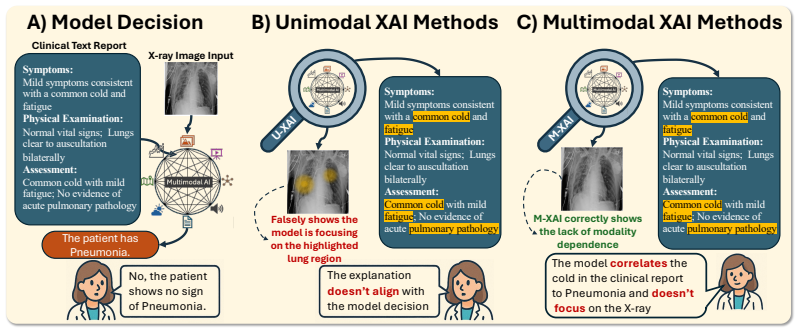
The paper's central claim is that a multimodal model's output is a joint function of its inputs, so an explanation that treats each input type separately cannot represent the cross-modal influence behind a decision. The paper states this as a categorical position: the community should stop relying on unimodal explainability techniques for multimodal models. As support, it points to cases where unimodal attributions look plausible while the model actually relies on a different modality, such as a clinical system that predicts pneumonia from the word 'cough' while ignoring a chest X-ray, and to experiments showing that gradient-based and attention-based explanations do not track what vision-language models use. The paper then formalizes what a proper multimodal explanation must do through three desiderata, each stated as a quantitative condition on a model and its per-modality explanation objects.
Load-bearing premise
The proposal assumes that inequalities with adjustable constants can actually separate good from bad explainers; as written, a bounded explainer can satisfy them by choosing a tiny multiplier and a large offset, so the tests bind only if the constants are fixed or constrained.
Editorial extensions
If this is right
- Per-modality heatmaps, attention maps, and token highlights should no longer be accepted as explanations of a multimodal model's decision.
- Evaluation of multimodal explainers should include ablation-based modality-influence tests, sufficiency and necessity perturbation tests, and cross-modal stability bounds.
- Shortcut detection becomes possible in principle: a criterion that tracks ablation changes can reveal when a model ignores one modality entirely, even if each unimodal map looks plausible.
- Future multimodal model design should incorporate explainability early, for example through explicit alignment modules or disentangled representations that expose modality contributions.
Reading between the lines
- Editorial extension: The three desiderata are declared in a modality-agnostic form, so benchmarking them on synthetic text-image, audio-text, or graph-language tasks with known modality contributions is a direct next step the paper calls for but does not execute.
- Editorial extension: The Granger-style influence condition could be used as a screening test on existing deployed models: any explainer showing near-zero importance for a modality whose ablation changes the output would signal a hidden dependence or a broken explainer, without retraining.
- Editorial extension: The stability bounds suggest a practical stress test for any candidate multimodal explainer using synonyms, brightness shifts, or other imperceptible perturbations; unimodal explainers would be expected to fail these bounds already at small magnitudes, which would make the paper's position empirically checkable.
Editorial analysis
A structured set of objections, weighed in public.
Referee Report
Summary. This position paper argues that unimodal explainability methods (saliency maps, attention visualizations, circuit traces, and similar per-modality tools) systematically misrepresent the decisions of multimodal models because they fail to capture cross-modal interactions. The authors propose three desiderata for multimodal explanations—Granger-style modality influence, synergistic faithfulness, and unified stability—formalized in Eqs. (2)-(7) of Section 3. The paper supports its position with illustrative examples (e.g., a clinical chest X-ray plus text report), a discussion of attention's non-causal nature, a critique of mechanistic interpretability tools, and a small original experiment applying logit lens to a graph-language model. It concludes with a call to stop relying on unimodal explanations in multimodal settings.
Significance. If the central claim were rigorously established, the paper would have practical importance for explainable AI, especially in high-stakes domains. The paper usefully compiles many relevant references and highlights real limitations of per-modality attributions. It also ships a small qualitative experiment (logit lens on a graph-language model), which is a concrete attempt to demonstrate the failure of a unimodal tool. However, the paper's constructive contribution depends on the formal desiderata being meaningful constraints, and as stated they are vacuous. The empirical claim of 'systematic' misrepresentation is not supported by a systematic study. Thus, the significance is contingent on substantial revision of the formalism and evidence.
major comments (4)
- [Section 3, Eq. (2)] The Granger Modality Influence condition ΔEm(x) ≥ αm Δfm - βm with existential αm > 0 and βm ≥ 0 is vacuous: any explainer with bounded output (including the constant zero explainer) satisfies it by setting βm = αm max_x Δfm, which makes the right-hand side non-positive. The text claims this inequality 'prevents an explainer from overstating or understating a modality's role,' but that is not true. To make the criterion meaningful, the constants must be fixed a priori (e.g., universal across explainers, or determined by the evaluation protocol) or the inequality must be replaced by a scale-invariant condition.
- [Section 3, Eqs. (6)-(7)] The Unified Stability conditions are similarly vacuous. In Eq. (6), the Lipschitz constant L'_m is existential; on a compact input space every Lipschitz continuous explainer satisfies the bound with some L'_m, so the condition rules out no method. In Eq. (7), the tolerance ϵ_{m→n} and Lipschitz constant L_{n,m} are also existential; one can set ϵ_{m→n}=0, making the condition trivially true, or choose L_{n,m} large enough to absorb any bounded change. As a result, the desiderata cannot serve as 'evaluation criteria for comparing explanation methods' as claimed in Section 3.
- [Abstract and Section 2] The central claim that unimodal explanations 'systematically misrepresent' multimodal decisions is supported only by illustrative examples (Figures 1-2), anecdotal citations (e.g., Neo et al., Casey et al., Wu et al.), and one qualitative logit-lens experiment. No quantitative evidence is provided about how frequently or severely unimodal explanations misrepresent decisions across different models, tasks, or methods. To justify the strong 'stop relying' conclusion, the paper should either report systematic experiments or explicitly frame the claim as a testable hypothesis rather than an established fact.
- [Section 3, Eqs. (4)-(5)] The synergistic faithfulness conditions depend on thresholds ϵ_keep_m and ϵ_remove_m, but the paper gives no procedure for setting these thresholds. Without a principled choice, the sufficiency and necessity tests are not operational: any explainer can pass or fail by adjusting the thresholds. The paper should specify how the thresholds are determined (e.g., fixed a priori, or relative to the model's output distribution) and how the resulting criteria distinguish between explainers.
minor comments (6)
- [Section 3, Notations] There is a typo in 'modelf is trained on'—it should be 'model f is trained on.'
- [Figure 4 caption] The caption refers to 'the perturbed x2 image' when the perturbation is applied to x1; this should read 'perturbed x1 image.'
- [Section 3, III) Unified Stability] The phrase 'that satisfies the following bounds' is ungrammatical; it should be 'that satisfy the following bounds.'
- [Section 3, II) Faithfulness] The opening definition of faithfulness uses the phrase 'where the irrelevant input features ... are masked or zeroed out,' which is circular unless 'irrelevant' is defined independently of the explainer; the later Keep/Remove construction resolves this, but the initial sentence should be clarified.
- [Figure 2 and Appendix A] The logit-lens experiment is described only qualitatively; it would be clearer if the text explained why tokens like 'bomb' and 'neighbor' are considered evidence of failure, and how the 'static across layers' observation is quantified.
- [References] The in-text citation 'Till, O'Neill and Bui, 2024' merges two separate references (Demian Till and Charles O'Neill with Thang Bui); this should be corrected to two distinct citations.
Circularity Check
No significant circularity: a position paper whose conclusions are argued from case studies and external evidence; self-citations are non-load-bearing and the formal desiderata are proposed definitions rather than derived predictions.
full rationale
This is a position paper, not a derivation, and the circularity analysis must be calibrated accordingly. The central claim — that unimodal explanations systematically misrepresent multimodal decisions and the community should stop relying on them — is argued, not derived. It rests on worked examples (multimodal sentiment analysis, the clinical X-ray/text case, the logit-lens study on TEA-GLM trained on Cora, and the concept-score shift in Fig. 4) and on external literature (Neo et al. 2024; Kang et al. 2025; Jain and Wallace 2019; Wiegreffe and Pinter 2019; Casey et al. 2021; Alvarez-Melis and Jaakkola 2018; Wu et al. 2023). No parameter is fitted to a subset of data and then renamed as a prediction, and no result is proven from inputs that contain the conclusion. The formal desiderata in Section 3 (Eqs. 2–7) are stated definitions of desired properties — Granger-style modality influence, synergistic faithfulness, unified stability — and the paper explicitly frames them as “evaluation criteria” and “design guidelines,” with the conclusion calling the whole discussion “a conceptual foundation,” not an empirical derivation. The several self-citations (Agarwal and Nguyen 2020; Agarwal et al. 2022a,b,c, 2023, 2024; Seth et al. 2025) support background assertions about attribution methods, stability, and plausibility-versus-faithfulness; none is the unique or load-bearing support for the paper’s call to abandon unimodal explainability, which is independently motivated. The skeptic’s objection has force but is not a circularity objection: Eq. (2) (dEm >= am dfm - bm with existential am>0, bm>=0) and Eqs. (6)–(7) (existential Lipschitz and tolerance constants) can indeed be satisfied vacuously by any bounded explainer, so the proposed framework may fail to constrain anything; that is a rigor and evaluation weakness, not a case of an input definition that produces the conclusion. Per the rules that vacuity and “not standard consensus” belong to correctness rather than circularity, the circularity burden here is low. The score of 2 sits at the bottom of the 0–2 band and reflects the presence of incidental, non-load-bearing self-citations, while the steps list is empty because no circular step reduces by construction to the paper’s own inputs.
Assumptions & free parameters
free parameters (3)
- Granger constants αm, βm =
unspecified, existentially quantified
- Faithfulness thresholds ϵ_keep_m, ϵ_remove_m =
unspecified
- Stability tolerances {ϵ_{m→n}, η_m} and Lipschitz constants {L_{n,m}, L'_m} =
unspecified
assumptions (4)
- domain assumption A multimodal model's behavior is not the sum of its parts and cannot be understood from per-modality explanations alone.
- domain assumption Replacing one modality with a neutral reference xref_m is a valid causal intervention that measures how much the model relies on that modality.
- domain assumption Explanation objects from different modalities can be combined by set union into one composite explanation (Eq. 1).
- standard math Lipschitz continuity of explanation maps is an appropriate formalization of explanation stability.
Cite this review
Pith. "Pith review of Rethinking Explainability in the Era of Multimodal AI." pith.science (2026). https://pith.science/paper/O2FT256R
@misc{pith2026250613060,
  author       = {Pith},
  title        = {Pith review of: Rethinking Explainability in the Era of Multimodal AI},
  year         = {2026},
  howpublished = {\url{https://pith.science/paper/O2FT256R}},
  note         = {Machine review of arXiv:2506.13060}
}
read the original abstract
While multimodal AI systems (models jointly trained on heterogeneous data types such as text, time series, graphs, and images) have become ubiquitous and achieved remarkable performance across high-stakes applications, transparent and accurate explanation algorithms are crucial for their safe deployment and ensure user trust. However, most existing explainability techniques remain unimodal, generating modality-specific feature attributions, concepts, or circuit traces in isolation and thus failing to capture cross-modal interactions. This paper argues that such unimodal explanations systematically misrepresent and fail to capture the cross-modal influence that drives multimodal model decisions, and the community should stop relying on them for interpreting multimodal models. To support our position, we outline key principles for multimodal explanations grounded in modality: Granger-style modality influence (controlled ablations to quantify how removing one modality changes the explanation for another), Synergistic faithfulness (explanations capture the model's predictive power when modalities are combined), and Unified stability (explanations remain consistent under small, cross-modal perturbations). This targeted shift to multimodal explanations will help the community uncover hidden shortcuts, mitigate modality bias, improve model reliability, and enhance safety in high-stakes settings where incomplete explanations can have serious consequences.
Figures


Figures from the paper (2 more)


Forward citations
Cited by 2 Pith papers
-
CHARM: Charge Calibration and Acoustic Rescue for LLM-based Multimodal Sarcasm Detection
Symmetric charged prompts cancel zero-shot LLM sarcasm bias; acoustic late fusion with openSMILE and Omni probes lifts weak backbones up to +0.382 Macro-F1 across English and Chinese.
-
Decoding the Multimodal Maze: A Systematic Review on the Adoption of Explainability in Multimodal Attention-based Models
A systematic review of 55 papers finds explainability for multimodal attention-based models is dominated by attention-weight visualizations, while evaluation remains mostly qualitative and non-standardized.
Reference graph
Works this paper leans on
-
[1]
Phi-3 technical report: A highly capable language model locally on your phone
Marah Abdin, Jyoti Aneja, Hany Awadalla, Ahmed Awadallah, Ammar Ahmad Awan, Nguyen Bach, Amit Bahree, Arash Bakhtiari, Jianmin Bao, Harkirat Behl, et al. Phi-3 technical report: A highly capable language model locally on your phone. arXiv, 2024
work page 2024
-
[2]
Explaining image classifiers by removing input features using generative models
Chirag Agarwal and Anh Nguyen. Explaining image classifiers by removing input features using generative models. In ACCV, 2020
work page 2020
-
[3]
Rethinking stability for attribution-based explanations
Chirag Agarwal, Nari Johnson, Martin Pawelczyk, Satyapriya Krishna, Eshika Saxena, Marinka Zitnik, and Himabindu Lakkaraju. Rethinking stability for attribution-based explanations. In ICLR Workshop on PAIR 2Struct , 2022 a
work page 2022
-
[4]
Openxai: Towards a transparent evaluation of model explanations
Chirag Agarwal, Satyapriya Krishna, Eshika Saxena, Martin Pawelczyk, Nari Johnson, Isha Puri, Marinka Zitnik, and Himabindu Lakkaraju. Openxai: Towards a transparent evaluation of model explanations. NeurIPS, 2022 b
work page 2022
-
[5]
Probing gnn explainers: A rigorous theoretical and empirical analysis of gnn explanation methods
Chirag Agarwal, Marinka Zitnik, and Himabindu Lakkaraju. Probing gnn explainers: A rigorous theoretical and empirical analysis of gnn explanation methods. In AISTATS, 2022 c
work page 2022
-
[6]
Evaluating explainability for graph neural networks
Chirag Agarwal, Owen Queen, Himabindu Lakkaraju, and Marinka Zitnik. Evaluating explainability for graph neural networks. Scientific Data, 2023
work page 2023
-
[7]
Chirag Agarwal, Sree Harsha Tanneru, and Himabindu Lakkaraju. Faithfulness vs. plausibility: On the (un) reliability of explanations from large language models. arXiv, 2024
work page 2024
-
[8]
On the robustness of interpretability methods
David Alvarez-Melis and Tommi S Jaakkola. On the robustness of interpretability methods. arXiv, 2018
work page 2018
Show all 69 references
-
[9]
Emmanuel Ameisen, Jack Lindsey, Adam Pearce, Wes Gurnee, Nicholas L. Turner, Brian Chen, Craig Citro, David Abrahams, Shan Carter, Basil Hosmer, Jonathan Marcus, Michael Sklar, Adly Templeton, Trenton Bricken, Callum McDougall, Hoagy Cunningham, Thomas Henighan, Adam Jermyn, A...
2025
-
[10]
Bottom-up and top-down attention for image captioning and visual question answering
Peter Anderson, Xiaodong He, Chris Buehler, Damien Teney, Mark Johnson, Stephen Gould, and Lei Zhang. Bottom-up and top-down attention for image captioning and visual question answering. In CVPR, 2018
2018
-
[11]
Mechanistic interpretability for ai safety--a review
Leonard Bereska and Efstratios Gavves. Mechanistic interpretability for ai safety--a review. arXiv, 2024
2024
-
[12]
Interpreting clip with sparse linear concept embeddings (splice)
Usha Bhalla, Alex Oesterling, Suraj Srinivas, Flavio Calmon, and Himabindu Lakkaraju. Interpreting clip with sparse linear concept embeddings (splice). NeurIPS, 2024
2024
-
[13]
A systematic review of natural language processing applied to radiology reports
Arlene Casey, Emma Davidson, Michael Poon, Hang Dong, Daniel Duma, Andreas Grivas, Claire Grover, V \' ctor Su \'a rez-Paniagua, Richard Tobin, William Whiteley, et al. A systematic review of natural language processing applied to radiology reports. BMC Medical Informatics and...
2021
-
[14]
Fleurs: Few-shot learning evaluation of universal representations of speech
Alexis Conneau, Min Ma, Simran Khanuja, Yu Zhang, Vera Axelrod, Siddharth Dalmia, Jason Riesa, Clara Rivera, and Ankur Bapna. Fleurs: Few-shot learning evaluation of universal representations of speech. In IEEE Spoken Language Technology Workshop, 2022
2022
-
[15]
Sparse autoencoders find highly interpretable features in language models
Hoagy Cunningham, Aidan Ewart, Logan Riggs, Robert Huben, and Lee Sharkey. Sparse autoencoders find highly interpretable features in language models. arXiv, 2023
2023
-
[16]
A survey of the state of explainable AI for natural language processing
Marina Danilevsky, Kun Qian, Ranit Aharonov, Yannis Katsis, Ban Kawas, and Prithviraj Sen. A survey of the state of explainable AI for natural language processing. In AACL, 2020
2020
-
[17]
Interpretable explanations of black boxes by meaningful perturbation
Ruth C Fong and Andrea Vedaldi. Interpretable explanations of black boxes by meaningful perturbation. In ICCV, 2017
2017
-
[18]
Attention in natural language processing
Andrea Galassi, Marco Lippi, and Paolo Torroni. Attention in natural language processing. IEEE Transactions on Neural Networks and learning systems, 2020
2020
-
[19]
Scaling and evaluating sparse autoencoders
Leo Gao, Tom Dupr \'e la Tour, Henk Tillman, Gabriel Goh, Rajan Troll, Alec Radford, Ilya Sutskever, Jan Leike, and Jeffrey Wu. Scaling and evaluating sparse autoencoders. arXiv, 2024
2024
-
[20]
Multimodal neurons in artificial neural networks
Gabriel Goh, Nick Cammarata †, Chelsea Voss †, Shan Carter, Michael Petrov, Ludwig Schubert, Alec Radford, and Chris Olah. Multimodal neurons in artificial neural networks. Distill, 2021. doi:10.23915/distill.00030. https://distill.pub/2021/multimodal-neurons
2021 doi
-
[21]
Localizing model behavior with path patching
Nicholas Goldowsky-Dill, Chris MacLeod, Lucas Sato, and Aryaman Arora. Localizing model behavior with path patching. arXiv, 2023
2023
-
[22]
circuit-tracer
Michael Hanna, Mateusz Piotrowski, Jack Lindsey, and Emmanuel Ameisen. circuit-tracer. https://github.com/safety-research/circuit-tracer, 2025. The first two authors contributed equally and are listed alphabetically
2025
-
[23]
Sparse autoencoders can interpret randomly initialized transformers
Thomas Heap, Tim Lawson, Lucy Farnik, and Laurence Aitchison. Sparse autoencoders can interpret randomly initialized transformers. arXiv, 2025
2025
-
[24]
How to use and interpret activation patching
Stefan Heimersheim and Neel Nanda. How to use and interpret activation patching. arXiv, 2024
2024
-
[25]
Gpt-4o system card
Aaron Hurst, Adam Lerer, Adam P Goucher, Adam Perelman, Aditya Ramesh, Aidan Clark, AJ Ostrow, Akila Welihinda, Alan Hayes, Alec Radford, et al. Gpt-4o system card. arXiv, 2024
2024
-
[26]
Attention is not explanation
Sarthak Jain and Byron C Wallace. Attention is not explanation. arXiv, 2019
2019
-
[27]
Towards better explanations of class activation mapping
Hyungsik Jung and Youngrock Oh. Towards better explanations of class activation mapping. In ICCV, 2021
2021
-
[28]
See what you are told: Visual attention sink in large multimodal models
Seil Kang, Jinyeong Kim, Junhyeok Kim, and Seong Jae Hwang. See what you are told: Visual attention sink in large multimodal models. arXiv, 2025
2025
-
[29]
Are sparse autoencoders useful? a case study in sparse probing
Subhash Kantamneni, Joshua Engels, Senthooran Rajamanoharan, Max Tegmark, and Neel Nanda. Are sparse autoencoders useful? a case study in sparse probing. arXiv, 2025
2025
-
[30]
Interpretability beyond feature attribution: Quantitative testing with concept activation vectors (tcav)
Been Kim, Martin Wattenberg, Justin Gilmer, Carrie Cai, James Wexler, Fernanda Viegas, et al. Interpretability beyond feature attribution: Quantitative testing with concept activation vectors (tcav). In ICML, 2018
2018
-
[31]
Visual explanations from hadamard product in multimodal deep networks
Jin-Hwa Kim and Byoung-Tak Zhang. Visual explanations from hadamard product in multimodal deep networks. arXiv, 2017
2017
-
[32]
Sparse autoencoders work on attention layer outputs
Connor Kissane, Robert Krzyzanowski, Arthur Conmy, and Neel Nanda. Sparse autoencoders work on attention layer outputs. In Alignment Forum, 2024
2024
-
[33]
Concept bottleneck models
Pang Wei Koh, Thao Nguyen, Yew Siang Tang, Stephen Mussmann, Emma Pierson, Been Kim, and Percy Liang. Concept bottleneck models. In ICML, 2020
2020
-
[34]
Jack Lindsey, Wes Gurnee, Emmanuel Ameisen, Brian Chen, Adam Pearce, Nicholas L. Turner, Craig Citro, David Abrahams, Shan Carter, Basil Hosmer, Jonathan Marcus, Michael Sklar, Adly Templeton, Trenton Bricken, Callum McDougall, Hoagy Cunningham, Thomas Henighan, Adam Jermyn, A...
2025
-
[35]
The llama 4 herd: The beginning of a new era of natively multimodal ai innovation, 2025
Llama. The llama 4 herd: The beginning of a new era of natively multimodal ai innovation, 2025. URL https://ai.meta.com/blog/llama-4-multimodal-intelligence/
2025
-
[36]
Dime: Fine-grained interpretations of multimodal models via disentangled local explanations
Yiwei Lyu, Paul Pu Liang, Zihao Deng, Ruslan Salakhutdinov, and Louis-Philippe Morency. Dime: Fine-grained interpretations of multimodal models via disentangled local explanations. In AIES, 2022
2022
-
[37]
Towards principled evaluations of sparse autoencoders for interpretability and control
Aleksandar Makelov, George Lange, and Neel Nanda. Towards principled evaluations of sparse autoencoders for interpretability and control. arXiv, 2024
2024
-
[38]
K-sparse autoencoders
Alireza Makhzani and Brendan Frey. K-sparse autoencoders. arXiv, 2013
2013
-
[39]
Cora Dataset , 2017
Andrew McCallum. Cora Dataset , 2017. URL https://doi.org/10.18738/T8/HUIG48
2017 doi
-
[40]
Dual attention networks for multimodal reasoning and matching
Hyeonseob Nam, Jung-Woo Ha, and Jeonghee Kim. Dual attention networks for multimodal reasoning and matching. In CVPR, 2017
2017
-
[41]
Attribution patching: Activation patching at industrial scale
Neel Nanda. Attribution patching: Activation patching at industrial scale. URL: https://www. neelnanda. io/mechanistic-interpretability/attribution-patching, 2023
2023
-
[42]
Towards interpreting visual information processing in vision-language models
Clement Neo, Luke Ong, Philip Torr, Mor Geva, David Krueger, and Fazl Barez. Towards interpreting visual information processing in vision-language models. arXiv, 2024
2024
-
[43]
Interpreting gpt: the logit lens — lesswrong, 2020
nostalgebraist. Interpreting gpt: the logit lens — lesswrong, 2020. URL https://www.lesswrong.com/posts/AcKRB8wDpdaN6v6ru/interpreting-gpt-the-logit-lens
2020
-
[44]
Sparse autoencoders enable scalable and reliable circuit identification in language models
Charles O'Neill and Thang Bui. Sparse autoencoders enable scalable and reliable circuit identification in language models. arXiv, 2024
2024
-
[45]
Orchestrating explainable artificial intelligence for multimodal and longitudinal data in medical imaging
Aur \'e lie Pahud de Mortanges, Haozhe Luo, Shelley Zixin Shu, Amith Kamath, Yannick Suter, Mohamed Shelan, Alexander P \"o llinger, and Mauricio Reyes. Orchestrating explainable artificial intelligence for multimodal and longitudinal data in medical imaging. NPJ digital medic...
2024
-
[46]
Multimodal explanations: Justifying decisions and pointing to the evidence
Dong Huk Park, Lisa Anne Hendricks, Zeynep Akata, Anna Rohrbach, Bernt Schiele, Trevor Darrell, and Marcus Rohrbach. Multimodal explanations: Justifying decisions and pointing to the evidence. In CVPR, 2018
2018
-
[47]
Perception test: A diagnostic benchmark for multimodal video models
Viorica Patraucean, Lucas Smaira, Ankush Gupta, Adria Recasens, Larisa Markeeva, Dylan Banarse, Skanda Koppula, Mateusz Malinowski, Yi Yang, Carl Doersch, et al. Perception test: A diagnostic benchmark for multimodal video models. NeurIPS, 2023
2023
-
[48]
why should i trust you?
Marco Tulio Ribeiro, Sameer Singh, and Carlos Guestrin. " why should i trust you?" explaining the predictions of any classifier. In KDD, 2016
2016
-
[49]
Multimodal explainable artificial intelligence: A comprehensive review of methodological advances and future research directions
Nikolaos Rodis, Christos Sardianos, Panagiotis Radoglou-Grammatikis, Panagiotis Sarigiannidis, Iraklis Varlamis, and Georgios Th Papadopoulos. Multimodal explainable artificial intelligence: A comprehensive review of methodological advances and future research directions. IEEE...
2024
-
[50]
Grad-cam: visual explanations from deep networks via gradient-based localization
Ramprasaath R Selvaraju, Michael Cogswell, Abhishek Das, Ramakrishna Vedantam, Devi Parikh, and Dhruv Batra. Grad-cam: visual explanations from deep networks via gradient-based localization. IJCV, 2020
2020
-
[51]
Towards a systematic evaluation of hallucinations in large-vision language models, 2025
Ashish Seth, Dinesh Manocha, and Chirag Agarwal. Towards a systematic evaluation of hallucinations in large-vision language models, 2025
2025
-
[52]
A survey on sparse autoencoders: Interpreting the internal mechanisms of large language models
Dong Shu, Xuansheng Wu, Haiyan Zhao, Daking Rai, Ziyu Yao, Ninghao Liu, and Mengnan Du. A survey on sparse autoencoders: Interpreting the internal mechanisms of large language models. arXiv, 2025
2025
-
[53]
Explain and improve: Lrp-inference fine-tuning for image captioning models
Jiamei Sun, Sebastian Lapuschkin, Wojciech Samek, and Alexander Binder. Explain and improve: Lrp-inference fine-tuning for image captioning models. Information Fusion, 2022
2022
-
[54]
A review of multimodal explainable artificial intelligence: Past, present and future
Shilin Sun, Wenbin An, Feng Tian, Fang Nan, Qidong Liu, Jun Liu, Nazaraf Shah, and Ping Chen. A review of multimodal explainable artificial intelligence: Past, present and future. arXiv, 2024
2024
-
[55]
Axiomatic attribution for deep networks
Mukund Sundararajan, Ankur Taly, and Qiqi Yan. Axiomatic attribution for deep networks. In ICML, 2017
2017
-
[56]
Gemini: a family of highly capable multimodal models
Gemini Team, Rohan Anil, Sebastian Borgeaud, Jean-Baptiste Alayrac, Jiahui Yu, Radu Soricut, Johan Schalkwyk, Andrew M Dai, Anja Hauth, Katie Millican, et al. Gemini: a family of highly capable multimodal models. arXiv, 2023
2023
-
[57]
true features
Demian Till. Do sparse autoencoders find" true features"? 2024. URL https://www. lesswrong. com/posts/QoR8noAB3Mp2KBA4B/do-sparse-autoencoders-find-true-features
2024
-
[58]
Interpretable multi-modal hate speech detection
Prashanth Vijayaraghavan, Hugo Larochelle, and Deb Roy. Interpretable multi-modal hate speech detection. arXiv, 2021
2021
-
[59]
Llms as zero-shot graph learners: Alignment of gnn representations with llm token embeddings
Duo Wang, Yuan Zuo, Fengzhi Li, and Junjie Wu. Llms as zero-shot graph learners: Alignment of gnn representations with llm token embeddings. NeurIPS, 2024
2024
-
[60]
Interpretability-based multimodal convolutional neural networks for skin lesion diagnosis
Sutong Wang, Yunqiang Yin, Dujuan Wang, Yanzhang Wang, and Yaochu Jin. Interpretability-based multimodal convolutional neural networks for skin lesion diagnosis. IEEE Transactions on Cybernetics, 2021 a
2021
-
[61]
M2lens: Visualizing and explaining multimodal models for sentiment analysis
Xingbo Wang, Jianben He, Zhihua Jin, Muqiao Yang, Yong Wang, and Huamin Qu. M2lens: Visualizing and explaining multimodal models for sentiment analysis. IEEE TVCG, 2021 b
2021
-
[62]
Logitlens4llms: Extending logit lens analysis to modern large language models
Zhenyu Wang. Logitlens4llms: Extending logit lens analysis to modern large language models. arXiv, 2025
2025
-
[63]
Measuring cross-modal interactions in multimodal models
Laura Wenderoth, Konstantin Hemker, Nikola Simidjievski, and Mateja Jamnik. Measuring cross-modal interactions in multimodal models. In AAAI, 2025
2025
-
[64]
Attention is not not explanation
Sarah Wiegreffe and Yuval Pinter. Attention is not not explanation. In EMNLP-IJCNLP, 2019
2019
-
[65]
Audio-text models do not yet leverage natural language
Ho-Hsiang Wu, Oriol Nieto, Juan Pablo Bello, and Justin Salamon. Audio-text models do not yet leverage natural language. In ICASSP. IEEE, 2023
2023
-
[66]
Visual entailment: A novel task for fine-grained image understanding
Ning Xie, Farley Lai, Derek Doran, and Asim Kadav. Visual entailment: A novel task for fine-grained image understanding. arXiv, 2019
2019
-
[67]
Gnnexplainer: Generating explanations for graph neural networks
Zhitao Ying, Dylan Bourgeois, Jiaxuan You, Marinka Zitnik, and Jure Leskovec. Gnnexplainer: Generating explanations for graph neural networks. NeurIPS, 2019
2019
-
[68]
Towards best practices of activation patching in language models: Metrics and methods
Fred Zhang and Neel Nanda. Towards best practices of activation patching in language models: Metrics and methods. In ICLR, 2024
2024
-
[69]
Vlm ^ 2 -bench: A closer look at how well vlms implicitly link explicit matching visual cues
Jianshu Zhang, Dongyu Yao, Renjie Pi, Paul Pu Liang, and Yi R Fung. Vlm ^ 2 -bench: A closer look at how well vlms implicitly link explicit matching visual cues. arXiv, 2025
2025
Reviewed August 7, 2026 · model on record in the stance chip above.
Discussion (0). Continue with ORCID to comment.