REVIEW 3 major objections 5 minor 53 references
A black hole in a Hernquist dark-matter halo can spontaneously develop a scalar field, with the coupling constant quantized by the halo's compactness.
Reviewed by Pith at T0; open to challenge. T0 means a machine referee read the full paper against a public rubric. the ladder, T0–T4 →
T0 review · deepseek-v4-flash
2026-08-01 18:16 UTC pith:O3AWO6FF
load-bearing objection The paper's headline quantization formula is unsupported: the printed Hernquist pressure has the wrong sign for the tachyonic instability it relies on. the 3 major comments →
Spontaneous scalarization around a black hole in a dark matter halo
The pith
A machine-rendered reading of the paper's core claim, the machinery that carries it, and where it could break.
Core claim
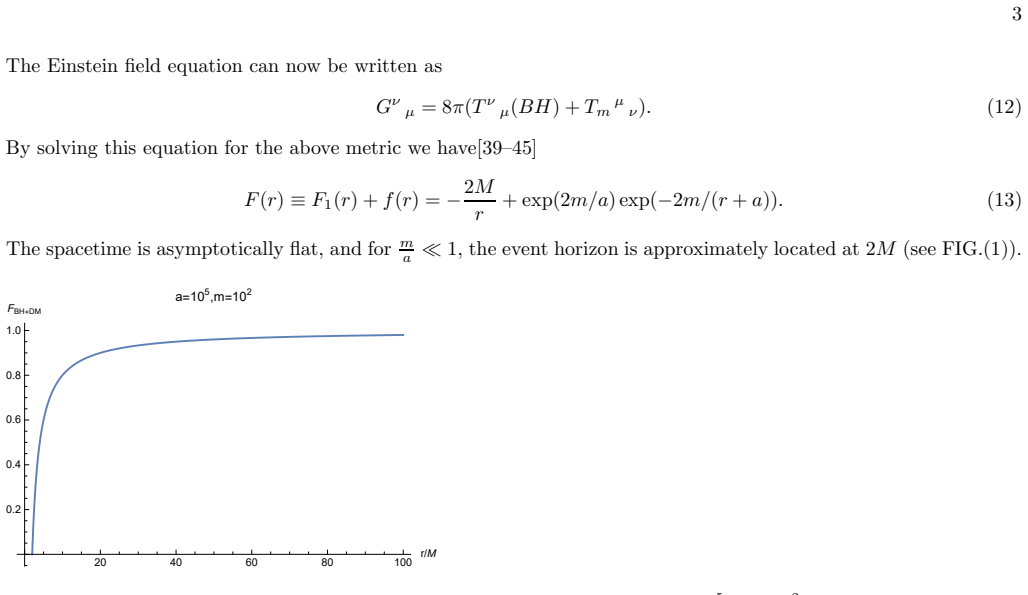
The central claim is that a Hernquist dark-matter halo alone, through its matter trace, can destabilize a conformally coupled scalar field around a black hole and select discrete scalar configurations. Concretely, with A(Φ)=exp(ηΦ²/2) and η<0, the scalar equation □Φ=2η(ρ−p)Φ has bound-state solutions only when ρ−p>0 in an extended region; the paper assumes this holds for r<a²/m. For M≪m≪a and large |η|, the effective potential's well is bounded by the horizon and infinity, and WKB/Bohr-Sommerfeld quantization gives η_n=−(n+1/2)²π³/(2C), where C=m/a. Numerically, for C=10⁻³ the first levels are |η|≈3317, 40324, 103308 with 0, 1, and 2 nodes, and the large-n spacing Δn=√|η_{n+1}|−√|η_n| tends
What carries the argument
The load-bearing object is the trace combination ρ−p of the Hernquist dark-matter energy-momentum tensor entering the scalar equation; its sign switches the scalar field's effective mass squared. The calculation also relies on the composed BH+halo metric F(r)=−2M/r+e^{2m/a}e^{−2m/(r+a)}, the compactness parameter C=m/a, and the WKB/Bohr-Sommerfeld quantization integral between the horizon and infinity. The Hernquist density ρ(r)=m/(2π)a/[r(r+a)³] with the tangential pressure (10) defines the matter source; the symmetric conformal coupling A(Φ)=exp(ηΦ²/2) makes η, chosen negative, the only free coupling.
Load-bearing premise
The argument requires that the dark-matter combination ρ−p be positive in a region outside the horizon when η is negative, so the scalar field feels a negative effective mass squared; if ρ−p is not positive there, the tachyonic instability and the resulting discrete spectrum do not occur.
What would settle it
Evaluate ρ−p from Eqs. (5) and (10) of the paper; the claimed condition r<a²/m can be checked algebraically. If ρ−p≤0 for all r>0, then for η<0 the effective mass squared 2η(ρ−p) is non-negative, eliminating the bound-state well and the quantization condition (37). A direct numerical integration of □Φ=2η(ρ−p)Φ for η<0 in the printed spacetime, searching for regular, normalizable modes, would settle the existence of scalarized solutions.
If this is right
- If correct, dark-matter halos can scalarize black holes without curvature-coupled terms such as Gauss-Bonnet, broadening the search for scalar hair in astrophysics.
- The spectrum η_n ∝ (n+1/2)²/C means halos with smaller compactness require much larger negative couplings for even the ground state, placing the effect in a strong-coupling regime.
- The asymptotic spacing Δn≈π^{3/2}/√(2C) is independent of m and a separately, giving a universal, compactness-only prediction that numerical solutions reproduce.
- Scalarized black holes in DM halos would have modified effective potentials, which could show up in quasinormal-mode spectra and shadow observables if the required couplings are realized.
- For fixed node number n, decreasing C increases |η_n|, so the existence of scalar hair becomes a probe of halo concentration.
Where Pith is reading between the lines
- A direct substitution of the paper's density (5) and pressure (10) into ρ−p appears to yield a negative value for all r>0, which would flip the sign of the effective mass squared for η<0; the proposed tachyonic mechanism and the discrete spectrum therefore hinge on whether the printed matter model satisfies ρ−p>0 in some region or on a modified pressure profile.
- If the trace sign is corrected or the matter model adjusted (e.g., a different equation of state for the halo), the same WKB derivation could be repeated for cored or NFW profiles, giving compactness-dependent spectra with different constants.
- The near-threshold n=0 ground-state coupling is relatively small (|η|~3300 for C=10⁻³); extending the exact numerical solution to small |η| would test the WKB assumption that the second turning point sits at infinity, and could reveal whether scalarization is a threshold effect or a continuous onset.
- If the discrete spectrum is real, one could look for binary black holes in galaxies with known halo compactness and ask whether deviations from GR correlate with C, providing an observational route to test DM-induced scalarization.
Editorial analysis
A structured set of objections, weighed in public.
Referee Report
Summary. The paper studies a scalar-tensor theory in which dark matter is conformally coupled to a scalar field through A(Φ)=exp(ηΦ²/2), with a Schwarzschild black hole embedded in a Hernquist dark-matter halo. The authors claim that spontaneous scalarization occurs when the effective mass squared 2η(ρ-p) is negative, leading to a discrete spectrum of the conformal coupling, η_n = -(n+1/2)²π³/(2C), where C=m/a is the halo compactness. The derivation uses a virial identity, a WKB quantization condition, and numerical evaluation of the resulting integral. The central physical claim is that the halo compactness alone determines the quantized coupling constant.
Significance. If correct, the result would identify a new astrophysical mechanism for spontaneous scalarization in which the dark-matter halo's compactness directly controls the existence and spectrum of scalar hair around a black hole. This would be a novel and potentially observable link between dark-matter structure and black-hole physics. The paper also provides explicit numerical tables and an asymptotic level-spacing prediction, which are welcome elements. However, because of an elementary sign error in the matter trace, the proposed tachyonic instability does not occur for the printed matter model, and the subsequent WKB/numerical analysis does not rehabilitate the conclusion. The claimed quantization is therefore not supported.
major comments (3)
- [II.B, Eqs. (5), (10), (21)-(22), and Fig. 2] The asserted trace sign is algebraically false. From Eq. (5), ρ = m a/[2π r(r+a)^3]. Eq. (10) gives p_t = m/[2π(r+a)^4] [a²/r + a + m] exp(2m/a)exp(-2m/(r+a)). Therefore p_t/ρ = E[1 + m r/(a(a+r))], with E = exp(2m/a)exp(-2m/(r+a)) = exp(2mr/(a(a+r))) > 1 for all r>0. Thus p_t > ρ and ρ-p < 0 everywhere, contradicting the statement before Eq. (22) that ρ-p > 0 for r<a²/m. Fig. 2, which shows p below ρ, is inconsistent with Eq. (10). With η<0, Eq. (21) then gives μ²_eff = 2η(ρ-p) > 0, so there is no tachyonic instability, no attractive potential well in Eq. (25), and no scalarization. This invalidates the central claim and the quantization formula (37).
- [II.C-II.E, Eqs. (32), (38)-(39), Fig. 5] The numerical confirmation is not independent of the derivation. Tables I-III and Figs. 5-6 are produced by numerically evaluating the Bohr-Sommerfeld integral (32), which is the same integral used for the analytic WKB result. The agreement between Δn ≈ 124.6 and the WKB value 124.52 therefore validates the analytic evaluation of that integral, not the existence of regular n-node bound-state solutions of the Schrödinger-like equation (24). To support the quantization claim, the authors should solve the boundary-value problem for Eq. (24) directly, e.g., by shooting, and show that regular solutions exist precisely at the discrete η_n. The present evidence is a self-consistency check, not a numerical confirmation of scalarization.
- [II.C, Eq. (26)] The WKB validity condition is numerically violated for the parameters used. With M=1, a=10^5, m=10^2 (C=10^-3), the left-hand side of Eq. (26) is M²C²/[a²(1+c)^6 √(2π)√|η|] ∼ 10^-23 / √|η| for c∼10, which is nowhere near ≫1 for the values |η|∼10^3-10^5 in Table I. Thus the eikonal approximation and the turning-point analysis leading to Eq. (31), which rely on (26), are not justified. This is a separate technical obstruction to the derivation of Eq. (37).
minor comments (5)
- [Title and author block] The title contains a typo: 'matt er'. The author block also contains a stray 'a meysam.navid@ut.ac.ir' fragment.
- [Eqs. (10)-(25)] The notation for the pressure is inconsistent: the tangential pressure is defined as p_t in Eq. (10) but later denoted simply p in Eqs. (17)-(25). Please define the notation once and use it uniformly.
- [Eq. (9) and discussion after Eq. (13)] The metric function f(r)=exp(2m/a)exp(-2m/(r+a)) tends to exp(2m/a) as r→∞, not to 1. The text's claim of asymptotic flatness requires an explicit time rescaling; state the ADM mass and the rescaling used.
- [Tables I-III and Figs. 2-4] The value of the black-hole mass M used in the numerical work is not stated. Since the figures use r/M, specify M (e.g., M=1) in the text and table captions.
- [Eqs. (29)-(31)] The notation r_1^>, r_2^< is ambiguous. Define the four roots clearly and indicate which are physical turning points.
Circularity Check
No significant circularity: the quantization condition is derived from the field equation, and the numerical check is a self-consistency check of the WKB approximation rather than an independent prediction.
full rationale
The claimed result η_n = −(n+1/2)^2π^3/(2C) is obtained from the scalar-field equation of motion (22) via the Bohr-Sommerfeld quantization condition (27) applied to the effective potential (25). No parameter is fitted to data and no external quantity is renamed: η_n is the eigenvalue of a definite differential problem, and the halo compactness C enters through the density/pressure profile. Although Ref. [47] is a self-citation for the tachyonic criterion (21), that criterion is standard and the same sign condition is embodied in the in-text identity (20); it is not a uniqueness theorem and does not by itself force the final spectrum. The numerical section solves the same integral (32) that the WKB approximation replaces by X√|η|, so the agreement (124.6 vs 124.52) validates the WKB quadrature rather than providing an independent empirical confirmation; this is methodologically weak but not circular in the derivation. Separately, the paper's assertion just before Eq. (22) that ρ−p > 0 for r < a²/m appears inconsistent with Eqs. (5) and (10), for which p/ρ = exp(2m/a − 2m/(r+a))[1 + mr/(a(r+a))] > 1 for all r > 0. If correct, this is a serious sign/correctness error — the effective mass has the wrong sign and no tachyonic instability follows — but it is not a circularity of the type defined here. Score 0 on circularity.
Axiom & Free-Parameter Ledger
free parameters (3)
- η (conformal coupling constant) =
η₀=−3316.5, η₁=−40324, η₂=−103308 (a=10⁵, m=10²); analytic claim η_n=−(n+1/2)²π³/(2C)
- Halo compactness C = m/a =
10⁻³ (Tables I, II), 10⁻⁵ (Table III), 84×10⁻⁵ (Fig. 6)
- WKB node number n =
0, 1, 2, ... (integers)
axioms (6)
- domain assumption Dark matter in the halo is described by the Hernquist density (5) and the pressure (10)
- domain assumption The combined BH+halo metric (13) solves G_μν = 8π(T_BH + T_DM)
- ad hoc to paper Trace of the DM energy-momentum tensor is negative, i.e. ρ − p > 0
- domain assumption WKB/eikonal validity with large |η| (Eq. 26)
- domain assumption Spherically symmetric scalar only (l=0 truncation)
- standard math Integration-by-parts boundary terms in (18)–(20) vanish
read the original abstract
We demonstrate that in a scalar-tensor theory where dark matter is conformally coupled to a scalar field, a black hole surrounded by a Hernquist dark matter halo can undergo spontaneous scalarization, acquiring a nontrivial scalar field configuration. The astrophysical properties of the dark matter halo directly dictate the quantum-like spectrum of scalar field configurations around the central black hole. Remarkably, the conformal coupling constant becomes discretized and is determined solely by the halo's compactness parameter.
Figures


Reference graph
Works this paper leans on
-
[1]
J. E. Chase, Commun. Math. Phys. 19 4, 276 (1970)
1970
-
[2]
J. D. Bekenstein, Phys. Rev. Lett. 28, 452 (1972)
1972
-
[3]
Brans and R
C. Brans and R. H. Dicke, Phys. Rev. 124, 925 (1961)
1961
-
[4]
T. Clifton, P. G. Ferreira, A. Padilla, and C. Skordis, Ph ys. Rep. 513, 1 (2012), [arXiv:1106.2476 [astro-ph.CO]]
Pith/arXiv arXiv 2012
-
[5]
T. P. Sotiriou and V. Faraoni, Phys. Rev. Lett. 108, 081103 (2012), [arXiv:1109.6324 [gr-qc]]
Pith/arXiv arXiv 2012
-
[6]
L. Heisenberg, Phys. Rep. 796, 1 (2019), [arXiv:1807.01725 [gr-qc]]
Pith/arXiv arXiv 2019
-
[7]
E. N. Saridakis, R. Lazkoz, V. Salzano, P. V. Moniz, S. Cap ozziello, J. B. Jim´ enez, M. De Laurentis, and G. J. Olmo, Modified gravity and cosmology, Tech. Rep. (Springer, 2021)
2021
-
[8]
Charmousis, Higher order gravity theories and their b lack hole solutions, in Physics of Black Holes: A Guided Tour (Springer, 2009) pp
C. Charmousis, Higher order gravity theories and their b lack hole solutions, in Physics of Black Holes: A Guided Tour (Springer, 2009) pp. 299–346
2009
-
[9]
G. W. Horndeski, Int. J. Theor. Phys. 10, 363 (1974)
1974
-
[10]
C. Deffayet, X. Gao, D. A. Steer, and G. Zahariade, Phys. R ev. D, 84, 064039 (2011), [arXiv:1103.3260 [hep-th]]
Pith/arXiv arXiv 2011
-
[11]
T. Kobayashi, M. Yamaguchi, and J. Yokoyama, Prog. Theo r. Phys. 126, 511 (2011), [arXiv:1105.5723 [hep-th]]
Pith/arXiv arXiv 2011
-
[12]
Deffayet and D
C. Deffayet and D. A. Steer, Class. Quantum Grav. 30, 214006 (2013)
2013
-
[13]
T. Kobayashi, Rep. Prog. Phys. 82, 086901 (2019), [arXiv:1901.07183 [gr-qc]]
Pith/arXiv arXiv 2019
-
[14]
J. D. Bekenstein, Ann. Phys. (N.Y.) 91, 75 (1975)
1975
-
[15]
J. D. Bekenstein, Ann. Phys. (N.Y.) 82, 535 (1974)
1974
-
[16]
N. M. Bocharova, K. A. Bronnikov, V. N. Melnikov, Vestn. Mosk. Univ. Fiz. Astron. 6, 706 (1970)
1970
- [17]
-
[18]
G. Antoniou, A. Bakopoulos, and P. Kanti, Phys. Rev. let t. 120, 131102 (2018), [arXiv:1711.03390 [hep-th]]
Pith/arXiv arXiv 2018
-
[19]
G. Antoniou, A. Bakopoulos, and P. Kanti, Phys. Rev. D 97, 084037 (2018), [arXiv:1711.07431 [hep-th]]
Pith/arXiv arXiv 2018
-
[20]
Damour and G
T. Damour and G. Esposito-Farese, Phys. Rev. Lett. 70, 2220 (1993)
1993
-
[21]
T. Damour and G. Esposito-Farese, Phys. Rev. D 54, 1474 (1996), [arXiv:gr-qc/9602056]
Pith/arXiv arXiv 1996
-
[22]
D. D. Doneva and S. S. Yazadjiev, Phys. Rev. Lett. 120, 131103 (2018), [arXiv:1711.01187 [gr-qc]]
Pith/arXiv arXiv 2018
-
[23]
H. O. Silva, J. Sakstein, L. Gualtieri, T. P. Sotiriou an d E. Berti, Phys. Rev. Lett. 120, 131104 (2018), [arXiv:1711.02080 [gr-qc]]
Pith/arXiv arXiv 2018
-
[24]
Mohseni Sadjadi, Journal of Researc h on Many-body Systems, 13(1), 63 (2023)
S.H.S, Sajjadi, H. Mohseni Sadjadi, Journal of Researc h on Many-body Systems, 13(1), 63 (2023)
2023
-
[25]
H. Mohseni Sadjadi and H. Yazdani Ahmadabadi, Phys. Let t. B 870, 139942 (2025), [arXiv:2510.00704 [hep-ph]]
arXiv 2025
-
[26]
H. Mohseni Sadjadi, Phys. Lett. B 850, 138508 (2024), [arXiv:2309.07816 [gr-qc]]
Pith/arXiv arXiv 2024
-
[27]
V. Cardoso, I. P. Carucci, P. Pani and T. P. Sotiriou, Phy s. Rev. Lett. 111, 111101 (2013), [arXiv:1308.6587 [gr-qc]]
Pith/arXiv arXiv 2013
-
[28]
V. Cardoso, I. P. Carucci, P. Pani and T. P. Sotiriou, Phy s. Rev. D 88, 044056 (2013), [arXiv:1305.6936 [gr-qc]]
Pith/arXiv arXiv 2013
-
[29]
Mohseni Sadjadi, M
H. Mohseni Sadjadi, M. Navid Gasemi Zad, arXiv:2606.29 864 [gr-qc]
-
[30]
Y. Sofue and V. Rubin, Ann. Rev. Astron. Astrophys. 39, 137 (2001), [arXiv:astro-ph/0010594 ]
Pith/arXiv arXiv 2001
-
[31]
C. S. Frenk, A. E. Evrard, S. D. M. White and F. J. Summers, Astrophys. J. 472, 460 (1996), [arXiv:astro-ph/9504020]
Pith/arXiv arXiv 1996
-
[32]
E. Gawiser and J. Silk, Phys. Rept. 333, 245 (2000), [arXiv:astro-ph/0002044]
Pith/arXiv arXiv 2000
-
[33]
Hernquist, ApJ 356, 359 (1990)
L. Hernquist, ApJ 356, 359 (1990)
1990
-
[34]
T. Matos and D. Nunez, Rev. Mex. Fis. 51, 71 (2005), [arXiv:astro-ph/0303594]
Pith/arXiv arXiv 2005
-
[35]
Z. Xu, X. Hou, X. Gong and J. Wang, JCAP 09, 038 (2018), [arXiv:1803.00767 [gr-qc]]
Pith/arXiv arXiv 2018
-
[36]
K. Jusufi, M. Jamil, P. Salucci, T. Zhu and S. Haroon, Phys . Rev. D 100, 044012 (2019), [arXiv:1905.11803 [physics.gen- ph]]
Pith/arXiv arXiv 2019
-
[37]
A. Al-Badawi, S. Shaymatov and Y. Sekhmani, JCAP 02, 014 (2025), [arXiv:2411.01145 [gr-qc]]
Pith/arXiv arXiv 2025
-
[38]
M. M. Gohain, P. Phukon and K. Bhuyan, Phys. Dark Univ. 46, 101683 (2024), [arXiv:2407.02872 [gr-qc]]
Pith/arXiv arXiv 2024
-
[39]
L. M. Nieto, F. Hosseinifar, K. Boshkayev, S. Zare and H. Hassanabadi, Phys. Dark Univ. 50, 102151 (2025)
2025
-
[40]
A. Ali, A. Ramasamya and S. G. Ghosh, JHEAp 48, 100418 (2025)
2025
-
[41]
S. K. Jha, JCAP 06, 033 (2025), [arXiv:2503.19938 [gr-qc]]
arXiv 2025
-
[42]
Jumaniyozov, Eur
S. Jumaniyozov, Eur. Phys. J. C 85, 1267 (2025)
2025
-
[43]
F. Ahmed, A. Al-Badawi and ˙I. Sakallı, Eur. Phys. J. C 85, 984 (2025), [arXiv:2506.18457 [gr-qc]]
Pith/arXiv arXiv 2025
-
[44]
Senjaya, Eur
D. Senjaya, Eur. Phys. J. C 85, 1256 (2025)
2025
-
[45]
U. Uktamov, S. Shaymatov, B. Ahmedov, and C. Yuan, Eur. P hys. J. C 85, 1432 (2025), [arXiv:2505.20031 [gr-qc]]
arXiv 2025
-
[46]
L. Pezzella, K. Destounis, A. Maselli and V. Cardoso, Ph ys. Rev. D 111, 064026 (2025), [arXiv:2412.18651 [gr-qc]]
Pith/arXiv arXiv 2025
-
[47]
H. Mohseni Sadjadi and M. Khodaei, JCAP 12, 005 (2019), [arXiv:1907.09902 [gr-qc]]
Pith/arXiv arXiv 2019
-
[48]
A. J. Cuesta, F. Prada, A. Klypin and M. Moles, Mon. Not. R oy. Astron. Soc. 389, 385 (2008), [arXiv:0710.5520 [astro-ph]]
Pith/arXiv arXiv 2008
-
[49]
Heading, An Introduction to Phase Integral Methods ( Wiley, New York, 1962)
J. Heading, An Introduction to Phase Integral Methods ( Wiley, New York, 1962). C. M. Bender and S. A. Orszag, Advance d Mathematical Methods for Scientists and Engineers (McGraw -Hill, New York, 1978), Chap. 10. 10
1962
-
[50]
L. D. Landau and E. M. Liftshitz, Quantum Mechanics, 3rd ed. (Pergamon, New York, 1977), Chap. VII
1977
- [51]
- [52]
-
[102]
A large negative value of η provides a deep negative potential. 20 40 60 80 100 r M -0.12 -0.10 -0.08 -0.06 -0.04 -0.02 0.02 M2 V (r ) a =105 , =102 |η|=108 |η|=7 8 FIG. 3. Effective potentials for a = 10 5, m = 10 2 C. WKB approximation and quantization condition The Schrodinger-like radial differential equation (24) has a mathem atical form that is amenab...
discussion (0)
Sign in with ORCID, Apple, or X to comment. Anyone can read and Pith papers without signing in.