REVIEW 2 major objections 4 minor 61 references
Next-to-leading-order prediction for the neutrinoless double-beta decay
T0 review · 2 major / 4 minor · reviewed 2026-08-07 · deepseek-v4-flash
Pith's one-line read The paper reports the first next-to-leading-order prediction of the $nn\to ppee$ amplitude in relativistic chiral effective field theory, with no unknown contact term required at this order, quoting $|A^{0\nu}| = 0.0209(7)\…
desk verdict First NLO nn→ppee amplitude in relativistic chiral EFT with no new contact term, but the key finiteness claim is deferred and the accuracy claim is slightly oversold. read the letter →
The pith
A machine-rendered reading of the paper's core claim, the machinery that carries it, and where it could break.
The reading
What carries the argument
The central object is the relativistic two-nucleon propagator $G_0(k;E)= \frac{M}{k^2+M^2}\frac{1}{E+2M-2\sqrt{k^2+M^2}+i0^+}$ inside the scattering equation (2). Because this propagator is milder in the ultraviolet than its nonrelativistic reduction, the neutrino-exchange loop integrals $J^{1,2\text{-loop}}_{fi}$ converge as $O(\Lambda^{-2})$, which removes the need for an unknown contact term at NLO. The amplitude is then expressed through the renormalized low-energy constants $C_R$ and $D_R$, which map onto the scattering length and effective range, the NLO neutrino potential, and the resummed pion-exchange Yukawa propagator.
What would settle it
One decisive check is to evaluate the two-loop neutrino-exchange integral $J^{2\text{-loop}}_{fi}$ numerically at increasing momentum cutoffs $\Lambda$: the central claim stands only if it converges as $O(\Lambda^{-2})$ with no residual cutoff dependence. A future lattice QCD determination of the $nn\to ppee$ amplitude at physical pion mass that disagrees with $|A^{0\nu}|=0.0209(7)\ \mathrm{MeV}^{-2}$ by more than the quoted 68% uncertainty would also falsify the prediction.
Extended reading notes
Core claim
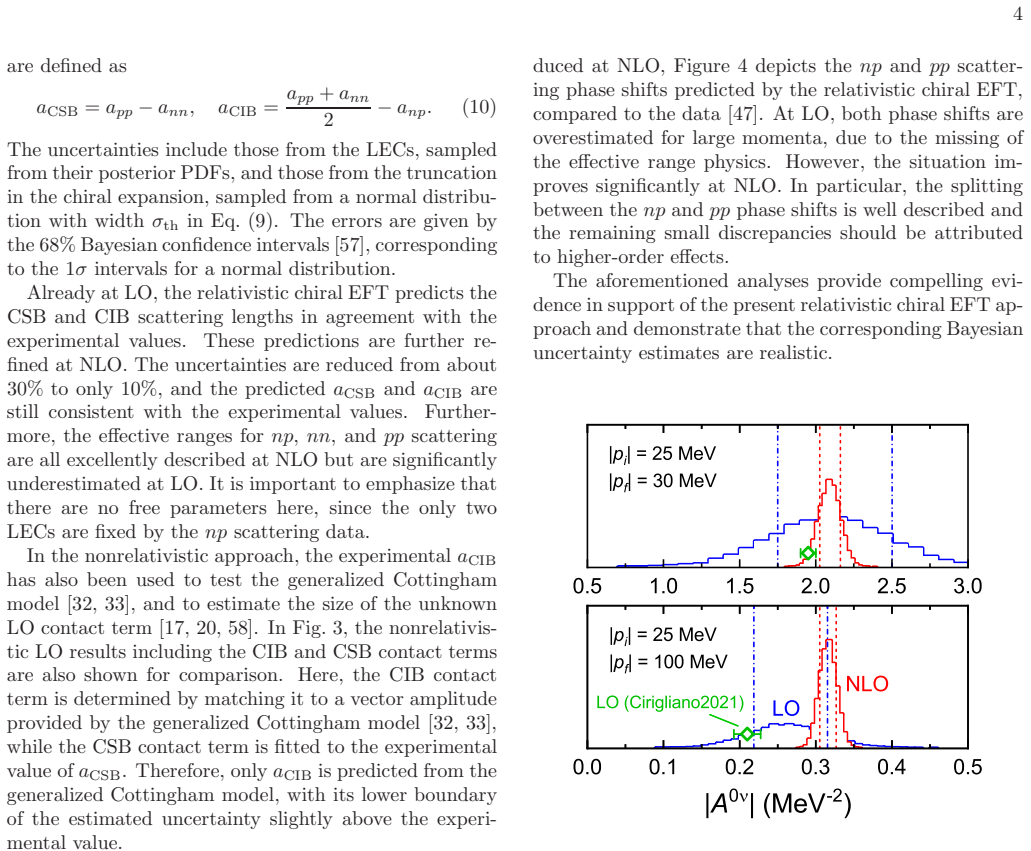
Within the standard picture of long-range Majorana-neutrino exchange, the authors derive the NLO amplitude from the renormalized couplings $C_R$ and $D_R$ together with the loop integrals $J^{1,2\text{-loop}}_{fi}$. Their central finding is that the relativistic nucleon propagator makes these integrals ultraviolet finite, converging as $O(\Lambda^{-2})$, in contrast to the logarithmic divergence that appears in nonrelativistic heavy-baryon treatments; hence no weak-sector counterterm is needed up to NLO. The two low-energy constants are determined from $np$ scattering data through a Bayesian posterior, and the maximum-likelihood prediction is $|A^{0\nu}|=0.0209(7)\ \mathrm{MeV}^{-2}$ at $|p_i|=25$ MeV and $|p_f|=30$ MeV. This is roughly 7% larger than the previous nonrelativistic LO estimate from the generalized Cottingham model at the same kinematics, and about 50% larger at 100 MeV, where the NLO correction is naturally more significant.
Load-bearing premise
The load-bearing premise is that the neutrino-exchange loop integrals in the relativistic framework are ultraviolet finite, converging as $O(\Lambda^{-2})$, so that no unknown contact term appears at NLO; the paper defers the details of that convergence argument to the Supplemental Material, and if a counterterm were actually required, an undetermined low-energy constant would enter and the parameter-free prediction would fail.
Editorial extensions
If this is right
- The NLO amplitude gives nuclear-matrix-element calculations a parameter-free anchor for the short-range contact operator, replacing model-based inputs with an EFT value whose uncertainty carries a statistical meaning.
- Because the only free inputs are two $NN$ low-energy constants, improved $np$ scattering data directly tighten the posterior and reduce the quoted amplitude uncertainty.
- The NLO corrections grow with momentum, differing from the previous nonrelativistic LO result by about 10% at 30 MeV and about 50% at 100 MeV, so the short-range piece of nuclear matrix elements should be evaluated at NLO rather than LO.
- The parameter-free reproduction of charge-independence and charge-symmetry breaking in $NN$ scattering supports the framework's use for the weak amplitude and its uncertainty estimate.
Reading between the lines
- If the ultraviolet-finiteness claim survives closer scrutiny, the same relativistic machinery should extend to other two-body electroweak amplitudes where nonrelativistic EFT needs counterterms, making the NLO amplitude a template for lepton-number-violating processes more generally.
- The growing gap between the relativistic NLO and nonrelativistic LO amplitudes at higher momenta suggests that nuclear-structure calculations using the older amplitude may systematically underestimate the short-range contribution; recomputing matrix elements with the new amplitude would test this.
- A direct extension would be to apply the same Bayesian analysis to $pp$ and $nn$ scattering data at higher energies, which would sharpen the truncation-error estimate and check whether the 68% band stays realistic.
Editorial analysis
A structured set of objections, weighed in public.
Referee Report
Summary. The authors report a next-to-leading-order (NLO) prediction for the elementary neutrinoless double-beta decay subprocess nn -> ppee, computed in a relativistic chiral EFT. The two strong-sector low-energy constants C_R and D_R are fitted to low-energy np scattering data, with uncertainties quantified by a Bayesian analysis, and the same constants are then used to predict the nn -> ppee amplitude. The central result is |A0nu| = 0.0209(7) MeV^-2 at |p_i| = 25 MeV and |p_f| = 30 MeV. The paper argues that no unknown weak-sector contact term is needed up to NLO because the neutrino-exchange loop integrals J^{1,2-loop}_{fi} are ultraviolet finite, in contrast to the nonrelativistic heavy-baryon framework. The approach is validated by comparing the predicted CIB and CSB contributions in NN scattering with experiment.
Significance. If the central finiteness claim is correct, this is an important step: it would provide the first NLO EFT prediction of the nn -> ppee amplitude without a weak-sector counterterm, with a quantified Bayesian uncertainty, and it would give a direct constraint for the short-range operator in 0nubb nuclear matrix element calculations. The calculation is not circular, since the target amplitude is not used in the fit; the LECs come from np scattering data, and the CIB/CSB comparison is a genuine external check. The paper makes a specific, falsifiable prediction. The main risk is not internal inconsistency but the reliance of the 'no contact term' claim on a convergence statement that is deferred to a self-cited reference and to an unavailable supplemental file.
major comments (2)
- [Relativistic chiral EFT for 0νββ at NLO (after Eq. (7))] The no-unknown-contact-term claim is the load-bearing result of the Letter, and it rests on the finiteness of J^{1,2-loop}_{fi} in Eq. (5). The manuscript asserts, after Eq. (7), that 'Following the renormalization analysis in Ref. [34], one finds J^{1,2-loop}_{fi} are convergent as O(Λ^-2)', and it defers details to the Supplemental Material [43]. Neither the integrands nor the regularization procedure are shown in the main text, the placeholder '[URL]' in Ref. [43] means the supplement is not available in the current submission, and the cited Ref. [34] is the authors' own previous work. This is not merely a presentation issue: if one of the two J loops has a logarithmic or power divergence, or if its finite part is regulator-dependent, an unknown weak-sector contact term enters at NLO, and Eq. (11) would no longer be a parameter-free prediction. I ask the authors to supply the explicit derivation of the loop ultraviolet behavior and a cutoff-convergence check, or at least a complete and accessible supplemental derivation, before the claim can be independently checked.
- [Validation] The validation in the 'Validation' section is useful but does not close the gap identified above. The CIB/CSB comparison tests one-photon exchange iterated in the NN scattering equation, which has a different ultraviolet structure from the neutrino-exchange loops in Fig. 1(a); it does not test the second-order insertions of Vν with the axial-current structure of Eq. (4). The statement that the nn and pp phase shifts are cutoff-independent is asserted without a cutoff-dependence plot. I recommend either adding such a plot for the J loops or explicitly limiting the validation claim to the strong sector.
minor comments (4)
- [Summary (Eq. (11))] The units of the quoted amplitude are inconsistent in the comparison with the previous model estimate: Eq. (11) gives MeV^-2 while the following paragraph quotes the previous value in MeV. Please correct this and also support the claim that the present result is 'by far the most accurate' given that the quoted Bayesian uncertainty is numerically comparable to the earlier model estimate.
- [Bayesian uncertainty quantification] Please report the explicit prior covariance for (C_R, D_R), the treatment of correlations among the np scattering data, and the Metropolis-Hastings acceptance rate and effective sample size for the 10^4 samples. The phrase 'mildly encodes the expected scaling' is not sufficient for reproducibility.
- [NLO predictions for nn → ppee (Fig. 5)] For the nonrelativistic generalized-Cottingham result shown as empty diamonds, please state explicitly whether the error bars are 68% intervals and which model inputs are varied in producing them.
- [References] Ref. [43] currently appears as 'Supplemental Material at [URL]'. This placeholder must be replaced with the actual link before publication; in the present submission the supplemental material is not accessible.
Circularity Check
No significant circularity: the nn→ppee amplitude is not used in the fit; CR and DR are determined from np scattering data and then used to predict the 0νββ amplitude, so the central prediction is not a fitted input renamed as a prediction.
full rationale
The central prediction |A0ν| = 0.0209(7) MeV^-2 at |pi| = 25 MeV, |pf| = 30 MeV is obtained by inserting renormalized LECs CR and DR, fitted to np scattering length and σ_np data, into the NLO amplitude formula of Eq. (5). The target 0νββ amplitude is not used in the likelihood or in the LEC determination, so the result is not statistically forced by construction. The CIB/CSB validation is likewise parameter-free: the same LECs are used to compute nn and pp phase shifts, with only the neutral pion mass and Coulomb potential changed, and charge-dependent contact terms are argued to appear only at higher orders. The remaining load-bearing premise, that the loop integrals J^{1,2-loop}_fi are ultraviolet finite and convergent as O(Λ^-2), is asserted by reference to the authors' earlier Ref. [34] and deferred to the Supplemental Material; this is a self-citation and a verifiability gap in the preprint, since the finiteness claim is what makes the result parameter-free. However, no equation in the paper exhibits the target amplitude entering the fit, and the self-citation is a technical support rather than a circular reduction of the NLO prediction to its own input. A missing independent proof is a correctness or verifiability concern, not evidence that the derivation is circular. Therefore no circular step is identified, and the appropriate score is near zero; the value 1 reflects the load-bearing self-citation rather than any constructed equivalence.
Assumptions & free parameters
free parameters (2)
- CR (renormalized LO 1S0 contact coupling) =
Not quoted in Letter; fitted to np scattering data
- DR (renormalized NLO momentum-dependent contact coupling) =
Not quoted in Letter; fitted to np scattering data
assumptions (6)
- domain assumption The relativistic scattering equation (Eq. 2) with time-ordered perturbation theory (no nonrelativistic reduction) is a correct three-dimensional reduction for NN scattering.
- domain assumption The 1S0 chiral potential (Eq. 3) with LO contact C, pion exchange, NLO δC and D terms is the correct strong potential through NLO.
- domain assumption The neutrino potential Vν(q) (Eq. 4) has no unknown LECs up to NLO.
- ad hoc to paper The loop integrals J^{1,2-loop}_fi are UV finite and converge as O(Λ^-2), so no counterterm is needed.
- domain assumption The Bayesian truncation error (Eq. 9) with σ_th = (Q/Λχ)^{2(ν+1)}/(1-(Q/Λχ)^2) correctly represents omitted higher orders.
- domain assumption The LECs CR and DR are natural, as encoded by a mildly constraining Gaussian prior.
Cite this review
Pith. "Pith review of Next-to-leading-order prediction for the neutrinoless double-beta decay." pith.science (2026). https://pith.science/paper/O3SYG7LI
@misc{pith2026250524121,
  author       = {Pith},
  title        = {Pith review of: Next-to-leading-order prediction for the neutrinoless double-beta decay},
  year         = {2026},
  howpublished = {\url{https://pith.science/paper/O3SYG7LI}},
  note         = {Machine review of arXiv:2505.24121}
}
abstract
The neutrinoless double-beta decay ($0\nu\beta\beta$) of two neutrons$nn \rightarrow ppee$ is the elementary subprocess of $0\nu\beta\beta$ decay in nuclei. Accurate knowledge of the $nn \rightarrow ppee$ amplitude is required to pin down the short-range contributions in the nuclear matrix elements of the candidate nuclei for large-scale $0\nu\beta\beta$ searches. In this Letter, we report the first next-to-leading-order prediction of the nn \rightarrow ppee amplitude, with Bayesian uncertainty quantification. This is made possible by the development of the relativistic chiral effective field theory, in which no unknown contact term is required up to next-to-leading order. The theory is validated by reproducing in a parameter-free way the available data on the charge independence and charge symmetry breaking contributions in the two-nucleon scattering. The present work makes an essential step towards addressing the uncertainty in the theoretical calculations of the nuclear matrix elements relevant for $0\nu\beta\beta$ searches.
Figures


Figures from the paper (2 more)

Reference graph
Works this paper leans on
- [34]
-
[43]
See Supplemental Material at [URL] for details on the derivation of the next-to-leading-order nn → ppee am- plitudes
-
[1]
C. E. Aalseth et al. (Majorana Collaboration), Phys. Rev. Lett. 120, 132502 (2018)
work page 2018
-
[2]
D. Q. Adams et al. (CUORE Collaboration), Phys. Rev. Lett. 124, 122501 (2020)
work page 2020
-
[3]
Agostini et al
M. Agostini et al. (GERDA Collaboration), Phys. Rev. Lett. 125, 252502 (2020)
2020
-
[4]
J. B. Albert et al. (EXO-200 Collaboration), Phys. Rev. Lett. 120, 072701 (2018)
work page 2018
-
[5]
E. Armengaud et al. (CUPID-Mo Collaboration), Phys. Rev. Lett. 126, 181802 (2021)
work page 2021
-
[6]
R. Arnold et al. (NEMO-3 Collaboration), Phys. Rev. Lett. 119, 041801 (2017)
work page 2017
Show all 61 references
-
[7]
Gando et al
A. Gando et al. (KamLAND-Zen Collaboration), Phys. Rev. Lett. 117, 082503 (2016)
2016
-
[8]
W. H. Dai et al. (CDEX Collaboration), Phys. Rev. D 106, 032012 (2022)
2022
-
[9]
Schechter and J
J. Schechter and J. W. F. Valle, Phys. Rev. D 25, 2951 (1982)
1982
-
[10]
Y. B. Zel’dovich and M. Y. Khlopov, JETP Lett. 34, 141 (1981)
1981
-
[11]
F. T. Avignone, S. R. Elliott, and J. Engel, Rev. Mod. Phys. 80, 481 (2008)
2008
-
[12]
Davidson, E
S. Davidson, E. Nardi, and Y. Nir, Phys. Rep. 466, 105 (2008)
2008
-
[13]
Weinberg, Phys
S. Weinberg, Phys. Rev. Lett. 43, 1566 (1979)
1979
-
[14]
Engel and J
J. Engel and J. Men´ endez, Rep. Prog. Phys. 80, 046301 (2017)
2017
-
[15]
J. Yao, J. Meng, Y. Niu, and P. Ring, Prog. Part. Nucl. Phys. 126, 103965 (2022)
2022
-
[16]
Agostini, G
M. Agostini, G. Benato, J. A. Detwiler, J. Men´ endez, and F. Vissani, Rev. Mod. Phys. 95, 025002 (2023)
2023
-
[17]
Cirigliano, W
V. Cirigliano, W. Dekens, J. de Vries, M. L. Graesser, E. Mereghetti, S. Pastore, and U. van Kolck, Phys. Rev. Lett. 120, 202001 (2018)
2018
-
[18]
Cirigliano, W
V. Cirigliano, W. Dekens, J. de Vries, M. L. Graesser, E. Mereghetti, S. Pastore, M. Piarulli, U. van Kolck, and R. B. Wiringa, Phys. Rev. C 100, 055504 (2019)
2019
-
[19]
Wirth, J
R. Wirth, J. M. Yao, and H. Hergert, Phys. Rev. Lett. 127, 242502 (2021)
2021
-
[20]
Jokiniemi, P
L. Jokiniemi, P. Soriano, and J. Men´ endez, Phys. Lett. B 823, 136720 (2021)
2021
-
[21]
Belley, J
A. Belley, J. M. Yao, B. Bally, J. Pitcher, J. Engel, H. Hergert, J. D. Holt, T. Miyagi, T. R. Rodr ´ ıguez, A. M. Romero, S. R. Stroberg, and X. Zhang, Phys. Rev. Lett. 132, 182502 (2024)
2024
-
[22]
Cirigliano, W
V. Cirigliano, W. Detmold, A. Nicholson, and P. Shana- han, Prog. Part. Nucl. Phys. 112, 103771 (2020)
2020
-
[23]
Drischler, W
C. Drischler, W. Haxton, K. McElvain, E. Mereghetti, A. Nicholson, P. Vranas, and A. Walker-Loud, Prog. Part. Nucl. Phys. 121, 103888 (2021)
2021
-
[24]
Davoudi, W
Z. Davoudi, W. Detmold, P. Shanahan, K. Orginos, A. P. no, M. J. Savage, and M. L. Wagman, Phys. Rep. 900, 1 (2021), nuclear matrix elements from lattice QCD for electroweak and beyond–Standard- Model processes
2021
-
[25]
Feng, L.-C
X. Feng, L.-C. Jin, X.-Y. Tuo, and S.-C. Xia, Phys. Rev. Lett. 122, 022001 (2019)
2019
-
[26]
X.-Y. Tuo, X. Feng, and L.-C. Jin, Phys. Rev. D 100, 094511 (2019)
2019
- [27]
-
[28]
Nicholson, E
A. Nicholson, E. Berkowitz, H. Monge-Camacho, D. Brantley, N. Garron, C. C. Chang, E. Rinaldi, M. A. Clark, B. Jo´ o, T. Kurth, B. C. Tiburzi, P. Vranas, and A. Walker-Loud, Phys. Rev. Lett. 121, 172501 (2018)
2018
-
[29]
P. E. Shanahan, B. C. Tiburzi, M. L. Wagman, F. Winter, E. Chang, Z. Davoudi, W. Detmold, K. Orginos, and M. J. Savage (NPLQCD Collaboration), Phys. Rev. Lett. 119, 062003 (2017)
2017
-
[30]
B. C. Tiburzi, M. L. Wagman, F. Winter, E. Chang, Z. Davoudi, W. Detmold, K. Orginos, M. J. Sav- age, and P. E. Shanahan (NPLQCD Collaboration), Phys. Rev. D 96, 054505 (2017)
2017
-
[31]
Davoudi, W
Z. Davoudi, W. Detmold, Z. Fu, A. V. Grebe, W. Jay, D. Murphy, P. Oare, P. E. Shana- han, and M. L. Wagman (NPLQCD Collaboration), Phys. Rev. D 109, 114514 (2024)
2024
-
[32]
Cirigliano, W
V. Cirigliano, W. Dekens, J. de Vries, M. Hoferichter, and E. Mereghetti, Phys. Rev. Lett. 126, 172002 (2021)
2021
-
[33]
Cirigliano, W
V. Cirigliano, W. Dekens, J. de Vries, M. Hoferichter, and E. Mereghetti, J. High Energy Phys. 2021, 289 (2021)
2021
-
[35]
Weinberg, Phys
S. Weinberg, Phys. Lett. B 251, 288 (1990)
1990
-
[36]
Long and C.-J
B. Long and C.-J. Yang, Phys. Rev. C 86, 024001 (2012)
2012
-
[37]
Kadyshevsky, Nucl
V. Kadyshevsky, Nucl. Phys. B 6, 125 (1968)
1968
-
[38]
Woloshyn and A
R. Woloshyn and A. Jackson, Nucl. Phys. B 64, 269 (1973)
1973
-
[39]
Epelbaum and J
E. Epelbaum and J. Gegelia, Phys. Lett. B 716, 338 (2012)
2012
-
[40]
van Kolck, Nucl
U. van Kolck, Nucl. Phys. A 645, 273 (1999)
1999
-
[41]
Beane, T
S. Beane, T. Cohen, and D. Phillips, Nucl. Phys. A 632, 445 (1998)
1998
-
[42]
Cirigliano, W
V. Cirigliano, W. Dekens, E. Mereghetti, and A. Walker- Loud, Phys. Rev. C 97, 065501 (2018)
2018
-
[44]
D. B. Kaplan, M. J. Savage, and M. B. Wise, Nucl. Phys. B 478, 629 (1996)
1996
-
[45]
Epelbaum, J
E. Epelbaum, J. Gegelia, U.-G. Meißner, and D.-L. Yao, Eur. Phys. J. A 53, 98 (2017)
2017
-
[46]
Yang and P
Y. Yang and P. Zhao, Phys. Lett. B 835, 137587 (2022)
2022
-
[47]
V. G. J. Stoks, R. A. M. Klomp, M. C. M. Rentmeester, and J. J. de Swart, Phys. Rev. C 48, 792 (1993)
1993
-
[48]
R. J. Furnstahl, N. Klco, D. R. Phillips, and S. Wesolowski, Phys. Rev. C 92, 024005 (2015)
2015
-
[49]
J. A. Melendez, S. Wesolowski, and R. J. Furnstahl, Phys. Rev. C 96, 024003 (2017)
2017
-
[50]
Wesolowski, R
S. Wesolowski, R. J. Furnstahl, J. A. Melendez, and D. R. Phillips, J. Phys. G 46, 045102 (2019)
2019
-
[51]
Metropolis, A
N. Metropolis, A. W. Rosenbluth, M. N. Rosenbluth, A. H. Teller, and E. Teller, J. Chem. Phys. 21, 1087 (1953), https://doi.org/10.1063/1.1699114
1953 doi
-
[52]
W. K. Hastings, Biometrika 57, 97 (1970), https://academic.oup.com/biomet/article-pdf/57/1/97/23940249/57-1-97
1970
-
[53]
Epelbaum, H.-W
E. Epelbaum, H.-W. Hammer, and U.-G. Meißner, Rev. Mod. Phys. 81, 1773 (2009)
2009
-
[54]
Q. Chen, C. R. Howell, T. S. Carman, W. R. Gibbs, B. F. Gibson, A. Hussein, M. R. Kiser, G. Mertens, C. F. Moore, C. Morris, A. Obst, E. Pasyuk, C. D. Roper, F. Salinas, H. R. Setze, I. Slaus, S. Sterbenz, W. Tornow, R. L. Walter, C. R. Whiteley, and M. Whit- ton, Phys. Rev. C...
2008
-
[55]
Machleidt, Phys
R. Machleidt, Phys. Rev. C 63, 024001 (2001)
2001
-
[56]
Miller, B
G. Miller, B. Nefkens, and I. ˇSlaus, Phys. Rep. 194, 1 (1990)
1990
-
[57]
Here, we adopt the highest pos - terior density definition, which is the shortest interval that contains 68% of the total probability [61]
These are also called credibility, credible intervals , or degree-of-belief intervals. Here, we adopt the highest pos - terior density definition, which is the shortest interval that contains 68% of the total probability [61]
-
[58]
T. R. Richardson, M. R. Schindler, S. Pastore, and R. P. Springer, Phys. Rev. C 103, 055501 (2021)
2021
-
[59]
Van Goffrier, Phys
G. Van Goffrier, Phys. Rev. D 111, 055033 (2025)
2025
-
[60]
Y. L. Yang and P. W. Zhao, Phys. Rev. D 111, 014507 (2025)
2025
-
[61]
Gelman, J
A. Gelman, J. Carlin, H. Stern, D. Dunson, A. Ve- htari, and D. Rubin, Bayesian Data Analysis, Third Edi- tion , Chapman & Hall/CRC Texts in Statistical Science (Talyor & Francis, Broca Raton, FL, 2013)
2013
Reviewed August 7, 2026 · model on record in the stance chip above.
Discussion (0). Continue with ORCID to comment.