REVIEW 2 major objections 4 minor 76 references
Fine-grained action intelligence—knowing the how and why of physical tasks—is foundational for embodied agents, yet current multimodal models are poor at it.
Reviewed by Pith at T0; open to challenge. T0 means a machine referee read the full paper against a public rubric. the ladder, T0–T4 →
T0 review · deepseek-v4-flash
2026-08-03 20:39 UTC pith:O5PDEUTS
load-bearing objection Useful benchmark, overclaimed transfer: the four-tier CFG-Bench is worth engaging, but the SFT gains need a control condition before they support a 'foundational knowledge' story. the 2 major comments →
Beyond Description: Cognitively Benchmarking Fine-Grained Action for Embodied Agents
The pith
A machine-rendered reading of the paper's core claim, the machinery that carries it, and where it could break.
Core claim
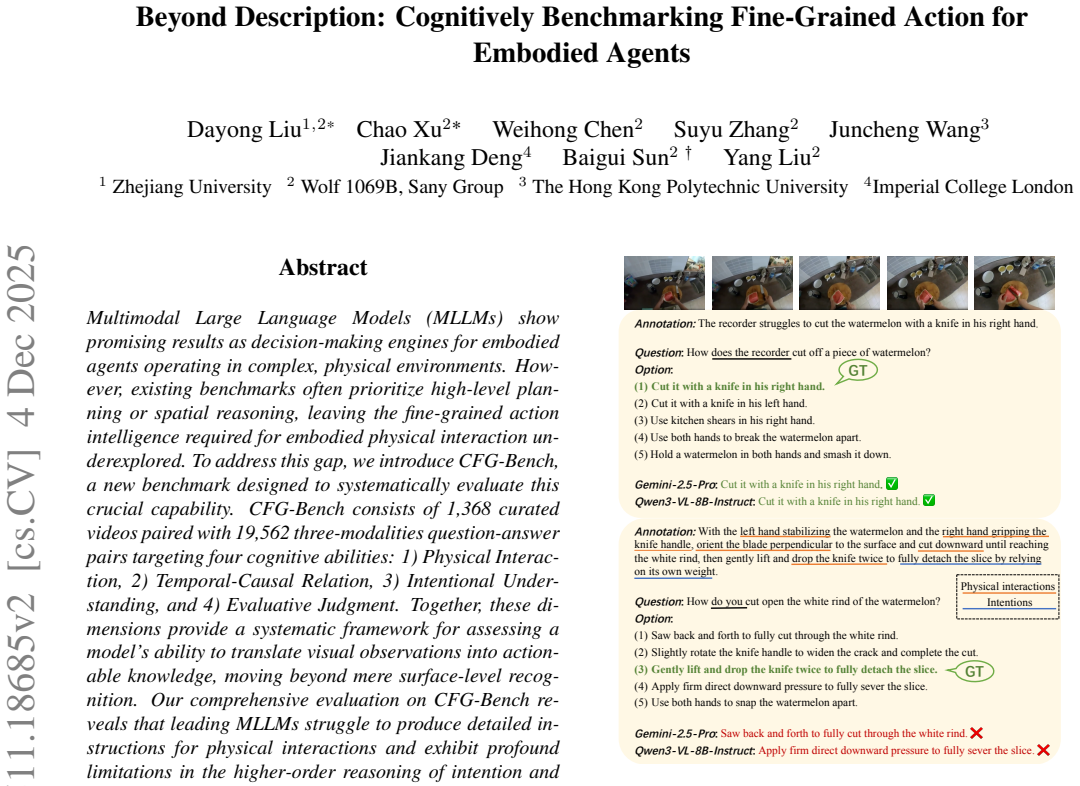
The central claim of the paper is that fine-grained action intelligence—precise knowledge of the physical how and cognitive why of an action—is a foundational capability for embodied agents, distinct from both high-level planning and low-level control. To make this tangible, the authors construct CFG-Bench, a benchmark whose 19,562 question-answer pairs are organized into four cognitive tiers: Physical Interaction (how an action is executed), Temporal-Causal Relation (how actions connect in time and cause), Intentional Understanding (why an action is performed), and Evaluative Judgment (how well it was done). The design deliberately uses open-ended questions and counterfactual scenarios for
What carries the argument
The central object is CFG-Bench: a benchmark built on a four-tier cognitive taxonomy—Physical Interaction, Temporal-Causal Relation, Intentional Understanding, and Evaluative Judgment—instantiated as 19,562 QA pairs over 1,368 curated ego- and exo-centric videos. Three design devices carry the argument. First, a hybrid QA format: closed-ended multiple-choice for factual tiers, open-ended for reasoning-heavy tiers, so that models cannot backward-reason from the options. Second, open-ended counterfactual questions in every tier, scored only if the model first rejects the question's false premise via a strict gating mechanism; this directly penalizes the common failure mode of acquiescing to an
Load-bearing premise
The claim that CFG-Bench knowledge is what improves downstream performance rests on comparing a fine-tuned model only with its base, without a matched control dataset; if the gains come from generic instruction-following or verbosity instead of fine-grained action knowledge, the paper's headline transfer result would not be conclusive.
What would settle it
Fine-tune the same base model on a control dataset matched for size, format, and verbosity but containing generic video descriptions or common-sense captions. If the control model matches the gains on EB-ALFRED and EB-Manipulation, the claim that fine-grained action knowledge is the causal ingredient would be falsified.
If this is right
- If fine-grained action intelligence is foundational, embodied-agent benchmarks and training should include detailed how-and-why action knowledge, not just high-level planning and spatial reasoning.
- SFT on CFG-Bench data should transfer to downstream embodied planning and control tasks; the paper reports gains on EB-ALFRED and EB-Manipulation.
- Models that fail the counterfactual gating on CFG-Bench are likely to accept false premises and hallucinate in real interactions, making the benchmark's failure mode a useful diagnostic for trustworthiness.
- The four-tier taxonomy links failures to specific bottlenecks: weak visual grounding and temporal reasoning (Tiers 1–2), poor goal synthesis (Tier 3), and lack of unguided critique (Tier 4) explain why current robots require human intervention.
- Open-ended formats are necessary for evaluating higher-order action reasoning; multiple-choice formats overestimate capability, as shown by the QA-format analysis.
Where Pith is reading between the lines
- A natural control experiment would fine-tune the same base model on a same-scale dataset of generic, non-action-specific video descriptions; if gains on EB-ALFRED and EB-Manipulation persist, the paper's attribution of transfer to fine-grained action knowledge would be weakened.
- The gating mechanism and four-tier taxonomy could be ported to other video-QA domains (e.g., surgical, industrial, or sports video) as a general recipe for forcing visual grounding over textual heuristics.
- The finding that fine-tuning on action knowledge yields larger gains than increasing model size hints that data composition, not scale alone, is the bottleneck for embodied understanding—a conclusion the paper gestures at but does not fully develop.
Editorial analysis
A structured set of objections, weighed in public.
Referee Report
Summary. The paper introduces CFG-Bench, a benchmark of 1,368 videos and 19,562 QA pairs designed to evaluate fine-grained action intelligence for embodied agents through four cognitive tiers: Physical Interaction, Temporal-Causal Relation, Intentional Understanding, and Evaluative Judgment. The benchmark combines close-ended multiple-choice questions for low-level factual tasks and open-ended questions with counterfactual variants for higher-order reasoning. The construction pipeline is human-in-the-loop: GPT-4o produces draft annotations and QA pairs, blind/single-frame filtering removes trivial items, and human annotators refine and verify the final set. The authors report high inter-annotator agreement on a 1,000-item subset (Krippendorff's alpha = 0.95 close-ended, 0.82/0.84 open-ended) and a human baseline of 95.85% close-ended accuracy and 9.05/10 open-ended score. They evaluate a range of proprietary and open-source MLLMs, finding substantial gaps, especially on counterfactual and higher-order reasoning tasks. Finally, they fine-tune Qwen2.5-VL-7B on CFG-Bench data and report performance gains on the EB-ALFRED and EB-Manipulation benchmarks, which they interpret as evidence that fine-grained action knowledge is a foundational capability for embodied agents.
Significance. If the benchmark and transfer claims hold, CFG-Bench would be a valuable resource for the embodied AI community. Its strengths are the carefully described dataset construction pipeline, the explicit four-tier cognitive taxonomy, the inclusion of open-ended counterfactual questions, and the reported human evaluation with high inter-annotator agreement. The paper also provides detailed prompt templates and examples in the appendix, which support reproducibility. The main scientific contribution—a benchmark that goes beyond coarse action description to probe physical, causal, intentional, and evaluative understanding—is timely and potentially useful for both benchmarking and fine-tuning embodied agents. However, the central transfer claim is currently under-supported by the experimental design, as detailed below.
major comments (2)
- [§4.4, Table 4] The transfer experiment compares only the base Qwen2.5-VL-7B against the same model after SFT on CFG-Bench data. This design cannot attribute the observed gains to fine-grained action knowledge specifically; SFT on any large, detailed, video-grounded QA corpus could improve downstream scores through better instruction following, fewer refusals, or longer/more explicit outputs, especially for EB-Manipulation where output detail may be scored more favorably. There is no control SFT on a matched dataset of the same scale, video source, answer format, and length without fine-grained cognitive annotations, no multiple seeds or error bars, and no analysis separating response-length/verbosity effects from knowledge effects. Since §4.4 and §5 describe this result as 'foundational' and 'prove' the capability transfer, the missing control is load-bearing. Please add a matched control SFT or ablati
- [§3.3, Appendix B4] All open-ended scores are produced by a GPT-assisted judge (Deepseek-R1) using a rubric against captions that were initially GPT-4o-drafted and human-refined. The paper reports human inter-annotator agreement on the ground-truth answers, but does not report agreement between the LLM judge and human scoring on the same 1,000-item sample. Since the central evidence for 'profound limitations' in intentional and evaluative reasoning rests entirely on open-ended scores, judge bias or insensitivity to the rubric could change the conclusions. Please compute judge–human agreement/correlation on the human baseline responses, and ideally run the judge multiple times to quantify its stability.
minor comments (4)
- [Appendix B2] The statement that models 'score lower on the seemingly easy perceptual tasks of Tiers 1 and 2 than on the more abstract reasoning of Tiers 3 and 4' compares close-ended accuracy (0-100) with open-ended scores (0-10). These are different metrics, so the comparison is not directly meaningful. Please re-frame as within-format comparisons or calibrate the scales if this point is to be made.
- [Abstract and §3.1] The abstract mentions 'three evaluation paradigms' but the main text only clearly distinguishes close-ended, open-ended, and counterfactual variants. Please define the three paradigms explicitly at first use.
- [Table 1] The caption says '✓ indicates partial coverage' but the table uses both ✓ and ✗; this is confusing. Should the legend read '✓ indicates coverage, ✗ indicates no coverage'?
- [Throughout] Minor typos: 'planing' should be 'planning' (Introduction and Table 1), 'long-horizontal' should be 'long-horizon', and 'FA VOR-Bench' is inconsistently spaced. Also, 'Qwen3-Max' is mentioned in §3.2.2 but not listed in the evaluated models in §4.1.
Circularity Check
No significant circularity: the benchmark evaluation and downstream transfer are empirical and externally grounded.
full rationale
The paper's derivation chain is a benchmark construction plus an empirical evaluation, not a mathematical derivation whose outputs are equivalent to its inputs. The QA ground truth is produced by a human-AI pipeline (GPT-4o drafts, manual refinement, double verification, inter-annotator agreement) and evaluated with a GPT-assisted protocol against those human-refined captions; this is a standard measurement setup, and scoring a model against reference answers is not a reduction of a prediction to a fitted parameter. The central transfer claim is tested on external EMBODIEDBENCH tasks with independent metrics (EB-ALFRED and EB-Manipulation, Tab. 4), and the improvement after SFT on CFG data is an empirical result rather than a quantity defined by construction. The absence of a matched control SFT dataset makes the causal attribution to fine-grained action knowledge underdetermined, and the paper's language claiming to 'prove' these capabilities are foundational is stronger than the evidence supports, but this is an experimental-design/over-claiming concern, not circularity. No load-bearing self-citation is present: the only overlapping-author citation (EgoThink [5] for egocentric perception) is peripheral, and key methodological references such as FAVOR-Bench [37] and EMBODIEDBENCH [41] are external. Appendix E1 states ordinary limitations but does not assert a circular step. Therefore no specific circular step can be quoted, and the score is 0.
Axiom & Free-Parameter Ledger
axioms (4)
- domain assumption GPT-4o-generated annotations and QA pairs, after human refinement and cross-verification, constitute accurate ground truth for fine-grained action understanding.
- domain assumption The GPT-assisted evaluation (Deepseek-R1) reliably scores correctness and detailedness of open-ended answers, as validated by the human baseline on 500 open-ended samples.
- ad hoc to paper The four-tier cognitive taxonomy (Physical Interaction, Temporal-Causal, Intention, Evaluation) is a valid decomposition of fine-grained action intelligence for embodied agents.
- domain assumption The five source datasets (EgoTaskQA, Charades-Ego, EgoExo4d, Something-Something-V2, FineAction) are sufficiently representative of embodied fine-grained actions to support general conclusions about MLLM limitations.
read the original abstract
Multimodal Large Language Models (MLLMs) show promising results as decision-making engines for embodied agents operating in complex, physical environments. However, existing benchmarks often prioritize high-level planning or spatial reasoning, leaving the fine-grained action intelligence required for embodied physical interaction underexplored. To address this gap, we introduce CFG-Bench, a new benchmark designed to systematically evaluate this crucial capability. CFG-Bench consists of 1,368 curated videos paired with 19,562 question-answer pairs spanning three evaluation paradigms targeting four cognitive abilities: 1) Physical Interaction, 2) Temporal-Causal Relation, 3) Intentional Understanding, and 4) Evaluative Judgment. Together, these dimensions provide a systematic framework for assessing a model's ability to translate visual observations into actionable knowledge, moving beyond mere surface-level recognition. Our comprehensive evaluation on CFG-Bench reveals that leading MLLMs struggle to produce detailed instructions for physical interactions and exhibit profound limitations in the higher-order reasoning of intention and evaluation. Moreover, supervised fine-tuning (SFT) on our data demonstrates that teaching an MLLMs to articulate fine-grained actions directly translates to significant performance gains on established embodied benchmarks. Our analysis highlights these limitations and offers insights for developing more capable and grounded embodied agents. Project page: https://cfg-bench.github.io/
Figures


Reference graph
Works this paper leans on
-
[1]
Cosmos world foun- dation model platform for physical ai.arXiv preprint arXiv:2501.03575, 2025
Niket Agarwal, Arslan Ali, Maciej Bala, Yogesh Balaji, Erik Barker, Tiffany Cai, Prithvijit Chattopadhyay, Yongxin Chen, Yin Cui, Yifan Ding, et al. Cosmos world foun- dation model platform for physical ai.arXiv preprint arXiv:2501.03575, 2025. 6, 7
Pith/arXiv arXiv 2025
-
[2]
Qwen2.5-vl technical report.arXiv preprint arXiv:2502.13923, 2025
Shuai Bai, Keqin Chen, Xuejing Liu, Jialin Wang, Wenbin Ge, Sibo Song, Kai Dang, Peng Wang, Shijie Wang, Jun Tang, Humen Zhong, Yuanzhi Zhu, Mingkun Yang, Zhao- hai Li, Jianqiang Wan, Pengfei Wang, Wei Ding, Zheren Fu, Yiheng Xu, Jiabo Ye, Xi Zhang, Tianbao Xie, Zesen Cheng, Hang Zhang, Zhibo Yang, Haiyang Xu, and Jun- yang Lin. Qwen2.5-vl technical repor...
Pith/arXiv arXiv 2025
-
[3]
Crc Press, 2018
Stuart K Card.The psychology of human-computer interac- tion. Crc Press, 2018. 2
2018
-
[4]
Spatialvlm: Endow- ing vision-language models with spatial reasoning capabili- ties
Boyuan Chen, Zhuo Xu, Sean Kirmani, Brain Ichter, Dorsa Sadigh, Leonidas Guibas, and Fei Xia. Spatialvlm: Endow- ing vision-language models with spatial reasoning capabili- ties. InProceedings of the IEEE/CVF Conference on Com- puter Vision and Pattern Recognition, pages 14455–14465,
-
[5]
Egothink: Evalu- ating first-person perspective thinking capability of vision- language models
Sijie Cheng, Zhicheng Guo, Jingwen Wu, Kechen Fang, Peng Li, Huaping Liu, and Yang Liu. Egothink: Evalu- ating first-person perspective thinking capability of vision- language models. InProceedings of the IEEE/CVF Con- ference on Computer Vision and Pattern Recognition, pages 14291–14302, 2024. 1
2024
-
[6]
Embodiedeval: Evaluate multimodal llms as embodied agents.arXiv preprint arXiv:2501.11858, 2025
Zhili Cheng, Yuge Tu, Ran Li, Shiqi Dai, Jinyi Hu, Shengding Hu, Jiahao Li, Yang Shi, Tianyu Yu, Weize Chen, et al. Embodiedeval: Evaluate multimodal llms as embodied agents.arXiv preprint arXiv:2501.11858, 2025. 1, 2, 3
Pith/arXiv arXiv 2025
-
[7]
Gheorghe Comanici, Eric Bieber, Mike Schaekermann, Ice Pasupat, Noveen Sachdeva, Inderjit Dhillon, Marcel Blis- tein, Ori Ram, Dan Zhang, Evan Rosen, et al. Gemini 2.5: Pushing the frontier with advanced reasoning, multimodality, long context, and next generation agentic capabilities.arXiv preprint arXiv:2507.06261, 2025. 6, 7, 1, 2
Pith/arXiv arXiv 2025
-
[8]
Zichen Jeff Cui, Yibin Wang, Nur Muhammad Mahi Shafi- ullah, and Lerrel Pinto. From play to policy: Conditional be- havior generation from uncurated robot data.arXiv preprint arXiv:2210.10047, 2022. 2
Pith/arXiv arXiv 2022
-
[9]
Ecbench: Can multi-modal foundation models understand the egocentric world? a holistic embod- ied cognition benchmark
Ronghao Dang, Yuqian Yuan, Wenqi Zhang, Yifei Xin, Bo- qiang Zhang, Long Li, Liuyi Wang, Qinyang Zeng, Xin Li, and Lidong Bing. Ecbench: Can multi-modal foundation models understand the egocentric world? a holistic embod- ied cognition benchmark. InProceedings of the Computer Vision and Pattern Recognition Conference, pages 24593– 24602, 2025. 1, 2, 3
2025
-
[10]
Video-mme: The first-ever comprehensive evaluation benchmark of multi-modal llms in video analysis
Chaoyou Fu, Yuhan Dai, Yongdong Luo, Lei Li, Shuhuai Ren, Renrui Zhang, Zihan Wang, Chenyu Zhou, Yunhang Shen, Mengdan Zhang, et al. Video-mme: The first-ever comprehensive evaluation benchmark of multi-modal llms in video analysis. InProceedings of the Computer Vision and Pattern Recognition Conference, pages 24108–24118, 2025. 2, 3
2025
-
[11]
The” something something” video database for learning and evaluating visual common sense
Raghav Goyal, Samira Ebrahimi Kahou, Vincent Michal- ski, Joanna Materzynska, Susanne Westphal, Heuna Kim, Valentin Haenel, Ingo Fruend, Peter Yianilos, Moritz Mueller-Freitag, et al. The” something something” video database for learning and evaluating visual common sense. InProceedings of the IEEE international conference on com- puter vision, pages 5842...
2017
-
[12]
Ego-exo4d: Understanding skilled human activity from first-and third-person perspectives
Kristen Grauman, Andrew Westbury, Lorenzo Torresani, Kris Kitani, Jitendra Malik, Triantafyllos Afouras, Kumar Ashutosh, Vijay Baiyya, Siddhant Bansal, Bikram Boote, et al. Ego-exo4d: Understanding skilled human activity from first-and third-person perspectives. InProceedings of the IEEE/CVF Conference on Computer Vision and Pattern Recognition, pages 193...
2024
-
[13]
Daya Guo, Dejian Yang, Haowei Zhang, Junxiao Song, Ruoyu Zhang, Runxin Xu, Qihao Zhu, Shirong Ma, Peiyi Wang, Xiao Bi, et al. Deepseek-r1: Incentivizing reasoning capability in llms via reinforcement learning.arXiv preprint arXiv:2501.12948, 2025. 1
Pith/arXiv arXiv 2025
-
[14]
Multimodal fusion and vision- language models: A survey for robot vision.Information Fusion, page 103652, 2025
Xiaofeng Han, Shunpeng Chen, Zenghuang Fu, Zhe Feng, Lue Fan, Dong An, Changwei Wang, Li Guo, Weiliang Meng, Xiaopeng Zhang, et al. Multimodal fusion and vision- language models: A survey for robot vision.Information Fusion, page 103652, 2025. 1
2025
-
[15]
Motionbench: Benchmarking and improving fine-grained video motion understanding for vision language models
Wenyi Hong, Yean Cheng, Zhuoyi Yang, Weihan Wang, Lefan Wang, Xiaotao Gu, Shiyu Huang, Yuxiao Dong, and Jie Tang. Motionbench: Benchmarking and improving fine-grained video motion understanding for vision language models. InProceedings of the Computer Vision and Pattern Recognition Conference, pages 8450–8460, 2025. 2, 3
2025
-
[16]
Aaron Hurst, Adam Lerer, Adam P Goucher, Adam Perel- man, Aditya Ramesh, Aidan Clark, AJ Ostrow, Akila Weli- hinda, Alan Hayes, Alec Radford, et al. Gpt-4o system card. arXiv preprint arXiv:2410.21276, 2024. 5
Pith/arXiv arXiv 2024
-
[17]
Robobrain: A unified brain model for robotic manipulation from abstract to concrete
Yuheng Ji, Huajie Tan, Jiayu Shi, Xiaoshuai Hao, Yuan Zhang, Hengyuan Zhang, Pengwei Wang, Mengdi Zhao, Yao Mu, Pengju An, et al. Robobrain: A unified brain model for robotic manipulation from abstract to concrete. InProceed- ings of the Computer Vision and Pattern Recognition Con- ference, pages 1724–1734, 2025. 3
2025
-
[18]
Egotaskqa: Understanding human tasks in egocentric videos
Baoxiong Jia, Ting Lei, Song-Chun Zhu, and Siyuan Huang. Egotaskqa: Understanding human tasks in egocentric videos. Advances in Neural Information Processing Systems, 35: 3343–3360, 2022. 2, 3, 5
2022
-
[19]
Rea- soning grasping via multimodal large language model.arXiv preprint arXiv:2402.06798, 2024
Shiyu Jin, Jinxuan Xu, Yutian Lei, and Liangjun Zhang. Rea- soning grasping via multimodal large language model.arXiv preprint arXiv:2402.06798, 2024. 1
Pith/arXiv arXiv 2024
-
[20]
Sage publications, 2018
Klaus Krippendorff.Content analysis: An introduction to its methodology. Sage publications, 2018. 2
2018
-
[21]
Mvbench: A comprehensive multi-modal video understand- ing benchmark
Kunchang Li, Yali Wang, Yinan He, Yizhuo Li, Yi Wang, Yi Liu, Zun Wang, Jilan Xu, Guo Chen, Ping Luo, et al. Mvbench: A comprehensive multi-modal video understand- ing benchmark. InProceedings of the IEEE/CVF Conference 9 on Computer Vision and Pattern Recognition, pages 22195– 22206, 2024. 2, 3
2024
-
[22]
Code as policies: Language model programs for embodied control
Jacky Liang, Wenlong Huang, Fei Xia, Peng Xu, Karol Hausman, Brian Ichter, Pete Florence, and Andy Zeng. Code as policies: Language model programs for embodied control. arXiv preprint arXiv:2209.07753, 2022. 1
Pith/arXiv arXiv 2022
-
[23]
Fineaction: A fine-grained video dataset for temporal action localization.IEEE transactions on image processing, 31: 6937–6950, 2022
Yi Liu, Limin Wang, Yali Wang, Xiao Ma, and Yu Qiao. Fineaction: A fine-grained video dataset for temporal action localization.IEEE transactions on image processing, 31: 6937–6950, 2022. 5
2022
-
[24]
Egoschema: A diagnostic benchmark for very long- form video language understanding.Advances in Neural In- formation Processing Systems, 36:46212–46244, 2023
Karttikeya Mangalam, Raiymbek Akshulakov, and Jitendra Malik. Egoschema: A diagnostic benchmark for very long- form video language understanding.Advances in Neural In- formation Processing Systems, 36:46212–46244, 2023. 2
2023
-
[25]
Harvard University Press, 1988
Hans Moravec.Mind children: The future of robot and hu- man intelligence. Harvard University Press, 1988. 1
1988
-
[26]
Embodiedgpt: Vision-language pre-training via embodied chain of thought.Advances in Neural Information Processing Systems, 36:25081–25094, 2023
Yao Mu, Qinglong Zhang, Mengkang Hu, Wenhai Wang, Mingyu Ding, Jun Jin, Bin Wang, Jifeng Dai, Yu Qiao, and Ping Luo. Embodiedgpt: Vision-language pre-training via embodied chain of thought.Advances in Neural Information Processing Systems, 36:25081–25094, 2023. 3
2023
-
[27]
Gpt-5 system card
OpenAI. Gpt-5 system card. 2025. 6, 7
2025
-
[28]
Large vlm-based vision- language-action models for robotic manipulation: A survey
Rui Shao, Wei Li, Lingsen Zhang, Renshan Zhang, Zhiyang Liu, Ran Chen, and Liqiang Nie. Large vlm-based vision- language-action models for robotic manipulation: A survey. arXiv preprint arXiv:2508.13073, 2025. 1
Pith/arXiv arXiv 2025
-
[29]
Alfred: A benchmark for interpreting grounded instructions for everyday tasks
Mohit Shridhar, Jesse Thomason, Daniel Gordon, Yonatan Bisk, Winson Han, Roozbeh Mottaghi, Luke Zettlemoyer, and Dieter Fox. Alfred: A benchmark for interpreting grounded instructions for everyday tasks. InProceedings of the IEEE/CVF conference on computer vision and pattern recognition, pages 10740–10749, 2020. 3
2020
-
[30]
Hollywood in homes: Crowdsourcing data collection for activity under- standing
Gunnar A Sigurdsson, G ¨ul Varol, Xiaolong Wang, Ali Farhadi, Ivan Laptev, and Abhinav Gupta. Hollywood in homes: Crowdsourcing data collection for activity under- standing. InEuropean conference on computer vision, pages 510–526. Springer, 2016. 5
2016
-
[31]
Ishika Singh, Valts Blukis, Arsalan Mousavian, Ankit Goyal, Danfei Xu, Jonathan Tremblay, Dieter Fox, Jesse Thoma- son, and Animesh Garg. Progprompt: Generating situated robot task plans using large language models.arXiv preprint arXiv:2209.11302, 2022. 1
Pith/arXiv arXiv 2022
-
[32]
Llm-planner: Few-shot grounded planning for embodied agents with large language models
Chan Hee Song, Jiaman Wu, Clayton Washington, Brian M Sadler, Wei-Lun Chao, and Yu Su. Llm-planner: Few-shot grounded planning for embodied agents with large language models. InProceedings of the IEEE/CVF international con- ference on computer vision, pages 2998–3009, 2023. 1
2023
-
[33]
Behav- ior: Benchmark for everyday household activities in virtual, interactive, and ecological environments
Sanjana Srivastava, Chengshu Li, Michael Lingelbach, Roberto Mart´ın-Mart´ın, Fei Xia, Kent Elliott Vainio, Zheng Lian, Cem Gokmen, Shyamal Buch, Karen Liu, et al. Behav- ior: Benchmark for everyday household activities in virtual, interactive, and ecological environments. InConference on robot learning, pages 477–490. PMLR, 2022. 3
2022
-
[34]
Aligning large multimodal models with factually augmented rlhf
Zhiqing Sun, Sheng Shen, Shengcao Cao, Haotian Liu, Chunyuan Li, Yikang Shen, Chuang Gan, Liangyan Gui, Yu- Xiong Wang, Yiming Yang, et al. Aligning large multimodal models with factually augmented rlhf. InFindings of the As- sociation for Computational Linguistics: ACL 2024, pages 13088–13110, 2024. 2
2024
-
[35]
Robobrain 2.0 technical report.arXiv preprint arXiv:2507.02029, 2025
BAAI RoboBrain Team, Mingyu Cao, Huajie Tan, Yuheng Ji, Xiansheng Chen, Minglan Lin, Zhiyu Li, Zhou Cao, Pengwei Wang, Enshen Zhou, et al. Robobrain 2.0 technical report.arXiv preprint arXiv:2507.02029, 2025. 3, 6, 7
Pith/arXiv arXiv 2025
-
[36]
Gemma 3 technical report.arXiv preprint arXiv:2503.19786, 2025
Gemma Team, Aishwarya Kamath, Johan Ferret, Shreya Pathak, Nino Vieillard, Ramona Merhej, Sarah Perrin, Ta- tiana Matejovicova, Alexandre Ram ´e, Morgane Rivi `ere, et al. Gemma 3 technical report.arXiv preprint arXiv:2503.19786, 2025. 6, 7
Pith/arXiv arXiv 2025
-
[37]
Chongjun Tu, Lin Zhang, Pengtao Chen, Peng Ye, Xianfang Zeng, Wei Cheng, Gang Yu, and Tao Chen. Favor-bench: A comprehensive benchmark for fine-grained video motion understanding.arXiv preprint arXiv:2503.14935, 2025. 2, 3, 5, 6
Pith/arXiv arXiv 2025
-
[38]
Chen Wang, Linxi Fan, Jiankai Sun, Ruohan Zhang, Li Fei- Fei, Danfei Xu, Yuke Zhu, and Anima Anandkumar. Mim- icplay: Long-horizon imitation learning by watching human play.arXiv preprint arXiv:2302.12422, 2023. 2
Pith/arXiv arXiv 2023
-
[39]
Qwen3 technical report.arXiv preprint arXiv:2505.09388, 2025
An Yang, Anfeng Li, Baosong Yang, Beichen Zhang, Binyuan Hui, Bo Zheng, Bowen Yu, Chang Gao, Chen- gen Huang, Chenxu Lv, Chujie Zheng, Dayiheng Liu, Fan Zhou, Fei Huang, Feng Hu, Hao Ge, Haoran Wei, Huan Lin, Jialong Tang, Jian Yang, Jianhong Tu, Jianwei Zhang, Jianxin Yang, Jiaxi Yang, Jing Zhou, Jingren Zhou, Junyang Lin, Kai Dang, Keqin Bao, Kexin Yang...
Pith/arXiv arXiv 2025
-
[40]
Thinking in space: How mul- timodal large language models see, remember, and recall spaces
Jihan Yang, Shusheng Yang, Anjali W Gupta, Rilyn Han, Li Fei-Fei, and Saining Xie. Thinking in space: How mul- timodal large language models see, remember, and recall spaces. InProceedings of the Computer Vision and Pattern Recognition Conference, pages 10632–10643, 2025. 1, 2, 3
2025
-
[41]
Rui Yang, Hanyang Chen, Junyu Zhang, Mark Zhao, Cheng Qian, Kangrui Wang, Qineng Wang, Teja Venkat Koripella, Marziyeh Movahedi, Manling Li, et al. Embodiedbench: Comprehensive benchmarking multi-modal large language models for vision-driven embodied agents.arXiv preprint arXiv:2502.09560, 2025. 1, 2, 3, 8
Pith/arXiv arXiv 2025
-
[42]
Activitynet-qa: A dataset for understanding complex web videos via question answering
Zhou Yu, Dejing Xu, Jun Yu, Ting Yu, Zhou Zhao, Yuet- ing Zhuang, and Dacheng Tao. Activitynet-qa: A dataset for understanding complex web videos via question answering. InProceedings of the AAAI Conference on Artificial Intelli- gence, pages 9127–9134, 2019. 3
2019
-
[43]
Boqiang Zhang, Kehan Li, Zesen Cheng, Zhiqiang Hu, Yuqian Yuan, Guanzheng Chen, Sicong Leng, Yuming Jiang, Hang Zhang, Xin Li, et al. Videollama 3: Frontier multi- modal foundation models for image and video understand- ing.arXiv preprint arXiv:2501.13106, 2025. 1, 6, 7
Pith/arXiv arXiv 2025
-
[44]
Task-oriented sequential grounding in 3d scenes
Zhuofan Zhang, Ziyu Zhu, Pengxiang Li, Tianxu Wang, Tengyu Liu, Xiaojian Ma, Yixin Chen, Baoxiong Jia, Siyuan 10 Huang, and Qing Li. Task-oriented sequential grounding in 3d scenes. 2024. 1
2024
-
[45]
Mlvu: A comprehensive benchmark for multi- task long video understanding.arXiv e-prints, pages arXiv– 2406, 2024
Junjie Zhou, Yan Shu, Bo Zhao, Boya Wu, Shitao Xiao, Xi Yang, Yongping Xiong, Bo Zhang, Tiejun Huang, and Zheng Liu. Mlvu: A comprehensive benchmark for multi- task long video understanding.arXiv e-prints, pages arXiv– 2406, 2024. 2
2024
-
[46]
Jinguo Zhu, Weiyun Wang, Zhe Chen, Zhaoyang Liu, Shen- glong Ye, Lixin Gu, Hao Tian, Yuchen Duan, Weijie Su, Jie Shao, et al. Internvl3: Exploring advanced training and test-time recipes for open-source multimodal models.arXiv preprint arXiv:2504.10479, 2025. 1, 6, 7 11 Beyond Description: Cognitively Benchmarking Fine-Grained Action for Embodied Agents S...
Pith/arXiv arXiv 2025
-
[50]
The correct option is a minimal, faithful restatement of the caption; never invent or modify execution details that are not supported by the caption
-
[55]
• The distractors must be physically plausible and context-appropriate for the video scene
Factual Action Understanding (“FAU”) • Ask about how a specific action is executed in the video, focusing on one or more execution dimensions. • The distractors must be physically plausible and context-appropriate for the video scene
-
[56]
Counterfactual Interaction (“CIA”) • Ask about how a specific action that is incorrectly described in the question stem is actually executed in the video. • The correct option must explicitly point out that the stem’s described method is incorrect according to the video, and provide the fine-detail task that accurately matches the caption. And two distrac...
-
[60]
The correct option is a minimal, faithful restatement of the caption; never invent or modify temporal or causal details that are not supported by the caption
-
[65]
• Distractors can involve: order swap, misplaced insertion/omission or wrong simultaneity
Temporal Relation (“TR”) • Ask about the sequence or simultaneity of actions. • Distractors can involve: order swap, misplaced insertion/omission or wrong simultaneity
-
[66]
Causal Relation (“CR”) • Given an action X and ask about its effect, or given an effect Y and ask about its cause
-
[67]
Counterfactual Relationship (“CRS”) • The question stem deliberately describes an incorrect event order, and the question asks for the result of this wrong order. • The correct option must explicitly identify the error in the stem’s described order, provide the correct sequence of events, and state the true consequence/result under this correct sequence. ...
-
[71]
The correct option is a minimal, faithful restatement of the caption; try not to invent or modify the intention details that are not supported by the caption
-
[76]
Functional Intention (“FI”) • Action-level: Ask about why a specific action is performed (its purpose or intended result). • Atomic-level: Ask about why a specific action is performed in a particular way, focusing on one or more execution dimensions (agent/effector, interaction object & tool, object part, manipulation type, dynamic qualities, action di- r...
-
[77]
Global Intention (“GI”) • Focus: What is the overall purpose or goal of the protagonist’s sequence of actions?
-
[78]
Prompt template for Intentional Understanding
Counterfactual Intention (“CIT”) • Focus: If the protagonist had a different intention, how should the action execution change? Table S5. Prompt template for Intentional Understanding. 6 Prompt Template: Generating QA Pairs for Evaluative Judgment You are an expert at designing multiple-choice questions (MCQs) about evaluating the quality of execution for...
-
[79]
The question stem must address the main actor in the second person (“you”)
-
[80]
The options must describe the main actor’s behavior in the first person (“I”, “my”)
-
[81]
Each question has 5 options, with exactly 1 correct; do not prefix options with A/B/C
-
[82]
The correct option is a minimal, faithful restatement of the caption; try not to invent or modify the details that are not supported by the caption
-
[83]
The distractors must be logically reasonable but not consistent with the video content
-
[84]
caption”, “annotation
Do not mention “caption”, “annotation”, or “text”. Use phrases like “in my view” or “I see”
-
[85]
Different questions should cover different parts or phases of the video as much as possible, avoiding repetitive ques- tioning
-
[86]
[Question Types]
Questions must require temporal understanding of the video: they should not be answerable from a single static frame or from the question wording alone. [Question Types]
-
[87]
• Identify whether progress is smooth, temporarily obstructed, failed, completed, or interrupted
Process Monitoring (“PM”) • Evaluate the stage, smoothness, or blockage of task execution in relation to the global intention. • Identify whether progress is smooth, temporarily obstructed, failed, completed, or interrupted. • Questions should focus on temporal stages and transitions rather than static conditions
-
[88]
• Questions should analyze how well the chosen method fits the physical constraints, and how effectively it balances coordination and efficiency
Strategy Evaluation (“SE”) • Assess the appropriateness, efficiency, and coordination complexity of the chosen execution dimensions. • Questions should analyze how well the chosen method fits the physical constraints, and how effectively it balances coordination and efficiency
-
[89]
VideoCaption
Counterfactual Evaluation (“CEU”) • Explore how changing a specific execution detail (e.g., tool, force, direction, timing, or repetition) would alter the quality, efficiency, or success of the action. Table S6. Prompt template for Evaluative Judgment. 7 Prompt Template for Open-Ended Evaluation (1/3) You are an expert at evaluating answers to open-ended ...
-
[90]
Check whether the answer points out the error in the question and explains the correct way of execution
Counterfactual Interaction (“CIA”): The question asks how an action that did not occur would be executed. Check whether the answer points out the error in the question and explains the correct way of execution
-
[91]
Check whether the answer identifies the error and provides the correct sequence and outcome
Counterfactual Relationship (“CRS”): The question describes an incorrect temporal or causal relationship. Check whether the answer identifies the error and provides the correct sequence and outcome
-
[92]
Functional Intention (“FI”): Focus on the intention behind a specific action
-
[93]
Global Intention (“GI”): Focus on the overall purpose or goal of the protagonist’s sequence of actions
-
[94]
Counterfactual Intention (“CIT”): Focus on how execution should change if the protagonist had a different intention
-
[95]
Process Monitoring (“PM”): Focus on the stage, smoothness, or blockage of task execution in relation to the global intention
-
[96]
Strategy Evaluation (“SE”): Focus on the appropriateness, efficiency, and coordination complexity of the chosen execution strategy
-
[97]
The question describes this incorrectly because X
Counterfactual Evaluation (“CEU”): Focus on how changing a specific execution detail would alter the quality, effi- ciency, or success of the action. Phase 1: Zero-Tolerance Check (for CIA / CRS) If the TaskType is CIA or CRS, the CandidateAnswer must explicitly identify that the question stem contains a false or incorrect description. • It is not enough ...
discussion (0)
Sign in with ORCID, Apple, or X to comment. Anyone can read and Pith papers without signing in.