REVIEW 3 major objections 6 minor 63 references
Combining Pre-Trained Models for Enhanced Feature Representation in Reinforcement Learning
T0 review · 3 major / 6 minor · reviewed 2026-08-06 · deepseek-v4-flash
Pith's one-line read WSA, a learned weighted sum over frozen pre-trained visual encoders, matches or beats end-to-end trained RL agents on multiple Atari games.
desk verdict WSA is a solid empirical method paper; its Atari claim holds, but only with per-game pretrained features rather than generic prior knowledge. read the letter →
The pith
A machine-rendered reading of the paper's core claim, the machinery that carries it, and where it could break.
The reading
What carries the argument
The central object is the Weight Sharing Attention (WSA) combination module. It takes embeddings $E_i$ computed by adapters $A_i$ from each frozen pre-trained model, forms a context $C$ from a separate state encoder, and uses a single shared MLP $f_\theta(C, E_i)$ to output a weight $w_i$ for every model. The weight vector is normalized by its $\ell^1$ norm and the enriched state is $R = \sum_i w_i E_i$. Because the MLP is shared and the adapters map any encoder output to a fixed dimension, the module works with any number of models and adds few trainable parameters; its job is to decide, for each state, which frozen view of the world the policy should trust.
What would settle it
Take a game whose state visually changes as play progresses, such as Space Invaders, train all encoders only on frames from random agents, then train WSA and an end-to-end agent with the same PPO budget; if WSA's evaluation score stays close to random while the end-to-end agent scores substantially higher, the parity claim is falsified for that game, because the failure is attributable to pretraining coverage rather than to the combination module.
Extended reading notes
Core claim
The paper's central discovery is that combined frozen features can carry the representational load of an RL agent. With WSA, each pre-trained model's output passes through a small trainable adapter to a common embedding space; a shared MLP takes the current state encoding $C$ and each embedding $E_i$ and predicts a weight $w_i$; the weights are L1-normalized and the final representation is $R = \sum_i w_i E_i$. On Pong and Ms. Pacman this representation matches or beats the end-to-end baseline, and on an extended nine-game evaluation WSA exceeds the end-to-end score on five games and is statistically comparable on Breakout. The paper also shows the weights are interpretable and adapt as the game changes, that WSA resists color and behavior modifications better than end-to-end nets, and that encoders can be inserted or removed mid-training; when the single most informative encoder is removed, performance collapses, while removing less informative ones does not.
Load-bearing premise
The load-bearing premise is that the frozen pre-trained encoders, trained on one million frames of random-agent play, encode features informative enough that they stay useful for every state the policy later encounters; if the pretraining data misses a part of the game, WSA's performance collapses regardless of how the embeddings are combined.
Editorial extensions
If this is right
- On a nine-game Atari evaluation with tuned hyperparameters, WSA outscores the standard end-to-end agent on Asteroids, Enduro, MsPacman, Pong, and Seaquest, and overlaps statistically with it on Breakout, with mean capped human-normalized scores within 0.05.
- During training, WSA reaches high rewards earlier on Pong and Ms. Pacman because the policy starts from meaningful visual features instead of raw pixels.
- In modified Atari settings, WSA keeps roughly three times the end-to-end agent's score on Breakout color and behavior changes and remains positive in Pong's Lazy Enemy variation.
- When the set of available encoders grows or shrinks while the agent is learning, WSA reallocates its weights without a performance drop, until the single most informative encoder is removed.
- The learned weights are inspectable: on Breakout, WSA spreads attention across models early and shifts to the object-tracking encoder once the playfield opens up, giving a window into which visual prior is doing the work.
Reading between the lines
- The same module could act as a lightweight router over heterogeneous frozen encoders, since adapters project any embedding into a common space; the open condition is that each encoder's pretraining data must cover the deployment states.
- The Breakout failure suggests a cheap diagnostic for distribution shift during deployment: monitor the WSA weight distribution and flag sudden concentration on a single encoder, as the paper observes weights concentrating late in the game but does not propose this as a monitoring signal.
- A direct testable extension is to pretrain the encoders on task-relevant expert frames, not random-agent frames, for the games where WSA lags (Beam Rider, Qbert, Space Invaders); the Breakout result predicts parity or better whenever the data covers the states the policy visits.
Editorial analysis
A structured set of objections, weighed in public.
Referee Report
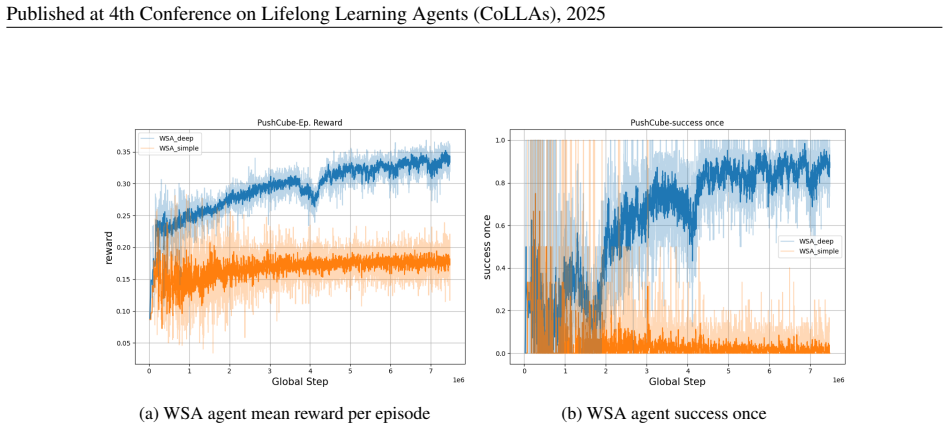
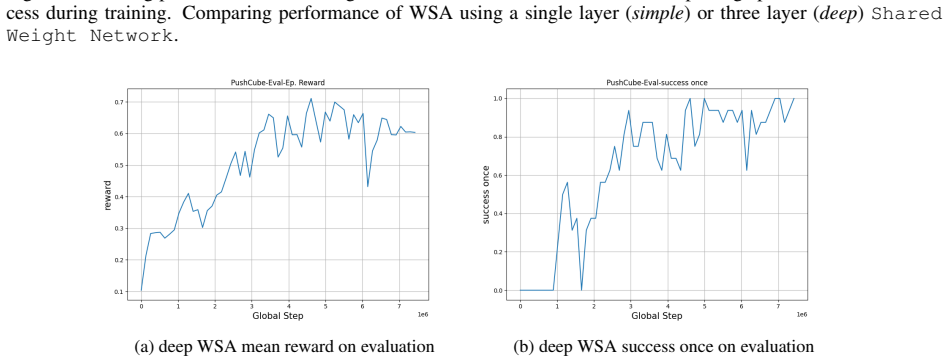
Summary. The paper proposes Weight Sharing Attention (WSA), a module that combines embeddings from multiple pre-trained vision models into a single state representation for deep RL agents. The module uses adapters to project each model's output into a shared space and a shared MLP, conditioned on a context encoding from an autoencoder, to compute L1-normalized weights per model; the final representation is a weighted sum of embeddings. The authors compare WSA against end-to-end PPO and several alternative combination modules (linear, fixed-linear, convolutional, reservoir, dot-product attention, averaging, single large pre-trained model, full training of the encoders) on three Atari games, then extend the comparison to nine Atari games with per-game hyperparameter optimization. Additional experiments evaluate robustness to HackAtari variations, dynamic addition/removal of pre-trained models, and a ManiSkill push-cube task. The central reported claim is that WSA achieves performance comparable to end-to-end models on multiple Atari games while adding modularity, explainability, and robustness.
Significance. If the central claim holds, WSA is a useful design pattern for injecting pre-trained visual knowledge into RL without fine-tuning large encoders, with a modest computational overhead and a dynamic, interpretable combination mechanism. The paper is an empirical method study with open code, clear architectural diagrams, and a wider breadth of combination baselines than is common in this literature. The reproducibility effort is a strength: the authors report pseudocode, hyperparameters, timing breakdowns, and per-seed evaluation protocols. However, the significance is bounded by two conditions: the pre-trained models are trained on 1M random-agent frames collected from the same game that is later used for RL, and the extractor/embedding-size selection is performed on the same games used for the headline comparison. These conditions substantially narrow the scope from 'prior knowledge about the world' to 'in-domain pretrained features,' and they weaken the head-to-head comparison against end-to-end baselines.
major comments (3)
- [Section 4.2 / Table 1] The central claim of comparable performance is conditional on environment-matched pretraining coverage, and the paper's own Breakout experiment demonstrates the failure mode. With random-agent pretraining data, WSA scores 99.58 ± 6.66 versus 404.46 ± 13.49 for E2E; performance only improves to 345.52 ± 6.47 after the pretraining data is augmented with expert demonstrations, still below E2E. As Section 4.3 notes, a similar distribution-shift problem is hypothesized for Space Invaders, meaning this is not an isolated artifact but a structural limitation. The abstract's framing that 'RL agents do not have any prior knowledge about the world' is undermined by the fact that the pretraining data is collected from the same game and the same environment, so the 'prior knowledge' is in-domain rather than general world knowledge. The authors should either re-scope the claims to explicitly say 'in-domain pretrained features' and report which games suffer from coverage gaps, or add experiments with encoders pretrained on other games or external image data to demonstrate true transfer.
- [Section 4 / 'Initial Experiments' and Appendix F] The selection of feature extractors and their embedding sizes is performed on the same three games that are later used for the main comparison (Pong, Ms. Pacman, Breakout). The paper states: 'we run a first round of experiments for the three games to select the three best performing extractors and their respective embedding size, which will be used for our empirical analysis.' This means the headline results in Table 1 reflect a test-set selection: the best combination module per game is chosen based on its performance on the evaluation games, and then that same module is reported as the winner on those games. The same issue applies to the extended experiments in Section 4.3, where CARBS sweeps are run per game to optimize hyperparameters including embedding size, and the best configuration is then evaluated on the same games. A fair comparison would require selecting configurations on development games and evaluating on held-out games, or at least documenting the selection protocol and its potential bias. As written, the 'comparable performance' over the alternative modules is not an unbiased estimate.
- [Section 4.3 / Table 2] The comparison with the end-to-end baseline is uneven because WSA receives per-game hyperparameter optimization while the E2E scores are taken from Open RL Benchmark without the same search budget. The paper reports that 'for each game, we run a set of sweeps consisting of 50/100 runs (2-3 days of compute time) to identify the optimal configurations,' whereas the E2E numbers are 'computed using the OpenAI/Baselines PPO results collected in Open RL Benchmark.' This confounds the contribution of the WSA module with the effect of per-game tuning. Moreover, even with this optimization, WSA is worse on three of nine games (Beam Rider, Qbert, Space Invaders), with Qbert showing a 40% drop in raw score. The honest summary is that WSA is comparable on roughly six of nine games after substantial per-game tuning, not that it matches E2E 'without any fine-tuning of hyperparameters.' The authors should either match the tuning budget for E2E or adjust the claim to explicitly distinguish the tuned WSA results from the untuned initial experiments.
minor comments (6)
- [Abstract / Introduction] There are several grammatical issues, e.g., 'pre-trained models have been a key components' and 'which presents themselves as the key challenges'; the manuscript would benefit from a careful proofread throughout.
- [Algorithm 1] Line 7 normalizes W by its L1 norm and reassigns W, but line 8 then writes 'R = sum_i w_i * E_i' without clarifying that w_i refers to the normalized weights; this is a minor notational ambiguity that could confuse readers implementing the algorithm.
- [Section 4.1] The sentence 'The poor performance of the ENS baseline further highlights the need for a smarter and more complex way to combine multiple embeddings' is slightly misleading because ENS is an intentionally simple baseline; a more precise statement would note that naive averaging is insufficient without overclaiming that complexity is the only remedy.
- [Appendix C.2 / Table 8] The comparison of WSA, InstructRL, and OpenVLA mixes training protocols: InstructRL is trained online for 7.5M steps, while OpenVLA is fine-tuned offline for 50K steps with LoRA. The table's 'Training Steps' column is therefore not directly comparable, and the conclusion 'WSA masters the task whereas the other methods struggle' should be qualified by this protocol mismatch even though wall-clock time is also reported.
- [Section 4.4 / Table 3] The table header 'Random E2E WSA Training Testing - variation original variation original variation' is confusing; it would be clearer to have separate column groups for the three methods (Random, E2E, WSA) with subcolumns for original and variation, as is done later in Appendix D.
- [Section 4.5] The 'WSA Explainability' paragraph is purely qualitative; reporting quantitative metrics for weight interpretability (e.g., agreement with oracle or ablation) would strengthen the claim, but as presented this is a minor presentation issue rather than a load-bearing flaw.
Circularity Check
No circular derivation; WSA is an empirical combination module evaluated on held-out seeds, and the only self-citation (Cossu et al., 2024) is contextual, not load-bearing.
full rationale
The paper does not derive a predictive law from a fitted parameter. WSA's learned weights are optimized on PPO/DQN training episodes and evaluated on held-out seeds, so the reported rewards are not forced by construction. The pre-trained encoders are trained on 1M random-agent frames per game and, for Breakout, augmented with expert frames; this is an in-domain-data limitation, and the paper reports the failure explicitly (Section 4.2: WSA 99.58 vs E2E 404.46 before augmentation, 345.52 afterward). No equation reduces to its inputs: the combination module, adapters, and policy are all trained with ordinary RL losses and compared to external Open RL Benchmark E2E numbers (Huang et al., 2024). The only self-citation is Cossu et al. (2024), referenced in Section 4.2 as related work on updating pre-trained models; it does not justify WSA, does not forbid alternatives, and carries no load in the argument. Per-game hyperparameter sweeps (Section 4.3) and initial extractor selection are standard model selection, not circularity, though they may affect how the comparison generalizes.
Assumptions & free parameters
free parameters (3)
- Per-game embedding size =
Pong: 1024; Ms.Pacman/Breakout: 256 (WSA)
- Number and choice of pre-trained models =
4 models: State Representation, Object Keypoints (CNN and KeyNet), Video Object Segmentation; plus a deep autoencoder…
- Shared Weight Network depth =
1 hidden layer for Atari; 3 layers for ManiSkill
assumptions (4)
- domain assumption Frozen pre-trained features from random-agent rollouts are sufficiently informative for policy learning on the target game.
- domain assumption A convex combination (L1-normalized weights) of embeddings is sufficient to represent the enriched state; no interaction terms are needed.
- standard math PPO with default hyperparameters is an adequate base learner for the comparison.
- domain assumption The attention weights assigned by the shared MLP, given context, reflect the true usefulness of each model.
Cite this review
Pith. "Pith review of Combining Pre-Trained Models for Enhanced Feature Representation in Reinforcement Learning." pith.science (2026). https://pith.science/paper/O6IOMOKS
@misc{pith2026250707197,
  author       = {Pith},
  title        = {Pith review of: Combining Pre-Trained Models for Enhanced Feature Representation in Reinforcement Learning},
  year         = {2026},
  howpublished = {\url{https://pith.science/paper/O6IOMOKS}},
  note         = {Machine review of arXiv:2507.07197}
}
read the original abstract
The recent focus and release of pre-trained models have been a key components to several advancements in many fields (e.g. Natural Language Processing and Computer Vision), as a matter of fact, pre-trained models learn disparate latent embeddings sharing insightful representations. On the other hand, Reinforcement Learning (RL) focuses on maximizing the cumulative reward obtained via agent's interaction with the environment. RL agents do not have any prior knowledge about the world, and they either learn from scratch an end-to-end mapping between the observation and action spaces or, in more recent works, are paired with monolithic and computationally expensive Foundational Models. How to effectively combine and leverage the hidden information of different pre-trained models simultaneously in RL is still an open and understudied question. In this work, we propose Weight Sharing Attention (WSA), a new architecture to combine embeddings of multiple pre-trained models to shape an enriched state representation, balancing the tradeoff between efficiency and performance. We run an extensive comparison between several combination modes showing that WSA obtains comparable performance on multiple Atari games compared to end-to-end models. Furthermore, we study the generalization capabilities of this approach and analyze how scaling the number of models influences agents' performance during and after training.
Figures


Figures from the paper (15 more)




Reference graph
Works this paper leans on
-
[1]
write newline
" write newline "" before.all 'output.state := FUNCTION n.dashify 't := "" t empty not t #1 #1 substring "-" = t #1 #2 substring "--" = not "--" * t #2 global.max substring 't := t #1 #1 substring "-" = "-" * t #2 global.max substring 't := while if t #1 #1 substring * t #2 global.max substring 't := if while FUNCTION format.date year duplicate empty "emp...
-
[2]
Ankesh Anand, Evan Racah, Sherjil Ozair, Yoshua Bengio, Marc - Alexandre C \^ o t \' e , and R. Devon Hjelm. Unsupervised state representation learning in atari. In Advances in Neural Information Processing Systems 32: Annual Conference on Neural Information Processing Systems 2019, NeurIPS 2019, December 8-14, 2019, Vancouver, BC, Canada, pp.\ 8766--8779...
work page 2019
-
[3]
Agent57: Outperforming the atari human benchmark
Adri \` a Puigdom \` e nech Badia, Bilal Piot, Steven Kapturowski, Pablo Sprechmann, Alex Vitvitskyi, et al. Agent57: Outperforming the atari human benchmark. In Proceedings of the 37th International Conference on Machine Learning, ICML 2020, 13-18 July 2020, Virtual Event , volume 119 of Proceedings of Machine Learning Research, pp.\ 507--517. PMLR , 202...
work page 2020
-
[4]
Bellemare, Yavar Naddaf, Joel Veness, and Michael Bowling
Marc G. Bellemare, Yavar Naddaf, Joel Veness, and Michael Bowling. The arcade learning environment: An evaluation platform for general agents. J. Artif. Intell. Res., 47: 0 253--279, 2013. doi:10.1613/jair.3912. URL https://doi.org/10.1613/jair.3912
-
[5]
Dota 2 with large scale deep reinforcement learning
Christopher Berner, Greg Brockman, Brooke Chan, Vicki Cheung, Przemyslaw Debiak, et al. Dota 2 with large scale deep reinforcement learning. CoRR, abs/1912.06680, 2019. URL http://arxiv.org/abs/1912.06680
arXiv 1912
-
[6]
Experiment tracking with weights and biases, 2020
Lukas Biewald. Experiment tracking with weights and biases, 2020. URL https://www.wandb.com/. Software available from wandb.com
work page 2020
-
[7]
Sam Blakeman and Denis Mareschal. Selective particle attention: Rapidly and flexibly selecting features for deep reinforcement learning. Neural Networks, 150: 0 408--421, 2022. doi:10.1016/j.neunet.2022.03.015. URL https://doi.org/10.1016/j.neunet.2022.03.015
-
[8]
Konstantinos Bousmalis, Giulia Vezzani, Dushyant Rao, Coline Devin, Alex X. Lee, et al. Robocat: A self-improving foundation agent for robotic manipulation. CoRR, abs/2306.11706, 2023. doi:10.48550/arXiv.2306.11706. URL https://doi.org/10.48550/arXiv.2306.11706
Show all 63 references
-
[9]
Generalized attention-weighted reinforcement learning
Lennart Bramlage and Aurelio Cortese. Generalized attention-weighted reinforcement learning. Neural Networks, 145: 0 10--21, 2022. doi:10.1016/j.neunet.2021.09.023. URL https://doi.org/10.1016/j.neunet.2021.09.023
2022 doi
-
[10]
Passaro, Vincenzo Lomonaco, Tinne Tuytelaars, and Davide Bacciu
Andrea Cossu, Antonio Carta, Lucia C. Passaro, Vincenzo Lomonaco, Tinne Tuytelaars, and Davide Bacciu. Continual pre-training mitigates forgetting in language and vision. Neural Networks, 179: 0 106492, 2024. doi:10.1016/J.NEUNET.2024.106492. URL https://doi.org/10.1016/j.neun...
2024
-
[11]
Hackatari: Atari learning environments for robust and continual reinforcement learning
Quentin Delfosse, Jannis Bl \"u ml, Bjarne Gregori, and Kristian Kersting. Hackatari: Atari learning environments for robust and continual reinforcement learning. arXiv preprint arXiv:2406.03997, 2024
2024 arXiv
-
[12]
An image is worth 16x16 words: Transformers for image recognition at scale, 2021
Alexey Dosovitskiy, Lucas Beyer, Alexander Kolesnikov, Dirk Weissenborn, Xiaohua Zhai, et al. An image is worth 16x16 words: Transformers for image recognition at scale, 2021. URL https://arxiv.org/abs/2010.11929
2021 arXiv
-
[13]
Rachit Dubey, Pulkit Agrawal, Deepak Pathak, Tom Griffiths, and Alexei A. Efros. Investigating human priors for playing video games. In Proceedings of the 35th International Conference on Machine Learning, ICML 2018, Stockholmsm \" a ssan, Stockholm, Sweden, July 10-15, 2018 ,...
2018
-
[14]
Fetterman, Ellie Kitanidis, Joshua Albrecht, Zachary Polizzi, Bryden Fogelman, Maksis Knutins, et al
Abraham J. Fetterman, Ellie Kitanidis, Joshua Albrecht, Zachary Polizzi, Bryden Fogelman, Maksis Knutins, et al. Tune as you scale: Hyperparameter optimization for compute efficient training. CoRR, abs/2306.08055, 2023. doi:10.48550/ARXIV.2306.08055. URL https://doi.org/10.485...
-
[15]
Deep reservoir computing: A critical experimental analysis
Claudio Gallicchio, Alessio Micheli, and Luca Pedrelli. Deep reservoir computing: A critical experimental analysis. Neurocomputing, 268: 0 87--99, 2017. doi:10.1016/J.NEUCOM.2016.12.089. URL https://doi.org/10.1016/j.neucom.2016.12.089
2017 doi
-
[16]
Multimodal masked autoencoders learn transferable representations
Xinyang Geng, Hao Liu, Lisa Lee, Dale Schuurmans, Sergey Levine, and Pieter Abbeel. Multimodal masked autoencoders learn transferable representations. arXiv preprint arXiv:2205.14204, 2022
2022 arXiv
-
[17]
Unsupervised video object segmentation for deep reinforcement learning
Vikash Goel, Jameson Weng, and Pascal Poupart. Unsupervised video object segmentation for deep reinforcement learning. In Advances in Neural Information Processing Systems 31: Annual Conference on Neural Information Processing Systems 2018, NeurIPS 2018, December 3-8, 2018, Mo...
2018
-
[18]
Hu, Yelong Shen, Phillip Wallis, Zeyuan Allen - Zhu, Yuanzhi Li, et al
Edward J. Hu, Yelong Shen, Phillip Wallis, Zeyuan Allen - Zhu, Yuanzhi Li, et al. Lora: Low-rank adaptation of large language models. In The Tenth International Conference on Learning Representations, ICLR 2022, Virtual Event, April 25-29, 2022 . OpenReview.net, 2022. URL http...
2022
-
[19]
Shengyi Huang, Rousslan Fernand Julien Dossa, Chang Ye, Jeff Braga, Dipam Chakraborty, Kinal Mehta, and João G.M. Araújo. Cleanrl: High-quality single-file implementations of deep reinforcement learning algorithms. Journal of Machine Learning Research, 23 0 (274): 0 1--18, 202...
2022
-
[20]
Open RL benchmark: Comprehensive tracked experiments for reinforcement learning
Shengyi Huang, Quentin Gallou \' e dec, Florian Felten, Antonin Raffin, Rousslan Fernand Julien Dossa, et al. Open RL benchmark: Comprehensive tracked experiments for reinforcement learning. CoRR, abs/2402.03046, 2024. doi:10.48550/ARXIV.2402.03046. URL https://doi.org/10.4855...
-
[21]
Unsupervised learning of object landmarks through conditional image generation
Tomas Jakab, Ankush Gupta, Hakan Bilen, and Andrea Vedaldi. Unsupervised learning of object landmarks through conditional image generation. In Advances in Neural Information Processing Systems 31: Annual Conference on Neural Information Processing Systems 2018, NeurIPS 2018, D...
2018
-
[22]
Continual pre-training of language models
Zixuan Ke, Yijia Shao, Haowei Lin, Tatsuya Konishi, Gyuhak Kim, and Bing Liu. Continual pre-training of language models. In The Eleventh International Conference on Learning Representations, ICLR 2023, Kigali, Rwanda, May 1-5, 2023 . OpenReview.net, 2023. URL https://openrevie...
2023
-
[23]
Openvla: An open-source vision-language-action model
Moo Jin Kim, Karl Pertsch, Siddharth Karamcheti, Ted Xiao, Ashwin Balakrishna, et al. Openvla: An open-source vision-language-action model. In Conference on Robot Learning, 6-9 November 2024, Munich, Germany, volume 270 of Proceedings of Machine Learning Research, pp.\ 2679--2...
2024
-
[24]
Kulkarni, Ankush Gupta, Catalin Ionescu, Sebastian Borgeaud, Malcolm Reynolds, et al
Tejas D. Kulkarni, Ankush Gupta, Catalin Ionescu, Sebastian Borgeaud, Malcolm Reynolds, et al. Unsupervised learning of object keypoints for perception and control. In Advances in Neural Information Processing Systems 32: Annual Conference on Neural Information Processing Syst...
2019
-
[25]
Offline q-learning on diverse multi-task data both scales and generalizes
Aviral Kumar, Rishabh Agarwal, Xinyang Geng, George Tucker, and Sergey Levine. Offline q-learning on diverse multi-task data both scales and generalizes. In The Eleventh International Conference on Learning Representations, ICLR 2023, Kigali, Rwanda, May 1-5, 2023 . OpenReview...
2023
-
[26]
Bootstrapped representations in reinforcement learning
Charline Le Lan, Stephen Tu, Mark Rowland, Anna Harutyunyan, Rishabh Agarwal, et al. Bootstrapped representations in reinforcement learning. In International Conference on Machine Learning, ICML 2023, 23-29 July 2023, Honolulu, Hawaii, USA , volume 202 of Proceedings of Machin...
2023
-
[27]
Instruction-following agents with jointly pre-trained vision-language models
Hao Liu, Lisa Lee, Kimin Lee, and Pieter Abbeel. Instruction-following agents with jointly pre-trained vision-language models. CoRR, abs/2210.13431, 2022. doi:10.48550/ARXIV.2210.13431. URL https://doi.org/10.48550/arXiv.2210.13431
-
[28]
Swin transformer: Hierarchical vision transformer using shifted windows
Ze Liu, Yutong Lin, Yue Cao, Han Hu, Yixuan Wei, et al. Swin transformer: Hierarchical vision transformer using shifted windows. In 2021 IEEE/CVF International Conference on Computer Vision, ICCV 2021, Montreal, QC, Canada, October 10-17, 2021 , pp.\ 9992--10002. IEEE , 2021. ...
2021
-
[29]
Arjun Majumdar, Karmesh Yadav, Sergio Arnaud, Yecheng Jason Ma, Claire Chen, et al. Where are we in the search for an artificial visual cortex for embodied intelligence? In Advances in Neural Information Processing Systems 36: Annual Conference on Neural Information Processing...
2023
-
[30]
Playing atari with deep reinforcement learning
Volodymyr Mnih, Koray Kavukcuoglu, David Silver, Alex Graves, Ioannis Antonoglou, et al. Playing atari with deep reinforcement learning. CoRR, abs/1312.5602, 2013. URL http://arxiv.org/abs/1312.5602
2013 arXiv
-
[31]
Rusu, Joel Veness, et al
Volodymyr Mnih, Koray Kavukcuoglu, David Silver, Andrei A. Rusu, Joel Veness, et al. Human-level control through deep reinforcement learning. Nat., 518 0 (7540): 0 529--533, 2015. doi:10.1038/nature14236. URL https://doi.org/10.1038/nature14236
2015 doi
-
[32]
Exploiting semantic segmentation to boost reinforcement learning in video game environments
Javier Montalvo, \' A lvaro Garc \' a - Mart \' n, and Jes \' u s Besc \' o s. Exploiting semantic segmentation to boost reinforcement learning in video game environments. Multim. Tools Appl., 82 0 (7): 0 10961--10979, 2023. doi:10.1007/S11042-022-13695-1. URL https://doi.org/...
2023 doi
-
[33]
R3m: A universal visual representation for robot manipulation, 2022
Suraj Nair, Aravind Rajeswaran, Vikash Kumar, Chelsea Finn, and Abhinav Gupta. R3m: A universal visual representation for robot manipulation, 2022. URL https://arxiv.org/abs/2203.12601
2022 arXiv
-
[34]
Mixtures of experts unlock parameter scaling for deep RL
Johan Samir Obando - Ceron, Ghada Sokar, Timon Willi, Clare Lyle, Jesse Farebrother, Jakob Nicolaus Foerster, Gintare Karolina Dziugaite, Doina Precup, and Pablo Samuel Castro. Mixtures of experts unlock parameter scaling for deep RL . In Forty-first International Conference o...
2024
-
[35]
Solving rubik's cube with a robot hand
OpenAI, Ilge Akkaya, Marcin Andrychowicz, Maciek Chociej, Mateusz Litwin, et al. Solving rubik's cube with a robot hand. CoRR, abs/1910.07113, 2019. URL http://arxiv.org/abs/1910.07113
1910 arXiv
-
[36]
Dinov2: Learning robust visual features without supervision
Maxime Oquab, Timoth \'e e Darcet, Th \'e o Moutakanni, Huy Vo, Marc Szafraniec, et al. Dinov2: Learning robust visual features without supervision. arXiv preprint arXiv:2304.07193, 2023
2023 arXiv
-
[37]
Open x-embodiment: Robotic learning datasets and rt-x models: Open x-embodiment collaboration 0
Abby O’Neill, Abdul Rehman, Abhiram Maddukuri, Abhishek Gupta, Abhishek Padalkar, et al. Open x-embodiment: Robotic learning datasets and rt-x models: Open x-embodiment collaboration 0. In 2024 IEEE International Conference on Robotics and Automation (ICRA), pp.\ 6892--6903. I...
2024
-
[38]
Learning transferable visual models from natural language supervision, 2021
Alec Radford, Jong Wook Kim, Chris Hallacy, Aditya Ramesh, Gabriel Goh, et al. Learning transferable visual models from natural language supervision, 2021. URL https://arxiv.org/abs/2103.00020
2021 arXiv
-
[39]
Rl baselines3 zoo
Antonin Raffin. Rl baselines3 zoo. https://github.com/DLR-RM/rl-baselines3-zoo, 2020
2020
-
[40]
Stable-baselines3: Reliable reinforcement learning implementations
Antonin Raffin, Ashley Hill, Adam Gleave, Anssi Kanervisto, Maximilian Ernestus, and Noah Dormann. Stable-baselines3: Reliable reinforcement learning implementations. Journal of Machine Learning Research, 22 0 (268): 0 1--8, 2021. URL http://jmlr.org/papers/v22/20-1364.html
2021
-
[41]
The surprising ineffectiveness of pre-trained visual representations for model-based reinforcement learning
Moritz Schneider, Robert Krug, Narunas Vaskevicius, Luigi Palmieri, and Joschka Boedecker. The surprising ineffectiveness of pre-trained visual representations for model-based reinforcement learning. In Advances in Neural Information Processing Systems 38: Annual Conference on...
2024
-
[42]
Proximal policy optimization algorithms
John Schulman, Filip Wolski, Prafulla Dhariwal, Alec Radford, and Oleg Klimov. Proximal policy optimization algorithms. CoRR, abs/1707.06347, 2017. URL http://arxiv.org/abs/1707.06347
2017 arXiv
-
[43]
Pretraining representations for data-efficient reinforcement learning
Max Schwarzer, Nitarshan Rajkumar, Michael Noukhovitch, Ankesh Anand, Laurent Charlin, et al. Pretraining representations for data-efficient reinforcement learning. In Advances in Neural Information Processing Systems 34: Annual Conference on Neural Information Processing Syst...
2021
-
[44]
Shah and Vikash Kumar
Rutav M. Shah and Vikash Kumar. RRL: resnet as representation for reinforcement learning. In Proceedings of the 38th International Conference on Machine Learning, ICML 2021, 18-24 July 2021, Virtual Event , volume 139 of Proceedings of Machine Learning Research, pp.\ 9465--947...
2021
-
[45]
Maddison, Arthur Guez, Laurent Sifre, et al
David Silver, Aja Huang, Chris J. Maddison, Arthur Guez, Laurent Sifre, et al. Mastering the game of go with deep neural networks and tree search. Nat., 529 0 (7587): 0 484--489, 2016. doi:10.1038/nature16961. URL https://doi.org/10.1038/nature16961
2016 doi
-
[46]
Decoupling representation learning from reinforcement learning
Adam Stooke, Kimin Lee, Pieter Abbeel, and Michael Laskin. Decoupling representation learning from reinforcement learning. In Proceedings of the 38th International Conference on Machine Learning, ICML 2021, 18-24 July 2021, Virtual Event , volume 139 of Proceedings of Machine ...
2021
-
[47]
Pufferlib: Making reinforcement learning libraries and environments play nice, 2024
Joseph Suarez. Pufferlib: Making reinforcement learning libraries and environments play nice, 2024. URL https://arxiv.org/abs/2406.12905
2024 arXiv
-
[48]
Pufferlib 2.0: Reinforcement learning at 1m steps/s
Joseph Suarez. Pufferlib 2.0: Reinforcement learning at 1m steps/s. In Reinforcement Learning Conference, 2025. URL https://openreview.net/forum?id=qRyteMTgn0
2025
-
[49]
Maniskill3: A versatile, scalable, and flexible machine learning framework for medical imaging
Stone Tao, Fanbo Xiang, Arth Shukla, Yuzhe Qin, Xander Hinrichsen, et al. Maniskill3: A versatile, scalable, and flexible machine learning framework for medical imaging. arXiv preprint arXiv:2410.00425, 2024
2024 arXiv
-
[50]
Scaling instructable agents across many simulated worlds
SIMA Team, Maria Abi Raad, Arun Ahuja, Catarina Barros, Frederic Besse, et al. Scaling instructable agents across many simulated worlds. CoRR, abs/2404.10179, 2024. doi:10.48550/ARXIV.2404.10179. URL https://doi.org/10.48550/arXiv.2404.10179
-
[51]
Building machines that learn and think like people
Josh Tenenbaum. Building machines that learn and think like people. In Proceedings of the 17th International Conference on Autonomous Agents and MultiAgent Systems, AAMAS 2018, Stockholm, Sweden, July 10-15, 2018 , pp.\ 5. International Foundation for Autonomous Agents and Mul...
2018
-
[52]
Llama 2: Open foundation and fine-tuned chat models
Hugo Touvron, Louis Martin, Kevin Stone, Peter Albert, Amjad Almahairi, et al. Llama 2: Open foundation and fine-tuned chat models. arXiv preprint arXiv:2307.09288, 2023
2023 arXiv
-
[53]
Terry, Ariel Kwiatkowski, John U
Mark Towers, Jordan K. Terry, Ariel Kwiatkowski, John U. Balis, Gianluca de Cola, et al. Gymnasium, March 2023. URL https://zenodo.org/record/8127025
2023
-
[54]
Attention is all you need
Ashish Vaswani, Noam Shazeer, Niki Parmar, Jakob Uszkoreit, Llion Jones, et al. Attention is all you need. In Advances in Neural Information Processing Systems 30: Annual Conference on Neural Information Processing Systems 2017, December 4-9, 2017, Long Beach, CA, USA , pp.\ 5...
2017
-
[55]
Czarnecki, Micha \" e l Mathieu, Andrew Dudzik, et al
Oriol Vinyals, Igor Babuschkin, Wojciech M. Czarnecki, Micha \" e l Mathieu, Andrew Dudzik, et al. Grandmaster level in starcraft II using multi-agent reinforcement learning. Nat., 575 0 (7782): 0 350--354, 2019. doi:10.1038/s41586-019-1724-z. URL https://doi.org/10.1038/s4158...
2019 doi
-
[56]
A comprehensive survey of continual learning: Theory, method and application
Liyuan Wang, Xingxing Zhang, Hang Su, and Jun Zhu. A comprehensive survey of continual learning: Theory, method and application. IEEE Trans. Pattern Anal. Mach. Intell. , 46 0 (8): 0 5362--5383, 2024. doi:10.1109/TPAMI.2024.3367329. URL https://doi.org/10.1109/TPAMI.2024.3367329
2024
-
[57]
SAPIEN : A simulated part-based interactive environment
Fanbo Xiang, Yuzhe Qin, Kaichun Mo, Yikuan Xia, Hao Zhu, et al. SAPIEN : A simulated part-based interactive environment. In The IEEE Conference on Computer Vision and Pattern Recognition (CVPR), June 2020
2020
- [58]
-
[59]
Pre-trained image encoder for generalizable visual reinforcement learning
Zhecheng Yuan, Zhengrong Xue, Bo Yuan, Xueqian Wang, Yi Wu, et al. Pre-trained image encoder for generalizable visual reinforcement learning. In Advances in Neural Information Processing Systems 35: Annual Conference on Neural Information Processing Systems 2022, NeurIPS 2022,...
2022
-
[60]
Sigmoid loss for language image pre-training
Xiaohua Zhai, Basil Mustafa, Alexander Kolesnikov, and Lucas Beyer. Sigmoid loss for language image pre-training. In Proceedings of the IEEE/CVF international conference on computer vision, pp.\ 11975--11986, 2023
2023
-
[61]
@esa (Ref
\@ifxundefined[1] #1\@undefined \@firstoftwo \@secondoftwo \@ifnum[1] #1 \@firstoftwo \@secondoftwo \@ifx[1] #1 \@firstoftwo \@secondoftwo [2] @ #1 \@temptokena #2 #1 @ \@temptokena \@ifclassloaded agu2001 natbib The agu2001 class already includes natbib coding, so you should ...
-
[62]
\@lbibitem[] @bibitem@first@sw\@secondoftwo \@lbibitem[#1]#2 \@extra@b@citeb \@ifundefined br@#2\@extra@b@citeb \@namedef br@#2 \@nameuse br@#2\@extra@b@citeb \@ifundefined b@#2\@extra@b@citeb @num @parse #2 @tmp #1 NAT@b@open@#2 NAT@b@shut@#2 \@ifnum @merge>\@ne @bibitem@firs...
-
[63]
@open @close @open @close and [1] URL: #1 \@ifundefined chapter * \@mkboth \@ifxundefined @sectionbib * \@mkboth * \@mkboth\@gobbletwo \@ifclassloaded amsart * \@ifclassloaded amsbook * \@ifxundefined @heading @heading NAT@ctr thebibliography [1] @ \@biblabel @NAT@ctr \@bibset...
Reviewed August 6, 2026 · model on record in the stance chip above.
Discussion (0). Continue with ORCID to comment.