REVIEW 3 major objections 4 minor 4 cited by
Roll the dice & look before you leap: Going beyond the creative limits of next-token prediction
T0 review · 3 major / 4 minor · reviewed 2026-08-16 · deepseek-v4-flash
Pith's one-line read Multi-token training beats next-token prediction on four minimal creativity tasks.
desk verdict Well-run empirical study: multi-token training beats NTP on four synthetic creativity tasks and seed-conditioning is a real surprise, but the paper overreaches by asserting a transfer guarantee its own limitations undercut. read the letter →
The pith
A machine-rendered reading of the paper's core claim, the machinery that carries it, and where it could break.
The reading
What carries the argument
The machinery is a suite of minimal generative tasks in which coherence is a global property of the whole string, paired with a metric called algorithmic creativity that counts the fraction of generated strings that are coherent, unique, and not in the training set. Two combinational tasks store a knowledge graph in the model's weights: sibling discovery asks for a parent node whose two revealed siblings both belong to it, and triangle discovery asks for three nodes whose pairwise edges all exist. Two exploratory tasks ask for an edge list that can be rearranged, under some permutation, into a circle or a line graph. The argument rides on a mechanism the authors call the Clever Hans cheat: a next-token model can predict late tokens from earlier ones without learning the latent plan, and the simplicity bias of gradient training makes that shortcut irresistible, after which gradient starvation removes any push to learn the plan. Teacherless training and diffusion are the two multi-token alternatives used to break that shortcut.
What would settle it
Train a next-token Transformer on the same task families with a token order that reveals the hidden plan early (parent-first for sibling discovery, or an explicit permutation token for circle and line construction) under matched data, compute, and decoding; if algorithmic creativity reaches or exceeds the multi-token models, the gap is an artifact of token ordering rather than next-token learning itself. Alternatively, run the same comparison on real knowledge graphs with semantic nodes: if the multi-token advantage disappears, the transfer premise fails.
Extended reading notes
Core claim
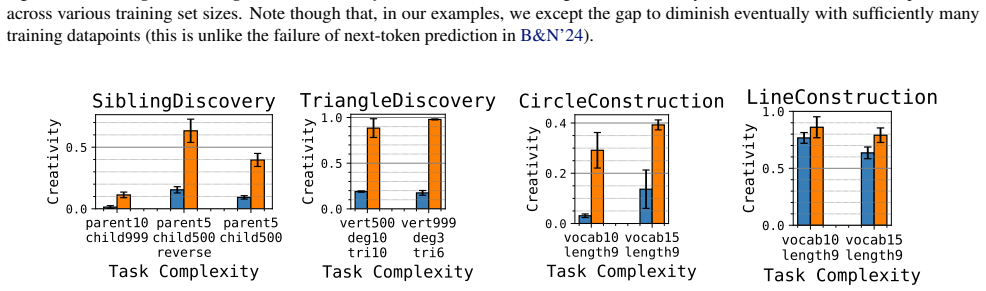
The paper's central claim is that creative leap-of-thought tasks are misaligned with next-token learning. In each task, the most natural generative rule is to settle a random latent plan first — the hidden parent node, the edges of a triangle, or the resolving permutation of an adjacency list — while the surface token order either reveals that plan last or not at all. A next-token learner can shortcut the plan by predicting late tokens from early ones, a "Clever Hans cheat" that starves the gradient signal for the latent structure and pushes the model toward memorizing its training set. Multi-token objectives, by contrast, force the model to commit to all tokens at once: teacherless training predicts every response token from the prompt alone, and discrete diffusion refines a fully corrupted sequence. The result is the paper's headline finding: in all four tasks, multi-token training attains higher algorithmic creativity than next-token training, and for Transformers, seed-conditioning with greedy decoding is as creative as temperature sampling.
Load-bearing premise
The load-bearing premise is that these four minimal tasks faithfully capture the computational core of real creative leaps, so that next-token failure here predicts failure in real open-ended tasks; the paper asserts the one-way transfer without demonstrating it.
Editorial extensions
If this is right
- Finetuning a transformer with a multi-token component should raise the diversity and originality of open-ended generations at fixed model size and compute, not just correctness.
- Seed-conditioning gives practitioners a cheap diversity knob: train with arbitrary random prefixes, then decode greedily without tuning temperature.
- Proposals that try to fix next-token prediction by reordering tokens or predicting infills will not help on the permutation-invariant tasks, since no token order makes the hidden plan local.
- Verbatim memorization in open-ended generation is partly a symptom of fitting late tokens via local shortcuts, so multi-token objectives are a direct way to curb memorization.
- The positive, if small, diversity gain at fixed ROUGE on XSUM summarization suggests the effect extends beyond toy tasks to realistic generation.
Reading between the lines
- The authors' own decomposition suggests seed-conditioning buys diversity while multi-token training buys both diversity and reduced memorization; an obvious extension is to combine them and measure whether the gains add.
- If the Clever Hans mechanism is the true cause, then a testable prediction follows: revealing the plan token early, or hiding the sibling evidence, should shrink the next-token versus multi-token gap.
- The paper asserts that failure on these minimal tasks guarantees failure on more complex ones, but that transfer claim is not demonstrated; scaling the same tasks to semantically meaningful knowledge graphs would test it directly.
- Seed-conditioning helps Transformers but not the diffusion model, so the noise-injection benefit is tied to autoregressive decoding; a diffusion analog would be conditioning on random initial latent states rather than a token prefix.
Signed reviews
Editorial analysis
A structured set of objections, weighed in public.
Referee Report
Summary. The paper introduces four minimal algorithmic tasks (Sibling Discovery, Triangle Discovery, Circle Construction, Line Construction) that are intended as controlled abstractions of open-ended creative tasks, and a quantitative metric called algorithmic creativity (Eq. 1) that rewards coherent, original, and unique generations. Across these tasks, the authors compare standard next-token prediction (NTP) with multi-token objectives: teacherless training on a Gemma 2B model and discrete diffusion (SEDD) on smaller models. They report that multi-token training improves algorithmic creativity on the Gemma 2B model across all four tasks and reduces memorization, while diffusion improves creativity in three of four small-model tasks. They also introduce seed-conditioning, where an arbitrary random prefix is used at training and inference, and report that it induces diversity even under greedy decoding, performing comparably to or better than temperature sampling in several settings. The paper argues that next-token learning is myopic in these tasks and that no token ordering is friendly to NTP in three of the four tasks, extending prior work on the path-star problem.
Significance. If the results hold, the paper provides a clean, controllable test-bed for studying creative generation and supplies new empirical evidence that multi-token objectives can improve originality and diversity relative to NTP, going beyond the correctness-focused path-star result of Bachmann and Nagarajan. The strengths of the paper include the four well-specified tasks with objective coherence conditions, the seed-memorization control in Fig. 8 that addresses a capacity-control confound, extensive sensitivity analyses across hyperparameters and dataset sizes, and a partly released codebase. The main significance, however, depends on a transfer claim from these minimal tasks to general creative limits of next-token prediction, and that claim is not established by the experiments as presented.
major comments (3)
- [Section 6.1, Limitation 1; Section 6.2, Limitation 2; Abstract] The paper's central conclusion about 'the creative limits of next-token prediction' rests on the statement in Section 6.1, Limitation 1, that 'failure here guarantees failure in more complex tasks.' This monotonicity claim is load-bearing but is asserted rather than demonstrated, and the paper's own Section 6.2, Limitation 2, concedes that many real-world creative tasks are 'out-of-distribution' in nature, which the minimal tasks deliberately do not capture. An in-distribution failure on a minimal task does not logically imply failure on an out-of-distribution complex task, because a more complex task can offer additional context, in-context reasoning, or alternative strategies that let an NTP model bypass the specific myopia diagnosed in these four benchmarks. The authors should either provide evidence for the transfer claim, for example by studying a family of tasks of increasing complexity and showing that the NTP-vs-MTP gap persists, or explicitly reframe the contribution as a finding about these minimal algorithmic tasks.
- [Section 4, Figs. 3-6] The main quantitative claims, such as the 'nearly a 5x factor' improvement for the discovery datasets and the statement that seed-conditioning 'results in algorithmic creativity comparable to temperature sampling,' are presented without error bars or per-run variability, despite the text stating that results are averaged over 4 runs. This makes it difficult to assess whether the observed differences are stable across seeds or training runs, particularly in the small-model comparisons where teacherless training shows no gain (Fig. 4) and where the seed-conditioning advantage is contingent on top-K sampling in Sibling Discovery and Triangle Discovery (Section 6.1, Limitation 6a). The authors should add error bars, confidence intervals, or per-run values to the main figures, or report statistical tests for the key comparisons.
- [Abstract; Section 4.1; Section 6.1, Limitation 6a] The abstract claims that 'multi-token approaches, namely teacherless training and diffusion models, comparatively excel in producing diverse and original output' and that seed-conditioning 'works surprisingly as well as temperature sampling.' These statements are broader than the evidence reported in the paper: teacherless training shows no gains on the smaller GPT-2 model, diffusion is mildly worse than NTP on Sibling Discovery in that setting, and the seed-conditioning advantage does not appear for Sibling Discovery on GPT-2 and is contingent on top-K sampling for Sibling Discovery and Triangle Discovery (Section 6.1, Limitation 6a). The claims should be qualified to the specific model sizes and tasks in which the effect is observed, or the paper should provide a meta-analysis of when the advantage appears and when it does not.
minor comments (4)
- [Eq. (1)] The subscript N in the metric \hat{cr}_N(T) is never defined in the main text; please define N or remove the subscript.
- [Section 4.1] There is a typo in 'parametersGPT-2 (86M)' which should read 'parameters GPT-2 (86M)'.
- [Appendix J] The sentence 'Likewise models like GPT4 and Claude currently underperform...' and the nearby discussion of Walsh et al. lack a full citation marker for the Walsh et al. work; please add the citation.
- [Figs. 18-20] The x-axis labels such as 'seed10 greedy' and 'null temp5.0' are long and overlapping; consider rotating the labels, abbreviating the conditions, or using a grouped bar layout to improve readability.
Circularity Check
No significant circularity: the multi-token vs. next-token comparisons are self-contained empirical benchmarks, and the self-citation to B&N'24 is not load-bearing.
full rationale
The paper's central comparisons are not circular: the four tasks (Sibling Discovery, Triangle Discovery, Circle Construction, Line Construction) are fixed, external benchmarks whose coherence conditions are defined independently of any model; the algorithmic creativity metric (Eq. 1) is defined once and applied uniformly to all training objectives; and no constant is fitted from the NTP-versus-MTP gap to produce that gap. The teacherless and diffusion results are measured on unseen test-time samples, with memorized and duplicated generations excluded, and the seed-memorization control in Fig. 8 addresses the capacity-control confound. The only notable self-citation is to Bachmann & Nagarajan (2024) for the 'Clever Hans cheat' concept and the path-star impossibility result, but the present paper's data-inefficiency claim is supported by its own experiments (Figs. 3-4, 12, 22, and the token-reordering study in B.4), so the self-citation is illustrative rather than load-bearing. Section 6.1's assertion that 'failure here guarantees failure in more complex tasks' is an unsupported monotonicity and transfer claim, and Section 6.2.2 concedes that many real-world tasks are 'out-of-distribution' in nature; however, overclaiming scope is a correctness concern, not circularity, because the minimal-task results do not reduce by definition to that guarantee. No equation in the paper defines a predicted quantity in terms of the input that supposedly produces it, so no circular step can be exhibited.
Assumptions & free parameters
free parameters (3)
- Seed length =
10 (default)
- Weight on multi-token objective =
0.5 to 0.75
- Training set size per task =
50k/15k/10k/10k
assumptions (3)
- domain assumption Training data are i.i.d. samples from a uniform distribution over coherent strings.
- ad hoc to paper These four tasks capture the computational core of real creative leaps.
- domain assumption Gradient-descent-trained networks exhibit simplicity bias, causing 'Clever Hans' shortcuts.
Cite this review
Pith. "Pith review of Roll the dice & look before you leap: Going beyond the creative limits of next-token prediction." pith.science (2026). https://pith.science/paper/OBR2JOXC
@misc{pith2026250415266,
  author       = {Pith},
  title        = {Pith review of: Roll the dice & look before you leap: Going beyond the creative limits of next-token prediction},
  year         = {2026},
  howpublished = {\url{https://pith.science/paper/OBR2JOXC}},
  note         = {Machine review of arXiv:2504.15266}
}
read the original abstract
We design a suite of minimal algorithmic tasks that are a loose abstraction of open-ended real-world tasks. This allows us to cleanly and controllably quantify the creative limits of the present-day language model. Much like real-world tasks that require a creative, far-sighted leap of thought, our tasks require an implicit, open-ended stochastic planning step that either (a) discovers new connections in an abstract knowledge graph (like in wordplay, drawing analogies, or research) or (b) constructs new patterns (like in designing math problems or new proteins). In these tasks, we empirically and conceptually argue how next-token learning is myopic; multi-token approaches, namely teacherless training and diffusion models, comparatively excel in producing diverse and original output. Secondly, to elicit randomness without hurting coherence, we find that injecting noise at the input layer (dubbed seed-conditioning) works surprisingly as well as (and in some conditions, better than) temperature sampling from the output layer. Thus, our work offers a principled, minimal test-bed for analyzing open-ended creative skills, and offers new arguments for going beyond next-token learning and temperature sampling. We make part of the code available under https://github.com/chenwu98/algorithmic-creativity
Figures


Figures from the paper (32 more)




Forward citations
Cited by 4 Pith papers
-
Distilled Pretraining: A modern lens of Data, In-Context Learning and Test-Time Scaling
Distilled pretraining improves test-time scaling via generation diversity but impairs induction-head-based in-context learning, with the trade-off explained by a bigram model analysis.
-
Hierarchical Domain Generalization
Over infinite domains, hierarchy-uniform domain generalization is impossible for every nontrivial hypothesis class; a length-generalization bound is a property of the length hierarchy, not a hierarchy-free guarantee.
-
Next-Latent Prediction Transformers Learn Compact World Models
NextLat augments next-token prediction with latent next-state prediction, theoretically converging latents to belief states and showing empirical gains in world modeling, reasoning, planning, and faster inference via ...
-
HypoSpace: A Diagnostic Benchmark for Set-Valued Hypothesis Generation under Underdetermination and Sublinear Coverage Bounds
A benchmark with exactly enumerated valid hypothesis sets shows LLMs maintain high validity but lose uniqueness and coverage as the admissible solution space grows.
Reference graph
Works this paper leans on
-
[1]
Discovering contradictions: Consider identifying non-trivial contradictions within (a large body) of knowledge (like a legal system, or a proof based on many lemmas, or the literature spanning many papers in a certain field). This may require identifying two or more facts that together result in an implication that contradicts another fact
-
[2]
Discovering feedback loops: Fields like biology, ecology, climate science and economics may involve discovering non-trivial feedback loops. Unlike feedback loops where two events encourage each other, a non-trivial loop would be one where anEvent A encouragesEvent B, that in turn encouragesEvent C that in turn encouragesEvent A
-
[3]
Antanaclasis: An antanaclasis involves using a word in two different senses in a sentence, while still ensuring that each sense has a coherent relationship with the rest of the sentence. Consider Benjamin Franklin’s quote, Your argument is sound, nothing but sound. Here, the two senses are sound1 as in “logically correct”, sound2 as in “noise”. This sente...
-
[4]
Pannatier, A., Courdier, E., and Fleuret, F.σ-gpts: A new approach to autoregressive models
URL https://openreview.net/forum?id= Feiz5HtCD0. Pannatier, A., Courdier, E., and Fleuret, F.σ-gpts: A new approach to autoregressive models. In Machine Learn- ing and Knowledge Discovery in Databases. Research Track - European Conference, ECML PKDD 2024, Vil- nius, Lithuania, September 9-13, 2024, Proceedings, Part VII, volume 14947 of Lecture Notes in C...
arXiv 2024
-
[5]
Talmor, A., Tafjord, O., Clark, P., Goldberg, Y ., and Berant, J
URL https://api.semanticscholar.org/ CorpusID:271719990. Talmor, A., Tafjord, O., Clark, P., Goldberg, Y ., and Berant, J. Leap-of-thought: Teaching pre-trained models to sys- tematically reason over implicit knowledge. In Advances in Neural Information Processing Systems 33: Annual Conference on Neural Information Processing Systems 2020, NeurIPS 2020, D...
arXiv 2020
-
[7]
Zhong, S., Huang, Z., Gao, S., Wen, W., Lin, L., Zitnik, M., and Zhou, P
URL https://api.semanticscholar.org/ CorpusID:267094860. Zhong, S., Huang, Z., Gao, S., Wen, W., Lin, L., Zitnik, M., and Zhou, P. Let’s think outside the box: Exploring leap- of-thought in large language models with creative humor generation. In IEEE/CVF Conference on Computer Vision and Pattern Recognition, CVPR 2024, 2024. Zhu, Y ., Lu, S., Zheng, L., ...
work page 2024
-
[11]
Word games: Some word games require identifying a set of words that simultaneously have pairwise relationships with each other. (a) For example, standard crosswords would require identifying sets of 4 or more words that have various simultaneous pairwise intersections in the letters used. (b) Devising “& Lit.” clues in cryptic crosswords are an altogether...
-
[12]
and learnability (Malach, 2023; Wies et al., 2023) of autoregressive Transformers as long as there is a sufficiently long chain of thought. Multi-token training. While multi-token methods employ diverse strategies, a common feature is their reliance on objec- tives that capture dependencies across entire sequences. Representative examples include teacherl...
work page 2024
Show all 12 references
-
[1995]
Hoogeboom, E., Nielsen, D., Jaini, P., Forr’e, P., and Welling, M
ISBN 0262082330. Hoogeboom, E., Nielsen, D., Jaini, P., Forr’e, P., and Welling, M. Argmax flows and multinomial diffusion: Learning categorical distributions. In Neural Information Processing Systems, 2021. Hopkins, A. K., Renda, A., and Carbin, M. Can LLMs generate random nu...
2021 arXiv
-
[2023]
Malach, E
doi: 10.1038/s41587-022-01618-2. Malach, E. Auto-regressive next-token predictors are uni- versal learners. arXiv preprint arXiv:2309.06979, 2023. McCoy, R. T., Yao, S., Friedman, D., Hardy, M., and Grif- fiths, T. L. Embers of autoregression: Understanding large language mode...
2023 arXiv
-
[2024]
Chung, J
URL https://api.semanticscholar.org/ CorpusID:274965054. Chung, J. J. Y ., Kamar, E., and Amershi, S. Increasing diversity while maintaining accuracy: Text data genera- tion with large language models and human interventions. In Proceedings of the 61st Annual Meeting of the As...
2023 arXiv
-
[2025]
Zhao, Y ., Zhang, R., Li, W., Huang, D., Guo, J., Peng, S., Hao, Y ., Wen, Y ., Hu, X., Du, Z., Guo, Q., Li, L., and Chen, Y
URL https://api.semanticscholar.org/ CorpusID:277621515. Zhao, Y ., Zhang, R., Li, W., Huang, D., Guo, J., Peng, S., Hao, Y ., Wen, Y ., Hu, X., Du, Z., Guo, Q., Li, L., and Chen, Y . Assessing and understanding creativ- ity in large language models. ArXiv, abs/2401.12491,
Reviewed August 16, 2026 · model on record in the stance chip above.
Discussion (0). Continue with ORCID to comment.