REVIEW 3 major objections 6 minor 1 cited by
Retrieval Visual Contrastive Decoding to Mitigate Object Hallucinations in Large Vision-Language Models
T0 review · 3 major / 6 minor · reviewed 2026-08-07 · deepseek-v4-flash
Pith's one-line read Train-free decoding with retrieved single-concept images claims to cut object hallucination in vision-language models.
desk verdict CHAIR results look real and the method is a genuine extension of VCD, but the POPE numbers are contaminated by YOLO answering for the LVLM, so the headline claims need re-scoping. read the letter →
The pith
A machine-rendered reading of the paper's core claim, the machinery that carries it, and where it could break.
The reading
What carries the argument
The carrying mechanism is the adjusted logit distribution of Eq. 5, which treats negative-image logits as a penalty term that suppresses tokens associated with objects the detector says are absent, and positive-image logits as a recovery term that keeps co-occurring ground-truth objects from being collateral damage; the hyperparameters $\alpha=1$ and $\beta=0.1$ balance the two. The support structure is the single-concept image database, one retrieved image per object word, which makes each penalty and recovery signal refer to a visually explicit concept.
What would settle it
Run RVCD on images where the object detector misses objects that are actually present and that a greedy caption correctly names; the method should suppress those correct mentions, which would appear as lower BLEU or lower POPE recall compared with running the same method on perfect human annotations. A sharper version is to compare detector-based object lists against annotation-based lists on the same sample, where the paper's Table 3 already shows CHAIR_S of 12.4 with the detector versus 8.44 with perfect annotations, predicting that improving detector recall monotonically closes that gap.
Extended reading notes
Core claim
On its own terms, RVCD establishes that the images used for visual contrastive decoding need not be transformations of the input image: external reference images that isolate a single concept can serve as stronger regulatory targets. The pipeline first writes a greedy draft caption and runs an object detector on the input; objects named in the draft but absent from the detector's list are labeled negative, and objects present in both are positive. For each object in those two lists, a single-concept image is retrieved from a database built by generating one image per word in the CHAIR dictionary and keeping only images whose captions agree with the generation prompt. At every token step the model computes logits from the original image, from each negative image, and from each positive image, and combines them as $f_{\mathrm{adjusted},t}(\cdot | v, x, y_{<t}) = (1+\alpha|N|-\beta|P|)\, f_\theta(\cdot | v, x, y_{<t}) - (\alpha \textstyle\sum_{i} N_{t,i} - \beta \textstyle\sum_{j} P_{t,j})$, taking the argmax of the adjusted softmax as the output token. The paper's evidence is that this lowers CHAIR_S to 11.32 on LLaVA-1.5 and 9.00 on MiniGPT-4, and lifts POPE accuracy to 88.54 and 85.96 respectively, while BLEU stays comparable to greedy decoding.
Load-bearing premise
The method treats the detector's object list as ground truth: any real object the detector misses is classified as a hallucination and actively suppressed.
Editorial extensions
If this is right
- If the central claim holds, object hallucination in 7B-scale vision-language models can be cut by roughly one-third to one-half relative to the strongest prior decoding baseline on CHAIR_S, without retraining.
- Because the method is train-free and decoding-only, it can be layered onto any compatible open vision-language model and combined with existing post-hoc corrections.
- The dependency on detector accuracy means every improvement in open-vocabulary object detection should transfer directly into lower hallucination rates for the same vision-language model.
- The latency cost, about six times greedy decoding but well below the HALC baseline, makes the method practical for offline captioning and feasible where real-time generation is not required.
Reading between the lines
- Beyond the paper, the same retrieval-and-contrast recipe could generalize from object nouns to attribute, count, and position predicates by building single-concept databases for those categories; the paper's MME results already show gains on existence and color, but not yet consistently on position and count.
- Beyond the paper, the method's ceiling is set by the closed CHAIR dictionary; moving to open-vocabulary detectors and generators would let the same logit surgery suppress arbitrary hallucinated concepts rather than only the 80 MSCOCO classes and their synonyms.
- Beyond the paper, the fixed $\beta=0.1$ recovery strength could be made instance-dependent, increasing when the draft mentions many co-occurring objects, which the ablations suggest would trade BLEU against CHAIR more flexibly.
Editorial analysis
A structured set of objections, weighed in public.
Referee Report
Summary. The paper proposes RVCD, a training-free decoding method that reduces object hallucination in large vision-language models (LVLMs). The method first greedily decodes a draft caption, then uses YOLO to detect objects in the input image, dividing draft-mentioned objects into 'negative' (not detected) and 'positive' (detected) sets. For each set, it retrieves AI-generated single-concept reference images and computes contrastive logits that are combined with the original logits via Equation (5), where alpha and beta control the suppression of negative objects and the recovery of positive objects. The authors evaluate RVCD on CHAIR, BLEU, POPE, MME, and LLaVA-Bench across three 7B backbones (LLaVA-1.5, MiniGPT-4, mPLUG-Owl2) and report substantial CHAIR reductions (e.g., CHAIRS from 18.60 to 11.32 on LLaVA-1.5) and large POPE accuracy gains, along with latency measurements and ablations. The code and reference-image database are released.
Significance. If the CHAIR results are taken at face value, the paper offers a practical, train-free, plug-and-play intervention that reduces hallucination more than prior decoding baselines across three architectures, with code and data publicly released. The core idea of retrieving explicit reference images beyond transformations of the input is a welcome extension of visual contrastive decoding. A particular strength is that the beta=0 ablation in Table 3 (CHAIRS 12.40 on LLaVA-1.5 with YOLOv8x) shows the main effect does not depend on the tuned positive-logit parameter, so the central OH-reduction claim has independent grounding. However, several evaluation and reporting issues, most importantly the POPE protocol in Appendix D, prevent the paper from being accepted in its current form.
major comments (3)
- [Section 5.1, Appendix D] The POPE evaluation is contaminated by a detector-oracle channel. As stated in Appendix D, the full POPE query (which always names exactly one candidate object) is concatenated with the initially greedy-decoded yes/no answer and used as the draft caption for RVCD. Because the draft thus always contains the queried object, the method classifies that object as positive or negative solely from YOLO's detection on the original image (Section 4.2) and adjusts the logits accordingly. The final decoded answer therefore tracks YOLO's verdict rather than the LVLM's own visual judgment, so the large POPE accuracy gains in Table 2 (e.g., LLaVA-1.5 from 72.19/72.48 to 88.54) mostly measure how well RVCD relays YOLO to the language output. The comparison to HALC's protocol in Appendix D does not resolve this, because HALC uses the detection model only to ground the focal area of the query, not to substitute the final yes/no decision. Please re-run POPE under a protocol that does not insert the answer or the query object into the RVCD draft, or, if that is impossible, explicitly label Table 2 as an oracle/upper-bound study and base the general claim of improvement on CHAIR only. As it stands, the abstract's broad claim of 'substantial improvements over existing decoding-based methods' is partly supported by an artifact.
- [Section 4.2, Table 3] The method treats YOLO's detections as ground truth, and CHAIR does not penalize omission of objects. Objects in the draft caption that YOLO misses are defined as negative (Section 4.2) and their logits are suppressed by Equation (5). Consequently, part of the CHAIR reduction may come from making captions more conservative (simply not mentioning undetected objects) rather than from improving visual grounding. Table 3 itself shows the ceiling directly: with perfect annotations CHAIRs is 8.44, with YOLOv3 it is 12.84, and with YOLOv8x it is 12.40 on LLaVA-1.5, so detector recall bounds the gain. The authors should report an object-level recall or omission rate for the final RVCD captions, and analyze whether the CHAIR advantage over baselines persists when conditioning only on objects that YOLO correctly detects. Without this, the magnitude of the claimed improvement is hard to interpret beyond 'remove objects YOLO does not see.'
- [Section 6.2, Tables 11-12] The reported optimal hyperparameters (alpha=1, beta=0.1) are selected on the same MSCOCO validation splits used for the final reported numbers, with no held-out set. The improvement from beta=0 to beta=0.1 is small and within the reported standard deviations (e.g., CHAIRs 11.08±1.15 to 10.84±0.89 on LLaVA-1.5, overlapping in both directions). The central conclusion is robust to this issue because beta=0 already beats the baselines, but the 'optimal' claim and the final Table 1 numbers are subjected to selection bias. Please either report results with a fixed default set (e.g., beta=0) as the headline, or tune on a separate subset and report the validation-tuned and held-out results separately.
minor comments (6)
- [Section 5.1, Table 1] The claim that RVCD maintains 'comparable BLEU scores' is not supported by the numbers: RVCD's BLEU is consistently lower than HALC's by roughly 0.8-1.8 points (e.g., 15.48 vs 16.32 on LLaVA-1.5, 15.98 vs 17.83 on MiniGPT-4, 14.78 vs 15.63 on mPLUG-Owl2), with small standard deviations. Please soften the claim or provide a statistical significance test for the BLEU differences.
- [Section 4.1] The cited source for FLUX.1-dev is Yang et al. (2024a), which is a paper about 1.58-bit FLUX quantization, not the original FLUX model. Please cite the proper release of FLUX.1-dev and clarify the exact version used.
- [Equations (5)-(6)] The notation is confusing: in Equation (5), 'len(N)' and 'len(P)' are used but N and P were defined as lists; in Equation (6), the superscripts N^t_i and P^t_j are not clearly explained. Consider defining len(N)=m and len(P)=k and using consistent subscripts throughout.
- [Section 3.2, Figure 1] The caption of Figure 1 is ambiguous: 'Hal (·) shows the proportion of hallucinated objects from greedy-decoded captions detected by YOLO and LVLMs VQA that were true hallucinations.' Clarify the denominator and the exact comparison, and specify how the LVLM VQA answers were mapped to detection labels.
- [Section 6.3, Table 4] The text says RVCD 'achieves superior performance in both output quality and decoding efficiency,' but RVCD is slower than greedy, DoLa, and VCD (latencies 0.143-0.204 s/token vs 0.034-0.073 s/token). Please rephrase to say it is more efficient than OPERA and HALC while still being slower than the simpler baselines.
- [Appendix D] The analogy to HALC's POPE protocol is imprecise: HALC uses the detection model to ground the focal area of the query but does not directly substitute the final yes/no response. Please articulate the difference, or remove the analogy to avoid misleading the reader.
Circularity Check
POPE evaluation is a detector oracle: the queried object is inserted into the draft and Eq. 5 relays YOLO's verdict, so Table 2's gains reduce by construction; CHAIR results remain independent.
-
other
[Appendix D (Table 2), with Section 4.2 and Eq. 5]
"In the POPE evaluation, to create a fair environment similar to previous studies (Chen et al., 2024b; Zhuang et al., 2024), we combined the entire query of POPE with an initially greedy decoded answer (yes/no) and used it as a draft caption for RVCD. Accordingly, the detector determines whether the object mentioned in the draft caption actually exists in the image and conveys this judgment to the LVLMs."
In POPE, each question names exactly one candidate object, so that object is always present in the draft caption. Section 4.2 classifies an object as negative if YOLO does not detect it and positive if YOLO detects it; Eq. 5 then subtracts the negative-image logits or adds the positive-image logits at every decoding step. The final yes/no answer is therefore a relay of YOLO's detection verdict rather than an independent LVLM judgment. The large POPE accuracy gains over decoding baselines in Table 2 are thus produced by construction from the detector input, not by a general suppression of hallucination. The CHAIR evaluation does not have this structure because its draft is an open caption, and Table 3 honestly shows the method's sensitivity to detector accuracy.
full rationale
The central RVCD mechanism is not circular: it combines YOLO detections with externally generated single-concept images and adjusts logits via Eq. 5, and the CHAIR results are obtained from open-ended captions with no oracle channel. Table 3 independently establishes that even the beta=0 variant (alpha=1) lowers LLaVA-1.5 CHAIRs from the HALC baseline, so the central claim has content beyond any detector-relay artifact. No load-bearing self-citations or uniqueness arguments appear. The one significant circular component is the POPE protocol in Appendix D, where the candidate object is forced into the draft caption and Eq. 5's positive/negative logit adjustment is driven by YOLO's detection of that same object, making the benchmark answer a function of the detector by construction. This contaminates the headline POPE claim in Table 2 and the abstract's broad 'substantial improvements' claim to the extent it relies on POPE; the CHAIR-based improvement remains credible. Hyperparameter selection on the same MSCOCO validation set is a statistical overfitting concern, not a circularity, and is not scored as a circular step.
Assumptions & free parameters
free parameters (4)
- alpha (negative logit regulation factor) =
1
- beta (positive logit recovery factor) =
0.1
- YOLO confidence threshold =
0.25
- Image database generation hyperparameters =
not specified
assumptions (4)
- domain assumption YOLO object detections are a reliable proxy for objects truly present in the image.
- domain assumption The CHAIR dictionary (80 MSCOCO classes plus synonyms) is sufficient to cover objects of interest in general captioning.
- domain assumption AI-generated single-concept images filtered by llava-1.5 captions faithfully represent the target concept.
- domain assumption Combining logits from multiple images via element-wise addition and scalar scaling is a valid way to control token probabilities.
invented entities (1)
-
Single-concept image database (RVCD reference database)
independent evidence
Cite this review
Pith. "Pith review of Retrieval Visual Contrastive Decoding to Mitigate Object Hallucinations in Large Vision-Language Models." pith.science (2026). https://pith.science/paper/OCVW2SI6
@misc{pith2026250520569,
  author       = {Pith},
  title        = {Pith review of: Retrieval Visual Contrastive Decoding to Mitigate Object Hallucinations in Large Vision-Language Models},
  year         = {2026},
  howpublished = {\url{https://pith.science/paper/OCVW2SI6}},
  note         = {Machine review of arXiv:2505.20569}
}
read the original abstract
Despite significant advancements in Large Vision-Language Models, Object Hallucination (OH) remains a persistent challenge. Building upon prior studies on contrastive decoding that address this issue without requiring additional model training, we introduce RVCD (Retrieval Visual Contrastive Decoding), an advanced method to suppress OH. RVCD leverages both negative and positive images at the logit level, explicitly referencing AI-generated images designed to represent a single concept. Our approach demonstrates substantial improvements over existing decoding-based methods.
Figures


Figures from the paper (7 more)


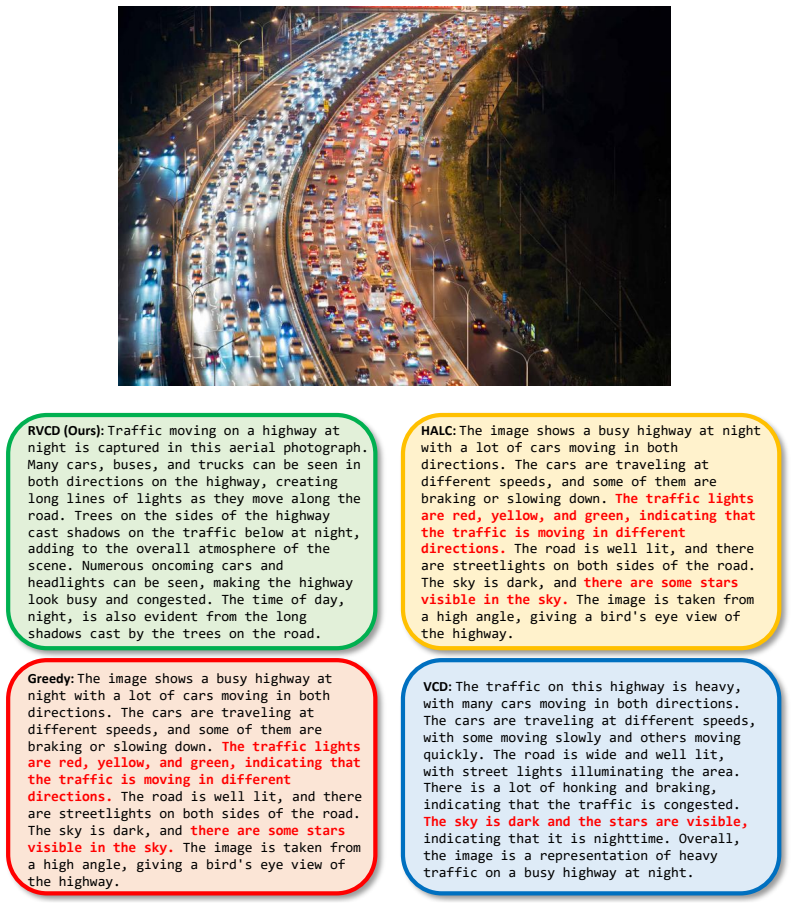

Forward citations
Cited by 1 Pith paper
-
MACD: Model-Aware Contrastive Decoding via Counterfactual Data
MACD reduces Video-LLM hallucination by masking model-identified critical objects/frames via gradient ascent and using the masked video as a contrastive decoding reference.
Reference graph
Works this paper leans on
-
[1]
Black Forest Labs . 2024. https://huggingface.co/black-forest-labs/FLUX.1-dev/blob/main/LICENSE.md FLUX.1 License . Accessed on February 7, 2025
work page 2024
-
[2]
Jun Chen, Deyao Zhu, Xiaoqian Shen, Xiang Li, Zechun Liu, Pengchuan Zhang, Raghuraman Krishnamoorthi, Vikas Chandra, Yunyang Xiong, and Mohamed Elhoseiny. 2023. Minigpt-v2: Large language model as a unified interface for vision-language multi-task learning https://arxiv.org/abs/2310.09478. arXiv:2310.09478
arXiv 2023
-
[3]
Xuweiyi Chen, Ziqiao Ma, Xuejun Zhang, Sihan Xu, Shengyi Qian, Jianing Yang, David F. Fouhey, and Joyce Chai. 2024 a . https://doi.org/10.48550/arXiv.2407.06192 Multi-object hallucination in vision-language models . In Proceedings of the 38th Conference on Neural Information Processing Systems (NeurIPS). Accepted to NeurIPS 2024
-
[4]
Zhaorun Chen, Zhuokai Zhao, Hongyin Luo, Huaxiu Yao, Bo Li, and Jiawei Zhou. 2024 b . HALC: Object hallucination reduction via adaptive focal-contrast decoding https://arxiv.org/abs/2403.00425. arXiv:2403.00425
arXiv 2024
-
[5]
Yung-Sung Chuang, Yujia Xie, Hongyin Luo, Yoon Kim, James Glass, and Pengcheng He. 2023. Dola: Decoding by contrasting layers improves factuality in large language models https://arxiv.org/abs/2309.03883. arXiv:2309.03883
arXiv 2023
-
[6]
Chenhang Cui, Yiyang Zhou, Xinyu Yang, Shirley Wu, Linjun Zhang, James Zou, and Huaxiu Yao. 2023. Holistic analysis of hallucination in GPT-4V (ision): Bias and interference challenges https://arxiv.org/abs/2311.03287. arXiv:2311.03287
arXiv 2023
-
[7]
Wenliang Dai, Zihan Liu, Ziwei Ji, Dan Su, and Pascale Fung. 2022. Plausible may not be faithful: Probing object hallucination in vision-language pre-training https://arxiv.org/abs/2210.07688. arXiv:2210.07688
arXiv 2022
-
[8]
Alessandro Favero, Luca Zancato, Matthew Trager, Siddharth Choudhary, Pramuditha Perera, Alessandro Achille, Ashwin Swaminathan, and Stefano Soatto. 2024. https://arxiv.org/abs/2403.14003 Multi-modal hallucination control by visual information grounding . In Proceedings of the Annual Meeting of the Association for Computational Linguistics (ACL). ArXiv:24...
arXiv 2024
Show all 45 references
-
[9]
Chaoyou Fu, Peixian Chen, Yunhang Shen, Yulei Qin, Mengdan Zhang, Xu Lin, Jinrui Yang, Xiawu Zheng, Ke Li, Xing Sun, Yunsheng Wu, and Rongrong Ji. 2023. MME: A comprehensive evaluation benchmark for multimodal large language models https://arxiv.org/abs/2306.13394. arXiv:2306.13394
2023 arXiv
-
[10]
Tianrui Guan, Fuxiao Liu, Xiyang Wu, Ruiqi Xian, Zongxia Li, Xiaoyu Liu, Xijun Wang, Lichang Chen, Furong Huang, Yaser Yacoob, Dinesh Manocha, and Tianyi Zhou. 2023. Hallusionbench: An advanced diagnostic suite for entangled language hallucination & visual illusion in large vi...
2023
-
[11]
Anisha Gunjal, Jihan Yin, and Erhan Bas. 2023. Detecting and preventing hallucinations in large vision language models https://arxiv.org/abs/2308.06394. arXiv:2308.06394
2023 arXiv
-
[12]
Qidong Huang, Xiaoyi Dong, Pan Zhang, Bin Wang, Conghui He, Jiaqi Wang, Dahua Lin, Weiming Zhang, and Nenghai Yu. 2023. Opera: Alleviating hallucination in multi-modal large language models via over-trust penalty and retrospection-allocation https://arxiv.org/abs/2311.17911. a...
2023 arXiv
-
[13]
Liqiang Jing and Xinya Du. 2024. FGAIF: Aligning Large Vision-Language Models with Fine-grained AI Feedback https://arxiv.org/abs/2404.05046. arXiv:2404.05046. Submitted on 7 Apr 2024 (v1), last revised 6 May 2025 (v2)
2024 arXiv
-
[14]
Sicong Leng, Hang Zhang, Guanzheng Chen, Xin Li, Shijian Lu, Chunyan Miao, and Lidong Bing. 2023. Mitigating object hallucinations in large vision-language models through visual contrastive decoding https://arxiv.org/abs/2311.16922. arXiv:2311.16922
2023 arXiv
-
[15]
Liunian Harold Li, Mark Yatskar, Da Yin, Cho-Jui Hsieh, and Kai-Wei Chang. 2019. Visualbert: A simple and performant baseline for vision and language https://arxiv.org/abs/1908.03557. arXiv:1908.03557
2019 arXiv
-
[16]
Yifan Li, Yifan Du, Kun Zhou, Jinpeng Wang, Wayne Xin Zhao, and Ji-Rong Wen. 2023. Evaluating object hallucination in large vision-language models https://arxiv.org/abs/2305.10355. arXiv:2305.10355
2023 arXiv
-
[17]
Lawrence Zitnick, and Piotr Dollár
Tsung-Yi Lin, Michael Maire, Serge Belongie, Lubomir Bourdev, Ross Girshick, James Hays, Pietro Perona, Deva Ramanan, C. Lawrence Zitnick, and Piotr Dollár. 2014. Microsoft coco: Common objects in context. In Computer Vision--ECCV 2014, pages 740--755. Springer
2014
-
[18]
Haotian Liu, Chunyuan Li, Yuheng Li, and Yong Jae Lee. 2023 a . Improved baselines with visual instruction tuning https://arxiv.org/abs/2310.03744. arXiv:2310.03744
2023 arXiv
-
[19]
Haotian Liu, Chunyuan Li, Qingyang Wu, and Yong Jae Lee. 2023 b . Visual instruction tuning https://arxiv.org/abs/2304.08485. arXiv:2304.08485
2023 arXiv
-
[20]
Shilong Liu, Zhaoyang Zeng, Tianhe Ren, Feng Li, Hao Zhang, Jie Yang, Qing Jiang, Chunyuan Li, Jianwei Yang, Hang Su, Jun Zhu, and Lei Zhang. 2023 c . Grounding DINO: Marrying DINO with Grounded Pre-Training for Open-Set Object Detection https://arxiv.org/abs/2303.05499. arXiv...
2023 arXiv
-
[21]
Kishore Papineni, Salim Roukos, Todd Ward, and Wei-Jing Zhu. 2002. Bleu: a method for automatic evaluation of machine translation. In Proceedings of the 40th Annual Meeting of the Association for Computational Linguistics, pages 311--318
2002
-
[22]
Alec Radford, Jong Wook Kim, Chris Hallacy, Aditya Ramesh, Gabriel Goh, Sandhini Agarwal, Girish Sastry, Amanda Askell, Pamela Mishkin, Jack Clark, Gretchen Krueger, and Ilya Sutskever. 2021. Learning transferable visual models from natural language supervision. In Internation...
2021
-
[23]
Joseph Redmon, Santosh Divvala, Ross Girshick, and Ali Farhadi. 2015. You Only Look Once: Unified, Real-Time Object Detection https://arxiv.org/abs/1506.02640. arXiv:1506.02640
2015 arXiv
-
[24]
Joseph Redmon and Ali Farhadi. 2018. YOLOv3: An Incremental Improvement https://arxiv.org/abs/1804.02767. arXiv:1804.02767. Tech Report
2018 arXiv
-
[25]
Tianhe Ren, Shilong Liu, Ailing Zeng, Jing Lin, Kunchang Li, He Cao, Jiayu Chen, Xinyu Huang, Yukang Chen, Feng Yan, Zhaoyang Zeng, Hao Zhang, Feng Li, Jie Yang, Hongyang Li, Qing Jiang, and Lei Zhang. 2024. Grounded SAM: Assembling Open-World Models for Diverse Visual Tasks h...
2024 arXiv
-
[26]
Anna Rohrbach, Lisa Anne Hendricks, Kaylee Burns, Trevor Darrell, and Kate Saenko. 2018. Object hallucination in image captioning https://arxiv.org/abs/1809.02156. arXiv:1809.02156
2018 arXiv
-
[27]
Zhiqing Sun, Sheng Shen, Shengcao Cao, Haotian Liu, Chunyuan Li, Yikang Shen, Chuang Gan, Liang-Yan Gui, Yu-Xiong Wang, Yiming Yang, Kurt Keutzer, and Trevor Darrell. 2023. Aligning Large Multimodal Models with Factually Augmented RLHF https://arxiv.org/abs/2309.14525. arXiv:2...
2023 arXiv
-
[28]
Haoqin Tu, Chenhang Cui, Zijun Wang, Yiyang Zhou, Bingchen Zhao, Junlin Han, Wangchunshu Zhou, Huaxiu Yao, and Cihang Xie. 2023. How many unicorns are in this image? A safety evaluation benchmark for vision LLMS https://arxiv.org/abs/2311.16101. arXiv:2311.16101
2023 arXiv
-
[29]
Ultralytics. 2023. https://github.com/ultralytics/ultralytics Yolo by ultralytics . Accessed on January 24, 2025
2023
-
[30]
Ultralytics. 2024. https://www.ultralytics.com/ko/blog/ultralytics-yolov8-turns-one-a-year-of-breakthroughs-and-innovations Ultralytics yolov8 turns one: A year of breakthroughs and innovations . Accessed on January 24, 2025
2024
-
[31]
Xiyao Wang, Yuhang Zhou, Xiaoyu Liu, Hongjin Lu, Yuancheng Xu, Feihong He, Jaehong Yoon, Taixi Lu, Gedas Bertasius, Mohit Bansal, Huaxiu Yao, and Furong Huang. 2024. Mementos: A comprehensive benchmark for multimodal large language model reasoning over image sequences https://...
2024 arXiv
-
[32]
Yun Xing, Yiheng Li, Ivan Laptev, and Shijian Lu. 2024. Mitigating Object Hallucination via Concentric Causal Attention https://arxiv.org/abs/2410.15926. arXiv:2410.15926. To appear at NeurIPS 2024, submitted on 21 Oct 2024
2024 arXiv
- [33]
-
[34]
Dingchen Yang, Bowen Cao, Guang Chen, and Changjun Jiang. 2024 b . Pensieve: Retrospect-then-Compare Mitigates Visual Hallucination https://arxiv.org/abs/2403.14401. arXiv:2403.14401. Submitted on 21 Mar 2024 (v1), last revised 1 Sep 2024 (v2)
2024 arXiv
-
[35]
Qinghao Ye, Haiyang Xu, Jiabo Ye, Ming Yan, Anwen Hu, Haowei Liu, Qi Qian, Ji Zhang, Fei Huang, and Jingren Zhou. 2023. mplug-owl2: Revolutionizing multi-modal large language model with modality collaboration https://arxiv.org/abs/2311.04257. arXiv:2311.04257
2023 arXiv
-
[36]
Shukang Yin, Chaoyou Fu, Sirui Zhao, Tong Xu, Hao Wang, Dianbo Sui, Yunhang Shen, Ke Li, Xing Sun, and Enhong Chen. 2023. Woodpecker: Hallucination correction for multimodal large language models https://arxiv.org/abs/2310.16045. arXiv:2310.16045
2023 arXiv
-
[37]
Bohan Zhai, Shijia Yang, Xiangchen Zhao, Chenfeng Xu, Sheng Shen, Dongdi Zhao, Kurt Keutzer, Manling Li, Tan Yan, and Xiangjun Fan. 2023. Halle-switch: Controlling object hallucination in large vision language models. arXiv e-prints, pages arXiv--2310
2023
-
[38]
Yiming Zhang, Zhuokai Zhao, Zhaorun Chen, Zhili Feng, Zenghui Ding, and Yining Sun. 2024. Rankclip: Ranking-consistent language-image pretraining https://arxiv.org/abs/2404.09387. arXiv:2404.09387
2024 arXiv
-
[39]
Yiyang Zhou, Chenhang Cui, Rafael Rafailov, Chelsea Finn, and Huaxiu Yao. 2024 a . Aligning modalities in vision large language models via preference fine-tuning https://arxiv.org/abs/2402.11411. arXiv:2402.11411
2024 arXiv
-
[40]
Yiyang Zhou, Chenhang Cui, Jaehong Yoon, Linjun Zhang, Zhun Deng, Chelsea Finn, Mohit Bansal, and Huaxiu Yao. 2023. Analyzing and mitigating object hallucination in large vision-language models https://arxiv.org/abs/2310.00754. arXiv:2310.00754
2023 arXiv
-
[41]
Yiyang Zhou, Zhiyuan Fan, Dongjie Cheng, Sihan Yang, Zhaorun Chen, Chenhang Cui, Xiyao Wang, Yun Li, Linjun Zhang, and Huaxiu Yao. 2024 b . Calibrated self-rewarding vision language models https://arxiv.org/abs/2405.14622. arXiv:2405.14622
2024 arXiv
-
[42]
Deyao Zhu, Jun Chen, Xiaoqian Shen, Xiang Li, and Mohamed Elhoseiny. 2023. Minigpt-4: Enhancing vision-language understanding with advanced large language models https://arxiv.org/abs/2304.10592. arXiv:2304.10592
2023 arXiv
-
[43]
Xianwei Zhuang, Zhihong Zhu, Zhanpeng Chen, Yuxin Xie, Liming Liang, , and Yuexian Zou. 2024. Game on tree: Visual hallucination mitigation via coarse-to-fine view tree and game theory. In Proceedings of the 2024 Conference on Empirical Methods in Natural Language Processing, ...
2024
-
[44]
online" 'onlinestring :=
ENTRY address archivePrefix author booktitle chapter edition editor eid eprint eprinttype howpublished institution journal key month note number organization pages publisher school series title type volume year doi pubmed url lastchecked label extra.label sort.label short.list...
-
[45]
write newline
" write newline "" before.all 'output.state := FUNCTION n.dashify 't := "" t empty not t #1 #1 substring "-" = t #1 #2 substring "--" = not "--" * t #2 global.max substring 't := t #1 #1 substring "-" = "-" * t #2 global.max substring 't := while if t #1 #1 substring * t #2 gl...
Reviewed August 7, 2026 · model on record in the stance chip above.
Discussion (0). Sign in to comment.