REVIEW 2 major objections 5 minor 71 references
Towards an Explainable Comparison and Alignment of Feature Embeddings
T0 review · 2 major / 5 minor · reviewed 2026-08-07 · deepseek-v4-flash
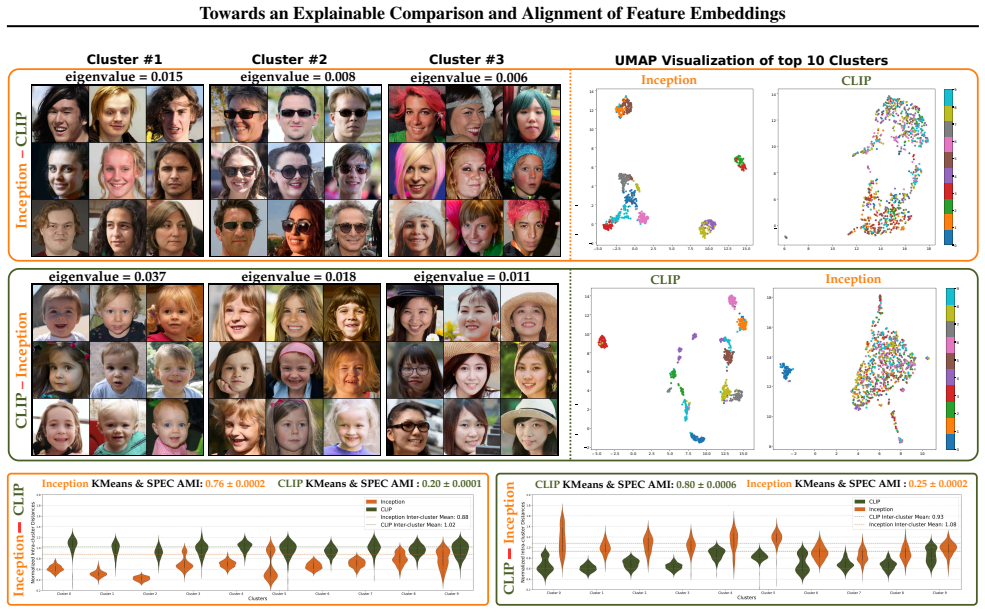
Pith's one-line read The principal eigenvectors of the normalized difference of two embeddings' kernel matrices mark the sample clusters one embedding captures and the other misses, computable in time linear in the number of samples.
desk verdict A useful spectral tool for embedding comparison that overstates its interpretability guarantee—worth reviewing, but the central claim needs a gap condition and the validation needs hardening. read the letter →
The pith
A machine-rendered reading of the paper's core claim, the machinery that carries it, and where it could break.
The reading
What carries the argument
The normalized kernel difference matrix $\Lambda_{\psi_1,\psi_2} = \frac{1}{n}(K_{\psi_1}-K_{\psi_2})$ is the object that carries the argument; its non-zero eigenspace is reinterpreted as a set of cluster indicators. The matching computational object is the differential covariance matrix $\Gamma_{\psi_1,\psi_2}$, a $(d_1+d_2)\times(d_1+d_2)$ block matrix built from the kernel covariance matrices of the two embeddings and their cross-covariance, which shares the non-zero eigenvalues of $\Lambda_{\psi_1,\psi_2}$ while having dimension independent of the sample size. For shift-invariant kernels, random Fourier features replace the infinite-dimensional feature map with a finite proxy and give the approximation error bound of Theorem 2.
What would settle it
Build a synthetic dataset with a well-separated cluster $I$ in embedding $\psi_1$ and make $\psi_2$ group inside $I$ but not across its boundary, so that the conditions of Theorem 1 hold with small $\epsilon_1$ and $\epsilon_2$; if the top eigenvector of $\Lambda_{\psi_1,\psi_2}$ then fails to concentrate on $I$, with its entries on $I^c$ exceeding $2\sqrt{\epsilon_1^2+\epsilon_2}/\gamma$ from Corollary 1, the central interpretation is false. On real data, the same check is available by computing the block norms for a SPEC-reported cluster and comparing the resulting $\xi$ with the measured eigenvalue gap.
Extended reading notes
Core claim
The paper's central claim is a spectral identification result: under two conditions on an index set $I$ — that embedding $\psi_1$ separates $I$ from its complement, $\|\frac{1}{n}K_{\psi_1}[I,I^c]\|_F \le \epsilon_1$, and that embedding $\psi_2$ groups $I$ only weakly, $\|\frac{1}{n}K_{\psi_2}[I,I]\|_2 \le \epsilon_2$ — the eigenvectors of $\Lambda_{\psi_1,\psi_2}=\frac{1}{n}(K_{\psi_1}-K_{\psi_2})$ concentrate their mass on $I$ or its complement, with total squared residual bounded by $\xi=4(\epsilon_1^2+\epsilon_2)$. Corollary 1 turns this into a per-eigenvector bound: if an eigenvalue is separated by $\gamma$ from the spectrum of the complement block, the off-cluster entries of the eigenvector have squared norm at most $4(\epsilon_1^2+\epsilon_2)/\gamma^2$. Proposition 1 supplies the scalable route: $\Lambda_{\psi_1,\psi_2}$ and the differential covariance matrix $\Gamma_{\psi_1,\psi_2}$ share their non-zero eigenvalues, so the eigendecomposition runs in $O(n(d_1+d_2)^2 + (d_1+d_2)^3)$ time, and Algorithm 1 computes the needed covariances in one streaming pass over the samples. The same eigenvalue spectrum defines the distance SPEC-diff, the spectral radius of $\Lambda_{\psi_1,\psi_2}$, and SPEC-align minimizes this distance by gradient descent using the top left and right eigenvectors of $\Gamma_{\psi_1,\psi_2}$.
Load-bearing premise
The method assumes that the groups the two embeddings cluster differently are spectrally separable, showing up as a clear, well-gapped direction in the kernel difference matrix, and the paper gives no procedure for checking that this is true on a given real dataset.
Editorial extensions
If this is right
- SPEC turns an embedding comparison into a checklist: each leading eigenvector names a concrete sample cluster, visualizable as images or sentences, that one model captures and the other misses.
- Because the eigendecomposition runs in time linear in $n$ for bounded feature dimension, SPEC applies to datasets of 100K samples or more, such as MS-COCO and FFHQ, without subsampling.
- SPEC-diff gives a symmetric, kernel-based distance between embeddings of different dimensions, and SPEC-align minimizes it by gradient descent; in the paper's setup, aligning CLIP to DINOv2 raised CLIP's frozen-feature ImageNet accuracy from 67.20% to 73.93%.
- Random Fourier features extend the linear-time computation to shift-invariant kernels such as the Gaussian RBF kernel, with an error that decays as $O(1/\sqrt{m})$ in the number of features.
- The comparison is directional: swapping the roles of the two embeddings reports clusters grouped by the second embedding but not the first, so the tool supports pairwise debugging of any two models.
Reading between the lines
- One natural extension the paper leaves implicit is using SPEC as an unsupervised diagnostic for spurious correlations: a leading eigenvector that separates CLIP's text-overlaid clusters from DINOv2's content clusters is exactly the kind of label-free signal useful for auditing a model before deployment.
- Because SPEC only needs kernel evaluations, it should apply to cross-modal and cross-architecture pairs beyond CLIP and DINOv2; the paper names cross-modal comparison as a future direction, and the same machinery would work for comparing image and text encoders with different dimensions.
- The spectral-separability conditions suggest a practical validator: after a SPEC run, one could compute the measured block norms $\epsilon_1,\epsilon_2$ for each reported cluster and use the size of $\xi$ relative to the eigenvalue gap to flag which clusters are trustworthy.
- A robustness check for real deployments would be to perturb the kernel matrices, by resampling the random Fourier features or subsampling the dataset, and ask whether the top clusters persist; the appendix reports RFF-count sensitivity, which supports this as a testable protocol.
Editorial analysis
A structured set of objections, weighed in public.
Referee Report
Summary. The paper proposes the Spectral Pairwise Embedding Comparison (SPEC) framework, which compares two feature embeddings by forming the normalized difference of their kernel matrices, Λ = (1/n)(K_ψ1 − K_ψ2), and interpreting the principal eigenvectors of Λ as clusters of samples grouped by ψ1 but not by ψ2. The paper proves Theorem 1, a residual bound over all eigenvectors under two conditions on a candidate index set I; Corollary 1, which bounds the entries of a single eigenvector on the complement set I^c under an additional spectral-gap condition; Proposition 1, showing that the nonzero spectrum of Λ can be obtained from a smaller differential covariance matrix with O(n) complexity for bounded feature dimension; Theorem 2, an RFF concentration bound for shift-invariant kernels; and Proposition 2, giving a gradient for a spectral-radius alignment objective. Experiments compare CLIP, DINOv2, Inception, SWAV, RoBERTa, and E5 embeddings on AFHQ, FFHQ, ImageNet, MS-COCO, and text datasets, and apply SPEC-align to finetune CLIP toward DINOv2, reporting improved ImageNet linear-probe accuracy.
Significance. If the central interpretation is justified, SPEC offers a scalable and genuinely interpretable tool for embedding comparison and alignment, complementing existing evaluation metrics that rely on downstream task accuracy. The O(n) differential-covariance implementation and the RFF concentration bound are concrete technical contributions; the large-scale experiments on 100K+ samples demonstrate practical scalability. The paper also makes an honest effort to validate its cluster interpretations beyond label-based metrics, notably the cosine-similarity ranking tests in Figures 16–17. However, the main theoretical claim is stated more strongly than what is proven: the eigenvector interpretation requires a spectral-separability condition that is neither stated as an explicit assumption nor verified empirically.
major comments (2)
- [Section 4 and Corollary 1] The paper states unconditionally that “the principal eigenvectors can be interpreted as the clusters of samples assigned by embedding ψ1 that are less strongly grouped by the second embedding ψ2,” but the proven support for this interpretation is conditional on a spectral gap: Corollary 1 requires λ − λmax(Λ[I^c, I^c]) ≥ γ > 0. Conditions 1 and 2 of Theorem 1 do not guarantee this gap; the block Λ[I^c, I^c] may itself have large positive eigenvalues, and the top eigenvalue may be degenerate, in which case an eigensolver returns an arbitrary mixture of cluster indicators. This gap between the stated claim and the proven theorem is load-bearing for the paper’s central contribution. Please restate the main claim as conditional on an explicit spectral-separability assumption, and add an empirical diagnostic (e.g., comparing the top eigenvalues of Λ with estimates of λmax(Λ[I^c, I^c]) for the identified clusters) to check this condition on real data.
- [Section 6, validation methodology] The AMI/NMI validation compares SPEC-derived cluster labels with K-Means labels computed on the same embedding that produced the eigenvectors. A high AMI for ψ1 only shows that SPEC labels are consistent with one possible clustering of ψ1’s space; it does not directly measure whether ψ2 fails to cluster those samples. The cosine-similarity ranking tests in Figures 16–17 are a much more direct validation of the “clustered by ψ1 but not ψ2” claim; please apply this type of check systematically to the reported clusters, or at least report a clustering-quality metric for ψ2 on the SPEC-identified sample groups.
minor comments (5)
- [Appendix A.1, final inequality] The proof uses the statement “for every PSD matrix A and vector v” to justify ∥Av − λv∥ ≥ |λ_j − λ| ∥v∥; the matrices Λ11 and Λ22 are not necessarily PSD. The inequality holds for all symmetric matrices, so replacing “PSD” with “symmetric” fixes the statement without changing the argument.
- [Definition 1] The notation “Λψ1,ψ2 ∈ Rn” is misleading; the matrix is n × n, so it should be R^{n×n}.
- [Algorithm 1, line 11] The mapped eigenvectors u_i are not normalized before being used for cluster identification; since clustering thresholds entries of u_i, normalization (or at least a stated convention) is needed for interpretability and comparability across eigenvectors.
- [Section 6, Experimental settings] The bandwidth selection rule “selected the embeddings bandwidths such that the difference between top eigenvalue is less than 0.01” is data-dependent and under-specified; please provide the exact procedure and report the chosen σ values for reproducibility.
- [Appendix A.3 and Remark 1] The Cholesky-based method for symmetric eigendecomposition of Θ is a useful contribution; however, the text should clarify that the correspondence holds only for nonzero eigenvalues and does not recover the null space of Λ, which is important when interpreting zero eigenvalues.
Circularity Check
No significant circularity: the SPEC eigenvector-cluster interpretation is supported by a self-contained perturbation bound; remaining issues are unverified spectral-gap assumptions and a self-referential sanity check, not circular reductions.
full rationale
The paper's central derivation is self-contained. Theorem 1 (Section 4, proof in Appendix A.1) treats the normalized kernel difference Λ = (1/n)(K_ψ1 − K_ψ2) as a perturbation of its block diagonal by the cross-block term Λ12, and uses Conditions 1–2 plus the PSD Schur complement to bound the sum of squared eigenvector residuals by ξ = 4(ε1² + ε2). Corollary 1 then converts this sum bound into an entrywise localization bound for an eigenvector whose eigenvalue clears the complement block by γ. This is a genuine mathematical argument with no fitted parameter and no appeal to the paper's own conclusions. The O(n) complexity (Proposition 1) is the standard nonzero-eigenvalue identity for AB and BA, proved in Appendix A.2; the RFF approximation (Theorem 2) is a separate concentration bound. SPEC-diff is defined as the spectral radius of Λ, and SPEC-align uses a gradient formula derived from the Jordan canonical form (Proposition 2), so the alignment objective does not presuppose the cluster interpretation. Two caveats are worth stating but they are not circularity. First, the paper's Section 4 wording, 'the principal eigenvectors can be interpreted as the clusters of samples assigned by embedding ψ1 that are less strongly grouped by the second embedding ψ2,' is stronger than what Conditions 1–2 alone prove; Corollary 1 requires an additional eigenvalue-gap condition, and the conclusion later admits 'the SPEC approach operates based on the assumption that the differently clustered samples can be detected by the spectral method.' This is an unverified assumption and a proof-to-claim gap, not a reduction of the claim to its inputs. Second, the KMeans-AMI sanity check in Section 6 compares SPEC labels to KMeans computed on the same embedding features whose kernel generated the eigenvectors, so high AMI is partly an internal-consistency check rather than independent ground truth; the bandwidth is also set using a criterion cited from the authors' prior generative-model papers. These choices affect interpretability of the experiments, but the theoretical result does not depend on them, and the ImageNet linear-probe result is an external benchmark. Overall, I find no step where a prediction is equivalent to a fitted parameter or to a self-citation by construction.
Assumptions & free parameters
free parameters (3)
- Gaussian kernel bandwidth σ (per embedding, per dataset) =
not reported; selected so that top eigenvalues differ by < 0.01
- Number of random Fourier features m =
2000 (main experiments)
- SPEC-align alignment loss weight β =
0.1
assumptions (5)
- standard math AB and BA share the same non-zero eigenvalues for any matrices A, B
- standard math For a symmetric matrix A and vector v, ||Av - λv|| >= min_j |λ_j(A) - λ| ||v||
- domain assumption Kernel matrices are PSD and normalized kernels satisfy k(x,x)=1, giving trace((1/n)K)=1
- domain assumption The top eigenvalue of Γ, in absolute value, is simple (unique) so that the gradient formula in Proposition 2 holds
- standard math Vector Bernstein inequality applies to the sum of bounded random matrices
Cite this review
Pith. "Pith review of Towards an Explainable Comparison and Alignment of Feature Embeddings." pith.science (2026). https://pith.science/paper/ODH2OL5U
@misc{pith2026250606231,
  author       = {Pith},
  title        = {Pith review of: Towards an Explainable Comparison and Alignment of Feature Embeddings},
  year         = {2026},
  howpublished = {\url{https://pith.science/paper/ODH2OL5U}},
  note         = {Machine review of arXiv:2506.06231}
}
read the original abstract
While several feature embedding models have been developed in the literature, comparisons of these embeddings have largely focused on their numerical performance in classification-related downstream applications. However, an interpretable comparison of different embeddings requires identifying and analyzing mismatches between sample groups clustered within the embedding spaces. In this work, we propose the \emph{Spectral Pairwise Embedding Comparison (SPEC)} framework to compare embeddings and identify their differences in clustering a reference dataset. Our approach examines the kernel matrices derived from two embeddings and leverages the eigendecomposition of the difference kernel matrix to detect sample clusters that are captured differently by the two embeddings. We present a scalable implementation of this kernel-based approach, with computational complexity that grows linearly with the sample size. Furthermore, we introduce an optimization problem using this framework to align two embeddings, ensuring that clusters identified in one embedding are also captured in the other model. We provide numerical results demonstrating the SPEC's application to compare and align embeddings on large-scale datasets such as ImageNet and MS-COCO. The project page is available at https://mjalali.github.io/SPEC/.
Figures


Figures from the paper (23 more)




Reference graph
Works this paper leans on
-
[1]
write newline
" write newline "" before.all 'output.state := FUNCTION n.dashify 't := "" t empty not t #1 #1 substring "-" = t #1 #2 substring "--" = not "--" * t #2 global.max substring 't := t #1 #1 substring "-" = "-" * t #2 global.max substring 't := while if t #1 #1 substring * t #2 global.max substring 't := if while FUNCTION format.date year duplicate empty "emp...
-
[2]
Fine-grained analysis of sentence embeddings using auxiliary prediction tasks
Adi, Y., Kermany, E., Belinkov, Y., Lavi, O., and Goldberg, Y. Fine-grained analysis of sentence embeddings using auxiliary prediction tasks. In International Conference on Learning Representations, 2017
work page 2017
-
[3]
Flamingo: a visual language model for few-shot learning
Alayrac, J.-B., Donahue, J., Luc, P., Miech, A., Barr, I., Hasson, Y., Lenc, K., Mensch, A., Millican, K., Reynolds, M., Ring, R., Rutherford, E., Cabi, S., Han, T., Gong, Z., Samangooei, S., Monteiro, M., Menick, J., Borgeaud, S., Brock, A., Nematzadeh, A., Sharifzadeh, S., Binkowski, M., Barreira, R., Vinyals, O., Zisserman, A., and Simonyan, K. Flaming...
arXiv 2022
-
[4]
Probing classifiers: Promises, shortcomings, and advances
Belinkov, Y. Probing classifiers: Promises, shortcomings, and advances. Computational Linguistics, 48 0 (1): 0 207--219, 04 2022. ISSN 0891-2017. doi:10.1162/coli_a_00422
-
[5]
M., Baldock, R., Nanda, S., Oostermeijer, K., Cruz-Salinas, A
Bellagente, M., Brack, M., Teufel, H., Friedrich, F., Deiseroth, B., Eichenberg, C., Dai, A. M., Baldock, R., Nanda, S., Oostermeijer, K., Cruz-Salinas, A. F., Schramowski, P., Kersting, K., and Weinbach, S. Multifusion: Fusing pre-trained models for multi-lingual, multi-modal image generation. In Advances in Neural Information Processing Systems, volume ...
work page 2023
-
[6]
Spectral clustering and kernel PCA are learning eigenfunctions , volume 1239
Bengio, Y., Vincent, P., Paiement, J.-F., Delalleau, O., Ouimet, M., and Le Roux, N. Spectral clustering and kernel PCA are learning eigenfunctions , volume 1239. Citeseer, 2003 a
work page 2003
-
[7]
Learning eigenfunctions of similarity: linking spectral clustering and kernel PCA
Bengio, Y., Vincent, P., Paiement, J.-F., Delalleau, O., Ouimet, M., and LeRoux, N. Learning eigenfunctions of similarity: linking spectral clustering and kernel PCA . Technical report, Technical Report 1232, Departement d’Informatique et Recherche Oprationnelle …, 2003 b
work page 2003
-
[8]
Bi \'n kowski, M., Sutherland, D. J., Arbel, M., and Gretton, A. Demystifying MMD GANs . arXiv preprint arXiv:1801.01401, 2018
arXiv 2018
Show all 71 references
-
[9]
Embedding comparator: Visualizing differences in global structure and local neighborhoods via small multiples
Boggust, A., Carter, B., and Satyanarayan, A. Embedding comparator: Visualizing differences in global structure and local neighborhoods via small multiples. In Proceedings of the 27th International Conference on Intelligent User Interfaces, IUI '22, pp.\ 746–766, New York, NY,...
2022
-
[10]
Unsupervised learning of visual features by contrasting cluster assignments, 2021
Caron, M., Misra, I., Mairal, J., Goyal, P., Bojanowski, P., and Joulin, A. Unsupervised learning of visual features by contrasting cluster assignments, 2021
2021
-
[11]
The expressive power of word embeddings, 2013
Chen, Y., Perozzi, B., Al-Rfou, R., and Skiena, S. The expressive power of word embeddings, 2013. URL https://arxiv.org/abs/1301.3226
2013 arXiv
-
[12]
Chitta, R., Jin, R., and Jain, A. K. Efficient kernel clustering using random fourier features. In 2012 IEEE 12th International Conference on Data Mining, pp.\ 161--170. IEEE, 2012
2012
-
[13]
Evaluation of BERT and ALBERT sentence embedding performance on downstream NLP tasks
Choi, H., Kim, J., Joe, S., and Gwon, Y. Evaluation of BERT and ALBERT sentence embedding performance on downstream NLP tasks. In 2020 25th International Conference on Pattern Recognition (ICPR), pp.\ 5482--5487, 2021. doi:10.1109/ICPR48806.2021.9412102
2020
-
[14]
StarGAN v2: Diverse image synthesis for multiple domains
Choi, Y., Uh, Y., Yoo, J., and Ha, J.-W. StarGAN v2: Diverse image synthesis for multiple domains. In Proceedings of the IEEE/CVF Conference on Computer Vision and Pattern Recognition (CVPR), June 2020
2020
-
[15]
Analyzing transformers in embedding space
Dar, G., Geva, M., Gupta, A., and Berant, J. Analyzing transformers in embedding space. In Proceedings of the 61st Annual Meeting of the Association for Computational Linguistics (Volume 1: Long Papers), pp.\ 16124--16170, Toronto, Canada, July 2023. Association for Computatio...
2023 doi
-
[16]
B., Cheung, J
Darrin, M., Formont, P., Ayed, I. B., Cheung, J. C., and Piantanida, P. When is an embedding model more promising than another? In The Thirty-eighth Annual Conference on Neural Information Processing Systems, 2024. URL https://openreview.net/forum?id=VqFz7iTGcl
2024
-
[17]
ImageNet: A Large-Scale Hierarchical Image Database
Deng, J., Dong, W., Socher, R., Li, L.-J., Li, K., and Fei-Fei, L. ImageNet: A Large-Scale Hierarchical Image Database . In CVPR09, 2009
2009
-
[18]
and de Melo, G
Eslami, S. and de Melo, G. Mitigate the gap: Improving cross-modal alignment in CLIP . In The Thirteenth International Conference on Learning Representations, 2025. URL https://openreview.net/forum?id=aPTGvFqile
2025
-
[19]
S im CSE : Simple contrastive learning of sentence embeddings
Gao, T., Yao, X., and Chen, D. S im CSE : Simple contrastive learning of sentence embeddings. In Proceedings of the 2021 Conference on Empirical Methods in Natural Language Processing, pp.\ 6894--6910, Online and Punta Cana, Dominican Republic, November 2021. Association for C...
2021 doi
-
[20]
o m, N., and Sch \
Gedon, D., Ribeiro, A. H., Wahlstr \"o m, N., and Sch \"o n, T. B. Invertible kernel PCA with random fourier features. IEEE Signal Processing Letters, 30: 0 563--567, 2023
2023
-
[21]
J., and Phillips, J
Ghashami, M., Perry, D. J., and Phillips, J. Streaming kernel principal component analysis. In Artificial intelligence and statistics, pp.\ 1365--1374. PMLR, 2016
2016
-
[22]
V., Joulin, A., and Misra, I
Girdhar, R., El-Nouby, A., Liu, Z., Singh, M., Alwala, K. V., Joulin, A., and Misra, I. Imagebind: One embedding space to bind them all. In CVPR, 2023
2023
-
[23]
Unsupervised alignment of embeddings with wasserstein procrustes
Grave, E., Joulin, A., and Berthet, Q. Unsupervised alignment of embeddings with wasserstein procrustes. In Chaudhuri, K. and Sugiyama, M. (eds.), Proceedings of the Twenty-Second International Conference on Artificial Intelligence and Statistics, volume 89 of Proceedings of M...
2019
-
[24]
Recovering low-rank matrices from few coefficients in any basis
Gross, D. Recovering low-rank matrices from few coefficients in any basis. IEEE Transactions on Information Theory, 57 0 (3): 0 1548--1566, 2011
2011
-
[25]
Onellm: One framework to align all modalities with language
Han, J., Gong, K., Zhang, Y., Wang, J., Zhang, K., Lin, D., Qiao, Y., Gao, P., and Yue, X. Onellm: One framework to align all modalities with language. In Proceedings of the IEEE/CVF Conference on Computer Vision and Pattern Recognition (CVPR), 2024
2024
-
[26]
Gans trained by a two time-scale update rule converge to a local nash equilibrium
Heusel, M., Ramsauer, H., Unterthiner, T., Nessler, B., and Hochreiter, S. Gans trained by a two time-scale update rule converge to a local nash equilibrium. Advances in neural information processing systems, 30, 2017
2017
-
[27]
ImageWoof : a subset of 10 classes from imagenet that aren't so easy to classify, March 2019
Howard, J. ImageWoof : a subset of 10 classes from imagenet that aren't so easy to classify, March 2019. URL https://github.com/fastai/imagenette#imagewoof
2019
-
[28]
T., and Farnia, F
Jalali, M., Li, C. T., and Farnia, F. An information-theoretic evaluation of generative models in learning multi-modal distributions. In Thirty-seventh Conference on Neural Information Processing Systems, 2023. URL https://openreview.net/forum?id=PdZhf6PiAb
2023
-
[29]
C onditional V endi S core: An information-theoretic approach to diversity evaluation of prompt-based generative models
Jalali, M., Ospanov, A., Gohari, A., and Farnia, F. C onditional V endi S core: An information-theoretic approach to diversity evaluation of prompt-based generative models. arXiv preprint arXiv:2411.02817, 2024. URL https://arxiv.org/abs/2411.02817
2024 arXiv
-
[30]
Feature likelihood score: Evaluating the generalization of generative models using samples
Jiralerspong, M., Bose, J., Gemp, I., Qin, C., Bachrach, Y., and Gidel, G. Feature likelihood score: Evaluating the generalization of generative models using samples. In Thirty-seventh Conference on Neural Information Processing Systems, 2023. URL https://openreview.net/forum?...
2023
-
[31]
A style-based generator architecture for generative adversarial networks
Karras, T., Laine, S., and Aila, T. A style-based generator architecture for generative adversarial networks. In 2019 IEEE/CVF Conference on Computer Vision and Pattern Recognition (CVPR), pp.\ 4396--4405, 2019. doi:10.1109/CVPR.2019.00453
2019
-
[32]
Kohler, J. M. and Lucchi, A. Sub-sampled cubic regularization for non-convex optimization. In International Conference on Machine Learning, pp.\ 1895--1904. PMLR, 2017
1904
-
[33]
The role of ImageNet classes in F r\'echet inception distance
Kynk \"a \"a nniemi, T., Karras, T., Aittala, M., Aila, T., and Lehtinen, J. The role of ImageNet classes in F r\'echet inception distance. In The Eleventh International Conference on Learning Representations, 2023. URL https://openreview.net/forum?id=4oXTQ6m_ws8
2023
-
[34]
BLIP-2: bootstrapping language-image pre-training with frozen image encoders and large language models
Li, J., Li, D., Savarese, S., and Hoi, S. BLIP-2: bootstrapping language-image pre-training with frozen image encoders and large language models. In ICML, 2023
2023
-
[35]
L., and Dollár, P
Lin, T.-Y., Maire, M., Belongie, S., Bourdev, L., Girshick, R., Hays, J., Perona, P., Ramanan, D., Zitnick, C. L., and Dollár, P. Microsoft COCO : Common objects in context, 2015
2015
-
[36]
Liu, H., Li, C., Wu, Q., and Lee, Y. J. Visual instruction tuning. In Advances in Neural Information Processing Systems, volume 36, pp.\ 34892--34916. Curran Associates, Inc., 2023
2023
-
[37]
Ro BERT a: A robustly optimized BERT pretraining approach, 2020
Liu, Y., Ott, M., Goyal, N., Du, J., Joshi, M., Chen, D., Levy, O., Lewis, M., Zettlemoyer, L., and Stoyanov, V. Ro BERT a: A robustly optimized BERT pretraining approach, 2020. URL https://openreview.net/forum?id=SyxS0T4tvS
2020
-
[38]
Ovis: Structural embedding alignment for multimodal large language model
Lu, S., Li, Y., Chen, Q.-G., Xu, Z., Luo, W., Zhang, K., and Ye, H.-J. Ovis: Structural embedding alignment for multimodal large language model. arXiv:2405.20797, 2024
2024 arXiv
-
[39]
Disentangling visual and written concepts in clip
Materzynska, J., Torralba, A., and Bau, D. Disentangling visual and written concepts in clip. In IEEE Conference on Computer Vision and Pattern Recognition (CVPR), 2022
2022
-
[40]
Umap: Uniform manifold approximation and projection for dimension reduction
McInnes, L., Healy, J., and Melville, J. Umap: Uniform manifold approximation and projection for dimension reduction. arXiv preprint arXiv:1802.03426, 2018
2018 arXiv
-
[41]
Pointer sentinel mixture models
Merity, S., Xiong, C., Bradbury, J., and Socher, R. Pointer sentinel mixture models. arXiv preprint arXiv:1609.07843, 2016
2016 arXiv
-
[42]
MTEB : Massive text embedding benchmark
Muennighoff, N., Tazi, N., Magne, L., and Reimers, N. MTEB : Massive text embedding benchmark. In Vlachos, A. and Augenstein, I. (eds.), Proceedings of the 17th Conference of the European Chapter of the Association for Computational Linguistics, pp.\ 2014--2037, Dubrovnik, Cro...
2014 doi
-
[43]
On spectral clustering: Analysis and an algorithm
Ng, A., Jordan, M., and Weiss, Y. On spectral clustering: Analysis and an algorithm. In Dietterich, T., Becker, S., and Ghahramani, Z. (eds.), Advances in Neural Information Processing Systems, volume 14. MIT Press, 2001. URL https://proceedings.neurips.cc/paper_files/paper/20...
2001
-
[44]
Dinov2: Learning robust visual features without supervision, 2024
Oquab, M., Darcet, T., Moutakanni, T., Vo, H., Szafraniec, M., Khalidov, V., Fernandez, P., Haziza, D., Massa, F., El-Nouby, A., Assran, M., Ballas, N., Galuba, W., Howes, R., Huang, P.-Y., Li, S.-W., Misra, I., Rabbat, M., Sharma, V., Synnaeve, G., Xu, H., Jegou, H., Mairal, ...
2024
-
[45]
and Farnia, F
Ospanov, A. and Farnia, F. On the statistical complexity of estimating Vendi Scores from empirical data, 2024. URL https://arxiv.org/abs/2410.21719
2024 arXiv
-
[46]
Towards a scalable reference-free evaluation of generative models
Ospanov, A., Zhang, J., Jalali, M., Cao, X., Bogdanov, A., and Farnia, F. Towards a scalable reference-free evaluation of generative models. In The Thirty-eighth Annual Conference on Neural Information Processing Systems, 2024. URL https://openreview.net/forum?id=Ex3rPvEct8
2024
-
[47]
Pasarkar, A. P. and Dieng, A. B. Cousins of the vendi score: A family of similarity-based diversity metrics for science and machine learning. In International Conference on Artificial Intelligence and Statistics, pp.\ 3808--3816. PMLR, 2024
2024
-
[48]
S., Silveira, R., and Paula, T
Perone, C. S., Silveira, R., and Paula, T. S. Evaluation of sentence embeddings in downstream and linguistic probing tasks. ArXiv, abs/1806.06259, 2018. URL https://api.semanticscholar.org/CorpusID:49306018
2018 arXiv
-
[49]
H., Zmigrod, R., Williams, A., and Cotterell, R
Pimentel, T., Valvoda, J., Maudslay, R. H., Zmigrod, R., Williams, A., and Cotterell, R. Information-theoretic probing for linguistic structure. In Proceedings of the 58th Annual Meeting of the Association for Computational Linguistics, pp.\ 4609--4622, Online, July 2020. Asso...
2020
-
[50]
W., Hallacy, C., Ramesh, A., Goh, G., Agarwal, S., Sastry, G., Askell, A., Mishkin, P., Clark, J., Krueger, G., and Sutskever, I
Radford, A., Kim, J. W., Hallacy, C., Ramesh, A., Goh, G., Agarwal, S., Sastry, G., Askell, A., Mishkin, P., Clark, J., Krueger, G., and Sutskever, I. Learning transferable visual models from natural language supervision, 2021
2021
-
[51]
and Recht, B
Rahimi, A. and Recht, B. Random features for large-scale kernel machines. Advances in neural information processing systems, 20, 2007 a
2007
-
[52]
and Recht, B
Rahimi, A. and Recht, B. Random features for large-scale kernel machines. In Advances in Neural Information Processing Systems, volume 20. Curran Associates, Inc., 2007 b
2007
-
[53]
and Gurevych, I
Reimers, N. and Gurevych, I. Sentence- BERT : Sentence embeddings using S iamese BERT -networks. In Proceedings of the 2019 Conference on Empirical Methods in Natural Language Processing and the 9th International Joint Conference on Natural Language Processing (EMNLP-IJCNLP), ...
2019 doi
-
[54]
A primer in BERT ology: What we know about how BERT works
Rogers, A., Kovaleva, O., and Rumshisky, A. A primer in BERT ology: What we know about how BERT works. Transactions of the Association for Computational Linguistics, 8: 0 842--866, 01 2021. ISSN 2307-387X
2021
-
[55]
Salman, S., Shams, M. M. B., and Liu, X. Unaligning everything: Or aligning any text to any image in multimodal models. arXiv preprint arXiv:2407.01157, 2024
2024 arXiv
-
[56]
Word embedding evaluation in downstream tasks and semantic analogies
Santos, J., Consoli, B., and Vieira, R. Word embedding evaluation in downstream tasks and semantic analogies. In Proceedings of the Twelfth Language Resources and Evaluation Conference, pp.\ 4828--4834, Marseille, France, May 2020. European Language Resources Association. ISBN...
2020
-
[57]
Nonlinear Component Analysis as a Kernel Eigenvalue Problem
Schölkopf, B., Smola, A., and Müller, K.-R. Nonlinear Component Analysis as a Kernel Eigenvalue Problem . Neural Computation, 10 0 (5): 0 1299--1319, July 1998. ISSN 0899-7667. doi:10.1162/089976698300017467. URL https://ieeexplore.ieee.org/document/6790375. Conference Name: N...
1998
-
[58]
and Markovitch, S
Simhi, A. and Markovitch, S. Interpreting embedding spaces by conceptualization. In The 2023 Conference on Empirical Methods in Natural Language Processing, 2023. URL https://openreview.net/forum?id=sPpft5DQJN
2023
-
[59]
Sriperumbudur, B. K. and Sterge, N. Approximate kernel PCA : Computational versus statistical trade-off. The Annals of Statistics, 50 0 (5): 0 2713--2736, 2022
2022
-
[60]
L., Taylor, E., and Loaiza-Ganem, G
Stein, G., Cresswell, J., Hosseinzadeh, R., Sui, Y., Ross, B., Villecroze, V., Liu, Z., Caterini, A. L., Taylor, E., and Loaiza-Ganem, G. Exposing flaws of generative model evaluation metrics and their unfair treatment of diffusion models. In Advances in Neural Information Pro...
2023
-
[61]
Rethinking the inception architecture for computer vision
Szegedy, C., Vanhoucke, V., Ioffe, S., Shlens, J., and Wojna, Z. Rethinking the inception architecture for computer vision. In Proceedings of the IEEE conference on computer vision and pattern recognition, pp.\ 2818--2826, 2016
2016
-
[62]
V., and Arora, R
Ullah, E., Mianjy, P., Marinov, T. V., and Arora, R. Streaming kernel PCA with o( n ) random features. Advances in Neural Information Processing Systems, 31, 2018
2018
-
[63]
and Hinton, G
Van der Maaten, L. and Hinton, G. Visualizing data using t-sne. Journal of machine learning research, 9 0 (11), 2008
2008
-
[64]
X., Epps, J., and Bailey, J
Vinh, N. X., Epps, J., and Bailey, J. Information theoretic measures for clusterings comparison: is a correction for chance necessary? In Proceedings of the 26th annual international conference on machine learning, pp.\ 1073--1080, 2009
2009
-
[65]
Improving text embeddings with large language models
Wang, L., Yang, N., Huang, X., Yang, L., Majumder, R., and Wei, F. Improving text embeddings with large language models. arXiv preprint arXiv:2401.00368, 2023 a
2023 arXiv
-
[66]
Understanding how dimension reduction tools work: An empirical approach to deciphering t-sne, umap, trimap, and pacmap for data visualization
Wang, Y., Huang, H., Rudin, C., and Shaposhnik, Y. Understanding how dimension reduction tools work: An empirical approach to deciphering t-sne, umap, trimap, and pacmap for data visualization. Journal of Machine Learning Research, 22 0 (201): 0 1--73, 2021. URL http://jmlr.or...
2021
-
[67]
Connecting multi-modal contrastive representations
Wang, Z., Zhao, Y., Cheng, X., Huang, H., Liu, J., Tang, L., Li, L., Wang, Y., Yin, A., Zhang, Z., and Zhao, Z. Connecting multi-modal contrastive representations. In Proceedings of the 37th International Conference on Neural Information Processing Systems, NIPS '23. Curran As...
2023
-
[68]
Modalchorus: Visual probing and alignment of multi-modal embeddings via modal fusion map
Ye, Y., Xiao, S., Zeng, X., and Zeng, W. Modalchorus: Visual probing and alignment of multi-modal embeddings via modal fusion map. IEEE Transactions on Visualization and Computer Graphics, 2024
2024
-
[69]
Sea: Supervised embedding alignment for token-level visual-textual integration in mllms
Yin, Y., Zhao, Y., Zhang, Y., Lin, K., Wang, J., Tao, X., Wan, P., Zhang, D., Yin, B., and Zhang, W. Sea: Supervised embedding alignment for token-level visual-textual integration in mllms. arXiv preprint arXiv:2408.11813, 2024
2024 arXiv
-
[70]
T., and Farnia, F
Zhang, J., Li, C. T., and Farnia, F. An interpretable evaluation of entropy-based novelty of generative models. In Proceedings of the 41st International Conference on Machine Learning, volume 235 of Proceedings of Machine Learning Research, pp.\ 59148--59172. PMLR, 21--27 Jul 2024
2024
-
[71]
T., and Farnia, F
Zhang, J., Jalali, M., Li, C. T., and Farnia, F. Unveiling differences in generative models: A scalable differential clustering approach. In Proceedings of the IEEE/CVF Conference on Computer Vision and Pattern Recognition (CVPR) , 2025. URL https://arxiv.org/abs/2405.02700
2025 arXiv
Reviewed August 7, 2026 · model on record in the stance chip above.
Discussion (0). Sign in to comment.