REVIEW 1 major objections 1 minor 1 cited by
Detectability to extreme mass ratio inspirals with alternative space-based detector networks
T0 review · 1 major / 1 minor · reviewed 2026-06-27 · grok-4.3
Pith's one-line read A three-detector network of LISA, TAIJI and TianQin yields EMRI parameter constraints in one month that match or exceed those from LISA alone after one year.
desk verdict Fisher-matrix estimates show a LISA-TAIJI-TianQin network over one month can match or beat LISA-alone constraints for EMRIs and help separate overlapping signals, but the lack of any full-likelihood checks leaves the size of those gains unverified. read the letter →
The pith
A machine-rendered reading of the paper's core claim, the machinery that carries it, and where it could break.
The reading
What carries the argument
Fisher information matrix analysis of simulated EMRI waveforms in multi-detector networks, used to derive parameter uncertainties, correlations, and source localization errors.
What would settle it
A direct comparison of Fisher-matrix uncertainty predictions against full Bayesian posterior widths extracted from simulated one-month network data containing one or two EMRIs; substantial disagreement in the recovered errors would falsify the central claims.
Extended reading notes
Core claim
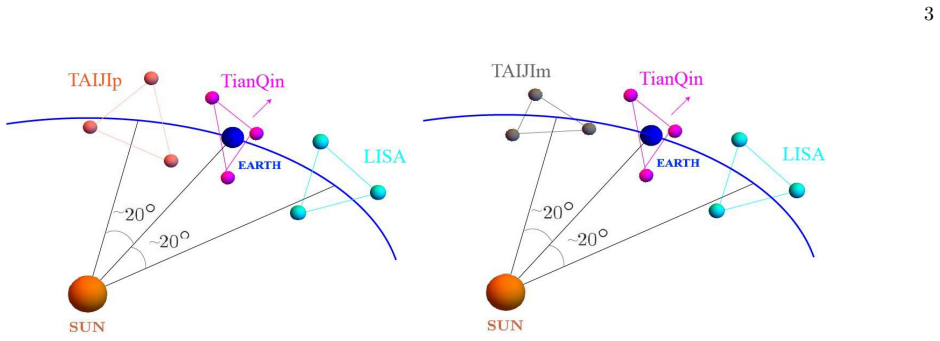
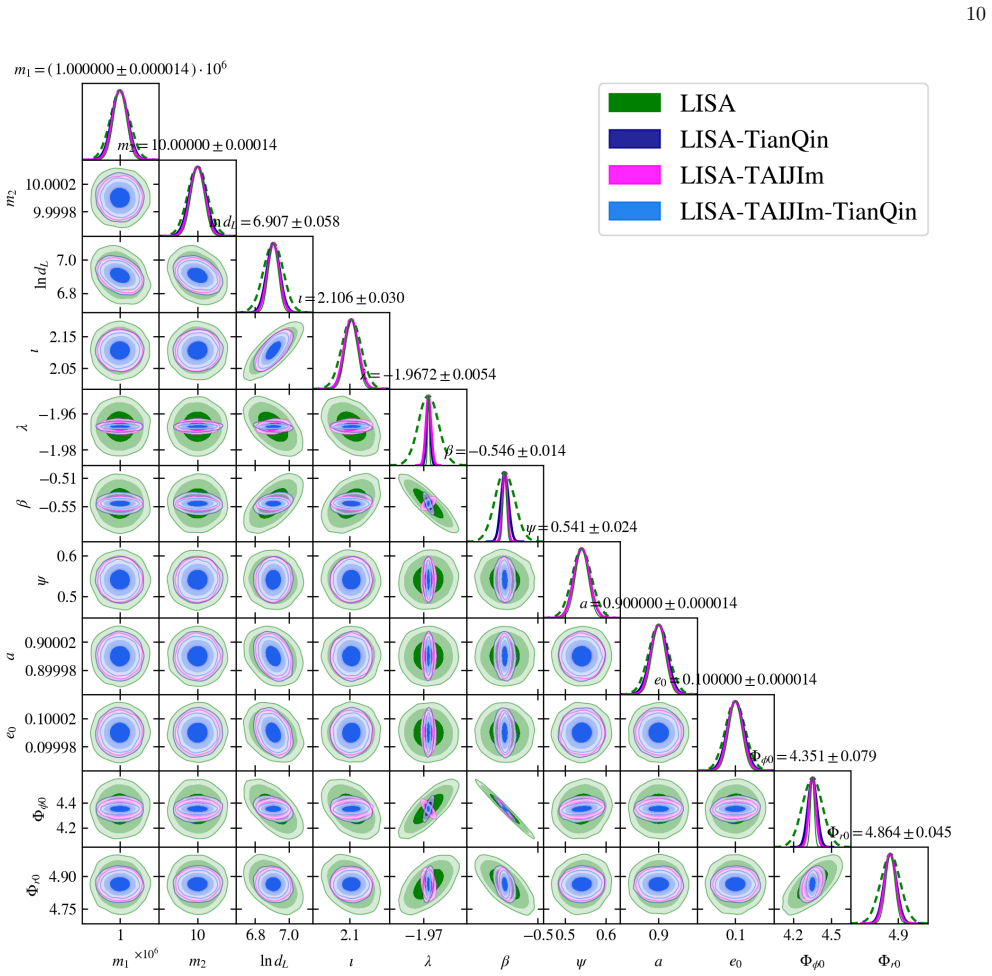
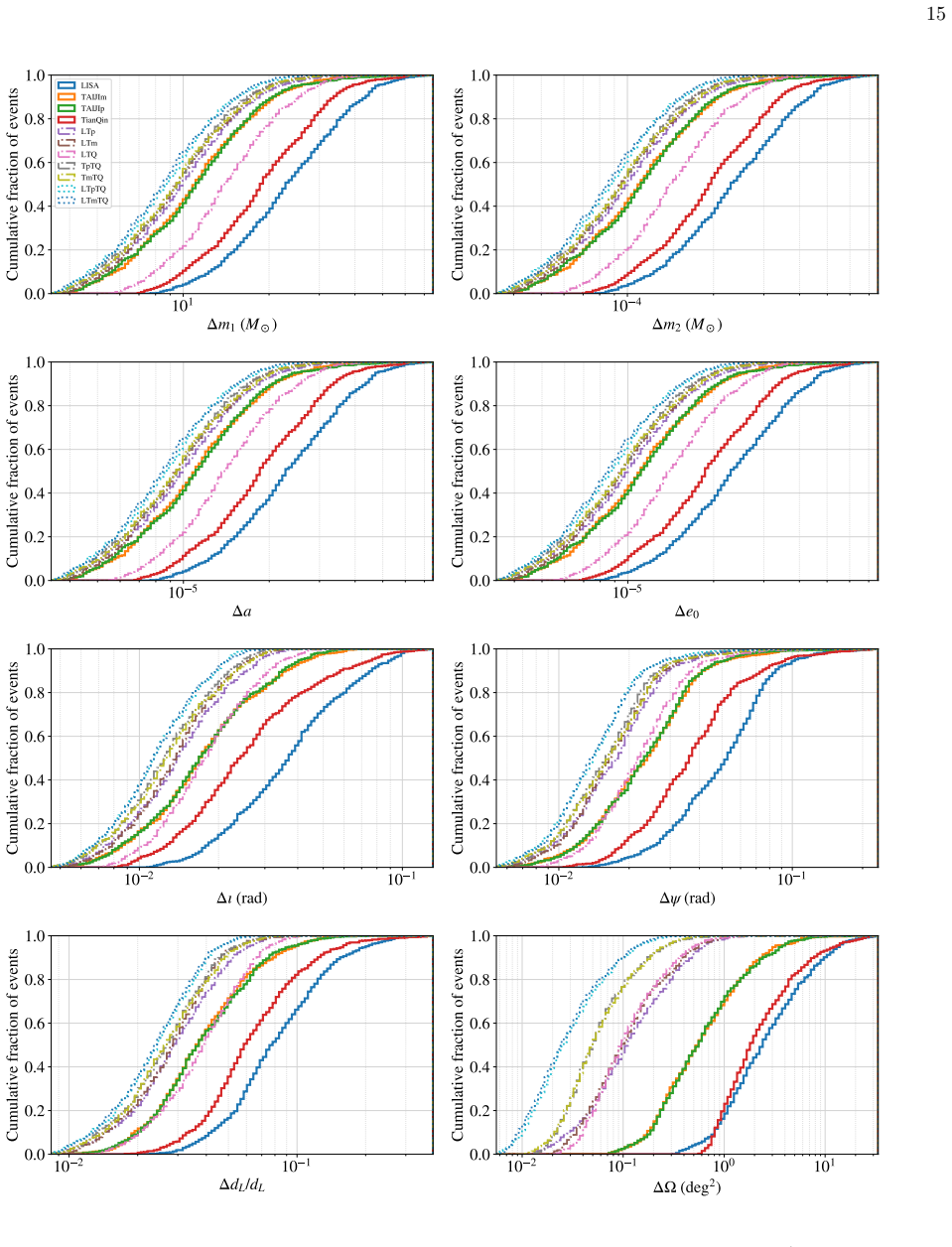
Joint observations by a LISA-TAIJI-TianQin network improve EMRI sky localization by up to two orders of magnitude compared to LISA alone for one-month observations, and produce parameter constraints comparable to or tighter than LISA's one-year results; overlapping signals remain distinguishable due to differing detector responses.
Load-bearing premise
The Fisher information matrix approximation accurately captures parameter uncertainties and correlations for EMRIs even in the presence of overlapping signals and for the specific orbital configurations considered.
Editorial extensions
If this is right
- Shorter observation durations become sufficient for high-precision EMRI science when multiple detectors operate together.
- Improved sky localization narrows the search area for possible electromagnetic counterparts by up to two orders of magnitude.
- Overlapping EMRI signals from the same central black hole or from different sky positions can still be separated without requiring a full year of data.
- Alternative TAIJI orbital configurations can be evaluated to optimize the overall network performance for a given mission lifetime.
Reading between the lines
- Mission planners could trade some individual detector lifetime against network coordination to cover more EMRI events within fixed resources.
- The same network logic might apply to other long-duration sources such as galactic binaries, potentially accelerating population studies.
- If the Fisher-matrix results hold, early network data releases could already deliver science-quality EMRI catalogs ahead of full mission duration.
Signed reviews
Editorial analysis
A structured set of objections, weighed in public.
Referee Report
Summary. The manuscript examines the prospects for detecting and characterizing extreme mass ratio inspirals (EMRIs) using networks of space-based gravitational wave detectors, specifically combinations of LISA, TAIJI (with alternative configurations), and TianQin. Through Fisher information matrix calculations, it reports that a LISA-TAIJI-TianQin network observing for one month can achieve parameter constraints comparable to or tighter than those from a single year of LISA data alone, with sky localization improved by up to two orders of magnitude. The analysis also addresses concurrent observations of two EMRIs, finding that differences in detector responses aid in distinguishing overlapping signals.
Significance. Should the Fisher-matrix results prove robust, this work would demonstrate that multi-detector networks can mitigate the effects of shorter observation times for EMRI parameter estimation, offering practical implications for the scientific return of the upcoming LISA, TAIJI, and TianQin missions. The emphasis on alternative orbital configurations for TAIJI adds value to mission design discussions.
major comments (1)
- [Fisher information matrix analysis and results sections] The central claim that a one-month LISA-TAIJI-TianQin network yields parameter constraints comparable to (or tighter than) a one-year LISA observation rests on the Fisher information matrix. This quadratic approximation is known to be unreliable for EMRIs (14+ parameters, long phase evolution, high SNR) and especially for overlapping signals; the manuscript provides no validation against full posterior sampling or injection-recovery tests to confirm the reported improvements hold when non-Gaussianity or strong correlations appear.
minor comments (1)
- [Title] The title uses 'Detectability to' which appears to be a grammatical error and should read 'Detectability of'.
Simulated Author's Rebuttal
We thank the referee for their thoughtful review and for highlighting the limitations of the Fisher information matrix approach. We address the major comment below and will incorporate appropriate revisions to the manuscript.
read point-by-point responses
-
Referee: [Fisher information matrix analysis and results sections] The central claim that a one-month LISA-TAIJI-TianQin network yields parameter constraints comparable to (or tighter than) a one-year LISA observation rests on the Fisher information matrix. This quadratic approximation is known to be unreliable for EMRIs (14+ parameters, long phase evolution, high SNR) and especially for overlapping signals; the manuscript provides no validation against full posterior sampling or injection-recovery tests to confirm the reported improvements hold when non-Gaussianity or strong correlations appear.
Authors: We agree that the Fisher information matrix relies on a quadratic approximation to the likelihood and can be unreliable for high-dimensional EMRI parameter spaces with long phase evolutions, high SNRs, and especially for overlapping signals where non-Gaussianity and correlations may be significant. This is a known limitation in the field. Our study employs the Fisher matrix as a standard tool for comparative assessments of detector networks, focusing on relative improvements in sky localization and parameter constraints rather than absolute precision. Full Bayesian validation via MCMC or injection-recovery tests for these 14+ parameter waveforms is computationally prohibitive at present and was not performed. We will revise the manuscript to add an explicit discussion of these limitations in the methods and results sections, to qualify the central claims as indicative of network benefits, and to note that the reported improvements should be confirmed with more rigorous methods in future work. We maintain that the relative gains from multi-detector configurations remain informative even under the approximation. revision: partial
- Validation of the Fisher matrix results against full posterior sampling or injection-recovery tests for EMRIs and overlapping signals, due to computational demands beyond the scope of this study.
Circularity Check
No circularity; standard Fisher analysis on external detector models
full rationale
The paper applies the Fisher information matrix to published LISA/TAIJI/TianQin response functions and orbital configurations. All reported constraints (sky localization, parameter uncertainties, dual-signal distinguishability) are computed outputs from this standard formalism. No self-definitional steps, fitted inputs renamed as predictions, or load-bearing self-citations appear in the derivation chain. The central network-vs-single-mission comparison is an independent numerical result, not a re-expression of the authors' prior fits or ansatze. This is the normal non-circular case for applied GW data-analysis papers.
Assumptions & free parameters
assumptions (2)
- domain assumption Fisher information matrix provides reliable covariance estimates for EMRI parameter inference
- domain assumption Detector noise is stationary and Gaussian across the network
Cite this review
Pith. "Pith review of Detectability to extreme mass ratio inspirals with alternative space-based detector networks." pith.science (2026). https://pith.science/paper/ODUUDGWN
@misc{pith2026260609238,
  author       = {Pith},
  title        = {Pith review of: Detectability to extreme mass ratio inspirals with alternative space-based detector networks},
  year         = {2026},
  howpublished = {\url{https://pith.science/paper/ODUUDGWN}},
  note         = {Machine review of arXiv:2606.09238}
}
read the original abstract
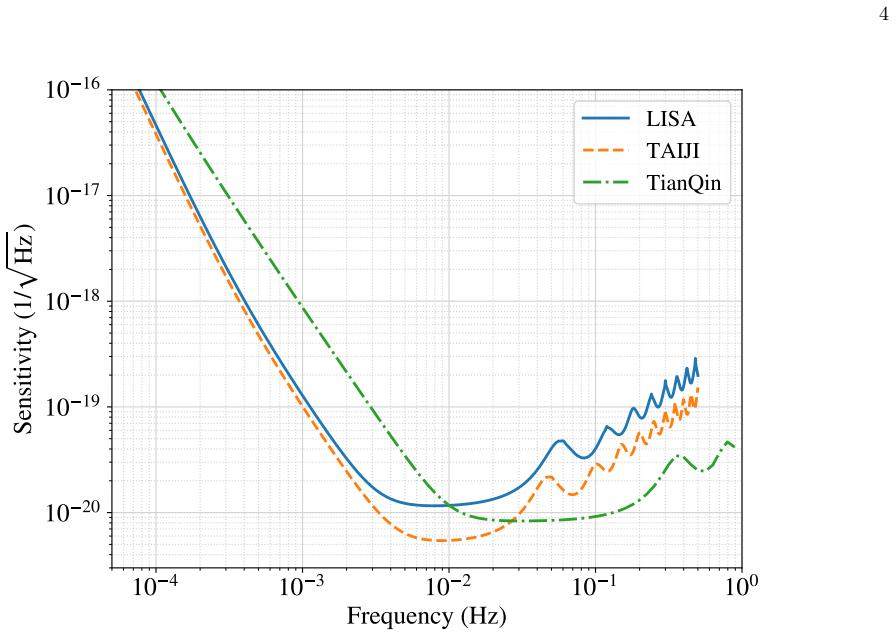
Extreme mass ratio inspirals (EMRIs) are among the primary targets for space-based gravitational-wave (GW) detectors, providing valuable opportunities to study stellar-mass compact objects orbiting supermassive black holes (SMBHs) and to probe gravity in the strong-field regime. As the LISA, TAIJI, and TianQin missions are expected to operate around 2035, joint observations by multiple detectors may provide enhanced measurement capabilities compared to individual missions. In this work, we investigate the detectability and parameter-constraint prospects for EMRIs using global detector networks composed of LISA, TianQin, and two alternative TAIJI orbital configurations. Employing Fisher information matrix analysis, we find that joint observations improve source localization relative to a standalone LISA mission, with sky-localization uncertainties reduced by up to two orders of magnitude for a one-month observation period. We further find that a three-detector network (LISA-TAIJI-TianQin) operating for one month yields parameter constraints comparable to, and in some cases tighter than, those obtained from a one-year observation by LISA alone. This result indicates that network observations can partially compensate for shorter observation durations in parameter inference. Furthermore, we evaluate measurement uncertainties in concurrent dual-signal scenarios: (i) two EMRIs orbiting the same SMBH and (ii) two EMRIs with identical intrinsic parameters but different sky locations and orientations. The results indicate that differences in the detector responses associated with the source geometries reduce correlations between overlapping signals, allowing the sources to remain distinguishable even for a standalone mission. The inclusion of multiple detector constellations further improves source localization and tightens parameter constraints in these concurrent-source scenarios.
Figures
Figures from the paper (4 more)



Forward citations
Cited by 1 Pith paper
-
Alternative LISA-TAIJI networks: polarization separation of the stochastic gravitational wave background
For stochastic gravitational wave backgrounds containing simultaneous tensor, vector, and scalar modes, the more inclined LISA-TAIJIm network separates polarization components substantially better than LISA-TAIJIp, al...
Reference graph
Works this paper leans on
-
[1]
B. P. Abbottet al.(LIGO Scientific, Virgo), Observation of Gravitational Waves from a Binary Black Hole Merger, Phys. Rev. Lett.116, 061102 (2016)
2016
-
[2]
B. P. Abbottet al.(LIGO Scientific, Virgo), GW150914: The Advanced LIGO Detectors in the Era of First Discoveries, Phys. Rev. Lett.116, 131103 (2016)
2016
-
[3]
Danzmann, LISA: An ESA cornerstone mission for a gravitational wave observatory, Class
K. Danzmann, LISA: An ESA cornerstone mission for a gravitational wave observatory, Class. Quant. Grav.14, 1399 (1997)
1997
-
[4]
Laser Interferometer Space Antenna
P. Amaro-Seoaneet al.(LISA), Laser Interferometer Space Antenna, arXiv:1702.00786 [astro-ph.IM]
-
[5]
M. Colpiet al.(LISA), LISA Definition Study Report, arXiv:2402.07571 [astro-ph.CO]
-
[6]
Luoet al.(TianQin), TianQin: a space-borne gravitational wave detector, Class
J. Luoet al.(TianQin), TianQin: a space-borne gravitational wave detector, Class. Quant. Grav.33, 035010 (2016)
2016
-
[7]
Hu and Y.-L
W.-R. Hu and Y.-L. Wu, The Taiji Program in Space for gravitational wave physics and the nature of gravity, Natl. Sci. Rev.4, 685 (2017)
2017
-
[8]
W.-H. Ruan, C. Liu, Z.-K. Guo, Y.-L. Wu, and R.-G. Cai, The LISA-Taiji network, Nature Astron.4, 108 (2020)
2020
Show all 97 references
-
[9]
Wang, W.-T
G. Wang, W.-T. Ni, W.-B. Han, S.-C. Yang, and X.-Y. Zhong, Numerical simulation of sky localization for LISA-TAIJI joint observation, Phys. Rev. D102, 024089 (2020)
2020
-
[10]
Zhang, Y
C. Zhang, Y. Gong, H. Liu, B. Wang, and C. Zhang, Sky localization of space-based gravitational wave detectors, Phys. Rev. D103, 103013 (2021)
2021
-
[11]
Zhang, Y
C. Zhang, Y. Gong, and C. Zhang, Source localizations with the network of space-based gravitational wave detectors, Phys. Rev. D106, 024004 (2022)
2022
-
[12]
Zhang, Y
C. Zhang, Y. Gong, and C. Zhang, Parameter estimation for space-based gravitational wave detectors with ringdown signals, Phys. Rev. D104, 083038 (2021)
2021
-
[13]
K. J. Shuman and N. J. Cornish, Massive black hole binaries and where to find them with dual detector networks, Phys. Rev. D105, 064055 (2022)
2022
-
[14]
Bianet al., Gravitational wave cosmology, Sci
L. Bianet al., Gravitational wave cosmology, Sci. China Phys. Mech. Astron.69, 210401 (2026)
2026
-
[15]
Lu and Y
X. Lu and Y. Gong, Supernova calibration by gravitational waves, Eur. Phys. J. C83, 949 (2023)
2023
-
[16]
Chen, C.-S
J. Chen, C.-S. Yan, Y.-J. Lu, Y.-T. Zhao, and J.-Q. Ge, On detecting stellar binary black holes via the LISA-Taiji network, Res. Astron. Astrophys.21, 285 (2021)
2021
-
[17]
Seto and K
N. Seto and K. Kyutoku, How many extragalactic stellar mass binary black holes will be detected by space gravitational- wave interferometers?, Mon. Not. Roy. Astron. Soc.514, 4669 (2022)
2022
-
[18]
Zhang, S.-D
X.-H. Zhang, S.-D. Zhao, S. D. Mohanty, and Y.-X. Liu, Resolving Galactic binaries using a network of space-borne gravitational wave detectors, Phys. Rev. D106, 102004 (2022)
2022
-
[19]
Huang, Y.-M
S.-J. Huang, Y.-M. Hu, V. Korol, P.-C. Li, Z.-C. Liang, Y. Lu, H.-T. Wang, S. Yu, and J. Mei, Science with the TianQin Observatory: Preliminary results on Galactic double white dwarf binaries, Phys. Rev. D102, 063021 (2020)
2020
-
[20]
Mei, Y.-Z
J. Mei, Y.-Z. Bai, J. Bao, E. Barausse, L. Cai, E. Canuto, B. Cao, W.-M. Chen, Y. Chen, Y.-W. Ding, H.-Z. Duan, H. Fan, W.-F. Feng, H. Fu, Q. Gao, T. Gao, Y. Gong, X. Gou, C.-Z. Gu, D.-F. Gu, Z.-Q. He, M. Hendry, W. Hong, X.-C. Hu, Y.-M. Hu, Y. Hu, S.-J. Huang, X.-Q. Huang, Q....
2021
-
[21]
Wang, Z.-W
L.-F. Wang, Z.-W. Zhao, J.-F. Zhang, and X. Zhang, A preliminary forecast for cosmological parameter estimation with gravitational-wave standard sirens from TianQin, J. Cosmol. Astropart. Phys. 11 (2020) 012
2020
-
[22]
Wang, S.-J
L.-F. Wang, S.-J. Jin, J.-F. Zhang, and X. Zhang, Forecast for cosmological parameter estimation with gravitational-wave standard sirens from the LISA-Taiji network, Sci. China Phys. Mech. Astron.65, 210411 (2022)
2022
-
[23]
Yang, Gravitational-Wave Detector Networks: Standard Sirens on Cosmology and Modified Gravity Theory, J
T. Yang, Gravitational-Wave Detector Networks: Standard Sirens on Cosmology and Modified Gravity Theory, J. Cosmol. Astropart. Phys. 05 (2021) 044
2021
-
[24]
Y. Zhan, D. Izquierdo-Villalba, X. Guo, Q. Yang, D. Spinoso, and F.-Y. Wang, Bright Siren without an Electromagnetic Counterpart Detected by the LISA-Taiji-TianQin Network, Astrophys. J.995, 71 (2025)
2025
-
[25]
Wang and W.-B
G. Wang and W.-B. Han, Observing gravitational wave polarizations with the LISA-TAIJI network, Phys. Rev. D103, 064021 (2021)
2021
-
[26]
Zhao and Z
Z.-C. Zhao and Z. Cao, Stochastic gravitational wave background due to gravitational wave memory, Sci. China Phys. Mech. Astron.65, 119511 (2022)
2022
-
[27]
Mu and Z.-K
B. Mu and Z.-K. Guo, Distinguishing gravity theories with networks of space-based gravitational-wave detectors, Phys. Rev. D113, 044046 (2026)
2026
-
[28]
Omiya and N
H. Omiya and N. Seto, Searching for anomalous polarization modes of the stochastic gravitational wave background with 21 LISA and Taiji, Phys. Rev. D102, 084053 (2020)
2020
-
[29]
Seto, Gravitational Wave Background Search by Correlating Multiple Triangular Detectors in the mHz Band, Phys
N. Seto, Gravitational Wave Background Search by Correlating Multiple Triangular Detectors in the mHz Band, Phys. Rev. D102, 123547 (2020)
2020
-
[30]
Wang and W.-B
G. Wang and W.-B. Han, Alternative LISA-TAIJI networks: Detectability of the isotropic stochastic gravitational wave background, Phys. Rev. D104, 104015 (2021)
2021
-
[31]
H. Su, B. Xu, J. Chen, C. Liu, and Y.-L. Zhang, Detectability of the chiral gravitational wave background from audible axions with the LISA-Taiji network, Commun. Theor. Phys.77, 115403 (2025)
2025
-
[32]
Zhao and S
Z.-C. Zhao and S. Wang, Measuring the anisotropies in astrophysical and cosmological gravitational-wave backgrounds with Taiji and LISA networks, Sci. China Phys. Mech. Astron.67, 120411 (2024)
2024
-
[33]
Wang and J
B.-R. Wang and J. Li, Ability of LISA, Taiji, and their networks to detect the stochastic gravitational wave background generated by cosmic strings, Phys. Rev. D109, 063520 (2024)
2024
-
[34]
Cai, Z.-K
R.-G. Cai, Z.-K. Guo, B. Hu, C. Liu, Y. Lu, W.-T. Ni, W.-H. Ruan, N. Seto, G. Wang, and Y.-L. Wu, On networks of space-based gravitational-wave detectors, Fund. Res.4, 1072 (2024)
2024
-
[35]
J. Chen, C. Liu, Y.-L. Zhang, and G. Wang, Alternative LISA-TAIJI networks: Detectability of parity violation in stochastic gravitational wave background, Phys. Rev. D111, 084026 (2025)
2025
-
[36]
Y. Chen, Y. Liu, J. Shu, B. Xu, X. Xue, and Y. Zeng, Identifying the quadrupolar nature of gravitational wave background through space-based missions, J. Cosmol. Astropart. Phys. 08 (2025) 063
2025
-
[37]
Amaro-Seoane, J
P. Amaro-Seoane, J. R. Gair, M. Freitag, M. Coleman Miller, I. Mandel, C. J. Cutler, and S. Babak, Astrophysics, detection and science applications of intermediate- and extreme mass-ratio inspirals, Class. Quant. Grav.24, R113 (2007)
2007
-
[38]
Babak, J
S. Babak, J. Gair, A. Sesana, E. Barausse, C. F. Sopuerta, C. P. L. Berry, E. Berti, P. Amaro-Seoane, A. Petiteau, and A. Klein, Science with the space-based interferometer LISA. V: Extreme mass-ratio inspirals, Phys. Rev. D95, 103012 (2017)
2017
-
[39]
C. P. L. Berry, S. A. Hughes, C. F. Sopuerta, A. J. K. Chua, A. Heffernan, K. Holley-Bockelmann, D. P. Mihaylov, M. C. Miller, and A. Sesana, The unique potential of extreme mass-ratio inspirals for gravitational-wave astronomy, Bull. Am. Astron. Soc.51, 42 (2019)
2019
-
[40]
Fan, Y.-M
H.-M. Fan, Y.-M. Hu, E. Barausse, A. Sesana, J.-d. Zhang, X. Zhang, T.-G. Zi, and J. Mei, Science with the TianQin observatory: Preliminary result on extreme-mass-ratio inspirals, Phys. Rev. D102, 063016 (2020)
2020
-
[41]
Zi, J.-D
T.-G. Zi, J.-D. Zhang, H.-M. Fan, X.-T. Zhang, Y.-M. Hu, C. Shi, and J. Mei, Science with the TianQin Observatory: Preliminary results on testing the no-hair theorem with extreme mass ratio inspirals, Phys. Rev. D104, 064008 (2021)
2021
-
[42]
Destounis, A
K. Destounis, A. G. Suvorov, and K. D. Kokkotas, Testing spacetime symmetry through gravitational waves from extreme- mass-ratio inspirals, Phys. Rev. D102, 064041 (2020)
2020
-
[43]
Destounis, A
K. Destounis, A. G. Suvorov, and K. D. Kokkotas, Gravitational-wave glitches in chaotic extreme-mass-ratio inspirals, Phys. Rev. Lett.126, 141102 (2021)
2021
-
[44]
Destounis and K
K. Destounis and K. D. Kokkotas, Gravitational-wave glitches: Resonant islands and frequency jumps in nonintegrable extreme-mass-ratio inspirals, Phys. Rev. D104, 064023 (2021)
2021
-
[45]
Cardoso, K
V. Cardoso, K. Destounis, F. Duque, R. P. Macedo, and A. Maselli, Black holes in galaxies: Environmental impact on gravitational-wave generation and propagation, Phys. Rev. D105, L061501 (2022)
2022
-
[46]
Z. Ren, T. Zhao, Z. Cao, Z.-K. Guo, W.-B. Han, H.-B. Jin, and Y.-L. Wu, Taiji data challenge for exploring gravitational wave universe, Front. Phys. (Beijing)18, 64302 (2023)
2023
-
[47]
A. J. K. Chua, M. L. Katz, N. Warburton, and S. A. Hughes, Rapid generation of fully relativistic extreme-mass-ratio- inspiral waveform templates for LISA data analysis, Phys. Rev. Lett.126, 051102 (2021)
2021
-
[48]
M. L. Katz, A. J. K. Chua, L. Speri, N. Warburton, and S. A. Hughes, Fast extreme-mass-ratio-inspiral waveforms: New tools for millihertz gravitational-wave data analysis, Phys. Rev. D104, 064047 (2021)
2021
-
[49]
Speri, M
L. Speri, M. L. Katz, A. J. K. Chua, S. A. Hughes, N. Warburton, J. E. Thompson, C. E. A. Chapman-Bird, and J. R. Gair, Fast and Fourier: Extreme Mass Ratio Inspiral Waveforms in the Frequency Domain, arXiv:2307.12585 [gr-qc]
-
[50]
C. E. A. Chapman-Birdet al., Efficient waveforms for asymmetric-mass eccentric equatorial inspirals into rapidly spinning black holes, Phys. Rev. D112, 104023 (2025)
2025
-
[51]
Wang, W.-T
G. Wang, W.-T. Ni, W.-B. Han, P. Xu, and Z. Luo, Alternative LISA-TAIJI networks, Phys. Rev. D104, 024012 (2021)
2021
-
[52]
Z. Luo, Z. Guo, G. Jin, Y. Wu, and W. Hu, A brief analysis to Taiji: Science and technology, Results Phys.16, 102918 (2020)
2020
-
[53]
Luoet al., Fundamental physics and cosmology with TianQin, Living Rev
J. Luoet al., Fundamental physics and cosmology with TianQin, Living Rev. Rel.29, 1 (2026)
2026
-
[54]
Hu, X.-H
X.-C. Hu, X.-H. Li, Y. Wang, W.-F. Feng, M.-Y. Zhou, Y.-M. Hu, S.-C. Hu, J.-W. Mei, and C.-G. Shao, Fundamentals of the orbit and response for TianQin, Class. Quant. Grav.35, 095008 (2018)
2018
-
[55]
Lu, Y.-J
X.-Y. Lu, Y.-J. Tan, and C.-G. Shao, Sensitivity functions for space-borne gravitational wave detectors, Phys. Rev. D100, 044042 (2019)
2019
-
[56]
Cutler, D
C. Cutler, D. Kennefick, and E. Poisson, Gravitational radiation reaction for bound motion around a Schwarzschild black hole, Phys. Rev. D50, 3816 (1994)
1994
-
[57]
Barack, Gravitational self force in extreme mass-ratio inspirals, Class
L. Barack, Gravitational self force in extreme mass-ratio inspirals, Class. Quant. Grav.26, 213001 (2009)
2009
-
[58]
Barack and A
L. Barack and A. Pound, Self-force and radiation reaction in general relativity, Rept. Prog. Phys.82, 016904 (2019)
2019
-
[59]
Poisson, A
E. Poisson, A. Pound, and I. Vega, The Motion of point particles in curved spacetime, Living Rev. Rel.14, 7 (2011)
2011
-
[60]
Y. Mino, M. Sasaki, and T. Tanaka, Gravitational radiation reaction to a particle motion, Phys. Rev. D55, 3457 (1997)
1997
-
[61]
S. A. Teukolsky, Perturbations of a rotating black hole. 1. Fundamental equations for gravitational electromagnetic and neutrino field perturbations, Astrophys. J.185, 635 (1973)
1973
-
[62]
J. N. Goldberg, A. J. MacFarlane, E. T. Newman, F. Rohrlich, and E. C. G. Sudarshan, Spin-s spherical harmonics and 22 ð, J. Math. Phys.8, 2155 (1967)
1967
-
[63]
Black Hole Perturbation Toolkit, (bhptoolkit.org)
-
[64]
S. A. Teukolsky and W. H. Press, Perturbations of a rotating black hole. III - Interaction of the hole with gravitational and electromagnetic radiation, Astrophys. J.193, 443 (1974)
1974
-
[65]
A. J. K. Chua, C. J. Moore, and J. R. Gair, Augmented kludge waveforms for detecting extreme-mass-ratio inspirals, Phys. Rev. D96, 044005 (2017)
2017
-
[66]
Khalvati, A
H. Khalvati, A. Santini, F. Duque, L. Speri, J. Gair, H. Yang, and R. Brito, Impact of relativistic waveforms in LISA’s science objectives with extreme-mass-ratio inspirals, Phys. Rev. D111, 082010 (2025)
2025
-
[67]
Ni, J.-T
W.-T. Ni, J.-T. Shy, S.-M. Tseng, X. Xu, H.-C. Yeh, W.-Y. Hsu, W.-L. Liu, S.-D. Tzeng, P. Fridelance, E. Samain, D. Lee, Z.-Y. Su, and A.-M. Wu, inSmall Spacecraft, Space Environments, and Instrumentation Technologies, Society of Photo-Optical Instrumentation Engineers (SPIE) ...
1997
-
[68]
J. W. Armstrong, F. B. Estabrook, and M. Tinto, Time-Delay Interferometry for Space-based Gravitational Wave Searches, Astrophysical Journal527, 814 (1999)
1999
-
[69]
Tinto, F
M. Tinto, F. B. Estabrook, and J. W. Armstrong, Time delay interferometry with moving spacecraft arrays, Phys. Rev. D69, 082001 (2004)
2004
-
[70]
D. A. Shaddock, M. Tinto, F. B. Estabrook, and J. W. Armstrong, Data combinations accounting for LISA spacecraft motion, Phys. Rev. D68, 061303 (2003)
2003
-
[71]
F. B. Estabrook, M. Tinto, and J. W. Armstrong, Time delay analysis of LISA gravitational wave data: Elimination of spacecraft motion effects, Phys. Rev. D62, 042002 (2000)
2000
-
[72]
Tinto, J
M. Tinto, J. W. Armstrong, and F. B. Estabrook, Discriminating a gravitational wave background from instrumental noise in the LISA detector, Phys. Rev. D63, 021101 (2001)
2001
-
[73]
Tinto, J
M. Tinto, J. W. Armstrong, and F. B. Estabrook, Discriminating a gravitational-wave background from instrumental noise using time-delay interferometry, Class. Quant. Grav.18, 4081 (2001)
2001
-
[74]
C. J. Hogan and P. L. Bender, Estimating stochastic gravitational wave backgrounds with Sagnac calibration, Phys. Rev. D64, 062002 (2001)
2001
-
[75]
J. W. Armstrong, F. B. Estabrook, and M. Tinto, Sensitivities of alternate LISA configurations, Class. Quant. Grav.18, 4059 (2001)
2001
-
[76]
T. A. Prince, M. Tinto, S. L. Larson, and J. W. Armstrong, The LISA optimal sensitivity, Phys. Rev. D66, 122002 (2002)
2002
-
[77]
Tinto, F
M. Tinto, F. B. Estabrook, and J. W. Armstrong, Time delay interferometry for LISA, Phys. Rev. D65, 082003 (2002)
2002
-
[78]
Tinto, D
M. Tinto, D. A. Shaddock, J. Sylvestre, and J. W. Armstrong, Implementation of time delay interferometry for LISA, Phys. Rev. D67, 122003 (2003)
2003
-
[79]
K. R. Nayak, S. V. Dhurandhar, A. Pai, and J. Y. Vinet, Optimizing the directional sensitivity of LISA, Phys. Rev. D68, 122001 (2003), [Erratum: Phys.Rev.D 70, 049901 (2004)]
2003
-
[80]
Tinto and S
M. Tinto and S. L. Larson, The LISA time-delay interferometry zero-signal solution. I. Geometrical properties, Phys. Rev. D70, 062002 (2004)
2004
-
[81]
J. D. Romano and G. Woan, A Principal component analysis for LISA: The TDI connection, Phys. Rev. D73, 102001 (2006)
2006
-
[82]
Zhang, Q
C. Zhang, Q. Gao, Y. Gong, B. Wang, A. J. Weinstein, and C. Zhang, Full analytical formulas for frequency response of space-based gravitational wave detectors, Phys. Rev. D101, 124027 (2020)
2020
-
[83]
N. J. Cornish and R. W. Hellings, The Effects of orbital motion on LISA time delay interferometry, Class. Quant. Grav. 20, 4851 (2003)
2003
-
[84]
Vallisneri, Synthetic LISA: Simulating time delay interferometry in a model LISA, Phys
M. Vallisneri, Synthetic LISA: Simulating time delay interferometry in a model LISA, Phys. Rev. D71, 022001 (2005)
2005
-
[85]
Krolak, M
A. Krolak, M. Tinto, and M. Vallisneri, Optimal filtering of the LISA data, Phys. Rev. D70, 022003 (2004), [Erratum: Phys.Rev.D 76, 069901 (2007)]
2004
-
[86]
Vallisneri, Geometric time delay interferometry, Phys
M. Vallisneri, Geometric time delay interferometry, Phys. Rev. D72, 042003 (2005), [Erratum: Phys.Rev.D 76, 109903 (2007)]
2005
-
[87]
Wang and W.-T
G. Wang and W.-T. Ni, Numerical simulation of time delay interferometry for TAIJI and new LISA, Res. Astron. Astrophys. 19, 058 (2019)
2019
-
[88]
Wang and W.-T
G. Wang and W.-T. Ni, Revisiting time delay interferometry for unequal-arm LISA and TAIJI, Phys. Scripta98, 075005 (2023)
2023
-
[89]
Rajesh Nayak and J
K. Rajesh Nayak and J. Y. Vinet, Algebraic approach to time-delay data analysis for orbiting LISA
-
[90]
K. R. Nayak and J. Y. Vinet, Algebraic approach to time-delay data analysis: Orbiting case, Class. Quant. Grav.22, S437 (2005)
2005
-
[91]
Wang, Time-Delay Interferometry for ASTROD-GW (2011), arXiv:2406.14173 [gr-qc]
G. Wang, Time-Delay Interferometry for ASTROD-GW (2011), arXiv:2406.14173 [gr-qc]
2011
-
[92]
Vallisneri, J
M. Vallisneri, J. Crowder, and M. Tinto, Sensitivity and parameter-estimation precision for alternate LISA configurations, Class. Quant. Grav.25, 065005 (2008)
2008
-
[93]
Wang, Time delay interferometry with minimal null frequencies and shortened time span, Sci
G. Wang, Time delay interferometry with minimal null frequencies and shortened time span, Sci. China Phys. Mech. Astron.69, 220411 (2026)
2026
-
[94]
Wang, Correlation and Redundancy of Time-Delay Interferometry Configurations, arXiv:2507.18397 [gr-qc]
G. Wang, Correlation and Redundancy of Time-Delay Interferometry Configurations, arXiv:2507.18397 [gr-qc]
-
[95]
Wang, SATDI: Simulation and Analysis for Time-Delay Interferometry, arXiv:2403.01726 [gr-qc]
G. Wang, SATDI: Simulation and Analysis for Time-Delay Interferometry, arXiv:2403.01726 [gr-qc]
-
[96]
Cutler, Angular resolution of the LISA gravitational wave detector, Phys
C. Cutler, Angular resolution of the LISA gravitational wave detector, Phys. Rev. D57, 7089 (1998)
1998
-
[97]
Zhang, N
C. Zhang, N. Dai, and D. Liang, Importance of including higher signal harmonics in the modeling of extreme mass-ratio inspirals, Phys. Rev. D108, 044076 (2023)
2023
Reviewed June 27, 2026 · model on record in the stance chip above.
Discussion (0). Continue with ORCID to comment.