REVIEW 2 major objections 1 cited by
3D-LENS uses 3D mesh reconstruction from a single real view to synthesize consistent novel views and solve aerial-ground re-identification without paired data.
Reviewed by Pith at T0; open to challenge. T0 means a machine referee read the full paper against a public rubric. the ladder, T0–T4 →
T0 review · grok-4.3
2026-07-01 08:49 UTC pith:OGAZ7PRU
load-bearing objection Abstract-only paper names a single-view AG-ReID setting and sketches a template-free 3D mesh synthesis pipeline, but offers no results or validation to support the SOTA claim. the 2 major comments →
3D-LENS: A 3D Lifting-based Elevated Novel-view Synthesis method for Single-View Aerial-Ground Re-Identification
The pith
A machine-rendered reading of the paper's core claim, the machinery that carries it, and where it could break.
Core claim
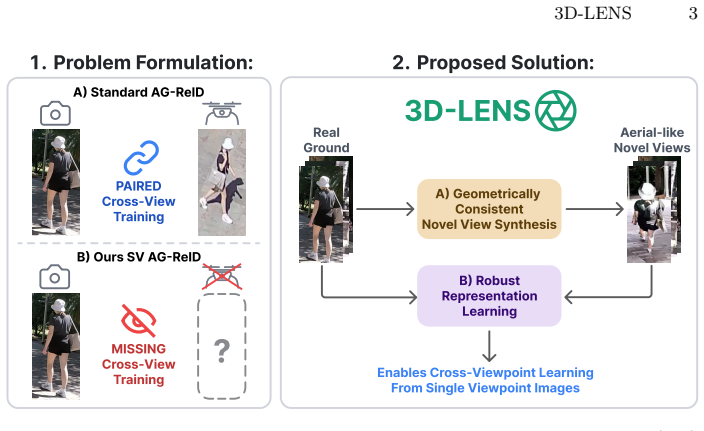
The paper claims that 3D-LENS, which combines geometrically consistent novel-view synthesis via large-scale 3D mesh reconstruction with a bias-mitigation representation scheme, is the first method to address single-view aerial-ground re-identification and reaches state-of-the-art performance on that setting across diverse object categories without relying on class-specific templates.
What carries the argument
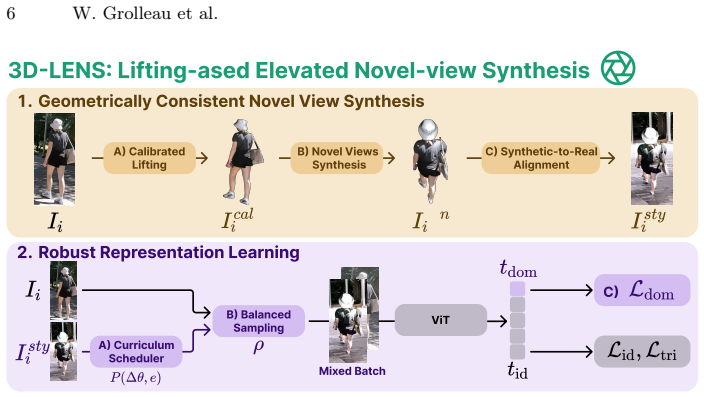
3D Lifting-based Elevated Novel-view Synthesis (3D-LENS) framework that reconstructs 3D meshes from single-view inputs to generate view-consistent novel images.
Load-bearing premise
Large-scale 3D mesh reconstruction from a single real image produces geometrically accurate novel views for many object categories, and a representation learning stage can remove the remaining synthetic-to-real appearance gap.
What would settle it
An experiment in which the 3D-synthesized views produce lower re-identification accuracy than a simple 2D baseline or visibly distort object shapes and carried items would show the central claim is incorrect.
If this is right
- Training data requirements for aerial-ground re-identification drop from paired cross-view images to single-view collections.
- The same model can be applied to search-and-rescue or surveillance tasks where only one viewpoint is recorded at training time.
- Fine-grained details such as carried objects remain visible after viewpoint change because no class-specific template is imposed.
- The approach generalizes across object categories rather than being limited to vehicles or persons with fixed shape priors.
Where Pith is reading between the lines
- The same lifting-plus-synthesis pipeline could be tested on other single-view cross-domain retrieval problems such as vehicle re-identification across day and night.
- If the mesh reconstruction step scales to video input, the method might support online viewpoint adaptation without retraining.
- Performance gains would be largest in scenarios where viewpoint change also alters lighting and background statistics.
Editorial analysis
A structured set of objections, weighed in public.
Referee Report
Summary. The manuscript formalizes the Single-View Aerial-Ground Re-Identification (SV AG-ReID) setting, in which a model trained on images from one real viewpoint must generalize to an unseen viewpoint. It proposes 3D-LENS, a framework that performs large-scale 3D mesh reconstruction to enable geometrically consistent novel-view synthesis, paired with a representation-learning scheme intended to close the synthetic-to-real gap, and asserts state-of-the-art performance on SV AG-ReID tasks.
Significance. If the central technical claims hold, the work would address a practically relevant gap in AG-ReID where paired cross-view annotations are unavailable. The combination of template-free 3D lifting with bias-mitigation learning could be useful for applications such as search-and-rescue. The abstract, however, supplies no quantitative results, ablation studies, or reconstruction metrics, so the actual significance cannot be assessed from the provided text.
major comments (2)
- [Abstract] Abstract: The central claim that 'large-scale 3D mesh reconstruction' from a single real viewpoint yields geometrically consistent novel views 'across diverse categories without predefined templates' is load-bearing for both the method and the SOTA assertion, yet the abstract contains no description of the reconstruction pipeline, no error metrics on geometry or texture, and no ablation isolating the contribution of the 3D component.
- [Abstract] Abstract: The statement that the representation-learning scheme 'mitigate[s] synthetic-to-real bias' is presented as a key enabler of the reported performance, but no training details, loss formulations, or quantitative evidence of bias reduction are supplied, preventing evaluation of whether the synthetic-to-real gap is actually closed.
Simulated Author's Rebuttal
We thank the referee for the review. The major comments correctly identify information absent from the provided abstract. We respond point by point below.
read point-by-point responses
-
Referee: [Abstract] Abstract: The central claim that 'large-scale 3D mesh reconstruction' from a single real viewpoint yields geometrically consistent novel views 'across diverse categories without predefined templates' is load-bearing for both the method and the SOTA assertion, yet the abstract contains no description of the reconstruction pipeline, no error metrics on geometry or texture, and no ablation isolating the contribution of the 3D component.
Authors: The provided manuscript consists solely of the abstract, which contains none of the requested pipeline description, error metrics, or ablations. We cannot supply these details. revision: no
-
Referee: [Abstract] Abstract: The statement that the representation-learning scheme 'mitigate[s] synthetic-to-real bias' is presented as a key enabler of the reported performance, but no training details, loss formulations, or quantitative evidence of bias reduction are supplied, preventing evaluation of whether the synthetic-to-real gap is actually closed.
Authors: The provided manuscript consists solely of the abstract, which contains none of the requested training details, loss formulations, or quantitative evidence. We cannot supply these details. revision: no
- The abstract lacks description of the reconstruction pipeline, error metrics on geometry or texture, and ablations isolating the 3D component.
- The abstract lacks training details, loss formulations, or quantitative evidence of bias reduction for the representation-learning scheme.
Circularity Check
No circularity; abstract contains no derivations or self-referential steps
full rationale
The provided abstract formalizes SV AG-ReID and describes 3D-LENS at a high level but supplies no equations, parameter fits, uniqueness theorems, or self-citations that could reduce any claimed result to its inputs by construction. All load-bearing elements (mesh reconstruction, novel-view synthesis, bias mitigation) are asserted as external capabilities whose correctness is left to empirical validation outside the text. This is the normal case of a self-contained high-level claim with no internal derivation chain to inspect.
Axiom & Free-Parameter Ledger
read the original abstract
Aerial-Ground Re-Identification (AG-ReID) is constrained by the viewpoint-domain gap, as drastic viewpoint disparities occlude or distort discriminative features, making cross-viewpoint image retrieval challenging. While existing methods rely on paired cross-view annotations, real-world deployments, such as wilderness search-and-rescue (SAR), often lack target-domain data, requiring retrieval from ground-level references alone. To our knowledge, we are the first to address this challenge by formalizing the Single-View AG-ReID (SV AG-ReID) setting, where models trained on a single real viewpoint must generalize to an unseen viewpoint. We propose 3D Lifting-based Elevated Novel-view Synthesis (3D-LENS), a unified framework combining geometrically-consistent novel view synthesis that leverages large-scale 3D mesh reconstruction, with a robust representation learning scheme to mitigate synthetic-to-real bias. Unlike 2D generative baselines that suffer from geometric inconsistencies or prior 3D methods that are restricted to class-specific templates, our approach ensures view-consistent synthesis across diverse categories without predefined templates that fail to capture fine-grained details, such as carried objects. Extensive experiments demonstrate that our method achieves state-of-the-art performance on SV AG-ReID scenarios. Code and data will be released at https://github.com/TurtleSmoke/3D-LENS.
Figures
Forward citations
Cited by 1 Pith paper
-
VR3D: View-Robust 3D Representation Learning for Aerial-Ground Person Re-Identification
VR3D reports state-of-the-art aerial-ground person re-identification by interacting 2D appearance with SAM3D-produced 3D voxels in a canonical space and adaptively fusing the resulting features.
discussion (0)
Sign in with ORCID, Apple, or X to comment. Anyone can read and Pith papers without signing in.