REVIEW 4 major objections 4 minor 29 references
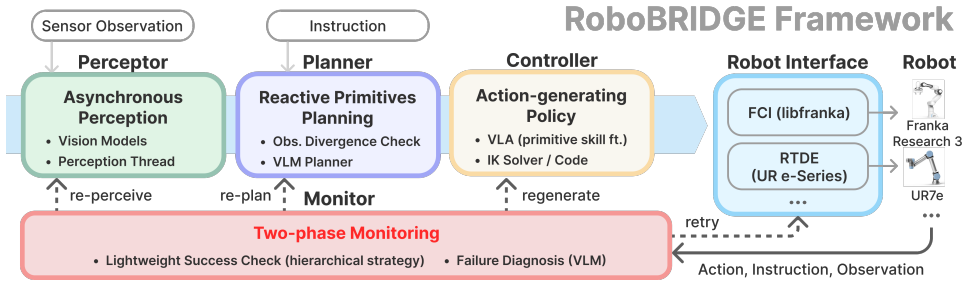
RoboBRIDGE claims that reliable robotic agency comes from structured orchestration around a frozen vision-language-action model, not from scaling the action predictor alone.
Reviewed by Pith at T0; open to challenge. T0 means a machine referee read the full paper against a public rubric. the ladder, T0–T4 →
T0 review · deepseek-v4-flash
2026-07-31 23:41 UTC pith:OH6XZYDT
load-bearing objection RoboBRIDGE is a plausible orchestration stack for wrapping VLAs, but the headline comparisons overclaim: they confound primitive LoRA fine-tuning with the framework, and the monitor that drives recovery is never validated. the 4 major comments →
RoboBRIDGE: A Modular Framework for Bridging Policies to Robust Real-World Robotic Agents
The pith
A machine-rendered reading of the paper's core claim, the machinery that carries it, and where it could break.
Core claim
The paper's discovery is that wrapping any action-generating policy with a specific orchestration stack converts it into a robust agent. A two-phase Monitor catches failures fast with a lightweight success checker and then invokes hierarchical recovery (retry, regenerate, replan, re-perceive). An asynchronous Perceptor hides perception latency behind execution and triggers replanning only when the scene diverges materially from the current plan. When a VLA serves as the controller, primitive-specific LoRA adapters factor manipulation into domain-invariant skills, reducing sensitivity to observation and embodiment shifts. Controlled comparisons show the same controller scores higher inside Ro
What carries the argument
The central object is the orchestration layer itself: five coordinated modules that wrap an off-the-shelf VLA. The two-phase Monitor (Eq. 1) pairs a fast success checker with a slower diagnosis model that selects among four recovery levels. Reactive planning with asynchronous perception (Eq. 3) uses a divergence measure over object poses and set differences to trigger replanning only when the scene has changed enough. Primitive skill fine-tuning attaches dedicated LoRA adapters for skills such as MOVE and GRIP to a frozen VLA backbone, with a resolver that averages adapters when no dedicated one exists. These mechanisms jointly turn a forward-pass action predictor into a closed-loop agent.
Load-bearing premise
The entire recovery mechanism rests on a lightweight success checker reliably producing correct failure flags and confidence scores at about 5 Hz, together with manually chosen thresholds that are well calibrated across tasks and environments.
What would settle it
Run RoboBRIDGE on the RoboCasa suite with a deliberately degraded success checker—random flags or a checker that misses a known class of failures—and show that success rates fall back to the standalone controller's level. Independently, sweep the confidence threshold gamma from 0.1 to 0.9 and the divergence threshold tau across a range; if the reported average success varies dramatically with these manual settings, the load-bearing assumption of well-calibrated thresholds is falsified.
If this is right
- The same VLA backbone, without retraining or architectural changes, achieves higher task completion when run inside RoboBRIDGE than standalone, including on long-horizon and contact-rich tasks.
- The framework is policy-agnostic: it improves LoRA fine-tuned, fully fine-tuned, and even classical IK controllers, suggesting that external orchestration is complementary to any action generator.
- The benefit of monitoring scales with the diagnostic ability of the LLM used for planning and diagnosis; small LLMs show little or no gain, indicating that recovery quality depends on the model's reasoning capacity.
- Primitive-specific LoRA adapters let a lightly fine-tuned controller approach or surpass the performance of full fine-tuning, reducing compute and data requirements for domain adaptation.
Where Pith is reading between the lines
- If this claim holds, a direct consequence is that a research community fixated on scaling VLA models could achieve reliability gains more cheaply by building external monitoring and recovery layers, not just larger action predictors.
- The paper's manual threshold and recovery-rule limitation suggests a natural extension: learning the confidence threshold gamma and divergence threshold tau from interaction data could make the framework self-calibrating and more robust across tasks.
- Since the failure-mode analysis identifies perception errors under occlusion as a dominant bottleneck, swapping the Perceptor for a stronger open-vocabulary detector is a testable way to get larger gains than scaling the VLA, which the paper does not directly test.
- The framework's policy-agnostic design implies it should work on new embodiments with zero fine-tuning of the base policy; this is a concrete prediction one could check on a new robot platform that was not in the paper's real-world deployments.
Editorial analysis
A structured set of objections, weighed in public.
Referee Report
Summary. The paper proposes RoboBRIDGE, a modular orchestration framework intended to convert any pretrained vision-language-action (VLA) model into a robust robotic agent. The framework wraps the VLA as a Controller inside five coordinated modules — Monitor, Perceptor, Planner, Controller, and Robot Interface — providing two-phase failure monitoring with hierarchical recovery, asynchronous perception with divergence-triggered replanning, and primitive-specific LoRA adapters. Experiments are reported on LIBERO and RoboCasa with three VLA backbones (SmolVLA, π0.5, GR00T-N1.5), plus a real-world case study on two robot platforms. The central claim is that reliable robotic agency comes from structured orchestration around action predictors, not from scaling the predictors themselves, and that RoboBRIDGE consistently outperforms standalone policies and prior augmented VLA deployments.
Significance. If the central claim were fully supported, RoboBRIDGE would be a useful systems contribution: it addresses a real gap in VLA deployment and the modular decomposition is sensible. The paper also has genuine strengths: it evaluates across multiple VLA backbones, includes a useful ablation on the LLM planner backbone (Table III), compares different controller types (Table IV), and honestly lists limitations such as manual thresholds. However, the evidence as presented does not yet establish the headline claim. The main comparisons conflate orchestration with task-specific LoRA fine-tuning; the reliability of the monitoring component — the component credited with most of the gain — is not directly measured; and the real-world evidence is qualitative only. These are load-bearing issues, not presentation details.
major comments (4)
- [Sec. IV-B, Tables I-II, Sec. III-C] The w/RB condition in Tables I and II includes primitive-specific LoRA adapters trained on 50 demos per task (Implementation Details: 'we apply LoRA-only adaptation ... training separate adapters for MOVE and GRIP'), while the w/o condition is the base VLA without any fine-tuning. The reported 'framework gain' therefore conflates task/domain fine-tuning with orchestration, contradicting the abstract's framing that gains come from 'structured orchestration around' the frozen policy. Table IV isolates LoRA-FT w/o vs w/RB on only five RoboCasa tasks, which is not enough to support the main tables' claims. Please report the isolated LoRA-FT-standalone baseline for the full task sets, or clearly frame Tables I-II as 'orchestration + primitive adapters'.
- [Sec. III-A, Eq. (1), Sec. IV-A] The phase-1 success checker D_check (Eq. 1) is the trigger for the entire recovery hierarchy, yet the paper never reports its precision, recall, or calibration, and does not state whether the failure flags suc_t in simulation come from the VLM-based D_check or from the simulator's ground-truth task predicate. Evaluation metric says success is simulator-provided, but not whether the monitor also uses it. If D_check is not the source of suc_t during rollouts, w/RB has privileged information; if it is, its accuracy is untested. This is load-bearing. Please report D_check's accuracy and threshold sensitivity (gamma, tau), or clearly separate simulator-predicate monitoring from D_check monitoring.
- [Table III, Sec. IV-C] The main results use Claude Opus 4.6 as Planner and Phase-2 Monitor; framework gain collapses with smaller LLMs: Claude Haiku 4.5 gives +0.0, Gemini-3 Flash +0.9, while Claude Opus gives +8.1. This is acknowledged in prose but not addressed as a limitation of the framework's generality. The abstract's claim of 'consistent improvements' is therefore contingent on an expensive proprietary backbone. The paper should either qualify the claim or demonstrate the orchestration gain with a reasonably sized open-weights LLM.
- [Sec. IV-B, Fig. 5, Sec. V] The real-world 'case study' is presented as evidence for 'consistent improvements over standalone baselines', but only qualitative traces in Fig. 5 are provided. No success-rate numbers, episode counts, per-task breakdown, or direct comparison to w/o deployment is included. Since real-world robustness is a central claim, quantitative real-world results are needed, even with small trials and clear caveats.
minor comments (4)
- [Eq. (3)] If O_a ∩ O_b is empty, max over empty set is undefined; define a convention, e.g., 0, for that term. Also note λ·|O_a △ O_b| remains nonzero, so the metric may still be defined.
- [Algorithm 1 vs Eq. (1)] Algorithm 1 line 11 passes (o_t, p_j) to D_failure, but Eq. (1) defines D_check : (o_t, c_t) -> (suc_t, con_t). Align notation between plan context and primitive label.
- [Sec. II] Typo: 'V oxPoser' should be 'VoxPoser'.
- [Table II] The abbreviation 'PnP' is used without definition; spell out 'pick-and-place' in the caption or table notes.
Circularity Check
No significant circularity: RoboBRIDGE's gains are empirical comparisons on external benchmarks; no claimed 'prediction' reduces to its inputs.
full rationale
RoboBRIDGE does not derive a theoretical result from an input that contains the conclusion. Its load-bearing claims are empirical: wrapping the same VLA in Monitor/Perceptor/Planner/Controller/Robot Interface yields higher simulator and real-world success rates. Eqs. (1)-(3), (5)-(6) define module interfaces (success check, diagnosis, divergence, LoRA resolution), not predictions derived from fitted parameters. Success is measured by the task-completion predicate in LIBERO/RoboCasa ('success is determined by the simulator-provided condition'), so the evaluation is external to the framework. Table III's comparison of LLM backbones is model selection, not a fitted parameter renamed as a prediction; the manual thresholds (Sec. V) and unstated D_check accuracy are experimental limitations/correctness risks, not circularity. The paper cites no prior work of its own as load-bearing; the 'orchestration' idea is borrowed from external LLM-agent frameworks (LangChain, AutoGen). No equation or definition reduces to another by construction.
Axiom & Free-Parameter Ledger
free parameters (4)
- gamma_thresh (failure-trigger confidence threshold) =
not reported
- tau (divergence threshold for replanning) =
not reported
- lambda (weight for object set difference in divergence metric) =
not reported
- LLM backbone for Planner and Phase-2 Monitor =
Claude Opus 4.6
axioms (5)
- domain assumption Florence-2 object-centric perception (identities + 3D poses) is accurate enough for planning.
- domain assumption A lightweight 5Hz success checker can reliably flag failures without blocking execution.
- domain assumption The LLM-based diagnoser (Claude Opus 4.6) has sufficient reasoning to select the right hierarchical recovery.
- domain assumption Primitive decomposition into MOVE/GRIP/ROTATE is domain-invariant and beneficial across embodiments.
- domain assumption LoRA adapters on a frozen backbone are sufficient for domain-shift robustness without retraining the base model.
Cite this review
Pith. "Pith review of RoboBRIDGE: A Modular Framework for Bridging Policies to Robust Real-World Robotic Agents." pith.science (2026). https://pith.science/paper/OH6XZYDT
@misc{pith2026260727881,
  author       = {Pith},
  title        = {Pith review of: RoboBRIDGE: A Modular Framework for Bridging Policies to Robust Real-World Robotic Agents},
  year         = {2026},
  howpublished = {\url{https://pith.science/paper/OH6XZYDT}},
  note         = {Machine review of arXiv:2607.27881}
}
read the original abstract
Vision-Language-Action (VLA) models have attracted growing interest as a scalable approach to robotic manipulation. While these models are effective action predictors, deploying them as robotic agents exposes critical gaps: no mechanism for failure recovery, inconsistent execution over long horizons, and limited robustness to shifts in observations, tasks, or embodiments. Existing solutions address these limitations individually through model retraining or environment-specific modules, yet what is needed is a general framework that systematically transforms a pretrained VLA into a robotic agent. We present RoboBRIDGE, a modular framework that provides an orchestration layer over five coordinated modules, namely Monitor, Perceptor, Planner, Controller, and Robot Interface, to compose robust robotic agents from off-the-shelf components, including pretrained VLAs. The Monitor pairs rapid failure detection with hierarchical recovery to correct errors before they cascade. When the environment diverges from the current plan, the Planner triggers replanning while the Perceptor updates scene understanding asynchronously, avoiding execution stalls. Within the Controller, primitive skill fine-tuning factors manipulation into domain-invariant primitives with dedicated LoRA adapters, reducing sensitivity to domain shifts when a VLA is used. Across LIBERO, RoboCasa, and real-world case studies spanning multiple robot platforms and VLA backbones, RoboBRIDGE consistently outperforms both standalone policies and prior augmented VLA deployments. These results suggest that reliable robotic agency does not arise from scaling action predictors alone, but from structured orchestration around them.
Figures



Reference graph
Works this paper leans on
-
[1]
OpenVLA: An open-source vision- language-action model,
M. J. Kim, K. Pertsch, S. Karamcheti, T. Xiao, A. Balakrishna, S. Nair, R. Rafailov, E. Fosteret al., “OpenVLA: An open-source vision- language-action model,” inProceedings of The 8th Conference on Robot Learning, 2025, pp. 2679–2713
2025
-
[2]
π 0.5: a vision-language-action model with open-world generalization,
K. Black, N. Brown, J. Darpinian, K. Dhabalia, D. Driess, A. Esmail, M. R. Equi, C. Finnet al., “π 0.5: a vision-language-action model with open-world generalization,” inProceedings of The 9th Conference on Robot Learning, 2025, pp. 17–40
2025
-
[3]
NVIDIA Isaac GR00T N1.5 model card (GR00T- N1.5-3B),
NVIDIA, “NVIDIA Isaac GR00T N1.5 model card (GR00T- N1.5-3B),” 2025, accessed: 2026-02-09. [Online]. Available: https://huggingface.co/nvidia/GR00T-N1.5-3B
2025
-
[4]
SmolVLA: A vision- language-action model for affordable and efficient robotics,
M. Shukor, D. Aubakirova, F. Capuano, P. Kooijmans, S. Palma, A. Zouitine, M. Aractingi, C. Pascalet al., “SmolVLA: A vision- language-action model for affordable and efficient robotics,”arXiv preprint arXiv:2506.01844, 2025
Pith/arXiv arXiv 2025
-
[5]
A survey on vision-language- action models: An action tokenization perspective,
Y . Zhong, F. Bai, S. Cai, X. Huang, Z. Chen, X. Zhang, Y . Wang, S. Guo, T. Guan, K. N. Luiet al., “A survey on vision-language- action models: An action tokenization perspective,”arXiv preprint arXiv:2507.01925, 2025
Pith/arXiv arXiv 2025
-
[6]
Vision- language-action (vla) models: Concepts, progress, applications and challenges,
R. Sapkota, Y . Cao, K. I. Roumeliotis, and M. Karkee, “Vision- language-action (vla) models: Concepts, progress, applications and challenges,”arXiv preprint arXiv:2505.04769, 2025
arXiv 2025
-
[7]
Code-as-monitor: Constraint-aware visual programming for reactive and proactive robotic failure detection,
E. Zhou, Q. Su, C. Chi, Z. Zhang, Z. Wang, T. Huang, L. Sheng, and H. Wang, “Code-as-monitor: Constraint-aware visual programming for reactive and proactive robotic failure detection,” inProceedings of the IEEE/CVF Conference on Computer Vision and Pattern Recognition, 2025, pp. 6919–6929
2025
-
[8]
Safe: Multitask failure detection for vision-language- action models,
Q. Gu, Y . Ju, S. Sun, I. Gilitschenski, H. Nishimura, M. Itkina, and F. Shkurti, “Safe: Multitask failure detection for vision-language- action models,” inAdvances in Neural Information Processing Sys- tems, 2025
2025
-
[9]
Doremi: Grounding language model by detecting and recovering from plan-execution mis- alignment,
Y . Guo, Y .-J. Wang, L. Zha, and J. Chen, “Doremi: Grounding language model by detecting and recovering from plan-execution mis- alignment,” in2024 IEEE/RSJ International Conference on Intelligent Robots and Systems, 2024, pp. 12 124–12 131
2024
-
[10]
C. Ma, G. Yang, K. Lu, S. Xu, B. Byrne, N. Trigoni, and A. Markham, “Cyclevla: Proactive self-correcting vision-language-action models via subtask backtracking and minimum bayes risk decoding,”arXiv preprint arXiv:2601.02295, 2026
Pith/arXiv arXiv 2026
-
[11]
Do as i can, not as i say: Grounding language in robotic affordances,
M. Ahn, A. Brohan, N. Brown, Y . Chebotar, O. Cortes, B. David, C. Finn, C. Fu, K. Gopalakrishnan, K. Hausmanet al., “Do as i can, not as i say: Grounding language in robotic affordances,” in Proceedings of The 6th Conference on Robot Learning, 2023, pp. 287– 318
2023
-
[12]
Llm-bt: Performing robotic adaptive tasks based on large language models and behavior trees,
H. Zhou, Y . Lin, L. Yan, J. Zhu, and H. Min, “Llm-bt: Performing robotic adaptive tasks based on large language models and behavior trees,” in2024 IEEE International Conference on Robotics and Automation, 2024, pp. 16 655–16 661
2024
-
[13]
Isr-llm: Iterative self-refined large language model for long-horizon sequential task planning,
Z. Zhou, J. Song, K. Yao, Z. Shu, and L. Ma, “Isr-llm: Iterative self-refined large language model for long-horizon sequential task planning,” in2024 IEEE International Conference on Robotics and Automation, 2024, pp. 2081–2088
2024
-
[14]
Don’t blind your vla: Aligning visual representations for ood generalization,
N. Kachaev, M. Kolosov, D. Zelezetsky, A. K. Kovalev, and A. I. Panov, “Don’t blind your vla: Aligning visual representations for ood generalization,”arXiv preprint arXiv:2510.25616, 2025
arXiv 2025
-
[15]
Langchain,
LangChain, “Langchain,” accessed: 2026-02-09. [Online]. Available: https://www.langchain.com
2026
-
[16]
Autogen: Enabling next-gen llm applications via multi-agent conversations,
Q. Wu, G. Bansal, J. Zhang, Y . Wu, B. Li, E. Zhu, L. Jiang, X. Zhang, S. Zhang, J. Liuet al., “Autogen: Enabling next-gen llm applications via multi-agent conversations,” inFirst Conference on Language Modeling, 2024
2024
-
[17]
Robocasa: Large-scale simulation of everyday tasks for generalist robots,
S. Nasiriany, A. Maddukuri, L. Zhang, A. Parikh, A. Lo, A. Joshi, A. Mandlekar, and Y . Zhu, “Robocasa: Large-scale simulation of everyday tasks for generalist robots,” inProceedings of Robotics: Science and Systems, 2024
2024
-
[18]
Rt-1: Robotics transformer for real-world control at scale,
A. Brohan, N. Brown, J. Carbajal, Y . Chebotar, J. Dabis, C. Finn, K. Gopalakrishnan, K. Hausman, A. Herzog, J. Hsuet al., “Rt-1: Robotics transformer for real-world control at scale,”arXiv preprint arXiv:2212.06817, 2022
Pith/arXiv arXiv 2022
-
[19]
Droid: A large-scale in-the- wild robot manipulation dataset,
A. Khazatsky, K. Pertsch, S. Nairet al., “Droid: A large-scale in-the- wild robot manipulation dataset,” inProceedings of Robotics: Science and Systems, 2024
2024
-
[20]
Open x-embodiment: Robotic learning datasets and rt-x models,
Open X-Embodiment Collaboration, “Open x-embodiment: Robotic learning datasets and rt-x models,” in2024 IEEE International Con- ference on Robotics and Automation, 2024, pp. 6892–6903
2024
-
[21]
Octo: An open- source generalist robot policy,
D. Ghosh, H. R. Walke, K. Pertsch, K. Blacket al., “Octo: An open- source generalist robot policy,” inProceedings of Robotics: Science and Systems, 2024
2024
-
[22]
Failsafe: Reasoning and recovery from failures in vision-language- action models,
Z. Lin, J. Duan, H. Fang, D. Fox, R. Krishna, C. Tan, and B. Wen, “Failsafe: Reasoning and recovery from failures in vision-language- action models,”arXiv preprint arXiv:2510.01642, 2025
Pith/arXiv arXiv 2025
-
[23]
Large language models as tool makers,
T. Cai, X. Wang, T. Ma, X. Chen, and D. Zhou, “Large language models as tool makers,” inInternational Conference on Learning Representations, 2024
2024
-
[24]
Avatar: Optimizing llm agents for tool usage via contrastive reasoning,
S. Wu, S. Zhao, Q. Huang, K. Huang, M. Yasunaga, K. Cao, V . N. Ioannidis, K. Subbian, J. Leskovec, and J. Zou, “Avatar: Optimizing llm agents for tool usage via contrastive reasoning,” inAdvances in Neural Information Processing Systems, 2024
2024
-
[25]
V oxposer: Composable 3d value maps for robotic manipulation with language models,
W. Huang, C. Wang, R. Zhang, Y . Li, J. Wu, and L. Fei-Fei, “V oxposer: Composable 3d value maps for robotic manipulation with language models,” inProceedings of The 7th Conference on Robot Learning, 2023, pp. 540–562
2023
-
[26]
Alrm: Agentic llm for robotic manipulation,
V . G. d. Santos, I. Khadraoui, I. Farhat, H. Yous, S. Teffahi, and H. Hacid, “Alrm: Agentic llm for robotic manipulation,”arXiv preprint arXiv:2601.19510, 2026
arXiv 2026
-
[27]
LoRA: Low-rank adaptation of large language models,
E. J. Hu, Y . Shen, P. Wallis, Z. Allen-Zhu, Y . Li, S. Wang, L. Wang, and W. Chen, “LoRA: Low-rank adaptation of large language models,” inInternational Conference on Learning Representations, 2022
2022
-
[28]
Libero: Benchmarking knowledge transfer for lifelong robot learning,
B. Liu, Y . Zhu, C. Gao, Y . Feng, Q. Liu, Y . Zhu, and P. Stone, “Libero: Benchmarking knowledge transfer for lifelong robot learning,” inAd- vances in Neural Information Processing Systems, 2023, pp. 10 700– 10 714
2023
-
[29]
Florence-2: Advancing a unified representation for a variety of vision tasks,
B. Xiao, H. Wu, W. Xu, X. Dai, H. Hu, Y . Lu, M. Zeng, C. Liu, and L. Yuan, “Florence-2: Advancing a unified representation for a variety of vision tasks,” inProceedings of the IEEE/CVF Conference on Computer Vision and Pattern Recognition, 2024, pp. 4818–4829
2024
discussion (0)
Sign in with ORCID, Apple, or X to comment. Anyone can read and Pith papers without signing in.