Evidence-Based Text-Conditioned 3D CT Synthesis for Ovarian Cancer
Pith reviewed 2026-06-30 09:33 UTC · model grok-4.3
The pith
OvESyn generates 3D CT scans of ovarian cancer from text built only from imaging descriptors and metadata
A machine-rendered reading of the paper's core claim, the machinery that carries it, and where it could break.
Core claim
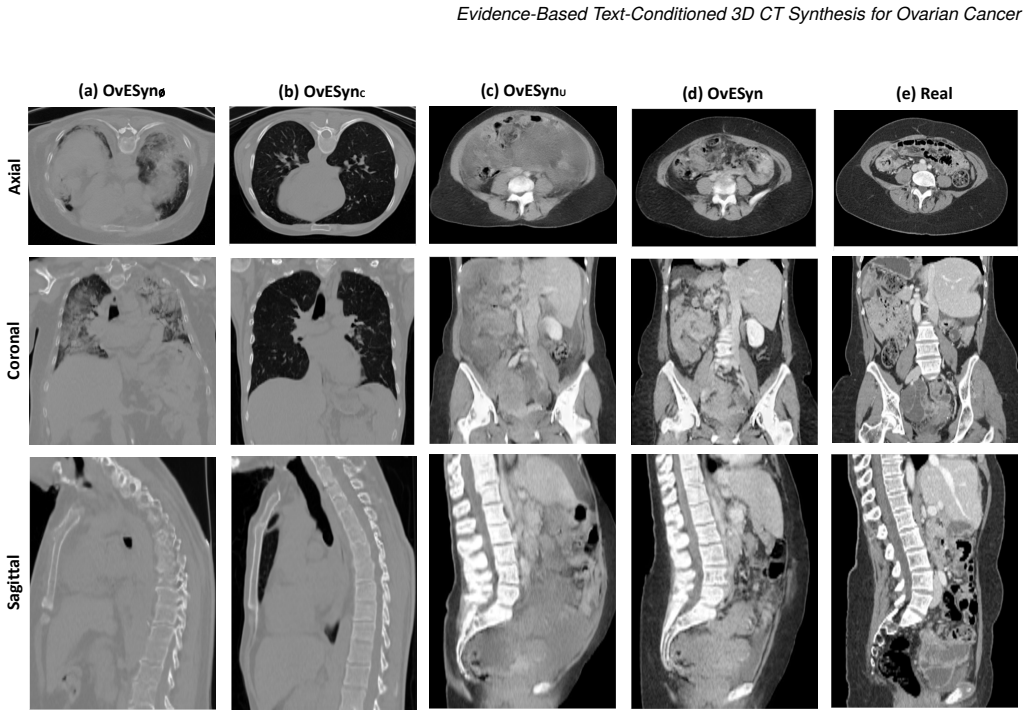
The central discovery is that generator domain adaptation serves as the key mechanism for adapting text-conditioned 3D CT synthesis from thoracic pretraining to abdomino-pelvic oncologic imaging. Without it, metrics collapse with precision and recall at zero and FID2.5D over 140. The full OvESyn framework, using evidence-based text from metadata, achieves FID2.5D of 29.35, precision 0.671, and Wasserstein-1 of 0.044, marking the first such application in this setting.
What carries the argument
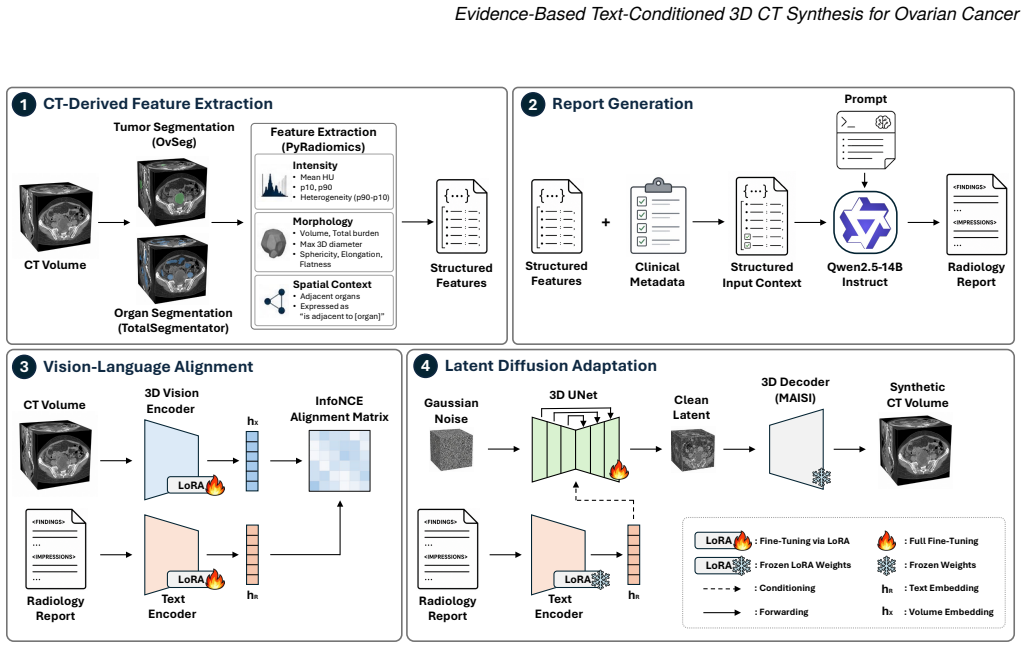
The OvESyn framework consisting of a latent diffusion model conditioned on standardized Findings and Impression text sections derived automatically from CT imaging descriptors and routine clinical metadata, with systematic ablations on encoder alignment and generator fine-tuning.
If this is right
- Generator domain adaptation is required to prevent the synthesis from remaining in the thoracic domain.
- Encoder alignment improves intensity and detail at the cost of some coverage.
- The method enables use in settings lacking original radiology reports.
- It lays groundwork for generating synthetic cohorts for abdomino-pelvic cancer imaging research.
Where Pith is reading between the lines
- The approach could be applied to other cancer types with similar data scarcity issues in abdominal imaging.
- Different model variants might be chosen based on whether fidelity or diversity is more important for a given clinical application.
- Automatic segmentations and metadata might suffice for conditioning in other modalities beyond CT.
Load-bearing premise
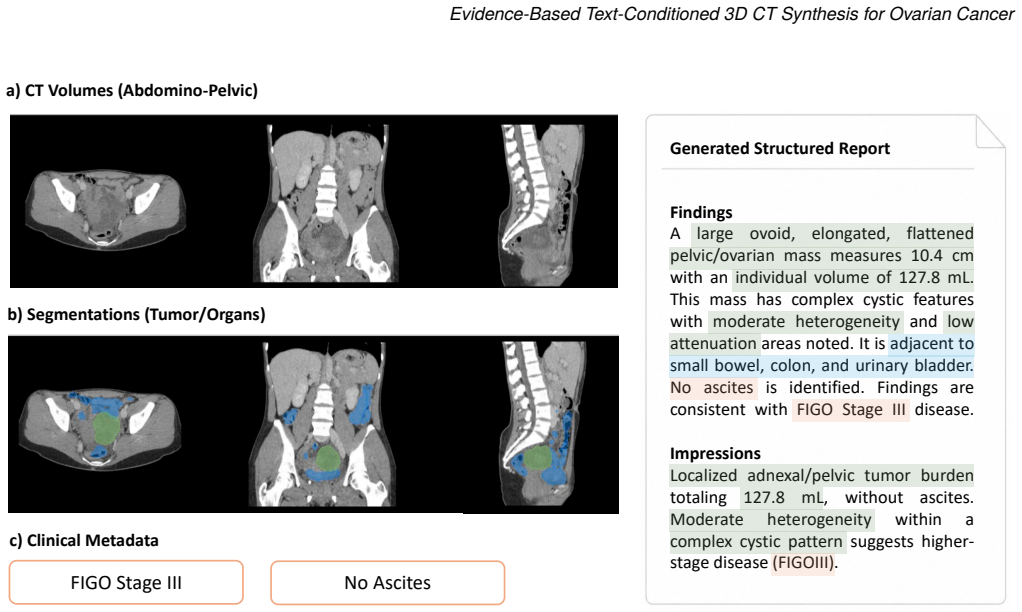
That standardized Findings and Impression sections constructed directly from CT-derived imaging descriptors and routine clinical metadata supply sufficient and accurate conditioning information for the latent diffusion model to synthesize realistic target anatomy, without original radiology reports.
What would settle it
A test where removing generator domain adaptation does not result in collapsed precision and recall or high FID scores on abdominal CT data would falsify the claim that it is the operative mechanism for domain transfer.
Figures
read the original abstract
Ovarian cancer is frequently diagnosed at an advanced stage, making preoperative contrast-enhanced computed tomography (CT) central to staging and surgical planning; yet the scarcity of annotated imaging data, compounded by privacy regulations, limits the development of generalizable computational models in this domain. Text-conditioned 3D CT synthesis has shown promise, but existing pipelines depend on paired radiology reports and have been evaluated only on chest CT. We propose OvESyn (Ovarian Evidence-based Synthesis), a framework that constructs standardized Findings and Impression sections directly from CT-derived imaging descriptors and routine clinical metadata, without any original radiology report, and uses them to condition a latent diffusion model adapted to 493 high-grade serous ovarian carcinoma patients. This is the first text-conditioned 3D CT synthesis framework adapted to an abdomino-pelvic oncologic setting. A systematic ablation over two adaptation axes, vision-language encoder alignment and generator fine-tuning, identifies generator domain adaptation as the operative mechanism for crossing the domain gap and establishing the target anatomy: without it, synthesis remains anchored to the thoracic pretraining domain, with Precision and Recall collapsing to zero and FID2.5D exceeding 140, regardless of encoder alignment. Encoder alignment instead refines intensity and fine detail. The full OvESyn attains the best distributional and intensity fidelity (FID2.5D 29.35, Precision 0.671, Wasserstein-1 0.044), while the generator-only variant maximizes coverage (Recall 0.645), reflecting a fidelity/coverage trade-off governed by encoder adaptation. Requiring only automatic segmentations and routine preoperative metadata, OvESyn supports transferability to report-scarce settings and provides a foundation for synthetic cohort generation in abdomino-pelvic oncologic imaging.
Editorial analysis
A structured set of objections, weighed in public.
Referee Report
Summary. The paper introduces OvESyn, the first text-conditioned 3D CT synthesis framework for abdomino-pelvic oncologic imaging. It constructs standardized Findings and Impression sections from CT-derived descriptors and routine metadata (no original reports), conditions a latent diffusion model on 493 high-grade serous ovarian carcinoma patients, and uses ablation to show that generator domain adaptation is the key mechanism for crossing the thoracic-to-abdomino-pelvic domain gap. Without generator adaptation, Precision/Recall collapse to zero and FID2.5D exceeds 140; the full model achieves FID2.5D 29.35, Precision 0.671, Wasserstein-1 0.044, with a fidelity-coverage trade-off when encoder alignment is added.
Significance. If the central empirical claims hold, the work supplies a concrete, report-free route to synthetic cohort generation in a data-scarce oncologic domain where privacy constraints are acute. The explicit ablation isolating generator adaptation, together with the reported distributional and intensity metrics, provides a falsifiable baseline for future abdomino-pelvic synthesis methods and directly supports transfer to other report-scarce settings.
major comments (2)
- [Abstract / ablation section] Abstract and § on ablation: the claim that generator domain adaptation is the operative mechanism for crossing the domain gap is load-bearing, yet the paper provides no quantitative validation (e.g., BLEU/ROUGE against real reports, radiologist scoring of captured peritoneal/vascular detail, or comparison of descriptor-derived vs. original-report prompts) that the automatically constructed Findings/Impression sections supply sufficient anatomical and pathological conditioning. Without this, the observed metric collapse without adaptation cannot be unambiguously attributed to domain gap rather than under-specified text.
- [Methods / evaluation] Methods / evaluation protocol: the manuscript reports concrete metrics (FID2.5D, Precision, Recall, Wasserstein-1) and an ablation over two axes, but does not specify the train/validation/test splits, exclusion criteria for the 493 patients, or whether the same patients appear in both source and target domains; these details are required to assess whether the reported gains are confounded by data leakage or selection bias.
minor comments (2)
- [Methods] Notation: the distinction between 'encoder alignment' and 'generator fine-tuning' should be made explicit with a table or diagram early in the methods so readers can map the ablation variants directly to the reported metrics.
- [Results / figures] Figure clarity: the 2.5D FID computation and the precise definition of the Wasserstein-1 distance on intensity histograms should be stated in a caption or footnote rather than left to supplementary material.
Simulated Author's Rebuttal
We thank the referee for the constructive feedback. We address the two major comments point by point below, providing clarifications and indicating where revisions will be made.
read point-by-point responses
-
Referee: [Abstract / ablation section] Abstract and § on ablation: the claim that generator domain adaptation is the operative mechanism for crossing the domain gap is load-bearing, yet the paper provides no quantitative validation (e.g., BLEU/ROUGE against real reports, radiologist scoring of captured peritoneal/vascular detail, or comparison of descriptor-derived vs. original-report prompts) that the automatically constructed Findings/Impression sections supply sufficient anatomical and pathological conditioning. Without this, the observed metric collapse without adaptation cannot be unambiguously attributed to domain gap rather than under-specified text.
Authors: We agree that further validation of the text prompts would strengthen the interpretation of the ablation results. However, because the framework is deliberately constructed without access to any original radiology reports, comparisons such as BLEU/ROUGE against real reports or descriptor-derived versus original-report prompts are not possible. The text is derived directly from CT-derived imaging descriptors and routine metadata that parallel the information contained in clinical reports. The ablation demonstrates that identical prompts yield thoracic-anchored outputs without generator adaptation but enable accurate abdomino-pelvic synthesis once generator adaptation is applied, indicating that the prompts supply sufficient conditioning when the model is adapted to the target domain. We will revise the manuscript to expand the description of the text-construction pipeline and its grounding in clinical descriptors. We will also explore the feasibility of adding a limited radiologist review of prompt fidelity in a future version. revision: partial
-
Referee: [Methods / evaluation] Methods / evaluation protocol: the manuscript reports concrete metrics (FID2.5D, Precision, Recall, Wasserstein-1) and an ablation over two axes, but does not specify the train/validation/test splits, exclusion criteria for the 493 patients, or whether the same patients appear in both source and target domains; these details are required to assess whether the reported gains are confounded by data leakage or selection bias.
Authors: We thank the referee for highlighting these missing details. The source domain consists of publicly available chest CT datasets used solely for pretraining and is completely disjoint from the 493 high-grade serous ovarian carcinoma patients in the target domain; therefore no patient overlap exists. We will add explicit statements on the train/validation/test split ratios, the exclusion criteria applied to the 493-patient cohort, and confirmation of domain separation in the revised Methods and Evaluation sections. revision: yes
- Direct quantitative comparison of the constructed prompts against original radiology reports (BLEU/ROUGE or equivalent), as the method is intentionally report-free and no such reports are available in the dataset.
Circularity Check
No circularity: empirical metrics from model training and evaluation
full rationale
The paper reports empirical results from training a latent diffusion model on 493 patient cases and evaluating distributional metrics (FID2.5D, Precision, Recall, Wasserstein-1) against real CT distributions. No equations, fitted parameters renamed as predictions, or self-citational derivations appear in the provided text. Ablations compare variants (encoder alignment vs. generator adaptation) via external performance numbers; the central claim that generator adaptation crosses the domain gap is tested by observable collapse in metrics when omitted, not by construction from inputs. The text-conditioner construction is an explicit methodological choice whose sufficiency is externally validated by the reported scores rather than assumed tautologically.
Axiom & Free-Parameter Ledger
free parameters (1)
- adaptation hyperparameters
axioms (1)
- domain assumption Text sections built from CT-derived descriptors and routine metadata serve as a sufficient proxy for radiology reports in model conditioning.
Reference graph
Works this paper leans on
-
[1]
A methodological framework for ai-assisted diagnosis of ovarian masses using ct and mr imaging.Journal of Personalized Medicine, 15(2):76, 2025
PratikAdusumilli,NishantRavikumar,GeoffHall,and Andrew F Scarsbrook. A methodological framework for ai-assisted diagnosis of ovarian masses using ct and mr imaging.Journal of Personalized Medicine, 15(2):76, 2025
2025
-
[2]
Prognosticfactorsinfluencingsurvivalinovariancan- cer patients: A 10-year retrospective study.Cancers, 15(24):5710, 2023
Maria Andreou, Maria Kyprianidou, Christos Cor- tas, Irene Polycarpou, Demetris Papamichael, Pan- teleimonKountourakis,andKonstantinosGiannakou. Prognosticfactorsinfluencingsurvivalinovariancan- cer patients: A 10-year retrospective study.Cancers, 15(24):5710, 2023
2023
-
[3]
Claude J Bajada and Mireille M Sant. Gdpr v. open neuroimaging: The case of europe’s data sharing dilemma. 2025
2025
-
[4]
Time to diagnosis and treatment for ovarian cancer and associations with outcomes: a systematic review.Journal of Women’s Health, 33(9):1185–1197, 2024
Rebecca J Bergin, Deirdre O’Sullivan, Suzanne Dixon-Suen,JonDEmery,DallasREnglish,RogerL Milne, and Victoria M White. Time to diagnosis and treatment for ovarian cancer and associations with outcomes: a systematic review.Journal of Women’s Health, 33(9):1185–1197, 2024. 8 Evidence-Based Text-Conditioned 3D CT Synthesis for Ovarian Cancer
2024
-
[5]
Making the most of text semantics to improve biomedical vision– language processing
BenediktBoecking, NaotoUsuyama, ShruthiBannur, Daniel C Castro, Anton Schwaighofer, Stephanie Hy- land, Maria Wetscherek, Tristan Naumann, Aditya Nori, Javier Alvarez-Valle, et al. Making the most of text semantics to improve biomedical vision– language processing. InEuropean conference on computer vision, pages 1–21. Springer, 2022
2022
-
[6]
Global cancer statis- tics 2022: Globocan estimates of incidence and mor- tality worldwide for 36 cancers in 185 countries.CA: a cancer journal for clinicians, 74(3):229–263, 2024
Freddie Bray, Mathieu Laversanne, Hyuna Sung, Jacques Ferlay, Rebecca L Siegel, Isabelle Soerjo- mataram, and Ahmedin Jemal. Global cancer statis- tics 2022: Globocan estimates of incidence and mor- tality worldwide for 36 cancers in 185 countries.CA: a cancer journal for clinicians, 74(3):229–263, 2024
2022
-
[7]
Deep learning-based segmentation of multisite disease in ovarian cancer.European radiology experimental, 7 (1):77, 2023
Thomas Buddenkotte, Leonardo Rundo, Ramona Woitek, Lorena Escudero Sanchez, Lucian Beer, Mireia Crispin-Ortuzar, Christian Etmann, Subhadip Mukherjee, Vlad Bura, Cathal McCague, et al. Deep learning-based segmentation of multisite disease in ovarian cancer.European radiology experimental, 7 (1):77, 2023
2023
-
[8]
Overcoming barriers to data shar- ingwithmedicalimagegeneration: acomprehensive evaluation.NPJ digital medicine, 4(1):141, 2021
August DuMont Schütte, Jürgen Hetzel, Sergios Ga- tidis,TobiasHepp,BenediktDietz,StefanBauer,and Patrick Schwab. Overcoming barriers to data shar- ingwithmedicalimagegeneration: acomprehensive evaluation.NPJ digital medicine, 4(1):141, 2021
2021
-
[9]
Predicting incomplete cytore- duction in patients with advanced ovarian cancer
Eva K Egger, Marie Antonia Buchen, Florian Recker, Matthias B Stope, Holger Strunk, Alexander Mustea, and Milka Marinova. Predicting incomplete cytore- duction in patients with advanced ovarian cancer. Frontiers in Oncology, 12:1060006, 2022
2022
-
[10]
Evaluation of 3d gans for lung tissue modelling in pulmonaryct.arXivpreprintarXiv:2208.08184, 2022
Sam Ellis, Octavio E Martinez Manzanera, Vasileios Baltatzis, Ibrahim Nawaz, Arjun Nair, Loïc Le Fol- goc, Sujal Desai, Ben Glocker, and Julia A Schnabel. Evaluation of 3d gans for lung tissue modelling in pulmonaryct.arXivpreprintarXiv:2208.08184, 2022
-
[11]
Konstantina Giouroukou, Kostas Marias, Manolis Tsiknakis,andMichailEKlontzas. Rethinkingprivacy inmedicalimagingai: Frommetadataandpixel-level identificationriskstofederatedlearningandsynthetic data challenges.Radiology: Artificial Intelligence, 8 (1):e250273, 2025
2025
-
[12]
Maisi: Medical ai for synthetic imaging
Pengfei Guo, Can Zhao, Dong Yang, Ziyue Xu, Vish- wesh Nath, Yucheng Tang, Benjamin Simon, Mason Belue,StephanieHarmon,BarisTurkbey,etal. Maisi: Medical ai for synthetic imaging. In2025 IEEE/CVF Winter Conference on Applications of Computer Vi- sion (WACV), pages 4430–4441. IEEE, 2025
2025
-
[13]
Generatect: Text-conditional generation of 3d chest ct volumes
Ibrahim Ethem Hamamci, Sezgin Er, Anjany Sekuboyina, Enis Simsar, Alperen Tezcan, Ayse Gul- nihan Simsek, Sevval Nil Esirgun, Furkan Almas, Irem Doğan, Muhammed Furkan Dasdelen, et al. Generatect: Text-conditional generation of 3d chest ct volumes. InEuropean Conference on Computer Vision, pages 126–143. Springer, 2024
2024
-
[14]
Assessment of the eu member states’ rules on health data in the light of gdpr
Johan Hansen, Petra Wilson, Eline Verhoeven, Mary Kirwan, and Robert Verheij. Assessment of the eu member states’ rules on health data in the light of gdpr. 2021
2021
-
[15]
Gans trained by a two time-scale update rule con- verge to a local nash equilibrium.Advances in neural information processing systems, 30, 2017
Martin Heusel, Hubert Ramsauer, Thomas Un- terthiner, Bernhard Nessler, and Sepp Hochreiter. Gans trained by a two time-scale update rule con- verge to a local nash equilibrium.Advances in neural information processing systems, 30, 2017
2017
-
[16]
Classifier-Free Diffusion Guidance
Jonathan Ho and Tim Salimans. Classifier-free dif- fusion guidance.arXiv preprint arXiv:2207.12598, 2022
work page internal anchor Pith review Pith/arXiv arXiv 2022
-
[17]
Early diag- nosis of ovarian cancer: A comprehensive review of the advances, challenges, and future directions
Mun-Kun Hong and Dah-Ching Ding. Early diag- nosis of ovarian cancer: A comprehensive review of the advances, challenges, and future directions. Diagnostics, 15(4):406, 2025
2025
-
[18]
Lora: Low-rank adaptation of large language models.Iclr, 1(2):3, 2022
Edward J Hu, Yelong Shen, Phillip Wallis, Zeyuan Allen-Zhu, Yuanzhi Li, Shean Wang, Liang Wang, Weizhu Chen, et al. Lora: Low-rank adaptation of large language models.Iclr, 1(2):3, 2022
2022
-
[19]
Predicting prognosis for epithelial ovarian cancer patients re- ceiving bevacizumab treatment with ct-based deep learning.NPJ Precision Oncology, 8(1):202, 2024
Xiaoyu Huang, Yong Huang, Kexin Liu, Fenglin Zhang, Zhou Zhu, Kai Xu, and Ping Li. Predicting prognosis for epithelial ovarian cancer patients re- ceiving bevacizumab treatment with ct-based deep learning.NPJ Precision Oncology, 8(1):202, 2024
2024
-
[20]
Synthetic data in medical imaging within the ehds: a path forward for ethics, regulation, and standards.Frontiers in Digital Health, 7:1620270, 2025
Junying Jiang, Lúcia Domingues, and Jorge M Mendes. Synthetic data in medical imaging within the ehds: a path forward for ethics, regulation, and standards.Frontiers in Digital Health, 7:1620270, 2025
2025
-
[21]
Improved precision and recall metric for assessing generative models
Tuomas Kynkäänniemi, Tero Karras, Samuli Laine, Jaakko Lehtinen, and Timo Aila. Improved precision and recall metric for assessing generative models. Advances in neural information processing systems, 32, 2019
2019
-
[22]
Deep learning.nature, 521(7553):436–444, 2015
Yann LeCun, Yoshua Bengio, and Geoffrey Hinton. Deep learning.nature, 521(7553):436–444, 2015
2015
-
[23]
Esgo–esmo–esp consensus conference recommen- dations on ovarian cancer: pathology and molecular biology and early, advanced and recurrent disease
Jonathan A Ledermann, X Matias-Guiu, F Amant, N Concin, B Davidson, C Fotopoulou, A González- Martin, C Gourley, A Leary, Domenica Lorusso, et al. Esgo–esmo–esp consensus conference recommen- dations on ovarian cancer: pathology and molecular biology and early, advanced and recurrent disease. Annals of Oncology, 35(3):248–266, 2024
2024
-
[24]
De- velopment and validation of radiomics nomogram for metastatic status of epithelial ovarian cancer.Scien- tific Reports, 14(1):12456, 2024
Yinping Leng, Xiwen Wang, Tian Zheng, Fei Peng, Liangxia Xiong, Yu Wang, and Lianggeng Gong. De- velopment and validation of radiomics nomogram for metastatic status of epithelial ovarian cancer.Scien- tific Reports, 14(1):12456, 2024
2024
-
[25]
Computer tomography in the diagnosis of ovarian cysts: The role of fluid atten- uation values
Roxana-Adelina Lupean, Paul-Andrei S, tefan, Mi- haelaDanielaOancea, AndreiMihaiMălut,an, Andrei Lebovici, Marius Emil Pus,cas,, Csaba Csutak, and Carmen Mihaela Mihu. Computer tomography in the diagnosis of ovarian cysts: The role of fluid atten- uation values. InHealthcare, volume 8, page 398. MDPI, 2020. 9 Evidence-Based Text-Conditioned 3D CT Synthesi...
2020
-
[26]
Imaging of peri- toneal carcinomatosis in advanced ovarian cancer: Ct, mri, radiomic features and resectability criteria
Valentina Miceli, Marco Gennarini, Federica Tomao, Angelica Cupertino, Dario Lombardo, Innocenza Palaia, Federica Curti, Sandrine Riccardi, Roberta Ninkova, Francesca Maccioni, et al. Imaging of peri- toneal carcinomatosis in advanced ovarian cancer: Ct, mri, radiomic features and resectability criteria. Cancers, 15(24):5827, 2023
2023
-
[27]
DanieleMolino,CamilloMariaCaruso,FilippoRuffini, Paolo Soda, and Valerio Guarrasi. Text-to-ct gen- eration via 3d latent diffusion model with con- trastive vision-language pretraining.arXiv preprint arXiv:2506.00633, 2025
-
[28]
Addressing contemporary threats in anonymised healthcaredatausingprivacyengineering.npjDigital Medicine, 8(1):145, 2025
Sanjiv M Narayan, Nitin Kohli, and Megan M Mar- tin. Addressing contemporary threats in anonymised healthcaredatausingprivacyengineering.npjDigital Medicine, 8(1):145, 2025
2025
-
[29]
org dos Santos Daniel Pinto Kotter Elmar Mildenberger Peter Martí-Bonmatí Luis
European Society of Radiology (ESR) communica- tions@ myesr. org dos Santos Daniel Pinto Kotter Elmar Mildenberger Peter Martí-Bonmatí Luis. Esr paper on structured reporting in radiology—update 2023.Insights into Imaging, 14(1):199, 2023
2023
-
[30]
Representation Learning with Contrastive Predictive Coding
Aaron van den Oord, Yazhe Li, and Oriol Vinyals. Representation learning with contrastive predictive coding.arXiv preprint arXiv:1807.03748, 2018
work page internal anchor Pith review Pith/arXiv arXiv 2018
-
[31]
Knowledge-guided 3d ct genera- tion: A conditioning-centric taxonomy
Francesca Pia Panaccione, Eugenio Lomurno, and Matteo Matteucci. Knowledge-guided 3d ct genera- tion: A conditioning-centric taxonomy. 2026
2026
-
[32]
Reliability of ct radiomic features reflecting tumour heterogeneity according to image quality and image processing parameters.Scientific reports, 10(1):3852, 2020
Bum Woo Park, Jeong Kon Kim, Changhoe Heo, and Kye Jin Park. Reliability of ct radiomic features reflecting tumour heterogeneity according to image quality and image processing parameters.Scientific reports, 10(1):3852, 2020
2020
-
[33]
Thieme Verlag, 2003
Mathias Prokop, Michael Galanski, Aart J Van Der Molen, Cornelia Schaefer-Prokop, Christoph En- gelke, Maik Jörgensen, Karl Juergen Lehmann, An- dreas Leppert, and Ulrich von Smekal.Spiral and multislicecomputedtomographyofthebody. Thieme Verlag, 2003
2003
-
[34]
Stefania Rizzo, Giacomo Avesani, Camilla Panico, Lucia Manganaro, Benedetta Gui, Yulia Lakhman, Pamela Causa Andrieu, Nishat Bharwani, Andrea Rockall, Isabelle Thomassin-Naggara, et al. Ovarian cancer staging and follow-up: updated guidelines from the european society of urogenital radiology female pelvic imaging working group.European Ra- diology, 35(7):...
2025
-
[35]
High- resolution image synthesis with latent diffusion mod- els
Robin Rombach, Andreas Blattmann, Dominik Lorenz, Patrick Esser, and Björn Ommer. High- resolution image synthesis with latent diffusion mod- els. InProceedings of the IEEE/CVF conference on computer vision and pattern recognition, pages 10684–10695, 2022
2022
-
[36]
Rethinking the inception architecture for computer vision
Christian Szegedy, Vincent Vanhoucke, Sergey Ioffe, Jon Shlens, and Zbigniew Wojna. Rethinking the inception architecture for computer vision. InPro- ceedings of the IEEE conference on computer vision and pattern recognition, pages 2818–2826, 2016
2016
-
[37]
Impact of ascites volume on clinical outcomes in ovarian cancer: A cohort study
J Brian Szender, Tiffany Emmons, Sarah Bel- liotti, Danielle Dickson, Aalia Khan, Kayla Morrell, ANM Nazmul Khan, Kelly L Singel, Paul C Mayor, Kirsten B Moysich, et al. Impact of ascites volume on clinical outcomes in ovarian cancer: A cohort study. Gynecologic oncology, 146(3):491–497, 2017
2017
-
[38]
Imag- ing of peritoneal metastases in ovarian cancer using mdct, mri, and fdg pet/ct: a systematic review and meta-analysis.Cancers, 16(8):1467, 2024
Athina C Tsili, George Alexiou, Martha Tzoumpa, Timoleon Siempis, and Maria I Argyropoulou. Imag- ing of peritoneal metastases in ovarian cancer using mdct, mri, and fdg pet/ct: a systematic review and meta-analysis.Cancers, 16(8):1467, 2024
2024
-
[39]
Computationalradiomicssystemtodecodetheradio- graphic phenotype.Cancer research, 77(21):e104– e107, 2017
Joost JM Van Griethuysen, Andriy Fedorov, Chin- tan Parmar, Ahmed Hosny, Nicole Aucoin, Vivek Narayan, Regina GH Beets-Tan, Jean-Christophe Fillion-Robin, Steve Pieper, and Hugo JWL Aerts. Computationalradiomicssystemtodecodetheradio- graphic phenotype.Cancer research, 77(21):e104– e107, 2017
2017
-
[40]
HebertAlbertoVargas,HariniVeeraraghavan,Maura Micco, Stephanie Nougaret, Yulia Lakhman, An- dreas A Meier, Ramon Sosa, Robert A Soslow, Dou- glas A Levine, Britta Weigelt, et al. A novel rep- resentation of inter-site tumour heterogeneity from pre-treatment computed tomography textures classi- fies ovarian cancers by clinical outcome.European radiology, 2...
2017
-
[41]
Medclip: Contrastive learning from unpaired medical images and text
Zifeng Wang, Zhenbang Wu, Dinesh Agarwal, and Jimeng Sun. Medclip: Contrastive learning from unpaired medical images and text. InProceedings of the 2022 Conference on Empirical Methods in Natural Language Processing, pages 3876–3887, 2022
2022
-
[42]
Totalsegmentator: robust segmen- tation of 104 anatomic structures in ct images.Radi- ology: Artificial Intelligence, 5(5):e230024, 2023
Jakob Wasserthal, Hanns-Christian Breit, Manfred T Meyer, Maurice Pradella, Daniel Hinck, Alexander W Sauter, Tobias Heye, Daniel T Boll, Joshy Cyriac, Shan Yang, et al. Totalsegmentator: robust segmen- tation of 104 anatomic structures in ct images.Radi- ology: Artificial Intelligence, 5(5):e230024, 2023
2023
-
[43]
Medsyn: text-guided anatomy-aware synthesis of high-fidelity 3-d ct images.IEEE Trans- actions on Medical Imaging, 43(10):3648–3660, 2024
Yanwu Xu, Li Sun, Wei Peng, Shuyue Jia, Kate- lyn Morrison, Adam Perer, Afrooz Zandifar, Shyam Visweswaran, Motahhare Eslami, and Kayhan Bat- manghelich. Medsyn: text-guided anatomy-aware synthesis of high-fidelity 3-d ct images.IEEE Trans- actions on Medical Imaging, 43(10):3648–3660, 2024
2024
-
[44]
An Yang, Anfeng Li, Baosong Yang, Beichen Zhang, Binyuan Hui, Bo Zheng, Bowen Yu, Chang Gao, Chengen Huang, Chenxu Lv, et al. Qwen3 technical report.arXiv preprint arXiv:2505.09388, 2025. 10 Evidence-Based Text-Conditioned 3D CT Synthesis for Ovarian Cancer A Prompt Templates for Structured Report Generation Report generation is implemented as a two-stage...
work page internal anchor Pith review Pith/arXiv arXiv 2025
-
[45]
invades",
NEVER use: "invades", "invasion", "metastatic", "malignancy", "peritoneal implants"
-
[46]
is adjacent to [organ]
For organ contact, use ONLY: "is adjacent to [organ]" or "adjacent to [organ]" (do not imply invasion)
-
[47]
mild/moderate/severe
Ascites: [ASCITES_INSTRUCTION] (NEVER "mild/moderate/severe")
-
[48]
Findings are consistent with FIGO Stage [FIGO_STAGE] disease
FIGO: State only "Findings are consistent with FIGO Stage [FIGO_STAGE] disease." (do not elaborate)
-
[49]
Use ONLY information from PATIENT DATA below - no additional clinical interpretation
-
[50]
State: ‘Ascitesis present.’
Report individual volumes AND combined total EXAMPLE: <FINDINGS> An irregular multilobulated omental mass measuring 14.9 cm with volume 31.2 mL demonstrates predominantly solid attenuation with moderate heterogeneity. The mass abuts small bowel and colon. A separate lobulated pelvic/ovarian mass measuring 7.6 cm with volume 7.6 mL shows mixed solid and cy...
-
[51]
Summarize the clinically relevant interpretation; do not restate the findings line-by-line
-
[52]
Write 1-2 sentences, 25-45 words total
-
[53]
Mention overall distribution, total tumor burden, ascites status, and FIGO stage
-
[54]
Do not mention individual lesion sizes, individual lesion volumes, HU values, organ-by-organ adjacency, or measurement-by-measurement details
-
[55]
adnexal/pelvic
Use "adnexal/pelvic" instead of "pelvis/ovaries"
-
[56]
Do not add information not present in KEY DATA
-
[57]
Do not diagnose histology, tissue invasion, metastases, or metastatic disease unless explicitly included in KEY DATA
-
[58]
imaging descriptors show
Avoid artificial phrases such as "imaging descriptors show", "clinical correlation is", "the key data indicate", and "findings are consistent with"
-
[59]
without ascites
If ascites is absent, state "without ascites" or "no ascites"; if present, state "with ascites"
-
[60]
STYLE: Use natural CT radiology language: concise, interpretive, and non-repetitive
If attenuation or heterogeneity descriptors differ across regions, summarize the overall pattern rather than listing every component. STYLE: Use natural CT radiology language: concise, interpretive, and non-repetitive. EXAMPLE 1: KEY DATA: - Sites: omental and adnexal/pelvic - Number of tumor regions: 2 - Total tumor burden: 38.8 mL - Dominant region: adn...
discussion (0)
Sign in with ORCID, Apple, or X to comment. Anyone can read and Pith papers without signing in.