REVIEW 4 major objections 5 minor 32 references
Knowledge Base Construction for Knowledge-Augmented Text-to-SQL
T0 review · 4 major / 5 minor · reviewed 2026-08-07 · deepseek-v4-flash
Pith's one-line read This paper argues that automatically building a comprehensive, reusable knowledge base from training queries and database schemas, then retrieving and refining knowledge from it at inference time, substantially improves how well large…
desk verdict A reusable knowledge base for text-to-SQL is a real step forward, but the headline cross-domain gain is mostly a same-domain effect and the cross-dataset reuse claim is not actually tested. read the letter →
The pith
A machine-rendered reading of the paper's core claim, the machinery that carries it, and where it could break.
The reading
What carries the argument
The central object is the knowledge base itself: a set of schema-grounded one-sentence entries, such as "albumin is within normal range refers to ALB between 3.5 and 5.5." Construction uses an LLM prompted with the query, its schema, and retrieved example triples, while sampling and permutation of exemplars diversifies the entries. A contrastively fine-tuned dense retriever built on MPNet and TAS-B selects the top relevant entries, a refinement prompt tailors them to the specific query, and the final LLM generates the SQL. The load-bearing mechanism is reuse: knowledge written for one query applies to related queries and, partially, to unseen databases and domains.
What would settle it
Build the knowledge base from BIRD training questions only, then run KAT-SQL on the Spider dev set, which shares no databases or domains with BIRD; if execution accuracy does not exceed the no-knowledge baseline on the same LLM, the paper's claim that the knowledge base transfers to unseen databases and domains is falsified.
Extended reading notes
Core claim
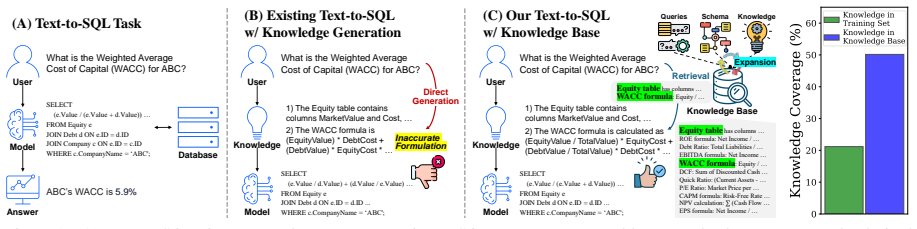
KAT-SQL claims that the bottleneck in knowledge-augmented text-to-SQL is not the LLM's ability to use knowledge but the availability and coverage of the knowledge itself. Where prior work either hand-annotates knowledge for each question or generates a small amount of per-query knowledge, KAT-SQL constructs a single large repository of concise knowledge sentences, each grounded in a database schema, built by prompting an LLM over all training queries and their schemas with retrieved few-shot exemplars and multiple sampling and permutation rounds. At inference, the system retrieves the top relevant entries with a contrastively trained dense retriever, asks the LLM to refine them into the knowledge specifically needed for the query, and only then generates the SQL. The paper reports that this pipeline beats the per-query generation baseline DELLM on every benchmark and scenario tested, and that augmenting a state-of-the-art BIRD model with KAT-SQL knowledge raises its execution accuracy from 51.69 to 57.56.
Load-bearing premise
The entire gain rests on the assumption that knowledge entries generated by an LLM from training queries and schemas are accurate enough and general enough to help answer queries on the same or different databases, including databases and domains never seen during training; if the generated knowledge is noisy or too domain-specific, the knowledge base stops helping.
Editorial extensions
If this is right
- Knowledge bases can be built once offline and then reused for any number of runtime queries on the same database, shifting annotation or generation cost out of the live text-to-SQL path.
- Because the knowledge base is dataset-agnostic, a KB constructed from one benchmark such as BIRD transfers to other datasets with no manual knowledge annotation, as shown by the gains on Spider and CSTINSIGHT.
- The method is LLM-agnostic: with Llama-3 70B, Granite 34B, or Mixtral 8x7B used for both knowledge and SQL generation, KAT-SQL outperforms the per-query generation baseline, suggesting the benefit comes from the knowledge-base design rather than a single model.
- Combining KAT-SQL with a strong existing text-to-SQL system (ExSL + granite-20b-code) produces a new state-of-the-art result on BIRD, so the knowledge-base construction is complementary to prompt-engineering and decomposition methods.
Reading between the lines
- A natural next stress test is to measure how execution accuracy scales with knowledge-base size and per-domain coverage; the paper's own oracle-KB retrieval results (MRR near 0.83) imply that most remaining error comes from missing entries rather than retriever quality, so expanding coverage should translate almost directly into accuracy.
- The refinement step adds roughly two points of execution accuracy beyond direct retrieval, so one can test whether a stronger retriever alone would close that gap or whether per-query refinement is intrinsically necessary.
- Because the knowledge base stores factual-sounding statements about a database, deployment must address the paper's own ethics caution: the KB may contain sensitive information that is later retrieved and echoed, making access control on the KB itself part of the system's security surface.
- The same construction-retrieval-refine loop could apply to other structured tasks, such as question answering over knowledge graphs or API code generation, where the reusable unit is a schema-grounded fact rather than a SQL formula.
Editorial analysis
A structured set of objections, weighed in public.
Referee Report
Summary. The paper proposes KAT-SQL, a method for text-to-SQL that automatically constructs a knowledge base from training queries, database schemas, and existing annotated knowledge, then retrieves and refines relevant knowledge at inference time to guide LLM-based SQL generation. The method is evaluated on BIRD under database-overlap and non-overlap settings, on Spider and CSTINSIGHT in a no-knowledge setting, and as an augmentation to a state-of-the-art BIRD model. The authors report consistent accuracy gains over a no-knowledge baseline and over DELLM, a per-query knowledge-generation baseline, and include ablations on knowledge generation, retrieval, and domain generalization.
Significance. If the central claim holds, KAT-SQL is a practical contribution: it avoids manual knowledge annotation, reuses knowledge across queries, and is shown to plug into a strong existing text-to-SQL system (ExSL + granite-20b-code) with a notable EX improvement. The paper's strengths include multi-dataset evaluation, a domain-overlap breakdown in Table 5, ablation tables isolating the contribution of retrieval and refinement, and an offline knowledge-base construction cost analysis. However, the headline non-overlap gain is largely driven by test databases whose domains were seen during knowledge-base construction, and the abstract's cross-dataset reuse claim is not directly tested, so the significance of the cross-domain generalization is weaker than presented.
major comments (4)
- [5, Table 5 vs Table 1] The strong BIRD Non-Overlap result in Table 1 (KAT-SQL 41.07 vs DELLM 24.64) is primarily a seen-domain effect. Table 5 shows that on test databases whose domains do not appear in the knowledge-base construction split, KAT-SQL achieves 24.19 EX versus DELLM's 19.43, a gain of only 4.76 points; a weighted combination of the two Table 5 rows at roughly the test split proportions reproduces the Table 1 numbers. The paper should report the unseen-domain margin separately, with error bars or significance tests, before claiming 'substantial' cross-domain generalization.
- [Abstract and §4.1] The abstract claims the knowledge base 'can be reused for unseen databases from different datasets and domains,' but no experiment transfers a knowledge base constructed on one dataset to another dataset. In §4.1, the Spider and CSTINSIGHT setups are described only as lacking knowledge in training and test; it is not stated whether their knowledge bases are built from their own training splits or transferred from BIRD. The authors should either add a cross-dataset transfer experiment (e.g., construct the KB on BIRD and apply it to Spider/CSTINSIGHT) or explicitly temper the reuse claim.
- [5, all tables] No variance estimates, significance tests, or multiple seeds are reported. SQL generation uses temperature 0.0, but knowledge-base construction involves random sampling and permutation of few-shot examples, and the retriever is trained with random initialization, so run-to-run variation is plausible. Given that the unseen-domain gain is only 4.76 EX points, the absence of error bars makes it difficult to judge whether even that gain is stable.
- [5, Efficiency] The comparison to DELLM is not compute-controlled: KAT-SQL adds a retrieval step and an extra knowledge-refinement LLM call that DELLM does not have. The efficiency paragraph states that per-query processing is under five seconds and retrieval is 2% of generation time, but it does not report the number of LLM calls or tokens for KAT-SQL versus DELLM, nor does it isolate the cost of the refinement step. The paper should quantify the additional LLM cost and discuss whether the accuracy gains persist under a comparable compute budget.
minor comments (5)
- [5, Analysis with Different LLMs] The text refers to 'KAT-SAL' instead of 'KAT-SQL' in the introductory sentence of this subsection; please correct the typo.
- [Appendix C, Knowledge Base Construction Cost] The text refers to 'KAT2SQL' instead of 'KAT-SQL'; please correct the typo.
- [Table 4] It is unclear whether the BERT and TAS-B rows use the constructed knowledge base or the oracle knowledge base; please clarify that only TAS-B* uses the oracle KB.
- [Table 5] The column headers 'Overlap' and 'Non-Overlap' duplicate the database-overlap terminology of Table 1 but here refer to domain overlap; rename them to 'Seen domain' and 'Unseen domain' to avoid confusion.
- [Figure 1] The right panel reports that knowledge in the training set covers 21% and the constructed KB covers 50% of test-time knowledge, but no experiment or table in the paper is cited for these numbers; please state their source.
Circularity Check
No significant circularity: KAT-SQL builds its knowledge base from training data and is evaluated on held-out queries and databases; the smaller unseen-domain gain is a generalization caveat, not a circular step.
full rationale
The paper's derivation chain is self-contained and does not reduce to its inputs. The knowledge base is constructed from the training split of BIRD (gold knowledge plus LLM-generated expansions from training query-schema pairs), and the scenarios explicitly state that in the Non-Overlap setting 'no samples from the test-time databases are available beforehand' (Section 4.1), so test-time gold knowledge is not used to build the KB. At inference, KAT-SQL retrieves entries from this training-derived KB, refines them with an LLM, and generates SQL; the retriever is trained with contrastive learning on training query-knowledge pairs, which is a standard and legitimate use of available data. All main comparisons are against external benchmarks and baselines with the same LLM, and the evaluations use held-out test queries and, in the Non-Overlap setting, held-out databases. The paper's Table 5 shows that the large Non-Overlap gain is concentrated on domains seen during KB construction, with a smaller gain on truly unseen domains (24.19 vs 19.43 EX); this is an honest generalization caveat and a possible overclaim, but it is not a case of a fitted parameter being renamed as a prediction, nor does any equation or construction force the reported accuracy. The Limitations section candidly concedes coverage gaps relative to oracle knowledge. There are no load-bearing self-citations, uniqueness theorems, or ansatz-smuggling citations. Accordingly, no circular step can be exhibited with the required specificity, and the appropriate finding is no significant circularity.
Assumptions & free parameters
free parameters (4)
- top-k relevant examples for knowledge generation prompt =
10 (implicitly, from the prompt template in Table 10)
- Number of knowledge generation sampling steps N =
Not stated for main results; varied up to 30 in Figure 3
- Number of retrieved knowledge entries j =
Not stated
- Retriever training hyperparameters =
batch size 128, epochs 30, temperature 0.0 (for LLM)
assumptions (3)
- domain assumption LLM-generated knowledge entries from queries and schemas are accurate and useful for SQL generation.
- domain assumption Embedding similarity (MPNet, TAS-B) captures the semantic relevance between a query and a knowledge entry.
- domain assumption Human-annotated knowledge in the BIRD training set is a reliable seed for the knowledge base.
Cite this review
Pith. "Pith review of Knowledge Base Construction for Knowledge-Augmented Text-to-SQL." pith.science (2026). https://pith.science/paper/OHXORZWD
@misc{pith2026250522096,
  author       = {Pith},
  title        = {Pith review of: Knowledge Base Construction for Knowledge-Augmented Text-to-SQL},
  year         = {2026},
  howpublished = {\url{https://pith.science/paper/OHXORZWD}},
  note         = {Machine review of arXiv:2505.22096}
}
read the original abstract
Text-to-SQL aims to translate natural language queries into SQL statements, which is practical as it enables anyone to easily retrieve the desired information from databases. Recently, many existing approaches tackle this problem with Large Language Models (LLMs), leveraging their strong capability in understanding user queries and generating corresponding SQL code. Yet, the parametric knowledge in LLMs might be limited to covering all the diverse and domain-specific queries that require grounding in various database schemas, which makes generated SQLs less accurate oftentimes. To tackle this, we propose constructing the knowledge base for text-to-SQL, a foundational source of knowledge, from which we retrieve and generate the necessary knowledge for given queries. In particular, unlike existing approaches that either manually annotate knowledge or generate only a few pieces of knowledge for each query, our knowledge base is comprehensive, which is constructed based on a combination of all the available questions and their associated database schemas along with their relevant knowledge, and can be reused for unseen databases from different datasets and domains. We validate our approach on multiple text-to-SQL datasets, considering both the overlapping and non-overlapping database scenarios, where it outperforms relevant baselines substantially.
Figures


Reference graph
Works this paper leans on
-
[4]
arXiv preprint arXiv:2305.11853
How to prompt llms for text-to-sql: A study in zero-shot, single-domain, and cross-domain settings. arXiv preprint arXiv:2305.11853. Jacob Devlin, Ming-Wei Chang, Kenton Lee, and Kristina Toutanova
-
[6]
arXiv preprint arXiv:2307.07306
C3: zero-shot text-to-sql with chatgpt. arXiv preprint arXiv:2307.07306. Longxu Dou, Yan Gao, Xuqi Liu, Mingyang Pan, Dingzirui Wang, Wanxiang Che, Dechen Zhan, Min- Yen Kan, and Jian-Guang Lou
-
[7]
Towards knowledge-intensive text-to-sql semantic parsing with formulaic knowledge. In Proceedings of the 2022 Conference on Empirical Methods in Natural Language Processing, EMNLP 2022, Abu Dhabi, United Arab Emirates, December 7-11, 2022, pages 5240–5253. Association for Computational Linguis- tics. Matthijs Douze, Alexandr Guzhva, Chengqi Deng, Jeff Joh...
work page 2022
-
[10]
arXiv preprint arXiv:2402.11517
Knowledge- to-sql: Enhancing SQL generation with data expert LLM. arXiv preprint arXiv:2402.11517. Albert Q. Jiang, Alexandre Sablayrolles, Antoine Roux, Arthur Mensch, Blanche Savary, Chris Bam- ford, Devendra Singh Chaplot, Diego de Las Casas, Emma Bou Hanna, Florian Bressand, Gianna Lengyel, Guillaume Bour, Guillaume Lample, Lélio Renard Lavaud, Lucile...
-
[11]
arXiv preprint arXiv:2401.04088
Mix- tral of experts. arXiv preprint arXiv:2401.04088. Vladimir Karpukhin, Barlas Oguz, Sewon Min, Patrick S. H. Lewis, Ledell Wu, Sergey Edunov, Danqi Chen, and Wen-tau Yih
-
[13]
arXiv preprint arXiv:2405.07467
MCS-SQL: leveraging multiple prompts and multiple-choice selection for text-to-sql generation. arXiv preprint arXiv:2405.07467. Jinyang Li, Binyuan Hui, Ge Qu, Jiaxi Yang, Binhua Li, Bowen Li, Bailin Wang, Bowen Qin, Ruiying Geng, Nan Huo, Xuanhe Zhou, Chenhao Ma, Guoliang Li, Kevin Chen-Chuan Chang, Fei Huang, Reynold Cheng, and Yongbin Li
-
[14]
Can LLM already serve as A database interface? A big bench for large- scale database grounded text-to-sqls. In Advances in Neural Information Processing Systems 36: Annual Conference on Neural Information Processing Sys- tems 2023, NeurIPS 2023, New Orleans, LA, USA, December 10 - 16,
work page 2023
-
[15]
arXiv preprint arXiv:2304.11556
Divide and prompt: Chain of thought prompting for text-to-sql. arXiv preprint arXiv:2304.11556. Mayank Mishra, Matt Stallone, Gaoyuan Zhang, Yikang Shen, Aditya Prasad, Adriana Meza Soria, Michele Merler, Parameswaran Selvam, Saptha Surendran, Shivdeep Singh, Manish Sethi, Xuan-Hong Dang, Pengyuan Li, Kun-Lung Wu, Syed Zawad, Andrew Coleman, Matthew White...
Show all 32 references
-
[16]
arXiv preprint arXiv:2405.04324
Granite code models: A family of open foundation models for code intelligence. arXiv preprint arXiv:2405.04324. Subhabrata Mukherjee, Arindam Mitra, Ganesh Jawa- har, Sahaj Agarwal, Hamid Palangi, and Ahmed Awadallah
-
[17]
arXiv preprint arXiv:2306.02707
Orca: Progressive learning from complex explanation traces of GPT-4. arXiv preprint arXiv:2306.02707. Anmol Nayak and Hariprasad Timmapathini
-
[18]
LLM2KB: constructing knowledge bases using in- struction tuned context aware large language mod- els. In Joint proceedings of the 1st workshop on Knowledge Base Construction from Pre-Trained Lan- guage Models (KBC-LM) and the 2nd challenge on Language Models for Knowledge Base...
2023
-
[19]
arXiv preprint arXiv:2303.08774
GPT-4 technical report. arXiv preprint arXiv:2303.08774. Mohammadreza Pourreza and Davood Rafiei
-
[20]
In Advances in Neural Information Processing Systems 36: Annual Confer- ence on Neural Information Processing Systems 2023, NeurIPS 2023, New Orleans, LA, USA, December 10 - 16,
DIN-SQL: decomposed in-context learning of text- to-sql with self-correction. In Advances in Neural Information Processing Systems 36: Annual Confer- ence on Neural Information Processing Systems 2023, NeurIPS 2023, New Orleans, LA, USA, December 10 - 16,
2023
-
[21]
arXiv preprint arXiv:2204.00498
Evaluating the text-to-sql capabil- ities of large language models. arXiv preprint arXiv:2204.00498. Kaitao Song, Xu Tan, Tao Qin, Jianfeng Lu, and Tie- Yan Liu
-
[22]
In Advances in Neural Information Processing Systems 33: An- nual Conference on Neural Information Processing Systems 2020, NeurIPS 2020, December 6-12, 2020, virtual
Mpnet: Masked and permuted pre- training for language understanding. In Advances in Neural Information Processing Systems 33: An- nual Conference on Neural Information Processing Systems 2020, NeurIPS 2020, December 6-12, 2020, virtual. Shivchander Sudalairaj, Abhishek Bhandwa...
2020
-
[23]
arXiv preprint arXiv:2403.01081
LAB: large-scale alignment for chatbots. arXiv preprint arXiv:2403.01081. Chang-Yu Tai, Ziru Chen, Tianshu Zhang, Xiang Deng, and Huan Sun
-
[24]
In Proceedings of the 2023 Conference on Empirical Methods in Natural Language Processing, EMNLP 2023, Singapore, De- cember 6-10, 2023, pages 5376–5393
Exploring chain of thought style prompting for text-to-sql. In Proceedings of the 2023 Conference on Empirical Methods in Natural Language Processing, EMNLP 2023, Singapore, De- cember 6-10, 2023, pages 5376–5393. Association for Computational Linguistics. Rohan Taori, Ishaan ...
2023
-
[25]
In Find- ings of the Association for Computational Linguis- tics: EMNLP 2023, Singapore, December 6-10, 2023, pages 6432–6443
Evaluating the knowl- edge base completion potential of GPT. In Find- ings of the Association for Computational Linguis- tics: EMNLP 2023, Singapore, December 6-10, 2023, pages 6432–6443. Association for Computational Linguistics. Denny Vrandecic and Markus Krötzsch
2023
-
[27]
Yizhong Wang, Yeganeh Kordi, Swaroop Mishra, Alisa Liu, Noah A
OpenReview.net. Yizhong Wang, Yeganeh Kordi, Swaroop Mishra, Alisa Liu, Noah A. Smith, Daniel Khashabi, and Hannaneh Hajishirzi. 2023c. Self-instruct: Aligning language models with self-generated instructions. In Proceed- ings of the 61st Annual Meeting of the Association for ...
2023
-
[28]
Chain-of-thought prompting elicits reasoning in large language models. In Ad- vances in Neural Information Processing Systems 35: Annual Conference on Neural Information Process- ing Systems 2022, NeurIPS 2022, New Orleans, LA, USA, November 28 - December 9,
2022
-
[29]
arXiv preprint arXiv:2304.12244
Wizardlm: Empowering large lan- guage models to follow complex instructions. arXiv preprint arXiv:2304.12244. Xiaojun Xu, Chang Liu, and Dawn Song
-
[31]
In Proceed- ings of the 2018 Conference on Empirical Methods in Natural Language Processing, Brussels, Belgium, October 31 - November 4, 2018, pages 3911–3921
Spider: A large-scale human-labeled dataset for complex and cross-domain semantic parsing and text-to-sql task. In Proceed- ings of the 2018 Conference on Empirical Methods in Natural Language Processing, Brussels, Belgium, October 31 - November 4, 2018, pages 3911–3921. Assoc...
2018
-
[1996]
Learning to parse database queries using inductive logic pro- gramming. In Proceedings of the Thirteenth National Conference on Artificial Intelligence and Eighth In- novative Applications of Artificial Intelligence Con- ference, AAAI 96, IAAI 96, Portland, Oregon, USA, August...
1996
-
[2014]
Wiki- data: a free collaborative knowledgebase. Commun. ACM, 57(10):78–85. Bing Wang, Changyu Ren, Jian Yang, Xinnian Liang, Jiaqi Bai, Qian-Wen Zhang, Zhao Yan, and Zhou- jun Li. 2023a. MAC-SQL: A multi-agent collab- orative framework for text-to-sql. arXiv preprint arXiv:231...
2023 arXiv
-
[2017]
arXiv preprint arXiv:1711.04436
Sql- net: Generating structured queries from natural lan- guage without reinforcement learning. arXiv preprint arXiv:1711.04436. Navid Yaghmazadeh, Yuepeng Wang, Isil Dillig, and Thomas Dillig
-
[2018]
In Proceedings of the Twenty- Seventh International Joint Conference on Artificial Intelligence, IJCAI 2018, July 13-19, 2018, Stock- holm, Sweden, pages 3977–3983
An encoder- decoder framework translating natural language to database queries. In Proceedings of the Twenty- Seventh International Joint Conference on Artificial Intelligence, IJCAI 2018, July 13-19, 2018, Stock- holm, Sweden, pages 3977–3983. ijcai.org. Shuaichen Chang and E...
2018
-
[2019]
BERT: pre-training of deep bidirectional transformers for language under- standing. In Proceedings of the 2019 Conference of the North American Chapter of the Association for Computational Linguistics: Human Language Tech- nologies, NAACL-HLT 2019, Minneapolis, MN, USA, June 2...
2019
-
[2020]
In Proceedings of the 2020 Conference on Empirical Methods in Nat- ural Language Processing, EMNLP 2020, Online, November 16-20, 2020, pages 6769–6781
Dense passage retrieval for open-domain question answering. In Proceedings of the 2020 Conference on Empirical Methods in Nat- ural Language Processing, EMNLP 2020, Online, November 16-20, 2020, pages 6769–6781. Associa- tion for Computational Linguistics. Dongjun Lee, Choongw...
2020
-
[2021]
In SIGIR ’21: The 44th International ACM SIGIR Conference on Research and Development in Information Retrieval, Virtual Event, Canada, July 11-15, 2021 , pages 113–122
Effi- ciently teaching an effective dense retriever with bal- anced topic aware sampling. In SIGIR ’21: The 44th International ACM SIGIR Conference on Research and Development in Information Retrieval, Virtual Event, Canada, July 11-15, 2021 , pages 113–122. ACM. Zijin Hong, Z...
2021
-
[2022]
Prompting as probing: Using language models for knowledge base construction. In Proceedings of the Seman- tic Web Challenge on Knowledge Base Construction from Pre-trained Language Models 2022 co-located with the 21st International Semantic Web Confer- ence (ISWC2022), Virtual...
2022
-
[2023]
arXiv preprint arXiv:2312.11805
Gemini: A family of highly capable multimodal models. arXiv preprint arXiv:2312.11805. Ruichu Cai, Boyan Xu, Zhenjie Zhang, Xiaoyan Yang, Zijian Li, and Zhihao Liang
-
[2024]
arXiv preprint arXiv:2401.08281
The faiss library. arXiv preprint arXiv:2401.08281. Dawei Gao, Haibin Wang, Yaliang Li, Xiuyu Sun, Yichen Qian, Bolin Ding, and Jingren Zhou
Reviewed August 7, 2026 · model on record in the stance chip above.
Discussion (0). Sign in to comment.