High-Fidelity Hole Spin Qubits Reveal Quadrupolar Nuclear-Bath Dynamics in Isotopically Purified Planar Germanium
Pith reviewed 2026-06-30 09:57 UTC · model grok-4.3
The pith
Isotopically purified planar germanium enables hole spin qubits with T2* above 3 microseconds off the sweet spot and single-qubit gate fidelity exceeding 99.9 percent in both regimes.
A machine-rendered reading of the paper's core claim, the machinery that carries it, and where it could break.
Core claim
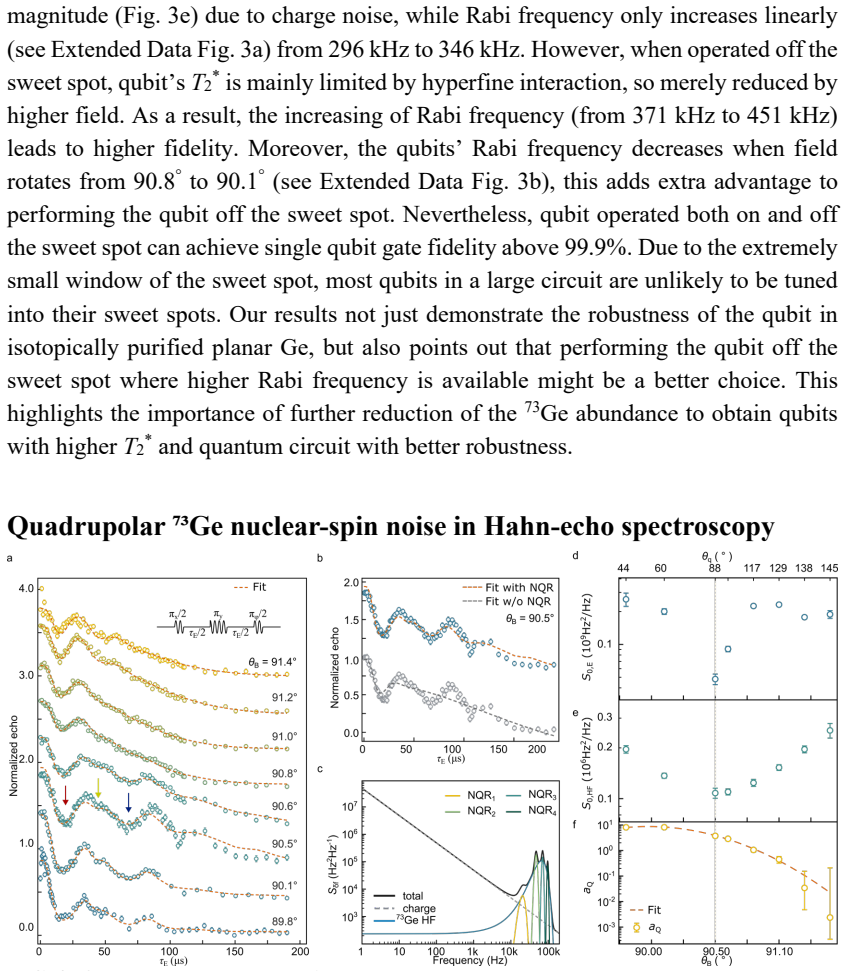
Synthesis of high-mobility 2DHG in isotopically purified planar germanium extends qubit T2* beyond 20 microseconds on the sweet spot and above 3 microseconds off it, enabling gate fidelities above 99.9 percent in both regimes; the same devices reveal a distinct finite-frequency nuclear-noise channel whose scaling is consistent with quadrupole-modified dynamics of residual 73Ge nuclei transduced by the anisotropic hyperfine interaction of Ge holes.
What carries the argument
Anisotropic hyperfine interaction of holes in germanium that converts interfacial quadrupolar fluctuations of residual 73Ge nuclei into a qubit-visible finite-frequency noise channel.
If this is right
- Single-qubit gates can be performed at high fidelity without calibrating every qubit exactly to its individual sweet spot, relaxing fabrication uniformity requirements across a wafer.
- The platform becomes viable for multi-qubit circuits where voltage offsets between neighboring devices would otherwise detune some qubits from their optimal points.
- Residual 73Ge nuclei now act as a spectroscopic reporter of interfacial electric-field gradients rather than the dominant decoherence source.
- Isotopic purification removes the main obstacle that had kept germanium hole qubits behind their silicon counterparts in off-sweet-spot performance.
Where Pith is reading between the lines
- The same purification strategy may allow germanium hole qubits to reach the coherence levels needed for surface-code error correction without additional dynamical decoupling overhead.
- Electric-field gradients engineered at the interface could be used as a controllable knob to study or suppress the quadrupolar noise channel in other hole-based systems.
- Because the noise is transduced through the anisotropic hyperfine interaction, similar quadrupolar signatures may appear in any hole qubit platform where the valence-band mixing produces strong anisotropy.
Load-bearing premise
The finite-frequency nuclear noise detected in Hahn-echo spectra is produced by quadrupole-modified precession of the remaining 73Ge nuclei under local electric-field gradients at the interface.
What would settle it
A measurement showing that the finite-frequency noise peak either disappears when the interface electric-field gradient is deliberately flattened or fails to exhibit the reported magnetic-field scaling and angle-dependent visibility.
Figures
read the original abstract
Planar Germanium has emerged as a promising platform to build spin-based large scale quantum computers. By exploiting the anisotropic hyperfine interaction of holes in Ge, qubits with long T2* have been recently realized. While the performance of single qubits is still more or less limited by 73Ge nuclear spin fluctuations, the site-to-site variation of qubit sweet spot becomes obstacles to maintaining high fidelity of each qubit across the whole wafer. To achieve high performance Ge-based quantum circuit, it is therefore essential to eliminate the origin source of hyperfine noise. In its Silicon counterparts, reduction of 29Si abundance enables exceptional high-fidelity operation. In contrast, hole qubits based on isotopically purified Ge have not been demonstrated. Here, we report the synthesis of high quality 2-dimensional hole gas (2DHG) with enriched 70GeH4 precursor. Due to the suppression of nonzero spin nucleus, the qubits' T2* on the sweet spot is moderately extended beyond 20 us, surpassing the previous best reported Ge hole qubits. More importantly, the qubits' T2* off the sweet spot is enhanced to above 3 us, enabling single qubit gate fidelity exceeding 99.9% in both operating regimes. Hahn-echo spectroscopy further resolves a finite-frequency nuclear-noise channel that is distinct from the conventional Larmor-linked hyperfine response. We associate this channel with quadrupole-modified dynamics of residual 73Ge nuclei sampling local electric-field gradients near the Ge/SiGe interface. Its field scaling and angle-dependent visibility are consistent with a qubit-visible quadrupolar nuclear-noise component transduced through the anisotropic hyperfine interaction of Ge holes. These results establish isotopically purified planar Ge as a high-coherence scalable platform for hole spin qubits and provide a spectroscopic probe of interfacial quadrupolar nuclear dynamics.
Editorial analysis
A structured set of objections, weighed in public.
Referee Report
Summary. The manuscript reports the growth of high-quality 2DHG in planar Ge using isotopically enriched 70GeH4 precursor and the resulting hole spin qubits. It claims T2* >20 μs on the sweet spot (surpassing prior Ge reports) and T2* >3 μs off the sweet spot, enabling single-qubit gate fidelities >99.9% in both regimes due to suppression of 73Ge nuclear spins. Hahn-echo spectroscopy reveals an additional finite-frequency nuclear noise channel, interpreted as arising from quadrupole-modified dynamics of residual 73Ge nuclei sampling interfacial electric-field gradients and transduced via anisotropic hyperfine coupling.
Significance. If the isotopic composition is verified and the noise-channel assignment holds, the work would establish isotopically purified planar Ge as a high-coherence platform for hole qubits, with the off-sweet-spot performance gain addressing a key scalability obstacle. The experimental demonstration of extended T2* and the spectroscopic identification of a quadrupolar nuclear-bath component would provide both a practical advance and a new probe of interface physics, analogous to isotopic engineering successes in Si.
major comments (2)
- [Abstract] Abstract: The central performance claims are explicitly attributed to 'suppression of nonzero spin nucleus' via the enriched 70GeH4 precursor, yet the manuscript contains no direct verification of the residual 73Ge fraction in the 2DHG (no SIMS, atom probe, or NMR data referenced). This leaves open alternative explanations such as improved interface quality and undercuts the causal link required for the headline attribution.
- [Hahn-echo spectroscopy] Hahn-echo spectroscopy section: The assignment of the finite-frequency channel to quadrupole-modified 73Ge dynamics is supported only by qualitative consistency with field scaling and angle dependence; without a quantitative model or simulation linking the anisotropic hyperfine interaction to the observed spectrum, the interpretation remains post-hoc and does not yet bear the weight placed on it for the 'reveal' claim.
minor comments (1)
- [Results] Ensure that all reported T2* values and fidelities include explicit error bars, fit details, and raw data traces or supplementary files so that the statistical support for the >20 μs and >3 μs thresholds can be assessed.
Simulated Author's Rebuttal
We thank the referee for the constructive feedback. We address the two major comments point-by-point below, clarifying the evidential basis for our claims while acknowledging where additional discussion or qualification is warranted.
read point-by-point responses
-
Referee: [Abstract] Abstract: The central performance claims are explicitly attributed to 'suppression of nonzero spin nucleus' via the enriched 70GeH4 precursor, yet the manuscript contains no direct verification of the residual 73Ge fraction in the 2DHG (no SIMS, atom probe, or NMR data referenced). This leaves open alternative explanations such as improved interface quality and undercuts the causal link required for the headline attribution.
Authors: We agree that direct post-growth verification of the 73Ge fraction (via SIMS, atom probe, or NMR) is absent from the manuscript. The attribution rests on the use of a commercially enriched 70GeH4 precursor whose specified isotopic purity is stated in the methods, combined with the observed coherence improvements relative to prior natural-abundance Ge devices fabricated in the same growth system. While these performance gains are consistent with nuclear-spin suppression, we acknowledge that interface-quality variations cannot be entirely ruled out without isotopic quantification. In revision we will add a brief methods paragraph citing the precursor specification and a short discussion noting the lack of direct 73Ge assay as a limitation, together with a statement that future devices will include such measurements. revision: partial
-
Referee: [Hahn-echo spectroscopy] Hahn-echo spectroscopy section: The assignment of the finite-frequency channel to quadrupole-modified 73Ge dynamics is supported only by qualitative consistency with field scaling and angle dependence; without a quantitative model or simulation linking the anisotropic hyperfine interaction to the observed spectrum, the interpretation remains post-hoc and does not yet bear the weight placed on it for the 'reveal' claim.
Authors: The finite-frequency feature is identified through its distinct dependence on magnetic-field magnitude and orientation, which deviates from the conventional Larmor-frequency hyperfine response. These trends match the expected signatures of quadrupolar splitting of residual 73Ge nuclei under interfacial electric-field gradients, transduced by the anisotropic hyperfine interaction of holes. A full microscopic simulation of the nuclear bath would require detailed knowledge of the interface gradient distribution and nuclear quadrupolar parameters, which lies outside the scope of the present experimental study. We will revise the text to make explicit that the assignment is based on qualitative consistency rather than quantitative modeling, while retaining the interpretation as the most parsimonious explanation of the observed spectroscopy. revision: partial
Circularity Check
No circularity: experimental report with direct measurements
full rationale
This is an experimental paper reporting measured T2* values and Hahn-echo spectra in isotopically purified Ge hole qubits. No mathematical derivation, model, or prediction is presented whose output reduces by construction to a fitted parameter, self-citation, or input ansatz. Performance claims are tied to direct observations and external literature comparisons without any load-bearing self-referential step that would require a circularity flag.
Axiom & Free-Parameter Ledger
Reference graph
Works this paper leans on
-
[1]
& DiVincenzo, D
Loss, D. & DiVincenzo, D. P. Quantum computation with quantum dots. Phys. Rev. A 57, 121–126 (1998)
1998
-
[2]
Steinacker, P. et al. Industry-compatible silicon spin-qubit unit cells exceeding 99% fidelity. Nature 646, 81–87 (2025)
2025
-
[3]
Gonzalez-Zalba, M. F. et al. Scaling silicon-based quantum computing using CMOS technology. Nat Electron 4, 872–884 (2021)
2021
-
[4]
Zwerver, A. M. J. et al. Qubits made by advanced semiconductor manufacturing. Nat Electron 5, 184–190 (2022)
2022
-
[5]
Elsayed, A. et al. Low charge noise quantum dots with industrial CMOS manufacturing. npj Quantum Inf. 10, 70 (2024)
2024
-
[6]
Maurand, R. et al. A CMOS silicon spin qubit. Nat. Commun. 7, 13575 (2016)
2016
-
[7]
Kawakami, E. et al. Electrical control of a long-lived spin qubit in a Si/SiGe quantum dot. Nat. Nanotechnol. 9, 666–670 (2014)
2014
-
[8]
Garreis, R. et al. Long-lived valley states in bilayer graphene quantum dots. Nat. Phys. 20, 428–434 (2024)
2024
-
[9]
Carballido, M. J. et al. Compromise-free scaling of qubit speed and coherence. Nat. Commun. 16, 7616 (2025)
2025
-
[10]
Hendrickx, N. W. et al. A single-hole spin qubit. Nat. Commun. 11, 3478 (2020)
2020
-
[11]
Tyryshkin, A. M. et al. Electron spin coherence exceeding seconds in high-purity silicon. Nat. Mater. 11, 143–147 (2012)
2012
-
[12]
Itoh, K. M. & Watanabe, H. Isotope engineering of silicon and diamond for quantum computing and sensing applications. MRS Commun. 4, 143–157 (2014)
2014
-
[13]
Eng, K. et al. Isotopically enhanced triple-quantum-dot qubit. Sci. Adv. 1, e1500214 (2015)
2015
-
[14]
Veldhorst, M. et al. An addressable quantum dot qubit with fault-tolerant control- fidelity. Nat. Nanotechnol. 9, 981–985 (2014)
2014
-
[15]
Tomić, P. et al. Long coherence silicon spin qubit fabricated in a 300 mm industrial foundry. Preprint at https://doi.org/10.48550/arXiv.2512.20758 (2025)
-
[16]
Yoneda, J. et al. A quantum-dot spin qubit with coherence limited by charge noise and fidelity higher than 99.9%. Nature Nanotech 13, 102–106 (2018)
2018
-
[17]
Xue, X. et al. Quantum logic with spin qubits crossing the surface code threshold. Nature 601, 343–347 (2022)
2022
-
[18]
Mądzik, M. T. et al. Precision tomography of a three-qubit donor quantum processor in silicon. Nature 601, 348–353 (2022)
2022
-
[19]
Noiri, A. et al. Fast universal quantum gate above the fault-tolerance threshold in silicon. Nature 601, 338–342 (2022)
2022
-
[20]
Chan, K. W. et al. Assessment of a Silicon Quantum Dot Spin Qubit Environment via Noise Spectroscopy. Phys. Rev. Applied 10, 044017 (2018)
2018
-
[21]
Zhang, X. et al. Universal control of four singlet–triplet qubits. Nat. Nanotechnol. 20, 209–215 (2025)
2025
-
[22]
W., Franke, D
Hendrickx, N. W., Franke, D. P., Sammak, A., Scappucci, G. & Veldhorst, M. Fast two-qubit logic with holes in germanium. Nature 577, 487–491 (2020)
2020
-
[23]
Jirovec, D. et al. A singlet-triplet hole spin qubit in planar Ge. Nat. Mater. 20, 1106–1112 (2021)
2021
-
[24]
Zhou, Y .-C. et al. High-fidelity geometric quantum gates exceeding 99.9% in germanium quantum dots. Nat. Commun. 16, 7953 (2025)
2025
-
[25]
Scappucci, G. et al. The germanium quantum information route. Nat Rev Mater 6, 926–943 (2020)
2020
-
[26]
Wang, C.-A. et al. Operating semiconductor quantum processors with hopping spins. Science 385, 447–452 (2024)
2024
-
[27]
Dijkema, J. J. et al. Simultaneous operation of an 18-qubit modular array in germanium. Preprint at https://doi.org/10.48550/ARXIV .2604.01063 (2026)
work page internal anchor Pith review doi:10.48550/arxiv 2026
-
[28]
Borsoi, F. et al. Shared control of a 16 semiconductor quantum dot crossbar array. Nat. Nanotechnol. 19, 21–27 (2024)
2024
-
[29]
Tosato, A. et al. A crossbar chip for benchmarking semiconductor spin qubits. Nat. Electron. 9, 324–333 (2026)
2026
-
[30]
John, V . et al. Robust and localised control of a 10-spin qubit array in germanium. Nat. Commun. 16, 10560 (2025)
2025
-
[31]
Jirovec, D. et al. Many-body interferometry with semiconductor spins. Science 392, 183–187 (2026)
2026
-
[32]
Crippa, A. et al. Electrical spin driving by g -matrix modulation in spin-orbit qubits. Phys. Rev. Lett. 120, 137702 (2018)
2018
-
[33]
Mutter, P. M. & Burkard, G. g-tensor resonance in double quantum dots with site- dependent g-tensors. Mater. Quantum Technol. 1, 15003 (2021)
2021
-
[34]
& Loss, D
Bosco, S. & Loss, D. Fully tunable hyperfine interactions of hole spin qubits in Si and Ge quantum dots. Phys. Rev. Lett. 127, 190501 (2021)
2021
-
[35]
A., Bulaev, D
Fischer, J., Coish, W. A., Bulaev, D. V . & Loss, D. Spin decoherence of a heavy hole coupled to nuclear spins in a quantum dot. Phys. Rev. B 78, 155329 (2008)
2008
-
[36]
Hendrickx, N. W. et al. Sweet-spot operation of a germanium hole spin qubit with highly anisotropic noise sensitivity. Nat. Mater. https://doi.org/10.1038/s41563- 024-01857-5 (2024) doi:10.1038/s41563-024-01857-5
-
[37]
Lawrie, W. I. L. et al. Spin relaxation benchmarks and individual qubit addressability for holes in quantum dots. Nano Lett. 20, 7237–7242 (2020)
2020
-
[38]
Kerckhoff, J. et al. Magnetic gradient fluctuations from quadrupolar 73 Ge in Si / Si Ge exchange-only qubits. PRX Quantum 2, 010347 (2021)
2021
-
[39]
Chekhovich, E. A. et al. Structural analysis of strained quantum dots using nuclear magnetic resonance. Nat. Nanotechnol. 7, 646–650 (2012)
2012
-
[40]
A., Hopkinson, M., Skolnick, M
Chekhovich, E. A., Hopkinson, M., Skolnick, M. S. & Tartakovskii, A. I. Suppression of nuclear spin bath fluctuations in self-assembled quantum dots induced by inhomogeneous strain. Nat. Commun. 6, 6348 (2015)
2015
-
[41]
Botzem, T. et al. Quadrupolar and anisotropy effects on dephasing in two-electron spin qubits in GaAs. Nat. Commun. 7, 11170 (2016)
2016
-
[42]
Asaad, S. et al. Coherent electrical control of a single high-spin nucleus in silicon. Nature 579, 205–209 (2020)
2020
-
[43]
Lu, J. et al. Impact of oxygen concentration on hole mobility in undoped Ge quantum wells. Chin. Phys. B http://iopscience.iop.org/article/10.1088/1674- 1056/ae39d4 (2026)
-
[44]
Costa, D. et al. Reducing disorder in Ge quantum wells by using thick SiGe barriers. Appl. Phys. Lett. 125, 222104 (2024)
2024
-
[45]
Corrigan, J. et al. Latched readout for the quantum dot hybrid qubit. Appl. Phys. Lett. 122, 74001 (2023)
2023
-
[46]
Urdampilleta, M. et al. Gate-based high fidelity spin readout in a CMOS device. Nat. Nanotechnol. 14, 737–741 (2019)
2019
-
[47]
J., Nelson, J
Connors, E. J., Nelson, J. & Nichol, J. M. Rapid high-fidelity spin-state readout in Si / Si - Ge quantum dots via rf reflectometry. Phys. Rev. Appl. 13, 24019 (2020)
2020
-
[48]
Harvey-Collard, P. et al. High-fidelity single-shot readout for a spin qubit via an enhanced latching mechanism. Phys. Rev. X 8, 21046 (2018)
2018
-
[49]
Hendrickx, N. W. et al. A four-qubit germanium quantum processor. Nature 591, 580–585 (2021)
2021
-
[50]
Taylor, J. M. et al. Relaxation, dephasing, and quantum control of electron spins in double quantum dots. Phys. Rev. B 76, 35315 (2007)
2007
-
[51]
Daoust, P. et al. Nuclear spin-Free70 Ge/28 Si70 Ge quantum well heterostructures grown on industrial SiGe-buffered wafers. Adv. Sci. 13, e23504 (2026)
2026
-
[52]
Hensen, B. et al. A silicon quantum-dot-coupled nuclear spin qubit. Nat. Nanotechnol. 15, 13–17 (2020)
2020
-
[53]
M., Nave, C
Cywiński, Ł., Lutchyn, R. M., Nave, C. P. & Das Sarma, S. How to enhance dephasing time in superconducting qubits. Phys. Rev. B 77, 174509 (2008)
2008
-
[54]
Verkhovskii, S. V . et al. Isotopic disorder in Ge single crystals probed with 73 Ge NMR. Phys. Rev. B 68, 104201 (2003). Extended Data Fig. 1 Density dependence of hole mobility for different Hall devices from the same isotopically purified wafers. The wafer is diced into 1 cm × 1 cm chip. Hall devices are fabricated on two chips. Two devices are tested ...
2003
discussion (0)
Sign in with ORCID, Apple, or X to comment. Anyone can read and Pith papers without signing in.