REVIEW 2 major objections 6 minor
Phase structure of the one-dimensional $\mathbb{Z}_2$ lattice gauge theory with second nearest-neighbor interactions
T0 review · 2 major / 6 minor · reviewed 2026-08-03 · deepseek-v4-flash
Pith's one-line read Adding second-nearest-neighbor repulsion to a one-dimensional Z2 lattice gauge theory creates a charge-ordered insulator phase with four-site (AABB) periodicity, and for strong nearest-neighbor coupling the system passes through an intermed
desk verdict Solid DMRG extension of the 1NN Z2 LGT model that maps a new four-site COI phase; the qualitative picture holds, but the quantitative boundaries rest on linear gap extrapolations that need scrutiny. read the letter →
The pith
A machine-rendered reading of the paper's core claim, the machinery that carries it, and where it could break.
The reading
What carries the argument
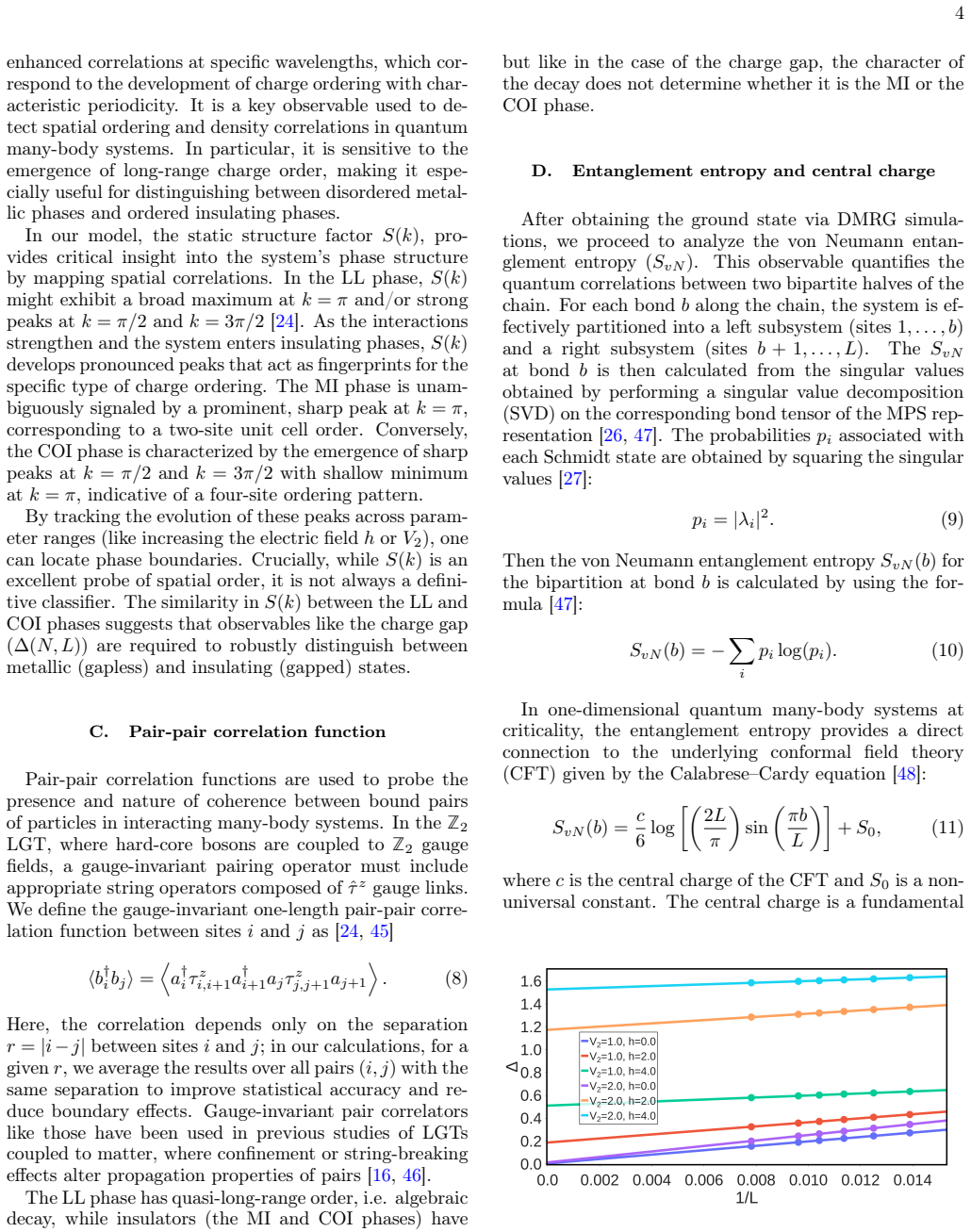
The working machinery is the extended Hamiltonian H = -t Σ (a†_i τ^z_{i,i+1} a_{i+1} + h.c.) - h Σ τ^x_{i,i+1} + V1 Σ n_i n_{i+1} + V2 Σ n_i n_{i+2}, in which the V2 term is the generator of the new physics. Two observables carry the argument: the charge gap Δ = [E(N+2,L)+E(N-2,L)-2E(N,L)]/2, whose vanishing after linear extrapolation to L→∞ fixes the LL/insulator boundaries, and the static structure factor S(k), whose peaks at k=π/2 and 3π/2 (with a shallow minimum at k=π) identify the four-site COI pattern as opposed to the two-site MI peak at k=π. The pair-pair correlator with string operators distinguishes gapless algebraic decay (LL) from exponential decay (COI, MI).
What would settle it
A direct check: compute the charge gap for V1=1, h=0 near V2=2.6t on larger systems (e.g., L=160, 200) with the same MPS method, and plot Δ(L/2,L) versus 1/L. If the extrapolated gap shows a clear curvature or remains finite at V2=2.6, the reported boundary and the linear-closure assumption fail. Alternatively, in the V1=4 case, measure the gap on a fine grid of V2 at h=0.5 and check whether the two zero-gap crossings (MI→LL and LL→COI) survive when the gap is extrapolated with a free power-law exponent rather than linearly; if the intermediate LL window disappears, the deconfined-liquid claim
Extended reading notes
Core claim
The central claim is that second nearest-neighbor repulsion V2 generates a charge-ordered insulator (COI) phase in the 1D Z2 lattice gauge theory at half-filling, with a four-site AABB charge pattern that is absent in the model with only nearest-neighbor interactions. In the V1=1 case, the ground state goes directly from a gapless Luttinger liquid to the COI as V2 or the electric field h is increased, with the gap opening at V2^C ≈ 2.6t along h=0. In the V1=4 case, the system passes from Mott insulator through an intermediate Luttinger liquid and then to the COI, so enhanced V2 both promotes charge order and, in an intermediate window, deconfines the matter. The claim is argued from DMRG/MPS
Load-bearing premise
The phase boundaries are inferred from the places where the charge gap, linearly extrapolated to the thermodynamic limit and then linearly extrapolated to zero as a function of V2 or h, vanishes — so the central assumption is that the gap closes linearly in both the system size (1/L) and in the control parameter, which need not hold near a quantum critical point.
Editorial extensions
If this is right
- For V1=1 (LL in the 1NN model), a direct LL→COI transition occurs, so second-neighbor repulsion alone can open a charge gap and induce four-site charge order; the critical coupling at h=0 is V2^C ≈ 2.6t.
- For V1=4 (MI at low h), the phase sequence MI→LL→COI appears, so a window of parameters exists in which the extended interaction actually deconfines the matter before re-confining it in the COI.
- The COI phase is diagnosed by sharp peaks in S(k) at k=π/2 and 3π/2 and by the fastest exponential decay of pair-pair correlators, while the MI has a single peak at k=π; hence S(k) alone cannot distinguish LL from COI at high h, and the charge gap is the necessary classifier.
- The COI exhibits a distinctive double-peak entanglement profile with minima at about L/4 and 3L/4, a signature of long-range periodic order.
- Central-charge estimates from finite-L entanglement entropy systematically deviate from the gap-derived boundaries, especially for the MI-LL boundary, showing that c≈1 analysis is not quantitatively reliable for this phase diagram.
Reading between the lines
- Because the boundaries are set by linearly extrapolating the gap to zero in both 1/L and the control parameter, any curvature in the gap closing — e.g., a critical exponent zν ≠ 1 — would shift the inferred critical couplings; the intermediate LL window in the V1=4 case is precisely the small-gap region where this shift is largest. Testing this by collapsing gap data with an exponent would either
- The AABB COI phase is reminiscent of charge orderings in extended Hubbard models with next-nearest-neighbor repulsion; the gauge-field coupling may renormalize the effective V2, so mapping the phase diagram onto a bosonized or parton description could predict how the LL window width varies with h far beyond the two V1 lines studied.
- Quantum simulators with tunable Rydberg or cold-atom couplings can realize the V2 term; the predicted S(k) peaks at k=π/2 and 3π/2 and the exponential pair correlator are directly measurable, making the COI phase a concrete target for experimental confirmation.
- The paper's proposal that V2 both induces charge order and (in an intermediate window) deconfines the matter suggests that longer-range interactions may generically produce re-entrant metallic regions between two ordered insulators in 1D gauge-matter systems, a pattern worth checking in related Z2 models with fermions or at other fillings.
Editorial analysis
A structured set of objections, weighed in public.
Referee Report
Summary. The paper uses DMRG/MPS to study the ground-state phase diagram of the 1D Z2 lattice gauge theory with hard-core bosons at half-filling, extending a previous 1NN model by adding a second-nearest-neighbor density-density interaction V2. For two representative values V1=1 and V1=4, the authors compute the thermodynamic charge gap via linear 1/L extrapolation, the static structure factor S(k), gauge-invariant pair-pair correlators, and the von Neumann entanglement entropy/central charge. They report a direct Luttinger-liquid to charge-ordered-insulator (COI) transition for V1=1, and an MI→LL→COI sequence for V1=4, with the COI phase identified by AABB (four-site) charge order and peaks at k=π/2,3π/2. Phase boundaries are placed where the linearly extrapolated gap vanishes.
Significance. If correct, the paper demonstrates that second-nearest-neighbor repulsion qualitatively enriches the phase structure of a paradigmatic 1D Z2 gauge theory, adding a charge-ordered insulator and an intermediate Luttinger-liquid region. The strengths are the multi-observable characterization (gap, structure factor, correlators, entanglement) and benchmarking against ED and the V2=0 limit. However, the central quantitative result—the phase boundaries and the existence of the intermediate LL window—rests on an unexamined linear extrapolation of the charge gap, so the significance is presently conditional.
major comments (2)
- [§IVA, §IVE, Figs. 2–3] The phase boundaries are obtained by linearly extrapolating the thermodynamic charge gap to zero as a function of V2 or h. This assumes the gap closes linearly in the control parameter. Near 1D quantum critical points the gap generally closes as |g−gc|^(zν) (with zν≠1) or exponentially for BKT transitions; a linear fit from finite-gap points therefore biases gc. This is not a minor technicality: the claimed LL point for V1=4, h=0.5, V2=2.0 is gapless only under this assumption. If the true gap there is small but positive, or if the MI–LL and LL–COI extrapolation lines cross at the same point, the intermediate LL region disappears. The paper calls the resulting boundaries 'rigorously determined' (Sec. IVE), which is overstated. Please provide the raw gap data and fits, demonstrate that the closure is linear (e.g., a scaling analysis with exponent), or quote critical values with uncertaint
- [§IVD, Figs. 10–11] The central-charge criterion c≈1 at L=128 gives phase boundaries that differ substantially from the gap-based boundaries, especially for the MI–LL boundary (the discrepancy is acknowledged in §IVD and §IVE). Since the central-charge analysis is the only independent estimator of the MI–LL boundary and it does not agree quantitatively, the existence of the intermediate LL phase should be confirmed with another approach (e.g., finite-size scaling of the gap with a different closure ansatz, or extraction of the Luttinger parameter). As it stands, the evidence for the LL window is primarily the extrapolated gap.
minor comments (6)
- [Abstract] Typo: 'neatest-neighbor' should be 'nearest-neighbor'.
- [§IVD] Grammatical error: 'there more localized' should be 'they are more localized'.
- [Fig. 1 caption] The caption reads '∆L/2, L)' — missing 'Δ' before the parenthesis; should be 'Δ(L/2, L)'.
- [§IVE] The text uses both 'rigorously constructed/determined' and 'estimated' for the same boundaries; this is inconsistent and the stronger wording is not supported by the linear extrapolation procedure.
- [§IIB] The benchmark against exact diagonalization is mentioned but no comparison is shown. A short discussion or a reference to a prior benchmark would be helpful.
- [§IVC, Fig. 8] The pair-pair correlator fits are stated to be power-law or exponential, but no fit parameters, exponents, or goodness-of-fit measures are reported. Please include these details or relegate the statement to a qualitative observation.
Circularity Check
No significant circularity: phase boundaries are inferred from directly computed charge gaps, not from fitted parameters or self-citation chains.
full rationale
The paper's central claims are numerical results from an independent DMRG solution of the Hamiltonian (Eq. 1). The charge gap (Eq. 6) is a direct energy difference computed at fixed N and L, with thermodynamic-limit values obtained by linear extrapolation in 1/L. Boundary locations are then set where the extrapolated gap vanishes as a function of V2 or h. This is a numerical inference procedure: the boundary is not an input to the gap calculation, no parameter is fitted that assumes a boundary, and no predicted quantity is identical by construction to a fitted value. The phase classification uses complementary diagnostics (S(k) peak positions, pair-pair decay, entanglement entropy), and the paper explicitly notes that S(k) alone cannot distinguish LL from COI, so the gap is used as an additional criterion. Self-citations are present (Refs. [50], [51]) but are supporting/methodological citations, not load-bearing derivations; the V2=0 benchmark [24] is by different authors. The skeptic's concern about linear extrapolation of the gap (potential nonlinear closure near quantum critical points) is a correctness/accuracy risk, not circularity: a biased extrapolation does not make the derivation equivalent to its inputs. No circular step satisfying the quoted-reduction standard was found.
Assumptions & free parameters
free parameters (3)
- filling penalty coefficient λ =
100
- thermodynamic-limit charge gap Δ (linear 1/L intercept) =
fitted per (V1,V2,h) from L=72–128
- critical boundary locations from linear ∆(V2) or ∆(h) extrapolation =
e.g., V2^C ≈ 2.6t at h=0 for V1=1
assumptions (5)
- domain assumption Working in the physical gauge sector G_i=+1 (with τ_{0,1}=1 and open boundaries) is representative of the theory
- standard math Hard-core boson to spin-1/2 mapping (Eq. 4) is exact for the constrained Hilbert space
- domain assumption Open-boundary charge gap with N±2 at fixed L extrapolates linearly in 1/L to the thermodynamic gap
- domain assumption Calabrese-Cardy relation (Eq. 11) provides a valid central-charge estimate at L=128
- ad hoc to paper Linear closure of the charge gap at phase boundaries
invented entities (2)
-
COI phase (four-site AABB charge-ordered insulator)
independent evidence
-
'meson-LL' and 'parton-plasma' sub-regions of the LL phase
Cite this review
Pith. "Pith review of Phase structure of the one-dimensional $\mathbb{Z}_2$ lattice gauge theory with second nearest-neighbor interactions." pith.science (2026). https://pith.science/paper/OJG26EIW
@misc{pith2026251210755,
  author       = {Pith},
  title        = {Pith review of: Phase structure of the one-dimensional $\mathbbZ_2$ lattice gauge theory with second nearest-neighbor interactions},
  year         = {2026},
  howpublished = {\url{https://pith.science/paper/OJG26EIW}},
  note         = {Machine review of arXiv:2512.10755}
}
abstract
We investigate the ground-state phase diagram of a one-dimensional $\mathbb{Z}_2$ lattice gauge theory (LGT) model with hard-core bosons at half-filling, extending previous studies by including second nearest-neighbor (2NN) interactions. Using matrix product state techniques within the density matrix renormalization group, we compute charge gap, static structure factor, pair-pair correlation functions, and entanglement entropy for various interaction strengths and field parameters. We analyze two representative neatest-neighbor interaction strengths ($V_1$) that correspond to the Luttinger liquid (LL) and Mott insulator (MI) phases in the absence of the 2NN interactions. We introduce the 2NN coupling $V_2$ and investigate its impact on the system. Our results reveal very rich behavior. As the 2NN repulsion increases, in the case of small $V_1$, we observe a direct transition from the LL phase to a charge-ordered insulator (COI) phase with four-site ordering pattern, whereas for large $V_1$, we observe a transition from the MI phase with two-site ordering pattern (previously found with only $V_1$ included), going through an intermediate LL region, and finally reaching the COI regime. Additionally, the inclusion of 2NN interactions enhances charge order and suppresses pair coherence, evidenced by sharp peaks in the structure factor and rapid decay in pair-pair correlators. Our work extends the well-studied phase structure of 1D $\mathbb{Z}_2$ LGT models and demonstrates the interplay between gauge fields, confinement, and extended interactions.
Figures


Figures from the paper (6 more)


Reviewed August 3, 2026 · model on record in the stance chip above.
Discussion (0). Continue with ORCID to comment.