REVIEW 3 major objections 4 minor 299 references
A cumulative-entropy coreset score can filter poisoned data, neutralize backdoors across eight attack types, and keep clean-data accuracy.
Reviewed by Pith at T0; open to challenge. T0 means a machine referee read the full paper against a public rubric. the ladder, T0–T4 →
ABCS selects a high-entropy coreset from poisoned training data and trains on it, mitigating eight backdoor attacks with minimal natural-accuracy loss.
T0 review reviewed 2026-08-01 challenge →
load-bearing objection Solid empirical training-time defense with broad evaluation, but the abstract overclaims robustness relative to the paper's own adaptive-attack results. the 3 major comments →
Anti-Backdoor Coreset Selection via Cumulative Entropy
The pith
A machine-rendered reading of the paper's core claim, the machinery that carries it, and where it could break.
The reading
Core claim
The paper's central proposal, ABCS, is that the cumulative entropy of a sample's prediction distribution across training epochs is a reliable anti-backdoor signal. Poisonous samples converge to the backdoor early, so their per-epoch entropy drops fast and stays low; benign samples, especially hard ones, keep higher entropy. Accumulating min-max normalized entropy over the selection phase stabilizes this separation and avoids the variance of one-shot uncertainty sampling. The method then unlearns the currently uncertain samples each epoch with smoothed labels and l2 weight anchoring, which enlarges the CENT gap before the final coreset is chosen. Training from scratch on the high-CENT coreset
What carries the argument
Cumulative Entropy (CENT): for each sample, the average over Tse selection epochs of its min-max normalized Shannon entropy over class predictions, H(x_i) = -Σ_c p_θ(c|x_i) log p_θ(c|x_i). This single object carries the argument by encoding both instantaneous uncertainty and temporal consistency of learning. Two supporting mechanisms do the heavy lifting: a warm-up phase sets the coreset size automatically from the mean entropy of correctly predicted samples, and a per-epoch unlearning step removes high-entropy samples under label smoothing with l2 weight regularization, enlarging the entropy gap between benign and poisonous samples before scores are accumulated. Final training is standard c
Load-bearing premise
Everything rests on the claim that poisoned samples have lower prediction uncertainty and are less frequent than benign samples; if an adversary can make poisoned samples as uncertain or as frequent as hard benign samples, the cumulative-entropy separation weakens and the defense's success rate declines.
What would settle it
Construct a poisoned dataset by poisoning only the 5% of clean samples with the highest Cumulative Entropy and randomizing half of their labels, then run ABCS. If the final model's attack success rate remains far from zero and the selected coreset still contains a nontrivial fraction of poisoned samples, the uncertainty-separation premise fails. The paper's own label-randomization experiments already show ASR rising to double digits for some attacks, so this is a directly checkable point.
If this is right
- If the central claim holds, a training-time defense can be built without clean reference data and without precise dataset splitting; a selection ratio around 55% is enough to keep natural accuracy.
- Because the coreset is smaller than the full set, final training is faster, so total defense time is comparable to unprotected training rather than a multiple of it.
- The defense transfers across architectures and task domains: the paper reports consistent results on image classification with several network families and on text classification with transformer models.
- The method remains effective when the dataset is clean, avoiding the natural-accuracy drop that several prior defenses suffer on unpoisoned data.
Where Pith is reading between the lines
- Beyond the paper, the CENT-versus-backdoor separation suggests a general trade-off: any defense that exploits 'poisoned samples learn first and become certain' can be circumvented by attacks that slow poisoned-sample convergence, so the entropy gap itself is the quantity future adversaries will target.
- The unlearning step's label-smoothing factor could be adapted online from the observed entropy gap, potentially making the defense more robust to the paper's own adaptive-attack results without changing the coreset formulation.
- The paper notes its coresets are larger than an optimal clean-data coreset; this hints that a poisoned dataset carries an extra, discardable 'backdoor task' component, and an information-theoretic measure of that component might predict how much larger a safe coreset must be.
Editorial analysis
A structured set of objections, weighed in public.
Referee Report
Summary. The paper proposes ABCS (Anti-Backdoor Coreset Selection), a training-time defense that treats backdoor defense as a coreset selection problem. The method computes a Cumulative Entropy (CENT) score for each training sample by accumulating normalized entropy over a selection phase, preceded by a warm-up phase; during selection it unlearns uncertain samples with label smoothing and regularization to widen the uncertainty gap between benign and poisoned samples. The final model is trained from scratch on the selected high-CENT coreset. The paper evaluates ABCS on CIFAR10, GTSRB, Tiny-ImageNet, and text classification against eight backdoor attacks, comparing to six defenses, and reports natural accuracy close to clean training, near-zero ASR in standard settings, and comparable runtime, plus ablations and adaptive-attack analyses.
Significance. The contribution is substantial if the empirical results hold: a simple, fast, training-time defense that covers many attack types without clean reference data and with public code. The paper is thorough in benchmarking, ablations, and adaptive evaluations, and it explicitly discusses limitations. The main caveat is that the central uncertainty premise is an empirical regularity rather than a guaranteed property; the paper's own adaptive label-randomization experiments show that the defense degrades substantially when poisoned samples are made uncertain. Nevertheless, the method still reduces ASR compared to no defense in most adaptive settings, and the standard-setting results are strong. The lack of theoretical foundation is acknowledged and is not by itself disqualifying.
major comments (3)
- [Abstract / Section 1 vs. Section E.5, Table 18] The claims that ABCS 'mitigates backdooring attacks consistently' (Abstract) and 'mitigate[s] all investigated backdoor' (Contributions) are contradicted by the paper's own adaptive experiments in Table 18. Under 50% label randomization, ABCS leaves ASR at 16.63% (BadNets), 30.03% (IAB), 23.99% (LF), 9.74% (Blend), and 15.69% (A-Blend). The Limitations section only mentions A-Blend as 'suboptimal' and does not qualify the general claim. Please soften the claims to reflect that ABCS substantially reduces ASR in standard settings and provides partial mitigation under adaptive uncertainty-raising attacks, or move the adaptive results into the main text and discuss their implications.
- [Section 4.1] The coreset size determination is ambiguous. The threshold τ is defined as an average over warm-up epochs of the mean entropy of correctly predicted samples, while the size s is defined using CENT(x_i), which is only accumulated during the subsequent selection phase. As written, CENT values do not exist at the point where τ is computed. Please provide a precise algorithm (or pseudocode) specifying whether τ is applied to the final CENT scores, whether the warm-up entropies are also accumulated, and how the two phases interact.
- [Section 5 and Section D.2] The hyperparameters ε=0.9, γ=0.1/0.01, Twa=10, and Tse=40 are set based on ablations on CIFAR10 and then used for other datasets. Since the same benchmark is used for both tuning and final evaluation, there is a risk of overfitting to the evaluation suite. The paper should report performance with fixed hyperparameters across datasets or provide a sensitivity analysis showing that the conclusions are robust to reasonable variations. At minimum, the evaluation protocol should be discussed explicitly.
minor comments (4)
- [Section 4.2, Step-2] The phrase 'select samples larger than the average' should specify that the average is computed over correctly predicted samples, as in the formula; otherwise the description is ambiguous.
- [Various] Typos: 'similiar' (p.2), 'mis-prediced' (p.15), 'in additon' (p.15), 'native training' (Table 3 caption), and the Figure 1 caption 'using with a ResNet18' should be corrected.
- [Section 4, CENT equation] The CENT equation does not explicitly define the model θ_t after each selection epoch; clarify whether it is the model after the unlearning step.
- [Table 1 caption] The caption states that defense failure (ASR >50%) is shown as orange boldface, but no orange entries appear in the ABCS columns; ensure the formatting is consistent in the final version.
Circularity Check
No significant circularity: ABCS's derivation is self-contained and its central claim is evaluated against external attacks.
full rationale
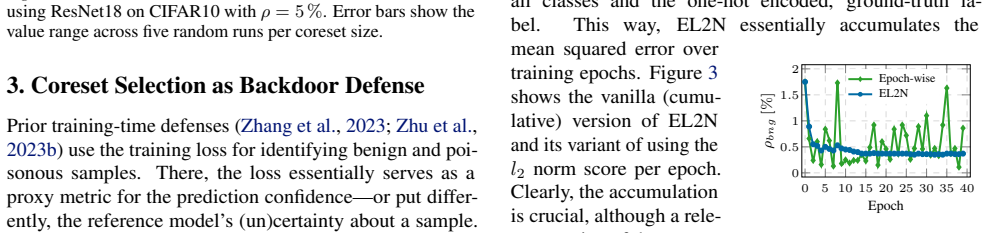
The paper's derivation chain is not circular. The CENT criterion is defined as an accumulated, min-max normalized Shannon entropy over training epochs (Section 4), independent of the ASR/DER metrics it is evaluated against. The premise that poisonous samples have lower prediction uncertainty is an empirical observation supported by Figure 1 and external citations (Li et al., 2021b), not a result derived from the defense's own outputs. The selection threshold τ is computed from the warm-up model's correct predictions, and the final coreset is trained from scratch, so the defense does not fit parameters to the target metric. The method is tested against eight external attacks and baselines, and the appendix's adaptive-attack experiments (including CENT-ranked poisoning and label randomization) directly challenge the central premise and show degraded but still meaningful ASR reduction, which is a sign of external evaluation rather than circularity. The authors' self-citations (Zhao & Wressnegger, 2024; 2025) support background observations about backdoor learning dynamics, but the central claim does not reduce to those citations. Hyperparameters such as Twa, Tse, ε, γ are ablated on the same attacks, which is benchmark tuning, not circularity in derivation. The Limitations section acknowledges the lack of a theoretical foundation and suboptimal performance on A-Blend, further confirming that the paper does not assert a forced result.
Axiom & Free-Parameter Ledger
free parameters (4)
- Label smoothing factor epsilon =
0.9
- Unlearning regularization gamma =
0.1 (small-scale), 0.01 (large-scale)
- Warm-up epochs Twa =
10
- Selection epochs Tse =
40
axioms (3)
- domain assumption Poisoned samples have lower prediction uncertainty and converge faster than benign samples during training.
- domain assumption Backdoor attacks preserve the natural data distribution, so a coreset of the primary task maintains natural accuracy.
- ad hoc to paper Unlearning with label smoothing enlarges the uncertainty gap between benign and poisoned samples without model collapse.
Cite this review
Pith. "Pith review of Anti-Backdoor Coreset Selection via Cumulative Entropy." pith.science (2026). https://pith.science/paper/OJSVRX4S
@misc{pith2026260725502,
  author       = {Pith},
  title        = {Pith review of: Anti-Backdoor Coreset Selection via Cumulative Entropy},
  year         = {2026},
  howpublished = {\url{https://pith.science/paper/OJSVRX4S}},
  note         = {Machine review of arXiv:2607.25502}
}
read the original abstract
Recent training-time defenses against neural backdoors isolate a benign subset from poisoned training data, to learn a backdoor-free model from it. In this paper, we formulate this defense strategy as a coreset selection problem, giving rise to so-called "Anti-Backdoor Coreset Selection." Since poisonous samples have (a) lower prediction uncertainty and are (b) less frequent than benign samples, coreset selection naturally focuses more on samples associated with benign functionality than the backdoor functionality. We use the Cumulative Entropy as selection criterion to further facilitate this effect. The metric tracks the learning dynamics of training samples and allowing us to select benign samples with high informativeness for the coreset. Additionally, we unlearn the chosen samples in each epoch to facilitate the separability between benign and poisonous samples. Together, this yields an exceptionally effective training-time defense that constructs a benign coreset to train a backdoor-free model. Unlike prior defenses that compromise natural accuracy and fail against certain attacks, our method mitigates backdooring attacks consistently with a negligible impact on natural performance.
Figures






Reference graph
Works this paper leans on
-
[1]
A new backdoor attack in cnns by training set corruption without label poisoning
Barni, M., Kallas, K., and Tondi, B. A new backdoor attack in cnns by training set corruption without label poisoning. In Proc. of the IEEE International Conference on Image Processing ( ICIP ) , 2019
2019
-
[2]
and Roli, F
Biggio, B. and Roli, F. Wild patterns: Ten years after the rise of adversarial machine learning. Pattern Recognition, 84: 0 317--331, 2018
2018
-
[3]
Poisoning attacks against support vector machines
Biggio, B., Nelson, B., and Laskov, P. Poisoning attacks against support vector machines. In Proc. of the International Conference on Machine Learning ( ICML ) , 2012
2012
-
[4]
Borgwardt, K. M., Gretton, A., Rasch, M. J., Kriegel, H.-P., Sch \"o lkopf, B., and Smola, A. J. Integrating structured biological data by kernel maximum mean discrepancy. Bioinformatics, 2006. doi:10.1093/bioinformatics/btl242
-
[5]
Poisoning the unlabeled dataset of Semi-Supervised learning
Carlini, N. Poisoning the unlabeled dataset of Semi-Supervised learning. In Proc. of the USENIX Security Symposium , 2021
2021
-
[6]
A., Paleka, D., Pearce, W., Anderson, H., Terzis, A., Thomas, K., and Tramèr, F
Carlini, N., Jagielski, M., Choquette-Choo, C. A., Paleka, D., Pearce, W., Anderson, H., Terzis, A., Thomas, K., and Tramèr, F. Poisoning web-scale training datasets is practical. In Proc. of the IEEE Symposium on Security and Privacy , 2024
2024
-
[7]
Effective backdoor defense by exploiting sensitivity of poisoned samples
Chen, W., Wu, B., and Wang, H. Effective backdoor defense by exploiting sensitivity of poisoned samples. In Proc. of the Annual Conference on Neural Information Processing Systems ( NeurIPS ) , 2022
2022
-
[8]
Targeted backdoor attacks on deep learning systems using data poisoning
Chen, X., Liu, C., Li, B., Lu, K., and Song, D. Targeted backdoor attacks on deep learning systems using data poisoning. CoRR, abs/1712.05526, 2017
Pith/arXiv arXiv 2017
-
[9]
Cheng, P., Wu, Z., Du, W., Zhao, H., Lu, W., and Liu, G. Backdoor attacks and countermeasures in natural language processing models: A comprehensive security review. IEEE Transactions on Neural Networks and Learning Systems, 2025. doi:10.1109/TNNLS.2025.3540303
arXiv 2025
-
[10]
Clark, P. J. and Evans, F. C. Distance to nearest neighbor as a measure of spatial relationships in populations. Ecology, 35 0 (4): 0 445--453, 1954
1954
-
[11]
Selection via proxy: Efficient data selection for deep learning
Coleman, C., Yeh, C., Mussmann, S., Mirzasoleiman, B., Bailis, P., Liang, P., Leskovec, J., and Zaharia, M. Selection via proxy: Efficient data selection for deep learning. In Proc. of the International Conference on Learning Representations ( ICLR ) , 2020
2020
-
[12]
Bert: Pre-training of deep bidirectional transformers for language understanding
Devlin, J., Chang, M.-W., Lee, K., and Toutanova, K. Bert: Pre-training of deep bidirectional transformers for language understanding. In Proc. of the Annual Meeting of the Association for Computational Linguistics, 2019
2019
-
[13]
Label smoothing improves machine unlearning
Di, Z., Zhu, Z., Jia, J., Liu, J., Takhirov, Z., Jiang, B., Yao, Y., Liu, S., and Liu, Y. Label smoothing improves machine unlearning. In Proc. of the International Conference on Learning Representations ( ICLR ) , 2026
2026
-
[14]
and Precioso, F
Ducoffe, M. and Precioso, F. Adversarial active learning for deep networks: a margin based approach. In Proc. of the AAAI Conference on Artificial Intelligence ( AAAI ) , 2018
2018
-
[15]
SalUn : Empowering machine unlearning via gradient-based weight saliency in both image classification and generation
Fan, C., Liu, J., Zhang, Y., Wong, E., Wei, D., and Liu, S. SalUn : Empowering machine unlearning via gradient-based weight saliency in both image classification and generation. In Proc. of the International Conference on Learning Representations ( ICLR ) , 2024
2024
-
[16]
Backdoor defense via adaptively splitting poisoned dataset
Gao, K., Bai, Y., Gu, J., Yang, Y., and Xia, S.-T. Backdoor defense via adaptively splitting poisoned dataset. In Proc. of the IEEE Conference on Computer Vision and Pattern Recognition (CVPR) , 2023
2023
-
[17]
Explaining and harnessing adversarial examples
Goodfellow, I., Shlens, J., and Szegedy, C. Explaining and harnessing adversarial examples. In Proc. of the International Conference on Learning Representations ( ICLR ) , 2015
2015
-
[18]
Badnets: Identifying vulnerabilities in the machine learning model supply chain
Gu, T., Dolan - Gavitt, B., and Garg, S. Badnets: Identifying vulnerabilities in the machine learning model supply chain. Proceeding of Machine Learning and Computer Security Workshop, 2017
2017
-
[19]
DeepCore : A comprehensive library for coreset selection in deep learning
Guo, C., Zhao, B., and Bai, Y. DeepCore : A comprehensive library for coreset selection in deep learning. In Proc. of the International Conference on Database and Expert Systems Applications ( DEXA ) , 2022
2022
-
[20]
Deep residual learning for image recognition
He, K., Zhang, X., Ren, S., and Sun, J. Deep residual learning for image recognition. In Proc. of the IEEE Conference on Computer Vision and Pattern Recognition (CVPR) , 2016
2016
-
[21]
He, X., Xu, Q., Wang, J., Rubinstein, B. I. P., and Cohn, T. SEEP : Training dynamics grounds latent representation search for mitigating backdoor poisoning attacks. In Proc. of the Annual Meeting of the Association for Computational Linguistics, 2024
2024
-
[22]
Hekmatfar, M. and Farahani, R. Z. (eds.). Facility Location: Concepts, Models, Algorithms and Case Studies. Contributions to Management Science. Springer, 2009. doi:10.1007/978-3-7908-2151-2
-
[24]
Densely connected convolutional networks
Huang, G., Liu, Z., and van der Maaten, L. Densely connected convolutional networks. In Proc. of the IEEE Conference on Computer Vision and Pattern Recognition (CVPR) , 2017
2017
-
[25]
Backdoor defense via decoupling the training process
Huang, K., Li, Y., Wu, B., Qin, Z., and Ren, K. Backdoor defense via decoupling the training process. In Proc. of the International Conference on Learning Representations ( ICLR ) , 2022 a
2022
-
[26]
Active learning by querying informative and representative examples
Huang, S.-j., Jin, R., and Zhou, Z.-H. Active learning by querying informative and representative examples. In Proc. of the Annual Conference on Neural Information Processing Systems ( NeurIPS ) , 2010
2010
-
[27]
Uncertainty-aware learning against label noise on imbalanced datasets
Huang, Y., Bai, B., Zhao, S., Bai, K., and Wang, F. Uncertainty-aware learning against label noise on imbalanced datasets. In Proc. of the AAAI Conference on Artificial Intelligence ( AAAI ) , 2022 b
2022
-
[28]
D., Hayase, J., and Oh, S
Jha, R. D., Hayase, J., and Oh, S. Label poisoning is all you need. In Oh, A., Naumann, T., Globerson, A., Saenko, K., Hardt, M., and Levine, S. (eds.), Proc. of the Annual Conference on Neural Information Processing Systems ( NeurIPS ) , 2023
2023
-
[29]
Killamsetty, K., Sivasubramanian, D., Ramakrishnan, G., of Texas at Dallas, R. I. U., of Technology Bombay Institution One, I. I., and Two, I. N. Glister: Generalization based data subset selection for efficient and robust learning. In Proc. of the AAAI Conference on Artificial Intelligence ( AAAI ) , 2020
2020
-
[30]
Killamsetty, K., Sivasubramanian, D., Mirzasoleiman, B., Ramakrishnan, G., De, A., and Iyer, R. K. GRAD-MATCH: A gradient matching based data subset selection for efficient learning. In Proc. of the International Conference on Machine Learning ( ICML ) , 2021
2021
-
[31]
CIFAR (canadian institute for advanced research), 2008
Krizhevsky, A., Nair, V., and Hinton, G. CIFAR (canadian institute for advanced research), 2008. URL http://www.cs.toronto.edu/ kriz/cifar.html
2008
-
[32]
Weight poisoning attacks on pretrained models
Kurita, K., Michel, P., and Neubig, G. Weight poisoning attacks on pretrained models. In Proc. of the Annual Meeting of the Association for Computational Linguistics, 2020
2020
-
[33]
M., Autenrieth, M., and Beluch, W
Köhler, J. M., Autenrieth, M., and Beluch, W. H. Uncertainty based detection and relabeling of noisy image labels. In Proceedings of the IEEE/CVF Conference on Computer Vision and Pattern Recognition (CVPR) Workshops, 2019
2019
-
[34]
and Yang, X
Le, Y. and Yang, X. Tiny imagenet visual recognition challenge. CS 231N, 2015
2015
-
[35]
LeCun, Y., Bengio, Y., and Hinton, G. Deep learning. Nature, 521 0 (7553): 0 436--444, 2015. doi:10.1038/nature14539
-
[36]
Invisible backdoor attack with sample-specific triggers
Li, Y., Li, Y., Wu, B., Li, L., He, R., and Lyu, S. Invisible backdoor attack with sample-specific triggers. In Proc. of the IEEE/CVF International Conference on Computer Vision ( ICCV ) , 2021 a
2021
-
[37]
Anti-backdoor learning: Training clean models on poisoned data
Li, Y., Lyu, X., Koren, N., Lyu, L., Li, B., and Ma, X. Anti-backdoor learning: Training clean models on poisoned data. In Proc. of the Annual Conference on Neural Information Processing Systems ( NeurIPS ) , 2021 b
2021
-
[38]
Backdoor learning: A survey
Li, Y., Jiang, Y., Li, Z., and Xia, S.-T. Backdoor learning: A survey. IEEE Transactions on Neural Networks and Learning Systems, 2022
2022
-
[39]
Trojaning attack on neural networks
Liu, Y., Ma, S., Aafer, Y., Lee, W.-C., Zhai, J., Wang, W., and Zhang, X. Trojaning attack on neural networks. In Proc. of the Network and Distributed System Security Symposium ( NDSS ) , 2018
2018
-
[40]
Coresets for data-efficient training of machine learning models
Mirzasoleiman, B., Bilmes, J., and Leskovec, J. Coresets for data-efficient training of machine learning models. In Proc. of the International Conference on Machine Learning ( ICML ) , 2020
2020
-
[41]
When does label smoothing help? In Proc
Müller, R., Kornblith, S., and Hinton, G. When does label smoothing help? In Proc. of the Annual Conference on Neural Information Processing Systems ( NeurIPS ) , 2019
2019
-
[42]
S., Ravikumar, P
Natarajan, N., Dhillon, I. S., Ravikumar, P. K., and Tewari, A. Learning with noisy labels. In Proc. of the Annual Conference on Neural Information Processing Systems ( NeurIPS ) , 2013
2013
-
[43]
Descent-to-delete: Gradient-based methods for machine unlearning
Neel, S., Roth, A., and Sharifi-Malvajerdi, S. Descent-to-delete: Gradient-based methods for machine unlearning. In Proc. of the Annual Conference on Neural Information Processing Systems ( NeurIPS ) , 2020
2020
-
[44]
Nguyen, T. A. and Tran, A. Input-aware dynamic backdoor attack. In Proc. of the Annual Conference on Neural Information Processing Systems ( NeurIPS ) , 2020
2020
-
[45]
Nguyen, T. A. and Tran, A. T. Wanet - imperceptible warping-based backdoor attack. In Proc. of the International Conference on Learning Representations ( ICLR ) , 2021
2021
-
[46]
Paul, M., Ganguli, S., and Dziugaite, G. K. Deep learning on a data diet: finding important examples early in training. In Proc. of the Annual Conference on Neural Information Processing Systems ( NeurIPS ) , 2021
2021
-
[47]
Scikit-learn: Machine learning in python
Pedregosa, F., Varoquaux, G., Gramfort, A., Michel, V., Thirion, B., Grisel, O., Blondel, M., Prettenhofer, P., Weiss, R., Dubourg, V., Vanderplas, J., Passos, A., Cournapeau, D., Brucher, M., Perrot, M., and Duchesnay, E. Scikit-learn: Machine learning in python. Journal of Machine Learning Research, 12: 0 2825--2830, 2011
2011
-
[48]
Hidden killer: Invisible textual backdoor attacks with syntactic trigger
Qi, F., Li, M., Chen, Y., Zhang, Z., Liu, Z., Wang, Y., and Sun, M. Hidden killer: Invisible textual backdoor attacks with syntactic trigger. In the 59th Annual Meeting of the Association for Computational Linguistics and the 11th International Joint Conference on Natural Language Processing, 2021
2021
-
[49]
Revisiting the assumption of latent separability for backdoor defenses
Qi, X., Xie, T., Li, Y., Mahloujifar, S., and Mittal, P. Revisiting the assumption of latent separability for backdoor defenses. In Proc. of the International Conference on Learning Representations ( ICLR ) , 2023
2023
-
[50]
InfoBatch : Lossless training speed up by unbiased dynamic data pruning
Qin, Z., Wang, K., Zheng, Z., Gu, J., Peng, X., Xu, Z., Zhou, D., Shang, L., Sun, B., Xie, X., and You, Y. InfoBatch : Lossless training speed up by unbiased dynamic data pruning. In Proc. of the International Conference on Learning Representations ( ICLR ) , 2024
2024
-
[51]
Deepsweep: An evaluation framework for mitigating dnn backdoor attacks using data augmentation
Qiu, H., Zeng, Y., Guo, S., Zhang, T., Qiu, M., and Thuraisingham, B. Deepsweep: An evaluation framework for mitigating dnn backdoor attacks using data augmentation. In Proc. of the ACM Asia Conference on Computer and Communications Security ( ASIA CCS ) , 2021
2021
-
[52]
Mobilenetv2: Inverted residuals and linear bottlenecks
Sandler, M., Howard, A., Zhu, M., Zhmoginov, A., and Chen, L.-C. Mobilenetv2: Inverted residuals and linear bottlenecks. In Proc. of the IEEE Conference on Computer Vision and Pattern Recognition (CVPR) , 2018
2018
-
[53]
and Savarese, S
Sener, O. and Savarese, S. Active learning for convolutional neural networks: A core-set approach. In Proc. of the International Conference on Learning Representations ( ICLR ) , 2018
2018
-
[54]
R., Najibi, M., Suciu, O., Studer, C., Dumitras, T., and Goldstein, T
Shafahi, A., Huang, W. R., Najibi, M., Suciu, O., Studer, C., Dumitras, T., and Goldstein, T. Poison frogs! targeted clean-label poisoning attacks on neural networks. In Proc. of the Annual Conference on Neural Information Processing Systems ( NeurIPS ) , 2018
2018
-
[55]
and Zisserman, A
Simonyan, K. and Zisserman, A. Very deep convolutional networks for large-scale image recognition. In Proc. of the International Conference on Learning Representations ( ICLR ) , 2015
2015
-
[56]
Stallkamp, J., Schlipsing, M., Salmen, J., and Igel, C. Man vs. computer: Benchmarking machine learning algorithms for traffic sign recognition. Neural Networks, 2012. ISSN 0893-6080
2012
-
[57]
Revisiting Unreasonable Effectiveness of Data in Deep Learning Era
Sun, C., Shrivastava, A., Singh, S., and Gupta, A. Revisiting Unreasonable Effectiveness of Data in Deep Learning Era . In Proc. of the IEEE/CVF International Conference on Computer Vision ( ICCV ) , 2017
2017
-
[58]
T., Trischler, A., Bengio, Y., and Gordon, G
Toneva, M., Sordoni, A., des Combes, R. T., Trischler, A., Bengio, Y., and Gordon, G. J. An empirical study of example forgetting during deep neural network learning. In Proc. of the International Conference on Learning Representations ( ICLR ) , 2019
2019
-
[59]
Label-consistent backdoor attacks
Turner, A., Tsipras, D., and Madry, A. Label-consistent backdoor attacks. ArXiv, abs/1912.02771, 2019
Pith/arXiv arXiv 1912
-
[60]
and Hinton, G
van der Maaten, L. and Hinton, G. Visualizing data using t-sne. Journal of Machine Learning Research, 2008
2008
-
[61]
Shared adversarial unlearning: Backdoor mitigation by unlearning shared adversarial examples
Wei, S., Zhang, M., Zha, H., and Wu, B. Shared adversarial unlearning: Backdoor mitigation by unlearning shared adversarial examples. In Proc. of the Annual Conference on Neural Information Processing Systems ( NeurIPS ) , 2023
2023
-
[62]
Herding dynamical weights to learn
Welling, M. Herding dynamical weights to learn. In Proc. of the International Conference on Machine Learning ( ICML ) , 2009
2009
-
[63]
Backdoorbench: A comprehensive benchmark of backdoor learning
Wu, B., Chen, H., Zhang, M., Zhu, Z., Wei, S., Yuan, D., and Shen, C. Backdoorbench: A comprehensive benchmark of backdoor learning. In Thirty-sixth Conference on Neural Information Processing Systems Datasets and Benchmarks Track, 2022
2022
-
[64]
and Wang, Y
Wu, D. and Wang, Y. Adversarial neuron pruning purifies backdoored deep models. In Proc. of the Annual Conference on Neural Information Processing Systems ( NeurIPS ) , 2021
2021
-
[65]
M., and Jia, R
Zeng, Y., Park, W., Mao, Z. M., and Jia, R. Rethinking the backdoor attacks' triggers: A frequency perspective. In Proc. of the IEEE/CVF International Conference on Computer Vision ( ICCV ) , 2021
2021
-
[66]
Exploring the orthogonality and linearity of backdoor attacks
Zhang, K., Cheng, S., Shen, G., Tao, G., An, S., Makur, A., Ma, S., and Zhang, X. Exploring the orthogonality and linearity of backdoor attacks. In Proc. of the IEEE Symposium on Security and Privacy , 2024
2024
-
[67]
Backdoor defense via deconfounded representation learning
Zhang, Z., Liu, Q., Wang, Z., Lu, Z., and Hu, Q. Backdoor defense via deconfounded representation learning. In Proc. of the IEEE Conference on Computer Vision and Pattern Recognition (CVPR) , 2023
2023
-
[68]
and Wressnegger, C
Zhao, Q. and Wressnegger, C. Adversarially robust anti-backdoor learning. In Proc. of the ACM Workshop on Artificial Intelligence and Security ( AISEC ) , October 2024
2024
-
[69]
and Wressnegger, C
Zhao, Q. and Wressnegger, C. Two sides of the same coin: L earning the backdoor to remove the backdoor. In Proc. of the Annual AAAI Conference on Artificial Intelligence ( AAAI ) , February 2025
2025
-
[70]
Clean-label backdoor attacks on video recognition models
Zhao, S., Ma, X., Zheng, X., Bailey, J., Chen, J., and Jiang, Y. Clean-label backdoor attacks on video recognition models. In Proc. of the IEEE/CVF International Conference on Computer Vision ( ICCV ) , 2023
2023
-
[71]
Enhancing fine-tuning based backdoor defense with sharpness-aware minimization
Zhu, M., Wei, S., Shen, L., Fan, Y., and Wu, B. Enhancing fine-tuning based backdoor defense with sharpness-aware minimization. In Proc. of the IEEE/CVF International Conference on Computer Vision ( ICCV ) , 2023 a
2023
-
[72]
The victim and the beneficiary: Exploiting a poisoned model to train a clean model on poisoned data
Zhu, Z., Wang, R., Zou, C., and Jing, L. The victim and the beneficiary: Exploiting a poisoned model to train a clean model on poisoned data. In Proc. of the IEEE/CVF International Conference on Computer Vision ( ICCV ) , 2023 b
2023
-
[73]
Adversarial attacks on machine learning cybersecurity defences in Industrial Control Systems , year =
Anthi, Eirini and Williams, Lowri and Rhode, Matilda and Burnap, Pete and Wedgbury, Adam , journal =. Adversarial attacks on machine learning cybersecurity defences in Industrial Control Systems , year =
-
[74]
and Dambra, Savino and Freeman, David and Pierazzi, Fabio and Roundy, Kevin A
Apruzzese, Giovanni and Anderson, Hyrum S. and Dambra, Savino and Freeman, David and Pierazzi, Fabio and Roundy, Kevin A. , booktitle = satml, title =
-
[75]
Bagdasaryan, Eugene and Shmatikov, Vitaly , booktitle = usenixss, title =
-
[76]
Detecting Poisoning Attacks on Machine Learning in IoT Environments , year =
Baracaldo, Nathalie and Chen, Bryant and Ludwig, Heiko and Safavi, Amir and Zhang, Rui , booktitle =. Detecting Poisoning Attacks on Machine Learning in IoT Environments , year =
-
[77]
Barni, Mauro and Kallas, Kassem and Tondi, Benedetta , booktitle = icip, title =
-
[78]
CoRR , title =
Bengio, Yoshua and L. CoRR , title =
-
[79]
Berthelot, David and Carlini, Nicholas and Goodfellow, Ian and Papernot, Nicolas and Oliver, Avital and Raffel, Colin , booktitle = neurips, title =
-
[80]
Biggio, Battista and Nelson, Blaine and Laskov, Pavel , booktitle = icml, title =
-
[81]
Wild patterns: Ten years after the rise of adversarial machine learning , year =
Biggio, Battista and Roli, Fabio , journal =. Wild patterns: Ten years after the rise of adversarial machine learning , year =
This paper was first reviewed by deepseek-v4-flash on August 1, 2026.
discussion (0)
Sign in with ORCID, Apple, or X to comment. Anyone can read and Pith papers without signing in.