REVIEW 3 major objections 5 minor 30 references
Component Based Quantum Machine Learning Explainability
T0 review · 3 major / 5 minor · reviewed 2026-08-07 · deepseek-v4-flash
Pith's one-line read This paper answers yes to whether QML can be made explainable by explaining its core components, using fidelity-based SHAP and ALE to reveal feature and parameter importance that monolithic analysis hides.
desk verdict A plausible component-level decomposition for QML explainability, but the central claim rests on an unvalidated fidelity proxy and needs major revisions. read the letter →
The pith
A machine-rendered reading of the paper's core claim, the machinery that carries it, and where it could break.
The reading
What carries the argument
The central mechanism is the 'pseudo model': a wrapper that takes a quantum state (or a state produced by perturbed ansatz parameters) and returns its fidelity $F = |\langle \psi | \phi \rangle|^2$ to a reference state, typically the average encoded state of a class. This turns quantum states into scalar outputs that classical model-agnostic explainers such as SHAP (Shapley additive explanations, a game-theoretic feature attribution method) and ALE (accumulated local effects, a perturbation-based feature effect plot) can consume, at which point those methods compute Shapley values or accumulated local effects over the original input features for the feature map and kernel, or over the ansatz parameters for the variational circuit. For the quantum kernel, the technique instead evaluates kernel values against a central sample per class, and for the decision function a surrogate model is trained on the SVC decision output with an $R^2$ of 0.98.
What would settle it
Take a trained classifier and add a synthetic feature that is random noise but happens to push encoded states toward the class-average reference; if fidelity-based SHAP reports that noise feature as important while the model's accuracy is unchanged when the feature is dropped, the fidelity-to-class-average assumption fails. In other words, compare component-level SHAP importance with leave-one-feature-out model accuracy: any feature that is important in the fidelity plots but has no effect on accuracy would falsify the link between fidelity and prediction.
Extended reading notes
Core claim
On the paper's own terms, the central discovery is that explainability can be inferred for a QML algorithm by decomposing it into components and applying explainability techniques to each component independently. The key adaptation is the use of 'pseudo models' that output quantum state fidelity to a class-average state, so that SHAP and ALE, which normally require a scalar prediction, can be applied to quantum states and to ansatz parameters. The empirical results show that feature importance differs across components in a way that is invisible to monolithic analysis: for example, Glucose and SkinThickness retain similar importance across stages, but Age and BMI gain importance only in the decision function, while Pregnancies matters in the initial encoding but not in the final decision. The paper concludes that the answer to the question of whether component-based explainability works is yes, and claims this is the first such component-based technique.
Load-bearing premise
The entire pipeline assumes that the fidelity of a quantum state to a class-average reference state accurately represents how that component contributes to the model's prediction; if fidelity measures similarity to a constructed average rather than decision-relevant signal, the resulting plots are not explanations of the model.
Editorial extensions
If this is right
- Feature engineering can now be targeted: features that matter only at the decision stage might be kept even if they look weak in the encoding, and features that matter only at encoding might be worth transforming or scaling.
- Model tuning can become layer-specific: parameter-level SHAP values identify which ansatz layers or repetitions drive the output, enabling pruning or reinitialization of the least important parameters.
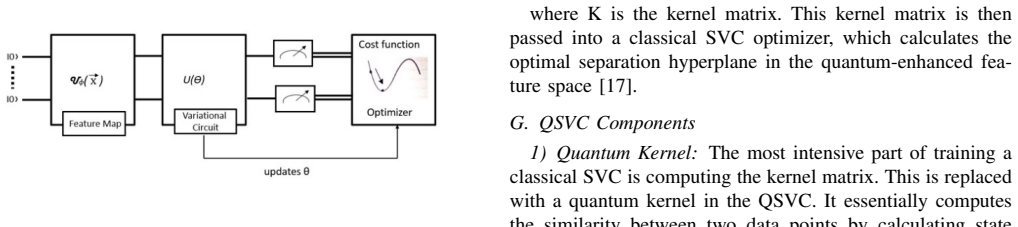
- The modular framework is intended to be model-agnostic, so the same pseudo-model approach can be dropped into other QML algorithms and other components, such as different optimizers or quantum-classical loop stages.
- Component-level importance can serve as a diagnostic for where a model is failing: if the encoding stage already separates the classes, the decision stage is the bottleneck, and vice versa.
Reading between the lines
- Because the fidelity reference is built from class averages, the technique may conflate 'close to a typical example' with 'increases the predicted probability'; replacing the reference with a probability-weighted mixture of class states could separate these two notions.
- A natural extension is to apply the same component decomposition to quantum regression, using target-value-conditioned reference states and inspecting how feature effects on the output emerge across components.
- The component-level plots could be used to compare two feature maps directly: if one feature map assigns high importance to the same features in the decision function as the classical model, it may be a better inductive bias for that task.
- The fidelity-based SHAP values for a single sample are local explanations; aggregating them across many samples could produce a global component-importance map that would let practitioners see, before training, which features the encoding will amplify.
Editorial analysis
A structured set of objections, weighed in public.
Referee Report
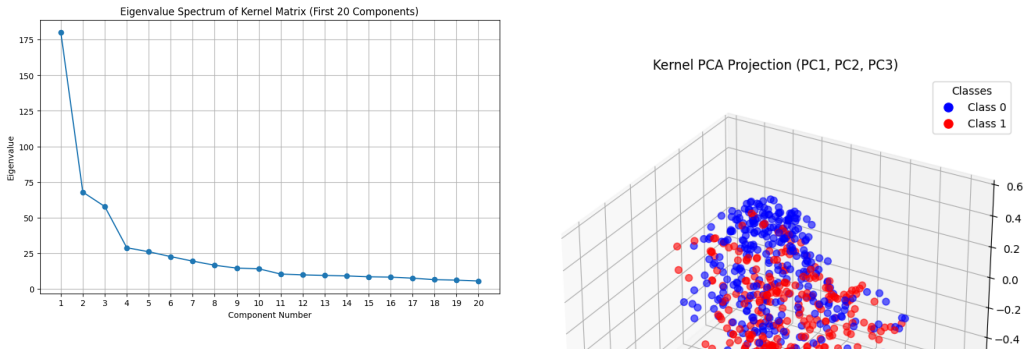
Summary. The paper proposes a modular framework for explainable quantum machine learning: instead of explaining a trained VQC or QSVC as a whole, it applies SHAP and ALE to individual components (feature map, ansatz, quantum kernel, SVC decision function) via 'pseudo-models' whose output is state fidelity to class-average quantum states. The framework is demonstrated on the Pima Indians Diabetes dataset, with waterfall plots, ALE curves, kernel eigenvalue/PCA analysis, and a surrogate-based SHAP analysis of the SVC decision function. The authors conclude that component-based explainability reveals feature and parameter importance that monolithic explainability would hide, answering their stated research question in the affirmative.
Significance. If the central assumption is validated, the modular decomposition is a plausible and potentially useful direction for XQAI: component-level attribution could guide feature-map and ansatz tuning in ways that monolithic explanations cannot. The paper has concrete strengths: it uses a real-world dataset, adapts two model-agnostic explainability methods, performs a surrogate analysis of the QSVC decision function with a reported R² of 0.98, and includes spectral analysis of the quantum kernel. However, the load-bearing claim depends on an unvalidated pseudo-model, and the evaluation is almost entirely qualitative, with no model accuracy numbers, no comparison to classical baselines despite a promise to do so, and no error bars or repeated-run statistics. The contribution is therefore promising but currently not established at the level required for a journal publication.
major comments (3)
- [Section IV and Section V.A] The pseudo-model that replaces the model prediction with fidelity to a 'class average quantum state' is never formally defined. If the class-average state is a normalized sum of statevectors, destructive interference can make it unrepresentative or nearly orthogonal to most class members; if it is a density-matrix mixture, the pseudo-model output becomes an average squared overlap, which is not the QSVC decision function (a kernel-weighted sum over support vectors) nor the VQC output (a parameterized measurement expectation). All SHAP and ALE plots in Figures 6-12 therefore explain similarity to a constructed reference, not necessarily the model's decision. The authors must provide evidence that the fidelity score tracks the actual decision function, for example by reporting the correlation or calibration between pseudo-model outputs and VQC/QSVC outputs on validation samples, or by an ablation showing that known decision-relevant features are recovered.
- [Section III.E and Section V] The paper promises 'a comprehensive and in depth analysis into the values will occur against classical ML algorithms', but no classical ML baseline results are reported, and no accuracy or F1 scores are given for the VQC or QSVC models themselves. Without these numbers, the conclusion that component-based explainability shows 'benefits' and 'the need' for the approach is not quantitatively supported. Please add a results table with VQC/QSVC and classical model metrics across repeated runs or seeds, and include quantitative explanation-quality measures such as agreement with the actual decision function or stability of SHAP values across runs.
- [Section IV.B and Section V.B.1] The ansatz SHAP adaptation is described only as 'slightly perturbing the original ansatz weights', but the perturbation scale, the number of SHAP samples, the background dataset, and the exact baseline for comparison are not specified. Likewise, the 'central sample from each class' used for kernel SHAP is undefined, and the ALE binning parameters are not given. These details are needed for reproducibility and for interpreting the parameter-importance plots in Figures 11 and 12. Please specify all hyperparameters of the explainability adaptations, or release the code in a way that makes the exact procedures available.
minor comments (5)
- [Section II.C.1 and Section V.A] Figure references are inconsistent: the ZZ feature map is called 'Figure 1' in the text but the actual circuit diagram is Figure 2, and several references appear as 'Figure ??' (e.g., for the ansatz circuit and the bloch sphere). Please correct these cross-references.
- [Throughout] There are numerous typos and grammatical slips that should be fixed, including 'alforithms' (Section II), 'od' (Section II.C), 'helper' (Section V.C.1), 'paperion' (Section V.C.1), and 'affect' where 'effect' is meant in the ALE description (Section II.H.2).
- [Section III.E] The sentence 'lit review table' appears to reference a table that is not present in the manuscript; either add the table or remove the dangling reference.
- [References] References [2] and [7] are duplicate entries for the same Gil-Fuster et al. paper, and some citations (e.g., [12] for the VQC diagram) do not appear to match the cited content. The bibliography should be cleaned and checked against the text.
- [Section VI] The claim that these are 'the first component based explainability techniques' is not supported by the related-work survey, which does not systematically demonstrate absence of prior component-level work. Please temper the claim or provide a more thorough literature search.
Circularity Check
No circularity found: the component explanations are self-contained descriptions of an explicitly defined fidelity-based pseudo-model; the main weakness is construct validity, not circular reasoning.
full rationale
The paper does not derive a predictive result from a fitted input. Its adaptation replaces the model output with a stated target—state fidelity to class-average or baseline quantum states—and then runs off-the-shelf SHAP/ALE attributions on that explicitly defined pseudo-model. The resulting plots literally report sensitivity of the defined fidelity measure; no equation in the paper reduces a later claim to an earlier fitted constant. The central weakness is not circularity but construct validity: nothing in Sections IV and V shows that fidelity to a class-average state tracks the VQC/QSVC decision function, so the plots may explain the pseudo-model rather than the model. That is a correctness threat, not a self-referential derivation. The only self-citation ([26], Power and Guha) appears in the related-work section as a comparison point and is not load-bearing for the paper's framework, so it does not raise the circularity score.
Assumptions & free parameters
free parameters (5)
- Z feature map repetition count =
2
- Ansatz type and repetition count =
EfficientSU2, repetitions unspecified
- Optimizer choice =
COBYLA
- Class-average quantum state baselines =
not reported
- Ansatz perturbation scale for SHAP =
not reported
assumptions (4)
- domain assumption State fidelity to a class-average quantum state is a meaningful proxy for a component's contribution to model decisions.
- domain assumption Explanations of individual QML components compose to explain the overall QML model.
- standard math Standard SHAP and ALE assumptions hold when the model output is a fidelity value rather than a prediction.
- domain assumption The Z feature map's class-average states are representative of the classes.
invented entities (2)
-
Pseudo model (fidelity as prediction output)
-
Class-average quantum state baseline
Cite this review
Pith. "Pith review of Component Based Quantum Machine Learning Explainability." pith.science (2026). https://pith.science/paper/OJTKUSVG
@misc{pith2026250612378,
  author       = {Pith},
  title        = {Pith review of: Component Based Quantum Machine Learning Explainability},
  year         = {2026},
  howpublished = {\url{https://pith.science/paper/OJTKUSVG}},
  note         = {Machine review of arXiv:2506.12378}
}
read the original abstract
Explainable ML algorithms are designed to provide transparency and insight into their decision-making process. Explaining how ML models come to their prediction is critical in fields such as healthcare and finance, as it provides insight into how models can help detect bias in predictions and help comply with GDPR compliance in these fields. QML leverages quantum phenomena such as entanglement and superposition, offering the potential for computational speedup and greater insights compared to classical ML. However, QML models also inherit the black-box nature of their classical counterparts, requiring the development of explainability techniques to be applied to these QML models to help understand why and how a particular output was generated. This paper will explore the idea of creating a modular, explainable QML framework that splits QML algorithms into their core components, such as feature maps, variational circuits (ansatz), optimizers, kernels, and quantum-classical loops. Each component will be analyzed using explainability techniques, such as ALE and SHAP, which have been adapted to analyse the different components of these QML algorithms. By combining insights from these parts, the paper aims to infer explainability to the overall QML model.
Figures


Figures from the paper (12 more)




Reference graph
Works this paper leans on
-
[1]
interpretability of black-box machine learning models,
Please, explain. interpretability of black-box machine learning models,
- [3]
-
[4]
Use of superposition and entanglement in quantum algorithms
Sumit Asthana. Use of superposition and entanglement in quantum algorithms. URL: https://www.linkedin.com/pulse/ use-superposition-entanglement-quantum-algorithms-sumit-asthana
-
[5]
Hybrid quantum- classical models: Unlocking the power of quantum machine learning, 2024
KqantumG Research Labs Pvt Ltd. Hybrid quantum- classical models: Unlocking the power of quantum machine learning, 2024. URL: https://www.linkedin.com/pulse/ hybrid-quantum-classical-models-unlocking-j0mxf
work page 2024
-
[6]
Chetan Nayak. Microsoft unveils majorana 1, the world’s first quantum processor powered by topological qubits, 2025. URL: https://azure.microsoft.com/en-us/blog/quantum/2025/02/19/ microsoft-unveils-majorana-1-the-worlds-first-quantum-processor-powered-by-topological-qubits/ ?msockid=0e634514af3c6aef0cd050d3aed66b64
work page 2025
-
[7]
E. Gil-Fuster, J. R. Naujoks, Wojciech Samek, and Jens Eisert. Oppor- tunities and limitations of explaining quantum machine learning. arXiv preprint, 2024. URL: https://arxiv.org/html/2412.14753v1
arXiv 2024
-
[8]
Survey of encoding techniques for quantum machine learning
Siddhartha Sharma and Renugadevi N. Survey of encoding techniques for quantum machine learning. Cybernetics and Physics Vol. 13 , 2024. URL: https://inspirehep.net/files/7a1f4eae2f5fadb4c1ea45dd0b884584
work page 2024
-
[9]
IBM. Z feature map documentation. URL: https://docs.quantum.ibm. com/api/qiskit/qiskit.circuit.library.z feature map
Show all 30 references
-
[10]
Pauli feature map documentation
IBM. Pauli feature map documentation. URL: https://docs.quantum. ibm.com/api/qiskit/qiskit.circuit.library.PauliFeatureMap
-
[11]
Qi et al
H. Qi et al. Variational quantum algorithms: fundamental concepts, applications and challenges. Quantum Information Processing , 2024. doi:10.1007/s11128-024-04438-2
2024 doi
-
[12]
Large scale diverse combinatorial optimization: Espn fantasy football player trades
Aaron Baughman, Daniel Bohm, Micah Forster, Eduardo Morales, Jeff Powell, Shaun McPartlin, Raja Hebbar, and Kavitha Yogaraj. Large scale diverse combinatorial optimization: Espn fantasy football player trades. 11 2021. doi:10.48550/arXiv.2111.02859
-
[13]
Variational algorithm design
IBM Quantum Learning. Variational algorithm design. URL: https://learning.quantum.ibm.com/course/variational-algorithm-design/ variational-algorithms
-
[14]
Efficientsu2, 2025
IBM. Efficientsu2, 2025. URL: https://docs.quantum.ibm.com/api/qiskit/ qiskit.circuit.library.EfficientSU2
2025
-
[15]
Realamplitudes, 2025
IBM. Realamplitudes, 2025. URL: https://docs.quantum.ibm.com/api/ qiskit/qiskit.circuit.library.RealAmplitudes
2025
-
[16]
S. Faldu. Quantum support vector machine 101, 2023. URL: https: //dzone.com/articles/quantum-support-vector-machine-101
2023
-
[17]
Navneet and S
S. Navneet and S. Raj Pokhrel. An independent implementation of quantum machine learning algorithms in qiskit for genomic data. arXiv preprint, 2024. URL: https://arxiv.org/pdf/2405.09781/
2024 arXiv
-
[18]
Quantum kernel machine learning, 2025
IBM. Quantum kernel machine learning, 2025. URL: https://qiskit-community.github.io/qiskit-machine-learning/tutorials/ 03 quantum kernel.html
2025
-
[19]
Explainable ai: Benefits and challenges, 2024
BotPenguin. Explainable ai: Benefits and challenges, 2024. URL: https: //botpenguin.com/glossary/explainable-ai
2024
-
[20]
Lundberg and Su-In Lee
Scott M. Lundberg and Su-In Lee. A unified approach to interpreting model predictions. Conference on Neural Information Processing Systems, 2017
2017
-
[21]
Accumulated local effects, 2020
Oracle. Accumulated local effects, 2020. URL: https: //accelerated-data-science.readthedocs.io/en/v2.6.3/user guide/model explainability/accumulated local effects.html
2020
-
[22]
Apley and Jingyu Zhu
Daniel W. Apley and Jingyu Zhu. Visualizing the effects of predictor variables in black box supervised learning models. Journal of the Royal Statistical Society Series B: Statistical Methodology , 82, 2020. doi: 10.1111/rssb.12377
2020 doi
-
[23]
Machine learning tutorials - qiskit machine learning 0.8.2
IBM. Machine learning tutorials - qiskit machine learning 0.8.2. URL: https://qiskit-community.github.io/qiskit-machine-learning/ tutorials/index.html
-
[24]
Baughman, K
A. Baughman, K. Yogaraj, R. Hebbar, S. Ghosh, R. U. Haq, and Y . Chhabra. Study of feature importance for quantum machine learning models. arXiv preprint, 2022. URL: https://arxiv.org/pdf/2202.11204
2022 arXiv
-
[25]
Steinmuller, T
P. Steinmuller, T. Schulz, F. Graf, and D. Herr. explainable ai for quantum machine learning. arXiv preprint , 2022. URL: https://arxiv. org/pdf/2211.01441
2022 arXiv
-
[26]
Power and K
L. Power and K. Guha. Feature importance and explainability in quantum machine learning. arXiv preprint , 2024. URL: https://arxiv. org/abs/2405.08917v1
2024 arXiv
-
[27]
R. Heese. Explaining quantum circuits with shapley values: Towards explainable quantum machine learning. Quantum Machine Intelligence,
-
[28]
Abdulsalam, S
G. Abdulsalam, S. Meshoul, and H. Shaiba. Explainable heart disease prediction using ensemble-quantum machine learning approach. Intelli- gent Automation and Soft Computing , 2022. doi:10.32604/iasc. 2023.032262
2022
-
[29]
Qubit fidelity, 2025
QuEra. Qubit fidelity, 2025. URL: https://www.quera.com/glossary/ fidelity
2025
-
[2019]
URL: https://www.appsilon.com/post/please-explain-black-box
-
[2025]
doi:10.1007/s42484-025-00254-8
Reviewed August 7, 2026 · model on record in the stance chip above.
Discussion (0). Sign in to comment.