REVIEW 3 major objections 5 minor 1 cited by
Elucidating and Endowing the Diffusion Training Paradigm for General Image Restoration
T0 review · 3 major / 5 minor · reviewed 2026-08-06 · deepseek-v4-flash
Pith's one-line read Transplanting the diffusion generative training objective into ordinary reconstruction-based restoration networks, guided by a per-degradation matching time step, improves generalization to unseen degradations and unifies ten restoration…
desk verdict A real framework with big empirical gains, but the matching time step tmat is a load-bearing premise whose transferability is not established. read the letter →
The pith
A machine-rendered reading of the paper's core claim, the machinery that carries it, and where it could break.
The reading
What carries the argument
The central organizing device is the degradation-specific matching time step $t_{\mathrm{mat}}$: for each degradation type, the pre-trained generative network runs the reverse diffusion process on a degraded image, and $t_{\mathrm{mat}}$ is the time step at which the successive-difference $(\mathbf{x}_t - \mathbf{x}_{t-1})$ best matches the degradation residual $(\mathbf{y} - \mathbf{x})$. This single scalar summarizes degradation complexity, selects the fine-tuning time step, orders the incremental multi-task training schedule, and supplies the time-based prompts to the MoE adapters. Around it the framework adds three regularizers: second-order parameter-importance regularization $L_{\mathrm{reg}}$ that slows forgetting of generative knowledge during fine-tuning, a gradient-orthogonality loss $L_{\mathrm{orthog}}$ that aligns generative and reconstruction gradient directions, and a layer-wise weight decay $w_{\mathrm{decay}}(t)=e^{-at}$ that confines generative fine-tuning to shallow, domain-invariant layers.
What would settle it
Compute the matching time step $t_{\mathrm{mat}}$ on one training split of a degradation (say RESIDE), then fine-tune the pre-trained network at $t_{\mathrm{mat}}$ and at neighboring time steps and evaluate on an out-of-distribution target (REVIDE); if $t_{\mathrm{mat}}$ does not coincide with the time step achieving the best target-domain PSNR, the framework's central premise fails. A cheaper check: re-estimate $t_{\mathrm{mat}}$ on a second training split or with a different training seed; if the estimated $t_{\mathrm{mat}}$ shifts by more than a few steps, it cannot be a stable degradation property.
Extended reading notes
Core claim
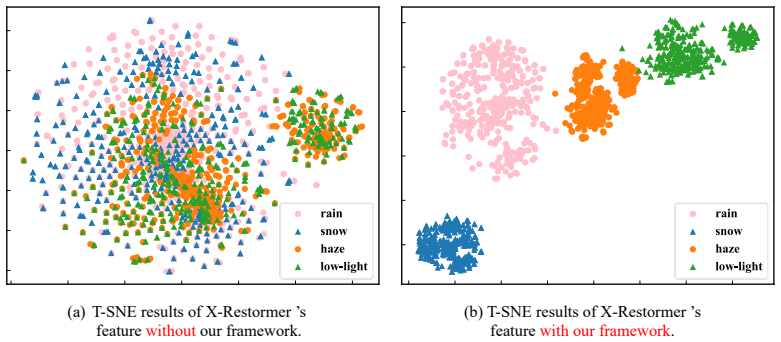
Diffusion generative pre-training on clean images gives an ordinary reconstruction-based restoration network $r_\theta(\mathbf{x}, t)$ access to the diffusion latent space, and each degradation type is assigned a matching time step $t_{\mathrm{mat}}$ via reverse sampling such that the reversed image aligns with the clean image. Fine-tuning the pre-trained network at that $t_{\mathrm{mat}}$, mixing about 10% generative data into the reconstruction fine-tuning, constraining updates with parameter-importance regularization and gradient orthogonality, and applying generative updates only to shallow layers produces restoration networks whose out-of-distribution generalization exceeds existing backbones in four single-task settings and whose unified model outperforms prior methods across ten degradations.
Load-bearing premise
The framework's gains ride on the assumption that the degradation-specific matching time step $t_{\mathrm{mat}}$, computed on training data, is a stable property of the degradation type that transfers to choosing fine-tuning time steps and ordering incremental training; if $t_{\mathrm{mat}}$ is instead a training-set artifact or needs tuning on the target generalization data, the advantage collapses.
Editorial extensions
If this is right
- In single-task settings, the framework raises out-of-distribution PSNR by large margins, e.g., dehazing trained on RESIDE reaches 20.74 dB on REVIDE versus 17.26 dB for the best compared prior.
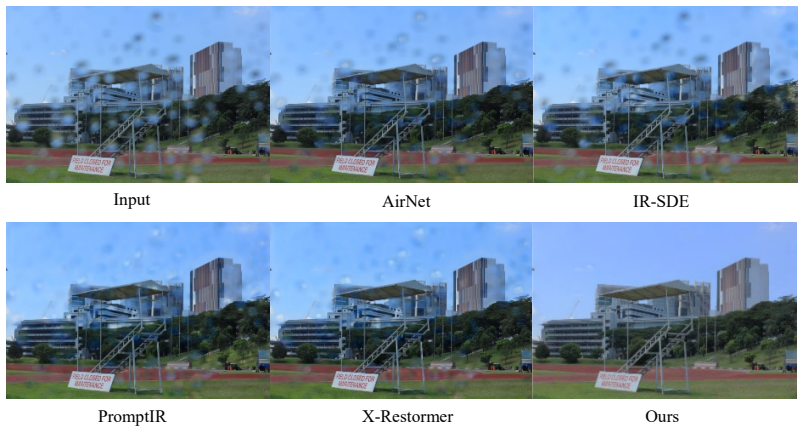
- In unified multi-task settings, the framework reaches 28.13 dB average PSNR across ten degradations, outperforming the 27.51 dB of the best prior, with the best LPIPS among compared methods.
- The framework is backbone-agnostic: applying it to NAFNet and X-Restormer lifts their unified-restoration averages to 28.47 and 28.32 dB respectively.
- A mixing ratio of roughly 10% generative data during fine-tuning maximizes the benefit; larger generative ratios begin to degrade restoration fidelity.
- Ordering incremental multi-task training by matching time steps gives better unified performance than directly mixing all task data.
Reading between the lines
- If $t_{\mathrm{mat}}$ is indeed a stable property of each degradation type, it offers a cheap proxy for degradation complexity: one could predict relative transfer difficulty between degradations and schedule data collection or fine-tuning for new degradations without retraining, a program the paper does not itself pursue.
- The shallow-layer/generative versus deep-layer/reconstruction split suggests a general recipe for injecting generative priors into discriminator-style networks, which may extend beyond restoration to super-resolution, JPEG artifact removal, or compressive sensing.
- The paper reports $t_{\mathrm{mat}}$ increasing with global, complex degradations (low-light $t_{\mathrm{mat}}=38$, haze $t_{\mathrm{mat}}=47$, blur $t_{\mathrm{mat}}=50$), hinting at a monotone degradation-complexity axis; a testable extension is to verify this ordering on graded synthetic degradations.
- The paper's stated limitation is extra training time; a natural follow-up is distilling the generative pre-training into fewer epochs or merging it into the fine-tuning stage, and the framework's own ablations suggest $L_{\mathrm{reg}}$ and $L_{\mathrm{orthog}}$ carry much of the benefit.
Editorial analysis
A structured set of objections, weighed in public.
Referee Report
Summary. The paper proposes a training framework that transplants the diffusion generative training paradigm into general reconstruction-based image restoration (IR) networks. The method has three stages: Timestep Matched Generative Pre-training (TMGP) on clean images, Generalization Enhanced Fine-tuning (GEF) that mixes generative and reconstructive objectives with regularization losses, and Multi-task Unified Learning (MTUL) that uses a degradation-specific matching time step tmat to order incremental training and to condition MoE adapters. The authors report substantial single-task generalization improvements (e.g., dehazing generalization PSNR 20.74 vs. best prior 17.26 in Table 1) and state-of-the-art average multi-task performance on 10 degradations (Table 2, average PSNR 28.13 vs. RAM's 27.51), with ablations supporting each component and extensions to NAFNet and X-Restormer.
Significance. The paper's core idea—using the diffusion time-step structure as an organizing principle for IR training—is interesting and potentially useful for the community, especially because the framework is architecture-agnostic and the authors provide pseudo-code, extensive ablations, visualizations, and complexity comparisons. The strengths of the manuscript include the systematic exploratory analysis in Section 2, the breadth of experiments on 14 datasets, and the attempt to unify single-task generalization and multi-task unified IR under one training paradigm. However, the central premise that tmat is a stable, transferable property of a degradation type is not convincingly established, and the multi-task comparison protocol may not be equitable. If these issues are resolved, the framework could be a valuable training recipe for general IR networks.
major comments (3)
- [Section 3.1, Algorithm 2, Table 4, and Fig. 3(b,d)] The matching time step tmat is the load-bearing quantity of the framework, but its computation is under-specified and its transferability is not demonstrated. Algorithm 2 line 9 writes 'tmat ← t If min ∥(xt − xt−1) − (y − x)∥²' without specifying whether the minimization is over time steps, over samples in the training set, or over random realizations of the reverse-process noise z; since xt−1 depends on the sampled noise z in line 7, the returned tmat is stochastic, yet Table 4 reports single values with no variance or seed-level stability. More importantly, Fig. 3(b,d) sweeps the fine-tuning time step and evaluates on the target generalization sets (REVIDE, Rain100H, RealSnow, LOL-v2); this only shows that some time step chosen with access to the target data improves generalization, not that tmat computed from source training data alone would select that same step. Because tmat also determines the TIT ordering and the MoE prompts in Section 3.3, the entire framework's advantage rests on a premise that is currently unsupported. Please report tmat distributions over samples/seeds, verify that source-computed tmat matches the target-sweep optimum without target-set access, and compare TIT against alternative orderings (e.g., reverse, random, or complexity-based).
- [Section 4, Table 2, and Appendix G.1] The claim of superior multi-task unified IR performance requires that the Setting B baselines are trained on the same 10-task mixture, the same data splits, and a comparable training budget. The manuscript does not state whether the numbers for AirNet, Restormer, NAFNet, PromptIR, IR-SDE, DA-CLIP, ResShift, X-Restormer, and RAM are taken from their original papers or retrained under the authors' protocol. The data mixture described in Appendix G.1 is non-standard (e.g., a subset of Snow100K-L, CelebA-HQ for inpainting with RePaint masks, and a specific low-light set), so published numbers trained on different mixtures are not directly comparable. Please either retrain all baselines under the identical mixture and budget or clearly report the source of each baseline number and provide a matched-training comparison; otherwise the headline average PSNR gain of 0.62 dB over RAM could be an artifact of training-set composition rather than the proposed method.
- [Appendix F, Algorithm 6, and Eqs. (3)-(5)] The parameter importance regularization Lreg is not implementable as written. Equations (3)-(5) define Ωθk in terms of the post-fine-tuning parameters θ1, but the regularization loss is supposed to be used during fine-tuning before those parameters exist; the notation is also inconsistent (θ1_r vs. θ0_k vs. θ1_k). Algorithm 6 appears to compute δθ0_k = θ1_k − θ0_k only at the 'last training epoch' and then performs a single update θ1_k ← θ0_k + ε∇Ls, which does not correspond to normal gradient-descent training and would not produce the reported results. The ablation tables (Tables 6-10) show that Lreg contributes meaningfully to performance, so this component cannot remain a black box. Please provide a correct, implementable algorithm (e.g., an EWC-style importance computed at the end of pre-training and fixed during fine-tuning) and clarify how the Gauss-Newton approximation in Eq. (25) is used in practice.
minor comments (5)
- [Section 2.1, Fig. 4 and Fig. 5] Fig. 4(b) and Fig. 5 appear to show the same 'matching t guided incremental training' plots with nearly identical captions; please remove the duplicate or differentiate the two figures.
- [Throughout, equation numbering] The main text refers to 'Eq. 17', 'Eq. 18', and 'Eq. 19' for the gradient orthogonality terms, but these equations appear earlier in the main text as Eqs. (6)-(8); the appendix renumbers them as (17)-(19). Please use consistent equation numbering and correct all in-text references.
- [Algorithm 2, line 9] The condition 'If min ∥(xt − xt−1) − (y − x)∥²' is formally incomplete because the domain of minimization is not stated; specify whether the minimum is taken over t, over training samples, or over the sampled noise z.
- [Section G.2] The hyperparameter notation is inconsistent: the main text says 'λ = 0.2' while Appendix G.2 says 'α = 0.2'; please unify the notation.
- [Table 4 and Fig. 3(c)] Table 4 reports tmat values without error bars or statistics, and Fig. 3(c) presents claims about optimal network layers without numerical values or error bars; adding quantitative support would strengthen the conclusions.
Circularity Check
No significant circularity: tmat is an empirically selected training hyperparameter, not a prediction that reduces to its own inputs.
full rationale
The framework's load-bearing components—generative pre-training (Eq. 11/13), time-step-matched sampling (Algorithm 2), and GEF/MTUL training objectives (Eqs. 12, 16, 19, 22)—are defined independently of the reported evaluation metrics. tmat is computed by minimizing ||(xt−xt−1)−(y−x)|| on degradation pairs; though this is a data-derived value, the paper's claims that tmat transfers to fine-tuning and incremental ordering are empirical hypotheses tested against held-out generalization sets (e.g., RESIDE→REVIDE, Snow100K→RealSnow) and ablations (Tabs. 3, 6–10), not consequences of the definition. No equation in the paper reduces to its own output, no fitted parameter is renamed as a prediction of the same quantity, and self-citations (e.g., Refs. [20]–[23], [61]–[64]) are contextual and not load-bearing. Concerns about tmat stability or benchmark-specific selection are validity/risk issues rather than circularity, since the reported gains could in principle fail on new degradations without any self-referential contradiction.
Assumptions & free parameters
free parameters (5)
- tmat per degradation type =
4, 8, 12, 15, 19, 22, 27, 38, 47, 50
- lambda (Lreg balance) =
0.2
- a (weight decay rate) =
0.05
- NE (number of MoE experts) =
10
- Mixing ratio of generative data =
about 10%
assumptions (4)
- standard math Standard diffusion SDE/score matching/DDPM training background
- domain assumption Generative pre-training on clean images transfers to degradation residuals
- domain assumption Shallow layers are domain-invariant and deep layers are domain-specific
- ad hoc to paper tmat ordering corresponds to degradation complexity and curriculum helps
Cite this review
Pith. "Pith review of Elucidating and Endowing the Diffusion Training Paradigm for General Image Restoration." pith.science (2026). https://pith.science/paper/OKMYQVUR
@misc{pith2026250621722,
  author       = {Pith},
  title        = {Pith review of: Elucidating and Endowing the Diffusion Training Paradigm for General Image Restoration},
  year         = {2026},
  howpublished = {\url{https://pith.science/paper/OKMYQVUR}},
  note         = {Machine review of arXiv:2506.21722}
}
read the original abstract
While diffusion models demonstrate strong generative capabilities in image restoration (IR) tasks, their complex architectures and iterative processes limit their practical application compared to mainstream reconstruction-based general ordinary IR networks. Existing approaches primarily focus on optimizing network architecture and diffusion paths but overlook the integration of the diffusion training paradigm within general ordinary IR frameworks. To address these challenges, this paper elucidates key principles for adapting the diffusion training paradigm to general IR training through systematic analysis of time-step dependencies, network hierarchies, noise-level relationships, and multi-restoration task correlations, proposing a new IR framework supported by diffusion-based training. To enable IR networks to simultaneously restore images and model generative representations, we introduce a series of regularization strategies that align diffusion objectives with IR tasks, improving generalization in single-task scenarios. Furthermore, recognizing that diffusion-based generation exerts varying influences across different IR tasks, we develop an incremental training paradigm and task-specific adaptors, further enhancing performance in multi-task unified IR. Experiments demonstrate that our method significantly improves the generalization of IR networks in single-task IR and achieves superior performance in multi-task unified IR. Notably, the proposed framework can be seamlessly integrated into existing general IR architectures.
Figures


Figures from the paper (18 more)






Forward citations
Cited by 1 Pith paper
-
AIM 2025 Challenge on High FPS Motion Deblurring: Methods and Results
The AIM 2025 challenge ranks 9 deblurring solutions on new high-FPS motion blur datasets, with VPEG placing first in both moderate and extreme tracks.
Reference graph
Works this paper leans on
-
[1]
E. Agustsson and R. Timofte. Ntire 2017 challenge on single image super-resolution: dataset and study. In Proceedings of the IEEE Conference on Computer Vision and Pattern Recognition (CVPR) Workshops, pages 126–135, 2017
work page 2017
-
[2]
B. D. O. Anderson. Reverse-time diffusion equation models. Stochastic Processes and Their Applications, 12(3):313–326, 1982
work page 1982
-
[3]
L. Chen, X. Chu, X. Zhang, and J. Sun. Simple baselines for image restoration. InProceedings of the European Conference on Computer Vision (ECCV), page 17–33, Berlin, Heidelberg, 2022. Springer-Verlag. ISBN 978-3-031-20070-0. doi: 10.1007/978-3-031-20071-7_2. URL https://doi.org/10.1007/ 978-3-031-20071-7_2
-
[4]
W.-T. Chen, H.-Y . Fang, C.-L. Hsieh, C.-C. Tsai, I.-H. Chen, J.-J. Ding, and S.-Y . Kuo. All snow removed: Single image desnowing algorithm using hierarchical dual-tree complex wavelet representation and contradict channel loss. In Proceedings of the IEEE/CVF International Conference on Computer Vision (ICCV), pages 4196–4205, October 2021
work page 2021
-
[5]
X. Chen, Z. Li, Y . Pu, Y . Liu, J. Zhou, Y . Qiao, and C. Dong. A comparative study of image restoration networks for general backbone network design. In ECCV, 2024
work page 2024
-
[6]
Robust Single Image Dehazing Based on Consistent and Contrast-Assisted Reconstruction
D. Cheng, Y . Li, D. Zhang, N. Wang, X. Gao, and J. Sun. Robust single image dehazing based on consistent and contrast-assisted reconstruction. arXiv preprint arXiv:2203.15325, 2022
work page Pith review arXiv 2022
-
[7]
H. Dong, J. shan Pan, L. Xiang, Z. Hu, X. Zhang, F. Wang, and M.-H. Yang. Multi-scale boosted dehazing network with dense feature fusion. 2020 IEEE/CVF Conference on Computer Vision and Pattern Recognition (CVPR), pages 2154–2164, 2020. URL https://api.semanticscholar. org/CorpusID:216562731
work page 2020
-
[8]
X. Fu, J. Huang, D. Zeng, Y . Huang, X. Ding, and J. Paisley. Removing rain from single images via a deep detail network. In 2017 IEEE Conference on Computer Vision and Pattern Recognition (CVPR), pages 1715–1723, 2017. doi: 10.1109/CVPR.2017.186
Show all 79 references
-
[10]
J. Ho, A. Jain, and P. Abbeel. Denoising diffusion probabilistic models. In Proceedings of Advances in Neural Information Processing Systems (NeurIPS), volume 33, pages 6840–6851, 2020
2020
-
[11]
Hyvärinen
A. Hyvärinen. Estimation of non-normalized statistical models by score matching. Journal of Machine Learning Research, 6(4):695–709, 2005
2005
-
[12]
Jiang, X
Y . Jiang, X. Gong, D. Liu, Y . Cheng, C. Fang, X. Shen, J. Yang, P. Zhou, and Z. Wang. Enlightengan: Deep light enhancement without paired supervision. IEEE Transactions on Image Processing, 30:2340–2349, 2021
2021
-
[13]
Jiang, Z
Y . Jiang, Z. Zhang, T. Xue, and J. Gu. Autodir: Automatic all-in-one image restoration with latent diffusion. In ECCV, 2024
2024
-
[14]
Kirkpatrick, R
J. Kirkpatrick, R. Pascanu, N. Rabinowitz, J. Veness, G. Desjardins, A. A. Rusu, K. Milan, J. Quan, T. Ra- malho, A. Grabska-Barwinska, et al. Overcoming catastrophic forgetting in neural networks. Proceedings of the national academy of sciences, 114(13):3521–3526, 2017
2017
-
[15]
B. Li, W. Ren, D. Fu, D. Tao, D. Feng, W. Zeng, and Z. Wang. Benchmarking single-image dehazing and beyond. IEEE Transactions on Image Processing, 28(1):492–505, 2019
2019
-
[16]
B. Li, X. Liu, P. Hu, Z. Wu, J. Lv, and X. Peng. All-in-one image restoration for unknown corruption. In CVPR, 2022
2022
-
[17]
K. Liao, Z. Yue, Z. Wang, and C. C. Loy. Denoising as adaptation: Noise-space domain adaptation for image restoration. arXiv preprint arXiv:2406.18516, 2024
2024 arXiv
-
[18]
X. Liu, Y . Ma, Z. Shi, and J. Chen. Griddehazenet: Attention-based multi-scale network for image dehazing. In Proceedings of the IEEE/CVF International Conference on Computer Vision, pages 7314–7323, 2019
2019
-
[19]
Liu, D.-W
Y .-F. Liu, D.-W. Jaw, S.-C. Huang, and J.-N. Hwang. Desnownet: Context-aware deep network for snow removal. IEEE Transactions on Image Processing, 27(6):3064–3073, 2018. 31
2018
-
[20]
X. Lu, Y . Zhu, X. Wang, D. Li, J. Xiao, Y . Zhang, X. Fu, and Z.-J. Zha. Hirformer: Dynamic high resolution transformer for large-scale image shadow removal. In Proceedings of the IEEE/CVF Conference on Computer Vision and Pattern Recognition (CVPR) Workshops, pages 6513–6523...
2024
-
[21]
X. Lu, Y . Bao, J. Yang, A. Hu, J. Xiao, K. Wang, S. Xu, K. Liu, X. Fu, and Z.-J. Zha. Evenformer: Dynamic even transformer for real-world image restoration. In Proceedings of the IEEE/CVF Conference on Computer Vision and Pattern Recognition (CVPR) Workshops, June 2025
2025
-
[22]
X. Lu, J. Xiao, Y . Zhu, and X. Fu. Continuous adverse weather removal via degradation-aware distillation. In Proceedings of the IEEE/CVF Conference on Computer Vision and Pattern Recognition (CVPR), June 2025
2025
-
[23]
X. Lu, J. Yang, Y . Bao, A. Hu, Z. Fan, K. Wang, J. Xiao, X. Wang, X. Fu, and Z.-J. Zha. Advancing ambient lighting normalization via diffusion shadow generation. In Proceedings of the IEEE/CVF Conference on Computer Vision and Pattern Recognition (CVPR) Workshops, June 2025
2025
-
[24]
Lugmayr, M
A. Lugmayr, M. Danelljan, A. Romero, F. Yu, R. Timofte, and L. Van Gool. Repaint: inpainting using denoising diffusion probabilistic models. In Proceedings of the IEEE/CVF Conference on Computer Vision and Pattern Recognition (CVPR), pages 11461–11471, 2022
2022
-
[25]
Z. Luo, F. K. Gustafsson, Z. Zhao, J. Sjölund, and T. B. Schön. Image restoration with mean-reverting stochastic differential equations. International Conference on Machine Learning, 2023
2023
-
[26]
Z. Luo, F. K. Gustafsson, Z. Zhao, J. Sjölund, and T. B. Schön. Controlling vision-language models for universal image restoration. In ICLR, 2024
2024
-
[27]
Z. Luo, F. K. Gustafsson, Z. Zhao, J. Sjölund, and T. B. Schön. Controlling vision-language models for multi-task image restoration. In International Conference on Learning Representations, 2024
2024
-
[28]
Z. Ma, Y . Zhang, G. Jia, L. Zhao, Y . Ma, M. Ma, G. Liu, K. Zhang, N. Ding, J. Li, and B. Zhou. Efficient diffusion models: A comprehensive survey from principles to practices. IEEE Transactions on Pattern Analysis and Machine Intelligence, pages 1–20, 2025. doi: 10.1109/TPAM...
2025
-
[29]
Martin, C
D. Martin, C. Fowlkes, D. Tal, and J. Malik. A database of human segmented natural images and its application to evaluating segmentation algorithms and measuring ecological statistics. In Proceedings of the 18th IEEE International Conference on Computer Vision (ICCV), volume 2...
2001
-
[30]
McCloskey and N
M. McCloskey and N. J. Cohen. Catastrophic interference in connectionist networks: The sequential learning problem. Psychology of Learning and Motivation, 24:109–165, 1989. URL https://api. semanticscholar.org/CorpusID:61019113
1989
-
[31]
S. Nah, T. Hyun Kim, and K. Mu Lee. Deep multi-scale convolutional neural network for dynamic scene deblurring. In Proceedings of the IEEE Conference on Computer Vision and Pattern Recognition (CVPR), pages 3883–3891, 2017
2017
-
[32]
S. Nah, S. Son, J. Lee, and K. M. Lee. Clean images are hard to reblur: Exploiting the ill-posed inverse task for dynamic scene deblurring. In International Conference on Learning Representations, 2021. URL https://api.semanticscholar.org/CorpusID:247939726
2021
-
[33]
Potlapalli, S
V . Potlapalli, S. W. Zamir, S. H. Khan, and F. Shahbaz Khan. Promptir: Prompting for all-in-one image restoration. NeurIPS, 2024
2024
-
[34]
R. Qian, R. T. Tan, W. Yang, J. Su, and J. Liu. Attentive generative adversarial network for raindrop removal from a single image. 2018 IEEE/CVF Conference on Computer Vision and Pattern Recognition, pages 2482–2491, 2017. URL https://api.semanticscholar.org/CorpusID:4539586
2018
-
[35]
R. Qian, R. T. Tan, W. Yang, J. Su, and J. Liu. Attentive generative adversarial network for raindrop removal from a single image. In CVPR, 2018
2018
-
[36]
Qin, R.-Q
C.-J. Qin, R.-Q. Wu, Z. Liu, X. Lin, C.-L. Guo, H. H. Park, and C. Li. Restore anything with masks: Leveraging mask image modeling for blind all-in-one image restoration, 2024. URL https://arxiv. org/abs/2409.19403
2024 arXiv
-
[37]
L. Qu, J. Tian, S. He, Y . Tang, and R. W. Lau. Deshadownet: A multi-context embedding deep network for shadow removal. In Proceedings of the IEEE Conference on Computer Vision and Pattern Recognition, pages 4067–4075, 2017. 32
2017
-
[38]
Radford, K
A. Radford, K. Narasimhan, T. Salimans, I. Sutskever, et al. Improving language understanding by generative pre-training. San Francisco, CA, USA, 2018
2018
-
[39]
C. Ren, X. He, C. Wang, and Z. Zhao. Adaptive consistency prior based deep network for image denoising. 2021 IEEE/CVF Conference on Computer Vision and Pattern Recognition (CVPR) , pages 8592–8602,
2021
-
[40]
D. Ren, W. Zuo, Q. Hu, P. Zhu, and D. Meng. Progressive image deraining networks: a better and simpler baseline. In Proceedings of the IEEE/CVF Conference on Computer Vision and Pattern Recognition (CVPR), pages 3937–3946, 2019
2019
-
[41]
W. Ren, S. Liu, H. Zhang, J. shan Pan, X. Cao, and M.-H. Yang. Single image dehazing via multi-scale convolutional neural networks. In European Conference on Computer Vision , 2016. URL https: //api.semanticscholar.org/CorpusID:17763780
2016
-
[42]
Rissanen, M
S. Rissanen, M. Heinonen, and A. Solin. Generative modelling with inverse heat dissipation. InProceedings of International Conference on Learning Representations (ICLR), 2022
2022
-
[43]
Rombach, A
R. Rombach, A. Blattmann, D. Lorenz, P. Esser, and B. Ommer. High-resolution image synthesis with latent diffusion models. In Proceedings of the IEEE/CVF Conference on Computer Vision and Pattern Recognition (CVPR), pages 10684–10695, 2022
2022
-
[44]
H. Sheikh. Live image quality assessment database release 2. http://live. ece. utexas. edu/research/quality, 2005
2005
-
[45]
Sohl-Dickstein, E
J. Sohl-Dickstein, E. Weiss, N. Maheswaranathan, and S. Ganguli. Deep unsupervised learning using nonequilibrium thermodynamics. In International Conference on Machine Learning (ICML) , pages 2256–2265. PMLR, 2015
2015
-
[46]
J. Song, C. Meng, and S. Ermon. Denoising diffusion implicit models. In 9th International Conference on Learning Representations, ICLR 2021, Virtual Event, Austria, May 3-7, 2021. OpenReview.net, 2021. URL https://openreview.net/forum?id=St1giarCHLP
2021
-
[47]
J. Song, C. Meng, and S. Ermon. Denoising diffusion implicit models. In Proceedigns of International Conference on Learning Representations (ICLR), 2021
2021
-
[48]
Song and S
Y . Song and S. Ermon. Generative modeling by estimating gradients of the data distribution. InProceedings of Advances in Neural Information Processing Systems (NeurIPS), volume 32, 2019
2019
-
[49]
Song and S
Y . Song and S. Ermon. Improved techniques for training score-based generative models. InProceedings of Advances in Neural Information Processing Systems (NeurIPS), volume 33, pages 12438–12448, 2020
2020
-
[50]
Y . Song, C. Durkan, I. Murray, and S. Ermon. Maximum likelihood training of score-based diffusion models. In Proceedings of Advances in Neural Information Processing Systems (NeurIPS), volume 34, pages 1415–1428, 2021
2021
-
[51]
Y . Song, J. Sohl-Dickstein, D. P. Kingma, A. Kumar, S. Ermon, and B. Poole. Score-based generative mod- eling through stochastic differential equations. In International Conference on Learning Representations (ICLR), 2021
2021
-
[52]
Y . Song, Z. He, H. Qian, and X. Du. Vision transformers for single image dehazing.IEEE Transactions on Image Processing, 32:1927–1941, 2023
1927
-
[53]
J. Tan, H. Yu, J. Huang, Z. Yang, and F. Zhao. Diffloss: unleashing diffusion model as constraint for training image restoration network. In Proceedings of the Asian Conference on Computer Vision, pages 1566–1584, 2024
2024
-
[54]
Timofte, E
R. Timofte, E. Agustsson, L. Van Gool, M.-H. Yang, and L. Zhang. NTIRE 2017 challenge on single image super-resolution: methods and results. In Proceedings of the IEEE Conference on Computer Vision and Pattern Recognition (CVPR) Workshops, pages 114–125, 2017
2017
-
[55]
Tsai, Y .-T
F.-J. Tsai, Y .-T. Peng, C.-C. Tsai, Y .-Y . Lin, and C.-W. Lin. Banet: A blur-aware attention network for dynamic scene deblurring. IEEE Transactions on Image Processing , 31:6789–6799, 2021. URL https://api.semanticscholar.org/CorpusID:231639270
2021
-
[56]
Z. Tu, H. Talebi, H. Zhang, F. Yang, P. Milanfar, A. Bovik, and Y . Li. MAXIM: Multi-axis MLP for image processing. In Proceedings of the IEEE/CVF Conference on Computer Vision and Pattern Recognition (CVPR), pages 5769–5780, 2022. 33
2022
-
[57]
Z. Wang, A. C. Bovik, H. R. Sheikh, and E. P. Simoncelli. Image quality assessment: from error visibility to structural similarity. IEEE transactions on image processing, 13(4):600–612, 2004
2004
-
[58]
C. Wei, W. Wang, W. Yang, and J. Liu. Deep retinex decomposition for low-light enhancement. arXiv preprint arXiv:1808.04560, 2018
2018 arXiv
-
[59]
W. Wu, J. Weng, P. Zhang, X. Wang, W. Yang, and J. Jiang. Uretinex-net: Retinex-based deep unfolding network for low-light image enhancement. In Proceedings of the IEEE/CVF Conference on Computer Vision and Pattern Recognition, pages 5901–5910, 2022
2022
-
[60]
B. Xia, Y . Zhang, S. Wang, Y . Wang, X. Wu, Y . Tian, W. Yang, and L. Van Gool. Diffir: Efficient diffusion model for image restoration. In CVPR, 2023
2023
-
[61]
J. Xiao, M. Zhou, X. Fu, A. Liu, and Z.-J. Zha. Improving de-raining generalization via neural reorganiza- tion. In 2021 IEEE/CVF International Conference on Computer Vision (ICCV), pages 4967–4976, 2021. doi: 10.1109/ICCV48922.2021.00494
2021
-
[62]
J. Xiao, X. Fu, M. Zhou, H. Liu, and Z. Zha. Random shuffle transformer for image restoration. In International Conference on Machine Learning , 2023. URL https://api.semanticscholar. org/CorpusID:260957206
2023
-
[63]
J. Xiao, R. Feng, H. Zhang, Z. Liu, Z. Yang, Y . Zhu, X. Fu, K. Zhu, Y . Liu, and Z. Zha. Dreamclean: Restoring clean image using deep diffusion prior. In The Twelfth International Conference on Learning Representations, ICLR 2024, Vienna, Austria, May 7-11, 2024 . OpenReview....
2024
-
[64]
J. Xiao, X. Fu, Y . Zhu, D. Li, J. Huang, K. Zhu, and Z.-J. Zha. Homoformer: Homogenized transformer for image shadow removal. In Proceedings of the IEEE/CVF Conference on Computer Vision and Pattern Recognition (CVPR), pages 25617–25626, June 2024
2024
-
[65]
H. Yang, L. Pan, Y . Yang, and W. Liang. Language-driven all-in-one adverse weather removal. In Proceedings of the IEEE/CVF Conference on Computer Vision and Pattern Recognition (CVPR), pages 24902–24912, June 2024
2024
-
[66]
L. Yang, Z. Zhang, Y . Song, S. Hong, R. Xu, Y . Zhao, Y . Shao, W. Zhang, B. Cui, and M.-H. Yang. Diffusion models: a comprehensive survey of methods and applications. arXiv preprint arXiv:2209.00796, 2022
2022
-
[67]
W. Yang, R. T. Tan, J. Feng, J. Liu, Z. Guo, and S. Yan. Deep joint rain detection and removal from a single image. In Proceedings of the IEEE Conference on Computer Vision and Pattern Recognition (CVPR), July 2017
2017
-
[68]
W. Yang, R. T. Tan, J. Feng, J. Liu, Z. Guo, and S. Yan. Deep joint rain detection and removal from a single image. In Proceedings of the IEEE Conference on Computer Vision and Pattern Recognition (CVPR) , pages 1357–1366, 2017
2017
-
[69]
W. Yang, W. Wang, H. Huang, S. Wang, and J. Liu. Sparse gradient regularized deep retinex network for robust low-light image enhancement. IEEE Transactions on Image Processing, 30:2072–2086, 2021. URL https://api.semanticscholar.org/CorpusID:231641545
2021
-
[70]
F. Yu, J. Gu, Z. Li, J. Hu, X. Kong, X. Wang, J. He, Y . Qiao, and C. Dong. Scaling up to excellence: Practicing model scaling for photo-realistic image restoration in the wild. In CVPR, 2024
2024
-
[72]
S. W. Zamir, A. Arora, S. Khan, M. Hayat, F. S. Khan, M.-H. Yang, and L. Shao. Learning enriched features for real image restoration and enhancement. In Proceedings of the 16th European Conference on Computer Vision, pages 492–511. Springer, 2020
2020
-
[73]
S. W. Zamir, A. Arora, S. Khan, M. Hayat, F. S. Khan, M.-H. Yang, and L. Shao. Multi-stage progres- sive image restoration. In Proceedings of the IEEE/CVF Conference on Computer Vision and Pattern Recognition (CVPR), pages 14821–14831, 2021
2021
-
[74]
S. W. Zamir, A. Arora, S. Khan, M. Hayat, F. S. Khan, and M.-H. Yang. Restormer: efficient transformer for high-resolution image restoration. In Proceedings of the IEEE/CVF Conference on Computer Vision and Pattern Recognition (CVPR), pages 5728–5739, 2022. 34
2022
-
[75]
Zhang, W
K. Zhang, W. Luo, Y . Zhong, L. Ma, B. Stenger, W. Liu, and H. Li. Deblurring by realistic blurring. In 2020 IEEE/CVF Conference on Computer Vision and Pattern Recognition (CVPR) , pages 2734–2743,
2020
-
[76]
Zhang, P
R. Zhang, P. Isola, A. A. Efros, E. Shechtman, and O. Wang. The unreasonable effectiveness of deep features as a perceptual metric. In Proceedings of IEEE Conference on Computer Vision and Pattern Recognition (CVPR), pages 586–595, 2018
2018
-
[77]
Zhang, H
X. Zhang, H. Dong, J. Pan, C. Zhu, Y . Tai, C. Wang, J. Li, F. Huang, and F. Wang. Learning to restore hazy video: A new real-world dataset and a new method. In 2021 IEEE/CVF Conference on Computer Vision and Pattern Recognition (CVPR), pages 9235–9244, 2021. doi: 10.1109/CVPR...
2021
-
[78]
Zheng, X.-M
D. Zheng, X.-M. Wu, S. Yang, J. Zhang, J.-F. Hu, and W.-S. Zheng. Selective hourglass mapping for universal image restoration based on diffusion model. In CVPR, 2024
2024
-
[79]
Y . Zhu, T. Wang, X. Fu, X. Yang, X. Guo, J. Dai, Y . Qiao, and X. hua Hu. Learning weather-general and weather-specific features for image restoration under multiple adverse weather conditions. 2023 IEEE/CVF Conference on Computer Vision and Pattern Recognition (CVPR), pages ...
2023
-
[2020]
doi: 10.1109/CVPR42600.2020.00281
2020
-
[2021]
URL https://api.semanticscholar.org/CorpusID:235702920
Reviewed August 6, 2026 · model on record in the stance chip above.
Discussion (0). Continue with ORCID to comment.