Exploring dynamics of individual vortices in a superconductor via a levitated magnetic transducer
Pith reviewed 2026-06-26 03:52 UTC · model grok-4.3
The pith
Levitated magnetic particles detect random tunneling of individual vortices in a YBCO film through telegraph signals in their motion.
A machine-rendered reading of the paper's core claim, the machinery that carries it, and where it could break.
Core claim
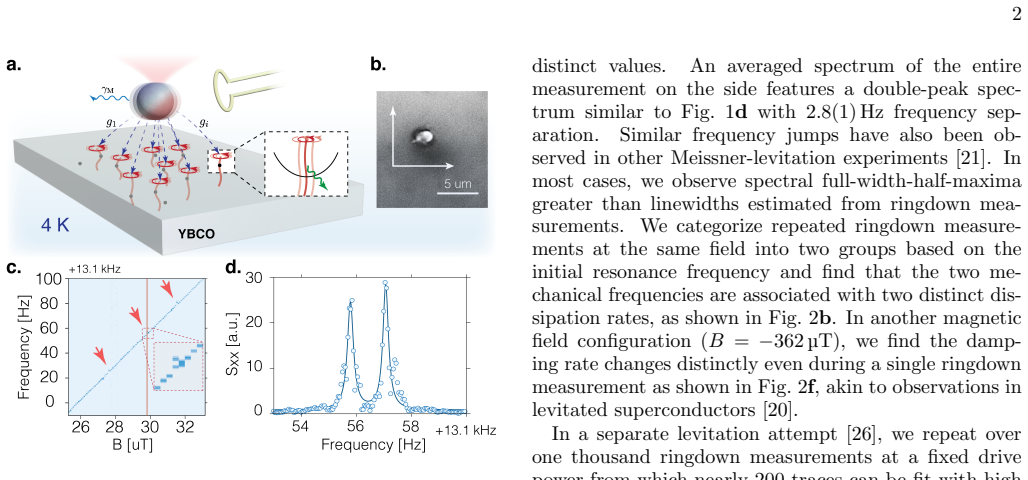
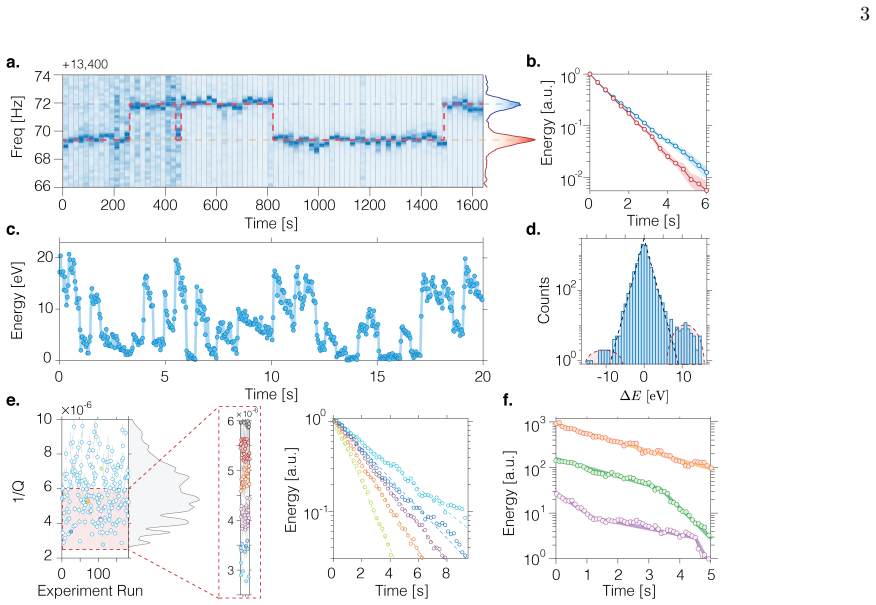
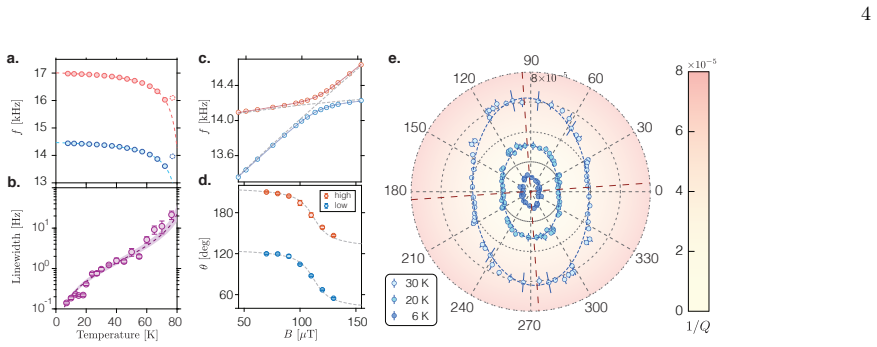
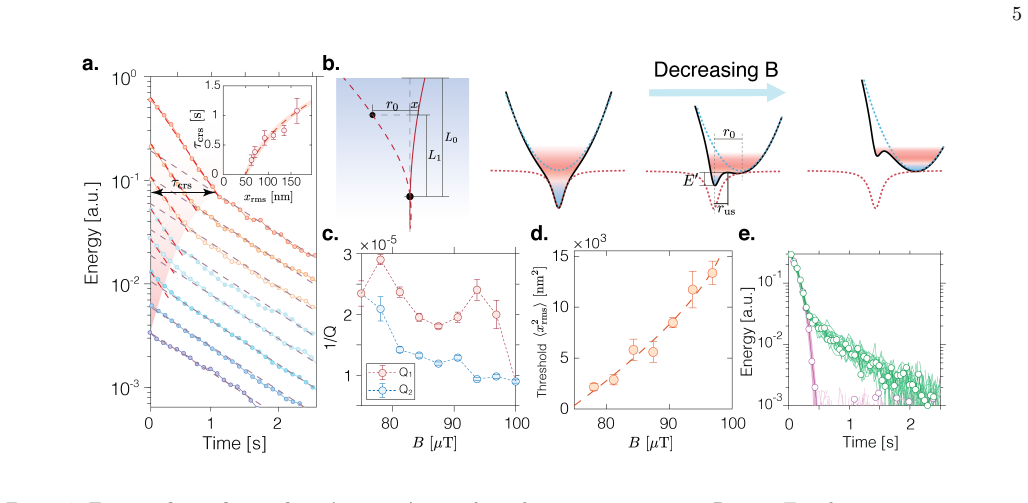
We show that the dynamics of levitated magnets are strongly influenced by vortices trapped in the YBCO superconducting film. We observe random telegraph signals in the mechanical frequency, dissipation rate, and energy of levitated particles, which we attribute to random tunneling of individual vortices. The nonlinearity of vortex-defect interaction manifests as non-exponential decay in ringdown measurements, revealing a complex underlying potential landscape.
What carries the argument
Interaction between a levitated magnetic particle and individual trapped vortices, read out as random telegraph noise in the particle's frequency and energy.
If this is right
- The technique supplies direct insight into dissipation mechanisms that limit coherence in superconducting levitated systems.
- Levitated magnets can serve as local probes of both static pinning sites and dynamic tunneling rates of individual vortices.
- Vortex-defect interactions create a nonlinear potential that can be mapped through mechanical ringdown measurements.
- Magnetic particles may function as coherent mechanical transducers whose properties are tunable by the underlying vortex configuration.
Where Pith is reading between the lines
- Similar telegraph signatures could be used to characterize vortex pinning landscapes in other superconducting materials.
- Controlling or monitoring individual vortex positions might improve stability and reduce loss in levitation-based sensors.
- The method could be combined with optical or microwave readout to track vortex motion at faster timescales.
- If vortex tunneling rates depend on temperature and field history, the same platform could map phase diagrams of pinning strength.
Load-bearing premise
The observed telegraph signals and non-exponential ringdown come from tunneling of single vortices interacting with material disorder rather than from collective vortex motion, external noise, or other mechanical effects.
What would settle it
The telegraph signals would disappear or change character if the same levitated particle were measured above the superconducting critical temperature or on a non-superconducting substrate with no trapped vortices.
Figures
read the original abstract
Trapped vortices determine fundamental properties of superconductors and play an important role in many practical applications such as magnetic levitation, however their complex dynamics remain poorly understood. Here, we use the mechanical motion of micron-scale levitated magnetic particles to probe the dynamics of individual vortices. Specifically, we show that the dynamics of levitated magnets are strongly influenced by vortices trapped in the YBCO superconducting film. We observe random telegraph signals in the mechanical frequency, dissipation rate, and energy of levitated particles, which we attribute to random tunneling of individual vortices. The nonlinearity of vortex-defect interaction manifests as non-exponential decay in ringdown measurements, revealing a complex underlying potential landscape. Our results provide insights into elusive dissipation mechanisms in superconducting levitated systems, open new avenues for using levitated magnets as sensitive probes of static and dynamic properties of individual vortices in superconductors and their interactions with material disorder, and point toward novel routes for using magnetic particles as highly coherent mechanical transducers.
Editorial analysis
A structured set of objections, weighed in public.
Referee Report
Summary. The paper reports an experiment using the mechanical motion of micron-scale levitated magnetic particles to probe vortex dynamics in a YBCO superconducting film. The authors observe random telegraph signals in the particles' mechanical frequency, dissipation rate, and energy, which they attribute to random tunneling of individual vortices. They further report non-exponential ringdown behavior arising from the nonlinearity of vortex-defect interactions, and position the technique as a probe of static and dynamic vortex properties and dissipation mechanisms in levitated superconducting systems.
Significance. If the attribution to single-vortex tunneling can be quantitatively validated, the work would introduce a mechanically based probe capable of resolving individual vortex motion and its coupling to material disorder. This could address open questions in vortex dynamics and dissipation relevant to both fundamental superconductivity and applications such as magnetic levitation. The approach is novel in combining levitated optomechanics with superconducting vortex physics.
major comments (1)
- [Abstract / main results section] The central claim that the observed random telegraph signals originate from tunneling of individual vortices (rather than collective motion, substrate two-level systems, or unmodeled electromagnetic or mechanical noise) is not supported by quantitative modeling. No calculation of the expected mechanical-frequency shift produced by the stray-field change from displacement of a single vortex is presented, nor is there a comparison of the observed jump rates or amplitudes to vortex tunneling rates predicted from the known pinning landscape of YBCO.
minor comments (1)
- [Methods / experimental details] The manuscript would benefit from explicit discussion of experimental controls (e.g., measurements without the superconducting film or with varying vortex densities) to strengthen the attribution.
Simulated Author's Rebuttal
We thank the referee for their careful reading and constructive feedback. We agree that quantitative modeling would strengthen the attribution of the random telegraph signals to single-vortex tunneling and will incorporate the requested calculations in the revised manuscript.
read point-by-point responses
-
Referee: [Abstract / main results section] The central claim that the observed random telegraph signals originate from tunneling of individual vortices (rather than collective motion, substrate two-level systems, or unmodeled electromagnetic or mechanical noise) is not supported by quantitative modeling. No calculation of the expected mechanical-frequency shift produced by the stray-field change from displacement of a single vortex is presented, nor is there a comparison of the observed jump rates or amplitudes to vortex tunneling rates predicted from the known pinning landscape of YBCO.
Authors: We acknowledge this is a valid point and that the current manuscript lacks explicit quantitative estimates. In the revised version we will add a calculation of the expected frequency shift Δf arising from the change in stray field when a single vortex displaces by one lattice spacing. The estimate will use the measured particle moment, levitation height, and the Biot-Savart contribution of a vortex in the YBCO film. We will also compare the observed telegraph amplitudes and rates to literature values for vortex tunneling in similar YBCO films (pinning energies ~10-100 K, attempt frequencies ~GHz), showing consistency with single-vortex events while arguing that collective motion or TLS would produce different statistics. These additions will be placed in a new subsection of the main text and will not change the experimental observations or conclusions. revision: yes
Circularity Check
No circularity: experimental attribution without derivation chain
full rationale
The manuscript is an observational experimental study reporting random telegraph signals in mechanical frequency, dissipation, and energy of levitated magnets, which are attributed to vortex tunneling. No equations, fitted parameters, or mathematical derivations are described in the provided text. The attribution is presented as a direct interpretation of observed signals and non-exponential ringdown rather than any self-definitional, fitted-input, or self-citation load-bearing step. The derivation chain is therefore self-contained as raw experimental reporting with no reduction of outputs to inputs by construction.
Axiom & Free-Parameter Ledger
Reference graph
Works this paper leans on
-
[1]
& Romero-Isart, O
Gonzalez-Ballestero, C., Aspelmeyer, M., Novotny, L., Quidant, R. & Romero-Isart, O. Levitodynamics: Levi- tation and control of microscopic objects in vacuum.Sci- ence374, eabg3027 (2021)
2021
-
[2]
P.et al.Search for non-newtonian inter- actions at micrometer scale with a levitated test mass
Blakemore, C. P.et al.Search for non-newtonian inter- actions at micrometer scale with a levitated test mass. Phys. Rev. D104, L061101 (2021)
2021
-
[3]
C., Rider, A
Moore, D. C., Rider, A. D. & Gratta, G. Search for mil- licharged particles using optically levitated microspheres. Phys. Rev. Lett.113, 251801 (2014)
2014
-
[4]
Wang, J.et al.Mechanical detection of nuclear decays. Phys. Rev. Lett.133, 023602 (2024)
2024
-
[5]
& Moore, D
Afek, G., Carney, D. & Moore, D. C. Coherent scattering of low mass dark matter from optically trapped sensors. Phys. Rev. Lett.128, 101301 (2022)
2022
-
[6]
Gieseler, J.et al.Single-spin magnetomechanics with levitated micromagnets.Phys. Rev. Lett.124, 163604 (2020)
2020
-
[7]
& Geraci, A
Ranjit, G., Cunningham, M., Casey, K. & Geraci, A. A. Zeptonewton force sensing with nanospheres in an optical lattice.Phys. Rev. A93, 053801 (2016)
2016
-
[8]
Nano.15, 89–93 (2020)
Ahn, J.et al.Ultrasensitive torque detection with an op- tically levitated nanorotor.Nat. Nano.15, 89–93 (2020)
2020
-
[9]
& Ulbricht, H
Timberlake, C., Gasbarri, G., Vinante, A., Setter, A. & Ulbricht, H. Acceleration sensing with magnetically levitated oscillators above a superconductor.Appl. Phys. Lett.115(2019)
2019
-
[10]
Deli´ c, U.et al.Cooling of a levitated nanoparticle to the motional quantum ground state.Science367, 892–895 (2020)
2020
-
[11]
Magrini, L.et al.Real-time optimal quantum control of mechanical motion at room temperature.Nature595, 373–377 (2021)
2021
-
[12]
Rossi, M.et al.Quantum delocalization of a levitated nanoparticle.Phys. Rev. Lett.135, 083601 (2025)
2025
-
[13]
& Aikawa, K
Kamba, M., Hara, N. & Aikawa, K. Quantum squeezing of a levitated nanomechanical oscillator.Science389, 1225–1228 (2025)
2025
-
[14]
Bose, S.et al.Spin entanglement witness for quantum gravity.Phys. Rev. Lett.119, 240401 (2017)
2017
-
[15]
Werfel, F.et al.Superconductor bearings, flywheels and transportation.Sup. Sci. and Tech.25, 014007 (2012)
2012
-
[16]
& Noudem, J
Bernstein, P. & Noudem, J. Superconducting magnetic levitation: principle, materials, physics and models.Sup. Sci. and Tech.33, 033001 (2020)
2020
-
[17]
Ahrens, F.et al.Levitated ferromagnetic magnetometer with energy resolution well belowℏ.Phys. Rev. Lett. 134, 110801 (2025)
2025
-
[18]
W., Knowles, T
Lewandowski, C. W., Knowles, T. D., Etienne, Z. B. & D’Urso, B. High-sensitivity accelerometry with a feedback-cooled magnetically levitated microsphere. Phys. Rev. Appl.15, 014050 (2021)
2021
-
[19]
Tian, S.et al.Feedback cooling of an insulating high-Q diamagnetically levitated plate.Appl. Phys. Lett.124 (2024)
2024
-
[20]
Hofer, J.et al.High-Q magnetic levitation and control of superconducting microspheres at millikelvin tempera- tures.Phys. Rev. Lett.131, 043603 (2023)
2023
-
[21]
& Wieczorek, W
Gutierrez Latorre, M., Higgins, G., Paradkar, A., Bauch, T. & Wieczorek, W. Superconducting microsphere mag- netically levitated in an anharmonic potential with inte- grated magnetic readout.Phys. Rev. Appl.19, 054047 (2023)
2023
-
[22]
Smit, R.et al.Superconducting flux concentrator coils for levitation of particles in the meissner state.PNAS nexus5, pgag072 (2026)
2026
-
[23]
Kordyuk, A. A. Magnetic levitation for hard supercon- ductors.Jour. of Appl. Phys.83, 610–612 (1998)
1998
-
[24]
Fung, F.et al.Toward programmable quantum proces- sors based on spin qubits with mechanically mediated interactions and transport.Phys. Rev. Lett.132, 263602 (2024)
2024
-
[25]
J.et al.Optical interferometric readout of a magnetically levitated superconducting microsphere
Hansen, J. J.et al.Optical interferometric readout of a magnetically levitated superconducting microsphere. Phys. Rev. Appl.25, 044080 (2026)
2026
-
[26]
See the Supplemental Information for details of material characterization and protocols, fits, and theoretical cal- culations
-
[27]
Pereg-Barnea, T.et al.Absolute values of the london penetration depth in YBa2Cu3O 6+y measured by zero field esr spectroscopy on gd doped single crystals.Phys. Rev. B69, 184513 (2004)
2004
-
[28]
Gustavsson, S.et al.Suppressing relaxation in supercon- ducting qubits by quasiparticle pumping.Science354, 1573–1577 (2016)
2016
-
[29]
Nano.12, 631–636 (2017)
G¨ uttinger, J.et al.Energy-dependent path of dissipation in nanomechanical resonators.Nat. Nano.12, 631–636 (2017)
2017
-
[30]
Y., Wollack, E
Cleland, A. Y., Wollack, E. A. & Safavi-Naeini, A. H. Studying phonon coherence with a quantum sensor.Nat. Commun.15, 4979 (2024)
2024
-
[31]
M.et al.Mechanics of individual isolated vortices in a cuprate superconductor.Nat
Auslaender, O. M.et al.Mechanics of individual isolated vortices in a cuprate superconductor.Nat. Phys.5, 35–39 (2009)
2009
-
[32]
Buchacek, M., Willa, R., Geshkenbein, V. B. & Blatter, G. Strong pinning theory of thermal vortex creep in type- II superconductors.Phys. Rev. B100, 014501 (2019)
2019
-
[33]
& Crowell, P
Compton, R. & Crowell, P. Dynamics of a pinned mag- netic vortex.Phys. Rev. Lett.97, 137202 (2006)
2006
-
[34]
Nambisan, A.et al.Quantum coherent manipulation and readout of superconducting vortex states.Nature653, 63–67 (2026)
2026
-
[35]
& Berezovsky, J
Mehrnia, M. & Berezovsky, J. Observation of pinning and pinning evasion dynamics of a magnetic vortex core. Jour. of Mag. and Mag. Mat.593, 171885 (2024)
2024
-
[36]
Elastic constants of the fluxoid lattice near the upper critical field.Phys
Labusch, R. Elastic constants of the fluxoid lattice near the upper critical field.Phys. Sta. Sol. (b)32, 439–442 (1969)
1969
-
[37]
The response of pinned flux vortices to low-frequency fields.Jour
Campbell, A. The response of pinned flux vortices to low-frequency fields.Jour. of Phys. C: Sol. St. Phys.2, 1492 (1969)
1969
-
[38]
& Somekh, R
Doyle, R., Campbell, A. & Somekh, R. Direct observa- tion of intrinsic pinning in YBCO thin films.Phys. Rev. Lett.71, 4241 (1993)
1993
-
[39]
& Stephen, M
Bardeen, J. & Stephen, M. Theory of the motion of vor- tices in superconductors.Phys. Rev.140, A1197 (1965)
1965
-
[40]
& Kobayashi, N
Nishizaki, T., Shibata, K., Maki, M. & Kobayashi, N. Vortex phase transition and oxygen vacancy in YBa2Cu3Oy single crystals.Jour. of Low Temp. Phys. 131, 931–940 (2003)
2003
-
[41]
Palau, A.et al.Crossover between channeling and pin- ning at twin boundaries in YBa 2Cu3O7 thin films.Phys. 8 Rev. Lett.97, 257002 (2006)
2006
-
[42]
H.et al.Vortex trapping and expulsion in thin-film YBa2Cu3O7−δ strips.Phys
Kuit, K. H.et al.Vortex trapping and expulsion in thin-film YBa2Cu3O7−δ strips.Phys. Rev. B77, 134504 (2008)
2008
-
[43]
Zhang, Z.-H.et al.Acceptor-induced bulk dielectric loss in superconducting circuits on silicon.Phys. Rev. X14, 041022 (2024)
2024
-
[44]
& Ioffe, L
Faoro, L. & Ioffe, L. B. Interacting tunneling model for two-level systems in amorphous materials and its predic- tions for their dephasing and noise in superconducting microresonators.Phys. Rev. B91, 014201 (2015)
2015
-
[45]
W., Cole, J
Kennedy, O. W., Cole, J. H. & Shelly, C. D. Josephson junction tuning described by depinning physics.Phys. Rev. Lett.135, 196202 (2025)
2025
-
[46]
Maksymowych, M.et al.Spectral diffusion of nanome- chanical resonators due to single quantum defects.Phys. Rev. Appl.24, 044066 (2025)
2025
-
[47]
P.et al.Millisecond lifetimes and coherence times in 2d transmon qubits.Nature1–6 (2025)
Bland, M. P.et al.Millisecond lifetimes and coherence times in 2d transmon qubits.Nature1–6 (2025)
2025
-
[48]
Eley, S.et al.Decoupling and tuning competing effects of different types of defects on flux creep in irradiated YBa2Cu3O7−δ coated conductors.Sup. Sci. and Tech. 30, 015010 (2016)
2016
-
[49]
Hoffman, J.et al.Imaging quasiparticle interference in Bi2Sr2CaCu2O8+δ.Science297, 1148–1151 (2002)
2002
-
[50]
Phys.3, 239–242 (2007)
Chen, B.et al.Two-dimensional vortices in supercon- ductors.Nat. Phys.3, 239–242 (2007)
2007
-
[51]
& Civale, L
Eley, S., Miura, M., Maiorov, B. & Civale, L. Universal lower limit on vortex creep in superconductors.Nat. Mat. 16, 409–413 (2017)
2017
-
[52]
A.et al.Scanning vortex microscopy reveals thickness-dependent pinning nano-network in su- perconducting niobium films.Commun
Hovhannisyan, R. A.et al.Scanning vortex microscopy reveals thickness-dependent pinning nano-network in su- perconducting niobium films.Commun. Mat.6, 42 (2025)
2025
-
[53]
Buchacek, M.et al.Experimental test of strong pinning and creep in current-voltage characteristics of type-II su- perconductors.Phys. Rev. B100, 224502 (2019)
2019
-
[54]
& Plourde, B
Nsanzineza, I. & Plourde, B. Trapping a single vortex and reducing quasiparticles in a superconducting resonator. Phys. Rev. Lett.113, 117002 (2014)
2014
-
[55]
Bahrami, F.et al.Vortex motion induced losses in tan- talum resonators.Phys. Rev. B113, 054505 (2026)
2026
-
[56]
Commun.5, 5836 (2014)
Wang, C.et al.Measurement and control of quasiparticle dynamics in a superconducting qubit.Nat. Commun.5, 5836 (2014)
2014
-
[57]
S., Pan, A
Wells, F. S., Pan, A. V., Wang, X. R., Fedoseev, S. A. & Hilgenkamp, H. Analysis of low-field isotropic vor- tex glass containing vortex groups in YBa2Cu3O7−x thin films visualized by scanning squid microscopy.Sci. Rep. 5, 8677 (2015)
2015
-
[58]
Schlussel, Y.et al.Wide-field imaging of superconductor vortices with electron spins in diamond.Phys. Rev. Appl. 10, 034032 (2018)
2018
-
[59]
W., Hoffman, J
Straver, E. W., Hoffman, J. E., Auslaender, O. M., Ru- gar, D. & Moler, K. A. Controlled manipulation of in- dividual vortices in a superconductor.Appl. Phys. Lett. 93(2008)
2008
-
[60]
& Hastings, M
Olson Reichhardt, C. & Hastings, M. Do vortices entan- gle?Phys. Rev. Lett.92, 157002 (2004)
2004
-
[61]
Nature425, 155–158 (2003)
Wallraff, A.et al.Quantum dynamics of a single vortex. Nature425, 155–158 (2003)
2003
-
[62]
Fruchter, L.et al.Low-temperature magnetic relaxation in YBa 2Cu3O7−δ: Evidence for quantum tunneling of vortices.Phys. Rev. B43, 8709 (1991)
1991
-
[63]
& Ray- chaudhuri, P
Dutta, S., Roy, I., Jesudasan, J., Sachdev, S. & Ray- chaudhuri, P. Evidence of zero-point fluctuation of vor- tices in a very weakly pinneda-moge thin film.Phys. Rev. B103, 214512 (2021)
2021
-
[64]
Roda-Llordes, M., Riera-Campeny, A., Candoli, D., Gro- chowski, P. T. & Romero-Isart, O. Macroscopic quantum superpositions via dynamics in a wide double-well poten- tial.Phys. Rev. Lett.132, 023601 (2024)
2024
-
[65]
Bassi, A., Lochan, K., Satin, S., Singh, T. P. & Ulbricht, H. Models of wave-function collapse, underlying theories, and experimental tests.Rev. of Mod. Phys.85, 471–527 (2013)
2013
-
[66]
Belenchia, A.et al.Quantum superposition of massive objects and the quantization of gravity.Phys. Rev. D98, 126009 (2018)
2018
-
[67]
J., Nemoto, K., Milburn, G
Munro, W. J., Nemoto, K., Milburn, G. J. & Braun- stein, S. L. Weak-force detection with superposed coher- ent states.Phys. Rev. A66, 023819 (2002)
2002
-
[68]
Chang, A.et al.Scanning hall probe microscopy.Appl. Phys. Lett.61, 1974–1976 (1992)
1974
-
[69]
Grosser, R., Martin, A., Niemetz, M., Pechen, E. & Schoepe, W. Detecting flux creep in superconduct- ing ybco thin films via damping of the oscillations of a levitating permanent magnet.arXiv preprint cond- mat/9712199(1997)
arXiv 1997
-
[70]
N., Bonn, D
Hardy, W. N., Bonn, D. A., Morgan, D. C., Liang, R. & Zhang, K. Precision measurements of the temperature dependence ofλin YBa 2Cu3O6.95: Strong evidence for nodes in the gap function.Phys. Rev. Lett.70, 3999–4002 (1993)
1993
-
[71]
Pesetski, A. A. & Lemberger, T. R. Experimental study of the inductance of pinned vortices in superconducting YBa2Cu3O7−δ films.Phys. Rev. B62, 11826 (2000)
2000
-
[72]
Anderson, P. W. & Kim, Y. Hard superconductivity: theory of the motion of abrikosov flux lines.Reviews of Modern Physics36, 39 (1964)
1964
-
[73]
V., Geshkenbein, V
Blatter, G., Feigel’man, M. V., Geshkenbein, V. B., Larkin, A. I. & Vinokur, V. M. Vortices in high- temperature superconductors.Reviews of Modern Physics66, 1125 (1994)
1994
-
[74]
& Schoepe, W
Großer, R., J¨ ager, J., Betz, J. & Schoepe, W. Damping of the oscillations of a permanent magnet levitating between high-tc superconductors.Appl. Phys. Lett.67, 2400–2402 (1995)
1995
-
[75]
& Schoepe, W
Grosser, R., H¨ ocherl, P., Martin, A., Niemetz, M. & Schoepe, W. Vortex motion in superconducting YBa2Cu3O7−δ inferred from the damping of the oscil- lations of a levitating magnetic microsphere.Journal of Low Temperature Physics119, 723–742 (2000)
2000
-
[76]
& Ulbricht, H
Timberlake, C., Simcox, E. & Ulbricht, H. Linear cool- ing of a levitated micromagnetic cylinder by vibration. Physical Review Research6, 033345 (2024)
2024
-
[77]
Brown, C.et al.Superfluid helium drops levitated in high vacuum.Phys. Rev. Lett.130, 216001 (2023). 9 METHODS Optical setup.diagram of our experiment optical setup is shown in Extended Data Fig. 1. We use a 637 nm laser whose polarization can be tuned using a quarter- wave plate and a half-wave plate to maximize the sig- nal. The beam is steered using a g...
2023
-
[78]
YBCO characterization We procure YBCO films from 2D Semiconductors. 270 nm of YBCO are PLD deposited onto both sides of a 2-inch 0.5 mm thick wafer of mechanically polished single crystal LAO and subsequently cleaved into 2 mm pieces used in the experiment. We characterize the YBCO film using resistive, magnetic moment, and X-ray measurements. Resistance:...
-
[79]
In this section, we discuss a correction to this model considering the contribution of interactions between mechanical motion and vortices
Mechanical-vortex Model The levitated magnet above a type-II superconductor can be primarily explained by the frozen-image-dipole model [6, 23], which quantitatively describes the response of a mixed state superconductor to the displacement of the magnet by a fixed frozen dipole and an image dipole which moves with the magnet. In this section, we discuss ...
-
[80]
Additional experimental evidence of strong pinning In the main text, we present a theoretical model based on strong pinning theory and show how the nonlinear interaction between individual vortices and pinning defects could give rise to the unusual nonlinear damping behavior that cannot be explained by the simplified model in Sec. 2. In this section, we f...
discussion (0)
Sign in with ORCID, Apple, or X to comment. Anyone can read and Pith papers without signing in.