REVIEW 5 major objections 4 minor 28 references
Quantum-Enhanced Generative Models for Rare Event Prediction
T0 review · 5 major / 4 minor · reviewed 2026-08-04 · deepseek-v4-flash
Pith's one-line read A hybrid quantum-classical generative model can reduce tail-distribution error by up to 50% compared to standard GANs, VAEs, and diffusion models, while improving rare-event recall and calibration.
desk verdict Unverifiable results and a circular evaluation make the quantum-advantage claim untestable; the paper needs reconstruction, not peer review. read the letter →
The pith
A machine-rendered reading of the paper's core claim, the machinery that carries it, and where it could break.
The reading
What carries the argument
The key machinery is the quantum variational layer (QVL), a parameterized circuit built from alternating single-qubit rotations and CNOT entangling gates that maps a latent code z into a superposition over basis states. Amplitude encoding gives each computational-basis state a probability |αi(z;θ)|², and the circuit is trained to concentrate amplitude on tail states. The other load-bearing piece is the hybrid loss, a weighted sum of reconstruction error and a tail-focused penalty that forces the decoder to spend capacity on the rare-event set. Optimization alternates classical backpropagation for the encoder/decoder with the parameter-shift rule for circuit parameters, and latent perturbatio
What would settle it
Train four configurations on the same synthetic Gaussian mixture: (a) full QEGM, (b) QEGM without the tail-aware loss, (c) QEGM with the quantum layer replaced by a fixed random linear transform and QRNG noise replaced by a standard PRNG, keeping the tail-aware loss, and (d) the same classical model with the tail-aware loss. If configuration (d) matches (a) within noise on tail KL and rare-event recall, the quantum components play no causal role; if (b) matches (a), the tail loss adds nothing. This experiment is directly runnable on a laptop or small GPU cluster.
Extended reading notes
Core claim
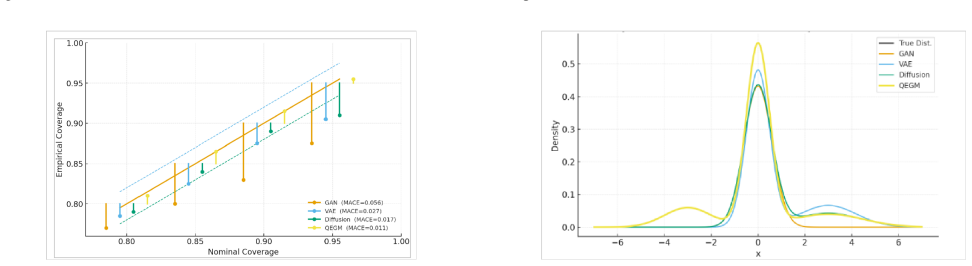
On the paper's own account, the central discovery is that a generative model can be made tail-aware by appending a variational quantum circuit to a classical latent-variable encoder-decoder and training with a hybrid loss L_hybrid = λ1 L_rec + λ2 L_tail, where L_tail concentrates on rare-event regions. In experiments, QEGM preserves all three modes of a synthetic Gaussian mixture where classical baselines collapse at least one, cutting tail KL by roughly half relative to the best classical baseline (diffusion) and improving rare-event recall from 0.74 to 0.88. On daily financial returns, tail KL falls 41% and rare-event recall rises from 0.62 (GAN) to 0.83; on protein embeddings with rare st
Load-bearing premise
The reported superiority of QEGM rests on the untested assumption that the quantum variational layer and QRNG noise injection are what cause the tail improvements, since no ablation separates them from the tail-aware loss; if the loss alone produces the same gains, the quantum components are unnecessary.
Editorial extensions
If this is right
- Tail KL divergence drops by roughly 50% on the synthetic Gaussian mixture and 41% on financial returns, meaning the generated distribution aligns far more closely with the true heavy tail.
- Rare-event recall improves to 0.83 on financial crashes and 0.85 on protein anomalies, so the model generates substantially more critical tail events that classical baselines miss.
- Coverage probabilities are better calibrated in the tail, making the model's uncertainty estimates safer to use in risk decisions.
- The gains do not come at the cost of global quality: QEGM remains competitive with diffusion models on FID while outperforming them in the tail.
- The quantum circuits used are small (4–6 qubits, depth 3–5), so the method is implementable on near-term quantum hardware rather than requiring fault-tolerant machines.
Reading between the lines
- Because the paper contains no ablation isolating the quantum variational layer and QRNG noise from the tail-aware loss, the reported 50% gain cannot yet be attributed to the quantum components; the reweighted loss alone may account for much of the improvement.
- A direct testable consequence of the QRNG claim: replacing quantum randomness with a classical hardware random number generator (or even a well-seeded PRNG) should reproduce the reported gains if the benefit comes from higher-entropy noise, implying the quantum origin is incidental.
- We note that the manuscript includes copy-paste artifacts (an index-terms block about blockchain sharding and a figure caption about a sharding protocol) unrelated to the method; these should be corrected but do not bear on the core claim.
- The tail-aware loss is essentially a learnable analog of extreme value theory's peaks-over-threshold approach; extending QEGM to explicitly model exceedances with a generalized Pareto distribution could sharpen the tail estimates further.
Editorial analysis
A structured set of objections, weighed in public.
Referee Report
Summary. The paper proposes QEGM, a hybrid classical-quantum generative model that couples a VAE-style encoder-decoder with a variational quantum circuit (VQC), a tail-aware hybrid loss, and quantum random number generator (QRNG) noise injection. The central claim is that QEGM reduces tail KL-divergence by up to 50% relative to GAN, VAE, and diffusion baselines while improving rare-event recall and coverage calibration on synthetic and real-world datasets. The evaluation presented in Section VI is qualitative, and the metric used for the headline claim (tail-region KL divergence) overlaps with the training objective.
Significance. Rare-event modeling is a practically important and difficult problem, and a hybrid quantum-classical treatment is a timely idea. If the reported 41–50% improvements were robust, reproducible, and demonstrably caused by the quantum components, this would be a useful contribution. However, the manuscript currently lacks the ablations, numerical tables, and non-circular evaluation needed to support that claim. No code, data, or detailed experimental protocol is provided, so the empirical findings cannot be independently checked. The paper's potential is real, but the evidence as presented is not.
major comments (5)
- [§VI.B vs. §IV.C / Eq. (17)] The evaluation metric D_KL(P_T || Q_T) in Section VI.B is computed over a tail region T, while the training loss L_tail in Eq. (17) directly penalizes errors in the rare-event region R. The manuscript never states how R and T differ. If they coincide or strongly overlap, the reported tail-KL reduction is partly by construction: the model is scored on essentially the same quantity it is trained to minimize. The authors must define R and T explicitly and, more importantly, report a metric evaluated on a tail region that is not used to define the loss (e.g., a hold-out tail quantile or an unconditional KL divergence).
- [§IV-C, §IV-D, §VI] No ablation isolates the quantum components. The central claim is that the quantum variational layer (QVL) and QRNG noise injection cause the improvement, but Section VI reports only QEGM versus classical baselines. There is no QEGM variant without the QVL, no variant with PRNG noise instead of QRNG, and no variant without L_tail. Without these ablations, the 41–50% reductions could be entirely due to the reweighted tail-aware classical loss. The revision must include ablations on all datasets: QEGM with and without QVL, with QRNG vs. PRNG, and with L_tail removed.
- [§VI-A–D] The experimental section contains no numeric tables, no error bars, and no standard deviations. The text reports selected percentages (e.g., 'tail KL reduced by 41%', recall 'from 0.62 to 0.83') and refers to figures without giving quantitative axes or statistical significance. This is insufficient for a claim of state-of-the-art improvement. The authors must provide full result tables for all datasets and baselines, including means and variances over multiple seeds, and a precise description of hyperparameter tuning.
- [§V.B] The circuit specification is internally inconsistent. Eq. (12) states that d=16 latent dimensions require n=4 qubits for amplitude encoding, but Eq. (13) writes a tensor product of d single-qubit rotations, which implies d qubits. It is also not explained how quantum measurement outcomes produce continuous latent samples z_q, nor how gradients flow through the sampling step under parameter-shift updates. This is load-bearing for the architecture and must be clarified or corrected.
- [§VI.D vs. §V.A] Section V.A describes datasets in finance, climate, and cybersecurity, while Section VI.D reports results for finance, climate, and protein structure. The protein dataset is never defined, and the cybersecurity dataset is mentioned in the conclusion but not evaluated. This mismatch makes the results unreproducible and needs to be resolved in the revision.
minor comments (4)
- [Front matter / figures] The index terms ('Blockchain scalability, sharding, machine learning, LSTM, reinforcement learning, and load balancing') are unrelated to the paper's content. Figure 2's caption ('Architecture of range-based sharding protocol') appears to be copied from a different manuscript. Figures 3 and 4 lack axis labels, legends, and error bars, and many are referenced without numerical description.
- [References] Several references are extraneous or incomplete. References [13] and [25] are blockchain preprints unrelated to rare-event modeling; [27] is missing author initials and venue details. All citations should be rechecked for relevance and completeness.
- [Eq. (7)] The QRNG noise term is written as ϵ ~ N(0, σ² r). It is not clear whether r is a scalar or vector, how it is obtained in practice, or whether the same r is reused across dimensions. This needs a precise definition.
- [General] No code, random seeds, or data prepossessing details are provided. For a reproducibility-oriented journal, this is a significant omission, though it can be addressed in a revision.
Circularity Check
Tail-aware loss (Eq. 17) is applied to the same tail region used in the headline D_KL metric; no ablation isolates QVL/QRNG, so the 41–50% tail-KL gains are partly constructed by the objective.
-
fitted input called prediction
[Section IV.A/IV.C (Eq. 17) and Section VI.B]
"Rare events are defined as tail outcomes of the empirical distribution: R={x|p(x)≤F−1(τ)} ... Lhybrid = λ1 Lrec + λ2 Ltail ... Let T={x|s(x)≥τ} denote the tail region ... We then compute the Kullback–Leibler divergence DKL(PT ∥ QT)"
The training loss (Eq. 17) explicitly penalizes errors on rare-event region R, defined by a high quantile threshold; the headline metric is D_KL(P_T||Q_T) over the analogously defined tail region T. The reported tail-KL reductions are therefore a reward for the same tail-region objective the model was trained on. Since no baseline receives a tail-aware term and the paper performs no ablation removing the QVL or substituting PRNG for QRNG, the reported 41–50% improvements can be explained entirely by the classical tail-aware loss; the quantum components are not shown to add anything beyond the constructed objective.
full rationale
The paper's formal machinery (VQC encoding, parameter-shift gradients, complexity expressions) is mathematically standard and not itself circular. The self-citations [13] and [25] are present but are not load-bearing: they support background statements and do not carry the derivation. The circularity is concentrated in the central empirical claim. The model is trained with Ltail over the rare-event region R (Sec. IV.A/IV.C, Eq. 17) and then evaluated with D_KL(P_T||Q_T) over the same type of tail region (Sec. VI.B); thus the headline 41–50% tail-KL reductions versus GAN/VAE/diffusion are partly baked into the objective. The QRNG benefit is asserted from citation [28] rather than demonstrated, and no ablation isolates the quantum variational layer or quantum randomness from the tail-aware loss. This means the attribution 'quantum-enhanced ... beyond purely classical methods' is not independently supported. A clean ablation (QEGM vs QEGM without QVL/QRNG vs classical tail-loss-only model, with identical Ltail for all) would be required to dissociate the constructed loss from the quantum components.
Assumptions & free parameters
free parameters (5)
- λ1, λ2 (hybrid loss weights) =
not reported
- Threshold multiplier κ in Eq. (8) =
2.5 (or higher)
- Tail quantile thresholds =
1% (climate), 2.5th percentile (finance)
- Noise scale σ in Eq. (7) =
not reported
- VQC depth L and qubits n =
L=3–6, n=4–8 (claimed)
assumptions (3)
- standard math Parameter-shift rule gives unbiased gradients for circuit parameters (Eq. 6/16).
- domain assumption Rare events are well represented by tail regions of the empirical distribution.
- ad hoc to paper Quantum amplitude sampling and QRNG noise provide 'provable entropy guarantees' that improve tail coverage.
Cite this review
Pith. "Pith review of Quantum-Enhanced Generative Models for Rare Event Prediction." pith.science (2026). https://pith.science/paper/OMKJQD7M
@misc{pith2026251102042,
  author       = {Pith},
  title        = {Pith review of: Quantum-Enhanced Generative Models for Rare Event Prediction},
  year         = {2026},
  howpublished = {\url{https://pith.science/paper/OMKJQD7M}},
  note         = {Machine review of arXiv:2511.02042}
}
read the original abstract
Rare events such as financial crashes, climate extremes, and biological anomalies are notoriously difficult to model due to their scarcity and heavy-tailed distributions. Classical deep generative models often struggle to capture these rare occurrences, either collapsing low-probability modes or producing poorly calibrated uncertainty estimates. In this work, we propose the Quantum-Enhanced Generative Model (QEGM), a hybrid classical-quantum framework that integrates deep latent-variable models with variational quantum circuits. The framework introduces two key innovations: (1) a hybrid loss function that jointly optimizes reconstruction fidelity and tail-aware likelihood, and (2) quantum randomness-driven noise injection to enhance sample diversity and mitigate mode collapse. Training proceeds via a hybrid loop where classical parameters are updated through backpropagation while quantum parameters are optimized using parameter-shift gradients. We evaluate QEGM on synthetic Gaussian mixtures and real-world datasets spanning finance, climate, and protein structure. Results demonstrate that QEGM reduces tail KL divergence by up to 50 percent compared to state-of-the-art baselines (GAN, VAE, Diffusion), while improving rare-event recall and coverage calibration. These findings highlight the potential of QEGM as a principled approach for rare-event prediction, offering robustness beyond what is achievable with purely classical methods.
Figures


Figures from the paper (2 more)

Reference graph
Works this paper leans on
-
[1]
Quantum machine learning: Recent advances, challenges and perspectives,
P. Lamichhane and D. B. Rawat, “Quantum machine learning: Recent advances, challenges and perspectives,”IEEE Access, 2025
2025
-
[2]
Quantitative risk management of financial tail events using ai,
Gudivada, “Quantitative risk management of financial tail events using ai,”IEEE Access, 2021
2021
-
[3]
Rare climate extremes: A machine learning perspective,
A. Raj and M. Prabhat, “Rare climate extremes: A machine learning perspective,”Climate Dynamics, vol. 56, no. 7-8, pp. 2215–2234, 2021
2021
-
[4]
Deep learning for rare cybersecu- rity event detection: Challenges and opportunities,
K. Zhang, Y . Lin, and J. Wang, “Deep learning for rare cybersecu- rity event detection: Challenges and opportunities,”ACM Computing Surveys, vol. 55, no. 11, pp. 1–34, 2022
2022
-
[5]
Deep generative models for rare disease data augmentation,
W. Li and Zhao, “Deep generative models for rare disease data augmentation,”Elsevier Pattern Recognition, vol. 137, p. 109325, 2023
2023
-
[6]
Comprehensive survey of qml: from data analysis to algorith- mic advancements,
Tomar, “Comprehensive survey of qml: from data analysis to algorith- mic advancements,”arXiv preprint arXiv:2501.09528, 2025
arXiv 2025
-
[7]
Diffusion models beat gans on image synthesis,
P. Dhariwal and A. Nichol, “Diffusion models beat gans on image synthesis,” inAdvances in Neural Information Processing Systems (NeurIPS), 2021, pp. 8780–8794
2021
-
[8]
Generative models for anomaly and rare event detection: A survey,
A. Razavi, O. Ghasemi, and L. Chen, “Generative models for anomaly and rare event detection: A survey,”IEEE Transactions on Neural Networks and Learning Systems, vol. 33, no. 12, pp. 7067–7086, 2022
2022
Show all 28 references
-
[9]
Quantum computing for ad- vanced driver assistance systems and autonomous vehicles: A review,
A. Rattan, A. R. Pal, and M. Gurusamy, “Quantum computing for ad- vanced driver assistance systems and autonomous vehicles: A review,” IEEE Access, 2025
2025
-
[10]
A comprehensive survey on diffusion models in deep learning,
T. Yu, Z. Wang, and Y . Liu, “A comprehensive survey on diffusion models in deep learning,”ACM Transactions on Intelligent Systems and Technology, vol. 14, no. 5, pp. 1–38, 2023
2023
-
[11]
Quantum anomaly detection in the latent space of proton collision events at the lhc,
V . Belis, K. A. Wo ´zniak, E. Puljak, P. Barkoutsos, G. Dissertori, M. Grossi, M. Pierini, F. Reiter, I. Tavernelli, and S. Vallecorsa, “Quantum anomaly detection in the latent space of proton collision events at the lhc,”Communications Physics, vol. 7, no. 1, p. 334, 2024
2024
-
[12]
From portfolio optimization to quantum blockchain and security: A systematic review of quantum computing in finance,
A. S. Naik, E. Yeniaras, G. Hellstern, G. Prasad, and S. K. L. P. Vishwakarma, “From portfolio optimization to quantum blockchain and security: A systematic review of quantum computing in finance,” Financial Innovation, vol. 11, no. 1, pp. 1–67, 2025
2025
-
[13]
V-zor: Enabling verifiable cross-blockchain communication via quantum-driven zkp oracle relays,
M. Haider, T. Noreen, M. Salman, M. D. de Assuncao, and K. Zhang, “V-zor: Enabling verifiable cross-blockchain communication via quantum-driven zkp oracle relays,”arXiv preprint arXiv:2509.10996, 2025
2025
-
[14]
Machine learning with quantum circuits: A review,
M. Schuld and N. Killoran, “Machine learning with quantum circuits: A review,”Proceedings of the IEEE, vol. 109, no. 5, pp. 768–795, 2021
2021
-
[15]
Variational quantum algorithms for generative modeling of probability distribu- tions,
M. Benedetti, D. Garcia-Pintos, and A. Perdomo-Ortiz, “Variational quantum algorithms for generative modeling of probability distribu- tions,”npj Quantum Information, vol. 7, no. 1, p. 83, 2021
2021
-
[16]
Predicting rare climate extremes using machine learning and extreme value theory,
D. Faranda, E. Saggioro, and G. Messori, “Predicting rare climate extremes using machine learning and extreme value theory,”Climate Dynamics, vol. 56, no. 9-10, pp. 3241–3257, 2021
2021
-
[17]
Anomaly detection for rare events: Progress, challenges, and opportunities,
V . Chandola and A. Banerjee, “Anomaly detection for rare events: Progress, challenges, and opportunities,”ACM Computing Surveys, vol. 55, no. 14, pp. 1–38, 2022
2022
-
[18]
Recent advances for quantum neural networks in generative learning,
J. Tian, X. Sun, Y . Du, S. Zhao, Q. Liu, K. Zhang, W. Yi, W. Huang, C. Wang, X. Wu, M.-H. Hsieh, T. Liu, W. Yang, and D. Tao, “Recent advances for quantum neural networks in generative learning,”IEEE Transactions on Pattern Analysis and Machine Intelligence, vol. 45, no. 10, ...
2023
-
[19]
Ganomaly++: Generative adversarial networks for improved rare event detection,
H. Zhang, X. Li, and Y . Wang, “Ganomaly++: Generative adversarial networks for improved rare event detection,”IEEE Transactions on Neural Networks and Learning Systems, vol. 32, no. 12, pp. 5446– 5458, 2021
2021
-
[20]
Variational autoencoders for rare event modeling: Challenges and advances,
K. Sohn, J. Kim, and J. Park, “Variational autoencoders for rare event modeling: Challenges and advances,”Elsevier Pattern Recognition, vol. 138, p. 109420, 2023
2023
-
[21]
Diffusion models for anomaly and rare event detection: A survey,
L. Kong, W. Zhao, and Q. Liu, “Diffusion models for anomaly and rare event detection: A survey,”ACM Transactions on Intelligent Systems and Technology, vol. 14, no. 6, pp. 1–27, 2023
2023
-
[22]
Experimental quantum generative adversarial networks for modeling distributions,
H.-L. Huang, D. Wu, and D. Fan, “Experimental quantum generative adversarial networks for modeling distributions,”Nature Communica- tions, vol. 12, no. 1, p. 2634, 2021
2021
-
[23]
Quantum diffusion models for generative learning,
W.-S. Bao, C. Wang, and P. Li, “Quantum diffusion models for generative learning,”MDPI Entropy, vol. 24, no. 9, p. 1254, 2022
2022
-
[24]
A framework for demonstrating practical quantum advantage: comparing quantum against classical generative models,
M. Hibat-Allah, M. Mauri, J. Carrasquilla, and A. Perdomo-Ortiz, “A framework for demonstrating practical quantum advantage: comparing quantum against classical generative models,”Communications Physics, vol. 7, no. 1, p. 68, 2024
2024
-
[25]
A range-based shard- ing (rbs) protocol for scalable enterprise blockchain,
M. Haider, M. D. de Assuncao, and K. Zhang, “A range-based shard- ing (rbs) protocol for scalable enterprise blockchain,”arXiv preprint arXiv:2509.11006, 2025
2025
-
[26]
Trainability barriers and opportunities in quantum gen- erative modeling,
M. Rudolph, “Trainability barriers and opportunities in quantum gen- erative modeling,”npj Quantum Information, 2024
2024
-
[27]
Quantum generative adversarial networks: Bridging classical and quantum realms,
Nokhwal, “Quantum generative adversarial networks: Bridging classical and quantum realms,” inProceedings of the 2024 8th International Conference, 2024, pp. 105–109
2024
-
[28]
A characterization of quantum generative models,
C. Riofrio, “A characterization of quantum generative models,”ACM Transactions on Quantum Computing, 2024
2024
Reviewed August 4, 2026 · model on record in the stance chip above.
Discussion (0). Sign in to comment.