REVIEW 4 major objections 6 minor 102 references
CODENS claims that pull-request history can be turned into a typed, queryable knowledge graph that yields highly relevant and well-grounded answers to repository-level developer questions.
Reviewed by Pith at T0; open to challenge. T0 means a machine referee read the full paper against a public rubric. the ladder, T0–T4 →
2026-08-01 17:01 UTC pith:ONC27CM5
load-bearing objection CODENS is a well-written integration of PR replay and typed knowledge graphs, but its own pipeline description drops new files added after the initial scan — a real gap under the 'living documentation' claim. the 4 major comments →
CODENS: Transforming Code Changes into Living, Accessible, and Queryable Documentation
The pith
A machine-rendered reading of the paper's core claim, the machinery that carries it, and where it could break.
Core claim
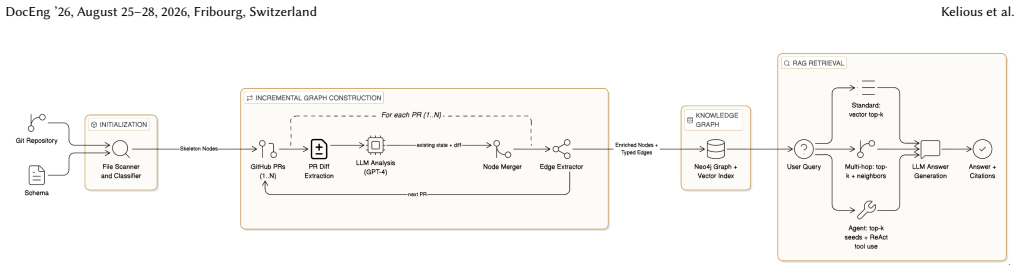
The central claim is that a schema-driven, state-injecting extraction pipeline can turn pull-request diffs into cumulative component knowledge. For each changed file, CODENS feeds a large language model the existing node state plus the new diff, so the model updates rather than replaces prior semantics. After processing pull requests chronologically, an edge extractor resolves typed relations such as invokes-model, renders-view, and tests-component to form a graph with hundreds of unique edges over thousands of skeleton nodes. The paper reports perfect context precision and faithfulness across 11 production questions, with an average answer relevancy of 0.94 and human relevance scores around
What carries the argument
The engine is the state-injection merge loop: the current semantic representation of a graph node is injected alongside each new pull-request diff into an LLM, which returns schema-valid JSON attributes that are merged (scalar fields replaced, lists unioned, provenance tracked). This loop lets incremental PR processing accumulate into a typed software knowledge graph whose node embeddings support three retrieval modes: vector search, automatic multi-hop expansion, and agent-guided traversal through tools that read nodes, list neighbors, and issue graph queries.
Load-bearing premise
The system's reliability rests on the LLM faithfully merging prior node state with each new diff into schema-valid, semantically accurate JSON, with no verification loop to catch or correct a bad extraction.
What would settle it
Replay a controlled sequence of pull requests affecting a single component, with the final source code fixed; after each PR, check whether the node's accumulated description actually matches the current code. A single bad extraction that persists into later states and silently contradicts the source would falsify the claim that the graph tracks the repository.
If this is right
- If CODENS works as described, merging a pull request automatically refreshes the documentation for every component it touches, removing the separate documentation-writing step.
- Developers can ask natural-language questions about features, flows, and business rules and receive answers whose evidence is traceable to graph nodes and typed relations.
- Each node preserves a semantic change history, giving a chronological rationale for why a component evolved the way it did.
- The three retrieval modes form a cost-completeness tradeoff: agent-guided traversal produces the most complete answers at the highest token and time cost.
- The evaluation suggests that the remaining bottleneck is answer presentation, not retrieval or grounding.
Where Pith is reading between the lines
- The state-injection design implies that documentation quality degrades gracefully only if extraction errors are rare; a natural testable extension is a confidence gate that flags low-confidence LLM updates for human review.
- The framework-convention schema might transfer to other MVC-like codebases, making PR-driven documentation a general pattern rather than a Rails-only tool.
- The identified verbosity problem suggests a two-stage synthesis: first retrieve graph evidence, then compress it into user-facing abstractions such as page paths and UI flows.
- If pull requests themselves become documentation events, code review could double as documentation review, changing how teams budget for maintenance.
Editorial analysis
A structured set of objections, weighed in public.
Referee Report
Summary. The paper describes CODENS, a system that mines a Ruby on Rails repository and its pull-request history to incrementally build a typed knowledge graph of software components. CODENS first creates skeleton nodes for framework component types (17 types, 1,739 nodes in the reported project), then replays PRs chronologically: for each changed file it injects the current node state and the diff into GPT-4, extracts schema-defined semantic attributes, merges them while preserving per-PR provenance, and later derives typed edges (622 edges, 11 relationship types). The graph is stored in Neo4j with vector embeddings and exposed through three retrieval modes: standard vector retrieval, graph-expanded multi-hop retrieval, and a ReAct agent with graph tools. The evaluation on one production codebase with 11 anonymized questions reports human scores averaging 4.09/5 relevance, 4.45/5 completeness, and 4.91/5 document relevance, perfect automatic context precision and faithfulness, and qualitative feedback asking for more concise, user-oriented synthesis.
Significance. The work addresses a real and well-motivated problem: PR-level design knowledge is typically lost unless someone writes documentation. The state-injection design, in which the LLM is prompted with the existing node state and the current diff so that semantic updates accumulate rather than overwrite, is a sensible and potentially useful idea. The provenance/change-history tracking and the operational metrics panel (latency, tokens, cost, carbon) are thoughtful additions for industrial deployment. The graph-agent retrieval design is a plausible extension of RAG for code artifacts. However, the evidence presented is currently too thin to substantiate the abstract's claim that CODENS 'produces highly relevant and well-grounded answers': only 11 questions from a single codebase, a single human evaluator, no baseline comparison, and no statistical testing. The paper reads as an exploratory case study or system demonstration, not as a validated research result.
major comments (4)
- [§3, Tables 2–3] The evaluation does not support the abstract's claim that 'CODENS produces highly relevant and well-grounded answers.' The evidence is 11 anonymized questions from a single codebase, with a single human evaluator (the project lead). There is no baseline comparison (e.g., standard vector RAG, GraphRAG, RepoCoder, or a non-graph RAG), no statistical testing or error bars, and only the agent retrieval mode is evaluated—the standard and multi-hop modes are never assessed. The paper itself calls the study 'exploratory,' but §3's 'These results indicate...' and the abstract overstate the findings. At minimum, the authors should add a baseline and report per-mode results, or explicitly reframe the claims as a case study with appropriate caveats.
- [§2.2, Step 1] The pipeline has a gap for changed files that do not correspond to skeleton nodes. The initial scan in §2.1 is described as scanning 'the repository' and creating 1,739 nodes, while Step 1 then 'retain[s] only files matching existing nodes.' If the scan is of the current repository snapshot, files added by later PRs that still exist are covered; if the scan is of an earlier historical state, any file added during the PR range is silently dropped. In either reading, files that were added and later deleted, or renamed away from a path that no longer exists, can never receive a node or enter the graph. Since the central value proposition is that PR history becomes 'living documentation,' the authors must either create nodes for newly appearing paths during replay or explicitly scope the system to the current file inventory and report how many added/deleted/renamed files occurred in the repl
- [§2.2, Steps 2–4] The pipeline assumes GPT-4 will produce schema-valid, semantically accurate node updates from the diff-plus-state prompt, and then applies them automatically: scalar fields are replaced (with the old value archived), list fields are merged by uniqueness. There is no verification loop, confidence threshold, or mechanism to detect and correct a bad extraction. Because the updated state is fed back as the 'prior state' for all subsequent PRs, a single erroneous extraction can propagate through the graph and degrade later QA answers. The manuscript should include at least a manual error analysis of a sample of merged node states, or add a validation/rollback step, before the extraction pipeline can be considered reliable.
- [§3, automatic metrics] The reported perfect context precision and faithfulness (1.00 for all 11 queries) are not informative evidence of retrieval quality as described in the paper. If the LLM is instructed to answer from the retrieved context, faithfulness to that context is almost guaranteed by construction, and context precision computed on the system's own retrieved set is not a meaningful quality measure. No definitions or computation details are given for these metrics (e.g., which model or human computes them, what the reference set is). The authors should either define the metrics and include a baseline, or withdraw them and rely on direct human assessment of the final answer.
minor comments (6)
- [§2.4] First sentence: '...with three retrieval modes of increasing depth, The chatbot' — comma splice; should be a period and capital 'T'.
- [§2.2, Step 1] Clarify what 'existing nodes' means after the initial scan—current repository snapshot or a historical checkout. This is central to interpreting the replay and should be stated explicitly.
- [§2.2–2.4] Report the values of the free parameters: top_k, multi-hop traversal depth / neighbor filter threshold, the full 17-type component taxonomy, the cue-based edge regex taxonomy, and the exact prompt templates. Without these, the reported scores cannot be reproduced or interpreted with respect to parameter sensitivity.
- [Table 2] The 'Avg' column is undefined. State clearly whether it is the mean of the three human scores, a composite automatic score, or something else. Also clarify how the automatic 'Ans.' (answer relevancy) metric is computed.
- [§2.2, Step 4] The phrase 'semantic change history' is not formally defined. The text suggests that scalar-field history is archived per PR, but list fields are merged without per-element provenance; state this explicitly.
- [§4] The conclusion suggests 'possible operational advantages' in cost, token usage, and response time, but no comparison to any alternative system is made. This sentence should be removed or supported by a baseline comparison.
Circularity Check
No significant circularity: CODENS is an implemented data-processing pipeline; its evaluation limitations are validity and generality concerns, not circular reductions.
full rationale
CODENS's claimed derivation is a sequential pipeline: repository scan creates skeleton nodes, PR diffs are injected with current node state into an LLM, schema-validated JSON updates are merged into a graph, edges are extracted, and retrieval modes query the resulting Neo4j store. None of these steps defines an output in terms of the claim it is used to support. The evaluation mixes human ratings (relevance, completeness, document relevance) with automatic RAG metrics; while the automatic metrics are computed on the system's own retrieved contexts and could be influenced by prompt design, the paper does not define either the metric or the answer generation so that a high score is guaranteed by construction. The authors cite only external prior work (KG4Py, CodexGraph, RepoCoder, GraphCoder, GraphRAG, ReAct, SWE-agent), with no load-bearing self-citation chain. The structural gap in §2.2 step 1 — retaining only files matching existing nodes, so new files in PRs are never added — is a correctness and completeness threat to the 'living documentation' claim, but it is not circularity: the system's outputs are not equivalent to its inputs. The reported limitations (single codebase, 11 questions, need for broader comparative benchmark) are evaluation-scope issues, not evidence that a prediction reduces to a fit or to a self-citation.
Axiom & Free-Parameter Ledger
free parameters (5)
- top_k seed retrieval count =
3
- multi-hop traversal depth / neighbor filter threshold =
1–2 hops; threshold unspecified
- component type taxonomy size =
17 component types
- cue-based edge regex taxonomy =
regex patterns from a taxonomy file
- merge instruction prompt design =
GPT-4 prompt with state injection
axioms (6)
- domain assumption Rails directory conventions deterministically classify each file's architectural role.
- domain assumption GPT-4 reliably produces schema-valid, faithful semantic extractions from diff plus state.
- domain assumption State injection causes the LLM to update rather than overwrite prior knowledge.
- domain assumption all-mpnet-base-v2 embeddings capture semantic similarity between natural-language questions and code documentation text.
- domain assumption GitHub API diff replay captures all meaningful design knowledge.
- domain assumption The lead developer's 1–5 ratings are reliable ground truth for answer quality.
Cite this review
Pith. "Pith review of CODENS: Transforming Code Changes into Living, Accessible, and Queryable Documentation." pith.science (2026). https://pith.science/paper/ONC27CM5
@misc{pith2026260718356,
  author       = {Pith},
  title        = {Pith review of: CODENS: Transforming Code Changes into Living, Accessible, and Queryable Documentation},
  year         = {2026},
  howpublished = {\url{https://pith.science/paper/ONC27CM5}},
  note         = {Machine review of arXiv:2607.18356}
}
read the original abstract
Maintaining up-to-date code documentation is difficult in fast-moving repositories because design knowledge is scattered across source files and pull requests. We present CODENS , a system that turns pull requests into living, accessible, and queryable documentation for production codebases. CODENS incrementally builds a typed software knowledge graph from pull requests, enriches components through schema-driven semantic extraction, derives typed relations between them, and exposes the resulting knowledge through three retrieval modes, including agent-guided graph traversal for repository-level question answering. The system also preserves semantic change history across pull requests and integrates both answer-quality and operational evaluation metrics. We evaluate CODENS on a client Ruby on Rails project in production. Results show that CODENS produces highly relevant and well-grounded answers, while qualitative feedback highlights a remaining challenge in concise, documentation-oriented synthesis.
Figures
Reference graph
Works this paper leans on
-
[1]
Patricia S. Abril and Robert Plant. The patent holder's dilemma: Buy, sell, or troll?. Communications of the ACM. doi:10.1145/1188913.1188915
-
[2]
Deciding equivalances among conjunctive aggregate queries
Sarah Cohen and Werner Nutt and Yehoshua Sagic. Deciding equivalances among conjunctive aggregate queries. doi:10.1145/1219092.1219093
-
[3]
Special issue: Digital Libraries. 1996
1996
-
[4]
Understanding Policy-Based Networking
David Kosiur. Understanding Policy-Based Networking
-
[7]
The title of book two. doi:10.1007/3-540-09237-4
-
[8]
Asad Z. Spector. Achieving application requirements. Distributed Systems. doi:10.1145/90417.90738
-
[9]
Douglass and David Harel and Mark B
Bruce P. Douglass and David Harel and Mark B. Trakhtenbrot. Statecarts in use: structured analysis and object-orientation. Lectures on Embedded Systems. doi:10.1007/3-540-65193-4_29
-
[10]
Donald E. Knuth. The Art of Computer Programming, Vol. 1: Fundamental Algorithms (3rd. ed.)
-
[11]
Donald E. Knuth. The Art of Computer Programming
-
[12]
Structured Variational Inference Procedures and their Realizations (as incol)
Dan Geiger and Christopher Meek. Structured Variational Inference Procedures and their Realizations (as incol). Proceedings of Tenth International Workshop on Artificial Intelligence and Statistics, The Barbados
-
[13]
Stan W. Smith. An experiment in bibliographic mark-up: Parsing metadata for XML export. Proceedings of the 3rd. annual workshop on Librarians and Computers
-
[14]
Catch me, if you can: Evading network signatures with web-based polymorphic worms
Matthew Van Gundy and Davide Balzarotti and Giovanni Vigna. Catch me, if you can: Evading network signatures with web-based polymorphic worms. Proceedings of the first USENIX workshop on Offensive Technologies
-
[15]
Sten Andler. Predicate Path expressions. Proceedings of the 6th. ACM SIGACT-SIGPLAN symposium on Principles of Programming Languages. doi:10.1145/567752.567774
-
[16]
LOGICS of Programs: AXIOMATICS and DESCRIPTIVE POWER
David Harel. LOGICS of Programs: AXIOMATICS and DESCRIPTIVE POWER
-
[17]
Anisi , title =
David A. Anisi , title =
-
[18]
Clarkson
Kenneth L. Clarkson. Algorithms for Closest-Point Problems (Computational Geometry)
-
[19]
Introduction to Bayesian Statistics
Harry Thornburg. Introduction to Bayesian Statistics. 2001
2001
-
[20]
CLIFFORD: a Maple 11 Package for Clifford Algebra Computations, version 11
Rafal Ablamowicz and Bertfried Fauser. CLIFFORD: a Maple 11 Package for Clifford Algebra Computations, version 11. 2007
2007
-
[21]
Stats and Analysis
Poker-Edge.Com. Stats and Analysis. 2006
2006
-
[22]
A more perfect union
Barack Obama. A more perfect union
-
[23]
The fountain of youth
Joseph Scientist. The fountain of youth
-
[24]
Solder man
Dave Novak. Solder man. ACM SIGGRAPH 2003 Video Review on Animation theater Program: Part I - Vol. 145 (July 27--27, 2003). doi:10.945/woot07-S422
2003
-
[25]
Interview with Bill Kinder: January 13, 2005
Newton Lee. Interview with Bill Kinder: January 13, 2005. Comput. Entertain. doi:10.1145/1057270.1057278
arXiv 2005
-
[26]
The Enabling of Digital Libraries
Bernard Rous. The Enabling of Digital Libraries. Digital Libraries
-
[28]
(new) Finding minimum congestion spanning trees , journal =
Werneck, Renato and Setubal, Jo\. (new) Finding minimum congestion spanning trees , journal =. doi:10.1145/351827.384253 , acmid = 384253, publisher =
-
[30]
Conti, Mauro and Di Pietro, Roberto and Mancini, Luigi V. and Mei, Alessandro , title =. Inf. Fusion , volume =. 2009 , issn =. doi:10.1016/j.inffus.2009.01.002 , acmid =
-
[31]
Li, Cheng-Lun and Buyuktur, Ayse G. and Hutchful, David K. and Sant, Natasha B. and Nainwal, Satyendra K. , title =. CHI '08 extended abstracts on Human factors in computing systems , year =. doi:10.1145/1358628.1358946 , acmid =
-
[32]
, title =
Hollis, Billy S. , title =. 1999 , isbn =
1999
-
[33]
Goossens, Michel and Rahtz, S. P. and Moore, Ross and Sutor, Robert S. , title =. 1999 , isbn =
1999
-
[34]
and Rosenberg, Arnold L
Buss, Jonathan F. and Rosenberg, Arnold L. and Knott, Judson D. , title =. 1987 , source =
1987
-
[35]
CHI '08: CHI '08 extended abstracts on Human factors in computing systems , year =
, note =. CHI '08: CHI '08 extended abstracts on Human factors in computing systems , year =
-
[36]
Algorithms for Closest-Point Problems (Computational Geometry) , year =
Clarkson, Kenneth Lee , advisor =. Algorithms for Closest-Point Problems (Computational Geometry) , year =
-
[37]
SIGCOMM Comput. Commun. Rev. , year =
-
[38]
IEEE TCSC Executive Committee , booktitle =. 2004 , isbn =. doi:http://dx.doi.org/10.1109/ICWS.2004.64 , acmid =
-
[39]
Distributed systems (2nd Ed.) , year =
-
[40]
, title =
Petrie, Charles J. , title =. 1986 , source =
1986
-
[41]
Donald E. Knuth. Seminumerical Algorithms. 1981
1981
-
[42]
E-commerce and cultural values , year =
Kong, Wei-Chang , Title =. E-commerce and cultural values , year =
-
[43]
E-commerce and cultural values , year =
Kong, Wei-Chang , type =. E-commerce and cultural values , year =
-
[44]
Chapter 9 , booktitle =
Kong, Wei-Chang , editor =. Chapter 9 , booktitle =
-
[45]
E-commerce and cultural values , editor =
Kong, Wei-Chang , title =. E-commerce and cultural values , editor =. 2003 , isbn =
2003
-
[46]
E-commerce and cultural values - (InBook-num-in-chap) , chapter =
Kong, Wei-Chang , editor =. E-commerce and cultural values - (InBook-num-in-chap) , chapter =. 2004 , address =
2004
-
[47]
E-commerce and cultural values (Inbook-text-in-chap) , chapter =
Kong, Wei-Chang , editor =. E-commerce and cultural values (Inbook-text-in-chap) , chapter =. 2005 , address =
2005
-
[48]
E-commerce and cultural values (Inbook-num chap) , chapter =
Kong, Wei-Chang , editor =. E-commerce and cultural values (Inbook-num chap) , chapter =. 2006 , address =
2006
-
[49]
Microelectron
Mehdi Saeedi and Morteza Saheb Zamani and Mehdi Sedighi , title =. Microelectron. J. , volume =. 2010 , pages =
2010
-
[50]
Mehdi Saeedi and Morteza Saheb Zamani and Mehdi Sedighi and Zahra Sasanian , title =. J. Emerg. Technol. Comput. Syst. , volume =
-
[51]
Kirschmer, Markus and Voight, John , title =. SIAM J. Comput. , issue_date =. 2010 , issn =. doi:https://doi.org/10.1137/080734467 , acmid =
-
[52]
Hoare, C. A. R. , title =. Structured programming (incoll) , editor =. 1972 , isbn =
1972
-
[53]
History of programming languages I (incoll) , editor =
Lee, Jan , title =. History of programming languages I (incoll) , editor =. 1981 , isbn =. doi:http://doi.acm.org/10.1145/800025.1198348 , acmid =
arXiv 1981
-
[54]
, title =
Dijkstra, E. , title =. Classics in software engineering (incoll) , year =
- [55]
-
[56]
, title =
Mumford, E. , title =. Critical issues in information systems research (incoll) , year =
-
[57]
and Golden, Donald G
McCracken, Daniel D. and Golden, Donald G. , title =. 1990 , isbn =
1990
-
[58]
The analysis of linear partial differential operators
H. The analysis of linear partial differential operators. 1985 , PAGES =
1985
-
[59]
IEEE", address =
A. Adya and P. Bahl and J. Padhye and A.Wolman and L. Zhou , title =. Proceedings of the IEEE 1st International Conference on Broadnets Networks (BroadNets'04) , publisher = "IEEE", address = "Los Alamitos, CA", year =
-
[60]
I. F. Akyildiz and W. Su and Y. Sankarasubramaniam and E. Cayirci , title =. Comm. ACM , volume = 38, number = "4", year =
-
[61]
I. F. Akyildiz and T. Melodia and K. R. Chowdhury , title =. Computer Netw. , volume = 51, number = "4", year =
-
[62]
ACM", address =
P. Bahl and R. Chancre and J. Dungeon , title =. Proceeding of the 10th International Conference on Mobile Computing and Networking (MobiCom'04) , publisher = "ACM", address = "New York, NY", year =
-
[63]
8 (Special Issue on Sensor Networks)
D. Culler and D. Estrin and M. Srivastava , title =. IEEE Comput. , volume = 37, number = "8 (Special Issue on Sensor Networks)", publisher = "IEEE", address = "Los Alamitos, CA", year =
-
[64]
Natarajan and M
A. Natarajan and M. Motani and B. de Silva and K. Yap and K. C. Chua , title =. Network Architectures , editor =. 960935712
-
[65]
Tzamaloukas and J
A. Tzamaloukas and J. J. Garcia-Luna-Aceves , title =
-
[66]
Zhou and J
G. Zhou and J. Lu and C.-Y. Wan and M. D. Yarvis and J. A. Stankovic , title =
-
[67]
Mapping Powerlists onto Hypercubes
Jacob Kornerup. Mapping Powerlists onto Hypercubes. 1994
1994
-
[68]
Automatic Parallelization for Distributed-Memory Multiprocessing Systems
Michael Gerndt. Automatic Parallelization for Distributed-Memory Multiprocessing Systems
-
[69]
J. E. Archer, Jr. and R. Conway and F. B. Schneider. User recovery and reversal in interactive systems. ACM Trans. Program. Lang. Syst
-
[70]
D. D. Dunlop and V. R. Basili. Generalizing specifications for uniformly implemented loops. ACM Trans. Program. Lang. Syst
-
[71]
Heering and P
J. Heering and P. Klint. Towards monolingual programming environments. ACM Trans. Program. Lang. Syst
-
[72]
Donald E. Knuth. The book
-
[73]
Korach and D
E. Korach and D. Rotem and N. Santoro. Distributed algorithms for finding centers and medians in networks. ACM Trans. Program. Lang. Syst
-
[74]
: A Document Preparation System
Leslie Lamport. : A Document Preparation System
-
[75]
F. Nielson. Program transformations in a denotational setting. ACM Trans. Program. Lang. Syst
-
[76]
Brian K. Reid. A high-level approach to computer document formatting. Proceedings of the 7th Annual Symposium on Principles of Programming Languages
-
[77]
Zhou, Gang and Wu, Yafeng and Yan, Ting and He, Tian and Huang, Chengdu and Stankovic, John A. and Abdelzaher, Tarek F. , title =. ACM Trans. Embed. Comput. Syst. , issue_date =. doi:10.1145/1721695.1721705 , acmid = 1721705, publisher =
-
[78]
Institutional members of the Users Group
-
[79]
Boris Veytsman , title =
-
[80]
Robin Schneider , title =
-
[81]
and Peterson, Larry L
Bowman, Mic and Debray, Saumya K. and Peterson, Larry L. , title =. ACM Trans. Program. Lang. Syst. , volume =. 1993 , doi =
1993
-
[82]
TUGboat , volume =
Braams, Johannes , title =. TUGboat , volume =
-
[83]
Post Congress Tristesse
Malcolm Clark. Post Congress Tristesse. TeX90 Conference Proceedings
-
[84]
ACM Trans
Herlihy, Maurice , title =. ACM Trans. Program. Lang. Syst. , volume =. 1993 , doi =
1993
This paper was first reviewed by deepseek-v4-flash on August 1, 2026.
discussion (0)
Sign in with ORCID, Apple, or X to comment. Anyone can read and Pith papers without signing in.