REVIEW 4 major objections 4 minor 109 references
Rethinking Semi-supervised Segmentation Beyond Accuracy: Reliability and Robustness
T0 review · 4 major / 4 minor · reviewed 2026-08-07 · deepseek-v4-flash
Pith's one-line read Semi-supervised segmentation's best method, UniMatchV2, gains accuracy and robustness at the price of calibration and uncertainty quality, and a new single-score metric, RSS, is proposed to surface that trade-off.
desk verdict Useful evaluation study of UniMatchV2 with a simple composite metric; the reliability-vs-accuracy trade-off is real, but the paper overstates calibration problems and needs threshold sensitivity analysis. read the letter →
The pith
A machine-rendered reading of the paper's core claim, the machinery that carries it, and where it could break.
The reading
What carries the argument
The load-bearing object is the Reliable Segmentation Score (RSS), defined as the harmonic mean of four components, accuracy (mIoU), calibration ($1-\mathrm{ECE}$), and the two conditional uncertainty probabilities $p(\mathrm{acc}|\mathrm{cer})$ (accurate given certain) and $p(\mathrm{unc}|\mathrm{inacc})$ (uncertain given inaccurate), with equal weights as the default. Because a harmonic mean is pulled down by its smallest term, RSS does what an arithmetic average would not: it lets the weakest reliability property dominate the score, so a model that is accurate but overconfident cannot hide the deficiency. The uncertainty probabilities are computed from the Shannon entropy of the full softmax distribution, with pixels split into certain and uncertain at the median entropy of each image. The paper argues that this distribution-wide view is the necessary complement to mIoU and ECE, which read only the top softmax probability or the hard decision and therefore cannot see whether the model's output is peaked or spread, the information that reveals whether a wrong answer carries low uncertainty.
What would settle it
Recompute the reliability tables on Cityscapes at the 1/16 label split using absolute uncertainty thresholds, the median entropy of the pooled validation set or fixed cutoffs at 0.5, 1.0, and 2.0 nats, instead of each image's own median, and check whether the supervised ViT-B baseline still beats UniMatchV2 on $p(\mathrm{unc}|\mathrm{inacc})$ and on RSS; if the ordering flips, the central trade-off claim is an artifact of the threshold rule, and if it stands, the claim is threshold-independent.
Extended reading notes
Core claim
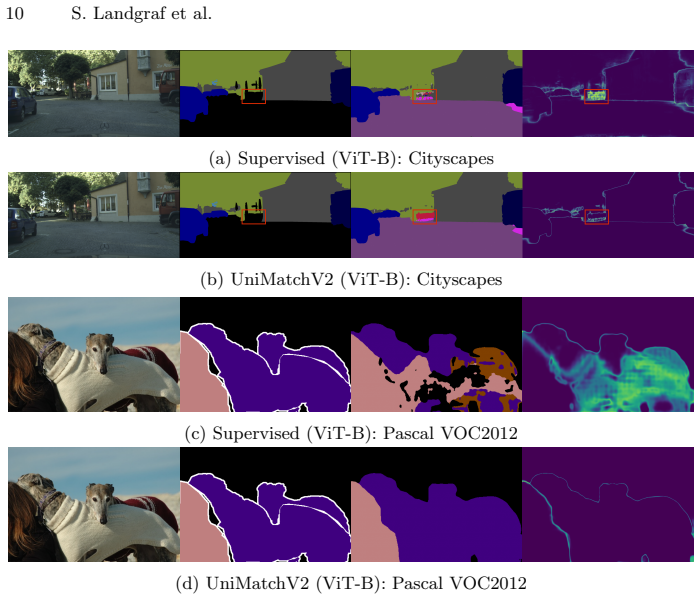
The paper's central claim, stated in its conclusion, is that "UniMatchV2 achieves superior predictive performance and robustness but is often less calibrated and produces less reliable uncertainty estimates than its supervised counterpart." The evidence for it comes from training UniMatchV2, its predecessor UniMatchV1, and a supervised ViT baseline under identical configurations and comparing them on two in-domain benchmarks, Cityscapes and Pascal VOC2012, plus fog- and rain-degraded versions of Cityscapes for out-of-domain robustness. The pattern that carries the argument is the split between accuracy and error-awareness: UniMatchV2 holds the highest mIoU at nearly every label regime, up to 0.903 on Pascal VOC2012, while its $p(\mathrm{unc}|\mathrm{inacc})$ value, the probability that a wrong prediction is flagged as uncertain, sinks as low as 0.515 on Cityscapes against the supervised baseline's 0.698. UniMatchV2 is accordingly confident about mistakes that a supervised model would hedge, and this shows up even in the qualitative examples, where it labels regions with low uncertainty where the supervised model is cautious. Fusing accuracy, calibration, and these uncertainty probabilities into the harmonic-mean RSS makes the trade-off legible as a single number, and on Cityscapes the supervised baseline tops the RSS at every label fraction.
Load-bearing premise
The load-bearing premise is that dividing each image's pixels into certain and uncertain at that image's median entropy yields meaningful reliability measurements; if a different rule, say a fixed entropy cutoff applied across the whole dataset, changed the measured $p(\mathrm{unc}|\mathrm{inacc})$ values, the reported gap between the models, and with it the paper's main claim, could shrink or reverse.
Editorial extensions
If this is right
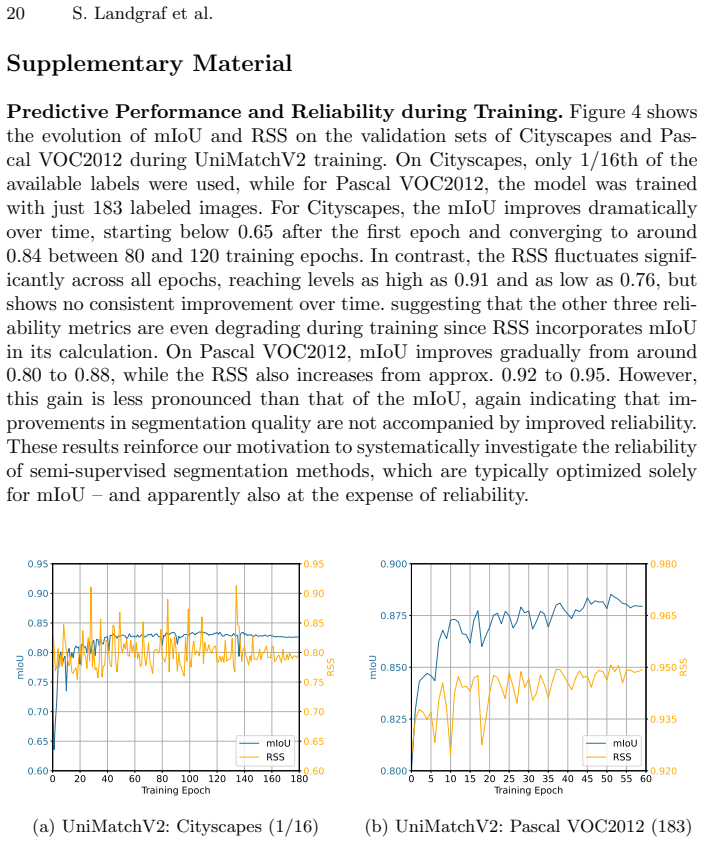
- If RSS becomes the evaluation standard, a semi-supervised method can no longer claim meaningful progress on a benchmark by raising mIoU alone; it must keep calibration and uncertainty quality from degrading at the same time, which the supplementary training curves show UniMatchV2 currently does not.
- On Cityscapes the fully supervised ViT-B baseline achieves the highest RSS at every label fraction despite losing on mIoU, so accuracy-focused leaderboards and reliability-focused leaderboards would rank the same methods in opposite orders.
- On Pascal VOC2012 UniMatchV2 leads RSS at every label count, so the accuracy-reliability trade-off is benchmark-dependent rather than a general property of semi-supervised learning.
- Under fog and rain, UniMatchV2's RSS degrades less than the supervised baseline's, a robustness win, but its $p(\mathrm{unc}|\mathrm{inacc})$ stays near 0.6 versus roughly 0.85, meaning out-of-domain accuracy gains do not come with out-of-domain error awareness.
Reading between the lines
- The per-image median threshold makes 'certain' relative to each image, so a model whose consistency training compresses its entire entropy distribution downward can look certain about errors that an absolute threshold would flag; rerunning the comparison with absolute thresholds is the cleanest test of whether the reported reliability gap is a property of the models or of the measurement rule.
- The equal-weight RSS is a policy choice, not a discovery: weighting $p(\mathrm{unc}|\mathrm{inacc})$ more heavily than mIoU, which a safety-critical practitioner plausibly would, would push rankings even farther toward the supervised baseline.
- A testable extension the authors do not run: add an uncertainty-aware or calibration-aware term to UniMatchV2's training objective, such as penalizing confident errors on pseudo-labeled pixels, and check whether the $p(\mathrm{unc}|\mathrm{inacc})$ gap closes without sacrificing mIoU; if it closes, the accuracy-reliability trade-off is an optimization artifact rather than an inherent cost of using
- Adopting RSS as a community metric would change what counts as a contribution in semi-supervised segmentation: methods that are polished on accuracy alone would need to demonstrate reliability too, which would likely redirect effort toward calibration-aware pseudo-labeling and uncertainty-regularized consistency training.
Editorial analysis
A structured set of objections, weighed in public.
Referee Report
Summary. The paper argues that semi-supervised semantic segmentation evaluation has focused too narrowly on mIoU and ignores reliability (calibration, uncertainty quality) and robustness. It introduces the Reliable Segmentation Score (RSS), a harmonic mean of mIoU, 1-ECE, p(acc|cer), and p(unc|inacc). The authors evaluate UniMatchV2 against UniMatchV1 and a supervised baseline on Cityscapes and Pascal VOC2012 across label fractions, plus out-of-domain tests on Foggy and Rainy Cityscapes. They report that UniMatchV2 achieves higher mIoU and robustness but is often less calibrated and produces less reliable uncertainty estimates than its supervised counterpart, concluding that evaluation protocols should adopt holistic metrics like RSS.
Significance. If validated, this is a useful contribution: it identifies a genuine blind spot in semi-supervised segmentation evaluation, proposes a simple and interpretable composite metric, and provides a first reliability-oriented comparison of a current state-of-the-art method. The out-of-domain robustness analysis is a valuable addition. However, the central empirical claim depends on a metric definition that contains a concrete error, on single-run experiments without error bars, and on a thresholding choice whose sensitivity is not examined. The paper's own Table 1 partially contradicts the claim that UniMatchV2 is 'often less calibrated'. These issues must be addressed before the conclusions can be fully supported.
major comments (4)
- [Section 3, Eq. (4)] Equation (4) defines RSS with omega_3 appearing in both uncertainty terms and no omega_4, although the text states there are four weights and gives the example omega_1 = 1.0, omega_2 = omega_3 = omega_4 = 1/3. This makes the proposed metric ambiguous and not reproducible as written. Please correct the equation and state clearly which weighting was used to compute the RSS values in Tables 1-3.
- [Section 5.1, Table 1] The conclusion that UniMatchV2 is 'often less calibrated' than its supervised counterpart is not supported by the ViT-B results in Table 1. On Cityscapes, UniMatchV2 ViT-B has ECE equal to or lower than Supervised ViT-B on four of five splits (0.019 vs 0.020, 0.025 vs 0.025, 0.015 vs 0.015, 0.011 vs 0.011); on Pascal VOC2012 it is lower on four of five splits (0.030 vs 0.038, 0.022 vs 0.026, 0.018 vs 0.018, 0.016 vs 0.017). The 'less calibrated' claim holds mainly for ViT-S on Cityscapes. Please qualify the conclusion per encoder or revise it.
- [Section 4.3, Tables 1-3] All quantitative results are reported from single runs without error bars, multiple seeds, or statistical significance tests. Because the central claim is a reliability/accuracy trade-off and some RSS differences are small (e.g., Table 1, Pascal VOC 1464: RSS 0.962 for UniMatchV2 ViT-B vs 0.958 for Supervised ViT-B), the reader cannot tell whether the observed rankings are stable. Please provide variance estimates from at least three seeds, or explicitly justify why single runs are sufficient.
- [Section 4.3, p(unc|inacc) definition] The uncertainty threshold is defined as the per-image median entropy, following Landgraf et al. [39]. This makes p(unc|inacc) a relative measure: each image is split into exactly 50% certain and 50% uncertain pixels, so the metric records whether errors fall in the higher-entropy half of each image, not whether the model is uncertain on an absolute scale. The paper does not test whether the RSS ranking (e.g., Supervised ViT-B above UniMatchV2 on Cityscapes in Table 1) is robust to alternative threshold choices, such as an absolute entropy cutoff or a dataset-level quantile. Since p(unc|inacc) strongly drives the RSS differences and the central reliability claim, please report a sensitivity analysis for the threshold.
minor comments (4)
- [Supplementary Material, Table 2/3 caption] There is a typo: 'Reminiscent of the finings' should read 'findings'.
- [Figure 2] Figure 2 is described as radar charts, but the plots appear to be line or marker charts on a radial layout; please clarify the description or correct the figure.
- [Section 3] The claim that the four RSS components are 'largely orthogonal' is asserted without quantitative support. If, for example, ECE and p(acc|cer) are strongly correlated, the harmonic mean may not capture four independent aspects; a correlation analysis over the evaluated models would strengthen the justification.
- [Section 4.3] The text says ECE is computed with the default 15-bin discretization via torchmetrics, but the number of pixels per bin and the handling of the maximum confidence bin are not described; please give the exact binning details for reproducibility.
Circularity Check
No significant circularity: RSS is a defined metric and the central reliability claim is an empirical evaluation, not a fitted or self-referential prediction.
full rationale
The paper introduces RSS as a definitional combination of mIoU, ECE, p(acc|cer), and p(unc|inacc) (Eq. 4); it does not derive any of these components from RSS, so there is no self-definitional loop. UniMatchV2 and the supervised baseline are evaluated on their actual predictions using standard metrics (mIoU, ECE, Shannon entropy), and no parameter is fitted to the data in order to produce the reported rankings. The only self-citation that affects the protocol is the per-image median-entropy threshold suggested by Landgraf et al. [39]. That threshold is a convention inherited from the authors' prior work, not a parameter fitted to the present results, and the paper's conclusion does not reduce to the threshold by construction; the robustness of the ranking to alternative thresholds is a methodological sensitivity concern, not a circularity. The RSS weights are explicitly hand-chosen equal weights, and the paper does not claim they are derived from first principles. The central claims are therefore self-contained empirical findings rather than predictions whose outputs are identical to their inputs.
Assumptions & free parameters
free parameters (2)
- RSS component weights =
Proposed equal weighting, but Eq. (4) is ambiguous (omega_3 appears twice, no omega_4)
- Uncertainty threshold =
Per-image median Shannon entropy
assumptions (3)
- domain assumption Ground-truth labels in Cityscapes, Pascal VOC, Foggy Cityscapes, and Rainy Cityscapes are correct enough to serve as references for pixel-wise reliability evaluation.
- domain assumption Shannon entropy of the softmax distribution is a meaningful pixel-wise uncertainty measure and median entropy is a sensible certain/uncertain threshold.
- ad hoc to paper The four components of RSS are sufficiently independent that a harmonic mean is an appropriate aggregation.
Cite this review
Pith. "Pith review of Rethinking Semi-supervised Segmentation Beyond Accuracy: Reliability and Robustness." pith.science (2026). https://pith.science/paper/OORQINCG
@misc{pith2026250605917,
  author       = {Pith},
  title        = {Pith review of: Rethinking Semi-supervised Segmentation Beyond Accuracy: Reliability and Robustness},
  year         = {2026},
  howpublished = {\url{https://pith.science/paper/OORQINCG}},
  note         = {Machine review of arXiv:2506.05917}
}
read the original abstract
Semantic segmentation is critical for scene understanding but demands costly pixel-wise annotations, attracting increasing attention to semi-supervised approaches to leverage abundant unlabeled data. While semi-supervised segmentation is often promoted as a path toward scalable, real-world deployment, it is astonishing that current evaluation protocols exclusively focus on segmentation accuracy, entirely overlooking reliability and robustness. These qualities, which ensure consistent performance under diverse conditions (robustness) and well-calibrated model confidences as well as meaningful uncertainties (reliability), are essential for safety-critical applications like autonomous driving, where models must handle unpredictable environments and avoid sudden failures at all costs. To address this gap, we introduce the Reliable Segmentation Score (RSS), a novel metric that combines predictive accuracy, calibration, and uncertainty quality measures via a harmonic mean. RSS penalizes deficiencies in any of its components, providing an easy and intuitive way of holistically judging segmentation models. Comprehensive evaluations of UniMatchV2 against its predecessor and a supervised baseline show that semi-supervised methods often trade reliability for accuracy. While out-of-domain evaluations demonstrate UniMatchV2's robustness, they further expose persistent reliability shortcomings. We advocate for a shift in evaluation protocols toward more holistic metrics like RSS to better align semi-supervised learning research with real-world deployment needs.
Figures


Figures from the paper (1 more)
Reference graph
Works this paper leans on
-
[39]
Landgraf, S., Hillemann, M., Kapler, T., Ulrich, M.: A comparative study on multi-task uncertainty quantification in semantic segmentation and monocular depth estimation. tm-Technisches Messen (2025)
work page 2025
-
[1]
Information fusion76, 243–297 (2021)
Abdar, M., Pourpanah, F., Hussain, S., Rezazadegan, D., Liu, L., Ghavamzadeh, M., Fieguth, P., Cao, X., Khosravi, A., Acharya, U.R., et al.: A review of uncer- tainty quantification in deep learning: Techniques, applications and challenges. Information fusion76, 243–297 (2021)
2021
-
[2]
In: Proceedings of the IEEE/CVF international conference on computer vision
Alonso, I., Sabater, A., Ferstl, D., Montesano, L., Murillo, A.C.: Semi-supervised semantic segmentation with pixel-level contrastive learning from a class-wise memory bank. In: Proceedings of the IEEE/CVF international conference on computer vision. pp. 8219–8228 (2021)
2021
-
[3]
In: Proceedings of the IEEE conference on computer vision and pattern recognition
Arnab, A., Miksik, O., Torr, P.H.: On the robustness of semantic segmentation models to adversarial attacks. In: Proceedings of the IEEE conference on computer vision and pattern recognition. pp. 888–897 (2018)
2018
-
[4]
IEEE transactions on pattern analysis and machine intelligence40(4), 834–848 (2017)
Chen, L.C., Papandreou, G., Kokkinos, I., Murphy, K., Yuille, A.L.: Deeplab: Semantic image segmentation with deep convolutional nets, atrous convolution, and fully connected crfs. IEEE transactions on pattern analysis and machine intelligence40(4), 834–848 (2017)
2017
-
[5]
In: International conference on machine learning
Chen, T., Kornblith, S., Norouzi, M., Hinton, G.: A simple framework for con- trastive learning of visual representations. In: International conference on machine learning. pp. 1597–1607. PMLR (2020)
2020
-
[6]
Advances in neural in- formation processing systems33, 22243–22255 (2020)
Chen, T., Kornblith, S., Swersky, K., Norouzi, M., Hinton, G.E.: Big self- supervised models are strong semi-supervised learners. Advances in neural in- formation processing systems33, 22243–22255 (2020)
2020
-
[7]
In: Proceedings of the IEEE/CVF conference on computer vision and pattern recognition
Chen, X., Yuan, Y., Zeng, G., Wang, J.: Semi-supervised semantic segmentation with cross pseudo supervision. In: Proceedings of the IEEE/CVF conference on computer vision and pattern recognition. pp. 2613–2622 (2021)
2021
Show all 109 references
-
[8]
In: Proceed- ings of the IEEE/CVF conference on computer vision and pattern recognition
Chen, X., He, K.: Exploring simple siamese representation learning. In: Proceed- ings of the IEEE/CVF conference on computer vision and pattern recognition. pp. 15750–15758 (2021)
2021
-
[9]
In: 2021 IEEE International Conference on Image Processing (ICIP)
Chen, Y., Ouyang, X., Zhu, K., Agam, G.: Complexmix: Semi-supervised semantic segmentation via mask-based data augmentation. In: 2021 IEEE International Conference on Image Processing (ICIP). pp. 2264–2268. IEEE (2021)
2021
-
[10]
In: Proceedings of the IEEE conference on computer vision and pattern recognition
Cordts, M., Omran, M., Ramos, S., Rehfeld, T., Enzweiler, M., Benenson, R., Franke, U., Roth, S., Schiele, B.: The cityscapes dataset for semantic urban scene understanding. In: Proceedings of the IEEE conference on computer vision and pattern recognition. pp. 3213–3223 (2016)
2016
-
[11]
In: European Conference on Computer Vision
Croce, F., Singh, N.D., Hein, M.: Towards reliable evaluation and fast training of robust semantic segmentation models. In: European Conference on Computer Vision. pp. 180–197. Springer (2024)
2024
-
[12]
De Jorge, P., Volpi, R., Torr, P.H., Rogez, G.: Reliability in semantic segmenta- tion: Are we on the right track? In: Proceedings of the IEEE/CVF Conference on Computer Vision and Pattern Recognition. pp. 7173–7182 (2023)
2023
-
[13]
Journal of Open Source Software7(70), 4101 (2022)
Detlefsen, N.S., Borovec, J., Schock, J., Jha, A.H., Koker, T., Di Liello, L., Stancl, D., Quan, C., Grechkin, M., Falcon, W.: Torchmetrics-measuring reproducibility in pytorch. Journal of Open Source Software7(70), 4101 (2022)
2022
-
[14]
In: Proceedings of the IEEE/CVF International Conference on Computer Vision
Ding, Z., Han, X., Liu, P., Niethammer, M.: Local temperature scaling for proba- bility calibration. In: Proceedings of the IEEE/CVF International Conference on Computer Vision. pp. 6889–6899 (2021)
2021
-
[15]
International journal of computer vision111, 98–136 (2015) 14 S
Everingham, M., Eslami, S.A., Van Gool, L., Williams, C.K., Winn, J., Zisser- man, A.: The pascal visual object classes challenge: A retrospective. International journal of computer vision111, 98–136 (2015) 14 S. Landgraf et al
2015
-
[16]
Pattern Recognition130, 108777 (2022)
Feng, Z., Zhou, Q., Gu, Q., Tan, X., Cheng, G., Lu, X., Shi, J., Ma, L.: Dmt: Dynamic mutual training for semi-supervised learning. Pattern Recognition130, 108777 (2022)
2022
-
[17]
arXiv preprint arXiv:1906.01916 (2019)
French, G., Laine, S., Aila, T., Mackiewicz, M., Finlayson, G.: Semi-supervised semantic segmentation needs strong, varied perturbations. arXiv preprint arXiv:1906.01916 (2019)
2019 arXiv
-
[18]
Advances in neural information processing systems27(2014)
Goodfellow, I.J., Pouget-Abadie, J., Mirza, M., Xu, B., Warde-Farley, D., Ozair, S., Courville, A., Bengio, Y.: Generative adversarial nets. Advances in neural information processing systems27(2014)
2014
-
[19]
arXiv preprint arXiv:1412.6572 (2014)
Goodfellow, I.J., Shlens, J., Szegedy, C.: Explaining and harnessing adversarial examples. arXiv preprint arXiv:1412.6572 (2014)
2014 arXiv
-
[20]
In: International Conference on Machine Learning
Guo, C., Pleiss, G., Sun, Y., Weinberger, K.Q.: On calibration of modern neu- ral networks. In: International Conference on Machine Learning. pp. 1321–1330. PMLR (2017)
2017
-
[21]
In: Proceedings of the IEEE conference on computer vision and pattern recognition
He, K., Zhang, X., Ren, S., Sun, J.: Deep residual learning for image recogni- tion. In: Proceedings of the IEEE conference on computer vision and pattern recognition. pp. 770–778 (2016)
2016
-
[22]
In: Proceedings of the IEEE/CVF International Conference on Computer Vision
He, R., Yang, J., Qi, X.: Re-distributing biased pseudo labels for semi- supervised semantic segmentation: A baseline investigation. In: Proceedings of the IEEE/CVF International Conference on Computer Vision. pp. 6930–6940 (2021)
2021
-
[23]
arXiv preprint arXiv:1903.12261 (2019)
Hendrycks, D., Dietterich, T.: Benchmarking neural network robustness to com- mon corruptions and perturbations. arXiv preprint arXiv:1903.12261 (2019)
2019 arXiv
-
[24]
In: Proceedings of the IEEE/CVF conference on computer vision and pattern recognition
Hendrycks, D., Zhao, K., Basart, S., Steinhardt, J., Song, D.: Natural adversarial examples. In: Proceedings of the IEEE/CVF conference on computer vision and pattern recognition. pp. 15262–15271 (2021)
2021
-
[25]
arXiv preprint arXiv:1207.0580 (2012)
Hinton, G.E., Srivastava, N., Krizhevsky, A., Sutskever, I., Salakhutdinov, R.R.: Improving neural networks by preventing co-adaptation of feature detectors. arXiv preprint arXiv:1207.0580 (2012)
2012 arXiv
-
[26]
In: Eu- ropean Conference on Computer Vision
Howlader, P., Das, S., Le, H., Samaras, D.: Beyond pixels: Semi-supervised se- mantic segmentation with a multi-scale patch-based multi-label classifier. In: Eu- ropean Conference on Computer Vision. pp. 342–360. Springer (2024)
2024
-
[27]
In: European Conference on Computer Vision
Hoyer, L., Tan, D.J., Naeem, M.F., Van Gool, L., Tombari, F.: Semivl: semi- supervised semantic segmentation with vision-language guidance. In: European Conference on Computer Vision. pp. 257–275. Springer (2024)
2024
-
[28]
In: Proceedings of the IEEE/CVF Conference on computer vision and pattern recognition
Hu, X., Fu, C.W., Zhu, L., Heng, P.A.: Depth-attentional features for single-image rain removal. In: Proceedings of the IEEE/CVF Conference on computer vision and pattern recognition. pp. 8022–8031 (2019)
2019
-
[29]
In: Proceedings of the IEEE/CVF Conference on Computer Vision and Pattern Recognition
Hu, X., Jiang, L., Schiele, B.: Training vision transformers for semi-supervised se- mantic segmentation. In: Proceedings of the IEEE/CVF Conference on Computer Vision and Pattern Recognition. pp. 4007–4017 (2024)
2024
-
[30]
arXiv preprint arXiv:1802.07934 (2018)
Hung, W.C., Tsai, Y.H., Liou, Y.T., Lin, Y.Y., Yang, M.H.: Adversarial learn- ing for semi-supervised semantic segmentation. arXiv preprint arXiv:1802.07934 (2018)
2018 arXiv
-
[31]
In: 2019 IEEE/CVF International Conference on Computer Vision Work- shop (ICCVW)
Ji, B., Jung, H., Yoon, J., Kim, K., et al.: Bin-wise temperature scaling (bts): improvement in confidence calibration performance through simple scaling tech- niques. In: 2019 IEEE/CVF International Conference on Computer Vision Work- shop (ICCVW). pp. 4190–4196. IEEE (2019)
2019
-
[32]
Information Processing & Management58(5), 102680 (2021) Rethinking Semi-supervised Segmentation Beyond Accuracy 15
Jin, G., Liu, C., Chen, X.: Adversarial network integrating dual attention and sparse representation for semi-supervised semantic segmentation. Information Processing & Management58(5), 102680 (2021) Rethinking Semi-supervised Segmentation Beyond Accuracy 15
2021
-
[33]
Advances in Neural Information Processing Systems35, 2803– 2816 (2022)
Jin, Y., Wang, J., Lin, D.: Semi-supervised semantic segmentation via gentle teaching assistant. Advances in Neural Information Processing Systems35, 2803– 2816 (2022)
2022
-
[34]
In: Proceedings of the IEEE/CVF conference on computer vision and pattern recognition
Kamann, C., Rother, C.: Benchmarking the robustness of semantic segmentation models. In: Proceedings of the IEEE/CVF conference on computer vision and pattern recognition. pp. 8828–8838 (2020)
2020
-
[35]
International journal of computer vision129(2), 462–483 (2021)
Kamann, C., Rother, C.: Benchmarking the robustness of semantic segmentation models with respect to common corruptions. International journal of computer vision129(2), 462–483 (2021)
2021
-
[36]
In: Computer Vision–ECCV 2020: 16th European Conference, Glasgow, UK, August 23–28, 2020, Proceedings, Part XIII 16
Ke, Z., Qiu, D., Li, K., Yan, Q., Lau, R.W.: Guided collaborative training for pixel- wise semi-supervised learning. In: Computer Vision–ECCV 2020: 16th European Conference, Glasgow, UK, August 23–28, 2020, Proceedings, Part XIII 16. pp. 429–445. Springer (2020)
2020
-
[37]
Advances in neural information processing systems32 (2019)
Kull, M., Perello Nieto, M., K¨ angsepp, M., Silva Filho, T., Song, H., Flach, P.: Beyond temperature scaling: Obtaining well-calibrated multi-class probabilities with dirichlet calibration. Advances in neural information processing systems32 (2019)
2019
-
[38]
In: DAGM German Conference on Pattern Recognition
Landgraf, S., Hillemann, M., Kapler, T., Ulrich, M.: Efficient multi-task uncertain- ties for joint semantic segmentation and monocular depth estimation. In: DAGM German Conference on Pattern Recognition. pp. 348–364. Springer (2024)
2024
-
[40]
ISPRS Annals of the Photogrammetry, Re- mote Sensing and Spatial Information Sciences10, 129–136 (2024)
Landgraf, S., Hillemann, M., Wursthorn, K., Ulrich, M.: Uncertainty-aware cross- entropy for semantic segmentation. ISPRS Annals of the Photogrammetry, Re- mote Sensing and Spatial Information Sciences10, 129–136 (2024)
2024
-
[41]
arXiv preprint arXiv:2501.08188 (2025)
Landgraf, S., Qin, R., Ulrich, M.: A critical synthesis of uncertainty quantifi- cation and foundation models in monocular depth estimation. arXiv preprint arXiv:2501.08188 (2025)
2025 arXiv
-
[42]
PFG–Journal of Photogrammetry, Remote Sensing and Geoinformation Science92(2), 101–114 (2024)
Landgraf, S., Wursthorn, K., Hillemann, M., Ulrich, M.: Dudes: Deep uncer- tainty distillation using ensembles for semantic segmentation. PFG–Journal of Photogrammetry, Remote Sensing and Geoinformation Science92(2), 101–114 (2024)
2024
-
[43]
Neurocomputing338, 321–348 (2019)
Lateef, F., Ruichek, Y.: Survey on semantic segmentation using deep learning techniques. Neurocomputing338, 321–348 (2019)
2019
-
[44]
In: Proceedings of the IEEE/CVF Conference on Computer Vision and Pattern Recognition
Li, D., Yang, J., Kreis, K., Torralba, A., Fidler, S.: Semantic segmentation with generative models: Semi-supervised learning and strong out-of-domain general- ization. In: Proceedings of the IEEE/CVF Conference on Computer Vision and Pattern Recognition. pp. 8300–8311 (2021)
2021
-
[45]
In: Proceedings of the IEEE/CVF International Conference on Computer Vision
Li, P., Purkait, P., Ajanthan, T., Abdolshah, M., Garg, R., Husain, H., Xu, C., Gould, S., Ouyang, W., Van Den Hengel, A.: Semi-supervised semantic seg- mentation under label noise via diverse learning groups. In: Proceedings of the IEEE/CVF International Conference on Compute...
2023
-
[46]
In: Proceedings of the IEEE/CVF International Conference on Computer Vision
Li, S., He, Y., Zhang, W., Zhang, W., Tan, X., Han, J., Ding, E., Wang, J.: Cfcg: Semi-supervised semantic segmentation via cross-fusion and contour guid- ance supervision. In: Proceedings of the IEEE/CVF International Conference on Computer Vision. pp. 16348–16358 (2023)
2023
-
[47]
arXiv preprint arXiv:2308.09281 (2023) 16 S
Li, Y., Wang, X., Yang, L., Feng, L., Zhang, W., Gao, Y.: Diverse cotraining makes strong semi-supervised segmentor. arXiv preprint arXiv:2308.09281 (2023) 16 S. Landgraf et al
2023 arXiv
-
[48]
In: Proceedings of the IEEE/CVF International Conference on Computer Vision
Liang, C., Wang, W., Miao, J., Yang, Y.: Logic-induced diagnostic reasoning for semi-supervised semantic segmentation. In: Proceedings of the IEEE/CVF International Conference on Computer Vision. pp. 16197–16208 (2023)
2023
-
[49]
In: Computer vision–ECCV 2014: 13th European conference, zurich, Switzerland, September 6-12, 2014, proceedings, part v 13
Lin, T.Y., Maire, M., Belongie, S., Hays, J., Perona, P., Ramanan, D., Doll´ ar, P., Zitnick, C.L.: Microsoft coco: Common objects in context. In: Computer vision–ECCV 2014: 13th European conference, zurich, Switzerland, September 6-12, 2014, proceedings, part v 13. pp. 740–75...
2014
-
[50]
arXiv preprint arXiv:2104.04465 (2021)
Liu, S., Zhi, S., Johns, E., Davison, A.J.: Bootstrapping semantic segmentation with regional contrast. arXiv preprint arXiv:2104.04465 (2021)
2021 arXiv
-
[51]
In: Proceedings of the IEEE/CVF conference on computer vision and pattern recognition
Liu, Y., Tian, Y., Chen, Y., Liu, F., Belagiannis, V., Carneiro, G.: Perturbed and strict mean teachers for semi-supervised semantic segmentation. In: Proceedings of the IEEE/CVF conference on computer vision and pattern recognition. pp. 4258–4267 (2022)
2022
-
[52]
Loiseau, T., Vu, T.H., Chen, M., P´ erez, P., Cord, M.: Reliability in semantic segmentation: Can we use synthetic data? In: European Conference on Computer Vision. pp. 442–459. Springer (2024)
2024
-
[53]
In: Proceedings of the IEEE conference on computer vision and pattern recognition
Long, J., Shelhamer, E., Darrell, T.: Fully convolutional networks for semantic segmentation. In: Proceedings of the IEEE conference on computer vision and pattern recognition. pp. 3431–3440 (2015)
2015
-
[54]
In: Proceedings of the IEEE/CVF International Confer- ence on Computer Vision
Ma, J., Wang, C., Liu, Y., Lin, L., Li, G.: Enhanced soft label for semi-supervised semantic segmentation. In: Proceedings of the IEEE/CVF International Confer- ence on Computer Vision. pp. 1185–1195 (2023)
2023
-
[55]
In: Proceedings of the IEEE/CVF Conference on Computer Vision and Pattern Recognition
Mai, H., Sun, R., Zhang, T., Wu, F.: Rankmatch: Exploring the better consistency regularization for semi-supervised semantic segmentation. In: Proceedings of the IEEE/CVF Conference on Computer Vision and Pattern Recognition. pp. 3391– 3401 (2024)
2024
-
[56]
In: Computer Vision–ECCV 2020: 16th European Conference, Glasgow, UK, August 23–28, 2020, Proceedings, Part XXIX 16
Mendel, R., De Souza, L.A., Rauber, D., Papa, J.P., Palm, C.: Semi-supervised segmentation based on error-correcting supervision. In: Computer Vision–ECCV 2020: 16th European Conference, Glasgow, UK, August 23–28, 2020, Proceedings, Part XXIX 16. pp. 141–157. Springer (2020)
2020
-
[57]
IEEE transactions on pattern analysis and machine intelligence44(7), 3523–3542 (2021)
Minaee, S., Boykov, Y., Porikli, F., Plaza, A., Kehtarnavaz, N., Terzopoulos, D.: Image segmentation using deep learning: A survey. IEEE transactions on pattern analysis and machine intelligence44(7), 3523–3542 (2021)
2021
-
[58]
IEEE transactions on pattern analysis and machine intelligence43(4), 1369–1379 (2019)
Mittal, S., Tatarchenko, M., Brox, T.: Semi-supervised semantic segmentation with high-and low-level consistency. IEEE transactions on pattern analysis and machine intelligence43(4), 1369–1379 (2019)
2019
-
[59]
IEEE Transactions on Intelligent Transportation Systems22(7), 4316–4336 (2020)
Muhammad, K., Ullah, A., Lloret, J., Del Ser, J., De Albuquerque, V.H.C.: Deep learning for safe autonomous driving: Current challenges and future direc- tions. IEEE Transactions on Intelligent Transportation Systems22(7), 4316–4336 (2020)
2020
-
[60]
arXiv preprint arXiv:1811.12709 (2018)
Mukhoti, J., Gal, Y.: Evaluating bayesian deep learning methods for semantic segmentation. arXiv preprint arXiv:1811.12709 (2018)
2018 arXiv
-
[61]
Advances in Neural Information Processing Systems36(2024)
Na, J., Ha, J.W., Chang, H.J., Han, D., Hwang, W.: Switching temporary teach- ers for semi-supervised semantic segmentation. Advances in Neural Information Processing Systems36(2024)
2024
-
[62]
In: Proceedings of the AAAI conference on artificial intelligence
Naeini, M.P., Cooper, G., Hauskrecht, M.: Obtaining well calibrated probabili- ties using bayesian binning. In: Proceedings of the AAAI conference on artificial intelligence. vol. 29 (2015)
2015
-
[63]
The International Journal of Robotics Research 37(4-5), 472–491 (2018) Rethinking Semi-supervised Segmentation Beyond Accuracy 17
Oliveira, G.L., Bollen, C., Burgard, W., Brox, T.: Efficient and robust deep net- works for semantic segmentation. The International Journal of Robotics Research 37(4-5), 472–491 (2018) Rethinking Semi-supervised Segmentation Beyond Accuracy 17
2018
-
[64]
In: Proceedings of the IEEE/CVF winter conference on applications of computer vision
Olsson, V., Tranheden, W., Pinto, J., Svensson, L.: Classmix: Segmentation- based data augmentation for semi-supervised learning. In: Proceedings of the IEEE/CVF winter conference on applications of computer vision. pp. 1369–1378 (2021)
2021
-
[65]
Transactions on Machine Learning Research Journal pp
Oquab, M., Darcet, T., Moutakanni, T., Vo, H., Szafraniec, M., Khalidov, V., Fernandez, P., Haziza, D., Massa, F., El-Nouby, A., et al.: Dinov2: Learning robust visual features without supervision. Transactions on Machine Learning Research Journal pp. 1–31 (2024)
2024
-
[66]
Advances in neural information processing systems32(2019)
Ovadia, Y., Fertig, E., Ren, J., Nado, Z., Sculley, D., Nowozin, S., Dillon, J., Lakshminarayanan, B., Snoek, J.: Can you trust your model’s uncertainty? eval- uating predictive uncertainty under dataset shift. Advances in neural information processing systems32(2019)
2019
-
[67]
In: Proceedings of the IEEE international conference on computer vision
Papandreou, G., Chen, L.C., Murphy, K.P., Yuille, A.L.: Weakly-and semi- supervised learning of a deep convolutional network for semantic image segmen- tation. In: Proceedings of the IEEE international conference on computer vision. pp. 1742–1750 (2015)
2015
-
[68]
In: Proceedings of the IEEE/CVF Winter Conference on Applications of Computer Vision
Patra, R., Hebbalaguppe, R., Dash, T., Shroff, G., Vig, L.: Calibrating deep neural networks using explicit regularisation and dynamic data pruning. In: Proceedings of the IEEE/CVF Winter Conference on Applications of Computer Vision. pp. 1541–1549 (2023)
2023
-
[69]
Interna- tional Journal of Machine Learning and Cybernetics13(4), 1065–1077 (2022)
Pedraza, A., Deniz, O., Bueno, G.: Really natural adversarial examples. Interna- tional Journal of Machine Learning and Cybernetics13(4), 1065–1077 (2022)
2022
-
[70]
arXiv preprint arXiv:2302.09899 (2023)
Pel´ aez-Vegas, A., Mesejo, P., Luengo, J.: A survey on semi-supervised semantic segmentation. arXiv preprint arXiv:2302.09899 (2023)
2023 arXiv
-
[71]
Pattern Recognition107, 107269 (2020)
Peng, J., Estrada, G., Pedersoli, M., Desrosiers, C.: Deep co-training for semi- supervised image segmentation. Pattern Recognition107, 107269 (2020)
2020
-
[72]
In: Proceed- ings of the IEEE/CVF Conference on Computer Vision and Pattern Recognition
Qiao, P., Wei, Z., Wang, Y., Wang, Z., Song, G., Xu, F., Ji, X., Liu, C., Chen, J.: Fuzzy positive learning for semi-supervised semantic segmentation. In: Proceed- ings of the IEEE/CVF Conference on Computer Vision and Pattern Recognition. pp. 15465–15474 (2023)
2023
-
[73]
Recht, B., Roelofs, R., Schmidt, L., Shankar, V.: Do imagenet classifiers generalize to imagenet? In: International conference on machine learning. pp. 5389–5400. PMLR (2019)
2019
-
[74]
International Journal of Computer Vision126, 973–992 (2018)
Sakaridis, C., Dai, D., Van Gool, L.: Semantic foggy scene understanding with synthetic data. International Journal of Computer Vision126, 973–992 (2018)
2018
-
[75]
In: Proceedings of the IEEE/CVF international conference on computer vision
Sakaridis, C., Dai, D., Van Gool, L.: Acdc: The adverse conditions dataset with correspondences for semantic driving scene understanding. In: Proceedings of the IEEE/CVF international conference on computer vision. pp. 10765–10775 (2021)
2021
-
[76]
The Bell system tech- nical journal27(3), 379–423 (1948)
Shannon, C.E.: A mathematical theory of communication. The Bell system tech- nical journal27(3), 379–423 (1948)
1948
-
[77]
Advances in neural information processing systems 33, 596–608 (2020)
Sohn, K., Berthelot, D., Carlini, N., Zhang, Z., Zhang, H., Raffel, C.A., Cubuk, E.D., Kurakin, A., Li, C.L.: Fixmatch: Simplifying semi-supervised learning with consistency and confidence. Advances in neural information processing systems 33, 596–608 (2020)
2020
-
[78]
In: Proceedings of the IEEE international conference on computer vision
Souly, N., Spampinato, C., Shah, M.: Semi supervised semantic segmentation using generative adversarial network. In: Proceedings of the IEEE international conference on computer vision. pp. 5688–5696 (2017)
2017
-
[79]
In: Pro- ceedings of the IEEE/CVF Conference on Computer Vision and Pattern Recog- nition
Sun, B., Yang, Y., Zhang, L., Cheng, M.M., Hou, Q.: Corrmatch: Label propaga- tion via correlation matching for semi-supervised semantic segmentation. In: Pro- ceedings of the IEEE/CVF Conference on Computer Vision and Pattern Recog- nition. pp. 3097–3107 (2024) 18 S. Landgraf et al
2024
-
[80]
Advances in neural information processing systems30(2017)
Tarvainen, A., Valpola, H.: Mean teachers are better role models: Weight-averaged consistency targets improve semi-supervised deep learning results. Advances in neural information processing systems30(2017)
2017
-
[81]
In: 2022 19th Conference on Robots and Vision (CR V)
Teh, E.W., DeVries, T., Duke, B., Jiang, R., Aarabi, P., Taylor, G.W.: The gist and rist of iterative self-training for semi-supervised segmentation. In: 2022 19th Conference on Robots and Vision (CR V). pp. 58–66. IEEE (2022)
2022
-
[82]
In: 2019 IEEE winter conference on applications of computer vision (W ACV)
Varma, G., Subramanian, A., Namboodiri, A., Chandraker, M., Jawahar, C.: Idd: A dataset for exploring problems of autonomous navigation in unconstrained en- vironments. In: 2019 IEEE winter conference on applications of computer vision (W ACV). pp. 1743–1751. IEEE (2019)
2019
-
[83]
In: Pro- ceedings of the IEEE/CVF International Conference on Computer Vision
Wang, C., Xie, H., Yuan, Y., Fu, C., Yue, X.: Space engage: Collaborative space supervision for contrastive-based semi-supervised semantic segmentation. In: Pro- ceedings of the IEEE/CVF International Conference on Computer Vision. pp. 931–942 (2023)
2023
-
[84]
Advances in Neural Information Pro- cessing Systems34, 11809–11820 (2021)
Wang, D.B., Feng, L., Zhang, M.L.: Rethinking calibration of deep neural net- works: Do not be afraid of overconfidence. Advances in Neural Information Pro- cessing Systems34, 11809–11820 (2021)
2021
-
[85]
In: Proceedings of the IEEE/CVF Conference on Computer Vision and Pattern Recognition
Wang, H., Zhang, Q., Li, Y., Li, X.: Allspark: Reborn labeled features from unla- beled in transformer for semi-supervised semantic segmentation. In: Proceedings of the IEEE/CVF Conference on Computer Vision and Pattern Recognition. pp. 3627–3636 (2024)
2024
-
[86]
In: Proceedings of the IEEE/CVF Conference on Computer Vision and Pattern Recognition
Wang, X., Bai, H., Yu, L., Zhao, Y., Xiao, J.: Towards the uncharted: Density- descending feature perturbation for semi-supervised semantic segmentation. In: Proceedings of the IEEE/CVF Conference on Computer Vision and Pattern Recognition. pp. 3303–3312 (2024)
2024
-
[87]
In: Proceedings of the IEEE/CVF Conference on Computer Vision and Pattern Recognition
Wang, X., Zhang, B., Yu, L., Xiao, J.: Hunting sparsity: Density-guided con- trastive learning for semi-supervised semantic segmentation. In: Proceedings of the IEEE/CVF Conference on Computer Vision and Pattern Recognition. pp. 3114–3123 (2023)
2023
-
[88]
In: Proceedings of the IEEE/CVF conference on computer vision and pattern recog- nition
Wang, Y., Wang, H., Shen, Y., Fei, J., Li, W., Jin, G., Wu, L., Zhao, R., Le, X.: Semi-supervised semantic segmentation using unreliable pseudo-labels. In: Proceedings of the IEEE/CVF conference on computer vision and pattern recog- nition. pp. 4248–4257 (2022)
2022
-
[89]
In: Proceedings of the IEEE/CVF conference on computer vision and pattern recognition
Wang, Z., Zhao, Z., Xing, X., Xu, D., Kong, X., Zhou, L.: Conflict-based cross- view consistency for semi-supervised semantic segmentation. In: Proceedings of the IEEE/CVF conference on computer vision and pattern recognition. pp. 19585–19595 (2023)
2023
-
[90]
Advances in Neural Information Processing Systems33, 4697– 4708 (2020)
Wilson, A.G., Izmailov, P.: Bayesian deep learning and a probabilistic perspective of generalization. Advances in Neural Information Processing Systems33, 4697– 4708 (2020)
2020
-
[91]
In: DAGM German Conference on Pattern Recognition
Wolf, D.W., Balaji, P., Braun, A., Ulrich, M.: Decoupling of neural network cal- ibration measures. In: DAGM German Conference on Pattern Recognition. pp. 117–130. Springer (2024)
2024
-
[92]
Multimedia Systems29(2), 511–523 (2023)
Wu, Y., Liu, C., Chen, L., Zhao, D., Zheng, Q., Zhou, H.: Perturbation consis- tency and mutual information regularization for semi-supervised semantic seg- mentation. Multimedia Systems29(2), 511–523 (2023)
2023
-
[93]
Ad- vances in neural information processing systems34, 12077–12090 (2021) Rethinking Semi-supervised Segmentation Beyond Accuracy 19
Xie, E., Wang, W., Yu, Z., Anandkumar, A., Alvarez, J.M., Luo, P.: Segformer: Simple and efficient design for semantic segmentation with transformers. Ad- vances in neural information processing systems34, 12077–12090 (2021) Rethinking Semi-supervised Segmentation Beyond Accuracy 19
2021
-
[94]
Advances in neural information pro- cessing systems35, 26007–26020 (2022)
Xu, H., Liu, L., Bian, Q., Yang, Z.: Semi-supervised semantic segmentation with prototype-based consistency regularization. Advances in neural information pro- cessing systems35, 26007–26020 (2022)
2022
-
[95]
In: Proceedings of the IEEE/CVF conference on computer vision and pattern recognition
Yang, L., Qi, L., Feng, L., Zhang, W., Shi, Y.: Revisiting weak-to-strong consistency in semi-supervised semantic segmentation. In: Proceedings of the IEEE/CVF conference on computer vision and pattern recognition. pp. 7236– 7246 (2023)
2023
-
[96]
IEEE Transactions on Pattern Analysis and Machine In- telligence (2025)
Yang, L., Zhao, Z., Zhao, H.: Unimatch v2: Pushing the limit of semi-supervised semantic segmentation. IEEE Transactions on Pattern Analysis and Machine In- telligence (2025)
2025
-
[97]
In: Proceedings of the IEEE/CVF conference on computer vision and pattern recognition
Yang, L., Zhuo, W., Qi, L., Shi, Y., Gao, Y.: St++: Make self-training work better for semi-supervised semantic segmentation. In: Proceedings of the IEEE/CVF conference on computer vision and pattern recognition. pp. 4268–4277 (2022)
2022
-
[98]
IEEE transactions on knowledge and data engineering35(9), 8934–8954 (2022)
Yang, X., Song, Z., King, I., Xu, Z.: A survey on deep semi-supervised learning. IEEE transactions on knowledge and data engineering35(9), 8934–8954 (2022)
2022
-
[99]
In: Proceedings of the IEEE/CVF International Conference on Computer Vision
Yu, X., Zuo, Y., Wang, Z., Zhang, X., Zhao, J., Yang, Y., Jiao, L., Peng, R., Wang, X., Zhang, J., et al.: The robust semantic segmentation uncv2023 challenge results. In: Proceedings of the IEEE/CVF International Conference on Computer Vision. pp. 4618–4628 (2023)
2023
-
[100]
In: Proceedings of the IEEE/CVF International Conference on Computer Vision
Yuan, J., Liu, Y., Shen, C., Wang, Z., Li, H.: A simple baseline for semi-supervised semantic segmentation with strong data augmentation. In: Proceedings of the IEEE/CVF International Conference on Computer Vision. pp. 8229–8238 (2021)
2021
-
[101]
Journal of Visual Communication and Image Representation78, 103170 (2021)
Zhang, J., Li, Z., Zhang, C., Ma, H.: Stable self-attention adversarial learning for semi-supervised semantic image segmentation. Journal of Visual Communication and Image Representation78, 103170 (2021)
2021
-
[102]
In: Proceedings of the IEEE conference on computer vision and pattern recognition
Zhao, H., Shi, J., Qi, X., Wang, X., Jia, J.: Pyramid scene parsing network. In: Proceedings of the IEEE conference on computer vision and pattern recognition. pp. 2881–2890 (2017)
2017
-
[103]
In: Proceedings of the IEEE/CVF conference on computer vision and pattern recognition
Zhao, Z., Long, S., Pi, J., Wang, J., Zhou, L.: Instance-specific and model-adaptive supervision for semi-supervised semantic segmentation. In: Proceedings of the IEEE/CVF conference on computer vision and pattern recognition. pp. 23705– 23714 (2023)
2023
-
[104]
In: Proceedings of the IEEE/CVF conference on computer vision and pattern recognition
Zhao, Z., Yang, L., Long, S., Pi, J., Zhou, L., Wang, J.: Augmentation mat- ters: A simple-yet-effective approach to semi-supervised semantic segmentation. In: Proceedings of the IEEE/CVF conference on computer vision and pattern recognition. pp. 11350–11359 (2023)
2023
-
[105]
In: Proceedings of the IEEE conference on computer vision and pattern recognition
Zhou, B., Zhao, H., Puig, X., Fidler, S., Barriuso, A., Torralba, A.: Scene parsing through ade20k dataset. In: Proceedings of the IEEE conference on computer vision and pattern recognition. pp. 633–641 (2017)
2017
-
[106]
In: International conference on machine learning
Zhou, D., Yu, Z., Xie, E., Xiao, C., Anandkumar, A., Feng, J., Alvarez, J.M.: Understanding the robustness in vision transformers. In: International conference on machine learning. pp. 27378–27394. PMLR (2022)
2022
-
[107]
IEEE Transactions on Intelli- gent Transportation Systems21(5), 1951–1963 (2019)
Zhou, W., Berrio, J.S., Worrall, S., Nebot, E.: Automated evaluation of semantic segmentation robustness for autonomous driving. IEEE Transactions on Intelli- gent Transportation Systems21(5), 1951–1963 (2019)
2019
-
[108]
IEEE Access10, 48855–48864 (2022)
Zhou, Y., Jiao, R., Wang, D., Mu, J., Li, J.: Catastrophic forgetting problem in semi-supervised semantic segmentation. IEEE Access10, 48855–48864 (2022)
2022
-
[109]
IEEE transactions on pattern analysis and machine intelligence46(3), 1589–1602 (2021) 20 S
Zhu, Y., Zhang, Z., Wu, C., Zhang, Z., He, T., Zhang, H., Manmatha, R., Li, M., Smola, A.: Improving semantic segmentation via efficient self-training. IEEE transactions on pattern analysis and machine intelligence46(3), 1589–1602 (2021) 20 S. Landgraf et al. Supplementary Mat...
2021
Reviewed August 7, 2026 · model on record in the stance chip above.
Discussion (0). Continue with ORCID to comment.