REVIEW 3 major objections 2 minor 1 cited by
A self-supervised tokenizer-plus-dual-axis transformer pretrained only on multi-animal calcium traces learns transferable population dynamics for forecasting and behavior decoding.
Reviewed by Pith at T0; open to challenge. T0 means a machine referee read the full paper against a public rubric. the ladder, T0–T4 →
T0 review · grok-4.5
2026-07-13 13:34 UTC pith:OP6JBWTF
load-bearing objection Abstract-only calcium foundation model with a plausible tokenizer + dual-axis AR idea; transfer claims are unverifiable without metrics or ablations. the 3 major comments →
CalM: A Self-Supervised Foundation Model for Population Dynamics in Calcium Imaging Data
The pith
A machine-rendered reading of the paper's core claim, the machinery that carries it, and where it could break.
Core claim
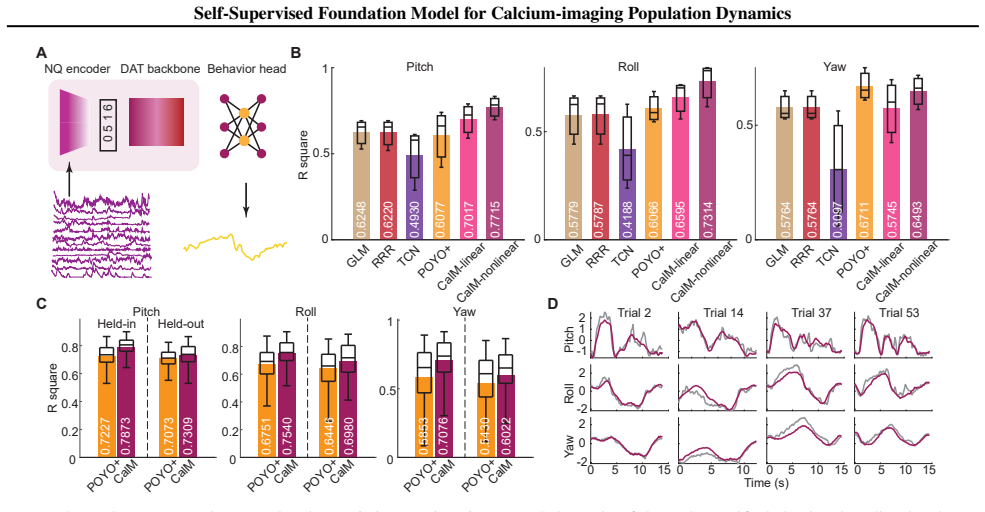
A self-supervised dual-axis autoregressive transformer, pretrained solely on multi-animal calcium traces after a high-performance tokenizer maps single-neuron signals into a shared discrete vocabulary, achieves competitive population-dynamics forecasting against specialized baselines and superior behavior decoding against supervised models, while its representations reveal interpretable functional structure.
What carries the argument
The high-performance calcium-trace tokenizer that converts continuous single-neuron traces into a shared discrete vocabulary, together with a dual-axis autoregressive transformer that models neural and temporal dependencies jointly; this pair carries pretraining and enables transfer via a task-specific head.
Load-bearing premise
That a discrete shared vocabulary of calcium-trace tokens plus dual-axis autoregressive modeling captures transferable population dynamics well enough for one pretrained backbone to match specialized forecasting baselines and beat supervised decoders across animals and sessions.
What would settle it
On a held-out multi-animal calcium dataset, check whether pretrained CalM forecasting error clearly exceeds strong specialized baselines, or whether behavior-decoding accuracy with the task head falls below strong supervised decoders; either result would falsify the claimed transfer advantage.
If this is right
- A single pretrained calcium backbone can be adapted to forecasting and decoding without full retraining from scratch.
- Multi-animal, multi-session calcium data can be pooled under one discrete vocabulary for shared modeling.
- Linear probes of the representations recover functional structure useful for neuroscience interpretation.
- Self-supervised pretraining becomes a practical route for functional neural analysis beyond single-task models.
Where Pith is reading between the lines
- The same tokenizer-plus-dual-axis design may transfer to other continuous neural modalities such as voltage imaging or multi-unit rates after analogous discretization.
- A stable shared vocabulary across animals could support few-shot adaptation when only sparse labeled behavior is available for a new subject.
- Functional structure recovered by linear probes may surface cell-type or circuit motifs that can be tested with targeted perturbations.
- If the discrete vocabulary remains stable, incremental pretraining on new sessions could continually improve the backbone without erasing earlier animals.
Editorial analysis
A structured set of objections, weighed in public.
Referee Report
Summary. The manuscript proposes CalM, a self-supervised foundation model for functional calcium imaging. It consists of a tokenizer that maps single-neuron calcium traces into a shared discrete vocabulary and a dual-axis autoregressive transformer that models dependencies along both the neural and temporal axes. Pretrained solely on multi-animal, multi-session calcium traces, CalM is claimed to achieve competitive performance on population-dynamics forecasting against specialized baselines and superior performance on behavior decoding relative to supervised decoding models; linear analyses of its representations are further said to reveal interpretable functional structure. Code is stated to be released.
Significance. If the empirical claims are borne out with rigorous, inspectable evidence, this would be a useful contribution: a task-agnostic pretrained backbone for calcium traces that transfers across animals and sessions and supports multiple common neuroscience objectives. Foundation-style models for neural population dynamics are an active direction; a calcium-specific, self-supervised paradigm with open code would be of practical interest. The abstract alone, however, does not yet establish that the result holds.
major comments (3)
- [Abstract] Abstract: The central claims of competitive forecasting and superior decoding are asserted without any quantitative metrics, error bars, baseline identities, effect sizes, or statistical tests. From the provided text the load-bearing transferability claim is therefore not inspectable; a full evaluation requires the corresponding results tables and protocols.
- [Abstract] Abstract: The dual-axis autoregressive design and the shared discrete vocabulary are presented as the key technical contributions, yet the abstract supplies no ablation of either component, no tokenizer reconstruction/perplexity or codebook-utilization numbers, and no account of how discrete codes remain comparable across animals with different GCaMP kinetics, sampling rates, or preprocessing. These elements are load-bearing for the claimed pretraining paradigm.
- [Abstract] Abstract: Dataset scale and train/eval separation are not reported (numbers of animals, sessions, neurons, time points; whether pretraining and downstream evaluation are strictly animal- or session-disjoint). Without this, residual risk that reported gains reflect corpus overlap, head capacity, or evaluation protocol rather than transferable dual-axis pretraining cannot be assessed.
minor comments (2)
- [Abstract] Abstract: The phrase “high-performance tokenizer” is underspecified; even a one-clause characterization of the discretization scheme would improve clarity.
- [Abstract] Abstract: The stated code release is a strength; the full manuscript should document training compute, hyperparameters, and exact data splits for reproducibility.
Circularity Check
Abstract-only review: no circular derivation chain is present or checkable; self-supervised pretraining and separate downstream evaluation are not definitionally circular.
full rationale
Only the abstract is available, so no equations, fitted parameters, uniqueness theorems, or load-bearing self-citations can be inspected for reduction-by-construction. The abstract describes a self-supervised dual-axis autoregressive transformer pretrained solely on multi-animal calcium traces (via a tokenizer into a shared discrete vocabulary), then evaluated on population-dynamics forecasting against specialized baselines and on behavior decoding against supervised models, with linear analyses of representations. That pipeline is the standard foundation-model pattern: pretrain without task labels, adapt with a head, report external metrics. Nothing in the abstract equates a claimed prediction to a fitted input by definition, renames a known empirical pattern as a derivation, or imports uniqueness from the authors' prior work. Residual concerns (possible train/eval session overlap, lack of ablations or margins) are about empirical protocol and verifiability, not circularity of a derivation chain. Per the rules, an abstract-only paper with no exhibited reduction scores 0 and leaves steps empty.
Axiom & Free-Parameter Ledger
free parameters (2)
- tokenizer vocabulary / codebook size and discretization scheme
- dual-axis transformer architecture and pretraining hyperparameters
axioms (3)
- domain assumption Discrete token sequences from single-neuron calcium traces preserve the population dynamics needed for forecasting and decoding.
- ad hoc to paper Autoregressive modeling along both neural and temporal axes yields transferable representations across animals and sessions.
- domain assumption Self-supervised next-token prediction on multi-animal calcium data is a sufficient pretraining objective for the reported downstream tasks.
invented entities (1)
-
CalM dual-axis autoregressive calcium foundation model (tokenizer + backbone)
no independent evidence
read the original abstract
Recent work suggests that large-scale, multi-animal modeling can significantly improve neural recording analysis. However, for functional calcium traces, existing approaches remain task-specific, limiting transfer across common neuroscience objectives. To address this challenge, we propose \textbf{CalM}, a self-supervised neural foundation model trained solely on neuronal calcium traces and adaptable to multiple downstream tasks, including forecasting and decoding. Our key contribution is a pretraining framework, composed of a high-performance tokenizer mapping single-neuron traces into a shared discrete vocabulary, and a dual-axis autoregressive transformer modeling dependencies along both the neural and the temporal axis. We evaluate CalM on a large-scale, multi-animal, multi-session dataset. On the neural population dynamics forecasting task, CalM achieves competitive performance against strong specialized baselines after pretraining. With a task-specific head, CalM further adapts to the behavior decoding task and achieves superior results compared with supervised decoding models. Moreover, linear analyses of CalM representations reveal interpretable functional structures beyond predictive accuracy. Taken together, we propose a novel and effective self-supervised pretraining paradigm for foundation models based on calcium traces, paving the way for scalable pretraining and broad applications in functional neural analysis. Code is released at https://github.com/TSuXinH/CalM.
Figures




Forward citations
Cited by 1 Pith paper
-
CAPT: A Multi-task Continuous Autoregressive Transformer enabling Cross-dataset and Cross-species Transfer for Calcium Population Dynamics
A continuous-token autoregressive transformer pretrained on mouse calcium traces transfers across datasets, paradigms, and species with a frozen backbone, beating specialized baselines.
discussion (0)
Sign in with ORCID, Apple, or X to comment. Anyone can read and Pith papers without signing in.