REVIEW 4 major objections 5 minor 74 references
DP-TRAE: A Dual-Phase Merging Transferable Reversible Adversarial Example for Image Privacy Protection
T0 review · 4 major / 5 minor · reviewed 2026-08-15 · deepseek-v4-flash
Pith's one-line read A two-phase reversible adversarial attack achieves 99.0% success against black-box classifiers while restoring original images.
desk verdict The dual-phase attack idea has merit, but the abstract's 99% ASR and 100% recovery claims are contradicted by the paper's own tables. read the letter →
The pith
A machine-rendered reading of the paper's core claim, the machinery that carries it, and where it could break.
The reading
What carries the argument
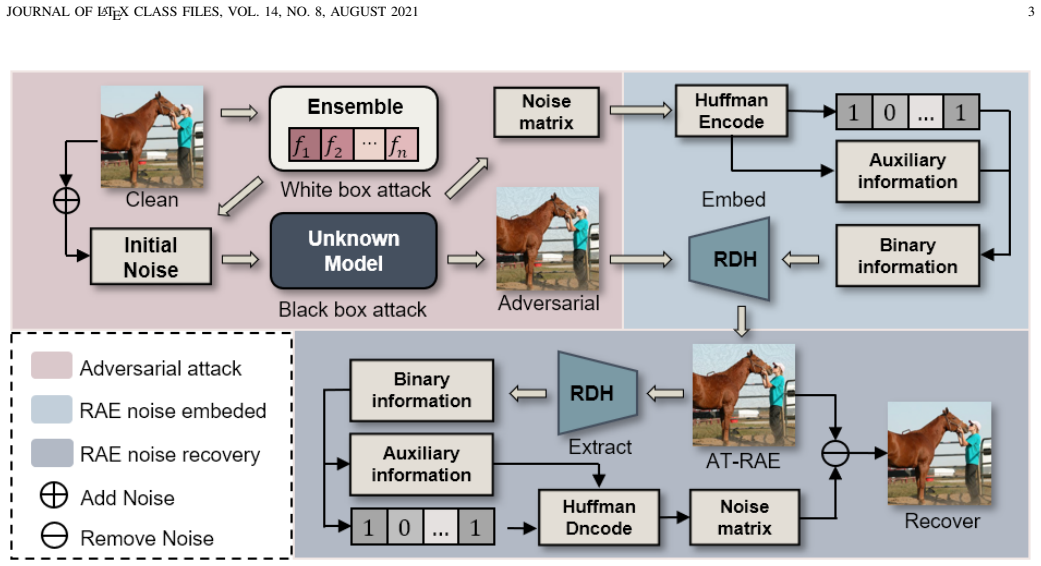
The load-bearing mechanism is the two-phase perturbation pipeline together with the compression scheme that makes reversibility affordable. SA-WA's stepwise adaptive rule labels the top $(N-i)/2N$ gradient positions for extra perturbation and shrinks that set as iterations grow, which the paper argues boosts transferability while curbing overfitting. MAE-BA's memory list $H$ stores the probability ratios from each queried superpixel block and periodically expands the block that gave the largest ratio, exploiting local coherence of gradients to reduce queries. Equation (8) maps each perturbation to a thresholded magnitude in $\{0,1,2\}$ times a stage threshold $\xi$, and Huffman coding then compresses the resulting message so the side information fits into the reversible data hiding stage; this quantization is what lets the attack use larger, more effective perturbations without exceeding RDH capacity.
What would settle it
Compare the restored images with the originals pixel by pixel on the paper's 1,000-image test set: lossless recovery requires every pixel to be identical, so any nonzero difference—already implied by the reported 48.94 dB PSNR—would refute the 100% recovery claim. A direct byte-level comparison settles it.
Extended reading notes
Core claim
On the paper's own terms, the discovery is that a reversible adversarial example can be made black-box practical by combining two complementary phases. The Stepwise Adaptive White-box Attack (SA-WA) first generates a transferable perturbation from a known surrogate model, amplifying gradient-sensitive regions early and tapering that amplification to avoid overfitting, using momentum, input diversity, and translation-invariant smoothing. The Memory-Assisted Expansion Black-box Attack (MAE-BA) then queries the unknown model on superpixel blocks—groups of neighboring pixels—and keeps a memory of which regions most changed the target probability, periodically revisiting and expanding those regions. The final perturbation is quantized to three magnitudes, compressed with Huffman coding, and embedded with reversible data hiding so the image can be restored. Across ten ImageNet classifiers of varied architecture, the paper reports 99.0% black-box attack success and 100% recovery of correct classifications from restored images.
Load-bearing premise
The load-bearing premise is that reversible data hiding recovers the original pixels losslessly; if that step is even slightly lossy, the advertised 100% recovery rate fails no matter how strong the attack is.
Editorial extensions
If this is right
- Reversible adversarial examples can be targeted at black-box and proprietary image classifiers, not only at white-box surrogates.
- A white-box initialization followed by black-box refinement lowers the query budget compared with starting from random perturbations.
- Threshold quantization plus Huffman coding is a workable way to fit strong adversarial perturbations inside the storage limits of reversible data hiding.
- The reported robustness under spatial squeezing, randomization, Gaussian blur, JPEG compression, and super-resolution suggests the approach survives common preprocessing defenses.
Reading between the lines
- Beyond the paper's claims, the finite PSNR of 48.94 dB for restored images means exact pixel-for-pixel recovery is not demonstrated; the 100% figure appears to measure classification success, not bit-exact identity.
- Beyond the paper's claims, the method's transferability is bounded by how well the surrogate models approximate the unknown target, so success on ImageNet-style classifiers may not carry over to very different domains.
- Beyond the paper's claims, the 92% commercial-API result on 50 images is a small sample; a larger evaluation with equalized query budgets against other black-box attacks would sharpen the practical estimate.
Signed reviews
Editorial analysis
A structured set of objections, weighed in public.
Referee Report
Summary. The manuscript proposes DP-TRAE, a reversible adversarial example method for image privacy protection. It combines a white-box stepwise adaptive attack (SA-WA) to generate a transferable initial perturbation with a memory-assisted black-box attack (MAE-BA) that queries superpixel blocks and uses historical query results. The perturbation is quantized, Huffman-coded, and embedded via reversible data hiding (RDH), with recovery intended to restore the original image. Experiments report attack success rates across several ImageNet classifiers, robustness against preprocessing defenses, recovery quality metrics, ablations, and a commercial API attack. The central claim, stated in the abstract and introduction, is that the method achieves 99.0% attack success rate and 100% recovery rate in black-box scenarios.
Significance. If the claims were substantiated, DP-TRAE would be a practically relevant advance: it would make reversible adversarial examples viable against black-box and commercial models, combining transferable initialization with query-efficient refinement while preserving lossless recovery. The paper has genuine strengths: it evaluates against multiple black-box baselines, tests robustness defenses, includes ablation studies, and reports a real-world commercial API attack. The algorithms are presented in sufficient detail to be reimplemented. However, the headline numerical claims are contradicted by the manuscript's own tables, and the defining 'reversible' property is not established: the reported recovery quality is finite-PSNR, not lossless, and the RDH mechanism is described only as LSB embedding with no losslessness mechanism or capacity analysis. These are load-bearing issues for the paper's central contribution.
major comments (4)
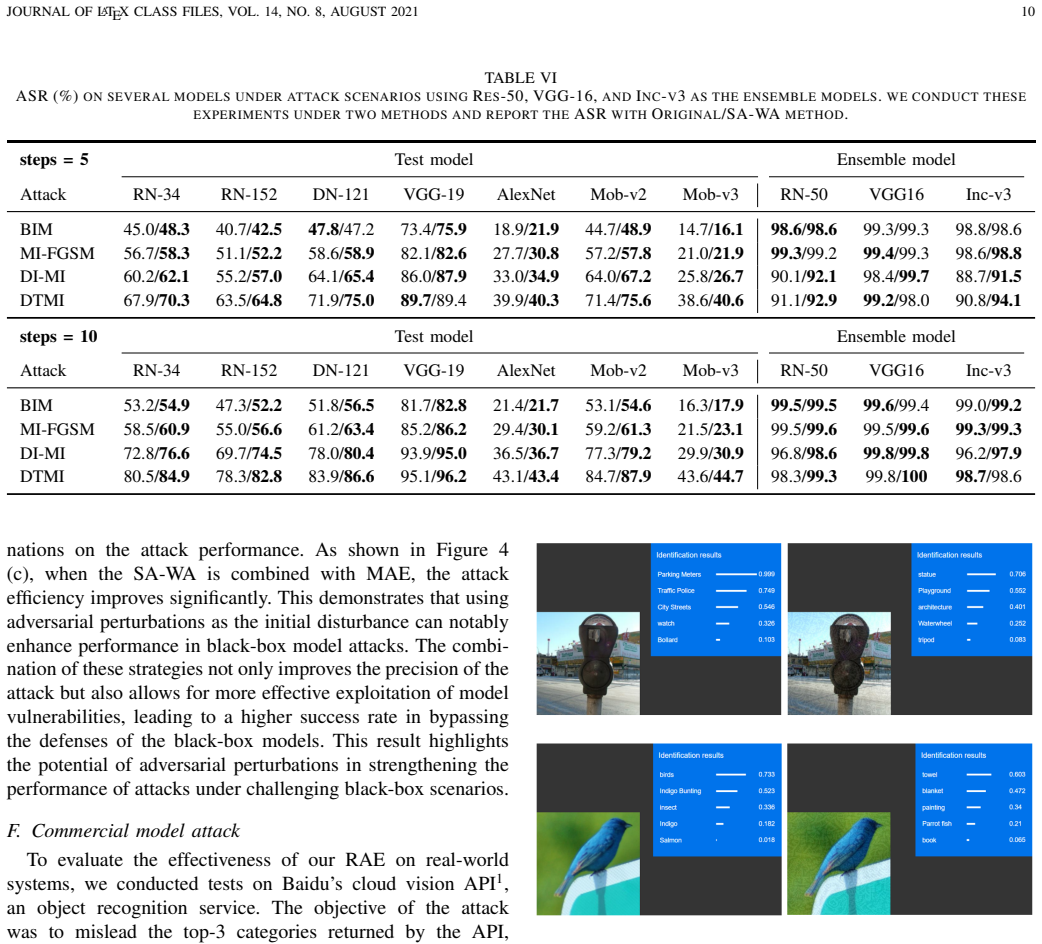
- [Abstract and Tables II-III] The abstract claims a '99.0% attack success rate and 100% recovery rate in black-box scenarios,' but the black-box results in Table III give DP-TRAE an average ASR of 81.5%, with the 99.0% value appearing only for the query model DN-121. The values near 99.0% in Table II occur in the ensemble/white-box transfer setting, not in the black-box scenario of Table III. The headline ASR claim is therefore unsupported by the reported black-box experiments. In addition, all ASR values are point estimates on 1,000 images with no error bars or significance tests, so the claimed superiority over baselines is not statistically grounded.
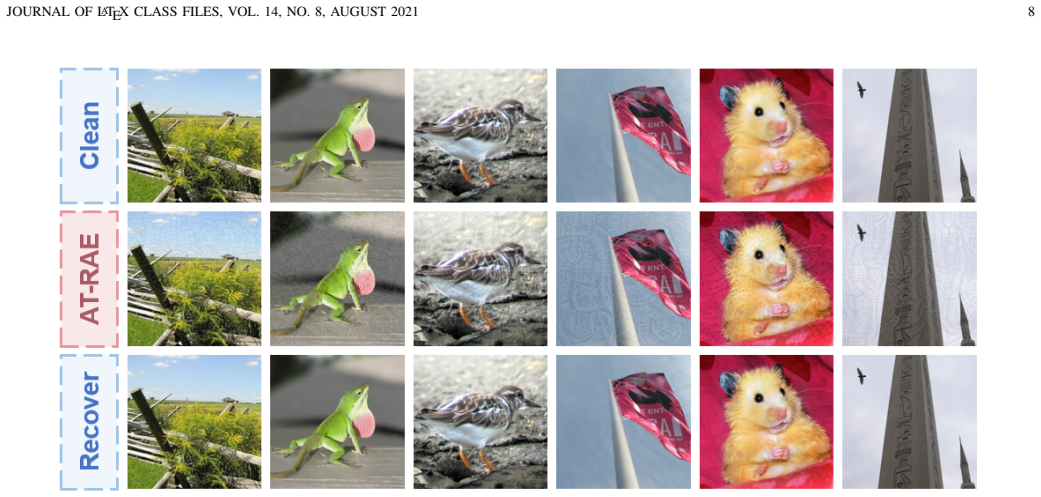
- [Section III.E and Table V] The paper repeatedly states that the RDH step recovers the original image losslessly (Section III.A, Section III.E, Section IV.D), and the abstract claims a 100% recovery rate. Table V, however, reports the recovered image at PSNR 48.94 dB and SSIM 0.9913. An exactly recovered image would have infinite PSNR and SSIM of 1.0. These numbers are inconsistent with lossless recovery and with the claim that the restored images are 'without loss' and 'indistinguishable from the original images.' This contradiction invalidates the central 'reversible' property as currently claimed; the authors must either provide a genuinely lossless recovery pipeline with corresponding evidence or restate the contribution as approximate recovery, which would be a fundamentally different result.
- [Section II.B and Section III.E] The RDH component is described only as 'we employ the LSB method for data embedding' (Section II.B) with no mechanism that would make LSB embedding reversible. Standard LSB substitution overwrites the least significant bits and is not lossless unless the original bits are stored, or histogram shifting/overflow handling is used. The paper provides no such mechanism, no discussion of overflow/underflow at pixel boundaries, and no capacity analysis for embedding the Huffman-coded stage matrix into x+delta while preserving exact recovery. Without these details, Algorithm 3 cannot substantiate the claim that the perturbation information is embedded reversibly.
- [Algorithm 3, line 5] In Algorithm 3, line 5 sets Mse[h,w] = xi for every position, while line 6 appends the computed stage value to the Huffman tree. As written, the message matrix does not encode the perturbation stages; if this is a typo for Mse[h,w] = stage, it must be corrected. Either way, the paper never specifies the extraction and recovery algorithm that reverses this embedding, so the reader cannot verify the claimed lossless restoration.
minor comments (5)
- [Abstract] There is a typo in the abstract: 'Further more' should be 'Furthermore'.
- [Table IV caption] The caption says 'againsting'; this should be 'against'.
- [Table V caption] The caption contains typos: 'RECOVERD' should be 'RECOVERED' and 'CLASSFICATION' should be 'CLASSIFICATION'.
- [Figure 4] The subplots in Figure 4 lack axis labels and units; please state what quantity is plotted (presumably average ASR) and over which target models the average is taken.
- [Section IV.F] The commercial model experiment uses only 50 images and does not specify the query budget or API constraints; please provide these details so the 92% success rate can be interpreted.
Circularity Check
No significant circularity: the paper's attack and recovery numbers come from direct experiments, not from a derivation that reduces to its own inputs.
full rationale
DP-TRAE is an empirical systems paper. Its headline quantities are attack success rates and recovery metrics measured on fixed models and a commercial API; none of these are derived from a fitted parameter, an assumed uniqueness theorem, or a self-citation chain. The method in Section III combines standard transferable white-box attacks (MI/DI/TI), a superpixel-based black-box search with a historical query memory, Huffman coding, and a reversible-data-hiding embedding step. Each component is described operationally, and the reported ASR tables compare against external baselines such as SimBA and SurFree. The comparison with the authors' own prior DP-RAE is a legitimate baseline, and the citation to the ACM MM preliminary version [42] does not carry any load-bearing mathematical or uniqueness claim. The tuning of expansion size and enhancement frequency on the test models is a model-selection and generalization concern, not a circular-reasoning defect. The claim of '100% recovery rate' is unsupported by the finite PSNR and SSIM in Table V, and the abstract's '99.0% attack success rate' is not the Table III average; these are consistency and support problems, but they are not cases where a prediction is forced by construction or where an output is defined as its own input. No specific reduction of a target quantity to the method's own assumptions or prior self-citations can be exhibited, so the appropriate circularity score is 0.
Assumptions & free parameters
free parameters (5)
- stage threshold ξ =
ξ = epsilon/2, with epsilon = 8/255 (approximately 4/255)
- expansion size Ep =
4
- enhance step size s =
5
- white-box and black-box iteration counts =
10 and 1000
- SA amplification schedule (top fraction labeled 2) =
(N-i)/2N at iteration i
assumptions (5)
- domain assumption The white-box model's gradient is available and the black-box model only returns labels and probabilities (Section III.B).
- ad hoc to paper Perturbations generated on a white-box model give a useful initial direction for attacking an unknown black-box model (Section I, Section III.A).
- ad hoc to paper Superpixel-level queries and memory of past queries preserve local gradient coherence and improve query efficiency (Section III.D).
- domain assumption The chosen LSB-based RDH can embed the Huffman-coded perturbation plus side information and recover the original image losslessly (Section III.E, Algorithm 3).
- ad hoc to paper Attack examples generated against the queried black-box model transfer to the other target models reported in Table III.
Cite this review
Pith. "Pith review of DP-TRAE: A Dual-Phase Merging Transferable Reversible Adversarial Example for Image Privacy Protection." pith.science (2026). https://pith.science/paper/OPOMRQP3
@misc{pith2026250506860,
  author       = {Pith},
  title        = {Pith review of: DP-TRAE: A Dual-Phase Merging Transferable Reversible Adversarial Example for Image Privacy Protection},
  year         = {2026},
  howpublished = {\url{https://pith.science/paper/OPOMRQP3}},
  note         = {Machine review of arXiv:2505.06860}
}
read the original abstract
In the field of digital security, Reversible Adversarial Examples (RAE) combine adversarial attacks with reversible data hiding techniques to effectively protect sensitive data and prevent unauthorized analysis by malicious Deep Neural Networks (DNNs). However, existing RAE techniques primarily focus on white-box attacks, lacking a comprehensive evaluation of their effectiveness in black-box scenarios. This limitation impedes their broader deployment in complex, dynamic environments. Further more, traditional black-box attacks are often characterized by poor transferability and high query costs, significantly limiting their practical applicability. To address these challenges, we propose the Dual-Phase Merging Transferable Reversible Attack method, which generates highly transferable initial adversarial perturbations in a white-box model and employs a memory augmented black-box strategy to effectively mislead target mod els. Experimental results demonstrate the superiority of our approach, achieving a 99.0% attack success rate and 100% recovery rate in black-box scenarios, highlighting its robustness in privacy protection. Moreover, we successfully implemented a black-box attack on a commercial model, further substantiating the potential of this approach for practical use.
Figures

Figures from the paper (2 more)

Reference graph
Works this paper leans on
-
[1]
Secure deep learning framework for moving object detection in compressed video
Xianhao Tian, Peijia Zheng, and Jiwu Huang. Secure deep learning framework for moving object detection in compressed video. IEEE Transactions on Dependable and Secure Computing , 21(4):2836–2851, 2023
work page 2023
-
[2]
Chunpeng Ge, Zhe Liu, Willy Susilo, Liming Fang, and Hao Wang. Attribute-based encryption with reliable outsourced decryption in cloud computing using smart contract. IEEE Transactions on Dependable and Secure Computing, 21(2):937–948, 2023
work page 2023
-
[3]
FedSN: A Federated Learning Framework over Heterogeneous LEO Satellite Networks
Zheng Lin, Zhe Chen, Zihan Fang, Xianhao Chen, Xiong Wang, and Yue Gao. FedSN: A Federated Learning Framework over Heterogeneous LEO Satellite Networks. IEEE Trans. Mobile Comput. , 2024
work page 2024
-
[4]
Automated Federated Pipeline for Parameter- efficient Fine-tuning of Large Language Models
Zihan Fang, Zheng Lin, Zhe Chen, Xianhao Chen, Yue Gao, and Yuguang Fang. Automated Federated Pipeline for Parameter- efficient Fine-tuning of Large Language Models. arXiv preprint arXiv:2404.06448, 2024
arXiv 2024
-
[5]
Lcfed: An efficient clustered federated learning framework for heterogeneous data
Yuxin Zhang, Haoyu Chen, Zheng Lin, Zhe Chen, and Jin Zhao. Lcfed: An efficient clustered federated learning framework for heterogeneous data. arXiv preprint arXiv:2501.01850 , 2025
arXiv 2025
-
[6]
AgentsCoDriver: Large Language Model Empow- ered Collaborative Driving with Lifelong Learning
Senkang Hu, Zhengru Fang, Zihan Fang, Yiqin Deng, Xianhao Chen, and Yuguang Fang. AgentsCoDriver: Large Language Model Empow- ered Collaborative Driving with Lifelong Learning. arXiv preprint arXiv:2404.06345, 2024
arXiv 2024
-
[7]
IC3M: In-Car Multimodal Multi- Object Monitoring for Abnormal Status of Both Driver and Passengers
Zihan Fang, Zheng Lin, Senkang Hu, Hangcheng Cao, Yiqin Deng, Xianhao Chen, and Yuguang Fang. IC3M: In-Car Multimodal Multi- Object Monitoring for Abnormal Status of Both Driver and Passengers. arXiv preprint arXiv:2410.02592 , 2024
-
[8]
Hierarchical Split Federated Learning: Convergence Analysis and System Optimization
Zheng Lin, Wei Wei, Zhe Chen, Chan-Tong Lam, Xianhao Chen, Yue Gao, and Jun Luo. Hierarchical Split Federated Learning: Convergence Analysis and System Optimization. IEEE Trans. Mobile Comput., 2025
work page 2025
Show all 74 references
-
[9]
Accelerating Federated Learning with Model Segmentation for Edge Networks
Mingda Hu, Jingjing Zhang, Xiong Wang, Shengyun Liu, and Zheng Lin. Accelerating Federated Learning with Model Segmentation for Edge Networks. IEEE Trans. Green Commun. Netw. , 2024
2024
-
[10]
Graph Learning for Multi-Satellite Based Spectrum Sensing
Haoxuan Yuan, Zhe Chen, Zheng Lin, Jinbo Peng, Zihan Fang, Yuhang Zhong, Zihang Song, Xiong Wang, and Yue Gao. Graph Learning for Multi-Satellite Based Spectrum Sensing. In Proc. IEEE ICCT , pages 1112–1116, 2023
2023
-
[11]
Constructing 4D Radio Map in LEO Satellite Networks with Limited Samples
Haoxuan Yuan, Zhe Chen, Zheng Lin, Jinbo Peng, Yuhang Zhong, Xuanjie Hu, Songyan Xue, Wei Li, and Yue Gao. Constructing 4D Radio Map in LEO Satellite Networks with Limited Samples. arXiv preprint arXiv:2501.02775, 2025
2025 arXiv
-
[12]
SigChord: Sniffing Wide Non-sparse Multiband Signals for Terrestrial and Non-terrestrial Wireless Networks
Jinbo Peng, Junwen Duan, Zheng Lin, Haoxuan Yuan, Yue Gao, and Zhe Chen. SigChord: Sniffing Wide Non-sparse Multiband Signals for Terrestrial and Non-terrestrial Wireless Networks. arXiv preprint arXiv:2504.06587, 2025
2025 arXiv
-
[13]
Channel Power Gain Estimation for Terahertz Vehicle-to-Infrastructure Networks
Zheng Lin, Lifeng Wang, Jie Ding, Bo Tan, and Shi Jin. Channel Power Gain Estimation for Terahertz Vehicle-to-Infrastructure Networks. IEEE Commun. Lett., 27(1):155–159, 2022
2022
-
[14]
MERIT: Multimodal Wearable Vital Sign Waveform Monitoring
Yongyang Tang, Zhe Chen, Ang Li, Tianyue Zheng, Zheng Lin, Jia Xu, Pin Lv, Zhe Sun, and Yue Gao. MERIT: Multimodal Wearable Vital Sign Waveform Monitoring. arXiv preprint arXiv:2410.00392 , 2024
2024 arXiv
-
[15]
seeing is not always believing
Jinshan Liu and Jung-Min Park. “seeing is not always believing”: Detecting perception error attacks against autonomous vehicles. IEEE Transactions on Dependable and Secure Computing , 18(5):2209–2223, 2021
2021
-
[16]
Privacy and artificial intelligence
James Curzon, Tracy Ann Kosa, Rajen Akalu, and Khalil El-Khatib. Privacy and artificial intelligence. IEEE Transactions on Artificial Intelligence, 2(2):96–108, 2021
2021
-
[17]
Adversarial robustness of deep neural networks: A survey from a formal verification perspective
Mark Huasong Meng, Guangdong Bai, Sin Gee Teo, Zhe Hou, Yan Xiao, Yun Lin, and Jin Song Dong. Adversarial robustness of deep neural networks: A survey from a formal verification perspective. IEEE Transactions on Dependable and Secure Computing , 2022
2022
-
[18]
Machine learning in metaverse security: Current solutions and future challenges
Yazan Otoum, Navya Gottimukkala, Neeraj Kumar, and Amiya Nayak. Machine learning in metaverse security: Current solutions and future challenges. ACM Computing Surveys , 2024
2024
-
[19]
Xporter: A study of the multi-port charger security on privacy leakage and voice injection
Tao Ni, Yongliang Chen, Weitao Xu, Lei Xue, and Qingchuan Zhao. Xporter: A study of the multi-port charger security on privacy leakage and voice injection. In Proceedings of the 29th Annual International Conference on Mobile Computing and Networking , pages 1–15, 2023
2023
-
[20]
The secret sharer: Evaluating and testing unintended memoriza- tion in neural networks
Nicholas Carlini, Chang Liu, ´Ulfar Erlingsson, Jernej Kos, and Dawn Song. The secret sharer: Evaluating and testing unintended memoriza- tion in neural networks. In 28th USENIX security symposium (USENIX security 19), pages 267–284, 2019
2019
-
[21]
Exploiting contactless side channels in wireless charging power banks for user privacy inference via few-shot learning
Tao Ni, Jianfeng Li, Xiaokuan Zhang, Chaoshun Zuo, Wubing Wang, Weitao Xu, Xiapu Luo, and Qingchuan Zhao. Exploiting contactless side channels in wireless charging power banks for user privacy inference via few-shot learning. In Proceedings of the 29th Annual International Con...
2023
-
[22]
Rethinking Adversarial Attacks in Reinforcement Learning from Policy Distribution Perspective
Tianyang Duan, Zongyuan Zhang, Zheng Lin, Yue Gao, Ling Xiong, Yong Cui, Hongbin Liang, Xianhao Chen, Heming Cui, and Dong Huang. Rethinking Adversarial Attacks in Reinforcement Learning from Policy Distribution Perspective. arXiv preprint arXiv:2501.03562, 2025
2025 arXiv
-
[23]
Uncovering user interactions on smartphones via contactless wireless charging side channels
Tao Ni, Xiaokuan Zhang, Chaoshun Zuo, Jianfeng Li, Zhenyu Yan, Wub- ing Wang, Weitao Xu, Xiapu Luo, and Qingchuan Zhao. Uncovering user interactions on smartphones via contactless wireless charging side channels. In 2023 IEEE Symposium on Security and Privacy (SP), pages 3399–...
2023
-
[24]
Revealed: 50 million facebook profiles harvested for cambridge analytica in major data breach
Carole Cadwalladr and Emma Graham-Harrison. Revealed: 50 million facebook profiles harvested for cambridge analytica in major data breach. The guardian, 17(1):22, 2018
2018
-
[25]
Subnetwork- lossless robust watermarking for hostile theft attacks in deep transfer learning models
Ju Jia, Yueming Wu, Anran Li, Siqi Ma, and Yang Liu. Subnetwork- lossless robust watermarking for hostile theft attacks in deep transfer learning models. IEEE transactions on dependable and secure comput- ing, 2022
2022
-
[26]
Towards transferable targeted adversarial examples
Zhibo Wang, Hongshan Yang, Yunhe Feng, Peng Sun, Hengchang Guo, Zhifei Zhang, and Kui Ren. Towards transferable targeted adversarial examples. In Proceedings of the IEEE/CVF conference on computer vision and pattern recognition , pages 20534–20543, 2023
2023
-
[27]
On generating transferable targeted pertur- bations
Muzammal Naseer, Salman Khan, Munawar Hayat, Fahad Shahbaz Khan, and Fatih Porikli. On generating transferable targeted pertur- bations. In Proceedings of the IEEE/CVF International Conference on Computer Vision, pages 7708–7717, 2021
2021
-
[28]
Interpreting universal adversarial example attacks on image classification models
Yi Ding, Fuyuan Tan, Ji Geng, Zhen Qin, Mingsheng Cao, Kim- Kwang Raymond Choo, and Zhiguang Qin. Interpreting universal adversarial example attacks on image classification models. IEEE Transactions on Dependable and Secure Computing , 20(4):3392–3407, 2022
2022
-
[29]
Cross-domain trans- ferability of adversarial perturbations
Muhammad Muzammal Naseer, Salman H Khan, Muhammad Haris Khan, Fahad Shahbaz Khan, and Fatih Porikli. Cross-domain trans- ferability of adversarial perturbations. Advances in Neural Information Processing Systems, 32, 2019
2019
-
[30]
Feature importance-aware transferable adversarial attacks
Zhibo Wang, Hengchang Guo, Zhifei Zhang, Wenxin Liu, Zhan Qin, and Kui Ren. Feature importance-aware transferable adversarial attacks. In Proceedings of the IEEE/CVF international conference on computer vision, pages 7639–7648, 2021
2021
-
[31]
Itpatch: An invisible and triggered physical adversarial patch against traffic sign recognition
Shuai Yuan, Hongwei Li, Xingshuo Han, Guowen Xu, Wenbo Jiang, Tao Ni, Qingchuan Zhao, and Yuguang Fang. Itpatch: An invisible and triggered physical adversarial patch against traffic sign recognition. arXiv preprint arXiv:2409.12394 , 2024
2024
-
[32]
Toward understanding and boosting adversarial transferability from a distribution perspective
Yao Zhu, Yuefeng Chen, Xiaodan Li, Kejiang Chen, Yuan He, Xiang Tian, Bolun Zheng, Yaowu Chen, and Qingming Huang. Toward understanding and boosting adversarial transferability from a distribution perspective. IEEE Transactions on Image Processing , 31:6487–6501, 2022
2022
-
[33]
Intriguing properties of neural networks
C Szegedy. Intriguing properties of neural networks. arXiv preprint arXiv:1312.6199, 2013
2013 arXiv
-
[34]
Adversarial image perturbation for privacy protection a game theory perspective
Seong Joon Oh, Mario Fritz, and Bernt Schiele. Adversarial image perturbation for privacy protection a game theory perspective. In 2017 IEEE International Conference on Computer Vision (ICCV), pages 1491–1500. IEEE, 2017
2017
-
[35]
Diffprotect: Generate adversarial examples with diffusion models for facial privacy protection
Jiang Liu, Chun Pong Lau, and Rama Chellappa. Diffprotect: Generate adversarial examples with diffusion models for facial privacy protection. arXiv preprint arXiv:2305.13625 , 2023
2023
-
[36]
Socialguard: An adversarial example based privacy- preserving technique for social images
Mingfu Xue, Shichang Sun, Zhiyu Wu, Can He, Jian Wang, and Weiqiang Liu. Socialguard: An adversarial example based privacy- preserving technique for social images. Journal of Information Security and Applications, 63:102993, 2021
2021
-
[37]
Unauthorized ai cannot recognize me: Reversible adversarial example
Jiayang Liu, Weiming Zhang, Kazuto Fukuchi, Youhei Akimoto, and Jun Sakuma. Unauthorized ai cannot recognize me: Reversible adversarial example. Pattern Recognition, 134:109048, 2023
2023
-
[38]
A black-box reversible adversarial example for authorizable recognition to shared images
Lizhi Xiong, Yue Wu, Peipeng Yu, and Yuhui Zheng. A black-box reversible adversarial example for authorizable recognition to shared images. Pattern Recognition, 140:109549, 2023
2023
-
[39]
Self- recoverable adversarial examples: A new effective protection mechanism JOURNAL OF LATEX CLASS FILES, VOL
Jiawei Zhang, Jinwei Wang, Hao Wang, and Xiangyang Luo. Self- recoverable adversarial examples: A new effective protection mechanism JOURNAL OF LATEX CLASS FILES, VOL. 14, NO. 8, AUGUST 2021 12 in social networks. IEEE Transactions on Circuits and Systems for Video Technology,...
2021
-
[40]
Reversible data hiding in encrypted images based on pixel prediction and bit-plane compression
Zhaoxia Yin, Yinyin Peng, and Youzhi Xiang. Reversible data hiding in encrypted images based on pixel prediction and bit-plane compression. IEEE Transactions on Dependable and Secure Computing , 19(2):992– 1002, 2020
2020
-
[41]
Separable reversible data hiding in encrypted jpeg bitstreams
Zhenxing Qian, Hang Zhou, Xinpeng Zhang, and Weiming Zhang. Separable reversible data hiding in encrypted jpeg bitstreams. IEEE Transactions on Dependable and Secure Computing , 15(6):1055–1067, 2016
2016
-
[42]
Dp-rae: A dual-phase merging reversible adversarial example for image privacy protection
Jiajie Zhu, Xia Du, Jizhe Zhou, Chi-Man Pun, Qizhen Xu, and Xiaoyuan Liu. Dp-rae: A dual-phase merging reversible adversarial example for image privacy protection. In Proceedings of the 32nd ACM International Conference on Multimedia , pages 671–680, 2024
2024
-
[43]
Reversible adversarial attack based on reversible image transformation
Zhaoxia Yin, Hua Wang, Li Chen, Jie Wang, and Weiming Zhang. Reversible adversarial attack based on reversible image transformation. arXiv preprint arXiv:1911.02360 , 2019
1911 arXiv
-
[44]
Explaining and harnessing adversarial examples
Ian J Goodfellow, Jonathon Shlens, and Christian Szegedy. Explaining and harnessing adversarial examples. arXiv preprint arXiv:1412.6572 , 2014
2014 arXiv
-
[45]
Adversarial examples in the physical world
Alexey Kurakin, Ian J Goodfellow, and Samy Bengio. Adversarial examples in the physical world. In Artificial intelligence safety and security, pages 99–112. Chapman and Hall/CRC, 2018
2018
-
[46]
Boosting adversarial attacks with momentum
Yinpeng Dong, Fangzhou Liao, Tianyu Pang, Hang Su, Jun Zhu, Xiaolin Hu, and Jianguo Li. Boosting adversarial attacks with momentum. In Proceedings of the IEEE conference on computer vision and pattern recognition, pages 9185–9193, 2018
2018
-
[47]
Improving transferability of adversarial exam- ples with input diversity
Cihang Xie, Zhishuai Zhang, Yuyin Zhou, Song Bai, Jianyu Wang, Zhou Ren, and Alan L Yuille. Improving transferability of adversarial exam- ples with input diversity. In Proceedings of the IEEE/CVF conference on computer vision and pattern recognition , pages 2730–2739, 2019
2019
-
[48]
Evading defenses to transferable adversarial examples by translation-invariant attacks
Yinpeng Dong, Tianyu Pang, Hang Su, and Jun Zhu. Evading defenses to transferable adversarial examples by translation-invariant attacks. In Proceedings of the IEEE/CVF conference on computer vision and pattern recognition, pages 4312–4321, 2019
2019
-
[49]
Simple black-box adversarial attacks
Chuan Guo, Jacob Gardner, Yurong You, Andrew Gordon Wilson, and Kilian Weinberger. Simple black-box adversarial attacks. In Interna- tional conference on machine learning, pages 2484–2493. PMLR, 2019
2019
-
[50]
Surfree: a fast surrogate-free black-box attack
Thibault Maho, Teddy Furon, and Erwan Le Merrer. Surfree: a fast surrogate-free black-box attack. In Proceedings of the IEEE/CVF Conference on Computer Vision and Pattern Recognition, pages 10430– 10439, 2021
2021
-
[51]
Analysis of lsb based image steganography techniques
Rajarathnam Chandramouli and Nasir Memon. Analysis of lsb based image steganography techniques. In Proceedings 2001 international conference on image processing (Cat. No. 01CH37205), volume 3, pages 1019–1022. IEEE, 2001
2001
-
[52]
Digital watermarking and steganography
Ingemar Cox, Matthew Miller, Jeffrey Bloom, Jessica Fridrich, and Ton Kalker. Digital watermarking and steganography . Morgan kaufmann, 2007
2007
-
[53]
Reversible data hiding in color image with grayscale invariance
Dongdong Hou, Weiming Zhang, Kejiang Chen, Sian-Jheng Lin, and Nenghai Yu. Reversible data hiding in color image with grayscale invariance. IEEE Transactions on Circuits and Systems for Video Technology, 29(2):363–374, 2018
2018
-
[54]
Hinet: Deep image hiding by invertible network
Junpeng Jing, Xin Deng, Mai Xu, Jianyi Wang, and Zhenyu Guan. Hinet: Deep image hiding by invertible network. In Proceedings of the IEEE/CVF international conference on computer vision , pages 4733– 4742, 2021
2021
-
[55]
Hidden: hiding data with deep networks
J Zhu. Hidden: hiding data with deep networks. arXiv preprint arXiv:1807.09937, 2018
2018 arXiv
-
[56]
Zoo: Zeroth order optimization based black-box attacks to deep neural networks without training substitute models
Pin-Yu Chen, Huan Zhang, Yash Sharma, Jinfeng Yi, and Cho-Jui Hsieh. Zoo: Zeroth order optimization based black-box attacks to deep neural networks without training substitute models. In Proceedings of the 10th ACM workshop on artificial intelligence and security, pages 15–26, 2017
2017
-
[57]
Imagenet large scale visual recognition challenge
Olga Russakovsky, Jia Deng, Hao Su, Jonathan Krause, Sanjeev Satheesh, Sean Ma, Zhiheng Huang, Andrej Karpathy, Aditya Khosla, Michael Bernstein, et al. Imagenet large scale visual recognition challenge. International journal of computer vision, 115:211–252, 2015
2015
-
[58]
Deep residual learning for image recognition
Kaiming He, Xiangyu Zhang, Shaoqing Ren, and Jian Sun. Deep residual learning for image recognition. In Proceedings of the IEEE conference on computer vision and pattern recognition , pages 770–778, 2016
2016
-
[59]
Densely connected convolutional networks
Gao Huang, Zhuang Liu, Laurens Van Der Maaten, and Kilian Q Weinberger. Densely connected convolutional networks. In Proceedings of the IEEE conference on computer vision and pattern recognition , pages 4700–4708, 2017
2017
-
[60]
Very deep convolu- tional networks for large-scale image recognition
Karen Simonyan and Andrew Zisserman. Very deep convolu- tional networks for large-scale image recognition. arXiv preprint arXiv:1409.1556, 2014
2014 arXiv
-
[61]
Rethinking the inception architecture for computer vision
Christian Szegedy, Vincent Vanhoucke, Sergey Ioffe, Jon Shlens, and Zbigniew Wojna. Rethinking the inception architecture for computer vision. In Proceedings of the IEEE conference on computer vision and pattern recognition, pages 2818–2826, 2016
2016
-
[62]
Imagenet classification with deep convolutional neural networks
Alex Krizhevsky, Ilya Sutskever, and Geoffrey E Hinton. Imagenet classification with deep convolutional neural networks. Advances in neural information processing systems , 25, 2012
2012
-
[63]
Mobilenetv2: Inverted residuals and linear bottlenecks
Mark Sandler, Andrew Howard, Menglong Zhu, Andrey Zhmoginov, and Liang-Chieh Chen. Mobilenetv2: Inverted residuals and linear bottlenecks. In Proceedings of the IEEE conference on computer vision and pattern recognition , pages 4510–4520, 2018
2018
-
[64]
Searching for mobilenetv3
Andrew Howard, Mark Sandler, Grace Chu, Liang-Chieh Chen, Bo Chen, Mingxing Tan, Weijun Wang, Yukun Zhu, Ruoming Pang, Vijay Vasudevan, et al. Searching for mobilenetv3. In Proceedings of the IEEE/CVF international conference on computer vision , pages 1314–1324, 2019
2019
-
[65]
Image quality assessment: from error visibility to structural similarity
Zhou Wang, Alan C Bovik, Hamid R Sheikh, and Eero P Simoncelli. Image quality assessment: from error visibility to structural similarity. IEEE transactions on image processing , 13(4):600–612, 2004
2004
-
[66]
Keeping the bad guys out: Protecting and vaccinating deep learning with jpeg compression
Nilaksh Das, Madhuri Shanbhogue, Shang-Tse Chen, Fred Hohman, Li Chen, Michael E Kounavis, and Duen Horng Chau. Keeping the bad guys out: Protecting and vaccinating deep learning with jpeg compression. arXiv preprint arXiv:1705.02900 , 2017
2017 arXiv
-
[67]
Mitigating adversarial effects through randomization
Cihang Xie, Jianyu Wang, Zhishuai Zhang, Zhou Ren, and Alan Yuille. Mitigating adversarial effects through randomization. arXiv preprint arXiv:1711.01991, 2017
2017 arXiv
-
[68]
Heat and blur: an effective and fast defense against adversarial examples
Haya Brama and Tal Grinshpoun. Heat and blur: an effective and fast defense against adversarial examples. arXiv preprint arXiv:2003.07573, 2020
2003 arXiv
-
[69]
Image super-resolution as a defense against adversarial attacks
Aamir Mustafa, Salman H Khan, Munawar Hayat, Jianbing Shen, and Ling Shao. Image super-resolution as a defense against adversarial attacks. IEEE Transactions on Image Processing , 29:1711–1724, 2019
2019
-
[70]
AgentsCoMerge: Large Language Model Empowered Collaborative Decision Making for Ramp Merging
Senkang Hu, Zhengru Fang, Zihan Fang, Yiqin Deng, Xianhao Chen, Yuguang Fang, and Sam Kwong. AgentsCoMerge: Large Language Model Empowered Collaborative Decision Making for Ramp Merging. arXiv preprint arXiv:2408.03624 , 2024
2024 arXiv
-
[71]
HSplitLoRA: A Heterogeneous Split Parameter-Efficient Fine-Tuning Framework for Large Language Models
Zheng Lin, Yuxin Zhang, Zhe Chen, Zihan Fang, Xianhao Chen, Praneeth Vepakomma, Wei Ni, Jun Luo, and Yue Gao. HSplitLoRA: A Heterogeneous Split Parameter-Efficient Fine-Tuning Framework for Large Language Models. arXiv preprint arXiv:2505.02795 , 2025
2025 arXiv
-
[72]
FedAC: A Adaptive Clustered Federated Learning Framework for Heterogeneous Data
Yuxin Zhang, Haoyu Chen, Zheng Lin, Zhe Chen, and Jin Zhao. FedAC: A Adaptive Clustered Federated Learning Framework for Heterogeneous Data. arXiv preprint arXiv:2403.16460 , 2024
2024 arXiv
-
[73]
Leo-Split: A Semi-Supervised Split Learning Framework over LEO Satellite Networks
Zheng Lin, Yuxin Zhang, Zhe Chen, Zihan Fang, Cong Wu, Xianhao Chen, Yue Gao, and Jun Luo. Leo-Split: A Semi-Supervised Split Learning Framework over LEO Satellite Networks. arXiv preprint arXiv:2501.01293, 2025
2025 arXiv
-
[74]
SatFed: A Resource-Efficient LEO Satellite-Assisted Heterogeneous Federated Learning Framework
Yuxin Zhang, Zheng Lin, Zhe Chen, Zihan Fang, Wenjun Zhu, Xianhao Chen, Jin Zhao, and Yue Gao. SatFed: A Resource-Efficient LEO Satellite-Assisted Heterogeneous Federated Learning Framework. arXiv preprint arXiv:2409.13503, 2024
2024 arXiv
Reviewed August 15, 2026 · model on record in the stance chip above.
Discussion (0). Continue with ORCID to comment.