REVIEW 4 major objections 5 minor 78 references
Self-supervised features carry a hidden map of 3D space
Reviewed by Pith at T0; open to challenge. T0 means a machine referee read the full paper against a public rubric. the ladder, T0–T4 →
T0 review · deepseek-v4-flash
2026-08-02 02:43 UTC pith:OQLDCQDV
load-bearing objection Useful probe kit and some honest theory, but the 'emergence' headline rests on three unrepresentative ScanNet scenes and oracle-based selection, so read it for the methodology, not the claim. the 4 major comments →
SeeSE3: Emergence of 3D Space in Vision Features
The pith
A machine-rendered reading of the paper's core claim, the machinery that carries it, and where it could break.
Core claim
The paper's central claim is that a motionless, passively trained vision transformer's latent manifold contains a locally Euclidean submanifold isomorphic to SE(3), even though no raw feature space is linearly equivariant. The authors prove that whenever the posed feature map has rank-6 Jacobian, a local linear readout exists; a nonlinear 'Poincaré adapter' removes the curvature obstruction, leaving only a residual from SE(3)'s non-commutativity. They validate this with a Siamese MLP plus linear readout, achieving held-out R² ≈ 0.65 for DINOv2 on ScanNet. They also show rotation is easier to decode than translation because rotational flow is depth-independent while translational flow scales
What carries the argument
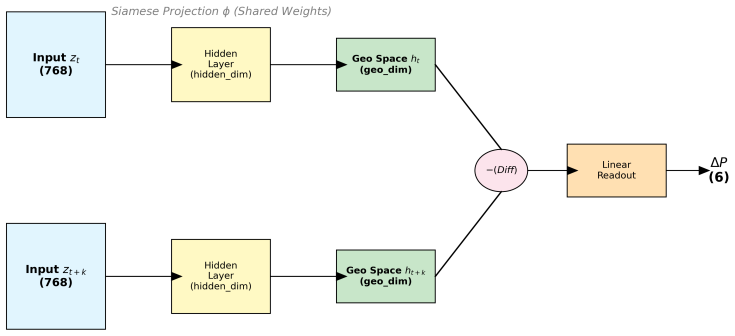
The central machinery is the Poincaré adapter: a Siamese two-layer MLP φ applied independently to each frame's feature vector, followed by a bias-free linear readout W, trained so that the adapted-feature difference maps to the 6D Lie-algebra twist: ΔP ≈ W(φ(z_{t+s}) − φ(z_t)). This 'unrolls' the curved feature manifold into a flat coordinate patch, converting nonlinear latent displacements into linear pose increments. The theoretical core is the posed feature map f: SE(3) → R^d, its Jacobian J(g), and the condition rank(J(g)) = 6; success requires the Jacobian to vary little across the pose region (low manifold curvature), and a residual from the Baker–Campbell–Hausdorff bracket remains for
Load-bearing premise
The central argument assumes the feature map from camera pose to feature vector is a smooth six-dimensional surface with full rank-6 Jacobian and no pose collisions—i.e., that distinct viewpoints never land on the same feature—an injectivity that the paper supports only indirectly via intrinsic-dimension estimates and never verifies directly.
What would settle it
Use a static scene with a large textureless wall (e.g., a white-walled room from TUM RGB-D). Collect frames from a dense grid of camera poses that all view the same blank region, and compute the mutual k-nearest-neighbor alignment M1 and intrinsic dimension in that region. If two distinct poses yield nearly identical feature vectors, the local intrinsic dimension will collapse below 6 and an adapter trained on those frames should show sharply lower R²; this would invalidate the embedded-submanifold interpretation in exactly the region where the paper's theory depends on injectivity.
If this is right
- Visual odometry and localization can run directly in adapted latent space: inverting the linear map with the pseudo-inverse W† predicts destination features, and nearest-neighbor retrieval finds physically near frames without any 3D reconstruction.
- Geometric awareness is an emergent, scale-dependent property: zero-shot pose recovery on unseen rooms improves monotonically with the number of training rooms and does not plateau at 200 rooms, so larger passive observation is predicted to yield even cleaner geometry.
- Probing design is decisive: Lie-algebra linearization, relative pose targets, and Siamese processing are each necessary; raw difference or absolute-pose formulations fail, indicating latent geometry is relational and only becomes explicit through the right readout.
- Rotation vs translation magnitude asymmetry is structural: rotation is decodable in 88% of hyperparameter configurations while translation magnitude is positive in only 27%, because translational flow depends on unknown depth; any downstream task should treat metric scale as a prior-restored quantity.
- The 'Visual Grid Code' gives a concrete interpretation of why self-distillation and large batches (batch size 192 vs 128) are critical for geometry: they allow a pose-aligned manifold to form; the paper's ablation shows topology can survive without them, but flat geometry does not.
Where Pith is reading between the lines
- We infer that because the adapted feature space is homogeneous and transferable across rooms with only a linear refit of the inverse map, it could be treated as a universal 'world grid' for embodied agents; testing this would require closed-loop navigation, which the authors do not run.
- We infer a testable developmental prediction from the rotation-before-translation difficulty hierarchy: if such geometry is a general property of passive vision, models (and possibly infants) should show reliable orientation recovery before metric-scale recovery.
- We infer that the gap between train-set R² above 0.9 and test R² 0.65 is likely a generalization gap, not a structural ceiling; a concrete extension is to check whether increasing adapter capacity or training data for the adapter closes this gap.
- We infer that extending the Poincaré adapter to dynamic scenes would require a temporal disentangling module to separate scene motion from camera motion; the current formulation offers no mechanism for distinguishing 'changes of state' from 'changes of position'.
Editorial analysis
A structured set of objections, weighed in public.
Referee Report
Summary. The paper asks whether self-supervised vision models, which are never trained with explicit 3D supervision or agency, nevertheless organize their latent spaces according to the geometry of SE(3). It introduces four metrics: M1 (mutual k-NN alignment between feature and pose neighborhoods), M2 (intrinsic dimensionality), M3 (linear readout of pose changes from feature differences), and M4 (a 'Poincaré Adapter', a Siamese MLP followed by a linear readout). The main empirical claim is that the Poincaré Adapter reaches test R2 ≈ 0.65 for DINOv2 on three ScanNet scenes, interpreted as evidence of a locally Euclidean SE(3)-isomorphic submanifold ('Visual Grid Code'). The paper also derives local and global decodability theorems, reports a rotation–translation difficulty asymmetry, presents training ablations, and applies the adapter to latent-space navigation via pseudo-inverse vector arithmetic.
Significance. If the headline result were representative and the protocol free of selection bias, the paper would be significant: it would demonstrate that passive self-supervised encoders contain a decodable, transferable 3D structure, with implications for probing, navigation world models, and theories of spatial representation. The manuscript has genuine strengths: M1 is a clean training-free metric; the cross-room generalization experiment (Fig. 5) is a properly split train/test regression and provides nontrivial evidence of a transferable subspace; and the appendices contain extensive, honest ablations (A.6, A.8) that document fragility rather than hiding it. However, the central 'remarkably strong correlation' claim rests on a small, unspecified subset of scenes and on oracle-based layer/hyperparameter selection, and the theoretical framework is partly tautological. These issues are load-bearing for the paper's interpretation, though they are addressable by re-analysis or by substantially tempering the claims.
major comments (4)
- [§5, Fig. 4, Table 2] The headline R2 ≈ 0.65 is 'averaged over 3 scenes from ScanNet', but no sampling or selection procedure for these three scenes is given in §5, App. A.2, or App. A.5. Table 2 reports that, across all 707 ScanNet rooms, DINOv2 achieves only 31% of rooms with R2 > 0 and only 3% with R2 > 0.3. Thus the headline number is not representative of the dataset; it is generated by a tiny, unspecified subset of unusually favorable rooms. This is load-bearing for the claim that self-supervised models possess latent subspaces 'remarkably strongly correlated' with SE(3). Please report aggregate statistics (e.g., median and interquartile range across rooms), specify the exact room selection procedure, and base the abstract's quantitative claim on a representative statistic.
- [§4, App. A.6, Table 8] The protocol states that 'for all metrics M1-M4, we perform a layer sweep across the encoder blocks to achieve the best performance' (Sec. 4), and App. A.6 describes a 3,328-configuration hyperparameter sweep. The paper does not state that layer and hyperparameter selection are nested inside the training folds; Table 8 reports results at the 'oracle layer'. If layer or hyperparameter selection uses the test split, the reported R2 is optimistically biased. Please clarify how selection is performed and, if it is not nested, re-run with nested selection or report the unbiased estimate.
- [§6, App. A.6, Table 7] The paper's own large-scale sweep (38,929 runs) shows that the positive result is highly fragile: translation magnitude has positive R2 in only 26.7% of configurations, with a mean R2_mag of −3.30 across all runs, and Table 8 shows four identical training runs yielding geometry R2 between 0.08 and 0.35. This contradicts the impression given by the main-text 'well-tuned' numbers (R2 ≈ 0.65; Table 8: 0.63 trans, 0.59 rot) and weakens the claim of a homogeneous coordinate system. The distribution over seeds and hyperparameters should be presented in the main text, with the headline claim revised accordingly.
- [A.7, Theorem 5(c), Theorem 3] The theoretical explanation is partially tautological. Theorem 3 is explicitly 'essentially trivial' (any C1 feature map with rank-6 Jacobian admits a local linear readout), and Theorem 5(c) constructs a nonlinear chart that 'unrolls' any injective smooth feature map. Consequently, the existence of a successful adapter does not by itself establish that the feature space 'contains' a pre-existing SE(3) manifold; it shows that a pose-supervised probe can impose one. The only nontrivial empirical evidence for a pre-existing structure is the cross-room generalization in Fig. 5 and Table 10. Please explicitly acknowledge this in the interpretation, and either provide additional evidence that the structure is not merely an artifact of the probe's capacity or weaken the 'Visual Grid Code' language.
minor comments (5)
- [Table 5 vs. Table 2] Table 5 reports a 9% R2>0 rate for 7-Scenes, while Table 2 reports 2% for DINOv2 on this dataset. The discrepancy is not explained; please reconcile the numbers or clarify what each table reports.
- [§5.1, Table 3] Table 3 is averaged over 3 scenes without specifying which scenes, and the Identity baseline's Hit@0.5 is 0.523 for both backbones, which seems inconsistent with a 'no navigation' baseline; please define how the Identity baseline is computed and report scene-level variances.
- [A.6, Table 7] The table reports 'Best R2' for translation magnitude as 0.725 while the text states mean R2_mag is −3.30; this is a useful but easily misread contrast. Please explicitly label that the best is over a large sweep and not a typical result.
- [§2, Related Work] Reference [30] is described as 'recent work by Mitchel et al.' but the reference list is incomplete in the provided text; please ensure all citations are complete.
- [A.11, MoE adapter] The MoE extension is described only in the appendix and is not evaluated in the main results. If it is not needed for the main claims, consider moving it to future work to reduce scope creep.
Circularity Check
Pose-supervised probe and a tautological chart theorem inject part of the SE(3) structure; held-out generalization keeps the core empirical claim partially independent.
specific steps
-
fitted input called prediction
[Section 5, 'Emergence of Linear Structure (Metric M4)'; Eq. (3)]
"Remarkably, by applying a lightweight Siamese MLP adapter φ, we recover strong linear equivariance. As shown in Figure 4, DINOv2 achieves strong performance, reaching test set R2 ≈0.65, averaged over 3 scenes from ScanNet. This implies that the latent space contains a locally Euclidean sub-manifold isomorphic to SE(3)—effectively a “Visual Grid Code”—which can be accessed via a non-linear projection."
Eq. (3) is trained with ground-truth pose displacements ΔP as regression targets, so the linearized 'SE(3) sub-manifold' is the label space of the fitted probe. The test R2=0.65 is held-out generalization of that pose-supervised fit, not an unsupervised measurement. The conclusion that the latent space 'contains a locally Euclidean sub-manifold isomorphic to SE(3)' therefore partly asserts what the probe's supervision injected. The qualifier 'when probed correctly' makes the probe part of the claim, but the probe uses the very camera poses defining SE(3). Held-out and zero-shot results mitigate, but do not remove, this by-construction alignment.
-
self definitional
[Section 6, 'Why does the adapter work?'; Appendix A.7.2, Remark 4; Appendix A.7.3, Theorem 5(c)]
"Theorem 3 is essentially trivial—it follows from Taylor’s theorem and the existence of a left inverse. The content is in recognizing that (C2) is the only condition needed for local decodability: any smooth, locally discriminative encoder automatically admits a Poincaré adapter."
Theorem 5(c)'s proof defines φ = (log ∘ f^{-1} ∘ π, normal coordinates) and sets W=[I_6|0], so the adapter output is log(g2)-log(g1) up to BCH terms—exactly the supervised target. Thus the claimed theoretical 'explanation' of the unrolling assumes the feature map is already an embedded copy of SE(3) and uses the ground-truth pose chart to build the adapter. It cannot independently establish that the learned φ discovers SE(3); it merely restates the definition of a Poincaré adapter under the embedding assumption. The paper's own remark calls Theorem 3 'essentially trivial'.
full rationale
The main empirical content—DINOv2's held-out adapter R2≈0.65, scaling to unseen rooms, and training-free M1 alignment—is not itself a fabricated equivalence: it is a genuine generalization measurement. However, two steps in the paper's interpretation are circular. First, Eq. (3) trains the Poincaré adapter on camera-pose labels, so the 'SE(3)-isomorphic sub-manifold' is the target of a fitted probe; the abstract's own qualifier 'when probed correctly' concedes that the discovery requires a pose-supervised accessor. Second, the theoretical support (Theorem 3 and Theorem 5(c)) is explicitly tautological: any rank-6 smooth feature map admits a local readout, and any injective immersion can be charted so that differences are Lie-algebra coordinates. The chart theorem constructs the adapter from f^{-1} and the ground-truth logarithm, so it restates the desired unrolling rather than deriving it from the encoder's training objective. These issues weaken the 'Visual Grid Code' and 'emergence' framing, but the held-out and zero-shot results provide independent evidence that the fitted structure transfers, so the circularity is partial, not total. The scene-selection and hyperparameter-sweep concerns noted by the skeptic are correctness risks, not circularity, and are not scored here.
Axiom & Free-Parameter Ledger
free parameters (3)
- Poincaré adapter weights (φθ, W) =
MLP d→64→20, W ∈ R^(6×20), optimized on training pose targets
- Adapter hyperparameters (bottleneck dim, learning rate, loss, etc.) =
best of 3,328 configurations (e.g., geo_dim=20)
- Oracle layer selection =
varies per model (e.g., DINOv2-B Layer 7/9)
axioms (5)
- domain assumption Static scene assumption: feature changes are caused only by camera motion.
- domain assumption Smoothness and local discriminability of the posed feature map (C1 and rank-6 Jacobian).
- domain assumption Global injectivity of f on the pose region K.
- domain assumption Pose ground truth is accurate enough for regression targets and neighbor graphs.
- standard math Standard smooth-manifold results: BCH formula, tubular neighborhood theorem, Hausdorff dimension under Lipschitz maps.
invented entities (1)
-
Visual Grid Code
no independent evidence
read the original abstract
In this paper, we ask whether vision foundation models construct representations that reflect the intrinsic properties of 3D Euclidean space. Unlike previous works that probe 3D awareness of vision features by regressing image-centric quantities such as depth or normals, we investigate the relation between the structure of the space of visual features and the group of Euclidean transformations $SE(3)$. We propose a set of probes to evaluate this relation from both topological and geometric perspectives: a mutual neighborhood metric that measures the alignment between feature neighborhoods and spatial topology, and a Poincar\'e Adapter to test the linear accessibility of the geometry of camera motion from latent displacements in static scenes. We show that self-supervised vision models, which, in principle, have not been trained with direct 3D supervision or active agency, possess latent subspaces that are remarkably strongly correlated with three-dimensional Euclidean space, when probed correctly. Building on this insight we propose a new class of "Latent-Space Navigation" techniques that perform visual odometry and localization purely in the latent space, bypassing the need for explicit 3D reconstruction.
Figures




Reference graph
Works this paper leans on
-
[1]
Cognitive maps in rats and men.Psychological review, 55(4):189, 1948
Edward C Tolman. Cognitive maps in rats and men.Psychological review, 55(4):189, 1948. 1
1948
-
[2]
Psychology press, 2014
James J Gibson.The ecological approach to visual perception: classic edition. Psychology press, 2014. 1
2014
-
[3]
Mental rotation of three-dimensional objects.Science, 171(3972):701–703, 1971
Roger N Shepard and Jacqueline Metzler. Mental rotation of three-dimensional objects.Science, 171(3972):701–703, 1971. 1
1971
-
[4]
Routledge, 2013
Jean Piaget.Child’s Conception of Space: Selected Works vol 4. Routledge, 2013. 1
2013
-
[5]
Allocentric and egocentric spatial representations: Definitions, distinctions, and interconnections
Roberta L Klatzky. Allocentric and egocentric spatial representations: Definitions, distinctions, and interconnections. InSpatial cognition: An interdisciplinary approach to representing and processing spatial knowledge, pages 1–17. Springer, 1998. 1
1998
-
[6]
Structure-from-motion revisited
Johannes L Schonberger and Jan-Michael Frahm. Structure-from-motion revisited. InProceed- ings of the IEEE conference on computer vision and pattern recognition, pages 4104–4113,
-
[7]
Nerf: Representing scenes as neural radiance fields for view synthesis
Ben Mildenhall, Pratul P Srinivasan, Matthew Tancik, Jonathan T Barron, Ravi Ramamoor- thi, and Ren Ng. Nerf: Representing scenes as neural radiance fields for view synthesis. Communications of the ACM, 65(1):99–106, 2021. 1, 5
2021
-
[8]
Habitat: A platform for embodied ai research
Manolis Savva, Abhishek Kadian, Oleksandr Maksymets, Yili Zhao, Erik Wijmans, Bhavana Jain, Julian Straub, Jia Liu, Vladlen Koltun, Jitendra Malik, et al. Habitat: A platform for embodied ai research. InProceedings of the IEEE/CVF international conference on computer vision, pages 9339–9347, 2019. 1
2019
-
[9]
Efficiently reconstructing dynamic scenes one d4rt at a time.arXiv preprint arXiv:2512.08924, 2025
Chuhan Zhang, Guillaume Le Moing, Skanda Koppula, Ignacio Rocco, Liliane Momeni, Junyu Xie, Shuyang Sun, Rahul Sukthankar, Joëlle K Barral, Raia Hadsell, et al. Efficiently reconstructing dynamic scenes one d4rt at a time.arXiv preprint arXiv:2512.08924, 2025. 1
arXiv 2025
-
[10]
IndyPublish.com, 1709
George Berkeley.An essay towards a new theory of vision. IndyPublish.com, 1709. 1
-
[11]
Movement-produced stimulation in the development of visually guided behavior.Journal of comparative and physiological psychology, 56(5):872, 1963
Richard Held and Alan Hein. Movement-produced stimulation in the development of visually guided behavior.Journal of comparative and physiological psychology, 56(5):872, 1963. 1
1963
-
[12]
Dover Publications, 2011
Henri Poincaré.Science and hypothesis. Dover Publications, 2011. 1
2011
-
[13]
Probing the 3D awareness of visual foundation models
Mohamed El Banani, Amit Raj, Kevis-Kokitsi Maninis, Abhishek Kar, Yuanzhen Li, Michael Rubinstein, Deqing Sun, Leonidas Guibas, Justin Johnson, and Varun Jampani. Probing the 3D awareness of visual foundation models. InProceedings of the IEEE/CVF Conference on Computer Vision and Pattern Recognition, pages 21795–21806, 2024. 2
2024
-
[14]
Z. Teed, L. Lipson, and J. Deng. Deep patch visual odometry. InAdvances in Neural Information Processing Systems (NeurIPS), volume 36, 2023. 2
2023
-
[15]
S. Wang, V . Leroy, Y . Cabon, B. Chidlovskii, and J. Revaud. DUSt3R: Geometric 3D vision made easy. InProc. IEEE/CVF Conf. Comput. Vis. Pattern Recognit. (CVPR), pages 20697– 20709, 2024. 2, 3, 6, 7, 8
2024
-
[16]
J. Wang, M. Chen, N. Karaev, A. Vedaldi, C. Rupprecht, and D. Novotny. VGGT: Visual geometry grounded transformer. InProc. IEEE/CVF Conf. Comput. Vis. Pattern Recognit. (CVPR), pages 5294–5306, 2025. 2, 3, 6
2025
-
[17]
Nomad: Goal masked diffusion policies for navigation and exploration
Ajay Sridhar, Dhruv Shah, Catherine Glossop, and Sergey Levine. Nomad: Goal masked diffusion policies for navigation and exploration. In2024 IEEE International Conference on Robotics and Automation (ICRA), pages 63–70, 2024. 2, 3
2024
-
[18]
Ria Doshi, Homer Walke, Oier Mees, Sudeep Dasari, and Sergey Levine. Scaling cross- embodied learning: One policy for manipulation, navigation, locomotion and aviation.arXiv preprint arXiv:2408.11812, 2024. 2, 3 11
Pith/arXiv arXiv 2024
-
[19]
Maeva Guerrier, Karthik Soma, Jana Pavlasek, and Giovanni Beltrame. Can vision founda- tion models navigate? zero-shot real-world evaluation and lessons learned.arXiv preprint arXiv:2603.25937, 2026. 2, 3
Pith/arXiv arXiv 2026
-
[20]
Navigation world models
Amir Bar, Gaoyue Zhou, Danny Tran, Trevor Darrell, and Yann LeCun. Navigation world models. InProceedings of the Computer Vision and Pattern Recognition Conference, pages 15791–15801, 2025. 2, 3, 5
2025
-
[21]
Lorenzo Mur-Labadia, Matthew Muckley, Amir Bar, Mido Assran, Koustuv Sinha, Mike Rabbat, Yann LeCun, Nicolas Ballas, and Adrien Bardes. V-JEPA 2.1: Unlocking dense features in video self-supervised learning.arXiv preprint arXiv:2603.14482, 2026. 2, 3, 5, 6, 7, 8
Pith/arXiv arXiv 2026
-
[22]
Yang You, Yixin Li, Congyue Deng, Yue Wang, and Leonidas Guibas. Multiview equivariance improves 3D correspondence understanding with minimal feature finetuning.arXiv preprint arXiv:2411.19458, 2024. 2
Pith/arXiv arXiv 2024
-
[23]
Deep ViT features as dense visual descriptors.arXiv preprint arXiv:2112.05814, 2(3):4, 2021
Shir Amir, Yossi Gandelsman, Shai Bagon, and Tali Dekel. Deep ViT features as dense visual descriptors.arXiv preprint arXiv:2112.05814, 2(3):4, 2021. 2
Pith/arXiv arXiv 2021
-
[24]
How much 3d do video foundation models encode?arXiv preprint arXiv:2512.19949, 2025
Zixuan Huang, Xiang Li, Zhaoyang Lv, and James M Rehg. How much 3d do video foundation models encode?arXiv preprint arXiv:2512.19949, 2025. 2
arXiv 2025
-
[25]
Lexicon3D: Probing visual foundation models for complex 3D scene understanding
Yunze Man, Shuhong Zheng, Zhipeng Bao, Martial Hebert, Liang-Yan Gui, and Yu-Xiong Wang. Lexicon3D: Probing visual foundation models for complex 3D scene understanding. Advances in Neural Information Processing Systems, 37:76819–76847, 2024. 3
2024
-
[26]
A. Bhattad, D. McKee, D. Hoiem, and D. A. Forsyth. StyleGAN knows normal, depth, albedo, and more.arXiv preprint arXiv:2306.00987, 2023. 3
Pith/arXiv arXiv 2023
-
[27]
Y . Chen, F. Viégas, and M. Wattenberg. Beyond surface statistics: Scene representations in a latent diffusion model.arXiv preprint arXiv:2306.05720, 2023. 3
Pith/arXiv arXiv 2023
-
[28]
Campos, R
C. Campos, R. Elvira, J. J. Gómez Rodríguez, J. M. M. Montiel, and J. D. Tardós. ORB- SLAM3: An accurate open-source library for visual, visual–inertial, and multimap SLAM. IEEE Transactions on Robotics, 37(6):1874–1890, 2021. 3
2021
-
[29]
Rust: Latent neural scene representations from unposed imagery
Mehdi SM Sajjadi, Aravindh Mahendran, Thomas Kipf, Etienne Pot, Daniel Duckworth, Mario Luˇci´c, and Klaus Greff. Rust: Latent neural scene representations from unposed imagery. In Proceedings of the IEEE/CVF Conference on Computer Vision and Pattern Recognition, pages 17297–17306, 2023. 3
2023
-
[30]
True self-supervised novel view synthesis is transferable.arXiv preprint arXiv:2510.13063, 2025
Thomas W Mitchel, Hyunwoo Ryu, and Vincent Sitzmann. True self-supervised novel view synthesis is transferable.arXiv preprint arXiv:2510.13063, 2025. 3
arXiv 2025
-
[31]
Primary visual cortex straightens natural video trajectories.Nature communications, 12(1):5982, 2021
Olivier J Hénaff, Yoon Bai, Julie A Charlton, Ian Nauhaus, Eero P Simoncelli, and Robbe LT Goris. Primary visual cortex straightens natural video trajectories.Nature communications, 12(1):5982, 2021. 3, 4
2021
-
[32]
Lucas Maes, Quentin Le Lidec, Damien Scieur, Yann LeCun, and Randall Balestriero. LeWorld- Model: Stable end-to-end joint-embedding predictive architecture from pixels.arXiv preprint arXiv:2603.19312, 2026. 3, 4
Pith/arXiv arXiv 2026
-
[33]
Sorscher, G
B. Sorscher, G. C. Mel, S. A. Ocko, L. M. Giocomo, and S. Ganguli. A unified theory for the computational and mechanistic origins of grid cells.Neuron, 111(1):121–137, 2023. 3
2023
-
[34]
W. Dorrell and J. Whittington. If grid cells are the answer, what is the question? a review of normative grid cell theory.arXiv preprint arXiv:2601.12424, 2026. 3
arXiv 2026
-
[35]
Gnm: A general navigation model to drive any robot
Dhruv Shah, Ajay Sridhar, Arjun Bhorkar, Noriaki Hirose, and Sergey Levine. Gnm: A general navigation model to drive any robot. In2023 IEEE International Conference on Robotics and Automation (ICRA), pages 7226–7233, 2023. 3
2023
-
[36]
Vint: A foundation model for visual navigation.arXiv preprint arXiv:2306.14846, 2023
Dhruv Shah, Ajay Sridhar, Nitish Dashora, Kyle Stachowicz, Kevin Black, Noriaki Hi- rose, and Sergey Levine. Vint: A foundation model for visual navigation.arXiv preprint arXiv:2306.14846, 2023. 3 12
Pith/arXiv arXiv 2023
-
[37]
Prior does matter: Visual navigation via denoising diffusion bridge models
Hao Ren, Yiming Zeng, Zetong Bi, Zhaoliang Wan, Junlong Huang, and Hui Cheng. Prior does matter: Visual navigation via denoising diffusion bridge models. InProceedings of the IEEE/CVF Conference on Computer Vision and Pattern Recognition, pages 12100–12110, 2025. 3
2025
-
[38]
Navmorph: A self-evolving world model for vision-and-language navigation in continuous environments
Xuan Yao, Junyu Gao, and Changsheng Xu. Navmorph: A self-evolving world model for vision-and-language navigation in continuous environments. InProceedings of the IEEE/CVF International Conference on Computer Vision, pages 5536–5546, 2025. 3
2025
-
[39]
R. M. Murray, Z. Li, and S. S. Sastry.A Mathematical Introduction to Robotic Manipulation. CRC Press, 1994. 4
1994
-
[40]
On the continuity of rotation representations in neural networks
Yi Zhou, Connelly Barnes, Jingwan Lu, Jimei Yang, and Hao Li. On the continuity of rotation representations in neural networks. InProceedings of the IEEE/CVF conference on computer vision and pattern recognition, pages 5745–5753, 2019. 4, 16
2019
-
[41]
Self-supervised video pretraining yields robust and more human-aligned visual representations.Advances in Neural Information Processing Systems, 36:65743–65765, 2023
Nikhil Parthasarathy, SM Eslami, Joao Carreira, and Olivier Henaff. Self-supervised video pretraining yields robust and more human-aligned visual representations.Advances in Neural Information Processing Systems, 36:65743–65765, 2023. 4
2023
-
[42]
Learning predictable and robust neural representations by straightening image sequences.Advances in Neural Information Processing Systems, 37:40316–40335, 2024
Xueyan Niu, Cristina Savin, and Eero P Simoncelli. Learning predictable and robust neural representations by straightening image sequences.Advances in Neural Information Processing Systems, 37:40316–40335, 2024. 4
2024
-
[43]
Chirality in action: Time-aware video represen- tation learning by latent straightening.Advances in Neural Information Processing Systems, 38:92695–92726, 2026
Piyush Nitin Bagad and Andrew Zisserman. Chirality in action: Time-aware video represen- tation learning by latent straightening.Advances in Neural Information Processing Systems, 38:92695–92726, 2026. 4
2026
-
[44]
A. Dai, A. X. Chang, M. Savva, M. Halber, T. Funkhouser, and M. Nießner. ScanNet: Richly- annotated 3D reconstructions of indoor scenes. InProc. IEEE Conf. Comput. Vis. Pattern Recognit. (CVPR), pages 5828–5839, 2017. 4, 6, 7, 8
2017
-
[45]
Gilad Baruch, Zhuoyuan Chen, Afshin Dehghan, Tal Dimry, Yuri Feigin, Peter Fu, Thomas Gebauer, Brandon Joffe, Daniel Kurz, Arik Schwartz, et al. ARKitScenes: A diverse real- world dataset for 3D indoor scene understanding using mobile RGB-D data.arXiv preprint arXiv:2111.08897, 2021. 4, 8
Pith/arXiv arXiv 2021
-
[46]
A benchmark for the evaluation of rgb-d slam systems
Jürgen Sturm, Nikolas Engelhard, Felix Endres, Wolfram Burgard, and Daniel Cremers. A benchmark for the evaluation of rgb-d slam systems. In2012 IEEE/RSJ international conference on intelligent robots and systems, pages 573–580, 2012. 4, 8
2012
-
[47]
Learning to navigate the energy landscape
Julien Valentin, Angela Dai, Matthias Nießner, Pushmeet Kohli, Philip Torr, Shahram Izadi, and Cem Keskin. Learning to navigate the energy landscape. In2016 Fourth International Conference on 3D Vision (3DV), pages 323–332. IEEE, 2016. 4, 8
2016
-
[48]
Scene coordinate regression forests for camera relocalization in rgb-d images
Jamie Shotton, Ben Glocker, Christopher Zach, Shahram Izadi, Antonio Criminisi, and Andrew Fitzgibbon. Scene coordinate regression forests for camera relocalization in rgb-d images. InProceedings of the IEEE conference on computer vision and pattern recognition, pages 2930–2937, 2013. 4, 8
2013
-
[49]
M. Huh, B. Cheung, T. Wang, and P. Isola. The platonic representation hypothesis.arXiv preprint arXiv:2405.07987, 2024. 4
Pith/arXiv arXiv 2024
-
[50]
Dynamic reflections: Probing video representations with text alignment
Tyler Zhu, Tengda Han, Leonidas Guibas, Viorica P˘atr˘aucean, and Maks Ovsjanikov. Dynamic reflections: Probing video representations with text alignment. InThe Fourteenth International Conference on Learning Representations, 2026. 4
2026
-
[51]
Levina and P
E. Levina and P. Bickel. Maximum likelihood estimation of intrinsic dimension. InAdvances in Neural Information Processing Systems (NeurIPS), volume 17, 2004. 4
2004
-
[52]
Facco, M
E. Facco, M. d’Errico, A. Rodriguez, and A. Laio. Estimating the intrinsic dimension of datasets by a minimal neighborhood information.Scientific Reports, 7(1):12140, 2017. 4 13
2017
-
[53]
Large vision models can solve mental rotation problems
Sebastian Ray Mason, Anders Gjølbye, Phillip Chavarria Højbjerg, Lenka Tˇetková, and Lars Kai Hansen. Large vision models can solve mental rotation problems. InIEEE International Conference on Acoustics, Speech and Signal Processing (ICASSP), pages 1571–1575, 2026. 5
2026
-
[54]
Metzer, E
G. Metzer, E. Richardson, O. Patashnik, R. Giryes, and D. Cohen-Or. Latent-NeRF for shape- guided generation of 3D shapes and textures. InProc. IEEE/CVF Conf. Comput. Vis. Pattern Recognit. (CVPR), pages 12663–12673, 2023. 5
2023
-
[55]
Weinzaepfel, V
P. Weinzaepfel, V . Leroy, T. Lucas, R. Brégier, Y . Cabon, V . Arora, L. Antsfeld, B. Chidlovskii, G. Csurka, and J. Revaud. CroCo: Self-supervised pre-training for 3D vision tasks by cross-view completion. InAdvances in Neural Information Processing Systems (NeurIPS), volume 35, pages 3502–3516, 2022. 6
2022
-
[56]
M. Oquab, T. Darcet, T. Moutakanni, H. V o, M. Szafraniec, V . Khalidov, P. Fernandez, D. Haziza, F. Massa, A. El-Nouby, et al. DINOv2: Learning robust visual features without supervision. arXiv preprint arXiv:2304.07193, 2023. 6, 8
Pith/arXiv arXiv 2023
-
[57]
Oriane Siméoni, Huy V V o, Maximilian Seitzer, Federico Baldassarre, Maxime Oquab, Cijo Jose, Vasil Khalidov, Marc Szafraniec, Seungeun Yi, Michaël Ramamonjisoa, et al. DINOv3. arXiv preprint arXiv:2508.10104, 2025. 6
Pith/arXiv arXiv 2025
-
[58]
Radford, J
A. Radford, J. W. Kim, C. Hallacy, A. Ramesh, G. Goh, S. Agarwal, G. Sastry, A. Askell, P. Mishkin, J. Clark, et al. Learning transferable visual models from natural language supervision. InInt. Conf. Mach. Learn. (ICML), pages 8748–8763, 2021. 6
2021
-
[59]
R. Wang, S. Xu, C. Dai, J. Xiang, Y . Deng, X. Tong, and J. Yang. MoGe: Unlocking accurate monocular geometry estimation for open-domain images with optimal training supervision. In Proc. IEEE/CVF Conf. Comput. Vis. Pattern Recognit. (CVPR), 2025. 6
2025
-
[60]
H. Lin, S. Chen, J. H. Liew, D. Y . Chen, Z. Li, G. Shi, J. Feng, and B. Kang. Depth Anything 3: Recovering the visual space from any views.arXiv preprint arXiv:2511.10647, 2025. 6
Pith/arXiv arXiv 2025
-
[61]
D. Bolya, P.-Y . Huang, P. Sun, J. H. Cho, A. Madotto, C. Wei, T. Ma, J. Zhi, J. Rajasegaran, H. Rasheed, et al. Perception encoder: The best visual embeddings are not at the output of the network.arXiv preprint arXiv:2504.13181, 2025. 6
Pith/arXiv arXiv 2025
-
[62]
M. Hu, W. Yin, C. Zhang, Z. Cai, X. Long, H. Chen, K. Wang, G. Yu, C. Shen, and S. Shen. Metric3D v2: A versatile monocular geometric foundation model for zero-shot metric depth and surface normal estimation.arXiv preprint arXiv:2404.15506, 2024. 6
Pith/arXiv arXiv 2024
-
[63]
High- resolution image synthesis with latent diffusion models
Robin Rombach, Andreas Blattmann, Dominik Lorenz, Patrick Esser, and Björn Ommer. High- resolution image synthesis with latent diffusion models. InProceedings of the IEEE/CVF conference on computer vision and pattern recognition, pages 10684–10695, 2022. 6
2022
-
[64]
Denoising diffusion implicit models.arXiv preprint arXiv:2010.02502, 2020
Jiaming Song, Chenlin Meng, and Stefano Ermon. Denoising diffusion implicit models.arXiv preprint arXiv:2010.02502, 2020. 6
Pith/arXiv arXiv 2010
-
[65]
Simian Luo, Yiqin Tan, Longbo Huang, Jian Li, and Hang Zhao. Latent consistency models: Synthesizing high-resolution images with few-step inference.arXiv preprint arXiv:2310.04378,
-
[66]
A tale of two features: Stable diffusion complements dino for zero-shot semantic correspondence.Advances in Neural Information Processing Systems, 36:45533–45547, 2023
Junyi Zhang, Charles Herrmann, Junhwa Hur, Luisa Polania Cabrera, Varun Jampani, Deqing Sun, and Ming-Hsuan Yang. A tale of two features: Stable diffusion complements dino for zero-shot semantic correspondence.Advances in Neural Information Processing Systems, 36:45533–45547, 2023. 6
2023
-
[67]
Andreas Blattmann, Tim Dockhorn, Sumith Kulal, Daniel Mendelevitch, Maciej Kilian, Do- minik Lorenz, Yam Levi, Zion English, Vikram V oleti, Adam Letts, et al. Stable video diffusion: Scaling latent video diffusion models to large datasets.arXiv preprint arXiv:2311.15127, 2023. 6
Pith/arXiv arXiv 2023
-
[68]
L. Wang, B. Huang, Z. Zhao, Z. Tong, Y . He, Y . Wang, Y . Wang, and Y . Qiao. VideoMAE v2: Scaling video masked autoencoders with dual masking. InProc. IEEE/CVF Conf. Comput. Vis. Pattern Recognit. (CVPR), pages 14549–14560, 2023. 6 14
2023
-
[69]
D. Zoran, N. Parthasarathy, Y . Yang, D. A. Hudson, J. Carreira, and A. Zisserman. Recurrent video masked autoencoders.arXiv preprint arXiv:2512.13684, 2025. 6
Pith/arXiv arXiv 2025
-
[70]
J. Carreira, D. Gokay, M. King, C. Zhang, I. Rocco, A. Mahendran, T. A. Keck, J. Heyward, S. Koppula, E. Pot, et al. Scaling 4D representations.arXiv preprint arXiv:2412.15212, 2024. 6
Pith/arXiv arXiv 2024
-
[71]
Unique lives, shared world: Learning from single-life videos.arXiv preprint arXiv:2512.04085, 2025
Tengda Han, Sayna Ebrahimi, Dilara Gokay, Li Yang Ku, Maks Ovsjanikov, Iva Babukova, Daniel Zoran, Viorica Patraucean, Joao Carreira, Andrew Zisserman, et al. Unique lives, shared world: Learning from single-life videos.arXiv preprint arXiv:2512.04085, 2025. 10
Pith/arXiv arXiv 2025
-
[72]
Federer.Geometric Measure Theory
H. Federer.Geometric Measure Theory. Springer, 1969. 21
1969
-
[73]
Poincaré adapter
J. M. Lee.Introduction to Smooth Manifolds. Springer, 2nd edition, 2012. 21 15 A Appendix Figure 7: Overview of the mutual nearest neighbor metricM1. For each frame in a scene we extract its visual features, as well as its corresponding (ground truth) camera pose. We then compare the nearest neighbor graphs computed in the feature (left) and pose (right) ...
2012
-
[74]
Assuming Φ =F ◦P is a smooth mapping, the intrinsic (Hausdorff) dimensionality of MS is at most6
-
[75]
Proof.We address each claim sequentially:
If Φ =F ◦P is a smoothembedding—meaning it is an injective immersion that maps homeomorphically onto its image—then MS is a regular smooth submanifold of Rd with intrinsic dimensionof exactly6. Proof.We address each claim sequentially:
-
[76]
Thus, time t influences the visual observation solely through the trajectory C(t), making P:U → Ia well-defined mapping that assigns a unique, repeatable image to any specific pose
For a strictly static scene S, the geometry, materials, and illumination of the environment are invariant over time. Thus, time t influences the visual observation solely through the trajectory C(t), making P:U → Ia well-defined mapping that assigns a unique, repeatable image to any specific pose. Moreover, by definition, the camera trajectory is restrict...
-
[77]
The domain of valid poses U is an open subset of the Lie group SE(3), which is a smooth manifold of dimension 6
Let Φ =F ◦P. The domain of valid poses U is an open subset of the Lie group SE(3), which is a smooth manifold of dimension 6. Because the composition Φ :U →R d is assumed to be a smooth mapping, it is continuously differentiable and therefore locally Lipschitz continuous. By standard results in geometric measure theory [72], locally Lipschitz mappings do ...
-
[78]
move forward 1 meter
By definition, a smooth embedding Φ is an immersion (its differential dΦ has a full rank of 6 everywhere) that is injective and maps homeomorphically onto its image. Under these assumptions, standard differential topology [ 73] guarantees that the image of an embedded manifold is a regular smooth submanifold, diffeomorphic to the domain. Because diffeomor...
discussion (0)
Sign in with ORCID, Apple, or X to comment. Anyone can read and Pith papers without signing in.