REVIEW 4 major objections 6 minor 24 references
Two-stage human-AI labeling beats majority vote for PD video ratings
Reviewed by Pith at T0; open to challenge. T0 means a machine referee read the full paper against a public rubric. the ladder, T0–T4 →
A cascaded human-in-the-loop weak supervision framework improves label quality for clinical and home video assessment of Parkinson's motor tasks, outperforming majority voting on a small gold-standard test set.
T0 review reviewed 2026-08-04 challenge →
load-bearing objection The cascade idea is reasonable, but the headline numbers are measured on unanimously-labeled videos, so the paper never tests the ambiguity it is designed to handle. the 4 major comments →
HiLWS: A Human-in-the-Loop Weak Supervision Framework for Curating Clinical and Home Video Data for Neurological Assessment
The pith
A machine-rendered reading of the paper's core claim, the machinery that carries it, and where it could break.
The reading
Core claim
The paper's central claim is that a cascaded human-in-the-loop weak supervision strategy yields higher-quality labels for neurological symptom severity than standard aggregation, and that those labels improve downstream classification. In the first stage, five expert raters' noisy ordinal scores (0–4) over seven hand motor tasks are aggregated by a weak-supervision label model into probabilistic labels; those labels train a LightGBM model on time-domain landmark features and a Random Forest on spatial-temporal and frequency features. In the second stage, the two models' predictions are added to the five experts and all seven sources are fused again, with learned per-source confidence weights
What carries the argument
The load-bearing mechanism is a two-stage cascade of weak-supervision label aggregation. Stage one fuses five expert annotations into probabilistic labels via a label model; stage two fuses the five experts with predictions from two trained classifiers (LightGBM and Random Forest) into a second probabilistic label. A weighted majority vote with learned source-confidence weights produces the final hard label, and the entropy of the predicted label distribution selects high-uncertainty cases for targeted expert review. The cascade is what distinguishes HiLWS from single-stage weak supervision: model output becomes another noisy source whose agreement pattern sharpens decisions on exactly the l
Load-bearing premise
Everything rests on the assumption that the gold-standard test set of 60 videos—chosen because all annotators fully agreed on them—fairly represents the hard, ambiguous videos that actually cause labeling error in home data; if ambiguous cases behave differently, the reported advantage of HiLWS over majority vote may not hold.
What would settle it
Take a held-out set of home videos intentionally enriched for ambiguity—for instance, cases where the five original raters disagreed by at least two severity points—and have an independent panel of experts produce consensus labels. Train identical downstream severity classifiers on HiLWS labels versus majority-vote labels and compare their MAE and false-positive rate on the no-symptom class. If HiLWS does not outperform majority vote on that ambiguous set, or if the 60-video fully-agreed test set correlates better with one strategy than the other, the central claim would be falsified.
If this is right
- Home-recorded video can be used to train severity classifiers if pipelines include quality filtering, task-aware segment selection, and probabilistic label fusion; naive majority voting leaves too much noise in the labels.
- Adding machine predictions as an extra labeling source reduces label uncertainty on severity classes 0 and 1, meaning hybrid labeling is most beneficial exactly where human raters are least consistent.
- The video quality thresholds identified here (roughly 24 fps minimum and 5–35% relative hand area) give practical minimum standards for collecting usable home assessments.
- Models trained on clinical-only data degrade on home data (landmark failure rate rising from about 3% to 27%, event-count error from 20% to 37%), so curation and domain-aware evaluation are prerequisites for remote deployment.
- On the gold-standard balanced test set, full HiLWS reduces false positives on the no-symptom class to 6%, which matters for unsupervised deployment where most real-world samples are healthy.
- The benefit over majority vote is largest in low-symptom classes where inter-rater disagreement is highest, suggesting the approach is a safety feature for false positives, not just an accuracy improvement.
Where Pith is reading between the lines
- An implication the authors leave implicit: if ambiguous, high-disagreement cases are exactly where HiLWS helps most, the benefit is probably underestimated by the fully-agreed gold-standard test set; a test set sampled to include borderline cases would likely show a larger gap over majority vote.
- The threshold values (24 fps, 5–35% hand area) are data- and task-specific; they can be tested as capture-time coaching rules in a prospective home-recording study, and likely need recalibration for other motor tasks such as gait or facial expression.
- Because entropy-driven adjudication concentrates expert effort on uncertain samples, the cost of annotation may scale sublinearly with dataset size; this could be tested by measuring how many expert reviews are needed to match full-expert labeling performance as the pool of videos grows.
- The same cascaded fusion recipe may transfer to other ordinal clinical ratings with noisy multi-rater labels, such as stroke rehabilitation scales, but transfer depends on a machine-learnable signal being present in the video stream; this is a testable hypothesis, not a claim of the paper.
Editorial analysis
A structured set of objections, weighed in public.
Referee Report
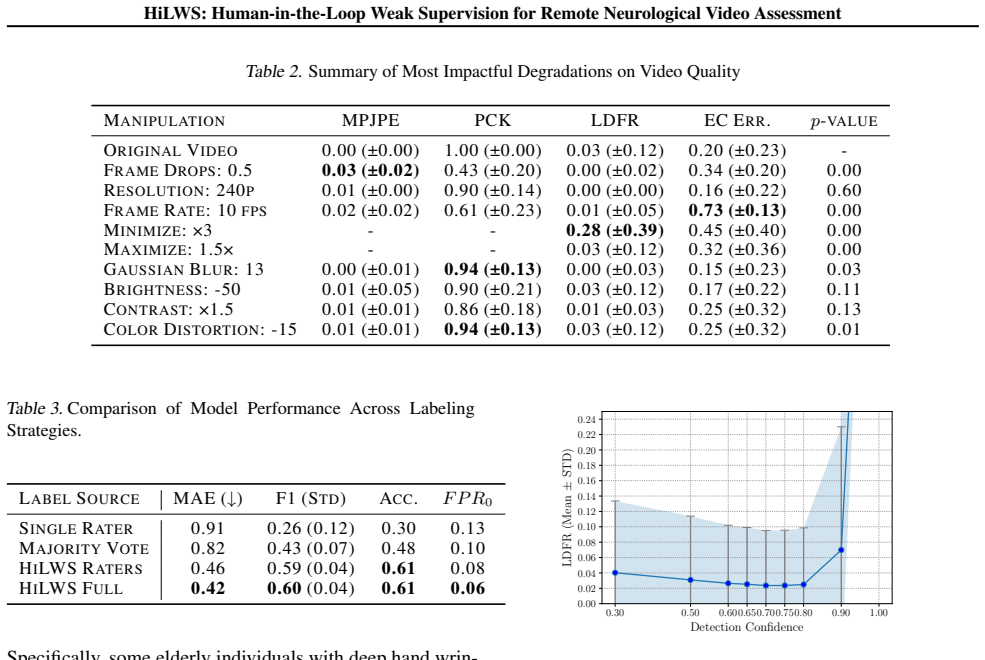
Summary. The paper presents HiLWS, a cascaded human-in-the-loop weak supervision framework for labeling hand motor task videos for neurological assessment, particularly Parkinson's disease. The pipeline includes video quality filtering, MediaPipe-based pose estimation with tuned confidence thresholds, task-aware segment extraction, and a two-stage label aggregation process. In stage 1, five clinical experts annotate a subset of videos; weak supervision aggregates these labels into soft probabilistic labels used to train LightGBM and Random Forest models. In stage 2, the two model predictions are combined with the five expert labels in a second weak-supervision layer, with an entropy-based criterion sending ambiguous cases back to experts for adjudication. The main claim is that the full HiLWS labeling strategy outperforms single-rater and majority-vote labels when used to train downstream severity classifiers, achieving MAE 0.42, F1 0.60, accuracy 0.61, and false-positive rate 0.06 on the no-symptom class (Table 3). The paper also contributes a degradation study and sensitivity analyses identifying quality thresholds (e.g., frame rate ≥24 FPS, relative hand area 10–35%) and an inter-rater agreement analysis.
Significance. If the central claim were established, HiLWS would be a practically useful data-curation tool for noisy home-recorded medical video, and the degradation/sensitivity analyses provide actionable guidance for remote monitoring deployments. The paper is transparent about the challenges of annotation noise and includes a held-out gold-standard set, an inter-rater agreement matrix, and systematic video manipulations. However, the evaluation supporting the headline label-quality claim is weakened by selecting the test set on annotator unanimity, which excludes the ambiguous cases the method is designed to address, and by a lack of uncertainty quantification. The degradation study is the most solid contribution; the labeling benefit of HiLWS over majority vote is not convincingly established as currently evaluated.
major comments (4)
- [Section 7.4 (Table 3)] The gold-standard test set comprises 60 individuals whose labels exhibited complete agreement across all annotators. This selection on the outcome variable excludes ambiguous videos, which are precisely the cases for which HiLWS's entropy-based adjudication (Section 5.3) is designed. The reported improvements over majority vote (MAE 0.42 vs 0.82) are therefore conditional on unanimity and do not establish the method's value in the low-agreement regime (e.g., Expert 1 vs Expert 5 QWK=0.21 in Figure 4) that motivates the framework. Please evaluate on a test set that includes non-unanimous cases with an independent adjudication standard, or explicitly restrict the claim to high-agreement videos.
- [Section 7.4 (Table 3)] No error bars, confidence intervals, or significance tests are reported for MAE, accuracy, or FPR0. With n=60, the difference between HiLWS raters-only (MAE 0.46) and full HiLWS (MAE 0.42) is plausibly within sampling noise. Report bootstrap confidence intervals or paired significance tests for all metrics, and account for multiple comparisons across the four labeling strategies. The F1 standard deviations alone are insufficient to support the superiority claim.
- [Section 5.3] The two machine sources are trained on stage-1 aggregated expert labels, and in stage 2 the same experts' labels are combined with the machine predictions. The improvement of full HiLWS over raters-only may therefore partly reflect the machine sources reinforcing the majority expert signal rather than contributing independent information. The held-out consensus labels provide some protection, but the training signal derives from the same expert pool. Please quantify the contribution of the ML sources (e.g., an ablation removing each model) and explicitly discuss this self-training effect.
- [Section 7.3.1 / Figure C.1] The quality thresholds (frame rate below 24 FPS, hand area outside 10–35%) are derived from sensitivity analysis on the same dataset used to motivate them, and are then presented as 'minimum technical standards' without independent validation. This in-sample threshold selection weakens the prescriptive claims. Either cross-validate the thresholds on a held-out subset or soften the recommendations to exploratory findings.
minor comments (6)
- [Section 4.2] The statement that approximately 60% of healthy controls were assigned non-zero severity should specify whether this refers to the clinical cohort (there is no HC group in the home cohort, Table A.2) and provide the denominator.
- [Section 5.3] The equations for entropy and weighted majority vote are not numbered; numbering them would make later references (e.g., Section 7.4) easier to follow.
- [Table 2] State the statistical test used for p-values and whether multiple-comparison correction was applied. Some p-values (0.60, 0.11, 0.13) are not significant, but the table and text treat all rows uniformly.
- [Table 3] The column header 'F1 (S TD)' contains a typo. More importantly, only F1 has an error measure; provide uncertainty for all metrics or state why it is omitted for MAE/accuracy/FPR0.
- [Figure 4] The heatmap text is small and difficult to read; consider also providing the QWK values in a table or increasing font size.
- [Section 7.2] The observation that some mild degradations (color distortion, Gaussian blur) slightly reduce EC error is interesting but unexplained. A brief mechanistic comment would help the reader interpret this counterintuitive finding.
Circularity Check
No significant circularity: held-out gold-standard evaluation keeps the central comparison independent; unanimity-based test set is a validity limitation, not a circular step.
full rationale
HiLWS is an empirical pipeline whose central claim (Table 3) is evaluated on a held-out gold-standard test set whose labels were manually validated and not used in any part of the training process (Section 7.4). The stage-1 expert labels are used to train the ML sources, and stage-2 fuses those sources with expert labels; this is a self-training/weak-supervision design, but the downstream comparison is not a re-prediction of the fitting targets—it measures generalization to unseen subjects' consensus labels. The entropy reduction in Table 4 is descriptive of the training-label distribution and is partly a consequence of the ML sources being trained on expert-derived labels, but the paper does not present Table 4 as a held-out prediction; it is an analysis of label confidence. No load-bearing self-citation, uniqueness theorem, or definitional identity was found. The unanimous-agreement test set restricts evaluation to low-ambiguity cases; this is a limitation on external validity for the method's stated ambiguous-case benefit, not a circularity of the derivation.
Axiom & Free-Parameter Ledger
free parameters (6)
- source confidence weights w_r in weighted majority vote =
Not reported
- Entropy threshold for expert adjudication =
Not specified
- MediaPipe detection confidence threshold =
0.7 to 0.8
- Minimum frame rate threshold =
24 FPS
- Relative hand area range =
0.05 to 0.35
- PCK tolerance alpha =
0.02
axioms (4)
- domain assumption Expert annotations constitute the gold standard for label quality evaluation.
- standard math The weak supervision label model can estimate source reliabilities without a separate labeled holdout.
- domain assumption The 60-individual complete-agreement test set is representative and unbiased.
- domain assumption MediaPipe hand landmarks provide sufficient kinematic signal for symptom severity estimation.
Cite this review
Pith. "Pith review of HiLWS: A Human-in-the-Loop Weak Supervision Framework for Curating Clinical and Home Video Data for Neurological Assessment." pith.science (2026). https://pith.science/paper/OSNBLX2F
@misc{pith2026250910557,
  author       = {Pith},
  title        = {Pith review of: HiLWS: A Human-in-the-Loop Weak Supervision Framework for Curating Clinical and Home Video Data for Neurological Assessment},
  year         = {2026},
  howpublished = {\url{https://pith.science/paper/OSNBLX2F}},
  note         = {Machine review of arXiv:2509.10557}
}
read the original abstract
Video-based assessment of motor symptoms in conditions such as Parkinson's disease (PD) offers a scalable alternative to in-clinic evaluations, but home-recorded videos introduce significant challenges, including visual degradation, inconsistent task execution, annotation noise, and domain shifts. We present HiLWS, a cascaded human-in-the-loop weak supervision framework for curating and annotating hand motor task videos from both clinical and home settings. Unlike conventional single-stage weak supervision methods, HiLWS employs a novel cascaded approach, first applies weak supervision to aggregate expert-provided annotations into probabilistic labels, which are then used to train machine learning models. Model predictions, combined with expert input, are subsequently refined through a second stage of weak supervision. The complete pipeline includes quality filtering, optimized pose estimation, and task-specific segment extraction, complemented by context-sensitive evaluation metrics that assess both visual fidelity and clinical relevance by prioritizing ambiguous cases for expert review. Our findings reveal key failure modes in home recorded data and emphasize the importance of context-sensitive curation strategies for robust medical video analysis.
Figures



Reference graph
Works this paper leans on
-
[1]
write newline
" write newline "" before.all 'output.state := FUNCTION n.dashify 't := "" t empty not t #1 #1 substring "-" = t #1 #2 substring "--" = not "--" * t #2 global.max substring 't := t #1 #1 substring "-" = "-" * t #2 global.max substring 't := while if t #1 #1 substring * t #2 global.max substring 't := if while FUNCTION format.date year duplicate empty "emp...
-
[2]
Acevedo, G., Lange, F., Calonge, C., Peach, R., Wong, J. K., and Guarin, D. L. VisionMD : an open-source tool for video-based analysis of motor function in movement disorders. npj Parkinson's Disease, 11 0 (1): 0 27, 2025
work page 2025
-
[3]
Federated learning for privacy preservation in smart healthcare systems: A comprehensive survey
Ali, M., Naeem, F., Tariq, M., and Kaddoum, G. Federated learning for privacy preservation in smart healthcare systems: A comprehensive survey. IEEE journal of biomedical and health informatics, 27 0 (2): 0 778--789, 2022
work page 2022
-
[4]
Monocular human pose estimation: A survey of deep learning-based methods
Chen, Y., Tian, Y., and He, M. Monocular human pose estimation: A survey of deep learning-based methods. Computer vision and image understanding, 192: 0 102897, 2020
work page 2020
-
[5]
Weighted kappa: Nominal scale agreement with provision for scaled disagreement or partial credit
Cohen, J. Weighted kappa: Nominal scale agreement with provision for scaled disagreement or partial credit. Psychological Bulletin, 70 0 (4): 0 213--220, 1968
work page 1968
-
[6]
Deng, D., Ostrem, J. L., Nguyen, V., Cummins, D. D., Sun, J., Pathak, A., Little, S., and Abbasi-Asl, R. Interpretable video-based tracking and quantification of parkinsonism clinical motor states. npj Parkinson's Disease, 10 0 (1): 0 122, 2024
work page 2024
-
[7]
Gao, M., Jiang, H., Hu, Y., Ren, Q., Xie, Z., and Liu, J. Suppressing label noise in medical image classification using mixup attention and self-supervised learning. Physics in Medicine & Biology, 69 0 (10): 0 105026, 2024
work page 2024
-
[8]
Goetz, C. G., Tilley, B. C., Shaftman, S. R., Stebbins, G. T., Fahn, S., Martinez-Martin, P., Poewe, W., Sampaio, C., Stern, M. B., Dodel, R., et al. Movement disorder society-sponsored revision of the unified Parkinson's disease rating scale ( MDS-UPDRS ): scale presentation and clinimetric testing results. Movement disorders: official journal of the Mov...
work page 2008
-
[9]
S., Rahman, W., Abdelkader, A., Lee, S., Yang, P
Islam, M. S., Rahman, W., Abdelkader, A., Lee, S., Yang, P. T., Purks, J. L., Adams, J. L., Schneider, R. B., Dorsey, E. R., and Hoque, E. Using AI to measure Parkinson ’s disease severity at home. NPJ digital medicine, 6 0 (1): 0 156, 2023
work page 2023
-
[10]
Explainability of Deep Learning models in medical video analysis: a survey
Kolarik, M., Sarnovsky, M., Paralic, J., and Babic, F. Explainability of Deep Learning models in medical video analysis: a survey. PeerJ Computer Science, 9: 0 e1253, 2023
work page 2023
-
[11]
Lugaresi, C., Tang, J., Nash, H., McClanahan, C., Uboweja, E., Hays, M., Zhang, F., Chang, C.-L., Yong, M. G., Lee, J., et al. MediaPipe : A framework for building perception pipelines. arXiv preprint arXiv:1906.08172, 2019
Pith/arXiv arXiv 1906
-
[12]
R., Macaluso, R., Lonini, L., Cotton, R
Mifsud, J., Embry, K. R., Macaluso, R., Lonini, L., Cotton, R. J., Simuni, T., and Jayaraman, A. Detecting the symptoms of Parkinson’s disease with non-standard video. Journal of neuroengineering and rehabilitation, 21 0 (1): 0 72, 2024
work page 2024
-
[13]
Colour image quality assessment using structural similarity index and singular value decomposition
Okarma, K. Colour image quality assessment using structural similarity index and singular value decomposition. In International Conference on Computer Vision and Graphics, pp.\ 55--65. Springer, 2008
work page 2008
-
[14]
Real-time human gesture grading based on OpenPose
Qiao, S., Wang, Y., and Li, J. Real-time human gesture grading based on OpenPose . In 2017 10th International Congress on Image and Signal Processing, BioMedical Engineering and Informatics (CISP-BMEI), pp.\ 1--6. IEEE, 2017
work page 2017
-
[15]
M., Yousefpoor, E., Yousefpoor, M
Rahmani, A. M., Yousefpoor, E., Yousefpoor, M. S., Mehmood, Z., Haider, A., Hosseinzadeh, M., and Ali Naqvi, R. Machine learning ( ML ) in medicine: review, applications, and challenges. Mathematics, 9 0 (22): 0 2970, 2021
work page 2021
-
[16]
H., Ehrenberg, H., Fries, J., Wu, S., and R \'e , C
Ratner, A., Bach, S. H., Ehrenberg, H., Fries, J., Wu, S., and R \'e , C. Snorkel : rapid training data creation with weak supervision. The VLDB Journal, 29 0 (2): 0 709--730, 2020
work page 2020
-
[17]
Video-based activity recognition for automated motor assessment of Parkinson's disease
Sarapata, G., Dushin, Y., Morinan, G., Ong, J., Budhdeo, S., Kainz, B., and O'Keeffe, J. Video-based activity recognition for automated motor assessment of Parkinson's disease. IEEE journal of biomedical and health informatics, 27 0 (10): 0 5032--5041, 2023
work page 2023
-
[18]
G., Girges, C., Hoque, E., and Foltynie, T
Sibley, K. G., Girges, C., Hoque, E., and Foltynie, T. Video-based analyses of Parkinson ’s disease severity: A brief review. Journal of Parkinson’s disease, 11 0 (s1): 0 S83--S93, 2021
work page 2021
-
[19]
So, C. W., Yuen, E. L. H., Leung, E. H. F., and Pun, J. C. S. Solar image quality assessment: a proof of concept using Variance of Laplacian method and its application to optical atmospheric condition monitoring. Publications of the Astronomical Society of the Pacific, 136 0 (4): 0 044504, 2024
work page 2024
-
[20]
Svingos, A. M., Hamner, T., Huntington, K. B., Chen, H. W., Sweeney, K. L., Ellis-Stockley, M., Denckla, M. B., Kalb, L. G., Slomine, B. S., and Suskauer, S. J. Inter-rater reliability of the revised physical and neurological examination of subtle signs (paness) scored using video review. Child neuropsychology, 29 0 (6): 0 922--933, 2023
work page 2023
-
[21]
Tian, H., Li, H., Jiang, W., Ma, X., Li, X., Wu, H., and Li, Y. Cross-spatiotemporal graph convolution networks for skeleton-based parkinsonian gait MDS-UPDRS score estimation. IEEE Transactions on Neural Systems and Rehabilitation Engineering, 32: 0 412--421, 2024
work page 2024
-
[22]
Wang, T.-s., Kim, G. T., Kim, M., and Jang, J. Contrast enhancement-based preprocessing process to improve deep learning object task performance and results. Applied Sciences, 13 0 (19): 0 10760, 2023
work page 2023
-
[23]
Z., Subramanian, A., Diedrich, D., Lindroth, H., Pickering, B., and Herasevich, V
Ye, R. Z., Subramanian, A., Diedrich, D., Lindroth, H., Pickering, B., and Herasevich, V. Effects of image quality on the accuracy human pose estimation and detection of eye lid opening/closing using OpenPose and DLib . Journal of Imaging, 8 0 (12): 0 330, 2022
work page 2022
-
[24]
Estimation of 3D human pose using prior knowledge
Zhang, L., Chen, S., and Zou, B. Estimation of 3D human pose using prior knowledge. Journal of Electronic Imaging, 30 0 (4): 0 040502--040502, 2021
work page 2021
This paper was first reviewed by deepseek-v4-flash on August 4, 2026.
discussion (0)
Sign in with ORCID, Apple, or X to comment. Anyone can read and Pith papers without signing in.