REVIEW 4 major objections 41 references
Interleaved text-image reasoning fails when modalities stop informing each other; supervising the transitions themselves restores long-chain coherence and accuracy.
Reviewed by Pith at T0; open to challenge. T0 means a machine referee read the full paper against a public rubric. the ladder, T0–T4 →
T0 review · grok-4.5
2026-07-12 14:12 UTC pith:OUDIC7A2
load-bearing objection Clean diagnosis of a real interleaved-CoT failure mode, with large gains from transition-level training—but the causal story still rides on unvalidated VLM judges and per-task models. the 4 major comments →
Bridging Modal Isolation in Interleaved Thinking: Supervising Modality Transitions via Stepwise Reinforcement
The pith
A machine-rendered reading of the paper's core claim, the machinery that carries it, and where it could break.
Core claim
Effective interleaved reasoning requires explicit structural supervision of modality transitions (via a modality transition loss over cross-modal hallucination and visual utilization deficit) rather than scaling or end-task rewards; optimizing only those transition signals with Reflective SFT and Flow-GRPO substantially improves both coherence and accuracy on long-chain visual puzzles.
What carries the argument
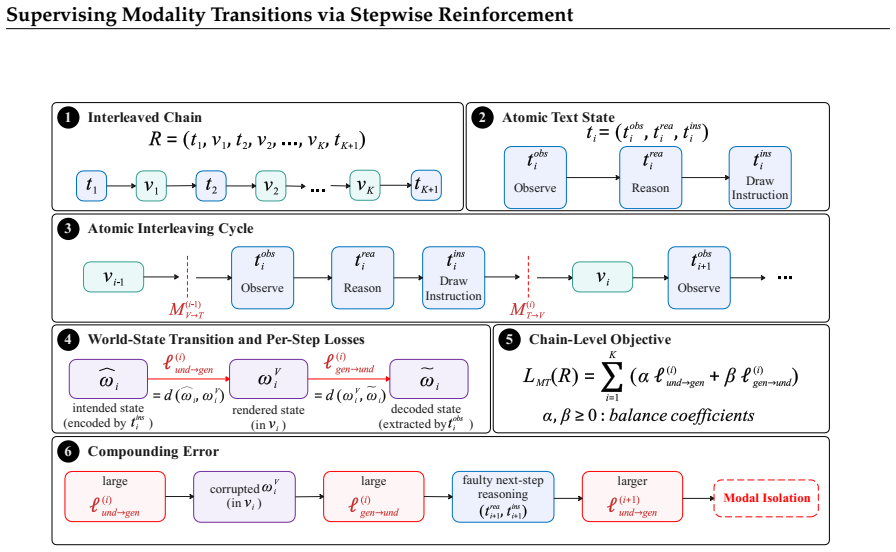
Modality Transition Loss (L_MT): the sum, over each cycle, of world-state divergence between intended and rendered states (text-to-image hallucination) plus rendered and decoded states (image-to-text utilization deficit); MoTiF minimizes it with Reflective SFT on deliberately corrupted images and Flow-GRPO on the image-generation policy.
Load-bearing premise
The binary judgments of a strong vision-language model are treated as faithful stand-ins for true world-state mismatch, so training against those judgments is assumed to reduce real isolation rather than merely matching the judge.
What would settle it
Hold the base model and tasks fixed, replace the VLM-as-Judge rewards with an independent ground-truth world-state extractor (or human annotation of state fidelity), retrain MoTiF, and test whether final accuracy and cross-modal coherence still rise; if they collapse, the claim that transition-level supervision works rests on the judge proxy.
If this is right
- Long-chain interleaved planners can be improved without outcome rewards by supervising only the fidelity of each modality hand-off.
- Training data that deliberately injects corrupted images and teaches recovery becomes a reusable recipe for reducing visual under-use.
- Flow-matching image generators can be policy-optimized for instruction fidelity inside a reasoning loop rather than only for aesthetic quality.
- Diagnostic benchmarks that score single-step text-to-image and image-to-text fidelity become necessary companions to end-task accuracy.
Where Pith is reading between the lines
- Any multimodal chain that mixes discrete symbolic steps with continuous generation is likely to exhibit an analogous isolation failure once chain length grows, so boundary-level losses may apply beyond pure vision-language puzzles.
- If the judge model itself hallucinates, MoTiF may simply teach the student to echo the judge’s biases; independent state extractors or multi-judge ensembles would be a natural robustness check.
- The same atomic observe-reason-instruct-draw decomposition could be used as an online monitor at inference time to decide when to re-generate an image rather than continuing a broken chain.
Editorial analysis
A structured set of objections, weighed in public.
Referee Report
Summary. The paper identifies Modal Isolation in long-chain interleaved thinking with unified multimodal models: text-to-image generation diverges from intended world state while subsequent text fails to use visual evidence, so modalities alternate without mutual information transfer. It decomposes each cycle into observe/reason/instruct/draw operations, defines Modality Transition Loss L_MT as the sum of cross-modal hallucination (Def. 1, und o gen) and visual utilization deficit (Def. 2, gen o und), and proposes MoTiF: Reflective SFT (contrastive recovery from corrupted images) plus Flow-GRPO (RL on the flow-matching image policy), both driven only by transition-level VLM-as-Judge signals rather than end-task accuracy. On four synthetic visual-puzzle suites (Sokoban, Maze, Multi-hop Manipulation, Ball Tracking), Bagel-7B-MoT rises from ~25% to ~71% overall accuracy, with transition rewards rising in tandem (Table 2, Fig. 4); Appendix Table 5 bounds gen o und degradation after Flow-GRPO.
Significance. If the causal story holds, the work supplies a useful diagnostic (modal isolation / L_MT) and a practical process-level training recipe for interleaved UMMs that is more targeted than end-task RL or naive SFT. The atomic decomposition of interleaved cycles, the explicit separation of und o gen and gen o und losses, and the two-stage pipeline that never uses final-answer reward are clear conceptual contributions. Empirical gains on Bagel-7B-MoT are large and consistent across four domains, and the authors report bounded multi-objective interference (Table 5). Promised code, website, and dataset would aid reproducibility. The result would matter for spatial/physical interleaved reasoning and for process supervision in multimodal CoT more broadly.
major comments (4)
- §3.2 footnote 1 and §4.2 Reward Design treat binary R_img / R_txt judgments from Qwen3.5-27B as empirical estimators of the abstract divergences d(ŵ_i, w^V_i) and d(w^V_i, w̃_i) in Defs. 1–2, and both training signals and the diagnostic curves in Fig. 4 are these same proxies. No calibration against ground-truth world states (available from the rule solvers and Blender renders used to build the data), no human agreement, and no inter-judge agreement are reported. Without that validation, the claim that gains come from reduced modal isolation (vs. high-quality process imitation under a strong teacher) is under-supported; a calibration study or GT-based d on held-out steps is needed for the central causal story.
- The abstract and §1/§6 assert that effective interleaved reasoning requires transition-level supervision “not merely scaling or end-task optimization,” and that all MoTiF signals avoid end-task accuracy. Table 2 and Fig. 4 compare to base Bagel, open-source interleaved models, and frontier models, but not to an end-task RL (or outcome-reward GRPO) baseline on the same base model and data. Without that contrast, the necessity claim over end-task optimization is not established; an outcome-only RL arm (and ideally a joint outcome+transition arm) is load-bearing for the paper’s strongest framing.
- §4.2 states “we train a separate model per task” to isolate Modal Isolation effects. Table 2’s overall ~45-point gain is therefore an average of four specialized models, not a single general interleaved reasoner. This weakens the claim that MoTiF yields a transferable structural fix for long-chain interleaved thinking. At minimum, report a multi-task trained model (or zero-shot transfer across the four suites) so the generality of transition-level supervision can be assessed.
- Fig. 4 jointly plots task accuracy and the same R_img / R_txt transition rewards used as training signals; partial circularity on the diagnostic metrics is acknowledged in the design but not quantified. End-task accuracy is partly independent, yet no error bars, multiple seeds, or statistical tests appear in Table 2 or Fig. 4. Given binary judges and synthetic domains, seed variance and judge noise could be large; report multi-seed means/std or bootstrap CIs so the magnitude of gains can be trusted.
Circularity Check
Mild self-definitional loop: Modal Isolation is defined as compounding of L_MT, so 'optimizing L_MT mitigates isolation' is partly by construction; reported cross-modal coherence gains reuse the same VLM-judge rewards used as training signals.
specific steps
-
self definitional
[§3.2 Defs. 1–2, Eq. 6, and paragraph after Eq. 6; Abstract]
"This mutual amplification accumulates with chain length K, providing a formal account of Modal Isolation: the progressive decoupling of textual reasoning from visual evidence, where each modality drifts further from the other with every transition. L_MT thus serves as both a diagnostic metric and a fundamental bottleneck on the scalability of interleaving thinking to long chains."
Modal Isolation is defined/accounted for as the compounding interaction of ℓ_und→gen and ℓ_gen→und. The subsequent claim that MoTiF, by minimizing L_MT, mitigates Modal Isolation therefore holds largely by the paper's own definition of the phenomenon, not as an independent empirical discovery. The interesting non-circular content is the transfer to end-task accuracy, not the isolation diagnosis itself.
-
fitted input called prediction
[§4.2 Reward Design; §5.1 Figure 4 and surrounding text]
"Figure 4 further demonstrates the synergistic evolution between model performance and cross-modal reward scores throughout the training process. We build two benchmarks adopting the designed VLM-as-Judge reward functions, which quantify the severity of modal isolation by evaluating single-step text and image generation during interleaved thinking. In the figure, ℓ_und→gen and ℓ_gen→und respectively represent the reward scores of the corresponding benchmarks."
Training Stage 1 filters/supervises with R_txt and Stage 2 optimizes with R_img (binary VLM judges). The paper then reports those same judge-derived transition rewards rising as evidence that modal isolation is reduced. For the diagnostic curves, the 'improvement in cross-modal coherence' is the training objective re-measured, not an independent prediction. End-task accuracy remains a separate outcome and is not forced by this loop.
full rationale
This is an empirical ML methods paper, not a first-principles derivation. The load-bearing scientific claim—that transition-level supervision (Reflective SFT + Flow-GRPO) improves held-out end-task accuracy without using end-task rewards as the primary objective—is not circular: Table 2 accuracy is an independent outcome on rule-solved puzzles. Two weaker loops exist. (1) Modal Isolation is introduced as the failure mode and then formally accounted for as the mutual amplification of the two components of L_MT (Defs. 1–2 and Eq. 6); claiming that minimizing L_MT reduces Modal Isolation is therefore largely definitional rather than an independent prediction. (2) Cross-modal coherence is operationalized and reported via the same binary VLM-as-Judge rewards R_img / R_txt that supply training signals (Fig. 4 dashed lines), so those diagnostic curves rising is expected by construction of the training objective. Neither loop forces the accuracy gains, and there is no self-citation uniqueness theorem or fitted parameter renamed as a novel prediction. Score 3 reflects partial circularity confined to the diagnostic framing, not the central empirical result.
Axiom & Free-Parameter Ledger
free parameters (4)
- α, β weights in L_MT
- Flow-GRPO β_KL / noise / SDE window
- Reflective SFT loss weights (mse_weight, ce_weight)
- Corruption / recovery pattern mix in Reflective SFT
axioms (5)
- domain assumption Each visual reasoning task admits a world-state space W and a divergence d that capture task-relevant configuration differences.
- ad hoc to paper Binary rubric judgments from a frontier VLM approximate d(ŵ, w^V) and d(w^V, w̃) well enough to supervise and evaluate transitions.
- domain assumption Text segments functionally decompose into observe / reason / instruct atomic operations in interleaved chains.
- domain assumption Flow-matching image generation can be cast as an MDP and optimized with group-relative policy gradients (Flow-GRPO) without destroying understanding.
- ad hoc to paper Synthetic interleaved chains from rule solvers plus Gemini rewriting are valid supervision for human-like interleaved reasoning.
invented entities (3)
-
Modal Isolation
no independent evidence
-
Modality Transition Loss L_MT (cross-modal hallucination + visual utilization deficit)
no independent evidence
-
MoTiF (Reflective SFT + Flow-GRPO pipeline)
no independent evidence
read the original abstract
Interleaved thinking, where a unified multimodal model alternates between textual reasoning and visual generation, has shown promise on spatial and physical tasks. However, in complex long-chain scenarios, we identify a fundamental failure mode: generated images diverge from the textual context while subsequent text ignores the visual evidence, causing the two modalities to alternate without genuinely informing each other. We term this Modal Isolation and attribute it to compounding information loss at modality boundaries. We decompose each reasoning cycle into atomic operations and define modality transition loss, quantifying cross-modal hallucination (text-to-image) and visual utilization deficit (image-to-text) at each boundary. We propose MoTiF (Modality Tiransition Fidelity), a two-stage training framework that directly optimizes these transitions: Reflective SFT trains the model to detect and recover from erroneous visual outputs; Flow-GRPO improves image generation fidelity via reinforcement learning. All training signals in MoTiF derive from transition-level fidelity rather than end-task accuracy. Across four visual puzzle benchmarks, this transition-level supervision substantially improves both cross-modal coherence and final task accuracy. The results demonstrate that effective interleaved reasoning requires explicit structural supervision at modality boundaries, not merely scaling or end-task optimization.
Figures



Reference graph
Works this paper leans on
-
[1]
Simulation as an engine of physical scene understanding.Proceedings of the national academy of sciences, 110(45):18327–18332, 2013
Peter W Battaglia, Jessica B Hamrick, and Joshua B Tenenbaum. Simulation as an engine of physical scene understanding.Proceedings of the national academy of sciences, 110(45):18327–18332, 2013
2013
-
[2]
Xiaokang Chen, Zhiyu Wu, Xingchao Liu, Zizheng Pan, Wen Liu, Zhenda Xie, Xingkai Yu, and Chong Ruan. Janus-pro: Unified multimodal understanding and generation with data and model scaling.arXiv preprint arXiv:2501.17811, 2025
Pith/arXiv arXiv 2025
-
[3]
Mint-cot: Enabling interleaved visual tokens in mathematical chain-of-thought reasoning.Advances in neural information processing systems, 38:69110–69139, 2026
Xinyan Chen, Renrui Zhang, Dongzhi Jiang, Aojun Zhou, Shilin Yan, Weifeng Lin, and Hongsheng Li. Mint-cot: Enabling interleaved visual tokens in mathematical chain-of-thought reasoning.Advances in neural information processing systems, 38:69110–69139, 2026
2026
-
[4]
Ethan Chern, Jiadi Su, Yan Ma, and Pengfei Liu. Anole: An open, autoregressive, native large multimodal models for interleaved image-text generation.arXiv preprint arXiv:2407.06135, 2024
Pith/arXiv arXiv 2024
-
[6]
Thinking with generated images, 2025
Ethan Chern, Zhulin Hu, Steffi Chern, Siqi Kou, Jiadi Su, Yan Ma, Zhijie Deng, and Pengfei Liu. Thinking with generated images, 2025. URLhttps://arxiv.org/abs/2505.22525
Pith/arXiv arXiv 2025
-
[7]
Emerging properties in unified multimodal pretraining.arXiv preprint arXiv:2505.14683, 2025
Chaorui Deng, Deyao Zhu, Kunchang Li, Chenhui Gou, Feng Li, Zeyu Wang, Shu Zhong, Weihao Yu, Xiaonan Nie, Ziang Song, et al. Emerging properties in unified multimodal pretraining.arXiv preprint arXiv:2505.14683, 2025
Pith/arXiv arXiv 2025
-
[8]
Dreamllm: Synergistic multimodal comprehension and creation
Runpei Dong, Yuang Peng, Zekun Qi, Zheng Ge, Jinrong Yang, Liang Zhao, Jianjian Sun, Hongyu Zhou, Haoran Wei, Xiangwen Kong, et al. Dreamllm: Synergistic multimodal comprehension and creation. In International Conference on Learning Representations, volume 2024, pages 6666–6702, 2024
2024
-
[9]
Grit: Teaching mllms to think with images.Advances in Neural Information Processing Systems, 38: 116522–116543, 2026
Yue Fan, Xuehai He, Diji Yang, Kaizhi Zheng, Ching-Chen Kuo, Yuting Zheng, Xinze Guan, and Xin Wang. Grit: Teaching mllms to think with images.Advances in Neural Information Processing Systems, 38: 116522–116543, 2026
2026
-
[10]
Interleaved-modal chain-of-thought
Jun Gao, Yongqi Li, Ziqiang Cao, and Wenjie Li. Interleaved-modal chain-of-thought. InProceedings of the Computer Vision and Pattern Recognition Conference, pages 19520–19529, 2025
2025
-
[11]
Thinkmorph: Emergent properties in multimodal interleaved chain-of-thought reasoning
Jiawei Gu, Yunzhuo Hao, Huichen Will Wang, Linjie Li, Michael Qizhe Shieh, Yejin Choi, Ranjay Krishna, and Yu Cheng. Thinkmorph: Emergent properties in multimodal interleaved chain-of-thought reasoning. arXiv preprint arXiv:2510.27492, 2025
arXiv 2025
-
[12]
Generating images with multimodal language models
Jing Yu Koh, Daniel Fried, and Russ R Salakhutdinov. Generating images with multimodal language models. Advances in Neural Information Processing Systems, 36:21487–21506, 2023
2023
-
[13]
Imagine while reasoning in space: Multimodal visualization-of-thought
Chengzu Li, Wenshan Wu, Huanyu Zhang, Yan Xia, Shaoguang Mao, Li Dong, Ivan Vuli´c, and Furu Wei. Imagine while reasoning in space: Multimodal visualization-of-thought. InInternational Conference on Machine Learning, pages 36340–36364. PMLR, 2025
2025
-
[14]
Flow-grpo: Training flow matching models via online rl.Advances in neural information processing systems, 38:40783–40818, 2026
Jie Liu, Gongye Liu, Jiajun Liang, Yangguang Li, Jiaheng Liu, Xintao Wang, Pengfei Wan, Di Zhang, and Wanli Ouyang. Flow-grpo: Training flow matching models via online rl.Advances in neural information processing systems, 38:40783–40818, 2026
2026
-
[15]
Towards unified multimodal interleaved generation via group relative policy optimization.Advances in Neural Information Processing Systems, 38: 5332–5353, 2026
Ming Nie, Chunwei Wang, Jianhua Han, Hang Xu, and Li Zhang. Towards unified multimodal interleaved generation via group relative policy optimization.Advances in Neural Information Processing Systems, 38: 5332–5353, 2026
2026
-
[16]
Luozheng Qin, Jia Gong, Yuqing Sun, Tianjiao Li, Mengping Yang, Xiaomeng Yang, Chao Qu, Zhiyu Tan, and Hao Li. Uni-cot: Towards unified chain-of-thought reasoning across text and vision.arXiv preprint arXiv:2508.05606, 2025
arXiv 2025
-
[17]
Qwen3.5: Towards native multimodal agents, February 2026
Qwen Team. Qwen3.5: Towards native multimodal agents, February 2026. URL https://qwen.ai/blog?id= qwen3.5. 11 Supervising Modality Transitions via Stepwise Reinforcement
2026
-
[18]
Generative multimodal models are in-context learners
Quan Sun, Yufeng Cui, Xiaosong Zhang, Fan Zhang, Qiying Yu, Yueze Wang, Yongming Rao, Jingjing Liu, Tiejun Huang, and Xinlong Wang. Generative multimodal models are in-context learners. InProceedings of the IEEE/CVF conference on computer vision and pattern recognition, pages 14398–14409, 2024
2024
-
[19]
Emu: Generative pretraining in multimodality
Quan Sun, Qiying Yu, Yufeng Cui, Fan Zhang, Xiaosong Zhang, Yueze Wang, Hongcheng Gao, Jingjing Liu, Tiejun Huang, and Xinlong Wang. Emu: Generative pretraining in multimodality. InInternational conference on learning representations, volume 2024, pages 12352–12380, 2024
2024
-
[21]
Chameleon: Mixed-modal early-fusion foundation models.arXiv preprint arXiv:2405.09818, 2024
Chameleon Team. Chameleon: Mixed-modal early-fusion foundation models.arXiv preprint arXiv:2405.09818, 2024
Pith/arXiv arXiv 2024
-
[22]
Multimodal learning with next-token prediction for large multimodal models.Nature, pages 1–7, 2026
Xinlong Wang, Yufeng Cui, Jinsheng Wang, Fan Zhang, Yueze Wang, Xiaosong Zhang, Zhengxiong Luo, Quan Sun, Zhen Li, Yuqi Wang, et al. Multimodal learning with next-token prediction for large multimodal models.Nature, pages 1–7, 2026
2026
-
[23]
Jingxuan Wei, Siyuan Li, Yuhang Xu, Zheng Sun, Junjie Jiang, Hexuan Jin, Caijun Jia, Honghao He, Xinglong Xu, Chang Yu, et al. The trinity of consistency as a defining principle for general world models.arXiv preprint arXiv:2602.23152, 2026
arXiv 2026
-
[24]
Janus: Decoupling visual encoding for unified multimodal understanding and generation
Chengyue Wu, Xiaokang Chen, Zhiyu Wu, Yiyang Ma, Xingchao Liu, Zizheng Pan, Wen Liu, Zhenda Xie, Xingkai Yu, Chong Ruan, et al. Janus: Decoupling visual encoding for unified multimodal understanding and generation. InProceedings of the Computer Vision and Pattern Recognition Conference, pages 12966–12977, 2025
2025
-
[25]
Jialong Wu, Xiaoying Zhang, Hongyi Yuan, Xiangcheng Zhang, Tianhao Huang, Changjing He, Chaoyi Deng, Renrui Zhang, Youbin Wu, and Mingsheng Long. Visual generation unlocks human-like reasoning through multimodal world models.arXiv preprint arXiv:2601.19834, 2026
arXiv 2026
-
[27]
Show-o: One single transformer to unify multimodal understanding and generation
Jinheng Xie, Weijia Mao, Zechen Bai, David Junhao Zhang, Weihao Wang, Kevin Qinghong Lin, Yuchao Gu, Zhijie Chen, Zhenheng Yang, and Mike Zheng Shou. Show-o: One single transformer to unify multimodal understanding and generation. InInternational Conference on Learning Representations, volume 2025, pages 28240–28264, 2025
2025
-
[28]
Xinlei Yu, Zhangquan Chen, Yongbo He, Tianyu Fu, Cheng Yang, Chengming Xu, Yue Ma, Xiaobin Hu, Zhe Cao, Jie Xu, et al. The latent space: Foundation, evolution, mechanism, ability, and outlook.arXiv preprint arXiv:2604.02029, 2026
Pith/arXiv arXiv 2026
-
[29]
Kaizhi Zheng, Xuehai He, and Xin Eric Wang. Minigpt-5: Interleaved vision-and-language generation via generative vokens.arXiv preprint arXiv:2310.02239, 2023
arXiv 2023
-
[30]
Ziwei Zheng, Michael Yang, Jack Hong, Chenxiao Zhao, Guohai Xu, Le Yang, Chao Shen, and Xing Yu. Deepeyes: Incentivizing” thinking with images” via reinforcement learning.arXiv preprint arXiv:2505.14362, 2025
Pith/arXiv arXiv 2025
-
[31]
Pre” denotes the model after Reflective SFT only; “Post
Yiyang Zhou, Haoqin Tu, Zijun Wang, Zeyu Wang, Niklas Muennighoff, Fan Nie, Yejin Choi, James Zou, Chaorui Deng, Shen Yan, et al. When visualizing is the first step to reasoning: Mira, a benchmark for visual chain-of-thought.arXiv preprint arXiv:2511.02779, 2025. 12 Supervising Modality Transitions via Stepwise Reinforcement Appendix A Training Hyperparam...
arXiv 2025
-
[32]
Describe what you actually see in it and explain specifically why it does NOT match what was expected based on Step{{j}}’s reasoning and drawing plan
**Observe and describe the error**: Carefully examine the WRONG image. Describe what you actually see in it and explain specifically why it does NOT match what was expected based on Step{{j}}’s reasoning and drawing plan
-
[33]
Based on what the CORRECT image SHOULD have shown (as intended by Step{{j}}), continue the logical reasoning for the next step
**Continue reasoning**: Acknowledge that an image generation error occurred, but decide to move forward rather than redraw. Based on what the CORRECT image SHOULD have shown (as intended by Step{{j}}), continue the logical reasoning for the next step
-
[34]
This drawing plan should be consistent with the original next step’s intended target
**Drawing plan for the next step**: Provide a clear, executable drawing instruction for the NEXT image to generate. This drawing plan should be consistent with the original next step’s intended target. Write in first person. Use natural hesitation markers like ”Hmm...”, ”Wait,”, ”Let me look more closely...”, or ”Actually...” where appropriate. Please thi...
-
[37]
The image to be evaluated, which is generated following the explicit visualization instructions of the previous step’s textual reasoning
-
[38]
## Strict Evaluation Principles Focus only on correctness, not standalone aesthetic preference
The ground-truth image. ## Strict Evaluation Principles Focus only on correctness, not standalone aesthetic preference. The generated image does not need to be pixel-identical to the ground truth, but it must be logically equivalent for the current reasoning step. Score = 1 only if all of the following are true: - The generated image and the ground-truth ...
-
[39]
The original multimodal problem image and problem text
-
[40]
The full context of completed interleaved multi-modal CoT reasoning steps, where the corresponding images at their respective positions are represented by the ‘¡auxiliary-image¿‘ placeholder
-
[41]
The image generated in the immediately preceding step (if any), which the model must observe and reflect upon. If there is no preceding image (i.e., this is the very first reasoning step), you will only see the problem image and must judge whether the model correctly observes the visual elements in the problem image instead
-
[42]
The generated text to be evaluated
-
[43]
This is an intermediate reasoning step
The step type: ”non-final” (a <think>...</think> block ending with <create_image>) or ”final” (an<ans>...</ans>block that concludes the entire reasoning chain). This is an intermediate reasoning step. The generated text must follow the format <think>...</think> and end with <create_image>. Score = 1 only if ALL of the following are true: - The generated t...
-
[44]
Change the orange cylinder into a gray cylinder
-
[45]
After completing all operations, what is the object in front of the red cuboid? Options: A
Change the blue sphere into a red cylinder. After completing all operations, what is the object in front of the red cuboid? Options: A. red cylinder B. purple sphere C. gray cylinder D. red cuboid Sokoban Images Question: This is a Sokoban puzzle where cartoon person is player, green X is target, brown box with X is box to push, brown tiles are walls, and...
-
[46]
Find the path to the finish and count the number of turns it takes to get there
The coordinates are given in the format (row, col), where row represents the vertical position and col represents the horizontal position. Find the path to the finish and count the number of turns it takes to get there. Model Response: <think> To solve the maze, I will start by identifying the player’s position at (9, 2) and the goal at (1, 7). The goal i...
discussion (0)
Sign in with ORCID, Apple, or X to comment. Anyone can read and Pith papers without signing in.