REVIEW 3 major objections 4 minor 80 references
Knowledge injection into multimodal models can be made both more accurate and less disruptive by splitting supervision into contrastively reweighted rollout tokens and sparse anchored correction for omitted facts, rather than fitting the fu
Reviewed by Pith at T0; open to challenge. T0 means a machine referee read the full paper against a public rubric. the ladder, T0–T4 →
T0 review · deepseek-v4-flash
2026-08-02 11:43 UTC pith:OVS7YZEN
load-bearing objection Solid incremental contribution to MLLM knowledge injection; strong experimental breadth, but the RoCo contrast has a prompt confound that weakens the mechanism story, while the ACE component and retention results hold up. the 3 major comments →
RoCo-ACE: Rollout-Conditioned Online Distillation for Retention-Aware Knowledge Injection
The pith
A machine-rendered reading of the paper's core claim, the machinery that carries it, and where it could break.
Core claim
The central claim is that the trade-off between acquiring injected facts and preserving old behavior is governed by supervision granularity, not just by update constraints. On a student rollout, the method computes, for each token, the log-likelihood difference between a teacher conditioned on the authoritative reference and one that is not; positive differences identify reference-supported tokens, and the resulting weights concentrate distillation there. For facts the rollout omits, the method extracts compact factual spans from the reference and applies cross-entropy only to those anchor tokens, weighting absent or weakly covered anchors more heavily. The paper shows this outperforms unifo
What carries the argument
The load-bearing identity is the same-rollout likelihood contrast Δ_{i,t} = log q_ref(y_{i,t}) − log q_base(y_{i,t}), where the two teacher views score the same student-generated prefix with and without the authoritative reference in the prompt; this contrast is converted into dense per-token distillation weights that concentrate gradient mass on reference-supported rollout tokens. Complementing it is the anchor-correction mechanism: the reference is segmented into compact factual spans, each span gets a coverage score against the rollout, and omitted or weakly matched spans receive higher weight in a sparse cross-entropy loss over only those reference anchor tokens. Together the two mechani
Load-bearing premise
The method depends on the assumption that the reference-conditioned teacher's likelihood contrast and the string-based span matching identify factual content rather than generic answer style — if the teacher mostly rewards style-matched wording, the reweighting amplifies noise, and exact-string anchor matching can reinforce spans that do not correspond to true reference facts.
What would settle it
Run a reference-conditioned teacher on rollouts whose wording is style-matched but fact-free (for example, referencing a different entity with identical phrasing); if high-contrast tokens are not the true fact-bearing tokens, the method's injection gains should disappear. Concretely, the paper's own mismatched-reference control — feeding the teacher a shuffled reference from another example — drops entity/news accuracy from 27.6 to 18.5, showing the signal is reference-specific; a token-level precision audit of high-weight spans against human-annotated factual spans would settle whether the me
If this is right
- If the central claim holds, knowledge injection no longer requires choosing between full-answer fitting and conservative updates: selective span-level supervision achieves both higher injected-knowledge accuracy and retention near the base model.
- Uniform online distillation leaves injection on the table; adding reference-conditioned contrast reweighting alone raises entity/news accuracy from 20.9 to 23.7, and the sparse anchor term raises it further to 27.6.
- Adding the full reference as a supervised target is less effective and hurts retention more than correcting only extracted anchors, implying that anchor sparsity itself is a load-bearing design choice.
- The method depends on an authoritative reference, so it targets entity-, event-, and domain-fact updates expressed as compact text spans; label-only or very short-answer settings have a weaker anchor signal.
- Across six retention benchmarks and three settings, the reported retention average stays within roughly one point of the base model, suggesting the trade-off shift is consistent rather than benchmark-specific.
Where Pith is reading between the lines
- A testable extension: if style imitation rather than fact acquisition drives forgetting, then rewriting the same facts in diverse styles and applying the same anchored correction should reduce retention drift further; the paper does not run this experiment.
- The same token-level contrast could double as a diagnostic: high-weight rollout tokens mark claims the model already reaches with reference support, which might be useful for spotting hallucination-prone generations before deployment.
- The anchor signal is currently string-based; grounding anchors in image evidence (OCR or region supervision) could strengthen correction for visual facts, but the paper leaves this as future work.
- An open direction is combining the objective with parameter-efficient updates; the paper uses full language-side updates, so whether the supervision granularity also makes low-rank adapters sufficient is not established.
Editorial analysis
A structured set of objections, weighed in public.
Referee Report
Summary. The manuscript proposes RoCo-ACE, a two-term objective for knowledge injection in MLLMs. RoCo reweights tokens of an on-policy student rollout using the log-likelihood contrast between a reference-conditioned and a reference-free teacher (Eqs. 2--4); ACE adds a sparse cross-entropy loss on extracted reference spans weighted by rollout coverage (Eqs. 5--7). Experiments on EVOKE, VP, and Sci with Qwen3-VL-8B, Qwen3-VL-30B, and InternVL3.5-8B, six retention benchmarks, and a hyperparameter grid report the best injected-knowledge accuracy among compared methods with retention close to the base model.
Significance. If the claims hold, the paper makes a useful contribution to knowledge injection by identifying supervision granularity as a bottleneck in online distillation and by providing a mechanism that combines rollout reweighting with sparse anchored correction. The experimental breadth is a genuine strength: three injection settings, two Qwen3-VL scales plus InternVL3.5-8B, component ablations, mismatched-reference and fixed-teacher controls, and an explicit hyperparameter sensitivity grid. However, the main empirical claims depend on an unvalidated LLM judge and on a teacher-prompt comparison that is not as clean as stated in Eq. (1); additionally, the reported retention differences are small and are presented without variance estimates. These issues are addressable within the scope of the manuscript, but they need to be resolved before the central claim can be accepted.
major comments (3)
- [§3.2, Eq. (1); Appendix K] Eq. (1) claims that the two teacher views “differ only in whether the authoritative reference a_i is included in the prompt context.” Appendix K states that the reference-conditioned teacher uses a long instruction wrapper (“Target Question:”, “Response to the target question:”, “Generate a new answer…”, “Do not contradict…”) while the base teacher uses “the original student input without the authoritative reference.” Thus Δ_i,t also encodes instruction-following format, not only reference-induced factual support. The mismatched-reference control (Table 2, 18.5 EVOKE) preserves the wrapper but changes reference semantics, so it does not remove this confound. Because the +2.8-point EVOKE gain of RoCo over SDFT and the mechanism of Eqs. (3)–(4) are attributed to reweighting reference-supported tokens, this is load-bearing. Please add a base-teacher control that uses the same instruction wr
- [§4.1 Evaluation metrics; Appendices I and G] The primary injection metric is an LLM judge (Qwen3-30B-A3B-Instruct-2507) with no reported human agreement, second-judge consistency, or bias analysis. Appendix G itself states that “judge-agreement or human-audit results should be reported when the benchmark setting allows them.” Since all main injection conclusions rest on this binary factual-consistency label, the paper should report agreement on a sample of responses (e.g., 100–200 items) and, ideally, a second judge, to rule out the possibility that gains reflect style matching to the reference wording rather than fact acquisition.
- [§4.2, Tables 1, 2, 4, 8–10] All experimental results are single-run point estimates with no error bars, confidence intervals, or multiple seeds. Several key comparisons are small (e.g., RoCo-ACE Ret. Avg. 56.5 vs. base 57.2 on EVOKE; VP and Sci retention differences of 0.1–0.5 points). Without repeated-seed averages and variance estimates, the claim of “keeping evaluated retention close to the base model” and the relative ordering of methods are not statistically supported. Please provide at least three seeds for the main tables and for the core ablations, with standard deviations or confidence intervals.
minor comments (4)
- [References] “The F ourteenth International Conference” appears in the KeepLoRA reference; typo and spacing also occur in “LLaV A-OneVision” and “Correspondence:Jun Lan”.
- [Table 1] The base-model row lacks spacing between numbers (e.g., “16.457.269.957.273.157.2”), making the table hard to read.
- [Appendix A, Table 3] The 30.8% “reference-supported” token share is definitional because the category is defined by Δ_i,t > τ. The paper already cautions that this is a diagnostic, but the sentence “showing how RoCo-ACE allocates supervision” could be misread as independent evidence; please add an explicit caveat that this share is a consequence of the threshold, not a validation of the contrast.
- [§3.2, Eq. (1)] The notation q_i,t_base(v) = q_ϕ(v | x_i, I_i, y_i,<t) is clear, but the prose “differ only in whether the authoritative reference a_i is included” conflicts with Appendix K; rewording this sentence would prevent the inconsistency.
Circularity Check
No significant circularity: the objective is a training signal evaluated against external benchmarks; the closest items are a definitional diagnostic and a prompt confound, neither load-bearing.
full rationale
RoCo-ACE's contribution is an empirical training objective, not a derivation that returns its own inputs. Equations (2)-(3) define token weights from a teacher likelihood contrast, and Eqs. (5)-(7) define anchor weights and an anchor CE loss; both are supervision signals, not fitted predictions of the EVOKE metric. EVOKE/VP/Sci accuracies are produced by an external LLM judge on a benchmark evaluation set (Appendix I), and the six retention benchmarks are explicitly held out of injection training (Appendix H: 'no retention benchmark examples are mixed into the injection training set'). Table 2's ablations separate SDFT, RoCo, ACE, SFT, fixed-teacher, and mismatched-reference controls, so the central comparison (RoCo-ACE 27.6 vs. SDFT 20.9 on EVOKE, with similar retention) is an empirical contrast, not a circular reduction. The only definitional element is Appendix A's diagnostic, which labels tokens with Δi,t>τ as 'reference-supported' and counts their share (30.8%); the paper explicitly frames this as a weight-assignment diagnostic rather than independent evidence, and the main claims do not rest on that percentage. The Appendix K prompt-template difference (the reference-conditioned teacher adds instruction text beyond the reference) is a construct-validity threat to the claim that Δ isolates factual support, but a confound is not a circular derivation. Hyperparameter selection on EVOKE (Table 11) raises selection-bias concerns but does not make any stated prediction equal an input by construction. No load-bearing self-citation chain is present: SDFT, KORE, and the benchmarks are external to the author set, and Appendix G's note about judge-agreement is a self-acknowledged limitation rather than circular reasoning.
Axiom & Free-Parameter Ledger
free parameters (8)
- λ_ACE =
0.2 (default; grid 0.0, 0.2, 1.0)
- β_miss =
5.0 (default; grid 3.0, 5.0, 7.0)
- τ =
0.2 (default; grid 0.1, 0.2, 0.4)
- w0 =
1.0
- β_Δ =
1.0
- u0 =
1.0
- EMA decay =
0.999
- num_generations =
1
axioms (5)
- domain assumption The authoritative reference answer is semantically aligned with the prompt and contains the target facts to be injected.
- domain assumption Tokenizer-level span extraction and normalized exact-string matching reliably identify factual units and their coverage in the rollout.
- domain assumption The LLM judge produces reliable binary correctness labels for open-ended injection responses.
- domain assumption An EMA-synchronized teacher provides stable and meaningful reference-conditioned next-token distributions.
- domain assumption The student rollout exposes a meaningful split between reference-supported, generic, and omitted-anchor tokens.
read the original abstract
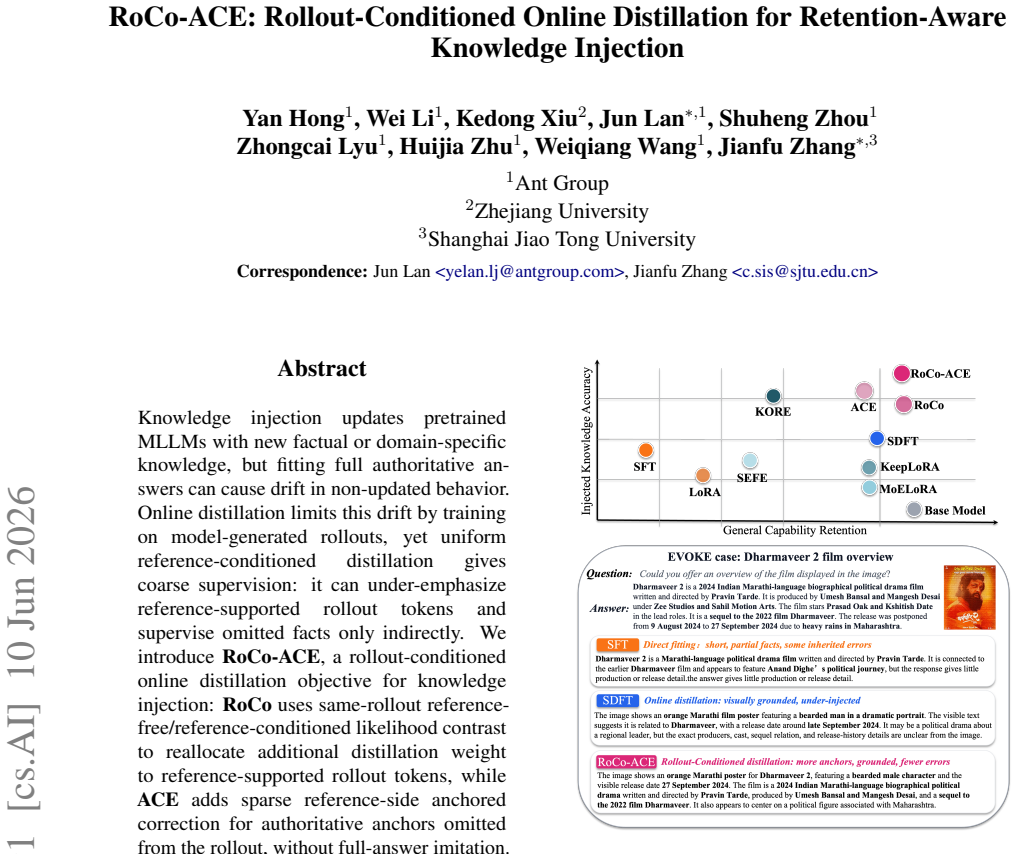
Knowledge injection updates pretrained MLLMs with new factual or domain-specific knowledge, but fitting full authoritative answers can cause drift in non-updated behavior. Online distillation mitigates this drift by training on model-generated rollouts, yet uniform reference-conditioned distillation provides coarse supervision: it can under-emphasize reference-supported rollout tokens and supervise omitted facts only indirectly. We introduce RoCo-ACE, a rollout-conditioned online distillation objective for knowledge injection. RoCo uses same-rollout reference-free/reference-conditioned likelihood contrast to reallocate additional distillation weight to reference-supported rollout tokens, while ACE adds sparse reference-side anchored correction for authoritative anchors omitted from the rollout without full-answer imitation. Across three knowledge-injection settings, six retention benchmarks, multiple baselines, and multiple base models, RoCo-ACE achieves the best injected-knowledge accuracy among compared methods while keeping evaluated retention close to the base model.
Figures


Reference graph
Works this paper leans on
-
[2]
Jean-Baptiste Alayrac, Jeff Donahue, Pauline Luc, Antoine Miech, Iain Barr, Yana Hasson, Karel Lenc, Arthur Mensch, Katherine Millican, Malcolm Reynolds, Roman Ring, Eliza Rutherford, Serkan Cabi, Tengda Han, Zhitao Gong, Sina Samangooei, Marianne Monteiro, Jacob Menick, Sebastian Borgeaud, and 8 others. 2022. https://proceedings.neurips.cc/paper_files/pa...
2022
-
[3]
Jinze Bai, Shuai Bai, Shusheng Yang, Shijie Wang, Sinan Tan, Peng Wang, Junyang Lin, Chang Zhou, and Jingren Zhou. 2023. https://arxiv.org/abs/2308.12966 Qwen-VL : A versatile vision-language model for understanding, localization, text reading, and beyond . arXiv preprint arXiv:2308.12966
Pith/arXiv arXiv 2023
-
[7]
Lin Chen, Jinsong Li, Xiaoyi Dong, Pan Zhang, Yuhang Zang, Zehui Chen, Haodong Duan, Jiaqi Wang, Yu Qiao, Dahua Lin, and Feng Zhao. 2024. https://arxiv.org/abs/2403.20330 Are we on the right way for evaluating large vision-language models? In Advances in Neural Information Processing Systems
Pith/arXiv arXiv 2024
-
[8]
Fung, and Steven C
Wenliang Dai, Junnan Li, Dongxu Li, Anthony Meng Huat Tiong, Junqi Zhao, Weisheng Wang, Boyang Li, Pascale N. Fung, and Steven C. H. Hoi. 2023. https://proceedings.neurips.cc/paper_files/paper/2023/hash/9a6a435e75419a836fe47ab6793623e6-Abstract-Conference.html InstructBLIP : Towards general-purpose vision-language models with instruction tuning . In Advan...
2023
-
[10]
Geoffrey Hinton, Oriol Vinyals, and Jeff Dean. 2015. https://arxiv.org/abs/1503.02531 Distilling the knowledge in a neural network . In NIPS Deep Learning and Representation Learning Workshop
Pith/arXiv arXiv 2015
-
[11]
Hu, Yelong Shen, Phillip Wallis, Zeyuan Allen-Zhu, Yuanzhi Li, Shean Wang, Lu Wang, and Weizhu Chen
Edward J. Hu, Yelong Shen, Phillip Wallis, Zeyuan Allen-Zhu, Yuanzhi Li, Shean Wang, Lu Wang, and Weizhu Chen. 2022. https://openreview.net/forum?id=nZeVKeeFYf9 LoRA : Low-rank adaptation of large language models . In International Conference on Learning Representations
2022
-
[14]
James Kirkpatrick, Razvan Pascanu, Neil Rabinowitz, Joel Veness, Guillaume Desjardins, Andrei A. Rusu, Kieran Milan, John Quan, Tiago Ramalho, Agnieszka Grabska-Barwinska, Demis Hassabis, Claudia Clopath, Dharshan Kumaran, and Raia Hadsell. 2017. https://doi.org/10.1073/pnas.1611835114 Overcoming catastrophic forgetting in neural networks . Proceedings of...
-
[15]
Bo Li, Yuanhan Zhang, Dong Guo, Renrui Zhang, Feng Li, Hao Zhang, Kaichen Zhang, Yanwei Li, Ziwei Liu, and Chunyuan Li. 2024. https://arxiv.org/abs/2408.03326 LLaVA-OneVision : Easy visual task transfer . arXiv preprint arXiv:2408.03326
Pith/arXiv arXiv 2024
-
[17]
Junnan Li, Dongxu Li, Silvio Savarese, and Steven C. H. Hoi. 2023. https://proceedings.mlr.press/v202/li23q.html BLIP-2 : Bootstrapping language-image pre-training with frozen image encoders and large language models . In Proceedings of the 40th International Conference on Machine Learning, pages 19730--19742
2023
-
[18]
Zhizhong Li and Derek Hoiem. 2016. https://doi.org/10.1007/978-3-319-46493-0_37 Learning without forgetting . In Proceedings of the European Conference on Computer Vision, pages 614--629. Springer
-
[19]
Haotian Liu, Chunyuan Li, Qingyang Wu, and Yong Jae Lee. 2023. https://proceedings.neurips.cc/paper_files/paper/2023/hash/6dcf277ea32ce3288914faf369fe6de0-Abstract-Conference.html Visual instruction tuning . In Advances in Neural Information Processing Systems, volume 36
2023
-
[22]
Mao-Lin Luo, Zi-Hao Zhou, Yi-Lin Zhang, Yuanyu Wan, Min-Ling Zhang, and Tong Wei. 2026. https://openreview.net/forum?id=T3Vc5fkTzV Keeplora: Continual learning with residual gradient adaptation . In The Fourteenth International Conference on Learning Representations
2026
-
[24]
Long Ouyang, Jeffrey Wu, Xu Jiang, Diogo Almeida, Carroll Wainwright, Pamela Mishkin, Chong Zhang, Sandhini Agarwal, Katarina Slama, Alex Ray, John Schulman, Jacob Hilton, Fraser Kelton, Luke Miller, Maddie Simens, Amanda Askell, Peter Welinder, Paul Christiano, Jan Leike, and Ryan Lowe. 2022. https://proceedings.neurips.cc/paper_files/paper/2022/hash/b1e...
2022
-
[31]
Haochen Wang, Xiangtai Li, Zilong Huang, Anran Wang, Jiacong Wang, Tao Zhang, Jiani Zheng, Sule Bai, Zijian Kang, Jiashi Feng, Zhuochen Wang, and Zhaoxiang Zhang. 2026. https://openreview.net/forum?id=zwMpimSZEq Traceable evidence enhanced visual grounded reasoning: Evaluation and method . In The Fourteenth International Conference on Learning Representations
2026
-
[33]
Shipeng Wang, Xiaorong Li, Jian Sun, and Zongben Xu. 2021. https://openaccess.thecvf.com/content/CVPR2021/html/Wang_Training_Networks_in_Null_Space_of_Feature_Covariance_for_Continual_CVPR_2021_paper.html Training networks in null space of feature covariance for continual learning . In Proceedings of the IEEE/CVF Conference on Computer Vision and Pattern ...
2021
-
[34]
Penghao Wu and Saining Xie. 2024. https://openaccess.thecvf.com/content/CVPR2024/html/Wu_V_Guided_Visual_Search_as_a_Core_Mechanism_in_Multimodal_CVPR_2024_paper.html V *: Guided visual search as a core mechanism in multimodal llms . In Proceedings of the IEEE/CVF Conference on Computer Vision and Pattern Recognition, pages 13084--13094
2024
-
[35]
Weixiang Wu, Dongxu Wang, Renze Xu, Xinnan Ma, Zhen Zeng, Xiaoshuai Guo, Gao Huang, and Yinghui Wang. 2025. https://aclanthology.org/2025.emnlp-main.41/ Automating steering for safe multimodal large language models . In Proceedings of the 2025 Conference on Empirical Methods in Natural Language Processing
2025
-
[40]
Advances in Neural Information Processing Systems , year=
Refusal in Language Models Is Mediated by a Single Direction , author=. Advances in Neural Information Processing Systems , year=
-
[41]
International Conference on Learning Representations , year=
Understanding and Enhancing Safety Mechanisms of LLMs via Safety-Specific Neuron , author=. International Conference on Learning Representations , year=
-
[42]
International Conference on Machine Learning , year=
The Geometry of Refusal in Large Language Models: Concept Cones and Representational Independence , author=. International Conference on Machine Learning , year=
-
[43]
arXiv preprint arXiv:2505.20977 , year=
Evaluating and Steering Modality Preferences in Multimodal Large Language Model , author=. arXiv preprint arXiv:2505.20977 , year=
-
[44]
arXiv preprint arXiv:2507.11878 , year=
LLMs Encode Harmfulness and Refusal Separately , author=. arXiv preprint arXiv:2507.11878 , year=
-
[45]
arXiv preprint arXiv:2511.08379 , year=
SOM Directions are Better than One: Multi-Directional Refusal Suppression in Language Models , author=. arXiv preprint arXiv:2511.08379 , year=
-
[46]
arXiv preprint arXiv:2410.03415 , year=
Surgical, Cheap, and Flexible: Mitigating False Refusal in Language Models via Single Vector Ablation , author=. arXiv preprint arXiv:2410.03415 , year=
-
[47]
arXiv preprint arXiv:2502.07823 , year=
Representation Bending for Large Language Model Safety , author=. arXiv preprint arXiv:2502.07823 , year=
-
[48]
Proceedings of the 2025 Conference on Empirical Methods in Natural Language Processing , year=
Automating Steering for Safe Multimodal Large Language Models , author=. Proceedings of the 2025 Conference on Empirical Methods in Natural Language Processing , year=
2025
-
[49]
arXiv preprint arXiv:2402.04249 , year=
HarmBench: A Standardized Evaluation Framework for Automated Red Teaming and Robust Refusal , author=. arXiv preprint arXiv:2402.04249 , year=
-
[50]
arXiv preprint arXiv:2405.20947 , year=
OR-Bench: An Over-Refusal Benchmark for Large Language Models , author=. arXiv preprint arXiv:2405.20947 , year=
-
[51]
arXiv preprint arXiv:2602.12533 , year=
AMPS: Adaptive Modality Preference Steering via Functional Entropy , author=. arXiv preprint arXiv:2602.12533 , year=
-
[52]
arXiv preprint arXiv:2602.04896 , year=
Steering Externalities: Benign Activation Steering Unintentionally Increases Jailbreak Risk for Large Language Models , author=. arXiv preprint arXiv:2602.04896 , year=
-
[53]
2025 , howpublished=
Heretic: Fully Automatic Censorship Removal for Language Models , author=. 2025 , howpublished=
2025
-
[54]
arXiv preprint arXiv:2406.14144 , year=
Finding Safety Neurons in Large Language Models , author=. arXiv preprint arXiv:2406.14144 , year=
-
[55]
Proceedings of the 2024 Conference on Empirical Methods in Natural Language Processing , year=
mDPO: Conditional Preference Optimization for Multimodal Large Language Models , author=. Proceedings of the 2024 Conference on Empirical Methods in Natural Language Processing , year=
2024
-
[56]
arXiv preprint arXiv:2503.14189 , year=
Towards Harmless Multimodal Assistants with Blind Preference Optimization , author=. arXiv preprint arXiv:2503.14189 , year=
-
[57]
arXiv preprint arXiv:2503.17682 , year=
Safe RLHF-V: Safe Reinforcement Learning from Multi-modal Human Feedback , author=. arXiv preprint arXiv:2503.17682 , year=
-
[58]
arXiv preprint arXiv:2505.17306 , year=
Refusal Direction is Universal Across Safety-Aligned Languages , author=. arXiv preprint arXiv:2505.17306 , year=
-
[59]
arXiv preprint arXiv:2602.04448 , year=
RASA: Routing-Aware Safety Alignment for Mixture-of-Experts Models , author=. arXiv preprint arXiv:2602.04448 , year=
-
[60]
arXiv preprint arXiv:2509.09660 , year=
Steering MoE LLMs via Expert (De)Activation , author=. arXiv preprint arXiv:2509.09660 , year=
-
[61]
arXiv preprint arXiv:2505.24449 , year=
When Large Multimodal Models Confront Evolving Knowledge: Challenges and Pathways , author=. arXiv preprint arXiv:2505.24449 , year=
-
[62]
arXiv preprint arXiv:2510.19316 , year=
KORE: Enhancing Knowledge Injection for Large Multimodal Models via Knowledge-Oriented Augmentations and Constraints , author=. arXiv preprint arXiv:2510.19316 , year=
-
[63]
arXiv preprint arXiv:2601.19897 , year=
Self-Distillation Enables Continual Learning , author=. arXiv preprint arXiv:2601.19897 , year=
-
[64]
arXiv preprint arXiv:2306.08543 , year=
MiniLLM: Knowledge Distillation of Large Language Models , author=. arXiv preprint arXiv:2306.08543 , year=
-
[65]
arXiv preprint arXiv:2306.13649 , year=
On-Policy Distillation of Language Models: Learning from Self-Generated Mistakes , author=. arXiv preprint arXiv:2306.13649 , year=
-
[66]
arXiv preprint arXiv:2602.12275 , year=
On-Policy Context Distillation for Language Models , author=. arXiv preprint arXiv:2602.12275 , year=
-
[67]
arXiv preprint arXiv:2601.18734 , year=
Self-Distilled Reasoner: On-Policy Self-Distillation for Large Language Models , author=. arXiv preprint arXiv:2601.18734 , year=
-
[68]
arXiv preprint arXiv:2603.05433 , year=
CRISP: Compressed Reasoning via Iterative Self-Policy Distillation , author=. arXiv preprint arXiv:2603.05433 , year=
-
[69]
arXiv preprint arXiv:2604.03128 , year=
Self-Distilled RLVR , author=. arXiv preprint arXiv:2604.03128 , year=
-
[70]
arXiv preprint arXiv:2604.02288 , year=
Unifying Group-Relative and Self-Distillation Policy Optimization via Sample Routing , author=. arXiv preprint arXiv:2604.02288 , year=
-
[71]
arXiv preprint arXiv:2604.00626 , year=
A Survey of On-Policy Distillation for Large Language Models , author=. arXiv preprint arXiv:2604.00626 , year=
-
[72]
and Shen, Yelong and Wallis, Phillip and Allen-Zhu, Zeyuan and Li, Yuanzhi and Wang, Shean and Wang, Lu and Chen, Weizhu , booktitle=
Hu, Edward J. and Shen, Yelong and Wallis, Phillip and Allen-Zhu, Zeyuan and Li, Yuanzhi and Wang, Shean and Wang, Lu and Chen, Weizhu , booktitle=. 2022 , url=
2022
-
[73]
Advances in Neural Information Processing Systems , volume=
Training Language Models to Follow Instructions with Human Feedback , author=. Advances in Neural Information Processing Systems , volume=. 2022 , url=
2022
-
[74]
NIPS Deep Learning and Representation Learning Workshop , year=
Distilling the Knowledge in a Neural Network , author=. NIPS Deep Learning and Representation Learning Workshop , year=
-
[75]
arXiv preprint arXiv:2503.02659 , year=
Put the Space of LoRA Initialization to the Extreme to Preserve Pre-trained Knowledge , author=. arXiv preprint arXiv:2503.02659 , year=
-
[76]
Proceedings of the IEEE/CVF Conference on Computer Vision and Pattern Recognition , pages=
Training Networks in Null Space of Feature Covariance for Continual Learning , author=. Proceedings of the IEEE/CVF Conference on Computer Vision and Pattern Recognition , pages=. 2021 , url=
2021
-
[77]
arXiv preprint arXiv:2506.05453 , year=
MLLM-CL: Continual Learning for Multimodal Large Language Models , author=. arXiv preprint arXiv:2506.05453 , year=
-
[78]
arXiv preprint arXiv:2508.06202 , year=
LoRA in LoRA: Towards Parameter-Efficient Architecture Expansion for Continual Visual Instruction Tuning , author=. arXiv preprint arXiv:2508.06202 , year=
-
[79]
The Fourteenth International Conference on Learning Representations , year=
KeepLoRA: Continual Learning with Residual Gradient Adaptation , author=. The Fourteenth International Conference on Learning Representations , year=
-
[80]
arXiv preprint arXiv:2402.12851 , year=
MoELoRA: Contrastive Learning Guided Mixture of Experts on Parameter-Efficient Fine-Tuning for Large Language Models , author=. arXiv preprint arXiv:2402.12851 , year=
-
[81]
arXiv preprint arXiv:2505.02486 , year=
SEFE: Superficial and Essential Forgetting Eliminator for Multimodal Continual Instruction Tuning , author=. arXiv preprint arXiv:2505.02486 , year=
-
[82]
Proceedings of the AAAI Conference on Artificial Intelligence , volume=
Divide, Conquer and Combine: A Training-Free Framework for High-Resolution Image Perception in Multimodal Large Language Models , author=. Proceedings of the AAAI Conference on Artificial Intelligence , volume=. 2025 , url=
2025
-
[83]
The Fourteenth International Conference on Learning Representations , year=
Traceable Evidence Enhanced Visual Grounded Reasoning: Evaluation and Method , author=. The Fourteenth International Conference on Learning Representations , year=
-
[84]
2024 , url=
Wu, Penghao and Xie, Saining , booktitle=. 2024 , url=
2024
-
[85]
arXiv preprint arXiv:2402.14804 , year=
Measuring Multimodal Mathematical Reasoning with the MATH-Vision Dataset , author=. arXiv preprint arXiv:2402.14804 , year=
-
[86]
Advances in Neural Information Processing Systems , year=
Are We on the Right Way for Evaluating Large Vision-Language Models? , author=. Advances in Neural Information Processing Systems , year=
-
[87]
Chen, Liang and Xie, Weichu and Liang, Yiyan and He, Hongfeng and Zhao, Hans and Yang, Zhibo and Huang, Zhiqi and Wu, Haoning and Lu, Haoyu and charles, Y. and Bao, Yiping and Fan, Yuantao and Li, Guopeng and Shen, Haiyang and Chen, Xuanzhong and Xu, Wendong and Si, Shuzheng and Cai, Zefan and Chai, Wenhao and Huang, Ziqi and Liu, Fangfu and Liu, Tianyu a...
-
[88]
Advances in Neural Information Processing Systems , volume=
Flamingo: A Visual Language Model for Few-Shot Learning , author=. Advances in Neural Information Processing Systems , volume=. 2022 , url=
2022
-
[89]
Li, Junnan and Li, Dongxu and Savarese, Silvio and Hoi, Steven C. H. , booktitle=. 2023 , url=
2023
-
[90]
and Hoi, Steven C
Dai, Wenliang and Li, Junnan and Li, Dongxu and Tiong, Anthony Meng Huat and Zhao, Junqi and Wang, Weisheng and Li, Boyang and Fung, Pascale N. and Hoi, Steven C. H. , booktitle=. 2023 , url=
2023
-
[91]
Advances in Neural Information Processing Systems , volume=
Visual Instruction Tuning , author=. Advances in Neural Information Processing Systems , volume=. 2023 , url=
2023
-
[92]
2024 , url=
Li, Bo and Zhang, Yuanhan and Guo, Dong and Zhang, Renrui and Li, Feng and Zhang, Hao and Zhang, Kaichen and Li, Yanwei and Liu, Ziwei and Li, Chunyuan , journal=. 2024 , url=
2024
-
[93]
2023 , url=
Bai, Jinze and Bai, Shuai and Yang, Shusheng and Wang, Shijie and Tan, Sinan and Wang, Peng and Lin, Junyang and Zhou, Chang and Zhou, Jingren , journal=. 2023 , url=
2023
-
[94]
arXiv preprint arXiv:2505.09388 , year=
-
[95]
2025 , url=
Bai, Shuai and others , journal=. 2025 , url=
2025
-
[96]
Wang, Taowen and Liu, Yiyang and Liang, James Chenhao and Zhao, Junhan and Cui, Yiming and Mao, Yuning and Nie, Shaoliang and Liu, Jiahao and Feng, Fuli and Xu, Zenglin and Han, Cheng and Huang, Lifu and Wang, Qifan and Liu, Dongfang , booktitle=. 2024 , address=. doi:10.18653/v1/2024.emnlp-main.218 , url=
-
[97]
Proceedings of the 2024 Conference on Empirical Methods in Natural Language Processing , pages=
Concept-skill Transferability-based Data Selection for Large Vision-Language Models , author=. Proceedings of the 2024 Conference on Empirical Methods in Natural Language Processing , pages=. 2024 , address=. doi:10.18653/v1/2024.emnlp-main.291 , url=
-
[98]
Liu, Haowei and Zhang, Xi and Xu, Haiyang and Shi, Yaya and Jiang, Chaoya and Yan, Ming and Zhang, Ji and Huang, Fei and Yuan, Chunfeng and Li, Bing and Hu, Weiming , booktitle=. 2024 , address=. doi:10.18653/v1/2024.emnlp-main.1250 , url=
-
[99]
Pi, Renjie and Han, Tianyang and Zhang, Jianshu and Xie, Yueqi and Pan, Rui and Lian, Qing and Dong, Hanze and Zhang, Jipeng and Zhang, Tong , booktitle=. 2024 , address=. doi:10.18653/v1/2024.emnlp-main.895 , url=
-
[100]
Liu, Xin and Zhu, Yichen and Gu, Jindong and Lan, Yunshi and Yang, Chao and Qiao, Yu , booktitle=. 2024 , publisher=. doi:10.1007/978-3-031-72992-8_22 , url=
-
[101]
Proceedings of the National Academy of Sciences , volume=
Overcoming catastrophic forgetting in neural networks , author=. Proceedings of the National Academy of Sciences , volume=. 2017 , doi=
2017
-
[102]
Proceedings of the European Conference on Computer Vision , pages=
Learning without Forgetting , author=. Proceedings of the European Conference on Computer Vision , pages=. 2016 , publisher=
2016
discussion (0)
Sign in with ORCID, Apple, or X to comment. Anyone can read and Pith papers without signing in.