A Joint Optimal Search for Gravitational Waves from Resolved and Unresolved Supermassive Binary Black Holes with Pulsar Timing Arrays
Pith reviewed 2026-06-26 22:50 UTC · model grok-4.3
The pith
A joint model of gravitational wave background and resolvable sources identifies 21 AGN candidates in tension with NANOGrav data.
A machine-rendered reading of the paper's core claim, the machinery that carries it, and where it could break.
Core claim
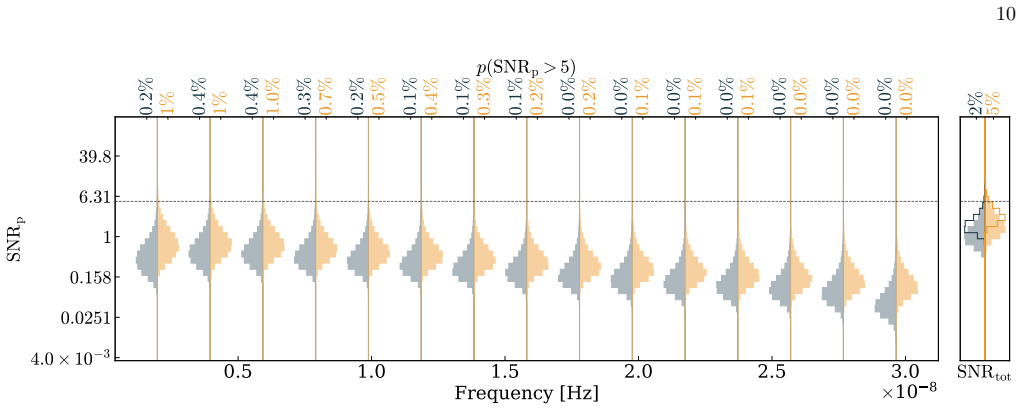
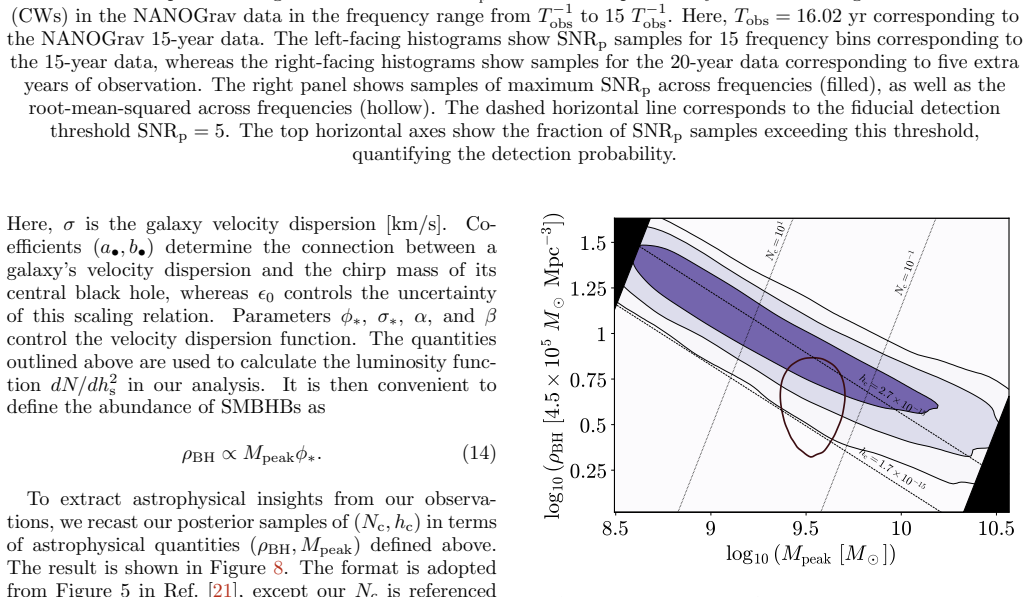
We introduce from first principles a joint model of the GWB and brightest SMBHBs that may be individually resolvable. We propose the characteristic number N_c as a detection statistic for the astrophysical origin of the GWB and demonstrate how the brightest sources assist in resolving it. Applying the model to simulated NANOGrav 15-year data, we find that 21 of 114 SMBHB candidates from AGN observations are in tension, versus one under the original analysis. We constrain the Poisson-specific N_c and calculate a 2% probability of detecting an isolated SMBHB at SNR=5 in the 15-year data, rising to 5% in 20-year data, with a 40% chance of an SNR=2 outlier then.
What carries the argument
The joint model of the unresolved gravitational wave background and individually resolvable supermassive black hole binaries, using the characteristic number N_c as the detection statistic for astrophysical origin.
If this is right
- 21 of 114 SMBHB candidates from AGN observations are in tension with the NANOGrav observations under the joint model.
- Only one candidate is in tension under the original upper-limits analysis.
- Constraints on N_c at per year carry implications for the population properties of SMBHBs.
- The probability of detecting GWs from an isolated SMBHB is 2% at SNR=5 in the 15-year data and rises to 5% in the 20-year data.
- The probability of finding an outlier with SNR of 2 in the NANOGrav 20-year data is 40%.
Where Pith is reading between the lines
- The joint approach may allow future PTA analyses to distinguish astrophysical GWB origins more cleanly than background-only searches.
- If N_c values remain low, models predicting a larger number of bright, resolvable SMBHBs would require revision.
- Extending the same joint search to independent PTA datasets could test whether the reported tensions are dataset-specific.
Load-bearing premise
The simulated NANOGrav 15-year data replicates all aspects of the real data's known noise, observations, and inferred GWB power spectrum.
What would settle it
A direct comparison of the joint model's tension counts and N_c constraints against the actual NANOGrav 15-year dataset, or a confirmed gravitational-wave detection from one of the 21 flagged AGN candidates at the predicted strain amplitude.
Figures
read the original abstract
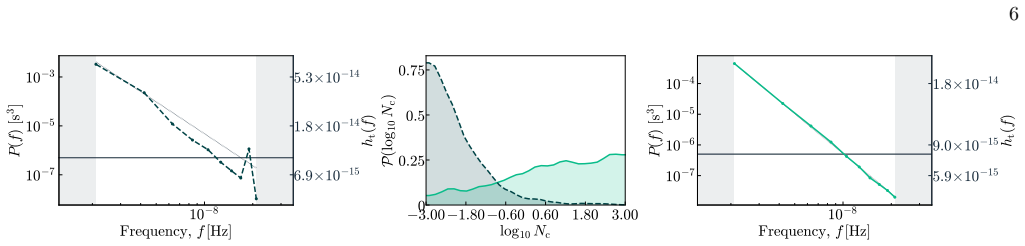
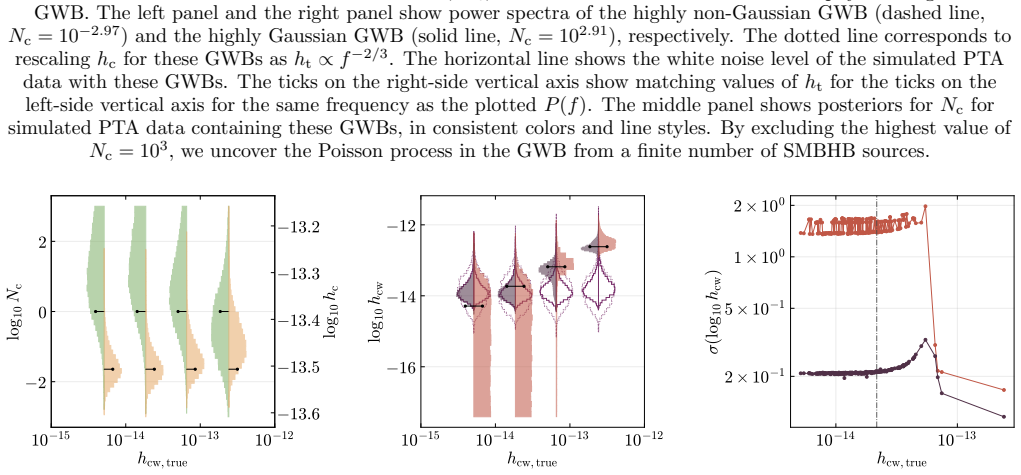
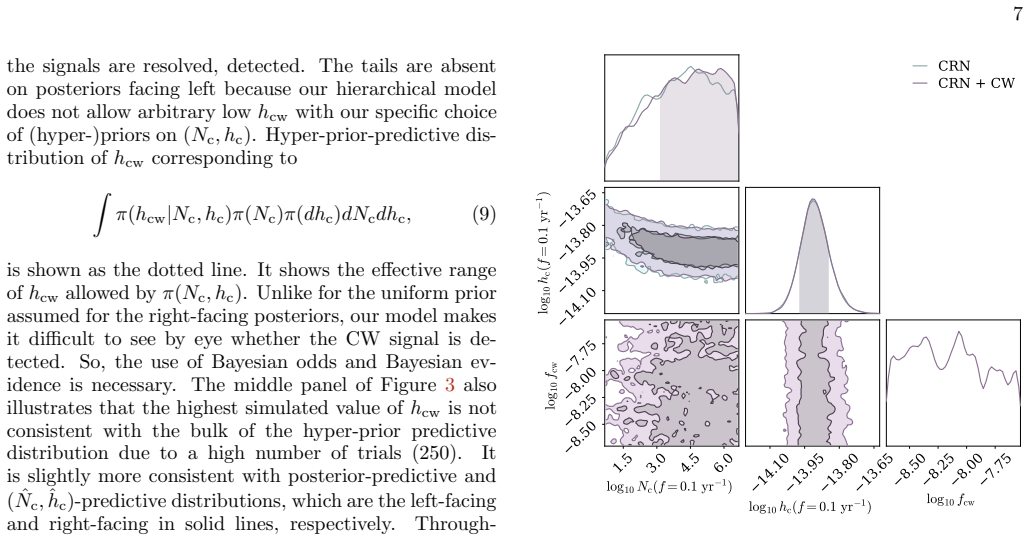
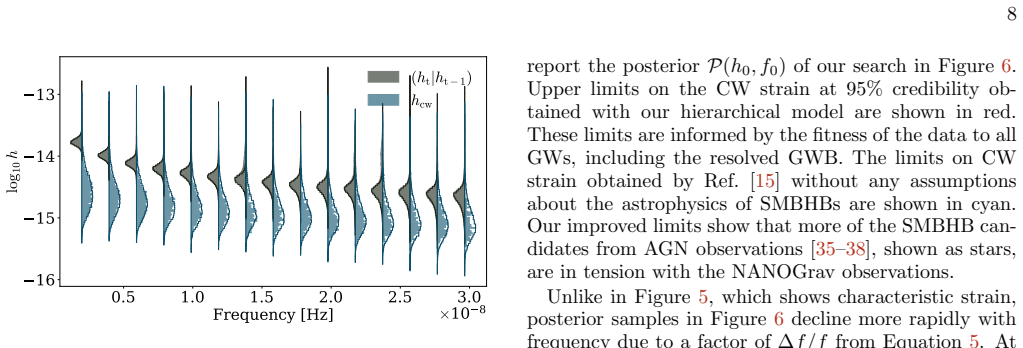
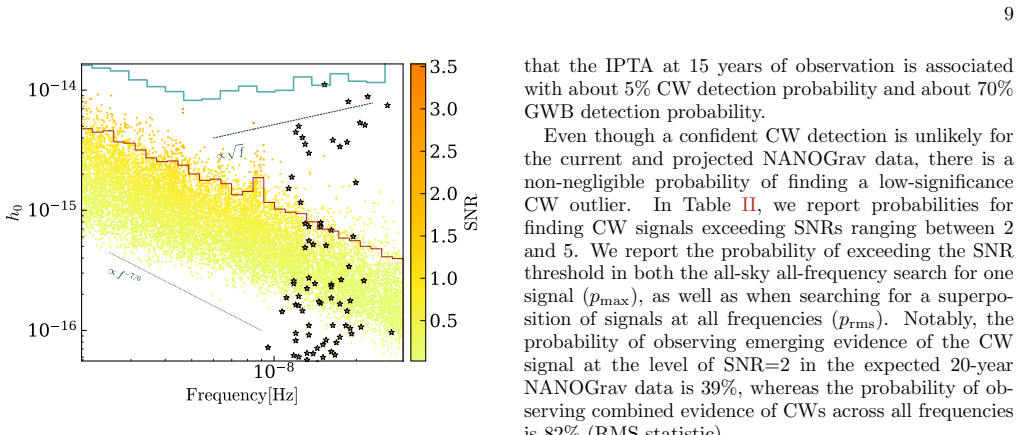
We introduce, from first principles, a joint model of the gravitational wave background (GWB) and brightest supermassive black hole binary (SMBHB) sources that may be individually resolvable in Pulsar Timing Array (PTA) searches for gravitational waves. We propose the characteristic number of SMBHB sources, $N_{\rm c}$, as a detection statistic for the astrophysical origin of the GWB. We then demonstrate how the brightest SMBHBs assist in resolving $N_{\rm c}$. Applying our method to the simulated NANOGrav 15-year data, which replicates all aspects of real data's known noise, observations, and the inferred GWB power spectrum, we demonstrate direct astrophysical limits on the strain amplitude of individually resolvable SMBHBs. We find that 21 of 114 SMBHB candidates from active galactic nuclei observations are in tension with the NANOGrav's observations. In contrast, only one candidate is in tension with the NANOGrav data based on the upper limits reported in the original analysis. Constraining the Poisson-specific characteristic number of SMBHBs, $N_{\rm c}$, at ${\rm yr}^{-1}$, we outline implications for the population properties of SMBHBs. Based on our new model applied to the simulated NANOGrav data, we calculate the probability of detecting GWs from isolated SMBHB in the 15-year data to be 2\% at the ${\rm SNR}=5$ level. Our projection towards the expected NANOGrav 20-year data suggests an increase to 5\%. With this, we estimate the probability of finding an outlier with an SNR of 2 in the NANOGrav 20-year data to be $40\%$.
Editorial analysis
A structured set of objections, weighed in public.
Referee Report
Summary. The paper introduces a joint Bayesian model for the stochastic gravitational wave background (GWB) and individually resolvable supermassive black hole binaries (SMBHBs) in pulsar timing array data. It defines the characteristic number N_c as a statistic for testing the astrophysical origin of the GWB, shows how bright resolvable sources help constrain N_c, and applies the framework to simulated NANOGrav 15-year data that is constructed to reproduce the inferred GWB spectrum, pulsar noise, and observing cadence. From this, the authors report that 21 of 114 AGN-selected SMBHB candidates are in tension with the simulated data (versus only one using prior upper limits), place limits on the Poisson rate N_c, and quote detection probabilities of 2% (15 yr) and 5% (20 yr) at SNR=5 together with a 40% probability of an SNR=2 outlier in the 20-year data set.
Significance. If the simulation faithfully reproduces the statistical properties of the real NANOGrav data set and the joint model is shown to be unbiased, the N_c statistic and the joint GWB+individual-source framework would provide a concrete, falsifiable route to testing whether the observed GWB is produced by a population of SMBHBs. The reported increase from one to 21 tensioned candidates illustrates how the new model can tighten astrophysical constraints; the projected detection probabilities supply quantitative guidance for the next observing campaigns. The manuscript does not, however, supply the quantitative validation or recovery tests that would anchor these claims to real timing residuals.
major comments (3)
- [Abstract] Abstract and the simulation description (presumably §3): the claim that the simulated 15-year data set 'replicates all aspects of real data's known noise, observations, and the inferred GWB power spectrum' is load-bearing for the tension counts (21/114) and the quoted detection probabilities, yet no quantitative comparison (e.g., recovered versus injected power-law parameters, residual power spectra, or covariance with pulsar noise) is provided. Without such validation the mapping from simulation to real-data conclusions remains unanchored.
- [§4] §4 (results on AGN candidates): the statement that 21 of 114 candidates are now in tension is obtained by applying the joint model to data simulated from the same GWB spectrum that N_c is intended to test; a direct demonstration that the joint posterior recovers injected individual-source strains without bias (or a sensitivity study varying the injected spectral index/amplitude) is required before the tension count can be interpreted as an astrophysical limit.
- [Results / probability section] The probability calculations (2% at SNR=5 for 15 yr, 5% for 20 yr, 40% for SNR=2 outlier) rest on the same simulated data set and on the definition of N_c; the manuscript must show how the SNR threshold and the Poisson rate prior are implemented in the joint likelihood so that these percentages are reproducible and not an artifact of the simulation construction.
minor comments (2)
- [Introduction / model section] Notation for N_c is introduced as both a detection statistic and a Poisson rate; a single, explicit definition with units would improve clarity.
- [Figures] Figure captions should state whether the plotted strains are 95% upper limits or median posteriors and whether they include the joint GWB+source model or the GWB-only case.
Simulated Author's Rebuttal
We thank the referee for their thoughtful and constructive comments on our manuscript. These comments have identified important areas for improvement regarding the validation of our simulations and the reproducibility of our results. We address each of the major comments in detail below, indicating the revisions we plan to make.
read point-by-point responses
-
Referee: [Abstract] Abstract and the simulation description (presumably §3): the claim that the simulated 15-year data set 'replicates all aspects of real data's known noise, observations, and the inferred GWB power spectrum' is load-bearing for the tension counts (21/114) and the quoted detection probabilities, yet no quantitative comparison (e.g., recovered versus injected power-law parameters, residual power spectra, or covariance with pulsar noise) is provided. Without such validation the mapping from simulation to real-data conclusions remains unanchored.
Authors: We agree that quantitative validation is necessary to support the claims. Although the simulation was constructed to replicate the properties of the real NANOGrav data, we did not provide explicit comparisons in the original manuscript. We will add a dedicated subsection detailing quantitative comparisons, including recovered versus injected GWB power-law parameters, residual power spectra, and covariance checks with pulsar noise. revision: yes
-
Referee: [§4] §4 (results on AGN candidates): the statement that 21 of 114 candidates are now in tension is obtained by applying the joint model to data simulated from the same GWB spectrum that N_c is intended to test; a direct demonstration that the joint posterior recovers injected individual-source strains without bias (or a sensitivity study varying the injected spectral index/amplitude) is required before the tension count can be interpreted as an astrophysical limit.
Authors: The referee raises a valid point about potential bias in the tension analysis. We will incorporate recovery tests in the revised manuscript to demonstrate that the joint posterior recovers injected individual-source strains without bias. Additionally, we will perform and report a sensitivity study varying the injected spectral index and amplitude. revision: yes
-
Referee: [Results / probability section] The probability calculations (2% at SNR=5 for 15 yr, 5% for 20 yr, 40% for SNR=2 outlier) rest on the same simulated data set and on the definition of N_c; the manuscript must show how the SNR threshold and the Poisson rate prior are implemented in the joint likelihood so that these percentages are reproducible and not an artifact of the simulation construction.
Authors: We will expand the methods section to explicitly describe the implementation of the SNR threshold and the Poisson rate prior for N_c in the joint likelihood. This will include the mathematical details and how the detection probabilities are derived, making the calculations reproducible. revision: yes
Circularity Check
N_c statistic and candidate tensions derived from data simulated using the inferred GWB spectrum
specific steps
-
fitted input called prediction
[Abstract]
"Applying our method to the simulated NANOGrav 15-year data, which replicates all aspects of real data's known noise, observations, and the inferred GWB power spectrum, we demonstrate direct astrophysical limits on the strain amplitude of individually resolvable SMBHBs. We find that 21 of 114 SMBHB candidates from active galactic nuclei observations are in tension with the NANOGrav's observations. ... we calculate the probability of detecting GWs from isolated SMBHB in the 15-year data to be 2% at the SNR=5 level."
The GWB power spectrum is first inferred from observations and then used to construct the simulated dataset to which the new joint model and N_c statistic are applied. The reported tensions, limits on resolvable strains, and detection probabilities are therefore obtained from data whose background properties are defined by the same spectrum, reducing the claim that N_c tests astrophysical origin to a check conditioned on the input by construction.
full rationale
The paper introduces N_c from first principles as a statistic for the astrophysical origin of the GWB and applies the joint model to simulated 15-year data. However, the simulation is explicitly constructed to replicate the inferred GWB power spectrum, making the derived upper limits, tension counts (21/114 candidates), and detection probabilities (2% and 5%) conditional on that same input spectrum. This matches the fitted_input_called_prediction pattern because the output constraints reduce to a consistency check with the spectrum used to build the data, rather than providing an independent test. No self-citation chains, self-definitions, or other patterns are present. The central claim therefore exhibits partial circularity.
Axiom & Free-Parameter Ledger
Reference graph
Works this paper leans on
-
[1]
hcw(fi): the search for one CW across all GW fre- quencies
-
[2]
hcw,i(fi): the search for CW at every GW fre- quency
-
[3]
white” noise, and B is the b-b covariance matrix. Temporally-correlated “red
hcw(f0): the search for one CW at a given fre- quency f0 (targeted). The strain amplitude parameter h0 used in CW searches, applied to the brightest source, is related to the charac- teristic strain of a CW, hcw, as h0 = 2(GM)5/3 DLc4 (πf )2/3 = 2hcw s 5 32 ∆f f , (5) 4 where M is the SMBHB chirp mass, DL is the lumi- nosity distance, G is the Newton’s co...
-
[4]
Nanograv Collaboration, ApJ 951, L8 (2023), arXiv:2306.16213 [astro-ph.HE]
Pith/arXiv arXiv 2023
-
[5]
EPTA Collaboration and InPTA Collaboration, A&A 678, A50 (2023), arXiv:2306.16214 [astro-ph.HE]
Pith/arXiv arXiv 2023
-
[6]
D. J. Reardon, A. Zic, R. M. Shannon, G. B. Hobbs, M. Bailes, V. Di Marco, A. Kapur, A. F. Rogers, E. Thrane, J. Askew, N. D. R. Bhat, A. Cameron, M. Cury lo, W. A. Coles, S. Dai, B. Goncharov, M. Kerr, A. Kulkarni, Y. Levin, M. E. Lower, R. N. Manchester, R. Mandow, M. T. Miles, R. S. Nathan, S. Os lowski, C. J. Russell, R. Spiewak, S. Zhang, and X.-J. Z...
Pith/arXiv arXiv 2023
-
[7]
H. Xu, S. Chen, Y. Guo, J. Jiang, B. Wang, J. Xu, Z. Xue, R. N. Caballero, J. Yuan, Y. Xu, J. Wang, L. Hao, J. Luo, K. Lee, J. Han, P. Jiang, Z. Shen, M. Wang, N. Wang, R. Xu, X. Wu, R. Manchester, L. Qian, X. Guan, M. Huang, C. Sun, and Y. Zhu, Re- search in Astronomy and Astrophysics23, 075024 (2023), arXiv:2306.16216 [astro-ph.HE]
Pith/arXiv arXiv 2023
-
[8]
M. T. Miles, R. M. Shannon, D. J. Reardon, M. Bailes, D. J. Champion, M. Geyer, P. Gitika, K. Grunthal, M. J. Keith, M. Kramer, A. D. Kulkarni, R. S. Nathan, A. Parthasarathy, J. Singha, G. Theureau, E. Thrane, F. Abbate, S. Buchner, A. D. Cameron, F. Camilo, B. E. Moreschi, G. Shaifullah, M. Shamohammadi, A. Pos- senti, and V. V. Krishnan, MNRAS 536, 148...
arXiv 2025
-
[9]
Nanograv Collaboration, ApJ 905, L34 (2020), arXiv:2009.04496 [astro-ph.HE]
arXiv 2020
-
[10]
B. Goncharov, R. M. Shannon, D. J. Reardon, G. Hobbs, A. Zic, M. Bailes, M. Cury lo, S. Dai, M. Kerr, M. E. Lower, R. N. Manchester, R. Mandow, H. Middleton, M. T. Miles, A. Parthasarathy, E. Thrane, N. Thyagara- jan, X. Xue, X. J. Zhu, A. D. Cameron, Y. Feng, R. Luo, C. J. Russell, J. Sarkissian, R. Spiewak, S. Wang, J. B. Wang, L. Zhang, and S. Zhang, A...
arXiv 2021
-
[11]
S. Chen, R. N. Caballero, Y. J. Guo, A. Chalumeau, K. Liu, G. Shaifullah, K. J. Lee, S. Babak, G. Desvignes, A. Parthasarathy, H. Hu, E. van der Wateren, J. Anto- niadis, A. S. Bak Nielsen, C. G. Bassa, A. Berthereau, M. Burgay, D. J. Champion, I. Cognard, M. Falxa, R. D. Ferdman, P. C. C. Freire, J. R. Gair, E. Graikou, L. Guillemot, J. Jang, G. H. Janss...
arXiv 2021
-
[12]
The International Pulsar Timing Array Collaboration, MNRAS 510, 4873 (2022), arXiv:2201.03980 [astro- ph.HE]
arXiv 2022
-
[13]
B. Goncharov, E. Thrane, R. M. Shannon, J. Harms, N. D. R. Bhat, G. Hobbs, M. Kerr, R. N. Manchester, D. J. Reardon, C. J. Russell, X.-J. Zhu, and A. Zic, ApJ 932, L22 (2022), arXiv:2206.03766 [gr-qc]
arXiv 2022
-
[14]
A. H. Jaffe and D. C. Backer, ApJ 583, 616 (2003), arXiv:astro-ph/0210148 [astro-ph]
Pith/arXiv arXiv 2003
-
[15]
A. Sesana and A. Vecchio, Classical and Quantum Grav- ity 27, 084016 (2010), arXiv:1001.3161 [astro-ph.CO]
Pith/arXiv arXiv 2010
-
[16]
C. M. F. Mingarelli, T. Sidery, I. Mandel, and A. Vecchio, Phys. Rev. D 88, 062005 (2013), arXiv:1306.5394 [astro- ph.HE]
Pith/arXiv arXiv 2013
-
[17]
P. A. Rosado, A. Sesana, and J. Gair, MNRAS 451, 2417 (2015), arXiv:1503.04803 [astro-ph.HE]
Pith/arXiv arXiv 2015
-
[19]
L. Z. Kelley, L. Blecha, L. Hernquist, A. Sesana, and S. R. Taylor, MNRAS 471, 4508 (2017), arXiv:1702.02180 [astro-ph.HE]
Pith/arXiv arXiv 2017
-
[20]
H. Middleton, S. Chen, W. Del Pozzo, A. Sesana, and A. Vecchio, Nature Communications 9, 573 (2018), 13 arXiv:1707.00623 [astro-ph.GA]
Pith/arXiv arXiv 2018
-
[21]
S. Chen, A. Sesana, and C. J. Conselice, MNRAS 488, 401 (2019), arXiv:1810.04184 [astro-ph.GA]
Pith/arXiv arXiv 2019
-
[22]
Nanograv Collaboration, ApJ 952, L37 (2023), arXiv:2306.16220 [astro-ph.HE]
arXiv 2023
-
[23]
R. W. Hellings and G. S. Downs, in General Relativity and Gravitation, Volume 1 , Vol. 1, edited by B. Bertotti, F. de Felice, and A. Pascolini (1983) p. 963
1983
-
[24]
G. Sato-Polito and M. Zaldarriaga, Phys. Rev. D 111, 023043 (2025), arXiv:2406.17010 [astro-ph.CO]
arXiv 2025
-
[25]
X. Xue, Z. Pan, and L. Dai, Phys. Rev. D 111, 043022 (2025), arXiv:2409.19516 [astro-ph.CO]
arXiv 2025
- [26]
- [27]
-
[28]
W. G. Lamb and S. R. Taylor, ApJ 971, L10 (2024), arXiv:2407.06270 [gr-qc]
arXiv 2024
-
[29]
H. Hisamatsu and K. Kyutoku, arXiv e-prints , arXiv:2605.17983 (2026), arXiv:2605.17983 [astro- ph.HE]
Pith/arXiv arXiv 2026
-
[30]
M. Falxa and A. Sesana, Phys. Rev. D 113, 043047 (2026), arXiv:2508.08365 [astro-ph.IM]
arXiv 2026
-
[31]
Ali-Ha¨ ımoud, arXiv e-prints , arXiv:2604.19701 (2026), arXiv:2604.19701 [astro-ph.CO]
Y. Ali-Ha¨ ımoud, arXiv e-prints , arXiv:2604.19701 (2026), arXiv:2604.19701 [astro-ph.CO]
Pith/arXiv arXiv 2026
-
[32]
S. C. Sardesai, J. Simon, and S. J. Vigeland, ApJ 976, 212 (2024), arXiv:2408.10139 [astro-ph.HE]
arXiv 2024
-
[33]
Nanograv Collaboration, ApJ 951, L9 (2023), arXiv:2306.16217 [astro-ph.HE]
arXiv 2023
-
[34]
R. van Haasteren, Y. Levin, P. McDonald, and T. Lu, MNRAS 395, 1005 (2009), arXiv:0809.0791 [astro-ph]
Pith/arXiv arXiv 2009
-
[35]
NANOGrav Collaboration, ApJ 821, 13 (2016), arXiv:1508.03024 [astro-ph.GA]
Pith/arXiv arXiv 2016
-
[36]
NANOGrav Collaboration, ApJ 951, L11 (2023), arXiv:2306.16219 [astro-ph.HE]
Pith/arXiv arXiv 2023
-
[37]
J. P. W. Verbiest, L. Lentati, G. Hobbs, R. van Haasteren, P. B. Demorest, G. H. Janssen, J.-B. Wang, G. Desvignes, R. N. Caballero, M. J. Keith, D. J. Cham- pion, et al., MNRAS 458, 1267 (2016), arXiv:1602.03640 [astro-ph.IM]
Pith/arXiv arXiv 2016
-
[38]
M. J. Graham, S. G. Djorgovski, D. Stern, A. J. Drake, A. A. Mahabal, C. Donalek, E. Glikman, S. Lar- son, and E. Christensen, MNRAS 453, 1562 (2015), arXiv:1507.07603 [astro-ph.GA]
Pith/arXiv arXiv 2015
-
[39]
S. O’Neill, S. Kiehlmann, A. C. S. Readhead, M. F. Aller, R. D. Blandford, I. Liodakis, M. L. Lister, P. Mr´ oz, C. P. O’Dea, T. J. Pearson, V. Ravi, M. Vallisneri, K. A. Cleary, M. J. Graham, K. J. B. Grainge, M. W. Hodges, T. Hovatta, A. L¨ ahteenm¨ aki, J. W. Lamb, T. J. W. Lazio, W. Max-Moerbeck, V. Pavlidou, T. A. Prince, R. A. Reeves, M. Tornikoski,...
arXiv 2022
-
[40]
P. V. de la Parra, S. Kiehlmann, P. Mr´ oz, A. C. S. Readhead, A. Synani, M. C. Begelman, R. D. Blandford, Y. Ding, F. Harrison, I. Liodakis, W. Max-Moerbeck, V. Pavlidou, R. Reeves, M. Vallisneri, M. F. Aller, M. J. Graham, T. Hovatta, C. R. Lawrence, T. J. W. Lazio, A. A. Mahabal, B. Molina, S. O’Neill, T. J. Pearson, V. Ravi, K. Tassis, and J. A. Zensu...
arXiv 2025
-
[41]
H. Sudou, S. Iguchi, Y. Murata, and Y. Taniguchi, Sci- ence 300, 1263 (2003), arXiv:astro-ph/0306103 [astro- ph]
Pith/arXiv arXiv 2003
-
[42]
J. S. Hazboun, J. D. Romano, and T. L. Smith, Phys. Rev. D 100, 104028 (2019), arXiv:1907.04341 [gr- qc]
arXiv 2019
-
[43]
Nanograv Collaboration, ApJ 998, L11 (2026), arXiv:2508.16534 [astro-ph.HE]
Pith/arXiv arXiv 2026
-
[44]
E. C. Gardiner, B. B´ ecsy, L. Z. Kelley, and N. J. Cornish, ApJ 988, 222 (2025), arXiv:2502.16016 [astro-ph.CO]
arXiv 2025
-
[45]
B. Goncharov, S. Sardana, A. Sesana, S. M. Tomson, J. Antoniadis, A. Chalumeau, D. Champion, S. Chen, E. F. Keane, K. Liu, G. Shaifullah, L. Speri, and S. Valtolina, Nature Communications 16, 9692 (2025), arXiv:2409.03627 [astro-ph.HE]
arXiv 2025
-
[46]
N. J. McConnell and C.-P. Ma, ApJ 764, 184 (2013), arXiv:1211.2816 [astro-ph.CO]
Pith/arXiv arXiv 2013
-
[47]
M. Bernardi, F. Shankar, J. B. Hyde, S. Mei, F. Marulli, and R. K. Sheth, MNRAS 404, 2087 (2010), arXiv:0910.1093 [astro-ph.CO]
Pith/arXiv arXiv 2087
-
[48]
E. R. Liepold and C.-P. Ma, ApJ 971, L29 (2024), arXiv:2407.14595 [astro-ph.GA]
arXiv 2024
-
[49]
A. Sesana, E. Barausse, M. Dotti, and E. M. Rossi, ApJ 794, 104 (2014), arXiv:1402.7088 [astro-ph.CO]
Pith/arXiv arXiv 2014
- [50]
-
[51]
V. Ravi, J. S. B. Wyithe, R. M. Shannon, G. Hobbs, and R. N. Manchester, MNRAS 442, 56 (2014), arXiv:1404.5183 [astro-ph.CO]
Pith/arXiv arXiv 2014
-
[52]
Sato-Polito, M
G. Sato-Polito, M. Zaldarriaga, and E. Quataert, Phys. Rev. D 110, 063020 (2024)
2024
-
[53]
EPTA Collaboration and InPTA Collaboration, A&A 685, A94 (2024), arXiv:2306.16227 [astro-ph.CO]
arXiv 2024
-
[54]
J. A. Casey-Clyde, C. M. F. Mingarelli, J. E. Greene, A. D. Goulding, S. Chen, and J. R. Trump, ApJ 987, 106 (2025), arXiv:2405.19406 [astro-ph.HE]
arXiv 2025
-
[55]
A. Sesana, Z. Haiman, B. Kocsis, and L. Z. Kelley, ApJ 856, 42 (2018), arXiv:1703.10611 [astro-ph.HE]. Appendix A: Units of GW strain In Section II and the rest of the manuscript, we operate primarily with two physical units related to GW strain. First, the strain amplitude h0 of a monochromatic CW signal produced by an SMBHB. Second, the characteris- tic...
Pith/arXiv arXiv 2018
-
[56]
Strain number-count The characteristic strain at a frequency bin of width ∆f measured by a PTA is given by the sum of the con- tributions of each binary SMBH emitting in that band. The inclination and polarization-averaged strain that a circular binary with chirp mass M radiating at a rest- frequency fr at a redshift z contributes is given by ˜h2(M, z, f)...
-
[57]
The luminosity function is initially calculated based on Equation 12, Equation 13, and the strain number count defined in Equation B6
Approach 1 towards the calculation of µ(x): interpolation In this work, we calculate µ(x) based on selecting an initial set of astrophysical parameters. The luminosity function is initially calculated based on Equation 12, Equation 13, and the strain number count defined in Equation B6. This calculation necessitates PDFs of the mass ratio q and redshift z...
-
[58]
Approach 2 towards the calculation of µ(x): the log-Normal approximation Although the integral of Equation B6 can be evalu- ated numerically for any SMBHB population model of choice, it is useful for future work to derive a more general parametrization by using a saddle-point approximation. Expressing the integrand as ˜h2(⃗θ) dN d⃗θd log f ≡ e−g(⃗θ,f) (B9...
-
[59]
for a more in-depth discussion of the relation between the effective parameters and astrophysical parametriza- tions of the SMBH merger rate density. 16
-
[60]
That is, in terms of the rescaled characteristic strain xt = X s xs, (B16) where s labels each source
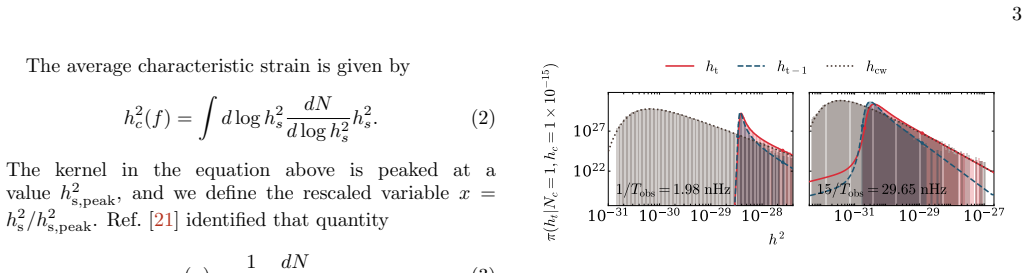
GWB distribution The observed GWB for a discrete set of sources is given by the sum of characteristic strain amplitudes of all sources emitting in a particular frequency bin. That is, in terms of the rescaled characteristic strain xt = X s xs, (B16) where s labels each source. The brightness of each source follows the distribution given in Eq. B15, while ...
-
[61]
In this section, we compute the probability distribution Pmax of the maximum strain,xcw = maxs xs, from the same astrophysical distribution as the GWB
PDF of the strain of the brightest source In a continuous-wave search, the imprint of the loudest binary on the timing residuals is modeled as a resolved point source. In this section, we compute the probability distribution Pmax of the maximum strain,xcw = maxs xs, from the same astrophysical distribution as the GWB. Given a set of Ns sources, the maximu...
discussion (0)
Sign in with ORCID, Apple, or X to comment. Anyone can read and Pith papers without signing in.